China’s Poultry Industy is Losing One Billion Yuan PER DAY

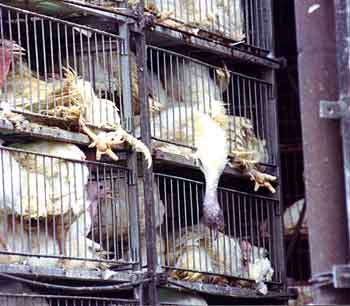
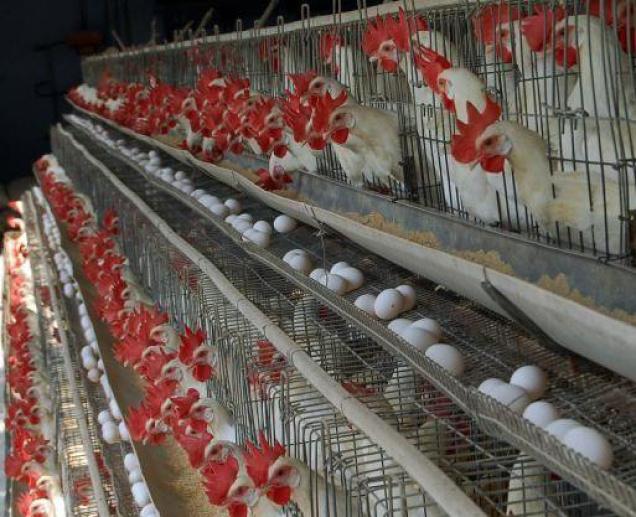
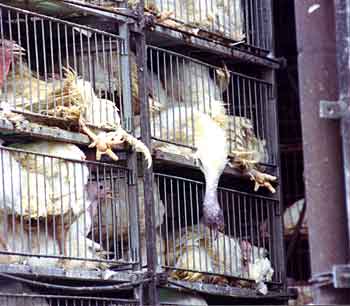
While an article in the Hindu Business Line tells us that China’s poultry industry has  lost 65 BILLION Yuan since the end of March, what I found shocking is that the industry has been losing an average of one billion Yuan a day for the past two months! What I want to know is, how many millions of birds does it take to raise one billion Yuan and what kind of horrendous living conditions must that many birds be forced to endure? How miserably confined, overcrowded and devoid of any semblance to natural bird life must it be like (for the short time their allowed to live).

The article (inadvertently) points out some shocking facts, which I’ve highlighted incage_1 bold

Bird flu costs China’s poultry industry $65 bn: State media

Beijing, May 21:

China’s human H7N9 bird flu outbreak has cost the country’s poultry industry more than $65 billion as consumers shun chicken, government officials said according to state media yesterday.

The sector has been losing an average of one billion yuan a day since the end of March, the Beijing Times said, citing Li Xirong, head of the National Animal Husbandry Service.

H7N9 avian influenza has infected 130 people in China, killing 35, since it was found in humans for the first time, according to latest official data.

Poultry sales have tumbled and prices plunged, Li said, causing major financial problems and job losses as a result.

Another agriculture ministry official, Wang Zongli, said government agencies should set a good example for the public by treating “poultry products in a correct way”, the report added.

In a stunt to boost confidence, officials and poultry business leaders in the eastern province of Shandong held a widely reported all-chicken lunch last week, according to Chinese media.

China has seen several food safety scares in recent years, including one in which the industrial chemical melamine was added to dairy products in 2008, killing at least six babies and making 300,000 ill.

poultry_845904f_jp_1463316f

Backyard Butchering: Loving Animals to Death

Yesterday I received the following comment to my post, All Meat is the Product of Cruelty and Exploitation… “How can you argue with those whose response is: ‘In the natural world animals kill other animals for food and in a most painful and cruel way and if I choose to raise my animals on my own property allowing them to live in a free and natural manner just as they would live in the wild that only differs in that they have shelter from the elements should they choose to use it and they are not kept in pens or tied but in large open barns and that at some point they will be killed as quickly and humanely as possible to be eaten by my family and the excess sold to others. I love animals but choose to eat them as well. I believe that how I treat them and kill them is better than they would live in the wild and their deaths much less horrible than being ripped apart alive as is the case in the wild’. What can you say to that?”

…to which I replied: First of all, it sounds like someone has been watching too many “nature” programs that revel in prolonged scenes of wildlife predation. Most cases of natural predation happen much faster; in many cases the prey are killed instantly.

In my book, Exposing the Big Game, I wrote about a wolf kill I witnessed in Yellowstone: “Suddenly they tore out after a young mule deer who had risked leaving the cover of the forest for the lure of an open meadow. The inexperienced doe didn’t stand a chance against the incredible, greyhound-like speed of the determined wolves. One quickly caught her by the hind leg, bringing her down, and a split second later the other had her by the throat. In less than a heartbeat, a living, breathing deer was reduced to a lifeless carcass.” Not a pretty sight, but much more the norm than the horrible scenarios depicted for entertainment on cable T.V. shows.

The hypothetical argument you spelled out (above) begins by raising the naturalist fallacy, which I covered in the post, Top Ten Retorts to Hunters’ Fallacies (just substitute hunter for animal farmer/rancher):

# 9) Animals kill other animals, so we can too.
That’s an example of what’s known as the naturalistic fallacy—the notion that any behavior that can be found in nature is morally justifiable. But wolves and other natural predators need to hunt to survive, humans don’t—for them it’s nothing more than a thrill kill. Human beings have moved beyond countless other behaviors such as cannibalism or infanticide, so why can’t some people tear themselves away from hunting?

A quote from author Robert Franklin Leslie adds to this:
“It is not important that a hawk takes a robin, that a bear robs a grouse nest. That is Nature’s own salient way even if we don’t understand it…Wilderness life has gone on that way since the beginning, and the prey has withstood the predation. But when man steps in…the very soul of Nature cringes for having endowed one of her creatures with intelligence disproportionate to responsibility.”

Backyard animal farming is nothing but the revival of Old World animal husbandry, from which modern-day factory farming is an unfortunate upshot. Both the factory farmer and the backyard butcher breed animals for the sole purpose of killing them when the time is ripe. They don’t raise the animals just because they love them and want to give them a good life, and raising them does nothing to eliminate any suffering that might go on in the wild between natural predator and prey (unless a person’s intent is to eliminate all natural relationships between wild animals, and there would be a lot of suffering on the predator’s part as the human strives to eliminate them).

Killing farmed animals “quickly and humanely” is easier said than done. At some point the animal knows that the human they trusted intends to hurt or kill them, as they probably would have seen it happen to one or more of their herd-mates. And the act of ending a healthy animal’s life so you can eat their flesh is cruel no matter how you slice it, especially since people do not have to eat meat to live a long, healthy life. And in fact, a lifetime of meat-eating is unhealthy for the human primate. Also from the Top Ten list mentioned above:

8) Humans are carnivores, look at our canine teeth.
Human teeth are designed primarily for chewing plant-based foods, like our primate cousins do. Humans “fangs” are teensy compared to those of gorillas, who are strict vegetarians and only show them to appear fierce. Also, our intestinal tract is long to allow for the slow digestion of high-fiber foods, while true carnivores have short intestines as needed to process meat and dispose of the resulting toxic wastes quickly.

7) Wild game (or free-range) meat is health food.
All animal flesh is rife with cholesterol throughout, and the protein in animal flesh is acidic, causing bone calcium losses as it is metabolized. According to the American Dietetic Association, a diet high in animal products has been linked to obesity, diabetes, colon and other cancers, osteoporosis, kidney stones, gallstones, diverticular disease, hypertension and coronary artery disease. New studies have found that another culprit in causing heart disease may be a little-studied chemical that is burped out by bacteria in the intestines after people eat meat.

Again, wolves and other predators need to eat meat to survive—modern humans do not. Natural predators don’t hate their prey, but they don’t pretend to love them either.

Forget the 4-H Club—you can’t really claim to “love” an animal you plan to someday kill, butcher and consume.

DSC_0331

All Meat Is the Product of Cruelty and Exploitation

A German serial killer, Fritz Haarmann, known as the “Butcher of Hanover,” cut his victims’ bodies into strips of flesh and sold them as pork. Here in North America, third-generation Canadian pig farmer and serial killer of 49 women, Robert Pickton, ground the bodies of his victims into sausage and sold it in packages or gave it out to friends.

While it’s appalling that folks who acquired meat from Pickton may have ingested human flesh, it is equally unsettling that they didn’t notice. To the taste buds it seems meat is meat. This tragedy was just one of many recent incidents that should make people rethink their carnivorous ways.

On a related note, according to an article by Cindi Avila with NBC News, Whole Foods admitted to accidentally reversing labels on two salads sold at its stores, a curried chicken salad and a vegan version called curried “chick’n” salad, last Tuesday and Wednesday at some 15 of its locations in the Northeast (including Connecticut, Maine, Massachusetts, New Jersey and New York). “The switched labels means it is highly likely someone who made a conscious choice not to eat animal products wound up doing so, through no fault of their own.”

To the ethical vegetarians who inadvertently ingested chicken flesh, the stomach-churning physical response of revulsion was on par with those of the pork-eaters who learned they’d cannibalized. Now, you might be asking yourself, “How can anyone compare eating chicken or pork to cannibalizing human flesh?”

The NBC article makes the clarifying point, “It may be hard for meat-eaters to understand, but this is a way of life that simply doesn’t involve compromise or mistakes. That’s especially the case for those of us who are vegetarian or vegan because of animal-welfare reasons or those who choose this for religious reasons.”

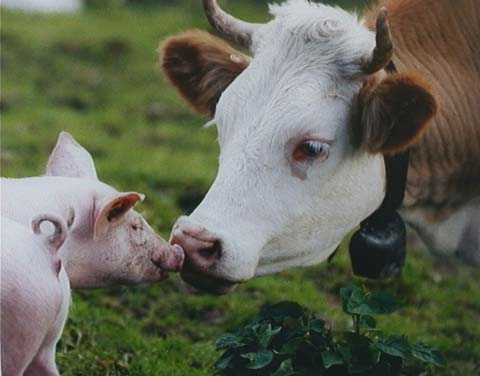
Pigs, like humans, cows and chickens, are capable of experiencing joy, affection, and pleasure. However, on hog farms, they are treated like unfeeling machines, confined in tiny stalls and fed growth-accelerating drugs that often cause lameness. Their teeth are cut with pliers, and their tails are cut off-without anesthetic. At the slaughterhouse, they are hung upside down and bled to death-often while they are fully conscious. Whether flesh comes from the victim of a serial killer or from a pig, a cow, or a chicken, it is the product of cruelty toward a thinking, feeling being who experiences pain and fear and wants to live free of exploitation.

In light of all this, why are people still eating meat? One common answer goes something like this: “I’m a human—superior to other beings—I’m entitled.” But a sense of entitlement is one of the trademark rationalizations that serial killers use to justify their wrongdoings, and grandiosity is also symptomatic of psychopathy, according to Canadian psychologist and author of Without Conscience: The Disturbing World of the Psychopaths Among Us, Robert D. Hare, Ph.D. Other symptoms outlined on Dr. Hare’s “psychopathy checklist,” such as shallow emotions and a lack of empathy or remorse, aid the killer—or meat-eater—in disregarding the suffering of his or her victims.

Psychopathic serial killers objectify their victims and consider their victims’ self-interests insignificant. The same rationale is called into play when one thinks of pigs only as “pork,” cows as “beef,” or chickens as “poultry,” without thought of the individuals or their suffering.

Both Canada and the U.S. have had recent cases of mad cow disease. As a result, we saw news footage of downer cows, too sick to walk, being dragged by chains into slaughterhouses. Press coverage of avian flu outbreaks reveal the intensely overcrowded conditions of chickens on factory farms-tens of thousands of animals cooped up in their own filth, each with less space than a standard sheet of typing paper. Besides being warned of health risks, consumers are finally learning about some of the cruelties endured by the animals they know only as “roasts” or “drumsticks.”

It is never too late to examine our actions and re-evaluate our food choices accordingly. By respecting the interests of all sentient beings, we are not akin to the conscienceless killers that plague our society. The only way to ensure that you are not supporting grotesque violence and cruelty against animals, or benefiting from their suffering, is to adopt a plant-based diet.

524958_3325028303604_654533903_n

Factory Farming is Inherently Evil

Humankind may or may not be inherently evil, but sometimes it seems the species is fundamentally stupid. Take bird flu, for instance. The fact that a new strain has cropped up in China, sickening or killing people in the poultry industry (i.e. chicken chopping), has led to “significant” profit losses for Yum Foods, the parent company of Kentucky Fried Chicken.

Yet, after a campaign to reassure customers that KFC is “high-quality food,” Yum is STILL planning to open seven hundred new KFCs across China this year. I shudder to think just how many birds will suffer miserable lives and horrible deaths to provide buckets full of extra-crispy flesh for SEVEN HUNDRED new KFCs there!

In case you hadn’t heard about H7N9, the new strain of bird flu that has now killed 16 people and infected 77 in 11 different places across China, it differs from other avian influenzas in that not everyone who carries the virus shows signs of illness. That means people could be unwittingly spreading it from place to place, if not infecting other humans, at least infecting other bird populations. Although 40% of those infected with N7H9 have had no contact with “poultry,” we’re still being told there is “no evidence of sustained human-to-human transmission,” so by all means, build more KFCs (sarcastic edge included for emphasis).

But before you decide to grab your shotgun and take out avians for as far as lead can spray, consider the fact that modern strains of bird and swine flu are just cases of friendly neighborhood factory-farm-cruelty coming home to roost.

A cursory glance at PETA’s KFC Cruelty.com reveals:
•The roughly 1 billion chickens killed each year for KFC’s buckets are crammed by the tens of thousands into excrement-filled sheds that stink of ammonia fumes.
•The birds’ legs and wings often break because they’re bred to be too top-heavy and because workers carelessly shove them into transport crates and shackles.
•Chickens’ throats are slit and the animals are dropped into tanks of scalding-hot water to remove their feathers, often while they are still conscious and able to feel pain.
•KFC lets frustrated factory-farm and slaughterhouse workers handle live birds, so many of the animals end up being sadistically abused.

The extreme insanity inherent in the ever-growing blight of modern factory farms—as well as the fact that most of the world’s 7 billion people still defend meat-eating and actively shun veganism— casts new light on the question of whether or not humans are inherently evil.

The former director of the CDC called the new strain of bird flu “a truly nasty virus” because, unlike previous strains, this one doesn’t seem to harm birds and can spread among flocks silently, making tracking its movement quite difficult.

I’m sure the birds would have a different opinion of a virus that doesn’t bother them, but instead affects the mammalian species which causes birds to suffer by the billions.

cage_1

Good Questions

561599_4740870687337_1697822471_n

On Facebook this morning a friend had posted a photo of a cruelly confined pig at a factory farm desperatly chewing on the bars of her cage. A caption read, “If your God had wanted us to eat animals, do you really think he would have given them the ability to feel pain and fear? What kind of sadistic individual would that make him?!”

Good questions. Taking it a step further, I have to wonder…if god had wanted us to eat animals, do you really think he would have given us the ability to feel their pain and fear?!

Unfortunately, empathy and compassion are not doled out equally to all.

Some people feel them so strongly it literally pains us to hear about the brutalities inflicted on nonhumans by their fellow man. The sadness is outweighed only by the understanding that many of the animal cruelties are so widespread and so accepted by society it will require nothing short of a major revolution in thinking to put an end to them. For those of us so well-endowed with empathy and compassion, every KFC, Arby’s or McDonalds commercial, every shiny photo ad for this weeks’ meat and dairy specials at the local market, every camo-clad nimrod in a pickup truck sporting an NRA bumper sticker inspires feelings of grief, anguish or anger.

There are those, Temple Grandin, for instance, may be able to feel empathy but apparently not compassion. Her autism allegedly allows her to experience the fear and anxiety factory farmed animals go through, yet her lack of compassion allows her to work for the animal industries, helping to spread the absurd, feel-good myth that some animals are “humanely” raised (and slaughtered), thereby giving consumers a license to ignore any twinges of empathy or compassion they might have.

And there are many who are completely incapable of feeling empathy for others. They’re the lucky ones—if hollowness, selfishness and superficiality are to be considered enviable traits.

WTF’s Up w/MFWP?

What the Fuck (WTF) is up with the Montana state wildlife officials these days? Now they want to make it even easier to hunt and trap wolves in their state.

Last year, just after wolves were removed from federal endangered species protection, the Montana Fish, Wildlife and Parks department (MFWP) seemed comparably tame (well, compared to Idaho anyway). Though they wasted no time in implementing the state’s first season on wolves in seventy-some years, at least they spared wolves the torment of trapping.

Ignoring 7,000 letters in support of wolves, this year they added trapping to their wolf assault and upped the original “bag limit” from one to three per trapper—before the season even started. Instead, they’re bowing to the whims and whinings of ranchers, hunters and trappers who have called for an expansion of wolf killing and more liberal rules than the state had last year, when “only” 166 wolves were ruthlessly murdered. MFWP officials responded to anti-wolf, anti-nature, anti-environmental pressure by making the 2012 season longer, eliminating most quotas and allowing wolf trapping for the first time.

The agency is now mercilessly asking for additional measures in the form of a state House Bill, HB 73. Their proposal would let hunters and trappers buy multiple tags; use electronic wolf calls; reduce the price of a non-resident tag from $350 to $50 and eliminate the potentially life-saving requirement that hunters wear fluorescent orange outside of elk and deer season. (Okay, I’ll go along with that last one—who cares if wolf hunters shoot each other?)

“We want to get a wolf bill out of the Legislature so we can implement those things that can potentially make a difference,” said FWP spokesman Ron Aasheim, adding selfishly, “More management flexibility. That’s what we want now.”

The House committee will also take up a second bill by Republican Rep. Ted (oh shit, not another Ted!) Washburn, of Bozeman, which would also limit the total number of wolves allowed to live in the entire state (we’re talking 147,046 square miles) to no more than 250. Washburn’s plan also asks for an Oct. 1-Feb. 28 wolf hunting season and an even longer season for special districts next to Yellowstone and Glacier National Parks!!

No doubt you all remember that fateful day in 2011 when congress lifted federal protections for wolves in Montana and Idaho, handing management over to those openly hostile states.

Meanwhile, the nefarious Montana state wildlife officials are currently opposing federal Threatened Species protection for the depressingly rare wolverine, down to only 35 breeding individuals in the lower 48.

Not many hunters can honestly say that they don’t mind sharing “their” elk, moose or deer with the likes of wolves, cougars or coyotes. But those few who claim to support a diversity of life need to realize that every time they purchase a hunting license and a deer or elk tag, they validate wolf hunting and trapping. To game managers, every action, right down to the purchase of ammo and camo at Outdoor World, is a show of support for their policies—including killing wolves to ensure more deer, elk, moose or caribou for hunters to “harvest.”

A far cry from living up to their laughably undeserved reputation as the “best environmentalists,” hunters are just foot-soldiers carrying out a hackneyed game department program of “harvesting” ungulates and “controlling” predators. It’s an agenda based not on science or the time-tested mechanisms of nature, but on the self-serving wants of a single species—Homo fucking sapiens (HFS). Modern hunting is about as anti-environmental as mining, clear-cut logging, commercial fishing or factory farming.

Text and Wildlife Photography ©Jim Robertson, 2012. All Rights Reserved

Text and Wildlife Photography ©Jim Robertson, 2012. All Rights Reserved

Remember, Tuesday Is Soylent Green Day

As with Christmas, Thanksgiving has become a rather hedonistic holiday these days. You’d have to pin your ears back, with empty cornucopias held tightly against them, to hear even a faint reference to the giving of thanks through the din of loud chatter about seemingly more important things like football, where to get the best deals on Black Friday, or how to deep fry a turkey. But any thanks you heard would be to “the lord above,” rather than to the victims of the decadent feast.

Completely lost in the hype of “tradition” and “Turkey-day” is any mention of giving even a passing “thank you” to the birds who suffered more indignities than space would allow me to mention here. Indignities that include the fact that turkeys on factory farms receive less than three square feet of personal space. And after they hatch, their beaks are cut off—a standard practice for chickens as well. No anesthesia or painkiller is used for either species. This process, which is known as “debeaking”, has been compared to having the ends of your fingers sliced off. It deprives birds of one of their most important sources of sensory input.

A debeaked bird cannot eat properly or explore his or her environment fully, nor can they preen themselves or their flockmates.  They may also experience acute and chronic pain in their beak, head, and face. In addition to being debeaked, turkeys also have the ends of their toes and their snoods cut off, often with nothing more than a pair of scissors (and as with debeaking, performed without anesthesia).

According to Liberation BC, both chickens and turkeys on modern factory farms have been genetically engineered and pumped with antibiotics; as a result they grow much faster than ever before. For example, in the 1960’s, it took a turkey 32 weeks to reach slaughter size, but now it takes only 13-16 weeks. In the 1950’s, it took a chicken 84 days to reach five pounds. Today, it takes 45 days, meaning that they are not even old enough to cluck yet when they die.

And PETA adds, their unnaturally large size also causes many turkeys to die from organ failure or heart attacks before they are even 6 months old. According to an investigative report in the Wall Street Journal on the miserable conditions on turkey farms, “It’s common in a rearing house to find a dead bird surrounded by four others whose hearts failed after they watched the first one ‘fall back and go into convulsions, with its wings flapping wildly.

Factory farm operators walk through the shed to kill the slow-growing turkeys (so that they don’t eat any more food), such as those who fall ill because of the filthy conditions or become crippled under their own weight.

In Canada, turkeys and chickens can legally be transported for up to 36 hours without food, water, or rest, and there are no limits as to the length of the journey. They are transported in open-air crates, resulting in high mortality as the birds are exposed to all sorts of weather.  Each bird is worth so little, however, that it is cheaper overall for the industry to use open-air crates.  Every year in Canada, 2 million broiler chickens and 20,000 turkeys are already dead when they arrive at slaughterhouses.  An additional 8 million broiler chickens and 200,000 turkeys arrive so diseased or injured that they are considered “unfit for human consumption”.
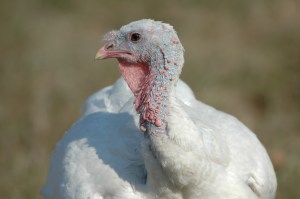
The surviving birds are handled roughly at the slaughterhouse, where they are unloaded by forklift and dropped onto a conveyor belt. With thousands of birds to be processed every hour, there is no reason for employees to stop and pick up the individual birds who miss the belt and fall to the ground.

When it comes time to slaughter the birds, they are hung by their feet on a moving rail and dragged through the stunning tank, an electrified water bath meant to stun and immobilize them. These are often set lower than is necessary to truly render the birds unconscious out of concerns that high voltage might damage the carcass and therefore diminish its value.

They are then carried past the tank to have their throats cut either by a mechanical blade or a plant employee. Often, struggling birds are cut improperly. As a result they are moved, fully conscious, to the scalding tank, where they are boiled alive.  Estimates place the number of affected birds at about one in twenty; at any rate, this occurrence is so common that the industry has a term for it: “redskins.”   …

Clearly, nobody gives much in the way of thanks to the “most important guest” at the table (as a recent Safeway ad described the turkey carcasses they were selling). You’d be damned lucky to overhear even a cursory mention of the miserable existence their edible “guest” underwent prior to the killing and plucking process. There is scarcely a sign that the hundreds of millions of Americans who gorge on the bodies of 45 million turkeys each year give a whit about whether these amazing and impressive birds had—prior to “harvest”—a life that allowed even a modicum of the freedom they would have experienced before the grossly over-populated human world made them their food-slaves.

Appropriately, I watched the timeless 1970s movie Soylent Green last night. Set in 2022, the film opens with a slide show of earlier eras, back when the Earth was covered with forests and open fields, and there were only a few scattered settlements of people who travelled in horse-drawn wagons.

As the images pass quickly by, we see the first automobiles (tail pipes spewing toxic carbon gases), followed by a massive blacktop parking lot jam packed with Model Ts. The pictures begin to flash almost more rapidly than we can focus, but we catch glimpses of factories with smokestacks billowing and crowds of people barely able to

move without trampling one another. (Come to think of it, what we are witnessing looks a lot like the inside of an average modern-day poultry barn, where Thanksgiving turkeys are forced to live out their lives in intense confinement.)

The first scene of action takes place in a cramped little New York City apartment, the dwelling of the film’s two main characters, Thorn, a semi-corrupt detective, and his elderly room-mate and research partner, Sol, who is constantly going on about the good old days—a world that Thorn can’t possibly envision or relate to.

They are among the lucky few; most people sleep on the stairways or in the hallways or anywhere they can find shelter from the oppressive heat caused by an out of control greenhouse effect. We overhear a program on their worn out old TV which is an interview with the governor of New York, touting a new food product called “Soylent Green,” ostensibly made from the ocean’s plankton. (Everyone in that day and age knows that the land is used up, but they’re told the oceans can still provide for them).

Food in this depressing, human-ravaged world comes in the form of color-coded wafers, distributed under strict government supervision. Hordes of people stand in line for their ration of Soylent yellow or blue made from soy, or other high protein plants grown behind the fortress-walls of heavily guarded farms.

Signs remind the throng that “Tuesday is Soylent Green day.”

The multitudes are exceptionally unruly on Tuesday. Brimming with anticipation, they can’t wait to obtain a ration of the special new product. When they get out of hand, “scoops” (garbage trucks fitted with backhoe-like buckets on the front) are called in to scoop them up and haul them off…

Spoiler Alert:

To make a long story short, by the end of the film, Thorn learns that the oceans are dead and the actual ingredients of Soylent Green are something a bit harder to stomach than plankton. In the final scene, a mortally-wounded Thorn is carried away on a stretcher as he desperately tries to tell skeptical onlookers, “Soylent Green is People!” “They’re making our food out of people. Next thing, they’ll be breeding us like cattle for food!”

Could it ever happen? Could the human race ever stoop so low? If the scenario seems too hard to swallow­, consider this: the conditions animals are forced to endure on today’s factory farms would have seemed unimaginable to people living a hundred years ago.
­­

The Last “Traditional” Thanksgiving

In the beginning, God created turkeys…well, that’s not exactly true—turkeys evolved in North and Central America somewhere in the neighborhood of twelve million years ago, during the Miocene/early Pliocene epoch—but it makes for a good story.

Turkeys are intelligent, highly social and easily distressed when isolated or kept from their familiar surroundings. Adults can differentiate between friends and possible foe, and have been known to go into attack mode to drive off outsiders. Benjamin Franklin described the turkey as “a Bird of Courage, and would not hesitate to attack a Grenadier of the British Guards who should presume to invade his Farm Yard with a red Coat on.”

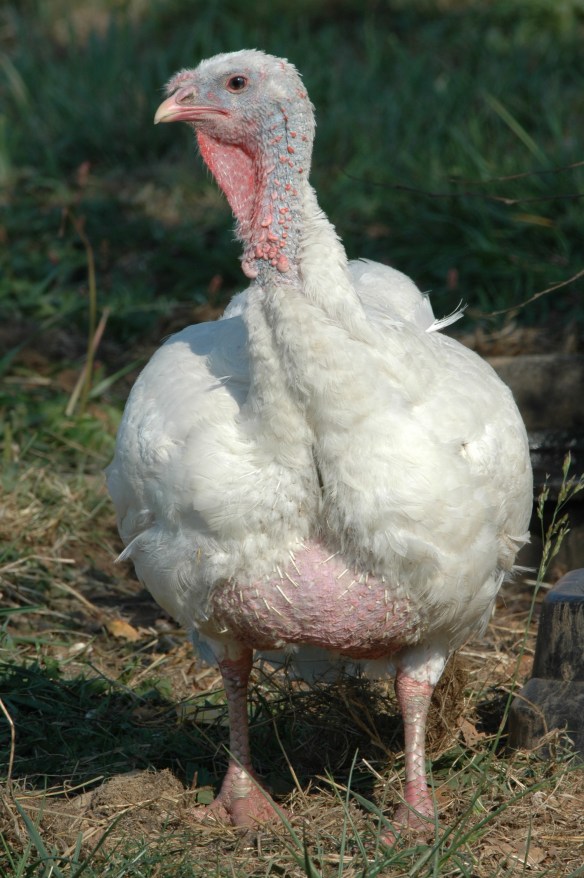
Their size, showy feathers and territorial disposition make turkeys an easy target for anyone with a weapon and an unwholesome urge to kill. Native Americans have a long history of feasting on turkeys that began well before the first Thanksgiving—the California turkey was hunted to extinction over 10,000 years ago. Meanwhile, modern human’s industrialized abuse of turkeys is nothing short of barbaric. Man has become so proficient at playing God with the turkey that nowadays the once proudly feathered bird is hardly recognizable. The vast majority of domesticated turkeys are bred to have white feathers because their pin feathers are less visible to the feaster when the carcass is “dressed” (glib jargon meaning butchered and mechanically plucked).

Any compassionate creator would be appalled by the unimaginable scale of institutionalized abuse of turkeys on factory farms or even on pseudo “free range” feel-good farms. Yet, each year turkeys are depicted—appearing at ease or even pleased with their plight—in inane commercials meant to soothe any holiday shopper who may have inadvertently stumbled onto the ugly truth about the suffering and cruelty inherent in the meat industry.

If you’re feasting on the flesh of one of the 45 million turkeys slaughtered this Thanksgiving season, please take a minute to consider the unnecessary suffering your meal caused and make this your last “traditional” Turkey-kill Day. Next year, try celebrating the life of the turkey while you feast on Tofurky or Field Roast, cranberries, candied yams, mashed potatoes, dressing, pumpkin pie and all the other tasty non-animal fixin’s. You may end up stuffed, but at least a bird won’t have to be.

Text and Wildlife Photography ©Jim Robertson, 2012. All Rights Reserved

.

The People Have Spoken: Global Warming, Real—Magic Underpants, Not

Well, the votes are in and counted; a decision has been made. The people have spoken: global warming is real—magic underpants are not. And bowhunters are not fit to hold higher office, much to the disappointment of Paul Ryan and his role model, Ted Nugent. By shunning the diehard deer hunter, the voters have made it clear that the animals of the Earth are not mere playthings for the rich and famous, the powerful and perverse.

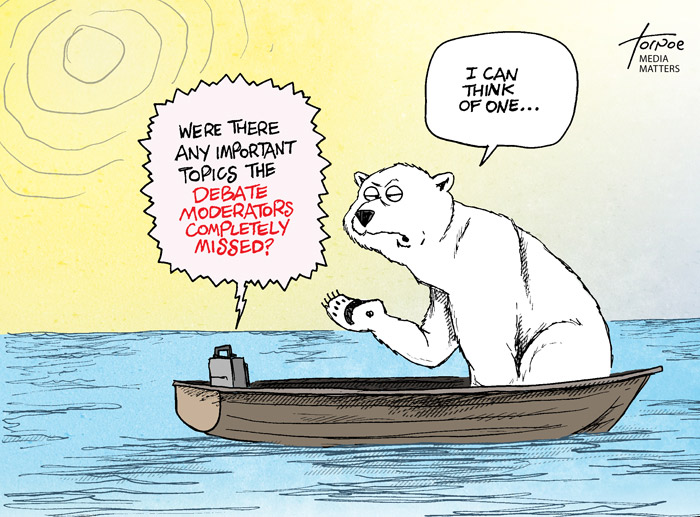
Perhaps now that the election is over we can forget about magic underpants and begin to focus our attention on the real issue that affects all our lives—namely, how human actions are changing the planet’s climate.

According to Kevin Knobloch, with the Union of Concerned Scientists, “President Obama has won another four years in office. In the wake of destruction left by Hurricane Sandy, the country may have experienced its first election disrupted by global warming. What makes this even more troubling is that the urgent crisis of climate change was never meaningfully discussed in the debates or on the campaign trail. After a year of punishing droughts in our nation’s breadbasket, extreme heat across most of the country, and wildfires that devastated our forests and property, it is now time to turn up the heat on our political leaders. Even with the continued polarization in Washington D.C., there is much President Obama can do to adopt science-based solutions that permanently drive down our carbon emissions and more effectively prepare for the climate-related disasters that will continue to threaten our lives and livelihoods.”

The trick will be making sure our lives and livelihoods don’t compound the problems of global warming. For example, shipping freighter-loads of coal across the ocean to be burned in Chinese power plants might provide a few jobs here for some, but is it worth the trade-off of carbon emissions produced?  Is the hedonism of the Western diet worth the continued suffering of billions of animals and the methane they produce? “Real change” will take real commitment and real innovation, rather than business as usual.

Cartoon © Rob Tornoe, 2012. All Rights Reserved