How much hunting is too much hunting?

https://phys.org/news/2019-04-how-much-hunting-is-too.html

**How much hunting is too much hunting?
Credit: Grant Gilchrist

One of the main challenges in wildlife conservation biology is to understand what factors affect vulnerable wildlife populations over time. Scientists have been trying to understand these factors to estimate how much hunting in a season is sustainable, but the lack of long-term monitoring data, especially in remote areas such as the Arctic, makes this task very difficult to accomplish.

In a new study published in Proceedings of the National Academy of Sciences, scientists at the University of Ottawa used a novel method to bypass this lack of data and track how nesting  changed over time, even before  census data were collected.

Professor Jules Blais and his team analyzed from the bottom of small lakes and ponds in Canada’s Eastern Arctic to examine the levels of a range of chemical compounds in the cores’ composition.

“When birds colonize an area, they begin to fertilize the local environment, drastically changing the nutrient levels in the water,” explained lead author Dr. Kathryn Hargan, a W. Garfield Weston postdoctoral fellow and a L’Oréal-UNESCO postdoctoral fellow at the University of Ottawa at the time the research was done. “Over time, sediments slowly accumulate at the bottom of lakes, archiving a detailed history of the biological changes in those bodies of water, much like tree rings reveal historical information.”

The common eider, an Arctic seaduck prized by the Inuit for its meat and down, once numbered in the millions, but reports by Northerners and some wildlife surveys suggested substantial reductions in recent decades. Although  pressures were suspected to be the cause of the population decline, this study was able to demonstrate that the eider population decline observed in the seaduck’s main breeding range coincided with increased sales in firearms and motorized boats in Greenland, indicating eider harvest at that time was unsustainable.

**How much hunting is too much hunting?
Credit: Nik Clyde, 2014

In the Hudson Strait near Cape Dorset, Nunavut – the common eider’s main nesting and breeding area – the scientists found evidence that populations declined in the mid to late 20th century, during a period of intense hunting by Greenlanders and the relocation of nearby Inuit communities. In more isolated eider nesting sites, with lower hunting pressure, scientists found that populations remained stable.

“The fact that traces of hunting practices over the last century can be detected in the nutrient profiles of pond sediment in the Arctic is fascinating,” added Prof. Blais. “Tools such as these offer a new perspective into tracking environmental changes going back hundreds of years, and can potentially revolutionize wildlife conservation efforts.”
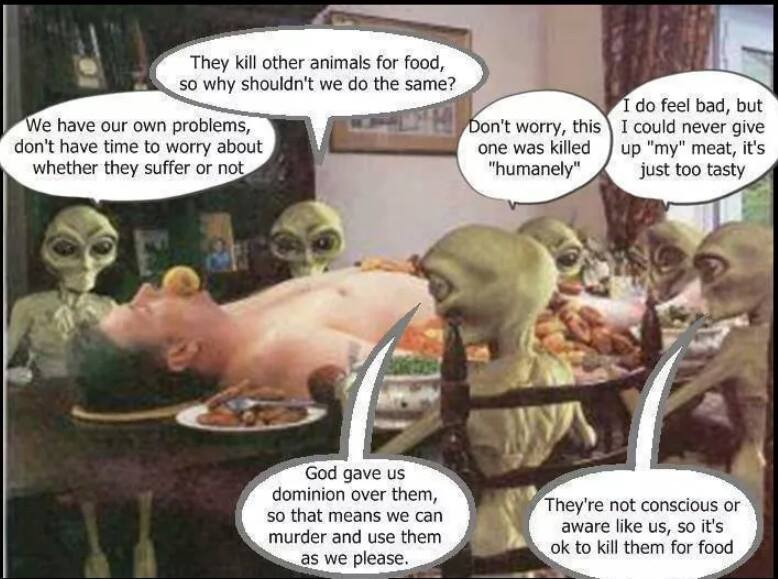
Every Hunter and Trapper Will Die Someday

10342876_644838815599443_2466424090983508710_n

This photo (allegedly taken in late November, 1947, near Roswell, New Mexico) recalls some of the most common feeble rationalizations humans use to justify the killing and consumption of the other beings with whom we share this planet.

Another equally feeble rationalization just cropped up in a letter to the editor of the Las Vegas Sun, using the twisted logic that since all animals are going to die someday, we might as well kill and eat them.

The letter, entitled, “Hunting, trapping to manage wildlife,” by the president of the Southern Nevada Coalition “for Wildlife,” starts out attacking animal rights activists and defending trappers and hunters:

“The litany of attacks on trappers and hunters by animal rights activists lately are usually based on the claim that trapping and hunting are inhumane. One needs to ask the question: compared to what? Compared to the standards of Walt Disney productions where Bambi and his deer family think and talk things over and where Lion Kings rule? Perhaps so, but in the real world of nature and wildlife, it is a different story.

“Every wild animal will die someday. If animal rights activists think wild animals die comfortably in their beds surrounded by loving family members, they are sadly mistaken. Disease, starvation, dehydration and predation are the most probable causes, and in the absence of management tools like hunting and trapping, entire wildlife populations suffer horribly.

“That is the reason the entire wildlife management profession and every conservation association support regulated hunting and trapping.

“Professionals know that regulated hunting and trapping are far more humane than letting nature run its course unimpeded. The animal rights activists beg to differ, but how is it more humane to allow (or mandate) that wild animals must die by disease, starvation or predation, or, much worse, allow (or mandate) entire populations to suffer this way when there is a much better way?”

A better way? That’s assuming a lot, such as that an unaware animal is killed outright with one clean shot (which almost never happens). And how is trapping an animal and letting it struggle until a human returns to finish it off ever humane?!

Yes all animals are going to eventually die someday, but usually when that day happens, nature steps in and prepares the individual for it through a process that includes shock, withdrawal and the gradual shutting down of the senses. Hospice professionals know the process well; it’s outlined in handouts they share with anyone who is caregiving for the dying.

Ending a healthy life (human or otherwise), before he or she have had the chance to fulfill their life’s journey, is murder, no matter how you rationalize it.

The pro-human predation letter ends with the line: “Since 1937, it’s been proved that regulated hunting and trapping programs are the essential tools of modern wildlife management.” Humans can just thank their lucky stars that no bigger brained beings have rationalized away their existence…yet.

Some Hunters Are Atheists Too

It’s interesting that two totally different people can follow completely divergent paths to10172782_486237174810952_1604406170771652512_n reach the same conclusion.  Lately I’ve been posting about hunters whose sense of self-entitlement was rooted in Christian beliefs. For instance, the Bonus Fallacy in Top Ten Retorts to Hunter Fallacies is, “God put Animals here for us to use.”

But today I received a comment from a hunter troll boasting that she’s an atheist. Like all other comments from hunters trying to justify their pastimes, it was not approved. Once you feed a troll, you can never get rid of them. But since she brought up the inarguable fact that not all killers use religion to justify their actions, I’m posting it here for your perusal:

“I’m an atheist and I love hunting. So it isn’t silly god reasons. Hunting regulations and conservation maintain the populations and of course meat isn’t sustainable for the world’s population, but thankfully we have goofy vegetarians. But yeah, I just love killing them and eating them. They are so delicious and tasty. For me, it’s that wonderful reminder that human beings are primitive and inferior, and I have no delusions about our meaningless existence. I can has retort, now?”

No, sorry, I’m fresh out of retorts. You’ll have to troll somewhere else for an argument to that one.


Killing Is Not Healthy Human Behavior

Yesterday a long-time friend and his wife stopped by for a visit on their way to a weekend at their family’s getaway cabin. I hadn’t seen him for years, so in catching up on what’s new I of course mentioned the release of Exposing the Big Game. I had previously sent him some excerpts so was caught off-guard when he asked, “What is the premise of your book?” Knowing that he is a fisherman (we fished together back in Boy Scouts before I recognized that fish are sentient and have the right to be left alone), that he dabbled in duck hunting and his father was an avid sport hunter, I geared my answer toward what I thought he would be equipped to comprehend, given his current position along the compassion continuum. I said frankly that the book is pro-wildlife, taking the animals’ side over their exploiters.

Since they were dinner guests (my wife served vegan Boca burgers, which they politely accepted—and eventually finished) I didn’t want to spoil the atmosphere of a friendly get-together, so I went a little easy on him and spared him the full-frontal assault he’ll be subjected to when he reads the book.

Here’s what I will say to the next person who asks, “What is the premise for your book?”

“Forget hunters’ feeble rationalizations and trust your gut feelings:  making sport of killing is not healthy human behavior.”