Exposing the Big Game

Forget Hunters' Feeble Rationalizations and Trust Your Gut Feelings: Making Sport of Killing Is Not Healthy Human Behavior

Exposing the Big Game

‘We All Owe Al Gore An Apology’: More People See Climate Change In Record Flooding

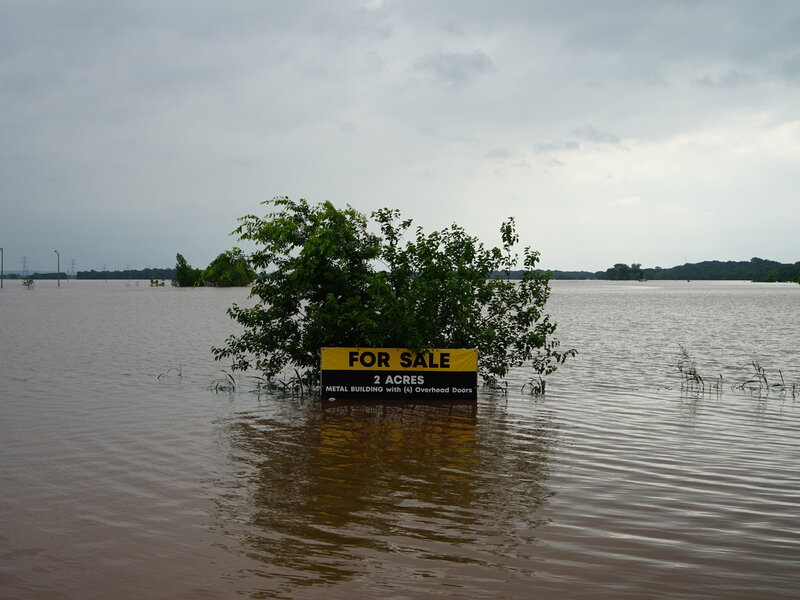
Floodwaters from the Arkansas River line either side of a road in Russellville, Arkansas, engulfing businesses and vehicles.

Nathan Rott/NPR

Angel Portillo doesn’t think about climate change much. It’s not that he doesn’t care. He’s just got other things to worry about. Climate change seems so far away, so big.

Lately though, Portillo says he’s been thinking about it more often.

Standing on the banks of a swollen and surging Arkansas River, just upriver from a cluster of flooded businesses and homes, it’s easy to see why.

“Stuff like this,” he says, nodding at the frothy brown waters, “all of the tornadoes that have been happening – it just doesn’t seem like a coincidence, you know?”

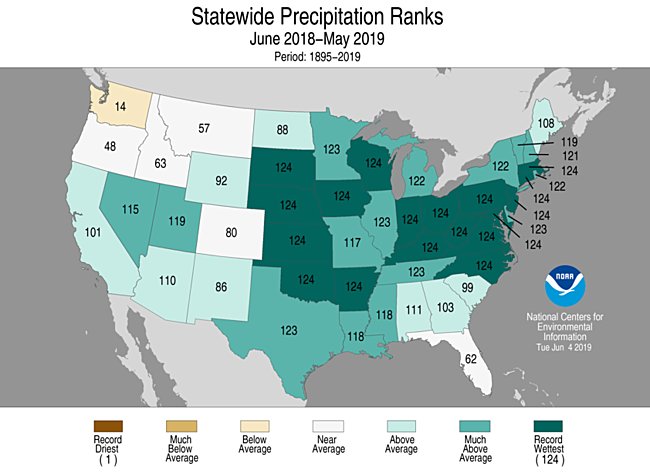
A string of natural disasters has hit the central U.S. in recent weeks. Tornadoes have devastated communities, tearing up trees and homes. Record rainfall has prevented countless farmers in America’s breadbasket from planting crops. Rising rivers continue to flood fields, inundate homes and threaten aging levees from Iowa to Mississippi.

And while none of these events can be directly attributed to climate change, extreme rains are happening more frequently in many parts of the U.S. and that trend is expected to continue as the Earth continues to warm.

For many of the people living in the affected areas, the connection feels clear.

A group of friends look at the record-high Arkansas River in Fort Smith, Arkansas. “It’s part of history now,” says Savanna Bowling. “We had to come see it.”

Nathan Rott/NPR

“I think climate change is affecting the world right now and we should probably start doing something,” says Lucero Silva, watching the cresting river in Russellville, Arkansas.

“Somebody at my office told me, ‘We all owe Al Gore an apology,'” says Breigh Hardman, standing on a bridge over the Arkansas River in nearby Fort Smith. Gore’s 2006 documentary An Inconvenient Truth spurred both activism around global warming and opposition to it.

“It just tells us we got to come to a conclusion — not to get crazy — about global warming,” says Matt Breiner, watching the river further upstream near downtown Tulsa, Oklahoma.

NPR asked nearly two dozen people in Oklahoma and Arkansas who were experiencing the ongoing flooding about their thoughts on climate change. All of them said they believed that the climate was changing, even if they didn’t directly associate the raining and floods with it, or agree on the cause. (Six people said they believed God was driving the change.)
That aligns with recent polling by the Yale Program on Climate Change Communication and George Mason University, which shows that more Americans are becoming concerned about global warming and believe in its existence, while a smaller majority understand that it’s mostly human-caused.

A follow-up report found that “directly experiencing climate change impacts” was the most common reason given by people who said they were becoming more concerned.

“Most studies do suggest that experiencing an extreme event does effect one’s beliefs about climate change,” says Elizabeth Albright, an assistant professor at Duke University’s Nicholas School of the Environment.

Albright was part of a research team that surveyed communities impacted by heavy rains and flooding in Colorado in 2013. They found that people whose wider communities were significantly impacted were more likely to be concerned about climate change and the risk of future floods.

It’s an imperfect science though.

A study by the University of Exeter last year found thatpolitical identity and exposure to partisan news were more likely to influence people’s perceptions of some extreme weather events, as they relate to climate change.

“Efforts to connect extreme events with climate change may do more to rally those with liberal beliefs than convince those with more conservative views that humans are having an impact on the climate,” said the study’s lead author, Dr. Ben Lyons, in a press statement.
Flooding near Muskogee, Oklahoma, inundated businesses and homes. May was the second-wettest month in U.S. history, according to the National Oceanic and Atmospheric Administration.

Nathan Rott/NPR

Climate scientists and communicators in the largely conservative central Plains still see the ongoing flooding as an opportunity, though.

Marty Matlock, the executive director of the University of Arkansas Resiliency Center, works with rural and urban communities throughout the state and with the region’s massive agriculture industry.

“People are not questioning that things are changing,” he says. “The challenge is how do we motivate people, give [them] a sense that there is an actual opportunity for influencing that change in a positive way.”

Matlock believes that for too long climate scientists have been beating people “with the cudgel of information of science.”

“In a democratic society, if people don’t believe what you say, it doesn’t matter how right you are,” he says.

That doesn’t necessarily mean you need to convince people about the causes of climate change, he says. In some cases, it might be just as important to convince people and community leaders that they’ll need to adapt.

Extreme rains and flooding events are expected to be more common and more severe in America’s heartland, according to the most recent National Climate Assessment.

Joe Hurst, the mayor of Van Buren, Arkansas, a town of about 24,000 people on the Arkansas River, says there do seem to be indications that the climate is changing.

“I don’t know what causes it,” he says. “But all I know is that we’re dealing with a historic flood and now, in my mind, I’m going to be prepared for this unprecedented event to happen now more often.”
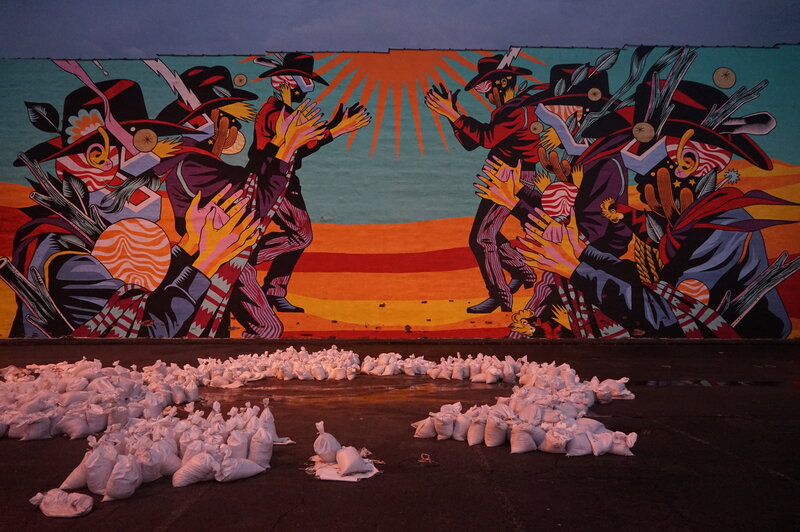
A pile of free sandbags in downtown Fort Smith, Arkansas. Volunteers filled them for homeowners and businesses trying to avoid the worst of the flooding.

Nathan Rott/NPR

Claire Heddles, Jennifer Ludden
Extreme weather in Midwest could impact your grocery bill

By OpinionFOXBusiness

The extreme weatherOpens a New Window. and record flooding that has been hammering the Plains and Midwest will likely impact everyone’s walletOpens a New Window..

Eight states along the Mississippi have been hit by the longest stretch of flooding since the Great Flood of 1927. Across the grain belt, farm fields are flooded. This is already having a big impact on grain prices as farmers can’t get into the field to plant, leading to the slowest pace of grain planting in recorded history.

MORE FROM FOXBUSINESS.COM…

According to the USDA, only 58 percent of the corn crop was planted as of May 26, compared to 90 percent at this time last year. Soybean planting is also well behind, as only 29 percent of the soybean crop was planted, below the average of 66 percent. Now it looks like over 6 million acres will go unplanted.

Because of this slow pace, grain market sentiment has shifted from fears of an oversupply due to the U.S.-China trade war, to now thoughts of shortages in just a few weeks. If the U.S. does not get its crop planted, there is a real risk of a global shortfall of grain.

Feed costs could rise dramatically, and eventually that will mean higher food costs on everything from meats, breads, pastas and poultry. But it is not just food prices that will rise. Floods are already impacting gasoline prices.

Just when you thought it was safe to go back to the gas pump, the floods are pushing gasoline prices higher. As a direct result of the floods, we are seeing prices in ethanol, a major gasoline additive, spike by over 10 percent in just a few weeks.

That has happened not only because the cost of corn is rising, but also because ethanol plants have slowed production and the flooding has shut down multiple pipelines and some ethanol producing plants.

Oil supply to refineries has been constrained as flooding has shut down major pipelines, even impacting the country’s biggest oil storage hub in Cushing, Oklahoma. The Ozark pipeline that is an artery out of Cushing was shut down this week due to the floods. This all translates to higher prices.

Yet, at the same time the floods are having a dampening effect on demand. Diesel demand is a far cry from what it could have been because farmers cannot get into the field to plant. If the rain doesn’t stop soon, those acres may never get planted and that expected bump in diesel demand may be gone forever.

CLICK HERE TO GET THE FOX BUSINESS APPOpens a New Window.

Gasoline demand may fall short of expectations as well. Memorial Day travelers may have stayed home as bad weather and flooding ruined many plans. So, while we are definitely seeing upward price pressures because of the damage to the supply side, the price spike may be delayed because of the hit to the demand side.

Phil Flynn is senior energy analyst at The PRICE Futures Group and a Fox Business Network contributor. He is one of the world’s leading market analysts, providing individual investors, professional traders, and institutions with up-to-the-minute investment and risk management insight into global petroleum, gasoline, and energy markets. His precise and timely forecasts have come to be in great demand by industry and media worldwide and his impressive career goes back almost three decades, gaining attention with his market calls and energetic personality as writer of The Energy Report. You can contact Phil by phone at (888) 264-5665 or by email at pflynn@pricegroup.com.

The Midwest flooding has killed livestock, ruined harvests and has farmers worried for their future

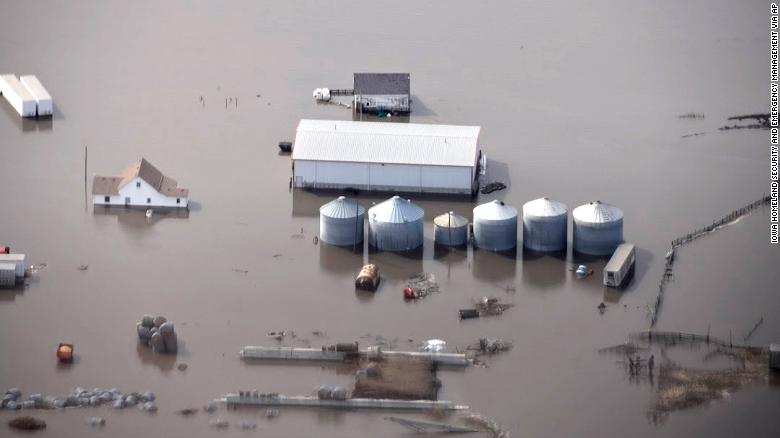
This photo taken by the South Dakota Civil Air Patrol shows flooding in western Iowa, along the Missouri River, on Monday.

(CNN)Farmers in parts of Nebraska and Iowa had precious little time to move themselves from the floodwaters that rushed over their lands last week, so many left their livestock and last year’s harvest behind.

Now as they watch the new lakes that overtook their property slowly recede, some have a painfully long time to reflect: They lost so much, staying in business will be a mighty struggle.
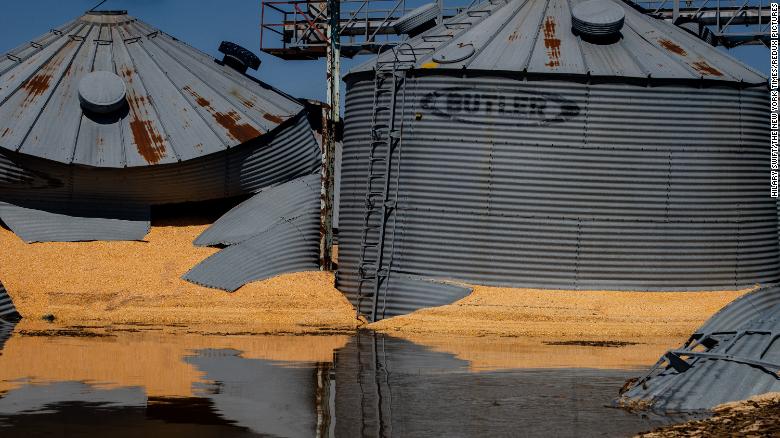
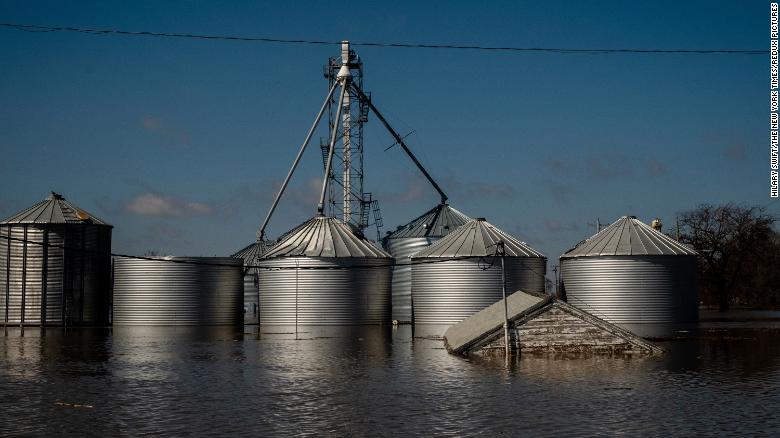
Across parts of the Midwest, hundreds of livestock are drowned or stranded; valuable unsold, stored grain is ruined in submerged storage bins; and fields are like lakes, casting doubt on whether they can be planted this year.
These are especially cruel times for Nebraska and Iowa farmers who had to scrape money to keep going just eight years ago, when floods overtook their lands in 2011.
“I would say 50% of the farmers in our area will not recover from this,” Dustin Sheldon, a farmer in southwestern Iowa’s flood-devastated Fremont County near the swollen Missouri River, said this week.
Grain silos destroyed by the flooding in Hamburg, Iowa, on Wednesday.

700 hogs drowned at one farm

Floodwaters washed over the Plains and Upper Midwest as a bomb cyclone dropped heavy rain and snow last week, and as previous snow and ice melted.
Nebraska Gov. Pete Ricketts called this the “most widespread disaster we have had in our state’s history.” Officials expect their initial farm damage estimates — $400 million in damages to crops, and $400 million in lost livestock, will be exceeded, Nebraska Department of Agriculture spokeswoman Christin Kamm said.
In Iowa, after Gov. Kim Reynolds flew over flooded farms in a helicopter, she said she could see only the tops of grain bins sticking out of what looked like an ocean.
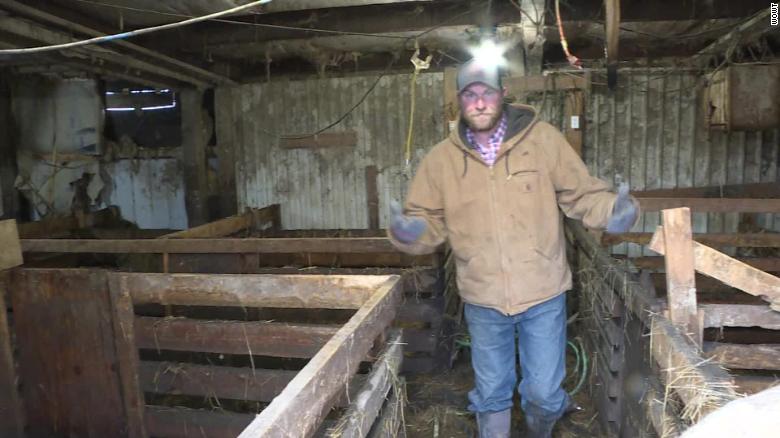
Farmers and ranchers have been especially hard hit. In rural eastern Nebraska outside of Omaha, farmer Eric Alberts told CNN affiliate WOWT that about 700 of his hogs drowned, many in his barn.
He was trying to move his animals when the waters started rising last week.
“Within 30 minutes, we had over 2 feet of water come through the front barn, and just swells were coming, and we barely made it out of here,” leaving most of the animals behind, he told WOWT.
Eric Alberts said many hogs drowned in this barn.

The fate of other animals is a mystery. Sheldon, the Iowa farmer, said Wednesday he knows of six facilities holding about 3,000 pigs each — and no one was immediately able to reach the flooded buildings to see how the livestock fared.
Rescue groups have tried to help in some cases.
Over the weekend, Iowan Scott Shehan crossed state lines to help ferry donkeys and ponies to dry land. In one of his Facebook videos, rescuers used a makeshift floating platform — pushed by an airboat — to get a pony out of a stranded portion of Sycamore Farms in Waterloo, Nebraska, on Sunday.
At least one donkey was found dead there, he said.
“Nobody could plan for this,” Shehan, co-owner of Lusco Farms Rescue, told CNN. “It’s flooded in places it’s never flooded before.”

A farmer says he lost hundreds of thousands of dollars in ruined harvest

Beyond livestock, crop loss — both harvested and not yet planted — will weigh heavily on farmers.
In Iowa’s Fremont County, Sheldon’s farm supports three families. Floodwaters got into their bins, ruining about 75% to 80% of their stored crop.
He estimates that’s hundreds of thousands of dollars of revenue lost — money that now can’t support the families or pay the farm’s expenses.
Farmers commonly store the harvest and sell portions throughout the year, sometimes to wait for better prices in the spring. Losing it is devastating.
“In 2011, we thought we had the 500-year flood — the Noah’s Ark of all floods,” Sheldon, who also is the Fremont County supervisor, told CNN. “We didn’t file bankruptcy, but we went though some really tough times on the money side.
“It took every dime of money our family had to put the land back into production at the level it was. Here, eight years later, we are right back to square one.”
Grain silos destroyed by the flooding in Hamburg, Iowa, on Wednesday.