Exposing the Big Game

Forget Hunters' Feeble Rationalizations and Trust Your Gut Feelings: Making Sport of Killing Is Not Healthy Human Behavior

Exposing the Big Game

‘A problem in every national forest’: tree thieves were behind Washington wildfire

Tree theft, which led to the deadly Maple Fire in Washington, may be costing the US Forest Service up to $100m each year

Hall of Mosses Trail at Olympic National Park in Washington.
 Hall of Mosses Trail at Olympic National Park in Washington. Photograph: Greg Vaughn/VW Pics/Universal Images Group via Getty Images

When two men discovered a rare and valuable 90ft-tall bigleaf maple tree in Washington State’s Olympic National Forest last year, they allegedly set about trying to steal it.

But there was a problem – the tree was home to a bee hive. The men reportedly tried to use a wasp killer to get rid of it. When that didn’t work, one allegedly poured gasoline on it, and lit it on fire.

The result, according to a federal indictment unsealed this week, was an August wildfire that raged across the eastern half of the ancient forest, setting 3,300 acres of public land ablaze and costing $4.5m to fight.

Known as the Maple Fire, the smoke from the blaze also served to exacerbate an already bad summer for the region’s air quality. There were fires raging in Canada and Eastern Washington, and as smoke from these blazes struck Seattle, at some points the city reportedly had the worst air quality in the world.

The bigleaf maple’s wood was covered in a distinct pattern, which if harvested is extremely popular for woodworking and potentially worth thousands of dollars. Before the fire, the pair had allegedly spent months illegally harvesting these high-value maple trees and selling the wood, which is used to make furniture and musical instruments.

Wilke was also specifically charged with “setting timber afire” and “using fire in furtherance of a felony” – the latter comes with a mandatory 10-year sentence, according to Seth Wilkinson, the lead prosecutor on the case.

“Timber theft, which involves destruction of a public resource, is in itself a really serious crime in this area,” said Wilkinson. “But this one is magnified many many times because of the consequences here, which involved the destruction of thousands of acres of national forest.”

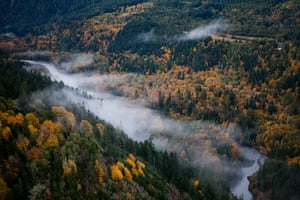
The upper portions of the winding Elwha River in the Olympic National Park south-west of Port Angeles, Washington.
Pinterest
 The upper portions of the winding Elwha River in the Olympic National Park south-west of Port Angeles, Washington. Photograph: Chris Wilson /The Washington Post/Getty Images

Hundreds of responders from a variety of agencies came together to fight the flames west of Seattle, but the combination of an extremely dry summer and the fact that this is a dense forest with a lot of flammable moss meant that it took at least four days to control.

Wilke pleaded not guilty during an initial court appearance this week and is being detained until his trial in December, according to Wilkinson. Williams was arrested a couple weeks ago and is in state custody in California, but is expected to be transferred to Washington for his arraignment.

Wilke’s attorney did not immediately respond to requests for comment, and court records did not name a federal attorney for Williams.

Tree theft has become a problem for the Olympic forest and other national forests across the country, said Susan Garner, spokesperson for the Olympic National Forest.

“We just don’t have enough law enforcement officers out there, and many of our roads are remote,” she said. “It’s a problem, I think, probably on every national forest.”

Tree theft may be costing the US. Forest Service up to $100m each year, according to a High Country News article published in 2017. Western Washington has been one of the areas most impacted.

The indictment states that Wilke and Williams, along with other unnamed individuals, spent the spring and summer on the hunt across the Pacific Northwest forest for maple trees. When they found a good candidate, the small team allegedly used a chainsaw to fell the tree, and later cut it into smaller pieces.

With the right permits, most national forests allow visitors to harvest trees for personal use. But Wilke and Williams were allegedly selling the blocks to a lumber mill in a small city in western Washington by presenting its owner with permits saying it had been harvested on private land, according to a news release from the US attorney’s office. By the time they found the maple in early August, they had allegedly sold thousands of dollars’ worth of wood to the mill.

After officials responded to the fire, Wilke was soon on their radar when he was found in the area. He was questioned by a Forest Service law enforcement officer, but denied cutting timber, according to the indictment.

More than one year later, the charred area, which had long been a popular place for hiking and sightseeing, remains closed to the public due to lingering safety concerns, such as falling trees, said Garner. And while there are spots where greenery has started to return, there are still many sections that have not shown signs of recovery.

“People need to be aware of their actions and to stop and think about what they’re doing and to treat public lands with the deference that they deserve because they belong to all of us,” said Garner.

Our climate plans are in pieces as killer summer shreds records

Updated 6:46 AM ET, Sun August 5, 2018

(CNN)Deadly fires have scorched swaths of the Northern Hemisphere this summer, from California to Arctic Sweden and down to Greece on the sunny Mediterranean. Drought in Europe has turned verdant land barren, while people in Japan and Korea are dying from record-breaking heat.

Climate change is here and is affecting the entire globe — not just the polar bears or tiny islands vulnerable to rising sea levels — scientists say. It is on the doorsteps of everyday Americans, Europeans and Asians, and the best evidence shows it will get much worse.
This summer, 119 people in Japan died in a heat wave, while 29 were killed in South Korea, officials there say. Ninety-one people in Greece died in wildfires, and ongoing fires in California have taken at least eight lives. Spain and Portugal sweltered through an exceptionally hot weekend with a heat wave that has killed three people in Spain and pushed temperatures toward record levels..
Deadly heat waves will become more frequent and occur in more places on the planet in coming decades, according to a study published last summer in the journal Nature Climate Change. Extreme heat waves are frequently cited as one of the most direct effects of man-made climate change.
Remarkably, scientists can now work out in just a matter of days how much human-induced climate change has had to do with a particular weather event, using a combination of observation, historical data and current information from weather stations.
“The European heat wave was at least twice as likely to happen because of human intervention. Based on findings in Ireland it was double — and we know that with very high confidence — and based on data from all other weather stations it was more than double,” said Karsten Haustein from the World Weather Attribution Project, part of Oxford University’s Environmental Change Institute.
Scientists have been able to use this kind of modeling for more than a decade, but improved technology now allows them to do it nearly in real time, letting people understand the links between what they are seeing and climate change.
Despite the deadly summer, overwhelming evidence that humans are altering the planet, and ever-improving science that links specific weather events to global warming, the international politics around the issue of climate change are in disarray. And there are alarming signs that the planet may be in worse shape than ever before.
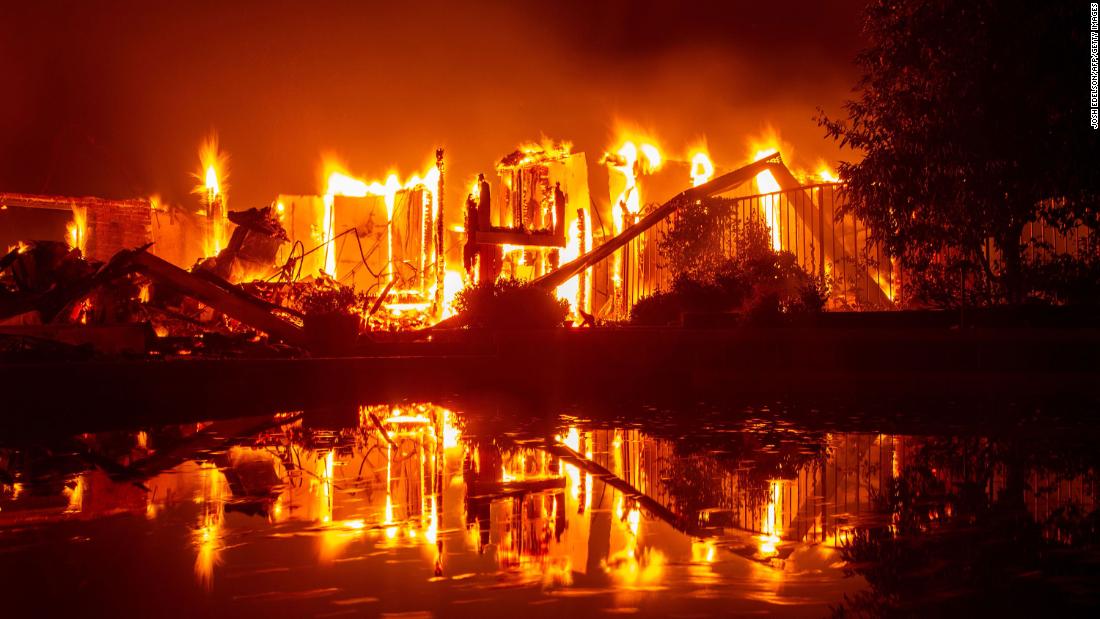
A house is caught up in the Carr fire in Redding, California, on July 27.

Carbon levels highest in 800,000 years

A report released Wednesday by the US National Oceanic and Atmospheric Administration (NOAA) gave the Earth in 2017 a grim report card.
The major greenhouse gases — carbon dioxide, methane and nitrous oxide — all rose to record levels last year. The global average carbon dioxide concentration was the highest ever recorded, and higher than at any point in the past 800,000 years, according to ice-core data.
Spending on oil and gas increased last year, pushing up the share of fossil fuels in energy supply investment for the first time since 2014, according to the International Energy Agency.Investment in renewable energy dropped 7%, while demand for coal rose, largely to keep Asia’s furnaces burning as the region rapidly develops.
And last year also saw US President Donald Trump announce his plan to pull the US from the Paris Agreement, in a striking blow to global action on climate change. The US is the world’s second-biggest emitter of carbon dioxide, and a pact without the powerhouse nation is significantly weakened.
The symptoms of climate change were also dramatic. Last year was the second or third-hottest year on record, depending on the dataset used, following three record-breaking hot years, the NOAA report showed. It was the hottest year on record without an El Niño, the natural weather event that adds to the warming of the seas and the whole planet.
A new record for global sea levels was set. Unprecedented coral bleaching occurred, and both the Arctic and the Antarctic saw record-low levels of sea ice, as warmer air and seas continued the trend of thinning out the polar ice.

Most Americans accept man-made climate change is real

The Earth has been getting steadily warmer since humans began using high levels of fossil fuels in the 18th to 19th centuries, during the Industrial Revolution. The planet has already warmed by around 1 degree Celsius since the late 19th century.
More and more Americans are starting to accept climate change is happening, despite Trump’s pledge to pull the US from the Paris Agreement.
American acceptance of climate change returned to an all-time high of 71% in October last year after sliding significantly from around a decade ago, according to the Yale Program on Climate Change Communication, which conducts quarterly surveys on attitudes to global warming. It has dropped to 70% this year so far.
Some 58% of Americans believe that climate change is mostly man-made, a clear majority but a lower percentage than in most other developed nations.
This understanding that climate change is at least happening has a lot to do with what people are seeing and experiencing, according to the Yale program’s director, Anthony Leiserowitz.
After the US was hit with several catastrophic hurricanes, the number of people who felt global warming was affecting US weather “a lot” leaped to 33% last October from 25% in May, five months earlier. That number went back down when winter came and extreme weather events subsided.
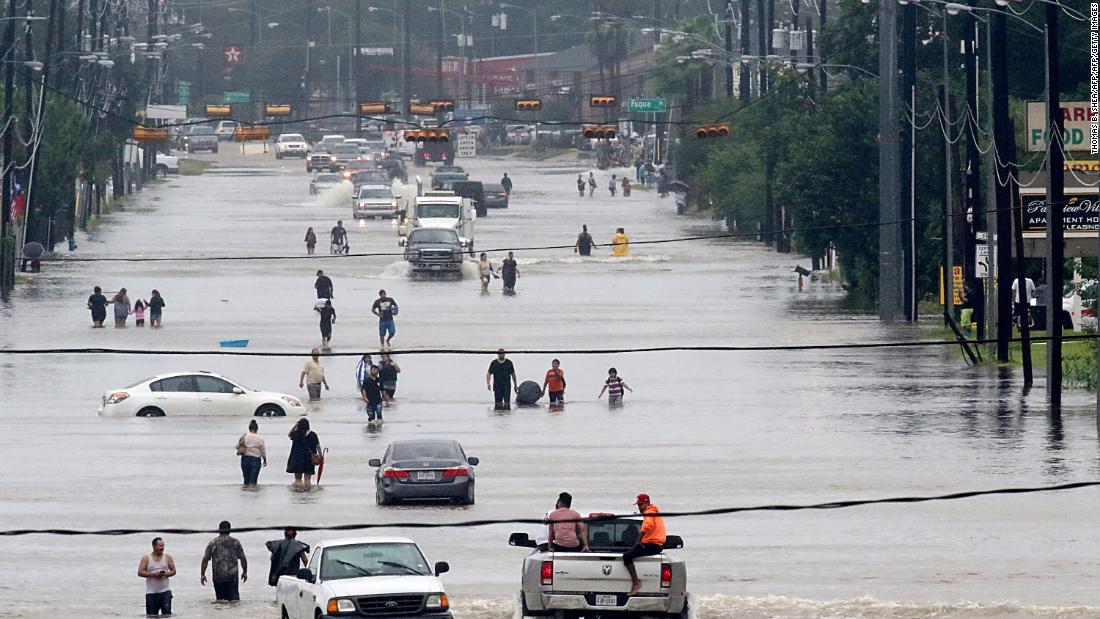
People walk through flooded roads in Houston, Texas, on August 27, 2017 as Hurricane Harvey hit the city.

“People are increasingly connecting the dots when they see these weather events happening across the United States,” Leiserowitz said.
“It’s about the pattern — if an extreme event happens once or twice, it’s just a coincidence, but three, five, 12, 22 times, seeing record-setting events, seeing 1,000-year event after 1,000-year event happen frequently, people begin to see that larger pattern, that climate change is actually affecting the weather today. And that’s a new concept for many Americans.”
This increase in awareness appears to be happening in Redding, California. The Carr Fire has torched more than 130,000 acres of land — the equivalent of nearly 100,000 football fields — and it became so big and hot this week, it created its own weather system.
Firefighter Gabriel Lauderdale, 29, has lived all his life by the forest near Redding, and he says even that’s enough time to have noticed the pattern and behavior of wildfires change dramatically.
“There seems to be more destructive wildfires and they’re happening more frequently,” said Lauderdale.
“It used to be that a 10,000-acre fire was a large fire, and in these cases, we’re seeing many exceed 100,000 acres, and they reach that size relative quickly. They move into homes and businesses, and they move very fast from structure to structure.”

The US pulls the plug on Paris

The Paris Agreement in 2015 was widely celebrated as an achievement, but it has major flaws — it is not legally binding, it’s unenforceable and soon it is likely to lack one of the world’s biggest polluters.
The agreement’s predecessor, the Kyoto Protocol, was much stronger. It set ambitious and legally binding emissions reduction targets. But it too had its problems.
It included only developed nations, so China, the world’s biggest carbon emitter, was not obliged to make reductions.
This was always a sticking point for the US. George W. Bush in 2001 pulled his country out of the Kyoto agreement, which Congress had never ratified.
Kyoto’s other major flaw was that although it was legally binding, no one was ever sanctioned for over-polluting.
So the success of Paris lies in the fact that it at least engaged more than just developed nations. Those who ratify it make pledges to combat climate change as their countries see fit, and they are obliged to report on them transparently, in more of a name-and-shame system than one with mutually set goals.
Another success of Paris is the recognition that the world should try to contain warming to 1.5 degrees Celsius above pre-industrial levels, or two degrees as a worst-case scenario.
The agreement, however, did not include the legally binding goals to reduce carbon emissions that were sought by Europe but largely opposed by the US.
Cars are blocked after a wildfire caused a road closure in Kineta in  Greece on July 23.

Now the world is left with a watered-down agreement, and the country that pushed strongly for that dilution is no longer playing along.
Todd Stern, the chief US negotiator in Paris, and the Obama administration are credited with bringing the US back into the fold after pulling out of Kyoto. But, Stern said, they knew they would never get binding targets past Congress, so they went into talks seeking an agreement that wouldn’t need Congressional approval.
Stern denies, however, that the US was the only one against binding targets, saying he would be “stunned” if all countries had agreed to get on board.
He made clear his strong disapproval of Trump’s announcement the day after it happened, and he has written op-ed after op-ed warning of the dangers of doing so.
“It’s a completely mind-bogglingly, ill-informed and unwise decision for so many reasons,” Stern told CNN, adding that the US was “too big and influential” to be left out.
Trump has governed with his “America First” agenda at the forefront of his policy making and had argued that the Paris Agreement placed “draconian” financial burdens on the American people.
“I was elected by the citizens of Pittsburgh, not Paris,” he said upon making his announcement in June last year.
With the Paris Agreement being largely non-binding and with the US out of the deal, environmental groups are calling on the rest of the world to make stronger commitments.
“All other nations have to ditch incremental action for transformational change,” said Claire Norman, speaking for Friends of the Earth in the UK.
“Other nations will need to step up — especially the UK, we used to be world-leading — and use every diplomatic and economic tool to compel the US to act.”

This Summer’s Heat Waves Could Be the Strongest Climate Signal Yet

‘In many places, people are preparing for the past or present climate. But this summer is the future.’

Extreme heat killed more than 80 people in Japan in July, just a few weeks after flooding from downpours was blamed for more than 200 deaths there. Martin Bureau/Getty Images

Extreme heat killed more than 80 people in Japan in July, just a few weeks after flooding from downpours was blamed for more than 200 deaths there. Martin Bureau/Getty Images

Sign up to receive our latest reporting on climate change, energy and environmental justice, sent directly to your inbox. Subscribe here.

https://insideclimatenews.org/news/27072018/summer-2018-heat-wave-wildfires-climate-change-evidence-crops-flooding-deaths-records-broken

Earth’s global warming fever spiked to deadly new highs across the Northern Hemisphere this summer, and we’re feeling the results—extreme heat is now blamed for hundreds of deaths, droughts threaten food supplies, wildfires have raced through neighborhoods in the western United States, Greece and as far north as the Arctic Circle.

At sea, record and near-record warm oceans have sent soggy masses of air surging landward, fueling extreme rainfall and flooding in Japan and the eastern U.S. In Europe, the Baltic Sea is so warm that potentially toxic blue-green algae is spreading across its surface.

There shouldn’t be any doubt that some of the deadliest of this summer’s disasters—including flooding in Japan and wildfires in Greece—are fueled by weather extremes linked to global warming, said Corinne Le Quéré, director of the Tyndall Centre for Climate Change Research at the University of East Anglia.

“We know very well that global warming is making heat waves longer, hotter and more frequent,” she said.

“The evidence from having extreme events around the world is really compelling. It’s very indicative that the global warming background is causing or at least contributing to these events,” she said.

Extreme Summer: Some of 2018's Most Extreme Events

The challenges created by global warming are becoming evident even in basic infrastructure, much of which was built on the assumption of a cooler climate. In these latest heat waves, railroad tracks have bent in the rising temperatures, airport runways have cracked, and power plants from France to Finland have had to power down because their cooling sources became too warm.

“We’re seeing that many things are not built to withstand the heat levels we are seeing now,” Le Quéré said.

Penn State climate scientist Michael Mann said this summer’s extreme weather fits into a pattern he identified with other researchers in a studypublished last year. The jet stream‘s north-south meanders have been unusually stationary, leading to persistent heat waves and droughts in some areas and days of rain and flooding in others, he said. “Our work last year shows that this sort of pattern … has become more common because of human-caused climate change, and in particular, amplified Arctic warming.”

Deadly Heat Waves from Canada to Japan

There are many ways to define a heat wave, but the conditions in many areas of the planet this summer have been universally recognized as severe, said Boram Lee, a senior research scientist with the World Meteorological Organization.

“From around end of June, many countries in Europe, Asia and North America have issued severe warnings,” she said. The UK, U.S., Japan and Korea all had long-lasting warnings, and Japan declared the recent heat wave a natural disaster, she added.

In Europe, scientists on Friday released a real-time attribution study of the heat wave that has baked parts of northern Europe since June. They found that global warming caused by greenhouse gas pollution made the ongoing heat wave five times more likely in Denmark, and twice as likely in Ireland.

In El Salvador, many farmers have lost their lost corn crops to drought this summer. Agriculture is suffering in the high heat and drought conditions in several parts of the world. Credit: Oscar Rivera/AFP/Getty Images

In El Salvador, many farmers have lost their lost corn crops to drought this summer. Agriculture is suffering in the high heat and dry conditions in several parts of the world. Credit: Oscar Rivera/AFP/Getty Images

“Near the Arctic, it’s absolutely exceptional and unprecedented. This is a warning,” said French heat wave expert Robert Vautard, who worked on the study for World Weather Attribution. The group previously determined that global warming made last summer’s “Lucifer” heat wave in southern Europe 10 times more likely.

“In many places, people are preparing for the past or present climate. But this summer is the future,” he said.

The geographic scope and persistence of the European heat wave stands out. An area stretching from the British Isles to Eastern Europe and north to the Arctic is bright red on European heat wave and drought maps, covering an area about as big as Texas and California combined.

Crop damage is being reported in parts Norway through Sweden, Denmark and the Baltics. Depending on conditions during the next month, more widespread crop failures could raise global food prices.

With the Jet Stream stuck well to the north, most of Europe has been feeling the heat. Credit: Met Office

In mid-July, temperatures reached all-time record highs above the Arctic Circle, around 90 degrees Fahrenheit, and hovered in the 80s for weeks at a time. In the Norwegian glacier area that Lars Holger Pilø studies, the average temperature has been 9 degrees Fahrenheit above average for the past 30 days.

“I have been working here since 2006, and we have snow records going back 60 years, and there’s nothing like what we’re seeing right now,” said Pilø, part of team of ice archaeologists who are measuring the snow and ice loss and recovering historic artifacts like arrowheads and skis that were buried for millennia.

“I’m watching with a mixture of excitement and dread. I try not to think too much about it and stick to what we do, which is rescuing the artifacts coming out of the warming. I call it dark archaeology,” he said. “I look at the ice and I think, dead man walking.”

Norwegian Meteorological Institute climate scientist Ketil Isaksen said the extreme situation in Scandinavia fits with the pattern of global warming.

“There are so many extremes now from all over the world. We’re seeing a very common pattern. For me this is a strong climate signal. Ice that’s several thousand years old, melting in the matter of just a few weeks,” he said.

Isaksen is finalizing some studies that find heat is penetrating between 30 and 50 meters deep into the ground through cracks in the rocky mountains around Norway’s fjords. Instead of just a thin skin of permafrost melting, those mountains could fall apart in large chunks when autumn rains start, threatening coastal communities with tsunamis.

“Now we have a new extreme this summer. This will probably affect slope stability, and we can expect mass movement events like debris flows and landslides in late summer,” he said.

He said the studies help define new geologic hazard areas with knowledge that some of the melted mountains will see wholesale slope failure when strong rains hit. Based on the information, emergency managers are developing new early warning systems.

The Increasing Influence of Global Warming

About the same time the Norwegian researchers were uncovering ancient tools in the Arctic tundra this summer, heat records were being set in many other parts of the world.

Temperatures in Algeria reached 124 degrees Fahrenheit, setting a record for the African continent. A few weeks earlier, a city in Oman is believed to have broken a global record when it went more than 24 hours with temperatures never falling below 108 degrees. Japan set a national record of 106 amid a heat wave that has been blamed for more than 80 deaths.

Regional western heat events are becoming so pronounced that some climate scientists see the current extremes in the U.S. as a climate inflection point, where the global warming signal stands out above the natural background of climate variability.

Global Warming's Growing Role in Extreme Heat Waves, by U.S. Region

In mid-July, a week of temperatures in the high 80s and up to 96 degrees Fahrenheit in normally cool Quebec killed more than 50 people, and while that heat wave was waning, another was building in Asia, where the Japan Meteorological Agency said that 200 of its 927 stations topped the 35 degree Celsius (95 degrees Fahrenheit) on July 15. Since then, at least 80 people have died and thousands have gone to hospitals with heat-related ailments.

“There are irrefutable scientific evidences that climate change alters both the intensity and frequency of such extreme phenomena as heat waves, and ongoing efforts are dedicated to understand how big the impact of man-made climate change is,” said the WMO’s Boram Lee.

Across social media, climate scientists are responding with a collective “we warned about this,” posting links to 10 years’ worth of studies that have consistently been projecting increases in deadly heat waves. If anything, the warnings may have been understated.

“The rise in heat waves is stronger than many climate models project,” said World Weather Attribution’s Geert Jan van Oldenborgh, who measured a record high temperature outside his office in the Netherlands on July 26, then tweeted that global warming is making the heat there 20 times more likely than in 1900.

Wildfires Out of Control

Hot and dry weather also makes forests more flammable. In Greece, after a month of record and near-record heat, flames ran wild through the community of Mati on July 23, killing at least 80 people. On July 26, a blaze in Northern California jumped the Sacramento River and spawned fire tornadoes, forcing the evacuation of parts of Redding, a city of 92,000. And in Germany, residents of southern Berlin awoke Friday to the sight of smoke on the horizon, an event that will also become more common in that part of the world.

Although climate scientists are reluctant to link any one particular fire to climate change, there is plenty of scientific evidence showing how heat-trapping greenhouse gases contribute to increased fire danger.

“Weather is a product of the climate system. We are drastically altering that system, and all the weather we observe now is the product of that human-altered climate system. One result is an increase in the frequency, size and severity of large fire events,” University of California, Merced researcher Leroy Westerling wrote on Twitter.

Residents watch as fires burn into the city of Rafina, near Athens, on July 23. Credit: Angelos Tzortzinis/AFP/Getty Images

Residents watch as fires burn into the city of Rafina, near Athens, on July 23. The blazes moved quickly through the drought-parched area, killing more than 80 people. Credit: Angelos Tzortzinis/AFP/Getty Images

University of Arizona climate researcher and geographer Kevin Anchukaitis publicized several wildfire studies from the last 10 years that all show how and why global warming is making fires bigger, more destructive and longer-lasting. “Is climate change the only factor influencing wildland fire? No, of course not—but climate change is influencing area burned and fuel aridity,” he wrote.

Tyndall Centre Director Le Quéré said she faulted some media for failing to connect global warming to the current global heat wave. “This signal is very clear,” she said, adding that some of the early stories about the deadly fire in Greece almost seemed to downplay a link to climate change.

On Friday, the WMO released a new statement highlighting the links between global warming and wildfires and reminding readers that “heat is drying out forests and making them more susceptible to burn.”

Extreme Rainfall and Flooding

There is also still reluctance to link individual extreme flood events with global warming, despite plenty of scientific evidence that today’s global atmosphere—1 degree Celsius warmer than 100 years ago—holds much more moisture that can be delivered by regional storm systems.

Those warnings were not enough to help the more than 200 people who died in Japan in late June amid a series of record-setting torrential rain storms. Regional weather patterns certainly played a role, but ocean currents and an atmosphere juiced up by global warming likely boosted moisture for the storm.

Extreme rainfall unleashed landslides and flooding that knocked homes off their foundations in Kumano, Japan. The storms and floods in early July were blamed for more than 200 deaths. Credit: Martin Bureau/AFP/Getty Images

Two years ago, Alfred Wegener Institute climate researcher Hu Yang showed how climate change is strengthening ocean currents that carry moisture from the ocean toward Japan. The research showed the currents have been getting stronger and warmer in tandem with rising atmospheric CO2 levels. Eventually, that heat is released to the atmosphere during storms, as wind or rain or both.

Yang said his continuing research is finding similar evidence that a powerful current near Japan may be “a super hotspot under global warming.” As the current strengthens, it will release its energy as water vapor, fuel for storms that can cause extra heavy rains in Japan and other parts of Asia, he said.

In the U.S., June flooding in the Midwest fits a detected pattern of increasing extreme rainfalls in that region. And in late July, 10 million people in the East, from Pennsylvania to North Carolina, were under various types of flood warnings with soggy air sloshing from the Gulf of Mexico and the Caribbean over the overheated Northeastern Atlantic toward the coast.

What Can We Do About It?

In some cases, the scientific warnings about global warming impacts have resonated. At least parts of Europe are better prepared for heat waves now than they were in 2003, when extreme heat killed up to 70,000 people, said Le Quéré.

More cities know what they need to do to protect vulnerable people in an extreme event, she said, but they lack the money to do things  like building more cooling shelters, or cooling core urban areas with green spaces and ponds.

“Maybe this is an opportunity, in a grim way, to prepare for events that will be longer and hotter,” she said. “It’s not just a case of holding our breath for three weeks and saying ‘it’s soon winter.’ It’s a time to push and protect vulnerable people and infrastructure.”

Comparing global temperature anomalies between the UK's 1976 heat wave and 2018. Credit: Simon Lee

To prepare for the new normal, people must act in the next five to 10 years, said environmental scientist Cara Augustenborg, chairperson of Friends of the Earth Europe.

“We have to consider how every new infrastructure, agricultural or development project from now on will be impacted by climate change. We need to look at planned retreat from coastlines and developing further inland, building infrastructure that is more resilient to the effects of climate change such as sea level rise and temperature extremes.

“We’ve had several years now where airport runways have melted on extremely hot days,” she continued. “That’s something we need to factor in to future construction as it’s a problem that won’t go away.”

Society also needs to think about food security, she said.

“That’s what I really lose sleep over,” she said. “Our available arable land is declining now as our global population is booming. It doesn’t take much in the way of extreme weather to have a major impact on food supplies.”

Listen to a conversation about the extreme heat and climate change with ICN Managing Editor John H. Cushman, Jr., at On Point.