Exposing the Big Game

Forget Hunters' Feeble Rationalizations and Trust Your Gut Feelings: Making Sport of Killing Is Not Healthy Human Behavior

Exposing the Big Game

Southern wildlife in jeopardy as giant tegu lizards invade Georgia and Florida

REIDSVILLE, Ga. — An invasive, giant, and dangerous lizard is creeping its way through southeast Georgia and beyond.

The Argentine black and white tegu lizards are originally from South America, and now they are wreaking havoc on wildlife throughout the South.

Daniel Sollengberge, senior wildlife biologist with the Georgia wildlife, said they never knew there was a population established in the wild until recently.
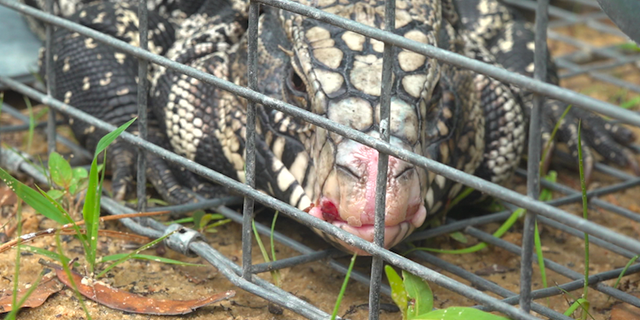
Tegu lizards are known to eat anything that they want, especially the eggs of other reptiles. 

Tegu lizards are known to eat anything that they want, especially the eggs of other reptiles.

“We presume that the animals started as the result of escaped or released pets in the area… there really common in the pet trade,” Sollengberger said.

After over a dozen sightings of the lizards in southeast Georgia, Tegus have become known as an invasive species particularly in Toombs and Tattnall counties.
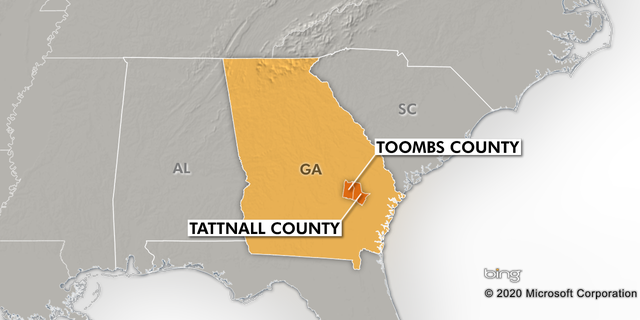
Map showing the two southeastern counties that have been invaded by Tegu lizards. 

Map showing the two southeastern counties that have been invaded by Tegu lizards.

Georgia Southern professor, Dr. Lance Mcbrayer studies the evolution of lizards and leads the U.S Geological Survey team.

“Already in 2020 we’ve caught five animals at this site right here,” Mcbrayer said.

The lizards can grow up to four feet long. As the number of lizards in southeast Georgia continue to increase, the geological survey team is racing to put down traps.

The traps are placed about 100 meters apart and members of the Geological team check them daily.
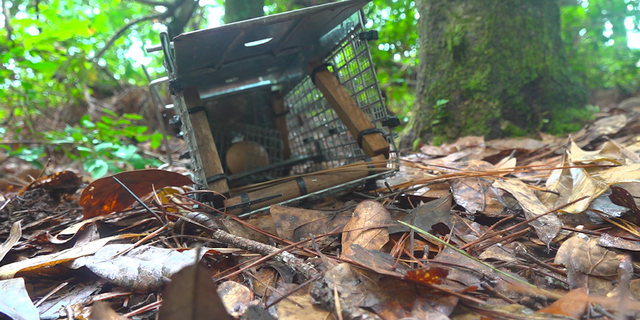
One trap in southeast Georgia that is set up to capture Tegu lizards. 

One trap in southeast Georgia that is set up to capture Tegu lizards.

Daniel Haro is a part of the geological team and works in the field about three to four times a week. “In general, right now, we have 85 and we’re going to get to 90… so, this week I’m hoping to place five more,” Haro said.

According to Georgia wildlife, the lizards don’t attack people unless provoked. However, with their strong jaws and sharp teeth, they will eat anything they can put in their mouth, especially eggs.
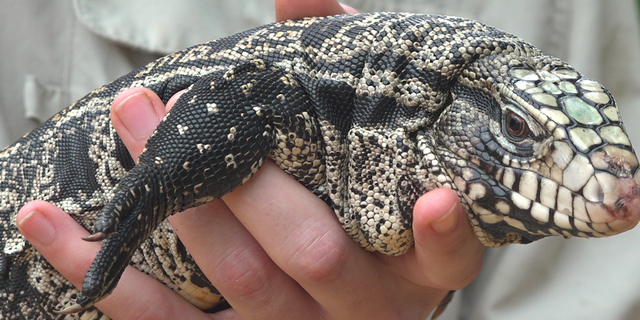
Crews hold Tegu lizards that was captured years ago. 

Crews hold Tegu lizards that was captured years ago.

“Whereby they’re damaging our gopher tortoise populations or bobwhite quail populations or turkey populations…the animal walks around and it hunts up nests on the ground,” Mcbrayer said.

On top of that, tegu lizards can lay up to 40 eggs, and once they hatch, they will be around 6 to 10 inches long.  “That’s our real concern… that there could be a very rapid increase in the number of tegus in just a few years,” Mcbrayer said.

The crew in southeast Georgia has not caught a juvenile tegu yet but, “all the habitat and the size of the animals we’re catching suggest that they’re reproducing – so that’s a problem,” Mcbrayer said.
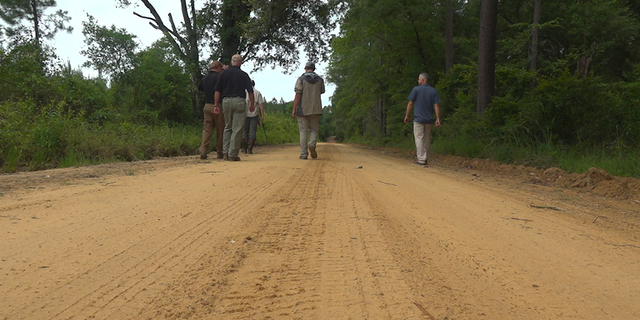
The U.S Geological survey team works to capture Tegu lizards in Reidsville, GA. 

The U.S Geological survey team works to capture Tegu lizards in Reidsville, GA.

Tegu lizards have established themselves as invasive species in Florida, too. “There’s at least three populations in Florida… the north side of the Everglades…one inland in St. Pete from Tampa … and now one in the Panhandle,” Mcbrayer said.
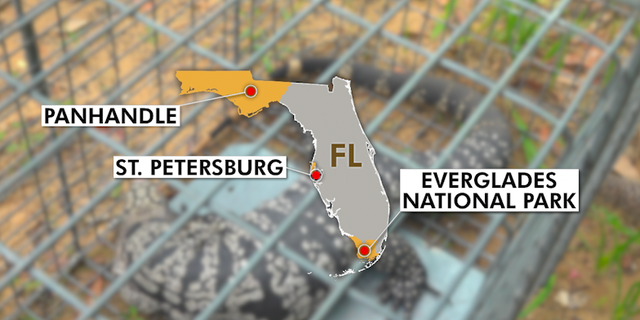
Map shows areas in Florida that have been impacted by Tegu lizards. 

Map shows areas in Florida that have been impacted by Tegu lizards.

The population of lizards in the South could spread rapidly because, unlike most lizards, Tegus move around.

“These animals can walk several miles in a day. They could walk 10 or 12vmiles just in a day or two,” Mcbrayer said.

As the population of lizards continues to grow, Mcbrayer says the lizards will spread if they aren’t stopped.

“These animals can be trapped or hunted humanely in safely,” Mcbrayer said. “We encourage anyone to do that to remove these animals from the wild.”
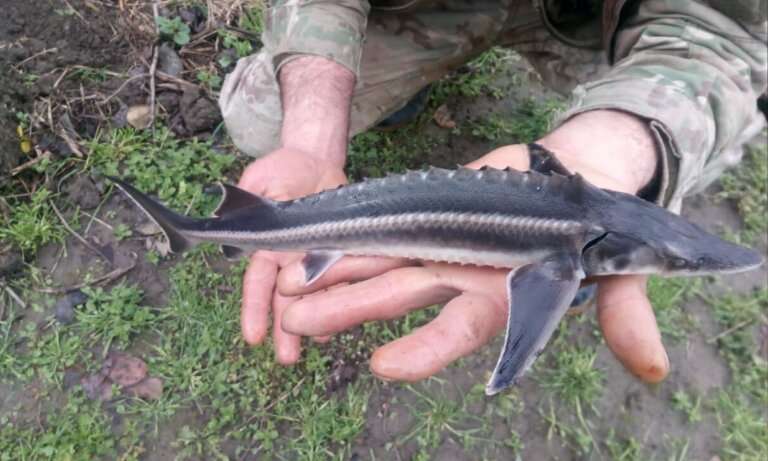
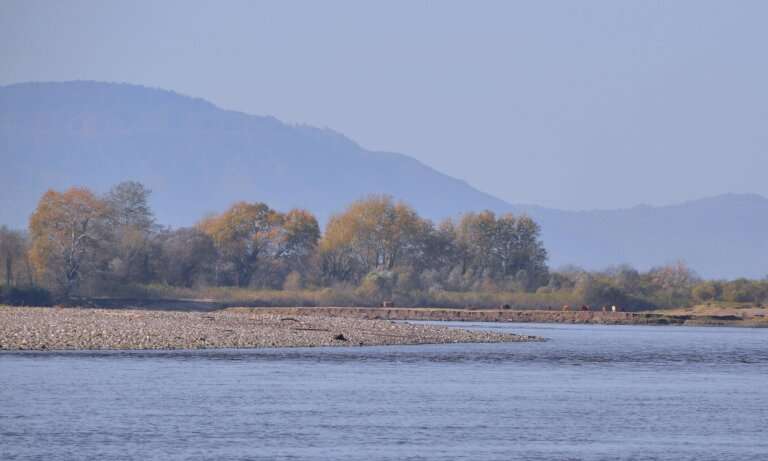
Dramatic double discovery of a fish on the brink of extinction

https://phys.org/news/2020-04-discovery-fish-brink-extinction.html

Dramatic double discovery of a fish on the brink of extinction
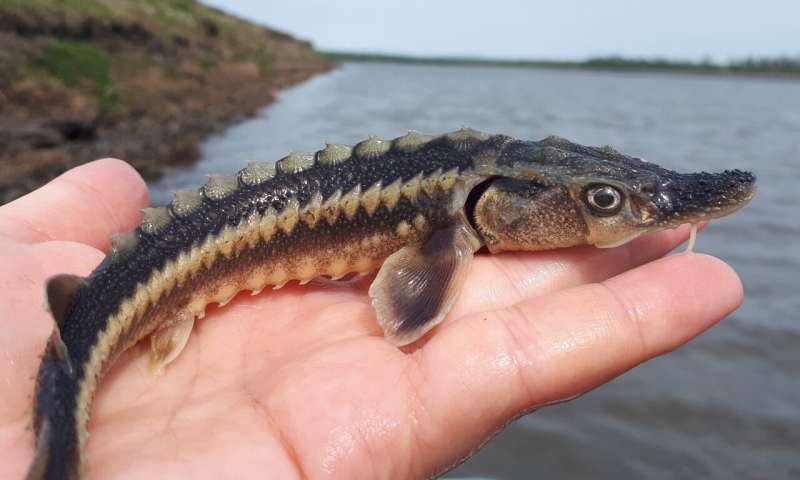
River phoenix – A precious juvenile ship sturgeon, risen from the depths. Credit: Irakli Tsulaia

Within the space of less than a month, two specimens of a vanishingly rare fish have been plucked from the waters of the Rioni River in Georgia.

Before these two juveniles were caught, conservationists had expressed fears that the critically endangered ship  might have already sunk without trace. This extraordinary, other-worldly fish—whose evolution dates back hundreds of millions of years—had not been seen alive in the wild for many years.

A lack of solid scientific research on the species means that very little is known about the ecology and distribution of the ship sturgeon, but no one disputes that it is in deep trouble. In that context, the capture of two juvenile fish in quick succession, each estimated to be less than three years old, is extremely exciting news, raising the prospect that this elusive and gravely imperiled species might still be reproducing in the Rioni.

Sturgeons were once widespread throughout Europe, but have been virtually wiped out by a lethal combination of overharvesting, poaching and the loss of traditional spawning grounds to habitat destruction. The Rioni is one of the last three remaining refuges of these dwindling denizens of the Danube and the continent’s other great river systems. Remarkably, it still harbors breeding populations of several sturgeon species.

Georgia on our minds

The first evidence of recent reproductive success came in 2018, when a tiny —tentatively identified as a stellate sturgeon—was caught by two female students working  for Fauna & Flora International (FFI) on a  launched earlier that year in an effort to safeguard Rioni’s remaining riches.

Dramatic double discovery of a fish on the brink of extinction
Sturgeon spawning grounds in Georgia’s Rioni River. Credit: Fleur Scheele/FFI

Since conducting what were the very first baseline studies for sturgeons in Georgia, FFI and our in-country partners have set about combating the threats to their survival, in particular poaching and illegal trade. We have established monitoring teams comprising ‘citizen inspectors’ drawn from communities along the river, whose role is to inform governmental agencies about incidences of poaching. FFI works closely with these communities—from schoolchildren to fish traders—to raise awareness of the plight of the sturgeons in the Rioni—and their global importance.

The FFI research team continues to work on the river from early spring to autumn, gathering vital data on sturgeon recruitment and genetic diversity in Georgia’s territorial waters. In collaboration with Ilia State University, we collect samples from any captured sturgeons for genetic analysis, in order to aid identification and shed light on which species still survive in the Rioni.

Hook, line and sturgeon

Ironically, both ship sturgeons were accidentally captured by surprised anglers, the first in mid-March, and the second just three weeks later. All sturgeon species in Georgia are officially protected, and commercial fishing on the Rioni is severely restricted, but sport fishing with rod and line is permitted, provided that anglers release any sturgeons they catch.

The fact that both anglers contacted one of FFI’s citizen inspectors immediately after catching the juvenile sturgeons—thereby enabling photographs and samples to be taken before the fish were returned to the river—is a success story in itself, vindicating FFI’s efforts to engage with nearby communities and engender local support for the project.

A week after the second ship sturgeon was caught, the river yielded a third juvenile, this time captured by the FFI team and provisionally labeled as a Colchic sturgeon—although hybrids are known to occur and can be difficult to differentiate from the real deal without detailed analysis.

While the ichthyologists may be agonizing over the idiosyncrasies of sturgeon subcategories, one thing is certain: the latest revelations provide further irrefutable evidence that the Rioni is an absolutely crucial sanctuary—and possibly the last hope—for these armor-plated icons of the fish world.

Dramatic double discovery of a fish on the brink of extinction
Another juvenile – believed to be a Colchic sturgeon – completed the trio of young fish caught within the space of a few weeks. Credit: Tamar Edisherashvili/FFI

Dammed to extinction?

Further studies will be required before we can confirm categorically that the ship sturgeon is still spawning in Georgia’s mightiest river, but it seems that there could be light at the end of the tunnel. Unfortunately, that glimmer of hope is in imminent danger of being snuffed out.

A significant new threat to the survival of Georgia’s sturgeons has recently surfaced. The proposed development of several hydropower plants upstream from our project site could have a potentially disastrous impact on the Rioni—and put paid to the recovery prospects of its flagship  species.

We risk having to bear witness to the tragedy of a rediscovered species being pulled back from the brink of extinction by conservationists only to be knowingly pushed over the precipice in the name of economic progress. Let’s hope that day never arrives.


Explore further

Little fish, big deal – Baby sturgeon offers hope for the future

Slutty Vegan restaurant a plant-based burger sensation

Lisa Respers France, CNN • Updated 6th August 2019
in a long line for hours on end
just to enjoy this experience,

PauseMuteMute

Current Time1:34
/
Duration Time1:44
Loaded: 0%

Progress: 0%

Fullscreen

Atlanta (CNN) — One scorching hot day in southwest Atlanta, Houston native Tamara Edwards stood in a line that stretched a full block for a chance to get “sluttified.”
“I found out about it on social media and the line has just been crazy and it’s nonstop,” Edwards said. “The food looks really, really good. Anything worth the people standing out for, I want to try it.”
Welcome to the world of Slutty Vegan, a 100% plant-based burger restaurant that has become such a food sensation in less than a year that owner Pinky Cole is already working on opening two more locations.
On a typical day, people wait for hours for a chance to sample Cole’s chefed-up versions of Impossible Burgers.
There’s the “One Night Stand,” which features a patty loaded with vegan bacon, vegan cheese, caramelized onions, lettuce, tomato and slutty sauce on a vegan Hawaiian bun.
The “Ménage à Trois” comes with all that and adds some vegan shrimp.
Cole gives a nod to her Jamaican heritage with menu items such as the “Dancehall Queen,” which adds sweet jerk plantains to the mix.
Pinky Cole's Slutty Vegan restaurant has lines down the block.

Pinky Cole’s Slutty Vegan restaurant has lines down the block.
Cameron Mitchell
No one is more surprised by the success of Slutty Vegan than the Baltimore native who dreamed it all up in her two-bedroom apartment.
“It literally was only supposed to be a ghost restaurant where people only order food online and they pick up through a delivery service,” said Cole, who graduated from Clark Atlanta University in Atlanta. “But I wasn’t thinking big enough because what I felt was only going to be a ghost restaurant turned out to be one of the biggest concepts and brands in America.”
She’s not blowing smoke with that.
Using her background as a former television producer (she’s worked on such hits as “The Maury Show” and “Iyanla: Fix My Life”) and her social media savvy, Cole has taken Slutty Vegan from a vision to a food truck and then a restaurant.

Growing black vegan community

She’s also at the forefront of a growing veganism movement among black people.
Spurred in part by the epidemic of diabetes and hypertension in the African American community, the plant-based lifestyle is starting to become so popular that in February PETA celebrated Black History Month with a feature on “29 Black Vegans Saving Animals.”
And while Cole’s burgers and fries aren’t exactly what one would think of as health food, Dymetra Pernell sees it as helping spread the word — especially in the black community — that eating a plant-based diet can be delicious.
Pernell is known as “The Plant Based Princess” and is owner of First Batch Artisan Foods, an Atlanta vegan ice cream and pastry company.
Cole credits Pernell as one of her biggest champions. Pernell was the first to use her thriving social media presence to plug Slutty Vegan, Cole said.
The restaurant features distinctive, chefed-up takes on Impossible Burgers.

The restaurant features distinctive, chefed-up takes on Impossible Burgers.
Cameron Mitchell
The pair met in a shared commercial kitchen space where Pernell was surprised to learn that the delicious-looking and smelling burgers coming from Cole’s area were vegan.
“She gave me the burger to try, and I got upset instantly,” Pernell said, laughing. “Like, wait, who are you and why didn’t I know who you were and why haven’t I heard of you?”
As a naturopath, Pernell has long been trying to help people understand the impact diet has on their health.
“I was one of the people who would always try and to raise awareness about that and how and why heart disease and type 2 diabetes are so prevalent in the [black] community,” she said. “People of color die and suffer at a disproportionately higher rate than any other race or community from chronic diseases and lifestyle diseases.”
Cole jokes that “vegan is the new black,” even as she says it transcends race.
“Veganism is a universal thing and as long as it’s universal, people can come together in the name of food and that’s the most beautiful part about it,” she said. “But black people coming together, especially standing in a long line for hours on end just to enjoy this experience and enjoy the food, it’s really history making.”

Worth the wait

On a typical day, crowds line up several hours in advance to await the small shop’s opening.
Cole’s team greets newbies with cries of “We’ve got a virgin,” while returning guests are “sluts.” It’s take-out only, so virgins and sluts alike are on their own for a dining spot.
She said she came up with the Slutty Vegan name while looking for something sexy that would hook potential customers.
“What I did was I connected a provocative way of putting food and sex together, but it’s positive manipulation because I knew that it wouldn’t have anything to do with sex,” Cole said. “It was really about food and how to connect people to eating healthier.”
It’s worked because stars such as Snoop Dogg, Usher, Tiffany Haddish and others have been featured on the restaurant’s Instagram account raving about being “sluttified.”
Cole said all of her marketing has been via word of mouth and she has never paid a celeb for an endorsement.
“This entire business was just created out of pure intentions and love,” said Cole, who added that many of the celebrities have reached out to her.
“[Celebrities] wanted to try the food because they heard so much great things about it and it wasn’t forced. It was so organic, it was so authentic. And that’s the beauty of Slutty Vegan.”

Alyssa Milano Calls for ‘Sex Strike’ in Response to Georgia’s Anti-Abortion Law

https://www.thewrap.com/alyssa-milano-sex-strike-esponse-to-georgias-anti-abortion-law-sex-strike/

“JOIN ME by not having sex until we get bodily autonomy back,” actress-activist tweets

Last Updated: May 11, 2019 @ 9:49 AM

Alyssa Milano responded to Georgia’s anti-abortion law Friday night, calling for women to just say no to sex “until we get bodily autonomy back.”

“Our reproductive rights are being erased,” the actress-activist tweeted. “Until women have legal control over our own bodies we just cannot risk pregnancy. JOIN ME by not having sex until we get bodily autonomy back. I’m calling for a #SexStrike. Pass it on.”

ADVERTISING

The message was accompanied by a giant pink “x” and the caption “If our choices are denied, so are yours.”

Milano’s call to action by female voters kicks up her protest of Republican Gov. Brian Kemp’s signed state legislation this week banning abortions after a fetal heartbeat is detected as early as six weeks into a pregnancy. Earlier in the week, she championed a boycott of the state of Georgia as a location of filming and where the second season of Netflix’s “Insatiable” is currently in production.

“I will do everything in my power to get as many productions as possible — including ‘Insatiable’ — to move out of this state which continues to put forth oppressive, hurtful policy that contradicts everything the entertainment industry stands for,” Milano said in a statement to TheWrapThursday.

She added: “Obviously, those who are already contractually obligated to be there, should fight to get their show out of Georgia while continuing their contractual obligation. I have to be there for another three weeks but you can be sure I will fight tooth and nail to move ‘Insatiable’ to a state that will protect our rights. And if it doesn’t move to another state, I will not be able to return to the show if we are blessed with a third season. This is my leverage. I will use it for the betterment of society and our great country.”

According to Georgia Trend, the Peach State overtook California as the top location for production of feature films in 2016, leading to an economic impact of $9.5 billion in fiscal 2017 and $2.7 billion in direct spending.

Alyssa Milano

@Alyssa_Milano

Our reproductive rights are being erased.

Until women have legal control over our own bodies we just cannot risk pregnancy.

JOIN ME by not having sex until we get bodily autonomy back.

I’m calling for a . Pass it on.