Father of 12-year-old big game trophy hunter Aryanna Gourdin is a convicted poacher

The father of a 12-year-old big game trophy hunter making headlines around the world is a convicted poacher.

Aryanna Gourdin and her father Eli sparked outrage after photos of her rejoicing over the carcass of a giraffe she shot dead were published.

He has been accused of “brainwashing” her and using her in a social media campaign to promote their bloodthirsty exploits in the name of conservation.

They appeared on ITV’s Good Morning Britain last week wearing “stand up to anti-hunter bullying” after the Mirror highlighted the issue in a front page story.

Eli has been convicted of “wanton destruction of protected wildlife” which he was found guilty of in 2010.

Giraffe girl
Aryanna Gourdin with a giraffe she has hunted

In Utah where they live the crime relates to illegally killing big game such as deer, elk, moose and bison.

He also has 15 other convictions related to protected wildlife for which he was jailed in 2000. These include eight counts of transporting and selling protected wildlife.

Dr Pieter Kat of the Charity Lion Aid, said: “Despite breaking conservation laws this man has the audacity to loudly proclaim that hunting is conservation.

Giraffe girl
Aryanna Gourdin poses next to one of her kills

More: http://www.mirror.co.uk/news/world-news/father-12-year-old-big-8827114

Footage of Rebecca Francis killing a giraffe in Africa

From Change.org

Apr 20, 2015 — This video shows Rebecca Francis hunting the giraffe from the picture. Although she made a rebuttal to Ricky Gervais last week, the video shows just had deceptive she was being.
https://www.youtube.com/watch?v=RmkslPmo1vU&feature=youtu.be

Footage of Rebecca Francis killing a giraffe in Africa
Here is footage of the hunt in which Rebecca Francis kills a giraffe with a bow and arrow in Africa which has caused outrage. Francis like all trophy hunters has claimed she killed the animal to feed local…

“You know that feeling of joy someone gets when they put an arrow through a giraffe’s eye…..No, me neither”*

*Recent Tweet by Ricky Gervis

More: http://www.oregonlive.com/today/index.ssf/2015/04/ricky_gervais_vs_rebecca_franc.html

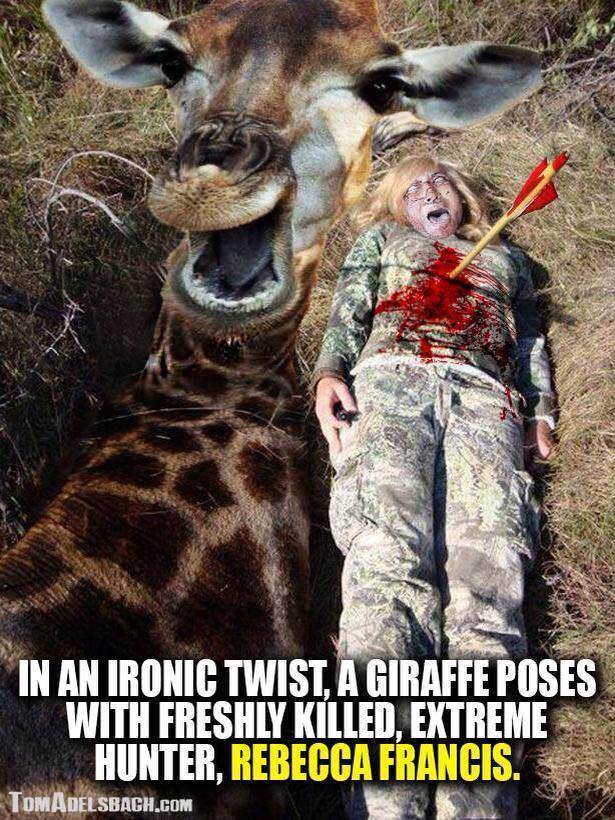
Rebecca Francis has been famous in hunting circles since 2010, when the photogenic Utah native won the obscure reality show “Extreme Huntress.”

But now she’s famous in the wider world as well, thanks to comedian Ricky Gervais.

Last week, Gervais, a dedicated animal-rights activist with more than 7 million Twitter followers, came upon a photo of Francis posing next to a giraffe she had just killed, a big smile spread across her face. The result: a tweet heard ’round the world.

CCdg2FaWgAAHhrY

“What must’ve happened to you in your life to make you want to kill a beautiful animal & then lie next to it smiling?”

Ricky Gervais         @rickygervais

People outraged by Francis’ apparently cavalier attitude toward killing wildlife expressed their disgust on social media and beyond.

Stunned by the criticism, Francis struck back, accusing Gervais of sexism. “Ricky Gervais has used his power and influence to specifically target women in the hunting industry and has sparked thousands of people to call for my death, the death of my family and many other women who hunt,” she said in a statement. She added: “I repeat I will never apologize for being a woman who hunts as I know that my passion for hunting and conservation is making a direct difference on the ground for wildlife.”

In the wake of Gervais’ giraffe tweet, a few people on Twitter did call for violence toward Francis. Some of Francis’ supporters have also suggested violence is the answer. One hunting enthusiast tweeted: “@rickygervais a real hunter would shoot idiots like you for the greater good of society.” Gervais retweeted it.

On her website, Francis boasts of having “taken” bears, moose, sheep, zebra and many other animals with both bows and rifles, and of mentoring other women who are interested in hunting. “For me, there is nothing more empowering than sharing that special moment of success with another female who is chasing her dreams,” she writes.

Gervais responded to Francis’ sexism claim by tweeting as if he were Francis: “I kill lions, giraffes & bears with guns and bows and arrows then pose grinning. Why don’t people like me? Must be because they’re sexist.” He then highlighted male hunters too, employing his usual un-PC humor.

Such as Tweeting, “Maybe he was hungry,” under this photo:

CCySocvXIAE93eY

Francis has gone quiet in recent days, but Gervais, whose Twitter feed often features his house cat Ollie, gives no indication that he’s done.

Men and Women Who Hunt Animals Are “Equally Vile”

http://www.usmagazine.com/celebrity-news/news/ricky-gervais-men-and-women-who-hunt-animals-are-equally-vile-2015184#ixzz3XmWp7ZFo

Ricky Gervais Says Men and Women Who Hunt Animals Are “Equally Vile” AfterPoacher-Hunters-6 Rebecca Francis Claims He’s Targeting Women

Celebrity News Apr. 18, 2015 AT 1:20PM

He’s just getting started. Ricky Gervais continued to slam hunters following his buzzed-about spat with Eye of the Hunter co-host Rebecca Francis. His new comments are in

“We need to stamp out this terrible sexism in the noble sport of trophy hunting,” he tweeted on Friday, April 17. “The men & women that do it are EQUALLY vile &  worthless.”                                  [except for the woman in the photo above–she hunts poachers.]

The British comedian-actor, 53, was appalled earlier this week when he saw a photo of Francis lying down – and smiling – next to a dead giraffe she just killed. “What must’ve happened to you in your life to make you want to kill a beautiful animal & then lie next to it smiling?” he wrote via Twitter on April 13.

PHOTOS: Celebs and their pets

Francis began to receive death threats following Gervais’ post, which has garnered over 30,000 retweets. On April 14, Francis released a statement saying she preserved the animal by providing locals with its meat. On Friday, she gave a second statement to Hunting Life.

“Ricky Gervais has used his power and influence to specifically target women in the hunting industry and has sparked thousands of people to call for my death, the death of my family and many other women who hunt,” she said, via The Telegraph. “This has evolved into an issue about the morality of threatening human lives over disagreeing with someone else’s beliefs. It shocks me that people who claim to be so loving and caring for animals can turn around and threaten to murder and rape my children.”

PHOTOS: Celebs fight back on Twitter

Gervais, however, doesn’t seem to be backing down. He’s continued to show his love for animals all week. “Enjoy the lovely weather and don’t leave your dog in the car. Have a great day,” he tweeted on April 17. On Friday, he gushed about his adorable “furry bagpipe” cats and snapped a selfie with his “new duck friends” near a lake.

Read more: http://www.usmagazine.com/celebrity-news/news/ricky-gervais-men-and-women-who-hunt-animals-are-equally-vile-2015184#ixzz3XmRYOAMn
Follow us: @usweekly on Twitter | usweekly on Facebook

Also See: http://www.huffingtonpost.com/2015/04/17/vet-kristen-lindsey-kills-cat-with-arrow_n_7090630.html

Death at a Zoo

 http://www.earthisland.org/journal/index.php/elist/eListRead/death_at_a_zoo

‘Zoothanasia’ is a common practice in Europe and also occurs in the US. Some wildlife advocates say it’s unnecessary

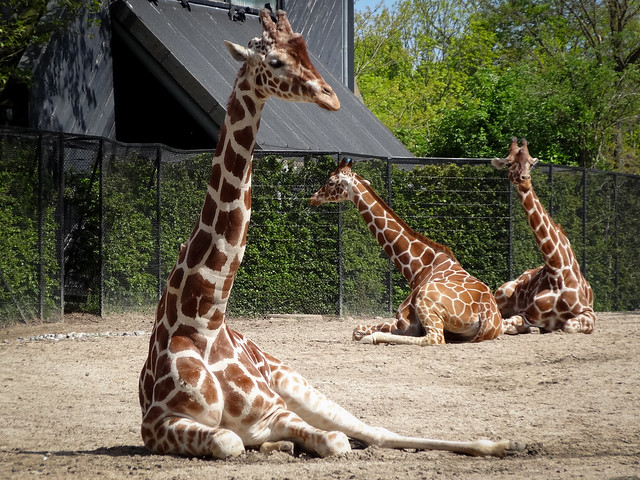
The killing of a young giraffe at the Copenhagen Zoo in February 2014 shook the world, causing protests from animal advocates and the public alike. “Marius,” an 18 month-old giraffe that had been born at the Copenhagen Zoo, was healthy and likely would have lived a long life. The animal was put down (and then fed to lions at the zoo), because officials at the zoo concluded it was unsuitable for breeding. A month later, the same zoo euthanized four lions, again on the grounds of genetic purity and breeding.

Giraffes at Copenhagen ZooPhoto by Michael ButtonGiraffes at the Copenhagen Zoo. Zoo animals are typically killed for two reasons: to control the population and manage “surplus animals,” or to maintain genetic strength and diversity within a captive breeding program.

Zoo administrators ended up receiving death threats, and the killings sparked a media feeding frenzy. The serial deaths ushered in a newfound awareness of a not-so-new practice and raised some overlooked questions: Is “zoothanasia,” as the practice has been called, really necessary? And how common is it?

Zoo animals are typically killed for two reasons: to control the population and manage “surplus animals,” or to maintain genetic strength and diversity within a captive breeding program. While many animal rights activists and some conservation biologists are against the use of euthanasia among zoo animals, organizations such as the European Association of Zoos and Aquaria and the Pan African Association of Zoos and Aquaria defend the practice. “As an organization, we believe that culling has a valid scientific basis and must remain one of the tools open to our members, provided that it is carried out humanely,” says David Williams-Mitchell, a spokesperson for EAZA.

Marc Bekoff, a professor of ecology and evolutionary biology at University of Colorado-Boulder and the person credited with coining the term “zoothanasia,” disagrees. He says that killing captive animals is the opposite of conservation. “There simply is no reason to kill any animals, members of endangered species or not, in zoos unless she/he is mortally ill or injured,” says Bekoff, who is author of the book Rewilding Our Hearts: Building Pathways of Compassion and Coexistence.

Sometimes, zoo animals are killed because there’s just too many of them in their cages and enclosures. These “surplus animals” are the result of animals that have been allowed to breed without a zoo considering how it might care for them in the future. These surplus animals then suffer due to lack of resources, money and care. According to a study from the Captive Animals’ Protection Society, at least 7,500 animals (and as many as 200,000 animals) are considered surplus at any one time. For some zoos, killing an animal is easier (and cheaper) than continuing to care for it, or even transferring it to some kind of a sanctuary. “They’ll tell you they do it for lack of money and space, for example,” Bekoff says.

Some animals are deemed ‘surplus’ because they are poor candidates for breeding. While zoos are mostly in the business of entertaining their visitors and educating them about wildlife, many are home to captive breeding programs and are under pressure to conserve the best of species to ensure they do not go extinct. Williams-Mitchell argues that, from EAZA’s perspective, there is an obligation to consider the future of a species over the future of just one animal. Williams-Mitchell said EAZA believes that “culling as a tool should be available to any zoo that is serious about maintaining a healthy population of a species,” though he was careful to caution that killing “is only one of the options.”

It’s important to note that US zoos practice euthanasia far more sparingly than zoos in the EU.

Accredited zoos in the US aren’t supposed to use euthanasia for routine population control, and typically only kill animals for medical purposes or to relieve suffering — for example, to aid ailing animals and those with deformities and terminal illnesses. In rare cases, animals are killed when the zoo cannot maintain its quality of life at an acceptable standard.

>US zoos primarily utilize contraception instead of euthanasia to manage animal populations. But veterinary birth control comes with its own risks. According to Williams-Mitchell, “Evidence from the United States shows that widespread use of contraception can and has led to catastrophic population collapse in some species, requiring severe remedial measures including the import of animals from elsewhere.”

Peter Dickinson, creator of an zoo professionals’ blog called ZooNews Digest, says the issue is complicated. Zoothanasia is a tool that can be used alongside other successful (and available) methods to help control breeding and population. And sometimes, he argues, it’s the lesser of two evils. “Within the Good Zoo/Bad Zoo way of looking at things….what is better, putting an animal to sleep or packing it off to slum facility?” he says. “Bad zoos take one of two actions. They rear the animal (hand rear) until it is just past the “cutsey” stage and then cull it. Or pack it off to some other slum facility.”

At the very least, the uproar over last year’s euthanasia is raising public awareness about this practice and sparking calls for change at European zoos. In Bekoff’s opinion, zoothanasia is accepted because in the past it was preformed routinely without the public’s knowledge. Also, few people would argue with killing in the name of “conservation.” Now, he says, that’s changing. “It’s often done behind closed doors, but more and more people today can no longer be fooled.”

Jacalyn Beales
Jacalyn Beales is a writer and animal welfare advocate in Toronto, Canada. She is also the founder of PACH (People Against Canned Hunting). You can follow PACH here.

I Swear Because I Care so Much

Cut the crap about a harmless little F-word, there’s animals fucking dying out there.

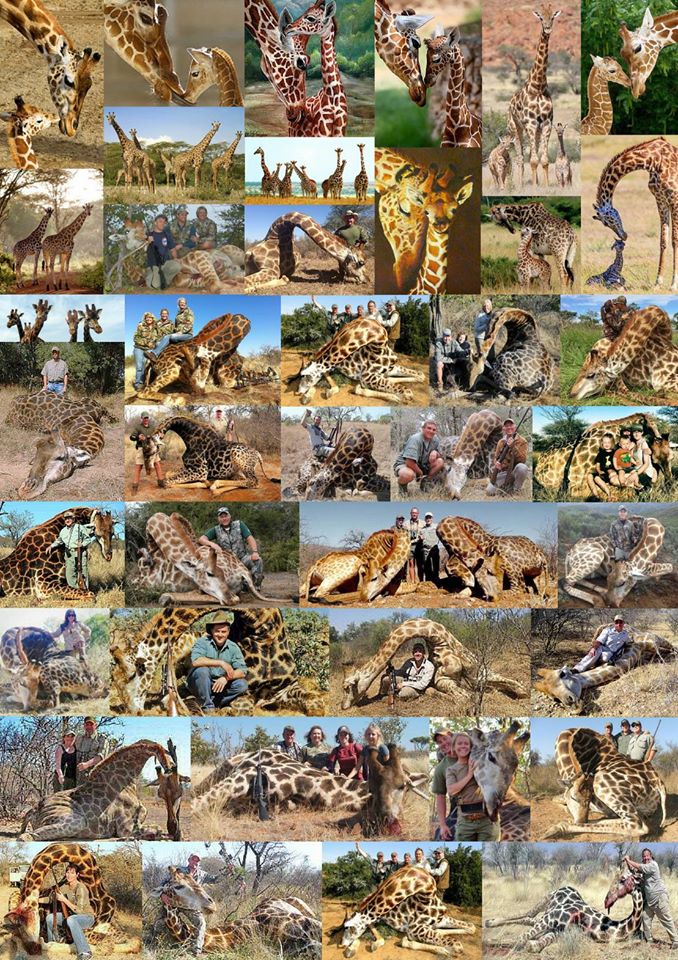
Yesterday I posted a picture someone put together of multiple murderers and their “trophy” giraffe kills. I’d thought about titling the post, “Who the Hell Hunts10557040_1609109249312078_7951148989311848842_o Giraffes for Sport and How You Can Stop Them?” But the issue made me so angry that I went with my gut reaction and titled it, “Who the Fuck Hunts Giraffes for Sport and How You Can Stop Them?” But, for that I’ve been chastised across the social media by certain readers.

Apologies to anyone reading this that’s a young kid or in some other way sheltered enough to think a word is somehow more offensive than a photo of dozens of dead giraffes and the fuckers who shot them down. Don’t get me wrong, I don’t normally go around spewing obscenities, but when some asshole is out murdering animals as harmless and miraculous as a giraffe I start to get a bit pissed off. You could say my tact goes out the fuckin’ window.

Forgive me if I can’t stay civil when addressing some shithead serial-killer-sport-hunter who wants to add a lion, rhino or giraffe to his trophy collection.

Instead of being so sensitive to swear words, perhaps some of you should save your comments for the real criminals—the murdering mother-fuckers who kill sentient beings for sport.

___________________________________________________

Please sign and share these petitions.

Rhinoceros in SA need your help before their extinction
http://www.change.org/petitions/rhinoceros-in-south-africa-need-your-help-before-their-extinction#shar

10978558_1612004402355896_3945515954454479494_n

Who the Fuck Hunts Giraffes for Sport and How You Can Stop Them

10557040_1609109249312078_7951148989311848842_o

Please sign and share these petitions.

Stop trophy hunting giraffes
http://www.thepetitionsite.com/929/929/857/stop-trophy-hunting-giraffes/

Stop hunting giraffes for sport
http://forcechange.com/12033/stop-hunting-giraffes-for-sport/

Stop any kind of safari hunting in South Africa
https://www.causes.com/actions/1742571-stop-any-kind-of-safari-hunting-in-south-africa

Stop the savage and sickening trophy and sport hunting
http://www.thepetitionsite.com/1/stop-the-savage-and-sickening-trophy-and-sport-hunting/

Complete ban on trophy hunting in South Africa and a full census
http://www.gopetition.com/petitions/complete-ban-on-trophy-hunting-full-census-carried-ou.html?

Stop the legal killing of wildlife in trophy hunting
http://www.gopetition.com/petitions/stop-the-legal-killing-of-wildlife-stop-hunting/sign.html

End WWF partnership with pro-hunting lobby
https://secure.avaaz.org/en/petition/Yolanda_Kakabadse_is_WWFs_International_President_and_USAID_WWF_End_your_partnership_with_the_USA_ProHunting_Lobby_Group/

Ban lion farming and trophy hunting
http://www.thepetitionsite.com/147/069/549/ban-lion-farming-and-trophy-hunting/?cid=FB_TAF

Stop the canned hunting of large cats in South Africa
https://www.change.org/p/ms-lakela-kaunda-stop-the-canned-hunting-of-large-cats-in-south-africa

USF&WService save the lions from mass extinction
https://secure.avaaz.org/en/petition/US_Fish_and_Wildlife_Service_Save_African_Lions/?sfmqQib

Zambian tourist board: to reinstate ban on hunting lions and leopards
https://secure.avaaz.org/en/petition/

Compassion in conservation: Don’t be cruel to be kind

1959301_512822552156794_8144645164928185909_n

http://www.newscientist.com/article/mg22229740.200-compassion-in-conservation-dont-be-cruel-to-be-kind.html#.U6L6w2dOVy2

June 2014 by Marc Bekoff and Daniel Ramp

Killing and harming animals in the name of conservation is not just unethical, it is counterproductive

EARLIER this year, a hunter based in Texas paid $350,000 for the dubious privilege of being allowed to kill a male black rhino in Namibia. The rhino, Ronnie, was past reproductive age and deemed to be a danger to other wild rhinos. Profits from the hunting permit are supposed to be ploughed back into conservation in the country.

A few weeks later, keepers at Copenhagen Zoo in Denmark killed Marius, a healthy young male giraffe, publicly dissected him and fed his remains to the zoo’s carnivores because he didn’t fit into their breeding programme. Several offers to rehouse him were declined on the grounds that the facilities were unsuitable.

The same zoo later killed four healthy lions because a male lion they wanted to introduce to a female may have attacked them. Then Dählhölzli zoo in Bern, Switzerland, killed a bear cub over fears his father would kill him.

These cases made headlines and caused global outrage. But they are just the tip of the iceberg. Zoos often kill healthy animals considered surplus to their needs: around 5000 a year in Europe alone. This isn’t euthanasia, or mercy killing, but “zoothanasia”.

The killing of “surplus” animals is just one example of people making life-and-death decisions on behalf of captive and wild animals. These are difficult decisions and various criteria are used, but almost without exception human interests trump those of the non-human animals.

Often, for example, animals are harmed or killed “in the name of conservation”, or for the “good of their own (or other) species”. The result is unnecessary suffering and, commonly, a failure to achieve sustainable and morally acceptable outcomes.

Increasingly, scientists and non-scientists are looking for more compassionate solutions. Compassionate conservation, a rapidly growing movement with a guiding principle of “first do no harm”, is just such an approach. It is driven by a desire to eliminate unnecessary suffering and to prioritise animals as individuals, not just as species. It is also a route to better conservation.

Although one of us, Marc Bekoff, has been writing about the importance of individual animals in conservation for more than two decades, it took an international meeting at the University of Oxford in September 2010 for compassionate conservation to get a big push. There have since been three more meetings. NGOs are becoming interested and a Centre for Compassionate Conservation has been established at the University of Technology, Sydney, Australia.

One sign that the influence of compassionate conservation is growing is that conservationists are questioning the ethics of producing captive pandas as ambassadors for their species. These animals have no chance of living in the wild and their existence is increasingly seen as indefensible.

Biologists are also re-evaluating the merits of reintroduction projects. The reintroduction of wolves into Yellowstone National Park, for example, resulted in numerous wolves dying or being killed “for the good of other wolves”. The surviving wolves also lack protection, especially when they leave the park. As a result, scientists are concerned that the project is failing.

Other reintroduction projects are being similarly reappraised. A team at the University of Oxford assessed 199 such programmes and found potential welfare issues in two-thirds of them, the most common being mortality, disease and conflict with humans.

Urban animals also get into the mix. Marc was recently asked to apply the principles of compassionate conservation to a project in Bloomington, Indiana, which proposed to kill numerous deer even when no one knew if they were causing a problem. In Cape Peninsula, South Africa, non-lethal paintball guns are being used to reduce conflicts between baboons and humans.

Compassionate conservation is also offering solutions to previously intractable conflicts. Innumerable wolves, coyotes, dogs, foxes and dingoes are killed by livestock farmers, often by trapping or poisoning. A recent study showed that poisoning dingoes by dropping tainted meat from aeroplanes changes the dynamics of the ecosystem and reduces biodiversity.

Management of this problem is being revolutionised by the use of guard animals such as Maremma sheepdogs, donkeys and llamas. These guardians bond with the livestock and protect them, not only reducing losses but also costing considerably less than shooting programmes. Even colonies of little penguins in Australia are now protected from foxes by Maremma sheepdogs.

Compassionate conservation is also changing the way researchers tag animals. This is an integral part of conservation as it enables scientists to identify individuals and estimate population sizes. But it is often harmful or painful and can reduce the animals’ fitness, which compromises the usefulness of the data collected. More researchers are now using methods that don’t stress animals or alter their behaviour, such as unobtrusive tags or remote camera traps.

There is often conflict between those interested in animal welfare and those interested in conservation, with the latter viewing concern for the well-being of individuals as misplaced sentimentalism. It is not.

Compassion for animals isn’t incompatible with preserving biodiversity and doing the best science possible. In fact, it is a must. Mistreatment of animals often produces poor conservation outcomes and bad science. It is also immoral. Only through compassion can we advance global conservation.

This article appeared in print under the headline “Cruel to be kind?”

Marc Bekoff is professor emeritus of ecology and evolutionary biology at the University of Colorado, Boulder. He edited Ignoring Nature No More: The case for compassionate conservation (University of Chicago Press). Daniel Ramp is director of the Centre for Compassionate Conservation at the University of Technology, Sydney