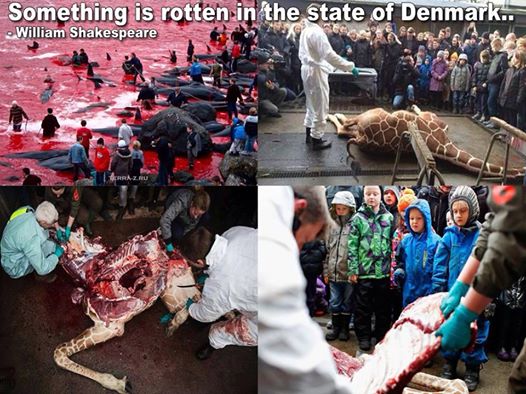
Copenhagen Zoo Kills Four Healthy Staff Members To Make Space For New Employees

http://www.theglobaledition.com/copenhagen-zoo-kills-four-healthy-staff-members-to-make-space-for-new-employees/

COPENHAGEN (The Global Edition) – The Copenhagen Zoo has killed several of its staff members early this morning in order to create four new job openings, the Zoo public relations sector reported.

Officials of the Zoo say that the four members of the staff were humanely executed after being put to sleep with a lethal injection, and then skinned and chopped up while visitors crowded around and the meat was fed to the lion population.

“Based on the recommendation of the European Association of Work and Organizational Psychology (EAWOP), we have decided to make space for new work positions, because the Zoo needs new workers, and we found that killing old staff members was the cheapest and the most efficient way to do it,” said Zoo spokesman Tobias Stenbaek Bro “Four of the oldest staff members, among them one female, were put to sleep with a lethal injection and then fed to the giraffes. However, the giraffes didn’t show interest in their meat, so they were fed to the lions,” explained the Zoo spokesman.

“Being that the oldest staff members could no longer keep track with the new Zoo technologies, and could not manage themselves in the fast and ever-changing job environment, we feel that the criticism coming from some of their family members is completely unfounded,” the Zoo spokesman was quoted as saying.

“Zoos do not own the staff, but they are in charge of their employment, and in that regard have the full right to do with them whatever is considered necessary when they are on the Zoo territory”, said Tobias Stenbeak Bro. “It was the only humane way to dispose of them, you know. We couldn’t just leave them without jobs in this economy, as some heartless observers suggested”.

The Zoo spokesman concluded that “considering that the Zoo animals were fed with the meat of the former employees, the food chain was virtually completed, which is totally in respect of the law of nature”.

APRIL FOOLS!!

8775_524935520889725_1949817662_n

Killing Healthy Zoo Animals Is Wrong—And the Public Agrees

http://news.nationalgeographic.com/news/2014/03/140327-copenhagen-zoo-giraffes-lions-animals-deaths-science-world/

Scientist calls lion, giraffe deaths “zoothanasia”—or heartless elimination.

A photo of two lionesses at the Copenhagen Zoo.

Two lionesses are seen at the Copenhagen Zoo on March 26, not long after four other lions were put to death.

PHOTOGRAPH BY JENS DRESLING, POLFOTO/AP

Marc Bekoff

for National Geographic

Published March 27, 2014

The four lions killed by the Copenhagen Zoo this week, as well as  the healthy young giraffe named Marius put to death in February, didn’t have to die.

A global uproar has followed the deaths of two African lions and their two ten-month-old cubs. Their lives ended because the zoo wants to introduce a new male to the remaining females to bear more lions.

The same outcry was heard when a healthy young giraffe named Marius, who had the wrong genes for the facility’s breeding program, was killed with a bolt to his head—so as not to contaminate his body with poisons. The giraffe was publicly dissected and then fed to the zoo’s carnivores, including lions.

None of the deaths were euthanasia, which is a mercy killing when an animal is suffering or lingering near death and must be “put down,” as zoos always refer to such situations.

Rather, it was “zoothanasia,” or killing done by zoo workers because an animal is no longer needed for one reason or another and is deemed to be a disposable object rather than a sentient being. (Related: “Opinion: Killing of Marius the Giraffe Exposes Myths About Zoos.”)

The “Marius Effect”

Many people around the world were outraged by Marius’s death. I call this the “Marius Effect.”

Many of them had never previously voiced their opinion about the common killings of what are disparagingly called “surplus animals” by zoos, or had spoken out about other animal issues. (See “National Zoo Deaths: ‘Circle of Life’ or Animal Care Concerns?“)

While some workers at the zoo and elsewhere said the giraffe had to be killed because he didn’t fit into the zoo’s breeding program, and therefore couldn’t be used as a breeding machine (like dogs at a puppy mill), countless others disagreed. An online petition asking the zoo to hold off on the killing until another home was found received tens of thousands of signatures.

Marius was killed despite the fact that another facility had offered him a home in which he could live out his life in peace and safety.

Many others and I figured that the negative attention that the late Marius brought to the Copenhagen Zoo would serve as a catalyst to change the breeding policies of zoos in Europe. We thought those responsible for killing him would reassess what they did and question their killing ways—even if such killings were required by existing regulations put forth by the European Association of Zoos and Aquaria (EAZA). (Read more about zoos and saving rare species in National Geographic magazine.)

We couldn’t have been more wrong. Now, with the deaths of the four lions, the Copenhagen Zoo wants to become a lion mill, I would argue, and still seems to think killing healthy animals is perfectly okay.

All of the newborn lions whose kin died to make way for them will spend their lives in captivity, and some will undoubtedly be “zoothanized” in the future because they, too, will be classified as disposable “surplus” animals without the right genes to pass on to future captive lions.

The zoo also argued that the new male lion brought to the zoo would kill the youngsters and the captive group, and thus the group wouldn’t resemble a wild pride of lions, as if it previously had.

Of course, there is nothing natural about the cage in which they are kept.  While some might call it an enclosure or pretty it up by calling it “lion habitat,” it is still a cage in which future lions will be mercilessly crammed, from cradle to grave.

“Perversely Justified”

I see heinous acts like killing Marius and the four lions as a perfect subject for study for researchers in the field of anthrozoology, the scientific study of human-animal relationships.

These easily avoidable deaths, perversely justified “in the name of conservation,” are horrible lessons for youngsters. They run counter to global programs in humane education and compassionate conservation, in which the life of every individual animal is valued—and not just because they can serve us in any number of ways, such as by making more of themselves for future captive breeding. (See “Is Breeding Pandas in Captivity Worth It?“)

Zoos need to change their ways and respect the caged animals for whom they are responsible as long as an individual is healthy.

Surely, people who choose to go to the Copenhagen Zoo can find other ways to spend their time and money.

Marc Bekoff is professor emeritus of ecology and evolutionary biology at the University of Colorado, Boulder. He has published numerous scientific and popular essays and 25 books, including Ignoring Nature No More: The Case for Compassionate Conservation and Why Dogs Hump and Bees Get Depressed: The Fascinating Science of Animal Intelligence, Emotions, Friendship, and Conservation.

After giraffe uproar, Copenhagen zoo kills 4 lions

01bfb39948b2f313b238ba43f926ea25

http://www.chron.com/news/world/article/After-giraffe-uproar-Copenhagen-zoo-kills-4-lions-5347528.php

COPENHAGEN, Denmark (AP) — A Danish zoo that faced protests for killing a healthy giraffe to prevent inbreeding says it has put down four lions, including two cubs, to make room for a new male lion.

Citing the “pride’s natural structure and behavior,” the Copenhagen Zoo said Tuesday that two old lions had been euthanized as part of a generational shift. It said the cubs were also put down because they were not old enough to fend for themselves and “anyway would have been killed by the new male lion.”

Zoo officials hope the new male and two females born in 2012 will form the nucleus of a new pride.

Last month the zoo triggered a wave of protests by killing a 2-year-old giraffe, and feeding its remains to the lions as visitors watched.

Also: http://www.theguardian.com/world/2014/mar/25/danish-copenhagen-zoo-kills-four-lions-marius-giraffe

Another Danish Giraffe Named Marius Could Be Killed By Zoo

http://www.nbcnews.com/news/world/another-danish-giraffe-named-marius-could-be-killed-zoo-n29516

A zoo in Denmark might euthanize one its giraffes, media reported Thursday,
days after another Danish zoo slaughtered an ‘unwanted’ giraffe and fed its
carcass to the lions.

Jyllands Park Zoo in western Denmark might put down its seven-year-old
Marius if the zoo manages to acquire a female giraffe, zoo keeper Janni
Lojtved Poulsen told a local news agency.

“We can’t have two males and one female. Then there will be fights,”
Poulsen said.

Staff at Copenhagen Zoo received death threats after it killed an 18-month-old healthy male giraffe – coincidentally also called Marius – because the animal’s genes were already well represented in an international breeding program.

Poulsen said that it might be possible to find another place for the giraffe to live, but that the probability is small. Like its namesake in Copenhagen, Jyllands Park Zoo’s Marius is considered unsuitable for breeding.

“If the breeding programme coordinator decides that he should be put down, then that’s what we’ll do,” Poulsen said.

She said that zoos in Denmark have been killing surplus animals for many years, and that the wave of protests following Sunday’s killing in Copenhagen is not deterring Jyllands Park Zoo.

“Many places abroad where they do not do this, the animals live under poor conditions, and they are not allowed to breed either. We don’t think that’s ok,” she said.

The giraffe at Copenhagen Zoo was dissected in front of crowds at the zoo, and afterwards, some of the carcass was then fed to other zoo animals and some was sent to research projects in Denmark and abroad for study.

Poulsen said Jyllands Park Zoo has not yet considered whether it should carry out a public dissection as the one in Copenhagen.

Reuters
First published February 13th 2014

1723934_10201528254343494_758053918_n

If you’re really saddened by the death of Marius the giraffe, stop visiting zoos

AN37096504FILES+-+Picture+t

http://www.independent.co.uk/voices/comment/if-youre-really-saddened-by-the-death-of-marius-the-giraffe-stop-visiting-zoos-9119868.html

We wouldn’t go to a prison to learn about typical human society, so it makes no sense to observe imprisoned animals in order to learn about them

by Mimi Bekhechi
Monday 10 February 2014

If there had ever been any doubt that zoos serve no purpose beyond incarcerating intelligent animals for profit, the slaughter of Marius, an 18-month-old giraffe, on Sunday has surely settled the issue. Copenhagen Zoo delivered Marius into a life of captivity, allowing his mother to give birth to the calf while knowing that the baby would be “surplus” to its requirements and “useless” for breeding because his genes were too common.

The zoo used the baby calf to attract visitors and then slaughtered him. He was shot rather than given a painless lethal injection, just so that his flesh wouldn’t be contaminated when it was cut up in front of horrified schoolchildren and, quite literally, thrown to the lions.

As the events of this weekend illustrate, breeding animals in zoos is not a sustainable practice because of space limitations and also because the practice creates a surplus of unwanted animals. It is estimated that approximately 7,500 animals in European zoos are considered “surplus” at any one time.

While Marius grabbed the headlines, it also emerged that lions were destroyed at Longleat Safari and Adventure Park in Wiltshire, owing to a rise in the population, which had caused “excessive violent behaviour”. Anyone who thought the practice of breeding and then killing animals would surely not be sanctioned in the UK should think again. It is absolutely routine for zoos to euthanise newborn males of various breeds because they have nowhere to put them when they mature. Other unwanted animals are sold at auction and carted across the globe.

Zoo breeding programmes serve no conservation purpose because giraffes and other animals born in zoos are rarely, if ever, returned to their natural habitats. They put the “con” in “conservation”, and zoos spend millions on keeping animals confined while natural habitats are destroyed and animals are killed, as there is insufficient funding for protection.

When London Zoo spent £5.3 million on a new gorilla enclosure, the chief consultant to the UN Great Apes Survival Partnership said that he was uneasy at the discrepancy between lavish spending at zoos and the scarcity of resources available for conserving threatened species in the wild. “Five million pounds for three gorillas when national parks are seeing that number killed every day for want of some Land Rovers and trained men and anti-poaching patrols. It must be very frustrating for the warden of a national park to see.”

Animals in zoos often go insane from the frustration of life in captivity, and visitors leave without having learned anything meaningful about animals’ natural behaviour, intelligence or beauty. There is nothing dignified or inspiring about seeing bored and depressed animals. In the wild, gorillas don’t eat their own sick and pull out their hair in frustration. Free polar bears don’t pace back and forth constantly on concrete. The typical behaviour of captive animals, such as bar-biting, self-mutilation, pacing and rocking, is unheard of among their free relatives.

We wouldn’t go to a prison to learn about typical human society, so it makes no sense to observe imprisoned animals in order to learn about them. Today, we have IMAX movies and entire television channels dedicated to showing wildlife documentaries, which serve as virtual field trips and teach generations of children about animals without harming them. We no longer have any excuse for keeping intelligent social animals incarcerated and denying them everything that’s natural and important to them.

From the moment he was born, Marius was destined to lead a life of misery at the hands of his human captors. Giraffes rarely die of old age in captivity. Had he not been killed yesterday, he would have spent his short life as an exhibit, stranded in a cold climate, thousands of miles away from his true home. Although his death is heartbreaking, it’s his birth that should have been prevented. I wish we could see this kind of outrage every time an animal is born at a zoo.

For everyone who genuinely cares about giraffes and all the other individuals serving life sentences in zoos, let’s hope Marius’ story is a wake-up call. Let’s avoid patronising zoos and instead donate to campaigns that actually protect animals in their native habitats.


Healthy Giraffe Is Killed at Zoo Despite Offer to Save Him

By Marc Bekoff, Ph.D. on February, 09, 2014 in Animal Emotions

Yesterday I wrote about the plight of Marius, a young giraffe at the Copenhagen Zoo who was to be killed because he didn’t fit into the zoo’s breeding program. Today I learned he was killed despite another zoo offering to save him. To quote from a BBC article: The director of a wildlife park in the Netherlands said, “Zoos need to change the way they do business.”

Read More: http://www.psychologytoday.com/blog/animal-emotions/201402/healthy-giraffe-is-killed-zoo-despite-offer-save-him

Also: http://www.usatoday.com/story/news/world/2014/02/10/giraffe-killed-fed-to-lions-denmark/5364775/

And: http://www.cnn.com/2014/02/10/world/europe/denmark-zoo-giraffe/

1520797_10201882741564950_2138451479_n

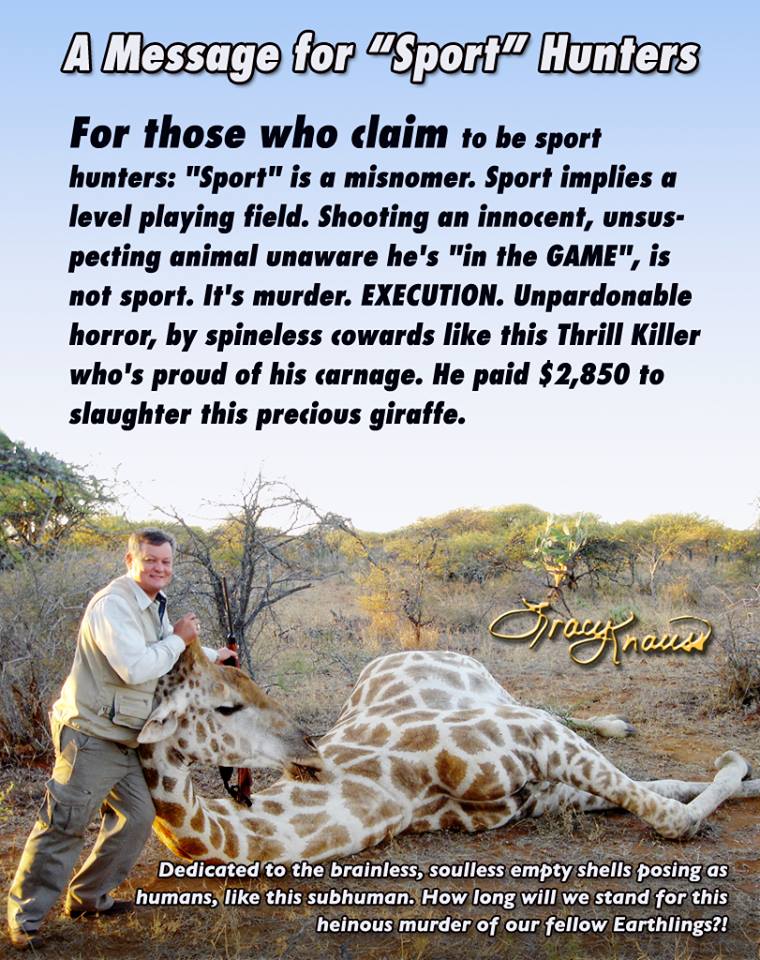
Stop Hunting Giraffes for Sport

by Christopher Baranowski

Target: Governments of South Africa, Namibia, and Zimbabwe

Goal: End the brutal and inhumane hunting of giraffes for sport.

In many African countries, it is legal to hunt giraffes for sport. Hunters from around the world pay up to 15,000 dollars just for the chance to kill one of these animals. Despite declining giraffe populations, these African countries claim that hunting can be profitable for the government and citizens and that giraffe populations can be sustainably managed. But the continuation of this brutal practice only perpetuates the idea that these animals are a commodity and encourages illegal poaching. End the hunting of giraffes for sport today.

Hunters from countries like Russia, the United States and Germany pay thousands of dollars for plane tickets to countries like South Africa, Namibia and Zimbabwe where hunting of giraffes is still allowed. Game parks charge trophy fees for killing the animals and additionally daily fees for hired trackers and guides. The final bill can be up to 15,000 dollars. The governments of these countries argue that this brings money, tourism and giraffe meat to local communities and point to the fact that giraffe populations in their countries have remained stable. But giraffes have gone extinct in Angola, Mali and Nigeria and the giraffe population has been halved since 1988 to the current number of 80,000. Though the Giraffe Conservation Foundation cites human development as the main reason for their decline, one cannot help but wonder how sustainable and ethical hunting these endangered animals can be.

Trophy hunters often miss their target and end up shooting the giraffe in a place that results in a painful death. Illegal poachers also use nets and snares to capture giraffes, which results in a similarly painful death. How can countries that have made giraffe hunting illegal expect to combat poachers when they are sending the message that hunting big game is okay? Giraffegiraffe populations are plummeting and no matter what the cause, we cannot allow these beautiful creatures to be hunted for sport.

PETITION LETTER:

Dear Presidents Jacob Zuma, Hifikepunye Pohamba and Robert Mugabe,

Currently, you are the only three African states that allow legal hunting of giraffes. We understand that this can be a lucrative industry for both the government and the people of your countries and that your giraffe populations have remained relatively stable, but you are also sending the message that it is okay to hunt these harmless and threatened animals. This may increase poaching in countries where hunting giraffes is illegal.

Poachers use cruel and inhumane methods to capture giraffes, and even legal hunting can sometimes result in a painful death for the giraffes. Angola, Mali and Nigeria have already seen their giraffe populations go extinct. Please take a stand against cruel game hunting and for the giraffes of Africa. Ban hunting of giraffes before it is too late.

Sincerely,

[Your Name Will Go Here]

Sign the Petition

First & Last Name*

Email*

Your email will not be published. By signing you accept the ForceChange terms of service and may receive updates on this and related petitions.

http://forcechange.com/12033/stop-hunting-giraffes-for-sport/

and there is another petition for giraffe’s here — http://www.ryot.org/young-giraffe-killed-tomorrow-copenhagen-zoo/562109
and:
http://www.psychologytoday.com/blog/animal-emotions/201402/healthy-young-zoo-giraffe-be-killed-zoothanasia-redux