U.S. Rep. Alexandria Ocasio-Cortez, D-N.Y., appeared on MSNBC Friday to address the Green New Deal with host Chris Hayes and discussed the dire world she’s convinced lies ahead for Americans if climate change is not addressed.
“So this issue is not just about our climate. First and foremost we need to save ourselves. Period. There will be no future for the Bronx. There will be no livable future for generations coming, for any part of this country in a way that is better than the lot that we have today if we don’t address this issue urgently and on the scale of the problem,” said Ocasio-Cortez.
The freshman congresswoman believes America has seen dire situations before and mobilized, but mostly in connection with conflict and war. “Historically speaking, we have mobilized our entire economy around war. But I thought to myself it doesn’t have to be that way, especially when our greatest existential threat is climate change,” Ocasio-Cortez said.
“First and foremost we need to save ourselves. Period.”
— U.S. Rep. Alexandria Ocasio-Cortez, D-N.Y.
“And so to get us out of this situation, to revamp our economy to create dignified jobs for working Americans, to guarantee health care and elevate our educational opportunities and attainment, we will have to mobilize our entire economy around saving ourselves and taking care of this planet.”
Ocasio-Cortez also addressed critics of the Green New Deal legislation she’d co-sponsored, after MSNBC played a montage of Republicans and pundits, including some on Fox News, criticizing her and talking about “cow farts” and accusing her of wanting to take away their “hamburgers.”
“I didn’t expect them to make total fools of themselves,” Ocasio-Cortez said, saying she expected the criticism.
The congresswoman also said Hurricane Maria and the devastation caused on Puerto Rico was a sign that climate change problems are “here,” invoking the Sept. 11, 2001, terror attacks and criticizing the government for the lack of response.
“You know that this is here. This is not something that’s coming. … On the events of September 11 2001, thousands of Americans died in one of the largest terrorist attack on U.S. soil. And our national response — whether we agree with that or not — our national response was to go to war in one, then eventually two countries. Three thousand Americans died in Puerto Rico in the aftermath of Hurricane Maria. Where’s our response?” Ocasio-Cortez said to loud applause.
A man pedals past an art installation of a boat made from plastic waste during the United Nations Environment Assembly in Nairobi, Kenya, on March 15, 2019. RNS photo by Fredrick Nzwili
NAIROBI, Kenya (RNS) — At a small tent on the edge of the U.N. campus here, environmental activists from the world’s faith traditions huddled on the sidelines of last week’s March 11-15 meeting of some 5,000 environmental scientists, politicians and civil society, the fourth gathering of the United Nations Environment Assembly.
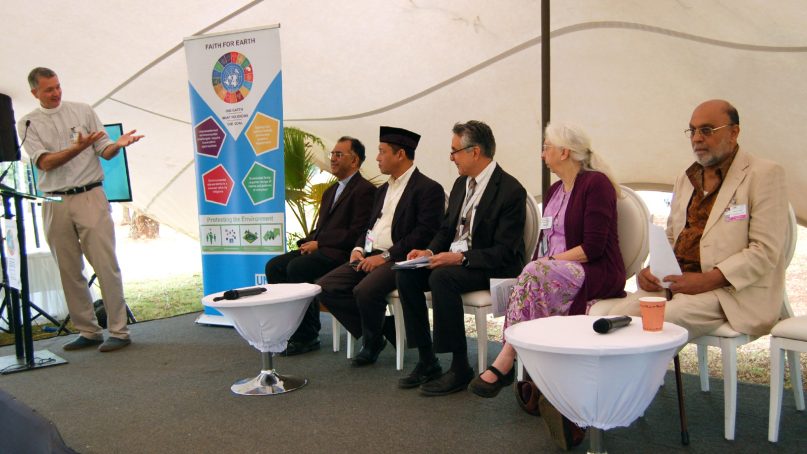
As the official delegates discussed current environmental challenges, sustainable consumption and production, the faith leaders, who joined the assembly for the first time in a U.N.-sponsored event called “Faith for Earth Dialogue,” talked about what religion’s role is in environmental protection.
“Religious leaders have a unique role to play in promoting ecological sustainability, especially because 85 percent of the (world’s) people are affiliated with a religion,” said Rabbi Yonatan Neril, who is the founder and executive director of the Interfaith Center for Sustainable Development in Jerusalem and attended the event.
The faith-based group unexpectedly served as a spiritual presence after the Ethiopian Airlines crash, which particularly affected the U.N.’s offices in Nairobi, a hub of the international aid community that lost several members in the disaster.
The assembly, which represented more than 170 United Nations member states, said it had delivered a bold blueprint for change that directs a radical shift in the approach to tackling environmental challenges.
The group also agreed on a series of non-binding resolutions, key among them a proposal to protect oceans and fragile ecosystems.
But those attending the Faith for Earth Dialogue urged the U.N. to recognize the growing religious wave of concern and called for dramatic steps while saying that enough was not being done to address climate change and related environmental challenges.
The Rev. Fletcher Harper, left, addresses panelists during the U.N.-sponsored event called “Faith for Earth Dialogue” at the U.N. Environment Assembly in Nairobi, Kenya, on March 15, 2019. RNS photo by Fredrick Nzwili
“There should be no mistake that more and more religious communities are clear that we face a clear emergency,” said the Rev. Fletcher Harper, the executive director of GreenFaith, an American interfaith coalition for the environment.
“We need a stronger representation of values, combined with science, to underlie the policies of the world in relationship to the environment,” said Harper.
At the same time, Harper said, it was not easy for intergovernmental bodies like the U.N. to integrate faith voices because their audiences are nation states, for whom religion can be a complicated subject.
The world’s religions can look for ways to change their own cultures to make faith itself more sustainable, said Neril.
“Meat in particular has a disproportional impact on climate change because cows emit methane from their digestive systems,” said the rabbi. Changing diets can be difficult, but religious teaching can have a powerful effect on what we put in our mouths and can support compassion toward animals.
Rev. Joshtrom Isaac Kureethadam, coordinator of the Sector on “Ecology and Creation” at the Vatican Dicastery for Promoting Integral Human Development, said he took hope from the increasing spiritual response to climate change, including the indigenous communities around the world who view themselves as the protectors of the land or planet.
He cited climate change as one reason Pope Francis has called a special synod for October of this year of Roman Catholic bishops from the Pan-Amazonian region.
“He (Pope Francis) believes at the period of planetary emergency, the answer can come from these people, who have defended our common home for thousands of years. We can learn from their indigenous wisdom,” said the priest. “It is a time when the whole world will sit at the feet of the indigenous people and learn from them to take care of our common home.”
Experts say tropical forests that are home to other indigenous groups in the Congo Basin, Asia and Central America also help regulate regional and international weather patterns.
Above all, the faith activists urged the U.N. delegations to the assembly to approach climate change as an urgent human problem as much as a scientific one.
Bright Mawudor, the deputy general secretary of the African Conference of Churches, said in a speech to her fellow faith leaders that climate change was the world’s common future. “It’s as real as the food that we eat or as the clothes we wear. We need to tackle it with urgency,” Mawudor said.
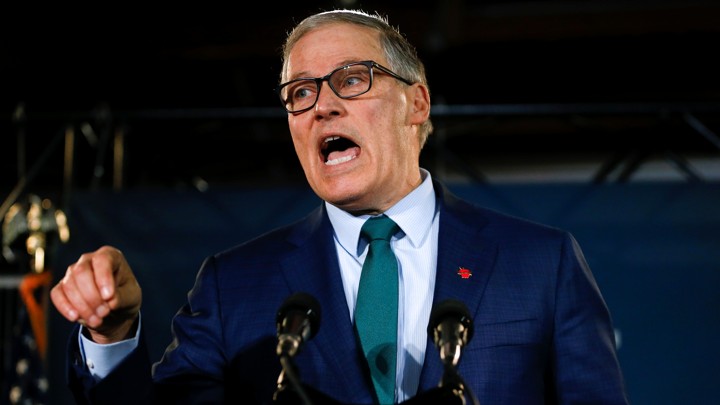
Jay Inslee’s long-shot, climate-focused presidential campaign is only one of several new campaigns, run by Democrats across the ideological spectrum.LINDSEY WASSON / REUTERS
Suddenly, climate change is a high-profile national issue again.
It’s not just the Green New Deal. Around the country, the loose alliance of politicians, activists, and organizations concerned about climate change is mobilizing. They are deploying a new set of strategies aimed at changing the minds—or at least the behaviors—of a large swath of Americans, including utility managers, school principals, political donors, and rank-and-file voters.
Get the latest issue now.
Subscribe and receive an entire year of The Atlantic’s illuminating reporting and expert analysis, starting today.
They make a ragtag group: United by little more than common concern, they don’t agree on an ideal federal policy or even how to talk about the problem. They do not always coordinate or communicate with one another. And while their efforts are real, it remains far too early to say whether they will result in the kind of national legislative victories that have eluded the movement in the past.
But for the first time since November 8, 2016, if not far earlier, climate advocates are once again playing offense.
This mobilization starts at the top of the U.S. political system. Earlier this month, Washington State Governor Jay Inslee announced that he would run for president to elevate climate change as a pressing national issue. Inslee’s launch did not mention his White House–ready biography—he’s a former star athlete who married his high-school sweetheart—and focused entirely on his decades-long climate focus.
“I’m the only candidate who will make defeating climate change our nation’s number-one priority,” Inslee said in his launch video. His campaign raised $1 million in its first three days, a surprisingly large figure for a single-issue underdog candidate.
Other national political leaders are trying different strategies. Michael Bloomberg, the former New York mayor who has made climate a signature issue, announced that he would not run for president because his considerable fortune would be better spent fighting carbon pollution directly. Instead, he will fund a new campaign called Beyond Carbon for the Sierra Club, an extension of the club’s wildly successful Beyond Coal campaign, also bankrolled by Bloomberg. Beyond Coal says it has helped close 285 of the country’s 530 coal plants, a major reason for the overall decline in U.S. carbon emissions.
This widespread public concern about climate change is already being reflected in policy made at the state level. New Mexico will soon become the third state to set a goal for 100 percent carbon-free electricity. Last week, lawmakers passed a mandate that by 2045, 80 percent of the state’s power must come from renewable sources and 20 percent from carbon-free sources. The governor cheered the measure and is expected to sign it.
California, Hawaii, and the District of Columbia have adopted similar goals, all pegged to 2045. And their ranks could soon expand. Twelve more Democratic governors have promised to mandate the same 100 percent target, according to Rob Sargent, a campaign director at Environment America, a consortium of state-level environmental groups. “Six governors got elected in November running on 100 percent renewables,” he told me. “That wouldn’t have happened four or even two years ago.”
This massive protest in Lisbon was one of hundreds of “climate strike” events held worldwide on Friday. The class boycott spilled into the United States for the first time last week. (Rafael Marchante / Reuters)
Much of this activity is concentrated among Democrats. But public opinion has shifted in their favor on the issue. Nearly two-thirds of Americans say that the Republican Party’s position on climate change is “outside the mainstream,” according to an NBC/Wall Street Journal poll conducted last month. That represents a nine-point bump since October 2015, when the question was last asked.
That poll was conducted in February, when the Democratic-led Green New Deal dominated media coverage. But a majority of Americans said that month that Democratic positions on climate change were “in the mainstream.”
Within the party, rank-and-file Democrats seem to be taking the issue more seriously. Eighty percent of likely Iowa Democratic caucus-goers say that primary candidates should talk “a lot” about climate change—a result that suggests climate change is one of the Democratic Party’s top two issues, according to a CNN/Des Moines Register poll conducted by Selzer and Company this month. Only health care merited such consensus concern among the group.
That points to a potential upheaval in how important voters consider climate policy. In May 2015, when the same polling firm last posed a similar question to likely Democratic caucus-goers, climate change did not rank among the top five most important issues.
Some Republicans say they’re taking notice. “I think we’re moving from the science of climate to the solutions of addressing climate, and that is a big shift in particular for Republicans,” says Heather Reams, the executive director of Citizens for Responsible Energy Solutions, a nonprofit that encourages GOP politicians to support renewable energy.
In the House, Republicans are far more skeptical of climate action. Representative Rob Bishop, a conservative lawmaker from Utah, has said the Green New Deal is nearly “tantamount to genocide.” The House GOP has offered very few climate policies of its own. An exception: Two Republicans—Representative Brian Fitzpatrick of Pennsylvania and Representative Francis Rooney of Florida—last year co-sponsored a bipartisan bill to tax carbon emissions without increasing the federal budget.
It’s still unclear whether the spike in public concern will translate to any lasting GOP shift. The Green New Deal, in all its ambition and haziness, has reframed the climate conversation around solutions, where Democrats have more to say right now; if moderate Democrats fell back to insisting on the acceptance of climate science alone, Republicans might be happy tomeet them there.
In any case, the views of the country’s most powerful Republican, President Donald Trump, seem extremely unlikely to change. So it’s left to his would-be 2020 opponents to heighten the contrast. At least eight candidates have made climate change a top issue, according to The New York Times. And announcing his candidacy for president last week, the former Representative Beto O’Rourke of Texas said that “interconnected crises in our economy, our democracy, and our climate have never been greater.” (He has yet to offer a concrete proposal on the issue.)
Whether this focus on climate change produces new policy ideas remains to be seen. Yet even so, environmental groups and their allies are feeling whiplash at how far the conversation has come since 2016. Says Alex Trembath, the deputy director of the Breakthrough Institute, an environmental research center based in Oakland: “If you had asked me a year ago if we would’ve been talking this much about climate change now, I would’ve said, ‘Absolutely not.’”
A POLAR BEAR LOOKS FOR FOOD AT THE EDGE OF THE PACK ICE NORTH OF SVALBARD, NORWAY. CREDIT: WOLFGANG KAEHLER/LIGHTROCKET VIA GETTY IMAGES.
Rapid and “devastating” Arctic warming is now almost unstoppable, United Nations researchers warn in a major new report.
Unless humanity makes very rapid and deep pollution cuts, Arctic winter temperatures will rise 5.4° to 9.0°F (3° to 5°C) by 2050 — and will reach an astounding 9° to 16°F (5° to 8.8°C) by 2080 — according to a report by the U.N. Environment Program released Wednesday.
Even worse, the report, “Global Linkages: A graphic look at the changing Arctic,” warns that warming will in turn awaken a “sleeping giant” in the form of vast quantities of permafrost carbon. This carbon has been frozen in the permafrost for up to thousands of years, but as the atmosphere warms, the permafrost will thaw. This will release the trapped carbon, and trigger more planet-wide warming in a dangerous feedback loop.
As the report explains, warming in the Arctic is occurring at least twice as fast as warming across the planet as a whole, thanks to Arctic amplification. One reason for this amplification is that when highly reflective snow and ice melts due to higher temperatures, it is replaced by the dark blue sea or darker land, both of which absorb more solar energy than they reflect, leading to more melting.
THE ARCTIC WARMING AND SEA ICE FEEDBACK LOOP. CREDIT: NASA.
“Arctic amplification is most pronounced in winter and strongest in areas with large losses of sea ice during the summer,” researchers explain, so winter warming in the region is projected to rise three times faster than the world as a whole.
But as this feedback loop plays out, it also triggers another one: the thawing of the Arctic permafrost and the release of the carbon that it contains.
Thawing permafrost is an especially dangerous amplifying feedback loop because the global permafrost contains twice as much carbon as the atmosphere does today . The permafrost, or tundra, is soil that stays below freezing (32°F or 0°C) for at least two years. It acts like a freezer for carbon, but now humanity has decided to leave the freezer door open.
The thawing releases not only carbon dioxide but also methane — a far more potent greenhouse gas — thereby further warming the planet. And as the planet continues to warm, more permafrost will melt, releasing even more greenhouse gases in a continuous feedback loop.
“New evidence suggests that permafrost is thawing much faster than previously thought,” the report warns. Indeed, a recent study found that Siberian permafrost at depths of up to 30 feet warmed a remarkable 1.6°F (0.9°C) from 2007 to 2016.
The most dangerous climate feedback loop is speeding up
The U.N. report quotes the saying: “What happens in the Arctic does not stay in the Arctic.”
For instance, the Arctic’s rapid warming is weakening the jet stream, which leads weather patterns to stall, and that drives more extreme weather in this country, such as heavy precipitation on the East Coast and extreme drought on the West Coast.
And the quicker the Arctic heats up, the quicker the land-based Greenland ice sheet melts and the quicker sea levels rise. One 2017 study concluded that Greenland ice mass loss has tripled in just two decades.
But the authors of the U.N. report explain that simply meeting the initial emissions reduction targets in the 2015 Paris Climate Accord will not be enough to stop “devastating” warming and the loss of nearly half the permafrost this century. Those initial targets would not limit total warming to 2°C (3.6°F), which is why the agreement calls for ratcheting down those targets over time in order to keep warming “well below 2°C.”
So, to avoid accelerated warming, massive permafrost loss, ever-worsening extreme weather, and multi-feet sea level rise, the nations of the world must not only make deep cuts in CO2 emissions over the next decade, but also they must then keep ratcheting down global emissions to near zero around mid-century.
Scientists say Ocasio-Cortez’s dire climate warning is spot on
Yet, President Donald Trump is taking the country in the dangerously wrong direction by starting the process of withdrawing from the Paris agreement and rolling back domestic climate efforts.
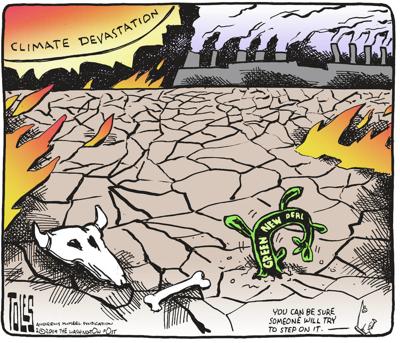
What humanity needs to avert catastrophe are the kind of rapid emissions reductions envisioned in the Green New Deal, which aims for a carbon-free power sector by 2030 and the decarbonization of all other sectors as fast as technically possible.
Plans to reduce greenhouse gas (GHG) emissions by 30% per kilo of milk in the next decade have been developed by Arla Foods as part of its sustainability strategy.
Arla has a wide ranging plan to reduce its global emissions impact from dairy farming
Issues around the impact of dairy farming on the climate have consistently been one of the big topics for addressing climate change globally. A cow can produce around 70 to 120kg of methane each year – the equivalent of 2,300kg of CO2 – with the Food and Agriculture Organisation of the United Nations (FAO) stating the overall agriculture sector is responsible for 18% of global emissions.
Arla Foods aims to mitigate the issue of emissions from a dairy value chain comes by reducing a cow’s methane emissions through a series of techniques, such as optimised feed composition. Additionally, the food firm is working with its farmers to quantify and increase the carbon captured and stored in the soil.
According to a recent analysis from the FAO, global milk production has become more sustainable with a global average of 2.5kg CO2 per kilo of milk, but Arla farmers aim, on average, for 1.15kg CO2 per kilo or half of the global level.
The company has conducted 5,000 climate assessments on its 10,300 farms since 2013, and now is accelerating the work through the use of a digital documentation system where farmers can input data about their herd, milking system, feed, grazing, land use, and animal welfare. It claims to be one of the largest dairy farm benchmarking datasets in Europe.
Dairy farmer and chairman of Arla Foods, Jan Toft Nørgaard, said: “The climate assessment is highly motivating because it identifies your farms’ potential for CO2 reductions, which will often lead to cost savings.
“A next step is to include parameters that will indicate the farm’s impact on climate and environment. This will give us an opportunity to see in which areas we have the biggest potential, to identify best practice farms that we can learn from across our cooperative.”
Farming initiatives
The news follows a number of initiatives by farmers and agriculture firms to mitigate the impact on the environment of their businesses.
Additionally, last August, Northern Ireland-based dairy manufacturer Dale Farm announced it was now running one of its cheese manufacturing plants with 100% renewable energy after bringing a self-consumption solar farm online.
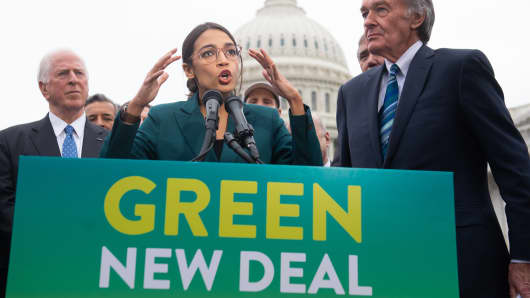
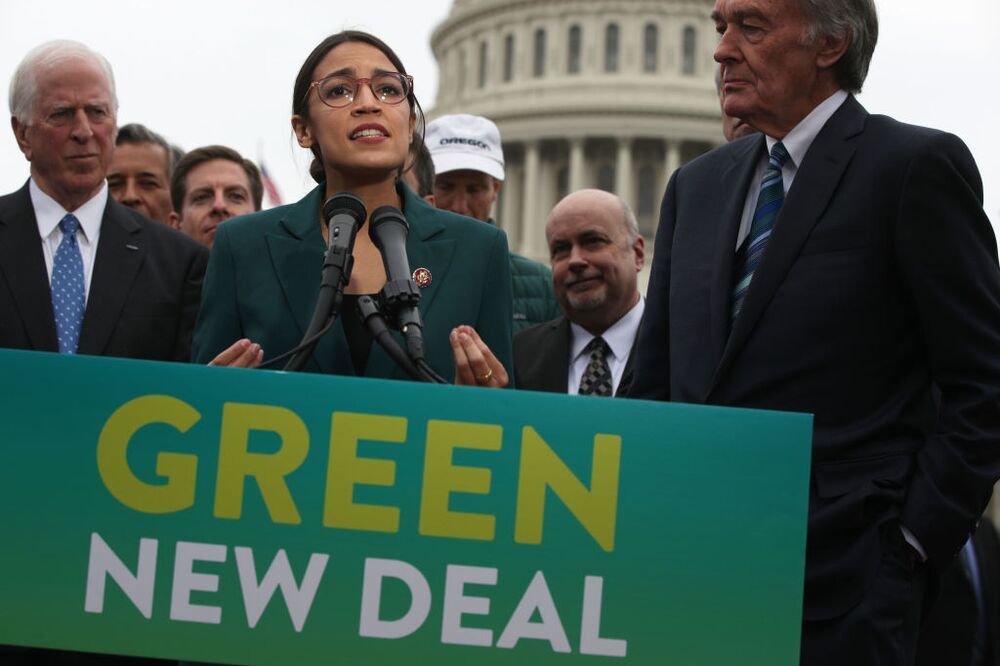
The ambitious “Green New Deal” resolution put forward by freshman Rep. Alexandria Ocasio-Cortez, D-N.Y., and Sen. Ed Markey, D-Mass., aims to fundamentally reimagine the U.S. economy with the environment at top of mind.
Among its proposals, the resolution would have the U.S. creating “net-zero” greenhouses gases in 10 years.
Why “net zero”? “We set a goal to get to net-zero, rather than zero emissions, in 10 years because we aren’t sure that we’ll be able to fully get rid of farting cows and airplanes that fast,” a summary of the proposal says.
US Representative Alexandria Ocasio-Cortez, Democrat of New York, and US Senator Ed Markey (R), Democrat of Massachusetts, speak during a press conference to announce Green New Deal legislation to promote clean energy programs outside the US Capitol in Washington, DC, February 7, 2019.
The “Green New Deal,” unveiled Thursday, sets sky-high goals to cut greenhouse gases to nearly zilch — but it’s not committed to getting rid of “farting cows” just yet.
Markey and Ocasio-Cortez, the 29-year-old democratic socialist, called for completely ditching fossil fuels, upgrading or replacing “every building” in the country and “totally overhaul transportation” to the point where “air travel stops becoming necessary.”
They also aimed to have the U.S. creating “net-zero” greenhouse gases in 10 years.
Why “net zero”? The lawmakers explained: “We set a goal to get to net-zero, rather than zero emissions, in 10 years because we aren’t sure that we’ll be able to fully get rid of farting cows and airplanes that fast.”
At the time this story was published, the FAQ page with the phrase “farting cows” appeared to have been removed from Ocasio-Cortez’s website. Fox News’ John Roberts reported that the language was tweaked to “emissions from cows” in an update, which also appears to have been deleted.
John Roberts
✔@johnrobertsFox
·
The FAQ’s released by @AOC ‘s office regarding the “Green New Deal” include the following passage: “We set a goal to get to net-zero, rather than zero emissions, in 10 years because we aren’t sure that we’ll be able to fully get rid of farting cows and airplanes that fast”
John Roberts
✔@johnrobertsFox
The latest version of FAQ’s on her blog has removed the “f” word in favor of “emissions from cows”
Language notwithstanding, greenhouse gas emissions from cows have a bigger environmental impact than one might expect.
Methane gas produced by bovine flatulence contributes a significant portion of the greenhouse gases contributing to global warming, according to the United Nations.
Livestock farming produces about 18 percent of all those environmentally damaging gases — and about a quarter of that chunk comes from cow farts and burps, the U.N. says.
The lawmakers appear to recognize this. One of the Green New Deal’s 14 infrastructure and industrial proposals is to “work with farmers and ranchers to create a sustainable, pollution and greenhouse gas free, food system that ensures universal access to healthy food and expands independent family farming.”
Spokespersons for Markey and Ocasio-Cortez did not immediately respond to CNBC’s questions about the reference to cow farts in the summary of their Green New Deal.
In the meantime, America’s nearly 100 million cows can look forward to years of munching grass and passing gas still ahead of them.
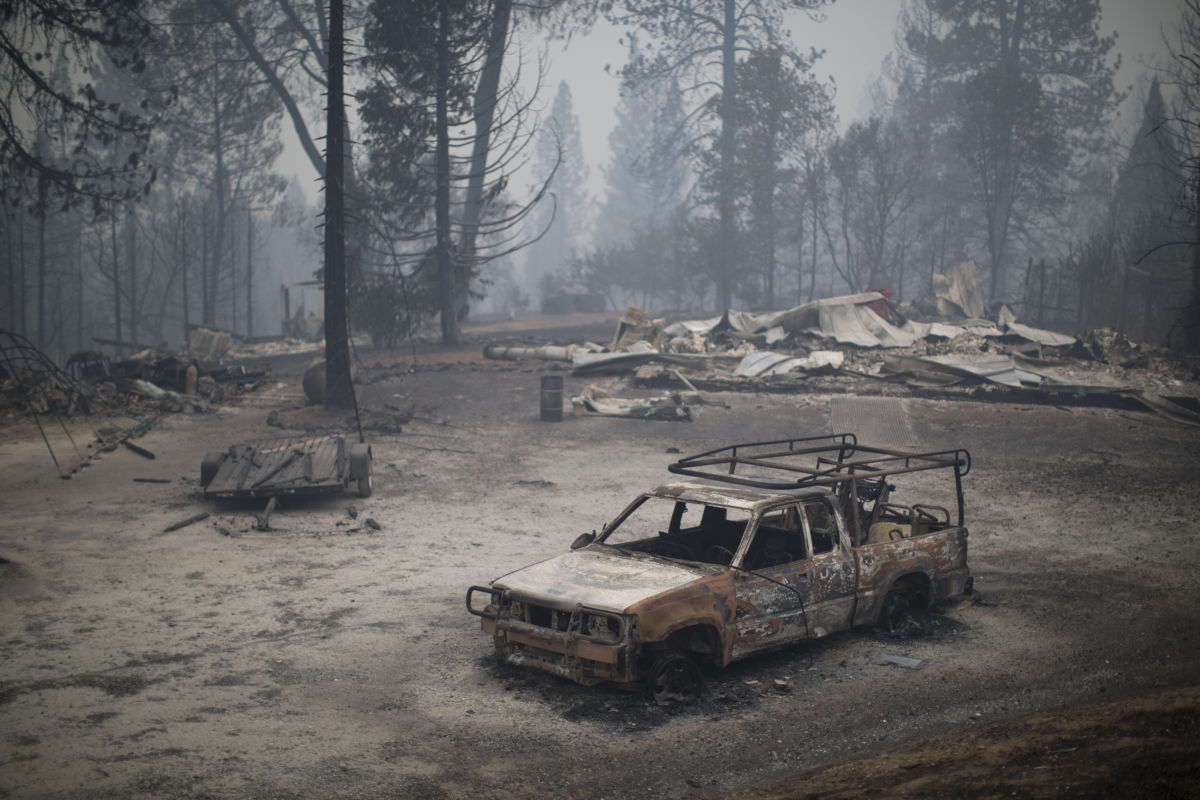
A burned truck and structures are seen in the wake of the Butte Fire, which burned over 70,000 acres, on September 13, 2015, near San Andreas, California.DAVID MCNEW / GETTY IMAGES
This is a hard piece to write, partly because we, too, are baffled. Environmental collapse, coupled with living in the sixth mass extinction, are new territory. We are still in the process of confronting the reality of living with the prospect of an unlivable planet. These thoughts emerge out of our sober forays into an uncertain future, searching for the right ways to live and serve in the present. The second reason for our reluctance to share this contemplation is anticipation of the grief, anger and fear it may trigger. We visit these chambers of the heart frequently, and know the challenges of deep feeling, particularly in a culture that denies feelings and pathologizes death.
As the unthinkable settles in our skin, the question of what to do follows closely. What is activism in the context of collapse? Professor of sustainability leadership and founder of the Institute for Leadership and Sustainability(IFLAS) at the University of Cumbria (UK) Jem Bendell’sdefinition of collapse is useful: “the uneven ending of our current means of sustenance, shelter, security … and identity.” Bendell isn’t the first to warn of collapse — NASA warned of it five years ago. Anyone who takes in the realities of our times will need to find their own relationship to the hard truths about converging environmental, financial, political and social unraveling. There are billions on the planet who are already experiencing the full direct effects of this right now. Forty percent of the human population of the planet is already affected by water scarcity. Humans have annihilated 60 percent of all animal life on the planet since 1970.
Described here, borrowing from Bendell’s analysis, are three responses to imminent collapse. The first is characterized by intensifying efforts to fixthe mess we have created. The idea here is that if we just work harder, we can change the situation. The second is mitigation of inevitable suffering and loss, easing the pain and harm that is already underway. Mitigation slows the demise down, giving us the time for the third, which is adaptation to the life-threatening scenarios before us, or in Bendell’s words, “deep adaptation.”
The three-tier framework we’re suggesting is more like a spectrum, and the tiers interlace at times. As our understanding of the biosphere catastrophe evolves, we may shift our focus of activism. Our age and stage of life also affect where we invest our lifeblood.
The downside of the first response, “fixing” the crisis, is that it often galvanizes false hope in an external panacea that we can vote for or count on. Riveted on the fixes, attention can be diverted away from the adaptation to the crisis that needs to happen in short order, both personally and within our institutions. For example, it takes time to plan for waves of millions of refugees and extreme food and water shortages. Solutions centered on “fixing” often sell books and technological promises. The opportunists are eyeing the take. This motivation is more of the same mentality that got us into this situation in the first place.
Never miss another story
Get the news you want, delivered to your inbox every day.
Your Email
The upside of the fixing response, however, is the upwelling of the human spirit through intensified social movements. Alexandria Ocasio-Cortez’s New Green Deal is a valiant example of a fresh plan to “fix” what is broken in the United States. The direct actions of the Extinction Rebellionare a powerful force, not to mention the electrified youth marchesgathering momentum around the world. Sixteen-year-old Greta Thunberg spearheaded a stunning victory in the EU recently. If the impeded stream sings, as Wendell Berry put it, these are rivers of rousing choirs.
The second response, mitigation, also has merit. It aims to stave off the collapse long enough to get needed preparation in place for what is to come.
Stellar examples of this are found in the regenerative agriculture movement. A farmer in drought-stricken Australia told us about the macadamia farm his family owned. He remembers his mother saying, “We’ll plant ’til we can’t.” That day came, so they decided to give farming a go in New South Wales. He described digging a posthole three feet deep recently. At the bottom of the hole was more dust. He and his family are joining fourth generation farmers who are jettisoning traditional farming practices that further deplete the parched earth. He uses no chemicals, rotates stock every three or four days, and is building every condition for the native grasses to thrive once again. Neighboring farms are “destocking” (i.e. slaughtering) sheep and cattle as feed disappears. Food supplies are dwindling for people and animals alike. But he will plant ’til he can’t. When asked about his motivation to persist in such difficult and heartbreaking work, he said it was for love of the land, but most importantly, love for his children. He wants to provide a safe refuge for them for as long as possible.
Regardless of the plethora of geoengineering plans to draw down CO2 levels or reflect solar radiation back into space, the tough reality is that the effects of CO2 already present in the biosphere are irreversible, and intensifying rapidly. Barring unforeseen forces at work, a consensus of scientific research tells us that a minimum of three degrees Celsius (3°C) warming is already baked into the system under current global climate pledges. A study published in Nature magazine showed that over the last quarter-century, the oceans have absorbed 60 percent more heat annually than estimated in the 2014 Intergovernmental Panel on Climate Change report. The study underscored that the oceans have already absorbed 93 percent of all the heat humans have added to the atmosphere and that planetary warming is already far more advanced than had previously been grasped. If the oceans had not absorbed that heat, global atmospheric temperatures would be 97 degrees Fahrenheit (97°F) hotter than they are today. Today’s carbon dioxide levels at 410 parts per million (ppm) are already in accordance of what historically brought about a steady state temperature of 7°C higher and sea levels 23 meters higher than they are today.
Anyone who thinks there is still time to wholly remedy the situation must answer the question: How do we remove all the heat that’s already been absorbed by the oceans? Invigorated activism, as heartening and important as it is, is not going to completely stem these tides.
Thus, the third level of activism, adaptation, comes into focus.
Adaptation is new territory. Here is the realm of healing, reparation (spiritual and psychological, among other ways) and collaboration. It is strangely rich with a new brand of fulfillment and unprecedented intimacy with the Earth and one another. It invites us to get to the roots of what went astray that has led us into the sixth mass extinction. Given that with even our own extinction a very real possibility, even if that worst-case scenario is to run its course, there is time left for amends, honorable completions, and the chance to reconnect in to this Earth with the utmost respect, and in the gentlest of ways.
The window for practical preparation for accelerating collapse and chaos is now open.
“Hope is not the conviction that something will turn out well,” Czech dissident, writer and statesman Václav Havel said, “but the certainty that something is worth doing no matter how it turns out.”
Here are a few stories about adaptation, to give a feel for actions that flow out of this type of hope — a hope that includes a hard-won acceptance of the very real possibility of impending collapse.
— An association of mental health workers has created the Climate Psychologists Alliance, in the U.K., Scotland and the U.S. They provide newly adapted psychological services for understanding and facing human-caused climate disruption, along with the difficult truths that come along with it, and helping one another engage while responding to our ecological crisis.
— Gerri Haynes is a 75-year-old and mother of four children and many precious grandchildren. She and her husband, Bob, live in Seattle. They have asked their children and families to remain located nearby in anticipation of duress to come. Their top priority in life, after years of work with Physicians for Social Responsibility, is keeping their family safe and together. The bonds are deep and will carry them through.
— Siena is an 18-year-old Canadian who has opted out of the university track, despite top grades. She has chosen to go to a local trade school where she is studying metal work (milling), welding, plumbing, electrical and carpentry. Her focus will be horticulture. Siena loves working with her hands both for practical purposes and for the joy of creating beauty. She is keenly aware of the usefulness of these skills should industrial infrastructure collapses. She is adapting to our global crisis with great enthusiasm, amid her keen awareness of how much is changing and the challenging times that are imminent.
— Dahr recently spoke to a class at Cabrillo Junior College, elaborating on the climate science in his book, The End of Ice, that explores bearing witness and finding meaning amidst climate disruption. At the end of his talk, a young woman raised her hand and asked, “What can I do? I am poor and have so little to offer.” Later on, in a conversation she mentioned that she was the mother of a young child. This brought tears. The act of parenting, while fully conscious of our likely demise, could now be one of the most heroic forms of activism on the planet. Though the future looks bleak, how can we live in a way that supports seven generations hence? What a form of activism, raising children who cherish this world, who are secure and confident in themselves, who can see and think clearly, who know they matter, who walk on this Earth with respect and curiosity?
— The two of us, along with neighbors, maintain a large garden that provides us vegetables, fruit and berries, along with the calm satisfaction of watching the insects and birds it attracts. Millions of people are already wisely and instinctively following their interests in growing food. Here is intense satisfaction, joy and preparation.
— Finally, a tribute to Stan Rushworth who is filling in a critical void in our attempts to reconnect with the Earth in the time before us. An elder of Cherokee descent who was brought up by his grandfather in traditional ways, Stan knows that all trees and rocks are alive, and that all beings are connected and communicating in their own ways. He knows there is no back-to-the-Earth movement in the United States that does get our history straight. The truth is that the first colonists arrived in North America when it was the thriving home of over 60 million Native people. In very short order, 96 percent of these men, women and children were cruelly sacrificed in the spirit of “manifest destiny” as one of the most barbaric rapid genocides that has ever been carried out. Rushworth teaches at a community college, where his labor of teaching this critical history to younger generations has gone on for a quarter of a century. Without commitment to acknowledge, work against and build reparations for the abomination of Native genocide, we have no foundation upon which to live.
Way upstream of all these noble stories is a subtle and profound kind of activism that could permeate every action we choose to take, on any tier. Author and teacher Joanna Macy, who is a scholar of Buddhism, systems thinking and deep ecology describes an activist as “anyone who does something for more than personal advantage.” The implications of generous action begin to tip a massive scale away from the pervasive greed and self-centeredness that fuels the root causes of this sixth mass extinction. In fact, we belong to a complex and wondrous net of life, characterized by balance, natural limits and respect.
What if, in the time we have left, we can simply remember this? Then we enable ourselves to walk away from the illusion of separation. Luckily, we already have a compass within ourselves, ready for activation. During a recent unseasonable cold snap in our hometown, one of our friends, Casey Taylor, spontaneously took it upon himself to make a large bag of peanut butter and jelly sandwiches and search out homeless people in the woods. He delivered the sandwiches along with blankets and heating fuel to everyone he could find. He knew of a need and deployed himself, no matter his humble resources, to fill it.
Perhaps one of the most potent rebellions of this time is the refusal to walk in the mainstream western herd, conforming to expectations and values that have ultimately ravaged the Earth. Opting out at its core means realignment with an inner knowing about what is ours to do, from the inside out.
Each one of us must choose the path that is ours. The sum total of this is legions of people taking action in their unique ways, and supporting one another.
Consider this story of a father’s support for his daughter’s choice to follow her calling. Mark Oates, father of 17-year-old Shayla, wrote to Barbara about his despair and fear, as his daughter heads into a dicey climate march that risks repercussions:
Shayla has decided she needs to rebel again and will be putting up posters for the School Strike 4 Climate on Friday in preparation for the 15th of March. She knows that it is too late, but will rebel anyway…. It is what she feels she needs to do…. I will be overseas during the school strikes, or I would have gone with her. My mum, Rosemary is going with her instead.
I have a tear in my eye … the grief, the courage of the young and old, the pride in her … she has always been one to stand up and protect another that is being victimized … but why is it the young and the old that are standing in front of the machine? So sad that we got to this place…. With love.
Barbara wrote him back:
Mark, I honor your clear sight and feel your breaking heart in all this. Amazing, your mom and Shayla going together. Even though we know how advanced the demise is, there are things we all need to do, to be able to live with ourselves, to galvanize in ourselves the ferocity to live in these times, to feel the oneness that pervades in these events. Intuitively I feel it is something formative and essential for Shayla. And REALLY hard on the heart of a Dad. Arms around your whole family and blessings on the Earth you walk on.
This reflection was written on the backs of many conversations … with one another, Mark Oates, Joanna Macy, Sarah-Jane Menato and indirectly, Jem Bendell. It is our hope that these words inspire these challenging conversations with your friends and loved ones.
Lastly, what if all the fixing and mitigating and adapting fail? Perhaps we will have become worthy human beings, having acted during this time of crisis with extraordinary love and integrity. We will turn toward one another and all the beings on the planet, with clear and humble love, knowing we are one living whole. On bended knee, we will weep in abject gratitude for the gift of life itself entrusted to us. In this is profound meaning and purpose.
Perhaps the singing of the impeded stream is, in the end, enough.
Annotated References:
“Deep Adaptation,” by Jem Bendell. A paper that provides readers “with an opportunity to reassess their work and life in the face of an inevitable near-term social collapse due to climate change.”
Joanna Macy, Ph.D., is an author and teacher, scholar of Buddhism, systems thinking and deep ecology. She is a respected voice in movements for peace, justice and ecology. Macy interweaves her scholarship with learnings from six decades of activism.
Going to Water, by Stan Rushworth. An historical novel, and one of the greatest books ever written about healing. “The journal of a Cherokee woman with tremendous courage and determination to persevere in the face of all odds, one who carries a transcendent vision while struggling with everyday life. Where she succeeds and fails is determined by her clarity of focus, by her trust in culture and family, by the powerful responses to the emotional ride she takes on her journey, and by her enduring love.”
The Climate Psychology Alliance provides a forum for people wanting to make connections between depth psychology and climate change, as we all face the difficult truths of climate change and ecological crisis.
Dahr Jamail’s “Climate Disruption Dispatches.” Jamail’s regular updates on the science of climate change are reliable sources of scientific truth.
The climate change lawsuit that could stop the U.S. government from supporting fossil fuels
A lawsuit filed on behalf of 21 kids alleges the U.S. government knowingly failed to protect them from climate change. If the plaintiffs win, it could mean massive changes for the use of fossil fuels
Of all the cases working their way through the federal court system none is more interesting or potentially more life changing than Juliana v. United States. To quote one federal judge, “This is no ordinary lawsuit.” It was filed back in 2015 on behalf of a group of kids who are trying to get the courts to block the U.S. government from continuing the use of fossil fuels. They say it’s causing climate change, endangering their future and violating their constitutional rights to life, liberty and property. When the lawsuit began hardly anyone took it seriously, including the government’s lawyers, who have since watched the Supreme Court reject two of their motions to delay or dismiss the case. Four years in, it is still very much alive, in part because the plaintiffs have amassed a body of evidence that will surprise even the skeptics and have forced the government to admit that the crisis is real.
The case was born here in Eugene, Oregon, a tree-hugger’s paradise, and one of the cradles of environmental activism in the United States. The lead plaintiff, University of Oregon student Kelsey Juliana, was only five weeks old when her parents took her to her first rally to protect spotted owls. Today, her main concern is climate change, drought and the growing threat of wildfires in the surrounding Cascade Mountains.
Kelsey Juliana
Kelsey Juliana: There was a wildfire season that was so intense, we were advised not to go outside. The particulate matter in the smoke was literally off the charts. I mean, it was so bad it was past severe, in terms of danger to health.
Steve Kroft: And you think that’s because of climate change.
Kelsey Juliana: That’s what scientists tell me.
It’s not just scientists. Even the federal government now acknowledges in its response to the lawsuit that the effects of climate change are already happening and likely to get worse, especially for young people who will have to deal with them for the long term.
“The government has known for over 50 years that burning fossil fuels would cause climate change. And they don’t dispute that we are in a danger zone on climate change.”
Steve Kroft: How important is this case to you?
Kelsey Juliana: This case is everything. This is the climate case. We have everything to lose, if we don’t act on climate change right now, my generation and all the generations to come.
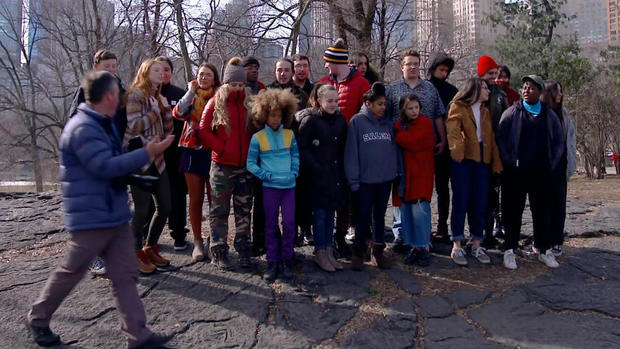
She was 19 when the lawsuit was filed and the oldest of 21 plaintiffs. They come from ten different states and all claim to be affected or threatened by the consequences of climate change. The youngest, Levi Draheim, is in sixth grade.
Steve Kroft: You’re 11 years old, and you’re suing the United States government, that’s not what most 11-year-olds do, right?
Levi Draheim: Yeah…
He’s lived most of his life on the beaches of a barrier island in Florida that’s a mile wide and barely above sea level.
Steve Kroft: What’s your biggest fear about this island?
Levi Draheim: I fear that I won’t have a home here in the future.
Steve Kroft: That the island will be gone.
Levi Draheim: Yeah. That the island will be underwater because of climate change.
Steve Kroft: So you feel like you’ve got a stake in this.
Levi Draheim: Yes.
The plaintiffs in Juliana v. United States
The plaintiffs were recruited from environmental groups across the country by Julia Olson, an oregon lawyer, and the executive director of a non-profit legal organization called “Our Children’s Trust.” She began constructing the case eight years ago out of this spartan space now dominated by this paper diorama that winds its way through the office.
Steve Kroft: So what is this?
Julia Olson: So this is a timeline that we put together…
It documents what and when past U.S. administrations knew about the connection between fossil fuels and climate change. The timeline goes back 50 years, beginning with the presidency of Lyndon Johnson.
Julia Olson: So during President Johnson’s administration, they issued a report in 1965 that talked about climate change being a catastrophic threat.
Whether it was a Democrat or a Republican in office, Olson says, there was an awareness of the potential dangers of carbon dioxide emissions.
Julia Olson: Every president knew that burning fossil fuels was causing climate change.
Fifty years of evidence has been amassed by Olson and her team, 36,000 pages in all, to be used in court.
Julia Olson: Our government, at the highest levels, knew and was briefed on it regularly by the national security community, by the scientific community. They have known for a very long time that it was a big threat.
Steve Kroft: Has the government disputed that government officials have known about this for more than 50 years and been told and warned about it for 50 years?
Julia Olson: No. They admit that the government has known for over 50 years that burning fossil fuels would cause climate change. And they don’t dispute that we are in a danger zone on climate change. And they don’t dispute that climate change is a national security threat and a threat to our economy and a threat to people’s lives and safety. They do not dispute any of those facts of the case.
The legal proceedings have required the government to make some startling admissions in court filings. It now acknowledges that human activity – in particular, elevated concentrations of greenhouse gases – is likely to have been the dominant cause of observed warming since the mid-1900s… That global carbon dioxide concentrations reached levels unprecedented for at least 2.6 million years… That climate change is increasing the risk of loss of life and the extinction of many species and is associated with increases in hurricane intensity, the frequency of intense storms, heavy precipitation, the loss of sea ice and rising sea levels. And the government acknowledges that climate change’s effects on agriculture will have consequences for food scarcity.
Julia Olson with correspondent Steve Kroft
Steve Kroft: So you’ve got them with their own words.
Julia Olson: We have them with their own words. It’s really the clearest, most compelling evidence I’ve ever had in any case I’ve litigated in over 20 years.
The lawsuit claims the executive and legislative branches of government have proven incapable of dealing with climate change. It argues that the government has failed in its obligation to protect the nation’s air, water, forests and coast lines. And it petitions the federal courts to intervene and force the government to come up with a plan that would wean the country off fossil fuels by the middle of this century.
Steve Kroft: You’re just saying, “Do it. We don’t care how.”
Julia Olson: Do it well and do it in the timeframe that it needs to be done.
Steve Kroft: You’re talking about a case that could change economics in this country.
Julia Olson: For the better.
Steve Kroft: Well, you say it changes the economy for the better, but other people would say it would cause huge disruption.
Julia Olson: If we don’t address climate change in this country, economists across the board say that we are in for economic crises that we have never seen before.
The lawsuit was first filed during the final years of the Obama administration in this federal courthouse in Eugene.
Steve Kroft: Did they take this case seriously when you filed it?
Julia Olson: I think in the beginning they thought they could very quickly get the case dismissed.
In November 2016, a federal judge stunned the government by denying its motion to dismiss the case and ruling it could proceed to trial. In what may become a landmark decision, Judge Ann Aiken wrote, “Exercising my reasoned judgment, I have no doubt that the right to a climate system capable of sustaining human life is fundamental to a free and ordered society.”
Steve Kroft: A federal judge ever said that before?
Julia Olson: No judge had ever written that before.
The opinion was groundbreaking because the courts have never recognized a constitutional right to a stable climate.
Ann Carlson
Ann Carlson: That’s a big stretch for a court.
Ann Carlson is a professor of environmental law at UCLA. Like almost everyone else in the legal community, she was certain the case was doomed.
Ann Carlson: There’s no constitutional provision that says the that environment should be protected.
Steve Kroft: Why is the idea that the people of the United States have a right to a stable environment such a radical idea?
Ann Carlson: Well, I think that Judge Aiken actually does a very good job of saying it’s not radical to ask the government to protect the health, and the lives and the property of this current generation of kids. Look, If you can’t have your life protected by government policies that save the planet, then what’s the point of having a Constitution?
Steve Kroft: How significant is this case?
Ann Carlson: Well, if the plaintiffs won, it’d be massive, particularly if they won what they’re asking for, which is get the federal government out of the business of in any way subsidizing fossil fuels and get them into the business of dramatically curtailing greenhouse gases in order to protect the children who are the plaintiffs in order to create a safe climate. That would be enormous.
So enormous that the Trump administration, which is now defending the case, has done everything it can to keep the trial from going forward. It’s appealed Judge Aiken’s decision three times to the ninth circuit court in California and twice to the Supreme Court. Each time it’s failed.
Julia Olson: They don’t want it to go to trial.
Steve Kroft: Why?
Julia Olson: Because they will lose on the evidence that will be presented at trial.
Steve Kroft: And that’s why they don’t want one.
Julia Olson: That’s why they don’t want one. They know that once you enter that courtroom and your witnesses take the oath to tell the truth and nothing but the truth the facts are the facts and alternative facts are perjury. And so, all of these claims and tweets about climate change not being real, that doesn’t hold up in a court of law.
The Justice Department declined our request for an interview, but in court hearings, in briefs, it’s called the lawsuit misguided, unprecedented and unconstitutional. It argues that energy policy is the legal responsibility of Congress and the White House, not a single judge in Oregon. And while climate change is real it’s also a complicated global problem that was not caused and cannot be solved by just the United States government.
Steve Kroft: Why is the federal government responsible for global warming? I mean it doesn’t produce any carbon dioxide. How are they causing it?
Julia Olson: They’re causing it through their actions of subsidizing the fossil fuel energy system, permitting every aspect of our fossil fuel energy system, and by allowing for extraction of fossil fuels from our federal public lands. We are the largest oil and gas producer in the world now because of decisions our federal government has made.
Steve Kroft: What about the Chinese government? What about the Indian government?
Julia Olson: Clearly, it’s not just the United States that has caused climate change but the United States is responsible for 25 percent of the atmospheric carbon dioxide that has accumulated over the many decades.
Julia Olson is confident they’re going to prevail in court. Ann Carlson and most of the legal community still think it’s a longshot, but she says she’s been wrong about this case every step of the way.
Ann Carlson: Courts have asked governments to do bold things. The best example would be Brown versus the Board of Education, when the court ordered schools to desegregate with all deliberate speed. So there have been court decisions that have asked governments to do very dramatic things. This might be the biggest.
Steve Kroft: You’ve been stunned by how far this case has gotten. Why has it gotten this far?
Ann Carlson: I think there are several reasons this case has actually withstood motions to dismiss. I think the first is that the lawyers have crafted the case in a way that’s very compelling. You have a number of kids who are very compelling plaintiffs who are experiencing the harms of climate change now and will experience the harms of climate change much more dramatically as they get older. I think the hard question here is the law.
Jayden Foytlin
The next oral arguments in Juliana v. United States are scheduled for June in Portland. But whatever happens next will certainly be appealed. Two-thousand miles away, in the aptly named town of Rayne, Louisiana, the family of one of the plaintiffs, 15-year-old Jayden Foytlin, is still rebuilding from the last disaster in 2016 that dumped 18 inches of rain on Rayne and Southern Louisiana in just 48 hours.
Jayden Foytlin: That’s just something that shouldn’t happen. You can’t really deny that it, climate change has something to do with it. And you can’t deny that it’s something that we have to pay attention to. I’m not sure if most of Louisiana, of South Louisiana is going to be here, that’s just a really big worry of mine.
For the foreseeable future, it’s impossible to predict when and how the storms and the lawsuit are likely to end.
Produced by Draggan Mihailovich. Associate producers, Katie Brennan and Chrissy Jones
In an exciting stroke of the pen, Gov. Michelle Lujan Grisham announced that New Mexico will join the U.S. Climate Alliance, adding New Mexico to the growing list of states pledging to embrace the necessary and ambitious goals of the 2015 Paris Agreement (“On climate, Lujan Grisham starts to deliver,” Our View, Jan. 31). Surrounded by environmental advocates, young people from the Santa Fe-based Global Warming Express, and heads of state agencies, we were honored to stand near the governor as she specifically named methane capture as a focal point in the state’s effort to combat climate change.
Climate change is a big, complex issue that can be difficult to understand. Within this complicated issue, methane has been overlooked and action on it has been consistently delayed or even rolled back. Gov. Lujan Grisham understands this and her actions demonstrate the crucial role that methane capture will play in the fight against climate change. The impacts of climate change pose dramatic challenges for New Mexico, including fires, flooding, drought, health impacts, and dramatic shifts in our state’s climate that will cause cascading damages to the state’s ecosystems and cultural resources.
The most recent report from the United Nations Intergovernmental Panel on Climate Change highlights the narrow 12-year window we have to mitigate the worst effects of climate change. Because of its potency as a greenhouse gas, regulating methane emissions is one of the most promising ways to make dramatic short-term changes to the atmosphere that could be the difference between manageable climate impacts and disastrous ones.
We are proud to have a governor that is taking such decisive action, and we are proud to be part of the diverse coalition keeping climate change in the forefront of the state’s legislative agenda. Over the past couple of years, Climate Advocates/Voces Unidas, known as CAVU, has worked hard to inform a wide audience about the the impacts of methane emissions to New Mexico. Our Unearthed film series continues to bring together a wide range of stakeholders to discuss the opportunities and challenges presented by oil and gas development in our state. By creating dialogue, we can work toward common sense solutions that protect our environment and move our economy forward. It is encouraging to see this work translate into policy.
On behalf of CAVU and the many organizations working to make New Mexico a leader in climate policy, we want to thank the governor for taking the lead with this executive order. As she said herself, “It’s up to us” to face this problem head on.
Twelve years will pass in the blink of an eye. For the sake of our children, we look forward to finding solutions to the most pressing issue of our time.
Jordan Vaughan Smith and David Smith are the founders of Climate Advocates/Voces Unidas. They live in Santa Fe.
Photographer: Alex Wong/Getty Images North America
Opinions on the “Green New Deal” run the gamut from calling it “a bold, ambitious vision” to warning that it represents “the first step down a dark path to socialism.” A fairly common critique, though, is that it is unrealistic in whole or part; and that’s a view that crosses political lines. Even Speaker Nancy Pelosi pointedly referred to the proposals put forward by Representative Alexandria Ocasio-Cortez and Senator Ed Markey as “the green dream, or whatever they call it” in an interview with Politico.
Producers of oil, natural gas and coal — those squarely in the GND’s crosshairs — may be tempted to draw comfort from, or mimic, Pelosi’s offhandedness. I think that would be a mistake.
There are two reasons why dismissing the GND as unrealistic would be an error. First, to do so would be to merely state the obvious. A 14-page set of non-binding resolutions encompassing everything from getting the U.S. to net-zero carbon emissions to overhauling the nation’s transportation infrastructure and even implementing a federal job guarantee is plainly not what you would call ready-to-go legislation. And while AOC’s many critics may deride her as inexperienced, surely even they don’t think she’s unable to count how many Republican senators there are right now.
Rather, the GND is a set of sketched-out goals; a flag to rally support around for what its authors surely know will be a multi-year, and grinding, political battle. As ClearView Energy Partners put it in a report on the GND — coming as it does from a master of social media in our increasingly clickable political culture — this is about “counting likes (not votes).” By marrying environmental objectives with issues related to economic insecurity, Ocasio-Cortez and Markey are attempting to recast the doom-laden threat of climate change as an opportunity for economic and national renewal — a stance that mixes FDR liberalism with dashes of America First populism.
Far from thinking the GND’s enormous scope renders it an unrealistic mess, the fossil-fuel industry should consider it an opening gambit. Many of the proposals could be ditched or modified over time and America might still be left with far-reaching federal measures curbing the use of oil, natural gas and coal when the smoke clears. As it stands, polling shows comfortable majorities of Americans already think climate change is happening and is mostly man-made. Perhaps more importantly, roughly four-in-ten discuss the issue “often or occasionally” with family and friends, the highest proportion since the “Climate Change in the American Mind” survey was launched in 2008.
Such shifts in attitudes are why many fossil-fuel producers have also shifted in recent years toward acknowledging the reality of climate change and the role of their products in causing it. Herein lies the second reason why the GND’s lack of “realism” isn’t a promising line of attack over the long term.
As I wrote here, the incumbent energy industry’s change of heart comes after decades of rejecting warnings about climate change and helping to transform it from a question of science to one of political tribalism. Oil majors calling for carbon taxes after spending so many years of denying the need for action now actually find themselves to the left of a lot of senior Republican politicians on that specific issue. When even relatively straightforward measures like pricing carbon have become untouchable for one of the major U.S. parties, yet even producers admit there’s a problem, something has to give.
We find ourselves perhaps less than two decades away from reaching a tipping point beyond which the planet faces possibly catastrophic impacts in terms of things like flooding, drought and wildfires (indeed, California’s getting a bitter taste of this already). It is from this that the urgency of efforts such as the GND spring. Delaying action for decades and then denouncing ambitious proposals to deal with the consequences of that in short order is, let’s be honest, not a good look.
Sarah Ladislaw, a director at the Center for Strategic and International Studies who published this smart blog post on the GND’s potential, offers this succinct rebuttal to the “realist” school of criticism:
It’s a hard conversation to calibrate. If the Green New Deal is infeasible, what do you call managing climate-change impacts? Surely that’s infeasible.
If the GND’s ambition is a testament to anything, it is that there are no easy solutions here. We have built our standard of living on forms of energy that we now know pose a threat to our very existence. That is a simple summation of a monumental challenge; one where time has eroded our margin for incremental action. No matter what you think of the specifics, or lack of them, this is a conversation that is long overdue — and necessarily begins with a shout, not a whisper.








 Exposing the Big Game