Exposing the Big Game

Forget Hunters' Feeble Rationalizations and Trust Your Gut Feelings: Making Sport of Killing Is Not Healthy Human Behavior

Exposing the Big Game

Hurricanes are strengthening faster in the Atlantic, and climate change is a big reason why, scientists say

A startling study says that devastating storms that intensify rapidly are becoming more common.


Television reporters watch as Category 4 Hurricane Michael makes landfall along the Florida panhandle on Oct. 10, 2018, in Panama City Beach, Fla. (Jabin Botsford/The Washington Post)

February 7 at 6:16 PM

A group of top hurricane experts, including several federal researchers at the National Oceanic and Atmospheric Administration, published striking new research Thursday suggesting that hurricanes in the Atlantic Ocean have grown considerably worse, and climate change is part of the reason why.

The study focused on rapid intensification, in which hurricanes may grow from a weak tropical storm or Category 1 status to Category 4 or 5 in a brief period. They found that the trend has been seen repeatedly in the Atlantic in recent years. It happened before Hurricane Harvey struck Texas and before Hurricane Michael pummeled the Gulf Coast with little warning last fall. Hurricane Michael, for example, transformed from a Category 1 into a raging Category 4 in the span of 24 hours.

The study, published in Nature Communications, describes its conclusion in blunt language, finding that the Atlantic already has seen “highly unusual” changes in rapid hurricane intensification, compared to what models would predict from natural swings in the climate. That led researchers to conclude that climate change played a significant role.

“Natural variability cannot explain the magnitude of the observed upward trend,” they wrote. The research was led by Kieran Bhatia, who conducted the research as a postdoctoral researcher at Princeton University and NOAA’s Geophysical Fluid Dynamics Laboratory.

“There’s just a whole host of issues that come along with rapid intensification, and none of them are good,” said Jim Kossin, one of the study’s authors and also a hurricane expert with the National Oceanic and Atmospheric Administration.

Kossin said that more rapidly intensifying storms means both that there are more strong storms overall, but also that there are more risky situations near land.

“Rapid intensification is exceedingly dangerous because people, they’re not warned adequately, they’re not prepared, many of them don’t evacuate,” he said.

The findings come in the wake of two of the most damaging years for hurricanes and other extreme events. In 2017, according to NOAA figures, the United States saw $306 billion in disaster losses, largely driven by Hurricanes Harvey, Maria and Irma. In 2018, Hurricanes Florence and Michael were major factors in a $91 billion damage total.

Rapid intensification is generally measured by comparing the strength of a hurricane over a 24-hour period. A change in storm wind speed of greater than 35 mph in 24 hours is generally the cutoff.

By this measure, the five most destructive Atlantic storms of the past two years all went through rapid intensification:


Chris Mooney/The Washington Post

In the new study, the researchers used two separate data sets of storm behavior to analyze changes in the tendency of hurricanes to rapidly intensify. They looked at the globe and also at the Atlantic region specifically, but had less confidence in global figures, given that record-keeping of storm behavior is less reliable in other regions than in the carefully studied Atlantic.

Over a 28-year period from 1982 to 2009, the percentage of Atlantic storms that rapidly intensified had tripled, the study found. This was true of both data sets used, one of which records official hurricane statisticsfrom global monitoring agencies, such as the National Hurricane Center, and one of which uses satellite imagery to estimate storm strengths.

The researchers then used a model that can reliably simulate hurricanes to determine whether the rates of rapid intensification found in the study are significantly greater than seen in a version of the model that did not include human-caused climate change. One obvious inference is that warmer ocean temperatures, which provide the fuel for hurricanes, are probably driving explosive storm strengthening.

Kossin said that if hurricanes have the potential to achieve higher intensities because of warmer ocean conditions, they’ll also probably rapidly intensify more frequently, since they have more “headroom” to grow in strength. That could explain the results.

And Kossin noted that the study only went through 2009, due to limitations in the satellite data set. That means it did not include multiple recent rapidly intensifying storms — if it had, the findings might have been even stronger.

“We’re finding trends even without including what we’ve been seeing in the last few years,” Kossin said.

Still, the study did include some major devastating storms, such as 2005′s Hurricane Wilma, which rapidly intensified from a strong tropical storm into a Category 5 hurricane in just 24 hours.

“It is fortunate that this ultrarapid strengthening took place over open waters, apparently void of ships, and not just prior to a landfall,” the National Hurricane Center wrote in a post-season analysis of the storm.

Kerry Emanuel, a hurricane expert at MIT, said the new results make theoretical sense — that storms are intensifying faster as the climate warms.

“One theoretical prediction, backed up by modeling results, is that intensity change should increase faster with global warming than intensity itself,” he said by email.

Emanuel added that rapid intensification creates a major emergency response problem — since rapid intensification is so hard to forecast, “important decisions, like whether not to evacuate a region, may have to be delayed.”

“Rapid intensification is a nightmare for hurricane forecasters especially for storms nearing land,” added Ryan Maue, a meteorologist with Weather.us. “As the climate warms, some ocean regions may disproportionately see more intense and rapidly intensifying storms.”

“This study uses an advanced climate model to determine if a climate warming signal has already emerged in recent decades. Their initial results suggest just that.”

Benjamin Strauss, chief executive and chief scientist at the research organization Climate Central, said the study seems in line with a growing body of research identifying the fingerprints of climate change in extreme weather events.

“This is a case where science seems to be following common sense. We’ve had so many badly destructive hurricanes strike the U.S. over the last 15 years that it’s hard not to feel something is amiss,” Strauss said.

“The intuition is easy: If you turn up the heat under a pot of water, it can shift quickly from simmer to boil,” Strauss added. “But the science of attributing hurricane characteristics to climate change has been difficult and requires a lot of computing power. This team has done important work, and I suspect it foreshadows a great deal more findings in the same direction.”

— Jason Samenow contributed to this report.

https://www.washingtonpost.com/climate-environment/2019/02/07/hurricanes-are-strengthening-faster-atlantic-climate-change-is-big-reason-why-scientists-say/?utm_term=.f4b51ed1664c

Black bear wandering around Kincaid Park in the middle of winter? Here’s why.

  •  Author: Tegan Hanlon
  •  Updated: 6 days ago
  •  Published 6 days ago
A black bear, in front of the front-end loader, rummages around equipment at Kincaid Park on Jan. 25, 2019. (Craig Norman photo)

A black bear, in front of the front-end loader, rummages around equipment at Kincaid Park on Jan. 25, 2019. (Craig Norman photo)

A black bear was spotted last week in Anchorage’s Kincaid Park, the wooded and popular recreation area on the west side of town.

Some reported the bear eating grass or drinking water or just wandering around, according to the Alaska Department of Fish and Game. At least a few young skiers with the Nordic Skiing Association of Anchorage’s Junior Nordic League saw the bear off the snowmaking loop last Wednesday evening during a particularly busy evening at the park. They reported the sighting to their coach, Geoff Wright.

“I assumed they were looking at a moose or a large dog or a coyote, but probably not a bear,” Wright said. “It’s stories from 6- and 7-year-old kids and they say all sorts of funny things.”

Like many park users, Wright has spotted bears in Kincaid in the summer. But in his 20 or so years of skiing in the park, he said, he’d never seen a bear there in the middle of winter. Still, he told his group to turn around just in case. Later, another skier showed him a picture of the bear taken that evening. Bear sighting confirmed.

Fish and Game hasn’t gotten a report of the Kincaid bear since last Friday, so it has likely headed back to its den, said department spokesman Ken Marsh. The department is aware of bear dens in Kincaid.

“They usually don’t stay up long unless they have that consistent food source,” Marsh said.

But the midwinter bear spotting raises the questions: Why was the bear awake? Did it have to do with the warmer-than-usual temperatures last week? Do bears actually sleep all winter?

Sean Farley, a Fish and Game wildlife physiologist, didn’t see the Kincaid Park bear last week, but here’s what he said about why a bear might be wandering around Anchorage in January:

Weather plays a role in when bears head into their dens. In the Anchorage area, black and brown bears generally hibernate from late October or November to April or May, he said. Female bears that are pregnant typically go in earliest and come out the latest.

Farley described hibernation as a “spectrum of physiological adaptations” to conserve energy. Arctic ground squirrels, for instance, can drop their body temperatures to below freezing. Bears aren’t like that.

“They’re not out cold like ground squirrels, they’re more like a sleeping dog that can be roused pretty easily,” Farley said. “They’ll get up and move around and thrash around.”

For bears, hibernation means heading into dens and lowering their metabolic rate. Their body temperature lowers from roughly 101 degrees to about 90 or 91 degrees, Farley said. It’s a survival tactic to make it through the winter, when there’s little to no food available.

[Support local journalism in Anchorage. Subscribe to the Anchorage Daily News / adn.com]

During hibernation, bears usually don’t eat, drink, urinate or defecate. They’ll lose about 20 to 25 percent of their body weight. Mostly fat, Farley said.

Yes, they also sleep, but not the whole time.

Bears cycle through periods of deep sleep and periods of arousal. Their body temperature will increase a bit when they’re aroused. They might shift positions. They might poke their heads out of their den. They might even leave for a few hours and come back — that’s not common, but it’s not unheard of, Farley said.

“When we say ‘leave the den,’ they don’t usually go on big walks,” he said.

Pregnant bears will give birth just a couple of months into hibernation. They’ll nurse their cubs in their dens, despite not eating or drinking.

“They’ve got these newborn cubs that they’ve got to take care of. They can’t go to sleep and just be out of it,” Farley said. “The cubs can’t do anything. … All they can do is eat and scream and that’s about it. She has to move them around and hold them close to her body so they can nurse. She has to clean them.”

It’s very unlikely that a female bear with cubs will leave its den in the winter, Farley said.

So, why might a bear head outside in January?

A bear might get restless and want to stretch its legs, Farley said.

It’s also possible the bear went into a den too skinny. Its energy reserves might have gotten so low at some point that it prompted the bear to wake up and go look for food. It’s that or starve to death, Farley said.

Or, maybe a noise outside of the den stirred it when it wasn’t in a deep sleep. Farley noted, however, that he has photographs of snowmachine tracks that go over a den hole that’s covered in snow.

What about last week’s weather? Temperatures spiked to 44 degrees on Friday at the Ted Stevens Anchorage International Airport. Could that be why the black bear wasn’t in its den?

A goal of a bear den: To keep the cold out, Farley said. So mild fluctuations in outside temperature shouldn’t really impact bears in insulated dens.

“If they’re deep inside in some sort of den, maybe covered with snow, they’re insulated,” he said. “So fluctuations in the ambient temperature outside the den don’t get reflected as strongly inside the den. Plus they’re in the den heating it themselves because they’re at least 90 degrees or so.”

In the Anchorage area, black bears often den in trees. Both brown and black bears will also dig into hillsides and excavate a dirt den. Bears can den in many other places too, Farley said.

If high temperatures melt snow and that leads to a bear’s den getting flooded, that’s another reason the bear might head outside. It’ll likely try to find another den, Farley said.

If you see a bear in the middle of winter, give it space, just as you would in the summer, Marsh said.

“Maybe turn around, change your course, you don’t want to push it,” he said.

Really this time of year, Marsh said, it’s more likely you’ll come upon a cranky moose.

“It’s been a long winter and they’re starting to get a little nutritionally stressed,” Marsh said. “Be alert just like you would in the summertime and give wildlife their space.”

15 ways the Trump administration has impacted the environment

President Donald Trump signs a presidential memorandum to “minimize unnecessary regulatory burdens” on October 19, 2018. Since his earliest days in office, President Trump has been

… Read More

PHOTOGRAPH BY DOUG MILLS, THE NEW YORK TIMES

For the past three years, National Geographic has been tracking how this administration’s decisions will influence air, water, and wildlife.

SINCE THE TRUMP administration took office, it has been fighting what they call an “anti-growth” agenda put in place by the Obama administration. Regulations that required businesses to spend time and money to meet the former administration’s environmental standards were swiftly reviewed and, in many cases, rolled back.

National Geographic has been tracking the decisions that will impact America’s land, water, air, and wildlife. What started with curtailing information when the president took office in 2017 has evolved into actions like executive orders that open public land for business.

States, municipalities, and NGOs have responded to these changes by filing lawsuits to block the administration. Some, like lawsuits against the Keystone XL pipeline, have successfully kept public land closed to additional development.

Below are 15 influential decisions made by the Trump administration that could impact the future of our nation.

Clean air

1. U.S. pulls out of Paris Climate Agreement

This is perhaps the decision that set the tone for the Trump administration’s approach to the environment: when he moved to withdraw from the Paris Climate Agreement in June of 2017. To many, it signaled less U.S. leadership in international climate change agreements. (Read more about this decision.)

2. Trump EPA poised to scrap clean power plan

The Clean Power Plan was one of the Obama’s signature environmental policies. It required the energy sector to cut carbon emissions by 32 percent by 2030, but in October 2017 it was rolled back by Trump’s EPA. Among the reasons cited were unfair burdens on the power sector and a “war on coal.” (Read more on why Trump can’t make coal great again.)

3. EPA loosens regulations on toxic air pollution

This regulation revolved around a complicated rule referred to as “once in, always in” or OIAI. Essentially, OIAI said that if a company polluted over the legal limit, they would have to match the lowest levels set by their industry peers and they would have to match them indefinitely. By dropping OIAI, the Trump EPA forces companies to innovate ways to decrease their emissions, but once those lower targets are met, they’re no longer required to keep using those innovations. (Read more about air pollution.)

4. Rescinding methane-flaring rules

Under the Affordable Clean Energy rule issued in August 2018, states were given more power over regulating emissions. In states like California, that means regulations would likely be stricter, whereas states that produce fossil fuels are likely to weaken regulations. The following month, the EPA announced they would relax rules around releasing methane flares, inspecting equipment, and repairing leaks. (Read more about methane.)

5. Trump announces plan to weaken Obama-era fuel economy rules

Under the Obama administration’s fuel economy targets, cars made after 2012 would, on average, have to get 54 miles per gallon by 2025. In August 2018, the Trump Department of Transportation and EPA capped that target at 34 miles per gallon by 2021. The decision created legal conflict with states like California that have higher emission caps. (Read more about speed bumps in the way of super-efficient cars.)

Water

6. Trump revokes flood standards accounting for sea-level rise

In August 2017, President Trump revoked an Obama-era executive order that required federally funded projects to factor rising sea levels into construction. However, in 2018, the Department of Housing and Urban Development required buildings constructed with disaster relief grants do just that. (Read more about how rising sea levels may imperil the internet.)

7. Waters of the U.S. Rule revocation

What are the “waters of the U.S.?” President Trump issued an executive order in 2017 ordering the EPA to formally review what waters fell under the jurisdiction of the EPA and Army Corps of Engineers according to the 1972 Clean Water Act. The proposed change narrowed the definition of what’s considered a federally protected river or wetland. (Read more about Trump’s plans to roll back the Clean Water Act.)

Wildlife

8. NOAA green lights seismic airgun blasts for oil and gas drilling

Five companies were approved to use seismic air gun blasts to search for underwater oil and gas deposits. Debate over the deafening blasts stem from concerns that they disorient marine mammals that use sonar to communicate and kill plankton. The blasts were shot down by the Bureau of Energy Management in 2017 but approved after NOAA found they would not violate the Marine Mammal Protection Act. (Read more about how scientists think seismic air guns will harm marine life.)

9. Interior Department relaxes sage grouse protection

The uniquely American sage grouse, a bird resembling a turkey with spiked feathers, has become the face of the debate between land developers and conservationists. In both 2017 and 2018, the Trump administration Department of Interior eased restrictions on activities like mining and drilling that had been restricted to protect the endangered bird. (Read more about how the sage grouse become caught in the fight over who owns America’s west.)

10. Trump officials propose changes to handling the Endangered Species Act

In July of 2018, the Trump administration announced its intention to change the way the Endangered Species Act is administered, saying more weight would be put on economic considerations when designating an endangered animal’s habitat. (Read more about the rollbacks facing endangered animals.)

11. Migratory Bird Treaty Act reinterpretation

Companies installing large wind turbines, constructing power lines, or leaving oil exposed are no longer violating the Migratory Bird Treaty Act if their activities kill birds. This controversial change was declared by the Trump administration in December of 2017. (Read more about why legally protecting birds is important.)

Opening public lands for business

12. Trump unveils plan to dramatically downsize two national monuments

Unlike national parks, which have to be approved by Congress, national monuments can be created by an executive order, which the president said means they can be dismantled just as easily. Such was the case for Bears Ears and Grand Staircase-Escalante in Utah, which President Trump reduced and opened for mining and drilling companies in 2017. Tribes and environmental groups are challenging that interpretation in court. (Read more about the impacts of downsizing these two monuments.)

13. Executive order calls for sharp logging increase on public lands

Just a day before the longest government shutdown in U.S. history, President Trump issued an executive order that called for a 30 percent increase in logging on public lands. The decision was billed as wildfire prevention, though environmental groups say it ignores the role climate change plays in starting wildfires. (Read more about California’s historic wildfires.)

Security & Enforcement

14. Trump drops climate change from list of national security threats

The Trump administration’s decision to delist climate change from national security threats in December of 2017 meant less Department of Defense research funding and a nationalistic viewpoint on the potential impacts of wildfires, droughts, hurricanes, and other natural disasters. (Read more about how climate change is forcing migration in Guatemala.)

15. EPA criminal enforcement hits 30-year low

The size and influence of the EPA has shrunk under the Trump administration, and it’s illustrated by their diminished prosecuting power. Criminal prosecutions are at a 30-year low, and many violations that would have been prosecuted in the past are now being negotiated with companies. The administration says this is streamlining its work, but environmentalists have warned it could lead to more pollution. (Read more about the scientists pushing back against President Trump’s environment agenda.)

Spread of ‘zombie’ disease killing off starfish linked to rising ocean temperatures Social Sharing

Rapidly spreading infection causes sunflower sea stars in Pacific coast to lose their limbs and die en masse

A newly released study says a combination of warm waters and infectious diseases has been determined as the cause of a die-off of populations of sunflower starfish across the Pacific coast. (Janna Nichols/University of California Davis via Associated Press)

42 comments

Listen6:29

When scientists first noticed a strange disease affecting sunflower starfish on the Pacific coast, the colourful creatures had just started to sprout “little white lesions” on their bodies.

Not long after that, it was like a “zombie apocalypse,” says Joseph Gaydos, science director of the SeaDoc Society at the University of California, Davis.

“They’re walking around and arms are falling off them,” he told As It Happens host Carol Off. “Ones that are in a greater progression of the disease, they’re just kind of melting into piles of ossicles.”

A few weeks later, divers recorded “a complete absence of these sunflower stars,” he said.

A study by Gaydos and his colleagues has connected the rapid spread of the so-called “wasting disease” behind mass die-offs of sunflower starfish to rising in ocean temperatures. The findings were published Wednesday in the journal Science Advances.

Sunflower starfish, also known as sunflower sea stars, are among the largest starfish in the world and come in a variety of bright colours, including purple and orange.

They can grow up to a metre wide and have as many as 24 arms.

A decade ago, they were “super abundant,” Gaydos said. “If you were to ask me then, you know, would these ever be rare, I would say no way, how could that ever happen?”

Population drops between 80-100%

But in 2013, scientists began noticing populations of the species declining between 80 and 100 per cent in deep and shallow waters, from Alaska and British Columbia right down to California.

The nature of the disease itself still eludes scientists, but one of the research theorize an increase in temperature makes the sea stars more susceptible to the disease that was already present, especially since they don’t have complex immune systems.

With global warming causing a heat wave in the oceans, the future is not looking bright for the starfish.

A side-by-side comparison of two photographs taken near Croker Island in B.C. shows thousands of sunflower sea stars swarming a rock on Oct. 9, 2013 on the left, and the same site, three weeks later, bereft of the sea creatures. (Neil McDaniel/UC Davis)

“Dealing with climate change is a huge thing. The other thing that I think we need to start thinking about now is what can we do to save these sunflower stars?” Gaydos said.

“We kind of have a mandate to take care of animals and not let them go extinct on our watch and we really are not certain what can we done at this point.”

A domino effect on the ecosystem

Gaydos said conservationists are looking at ways to preserve the species, possibly through selective breeding in captivity.

But it’s not just the starfish at risk.

The once-bountiful population feeds on sea urchins, which themselves feed on kelp — a major source of food and habitat for other ocean life.

“So with the sunflower stars gone, in a lot of places, the urchin population exploded and then they just gobbled up the kelp forest,” Gaydos said. “It’s just kind of like clear-cutting a forest on land.”

The die-offs, he said, should be a wake-up call.

“I think we can all make differences in everything we do with our life. We can push our governments to make differences. We can take the bus more. We can use less fossil fuels, ride our bikes,” he said.

“If we all start doing things, we’re going to have some impact. We can’t just throw our hands up.”

Written by Sheena Goodyear with Canadian Press. Produced by Allie Jaynes. 

Rising heat weakens jet stream, frees Arctic cold to fly south


Thanks to an economy long dependent on fossil fuels, the atmophere has become an increasingly effective heat trap. Overnight temperatures are still cooler than daytime temps, but they’re rising faster than daytime temps are, so the difference between night and day is shrinking.

It’s the same story for the Arctic and points south. The Arctic is still cooler than points south, but it’s warming faster, so the difference between up there and down here is shrinking. This is making a difference to the Northern Hemisphere’s jet stream, weakening it, which, in turn, is setting cold Arctic air masses free to fly south.
The polar vortex is the name of cold Arctic air normally swirling around the North Pole. With a weakened and more widely meandering jet, we get what you see here
Polar-Vortex-529px.png

=================================================

The poorest half of the world population is responsible for only around 10% of total global emissions attributed to individual consumption.”

<<https://www.oxfam.org/sites/www.oxfam.org/files/file_attachments/mb-extreme-carbon-inequality-021215-en.pdf

The Midwest is colder than Antarctica, Alaska, and Siberia right now

North American cities will be some of the coldest places in the world this week

Photo by Mario Tama / Getty Images

Saying that the upper half of North America is cold right now would be like saying that the Sun is hot. A polar vortex has caused extremely cold winds to sweep across the country, promising record-low temperatures, with highs still well below freezing.

How cold is that? Not that many places are likely to beat the coldest inhabited place on Earth, Oymyakon in Russia, which is expected to see lows in the negative 40s Fahrenheit this week. But plenty of Midwestern cities are going to be chillier than areas in the Arctic, Antarctic, and even other planets. Here is a list of places that will be warmer than the Midwest over the next couple of days.

ALASKA

While the Midwest shivers, Alaska has actually canceled its Willow 300 Sled Dog Racebecause it’s too warm. (The 300 Sled Race is a qualifier for the famous Iditarod.) Warm — which here means “above-freezing” — temperatures have led to pockets of open water on the trail, which would make the race dangerous. Similarly, the Yukon Quest race has been shortened because there’s just not enough snow.

SIBERIA

The low in Siberia is about 4 degrees Fahrenheit today. Milwaukee? Negative 20. Major bragging rights, but at what cost?

MOUNT EVEREST BASE CAMP

Early on Wednesday, Indianapolis was already negative 10 degrees Fahrenheit, according to the Indianapolis Star. In contrast, Everest’s base camp (which, to be clear, is not the peak of Everest) was a positively balmy negative 2 degrees.

ANTARCTICA

By Thursday morning, Chicago is likely to reach its coldest-ever temperature of negative 27 degrees Fahrenheit, with a high of negative 15 degrees Fahrenheit, according to CNN. In comparison, Antarctica’s Priestley Glacier, which is part of the continent’s Deep Freeze Range, will have a low of negative 7 degrees and a high of 6 degrees.

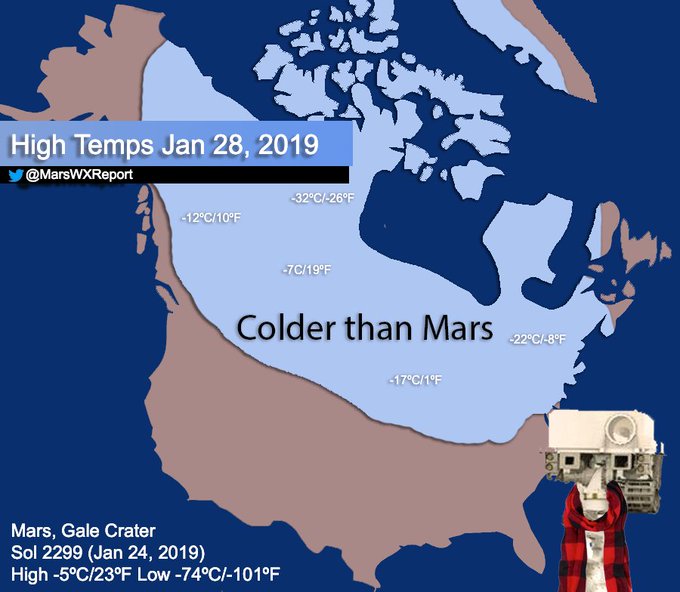
MARS

Mars Weather@MarsWxReport

High temps today across Canada and the upper midwest of the US didn’t reach Mars last reported high.

1,796 people are talking about this

To be fair, the Mars reading that Chicago and Madison are currently beating is a daily high, and it was recorded by one instrument on the Curiosity rover. Other places on Mars are probably colder. In fact, the last recorded low on Mars was negative 99.4 degrees Fahrenheit — way colder than the Midwest, but still pretty impressive.

The dramatic temperatures we’re seeing this week are not an indication that global warming has slowed. A study last year found that extreme winter weather events like these are linked to a warming Arctic. That means that even as average temperatures rise, people living in those areas need to adjust to sudden cold snaps.

The situation is so dire that experts who have worked in the Arctic and Antarctic are giving advice to Midwesterners on how to stay warm. Stay dry and combine layers of wool and silk, Akiko Shinya, an Antarctic researcher and the chief fossil preparator at Chicago’s Field Museum tells the Chicago Tribune.

But no matter how cold it is in Chicago, Minnesota, or Wisconsin — even if it’s colder than some places on Mars — we need to keep things in perspective: at least we’re not with the spacecraft New Horizons, which has been plunging farther and farther into the Solar System. It’s somewhere near the Kuiper Belt, which has a temperature hovering not above zero, but above absolute zero, which is the lowest theoretical temperature possible. Take notes, #PolarVortex 2020. Time to start setting goals.

Trump used the polar vortex to mock global warming. This map shows how wrong he is.

Trump tweeted, “What the hell is going on with Global Warming?” Well, it’s still happening.

It’s freaking cold out there, America. But you don’t need a Vox explainer to know that. You knew it the second you woke up. Knew it in that dreadful moment just before peeling off the blankets, when you thought, “This is the warmest and most comfortable I’ll feel all day.”

A mass of polar air is descending over the Midwestern United States. Chicago might hit a low of minus 22 degrees Fahrenheit on Wednesday. It’s a dangerous, potentially deadly situation. “This is not a case of ‘meh, it’s Iowa during winter and this cold happens,’” the Des Moines office of the National Weather Service warned.

This forecast is not, however, evidence against climate change. Let’s say it again: This forecast is not evidence against climate change.

Yet the president of the United States, who has consistently expressed skepticism over climate change, and whose administration has deliberately made backward progress on the issue, could not help himself (complete with “Waming” typo):

Donald J. Trump

@realDonaldTrump

In the beautiful Midwest, windchill temperatures are reaching minus 60 degrees, the coldest ever recorded. In coming days, expected to get even colder. People can’t last outside even for minutes. What the hell is going on with Global Waming? Please come back fast, we need you!

120K people are talking about this

(If this feels familiar, it’s because President Trump often tweets out this sentiment — I could keep linking — when it’s cold out.)

Yes, it can be weirdly cold in parts of the United States while global temperatures are still warmer than average. Remember, weather and climate are two different things. Weather is what we’re experiencing in the moment; climate is the broader trends that make certain weather experiences more or less likely.

Here’s one simple recent map from University of Maine’s Climate Change Institute that proves Trump wrong.

University of Maine Climate Change Institute

It shows daily temperature anomaly — or how different global temperatures were compared to a baseline from 1979 to 2000 — around the whole world. Overall, the world on January 29 was 0.3°C warmer on average, compared to the baseline. That’s true despite the fact parts of North America are 10-plus degrees below average.

And it doesn’t change the fact that 2018 was the fourth-hottest year on record, or that there’s a massive heat wave currently overtaking much of Australia, or that Arctic sea ice continues to disappear at an alarming rate. This year could still end up being the hottest year on record, as forecasters anticipate an El Niño cycle picking up.

Here’s the take-home lesson: You shouldn’t look out your window to determine if you believe climate change is real.

https://www.vox.com/science-and-health/2019/1/29/18202010/polar-vortex-2019-trump-tweet-wrong

‘Tipping point’ risk for Arctic hotspot

News.

‘Tipping point’ risk for Arctic hotspot

A rapid shift under way in the Barents Sea could spread to other Arctic regions, scientists attending a conference in Norway have warned. The Barents Sea is said to be at a “tipping point”, BBC News explains, changing from an Arctic climate to an Atlantic climate as the water warms. The Arctic Ocean has a surface layer of freshwater “which acts as a cap” on a layer of warmer, saltier water below. “But now in the Barents Sea there’s not enough freshwater-rich sea ice flowing from the high Arctic to maintain the freshwater cap,” BBC News reports.

BBC News Read Article
Scientists warn climate change could reach a ‘tipping point’ sooner than predicted as global emissions outpace Earth’s ability to soak up carbon

A new study warns that if greenhouse gas emissions continue at current rates, Earth’s vegetation may not be able to keep up. “Once plants and soil hit the maximum carbon uptake they can handle, warming could rapidly accelerate”, MailOnline writes. The study from Columbia University’s School of Engineering and Applied Science investigates how changes in soil moisture affect its capability to act as a “carbon sink”. Currently, “plants and soil around the world absorb roughly a quarter of the greenhouse gases that humans release”, the New York Times explains. But “when the soil is dry, plants are stressed and can’t absorb as much CO2 to perform photosynthesis”. And with warmer conditions microorganisms in the soil become more productive and “release more CO2”. The researchers found that although “plants and soil could absorb more CO2 during the wetter years, it did not make up for their reduced ability to absorb CO2 in the years when soil was dry”. Carbon Brief has also covered the study.

MailOnline Read Article
UK team drills record West Antarctic hole

Scientists have succeeded in cutting a 2km hole through the West Antarctic Ice Sheet to its base using a hot-water drill, BBC News reports. The team then collected sediment from the bottom of the hole and “deployed a series of instruments”. The researchers from the British Antarctic Survey hope that the data collected can help them determine how fast Antarctica might lose its ice in a warming world. Dr Andy Smith, who led the team, commented: “There are gaps in our knowledge of what’s happening in West Antarctica and by studying the area where the ice sits on soft sediment, we can understand better how this region may change in the future and contribute to global sea-level rise.”

BBC News Read Article
US coal retirements in 2019 to hit at least 6GW

2019 will see the retirement of nearly 6GW of coal power in the US, while 49GW of new power generation capacity will be added to the grid, according to the latest figures from S&P Global Market Intelligence, which is highlighted by CleanTechnica. In a related story, E&E News reports that a group of US utilities and other power producers say they may have to shut down their coal-fired power plants if a court rolls back a Trump administration extension to the deadline for closing some coal ash dumps. Their filing to the US Court of Appeals follows a legal challenge brought by environmental groups to the administration’s changes last July to the Obama-era regulations governing coal ash disposal, the article explains.

In other coal news, the Australian Financial Review reports that Jeremy Grantham, the “legendary British hedge fund manager” who founded GMO, has said that thermal coal is “dead meat”. Bloomberg investigates how a “loophole” lets Norway’s $1 trillion sovereign wealth fund boost its coal exposure. Meanwhile, Forbes says that China’s “coal reliance is not falling nearly as fast as some like to claim”. Chinese coal demand “hasn’t been falling in the absolute sense”, the piece argues, continuing: “China approved nearly $6.7bn worth of new coal mining projects in 2018, and production increased 5.2% to 3.55bn tonnes”.

CleanTechnica Read Article

Pentagon Confirms Climate Change Is A National Security Threat, Contradicting Trump

The military walks a fine line between the White House’s official climate denialism and the stark realities of a warming planet.
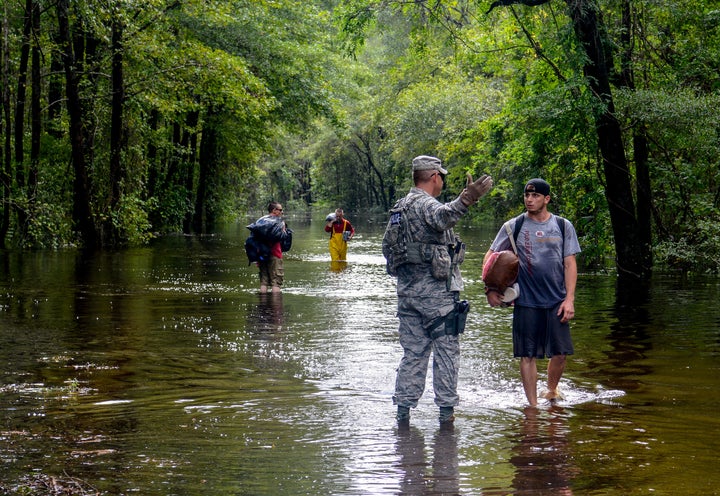
A U.S. Air Force member assigned to the South Carolina Air National Guard assists citizens during evacuation efforts after Hu

U.S. ARMY NATIONAL GUARD VIA GETTY IMAGES
A U.S. Air Force member assigned to the South Carolina Air National Guard assists citizens during evacuation efforts after Hurricane Florence hit in September 2018.

More than a year after President Donald Trump nixed climate change from his administration’s list of national security threats, the Pentagon has released an alarming report detailing how dozens of U.S. military bases are already threatened by rising seas, drought and wildfire.

“The effects of a changing climate are a national security issue with potential impacts to Department of Defense missions, operational plans, and installations,” states the 22-page document, which was published Thursday.

The congressionally mandated analysis looked at a total of 79 military installations around the country. The Defense Department found that 53 sites are currently vulnerable to repeat flooding. Langley Air Force Base in Virginia, for example, has experienced 14 inches of sea level rise since 1930. Additionally, more than half of the 79 bases are at risk from drought, while nearly half are vulnerable to wildfire.

These climate impacts are expected to pose a risk to several other installations over the next two decades, and the report notes that “projected changes will likely be more pronounced at the mid-century mark” if climate adaptation measures are not taken.

While the report is a clear recognition of the immediate threat that climate change poses to the nation’s military infrastructure, it makes no mention of the greenhouse gas emissions driving the crisis. It also doesn’t mention some of the most recent climate-related devastation to military bases, including the estimated $3.6 billion in damages that Camp Lejeune in North Carolina suffered during Hurricane Florence last year.

President Donald Trump removed any reference to climate change from the White House's National Security Strategy report in 20

BLOOMBERG VIA GETTY IMAGES
President Donald Trump removed any reference to climate change from the White House’s National Security Strategy report in 2017.

The Pentagon’s assessment comes just over a year after Trump eliminated any reference to climate change from the White House’s 2017 National Security Strategy report, breaking with two decades of military planning.

Even then, there was dissonance between the Defense Department and the White House.

A week earlier, Trump had signed the National Defense Authorization Act, which devoted about 870 words to the “vulnerabilities to military installations” over the next two decades and warned that rising temperatures, droughts and famines might lead to more failed states ― which are “breeding grounds of extremist and terrorist organizations.” “Climate change is a national security issue,” the legislation said, quoting then-Defense Secretary Jim Mattis; Gen. Joseph Dunford, the chairman of the Joint Chiefs of Staff; and four other former top military commanders. And it said that the Air Force’s $1 billion radar installation on a Marshall Islands atoll “is projected to be underwater within two decades.”

Yet a month later, in January 2018, the Pentagon followed Trump’s lead and scrubbed its National Defense Strategy of all references to climate change.

In Thursday’s report, the Defense Department describes climate change as “a global issue” and says it is “continuing to work with partner nations to understand and plan for future potential mission impacts.”

Subscribe to the Politics email.
How will Trump’s administration impact you?

The department said in a statement to HuffPost that the report delivers a “high-level assessment of the vulnerability of DOD installations.”

“DOD must be able to adapt current and future operations to address the impacts of a wide variety of threats and conditions, to include those from weather, climate and natural events,” Pentagon spokeswoman Heather Babb said by email. “DOD will focus on ensuring it remains ready and able to adapt to a wide variety of threats ― regardless of the source ― to fulfill our mission to deter war and ensure our nation’s security.”

The department did not respond to HuffPost’s questions about any White House role in the report.

Oddly, the new analysis omits the Marine Corps. It also doesn’t identify the top 10 military bases within each service branch that are most vulnerable to climate impacts, a requirement of the defense bill that Trump signed into law in December 2017.

“They don’t have the prioritization of impact. That’s confusing,” said John Conger, a former principal deputy under secretary of defense in the Obama administration and current director of the research group Center for Climate and Security.

Conger said he expects that Congress will tell the Pentagon to go back and fulfill its request.

Climate change was first publicly recognized as a major concern for the Pentagon in May 1990, when the U.S. Naval War College issued a 73-page report, titled “Global Climate Change Implications for the United States,” which found that “Naval operations in the coming half century may be drastically affected by the impact of global climate change.”

The issue gained prominence under President George W. Bush, despite that administration’s embrace of climate change denialism. In October 2003, the National Defense University published a report stating that “global warming could have a chilling effect on the military.”

Today, the military still walks a fine line when discussing climate issues, particularly given that many congressional Republicans reject the realities of human-driven warming. Officials at Naval Station Norfolk in Virginia, the world’s largest naval station, have admitted to avoiding language such as “sea level rise” when requesting maintenance funds to raise docks, according to journalist Jeff Goodell’s recent book The Water Will Come.

Sen. Jack Reed (D-R.I.), the ranking member on the Senate Armed Services Committee, called the new report “inadequate” and criticized the Trump-era Defense Department for “treating climate change as a back burner issue.”

“President Trump’s climate change denial must not adversely impact the security environment where our troops live, work, and serve,” Reed said in a Friday statement. “Whether the Trump Administration wants to admit it or not, climate change is already costing the Department significant amounts of taxpayer resources and impacting military readiness.”

The most dangerous climate feedback loop is speeding up

In Siberia, the carbon-rich permafrost warmed by 1.6°F in just the last decade.

AWI permafrost scientists investigate the eroding coastline at the Siberian island Sobo-Sise. CREDIT: Alfred Wegener Institute.
AWI PERMAFROST SCIENTISTS INVESTIGATE THE ERODING COASTLINE AT THE SIBERIAN ISLAND SOBO-SISE. CREDIT: ALFRED WEGENER INSTITUTE.

The carbon-rich permafrost warmed “in all permafrost zones on Earth” from 2007 to 2016, according to a new study.

Most ominously, Siberian permafrost at depths of up to 30 feet warmed a remarkable 1.6°F (0.9°C) in those 10 years, the researchers found. The permafrost, or tundra, is soil that stays below freezing (32°F) for at least two years.

Permafrost warming can “amplify global climate change, because when frozen sediments thaw it unlocks soil organic carbon,” warns the study, which was released Wednesday by the journal Nature Communications.

The thawing releases not only carbon dioxide but also methane (CH4) — a far more potent greenhouse gas — thereby further warming the planet. And as the planet continues to warm, more permafrost will melt, releasing even more greenhouse gases in a continuous feedback loop.

Thawing permafrost is an especially dangerous amplifying feedback loop because the global permafrost contains twice as much carbon as the atmosphere does today .

Normally, plants capture CO2 from the air during photosynthesis and slowly release that carbon back into the atmosphere after they die. But the Arctic permafrost acts like a very large carbon freezer — and the decomposition rate is very low. Or, rather, it was.

Humanity is leaving the freezer door wide open. As a result, the tundra is being transformed from a long-term carbon locker to a short-term carbon un-locker.

2017 study found the Alaskan tundra is warming so quickly it had become a net emitter of CO2 ahead of schedule. That study was the first to report a major portion of the Arctic had already become a net source of heat-trapping emissions.

The lead author, Dr. Roisin Commane, told ThinkProgress at the time, “We’re seeing this much earlier than we thought we would see it.”

The new study released on January 16 is the first “globally consistent assessment of permafrost temperature.” Four dozen researchers from around the world found that the ground temperature tens of feet below the surface “increased in all permafrost zones on Earth” — in the Northern Hemisphere, the mountains, and Antarctica.

“My take home [on the new study] is that the anecdotal site thawing that I heard about this winter is part of a region-wide warming that seems to be accelerating faster in this decade than in previous decades,” Dr. Commane told Inside Climate News.

That’s no surprise given that “Arctic air temperatures for the past five years (2014-18) have exceeded all previous records since 1900,” as the National Oceanic and Atmospheric Administration reported in its annual Arctic Report Card last month.

The only surprise is that the world continues to ignore this gravest of threats to humanity, even as it speeds up, triggers amplifying feedbacks, and rapidly approaches a climate death spiral.