(AP Photo/Sergei Chuzavkov) (The Associated Press)
Earth is on track to face devastating consequences of climate change – extreme drought, food shortages and deadly flooding – unless there’s an “unprecedented” effort made to reduce greenhouse gas emissions by 2030, a new United Nations report warns.
The planet’s surface has already warmed by 1 degree Celsius – or 1.8 degrees Fahrenheit – and could see a catastrophic 1.5 C — 2.7 F — increase between 2030 and 2052, scientists say.
“This is concerning because we know there are so many more problems if we exceed 1.5 degrees C global warming, including more heat waves and hot summers, greater sea level rise, and, for many parts of the world, worse droughts and rainfall extremes,” Andrew King, a climate science academic at the University of Melbourne, said in a statement to CNN.
The stunning statistics were released Monday in a report by the United Nations Intergovernmental Panel on Climate Change, which warned that we must take “rapid, far-reaching and unprecedented changes in all aspects of society” in order to save our planet.
Scientists with the Nobel Prize-winning IPCC said in order to have even a 50-50 chance of staying under the 1.5 degree cap, the world must become “carbon neutral” by 2050. Any additional carbon dioxide emissions would require removing the harmful gas from the air.
If nothing is done, Earth can expect heat wave temperatures to rise by 3 degrees Celsius, more frequent or extreme droughts, an increase in deadly hurricanes and as much as 90 percent of coral reefs dying off — including the Great Barrier Reef in Australia, according to the report.
Countries in the southern hemisphere would see the most drastic effects.
“The next few years are probably the most important in human history,” IPCC co-chair Debra Roberts, head of the Environmental Planning and Climate Protection Department in South Africa, told Agence France-Presse.
“The window on keeping global warming below 1.5 degrees C is closing rapidly and the current emissions pledges made by signatories to the Paris Agreement do not add up to us achieving that goal,” said King.
Staying within the 1.5 degrees C target, instead of 2 degrees C, would result in the global sea level rising 3.9 inches less by 2100, reducing flooding. It would also cut down on species loss and extinction and reduce the impact on various ecosystems.
“There were doubts if we would be able to differentiate impacts set at 1.5 C and that came so clearly. Even the scientists were surprised to see how much science was already there and how much they could really differentiate and how great are the benefits of limiting global warming at 1.5 compared to 2,” Thelma Krug, vice-chair of the IPCC, told Reuters. “And now more than ever we know that every bit of warming matters.”
With Post Wires
This story originally appeared in the New York Post.
It begins with how we live our lives every moment of every day.
By Auden Schendler and Andrew P. Jones
Mr. Schendler is a climate activist and businessman. Mr. Jones creates climate simulations for the nonprofit Climate Interactive.
Image
CreditCreditClaire Merchlinsky
On Monday, the world’s leading climate scientists are expected to release a report on how to protect civilization by limiting global warming to 1.5 degrees Celsius, or 2.7 degrees Fahrenheit. Given the rise already in the global temperature average, this critical goal is 50 percent more stringent than the current target of 2 degrees Celsius, which many scientists were already skeptical we could meet. So we’re going to have to really want it, and even then it will be tough.
The world would need to reduce greenhouse gas emissions faster than has ever been achieved, and do it everywhere, for 50 years. Northern European countries reduced emissions about 4 to 5 percent per year in the 1970s. We’d need reductions of 6 to 9 percent. Every year, in every country, for half a century.
We’d need to spread the world’s best climate practices globally — like electric cars in Norway, energy efficiency in California, land protection in Costa Rica, solar and wind power in China, vegetarianism in India, bicycle use in the Netherlands.
We’d face opposition the whole way. To have a prayer of 1.5 degrees Celsius, we would need to leave most of the remaining coal, oil and gas underground, compelling the Exxon Mobils and Saudi Aramcos to forgo anticipated revenues of over $33 trillion over the next 25 years.
And while the air would almost immediately be cleaner and people healthier, the heartbreaking impacts of climate change — flooding in London, New York and Shanghai, as well as in Mumbai, India; Hanoi, Vietnam; Alexandria, Egypt; and Jakarta, Indonesia, to touch on just one consequence — would continue for decades, regardless of emissions cuts, because of the long life of man-made greenhouse gases already in the atmosphere.
Some cynical news headlines will certainly follow the report: “Scientists Agree — We’re Cooked!” The headline writers would have a point. Solving climate is going to be harder, and more improbable, than winning World War II, achieving civil rights, defeating bacterial infection and sending a man to the moon all together.
So how do we engage in a possibly — but not probably — winnable struggle within a rigged system against great odds, the ultimate results of which we’ll never see? Forget success, how do we even get out of bed in the morning?
We could order in Chinese and lock ourselves in the closet, but we shouldn’t. Because there’s good news: We’re perfect for the job. If the human species specializes in one thing, it’s taking on the impossible.
We are constitutionally equipped to understand this situation. We are, after all, mortal, and so our very existence is a fight against inevitable demise. We also have experience: The wicked challenges we’ve faced through the ages have often been seemingly insurmountable. The Black Death killed off at least a third of Europein its time. World War II claimed 50 million lives. We won those battles — sort of. We’ve spent our time as Homo sapiens fighting what J.R.R. Tolkien called “the long defeat.”
Historically, we’ve tackled the biggest challenge — that of meaning, and the question of how to live a life — through the concept of “practice,” in the form of religion, cultural tradition or disciplines like yoga or martial arts. Given the stark facts, this approach might be the most useful. Practice has value independent of outcome; it’s a way of life, not a job with a clear payoff. A joyful habit. The right way to live.
Such an approach will require dropping the American focus on destination over journey, and releasing the concepts of “winning” and “winners,” at least in the short term. As the journalist I.F. Stone was said to have explained: “The only kinds of fights worth fighting are those you are going to lose because somebody has to fight them and lose and lose and lose until someday, somebody who believes as you do wins.” He added: “You mustn’t feel like a martyr. You’ve got to enjoy it.” Or as Camus put it: “One must imagine Sisyphus happy.”
To save civilization, most of us would need to supplement our standard daily practices — eating, caring for family and community, faith —with a steady push on the big forces that are restraining progress, the most prominent being the fossil fuel industry’s co-option of government, education, science and media. This practice starts with a deep understanding of the problem, so it will mean reading a little about climate science. Our actions must be to scale, so while we undertake individual steps in our lives, like retrofitting light bulbs, we must realize that real progress comes from voting, running for office, marching in protest, writing letters, and uncomfortable but respectful conversations with fathers-in-law. This work must be habitual. Every day some learning and conversation. Every week a call to Congress. Every year a donation to a nonprofit advancing the cause. In other words, a practice.
Maybe this approach doesn’t seem as noble as, say, our memory of the civil rights movement. But that era’s continuous, workmanlike grinding probably didn’t feel all that glorious then, either. With history as our judge, though, it does. And we know what happens when enough people take up a cause as practice: Cultural norms change. Think gay marriage. Think the sharp decline in smoking in the United States.
There should be no shortage of motivation. Solving climate change presents humanity with the opportunity to save civilization from collapse and create aspects of what the Rev. Dr. Martin Luther King Jr. called “the beloved community.” The work would endow our lives with some of the oldest and most numinous aspirations of humankind: leading a good life; treating our neighbors well; imbuing our short existence with timeless ideas like grace, dignity, respect, tolerance and love. The climate struggle embodies the essence of what it means to be human, which is that we strive for the divine.
Perhaps the rewards of solving climate change are so compelling, so nurturing and so natural a piece of the human soul that we can’t help but do it.
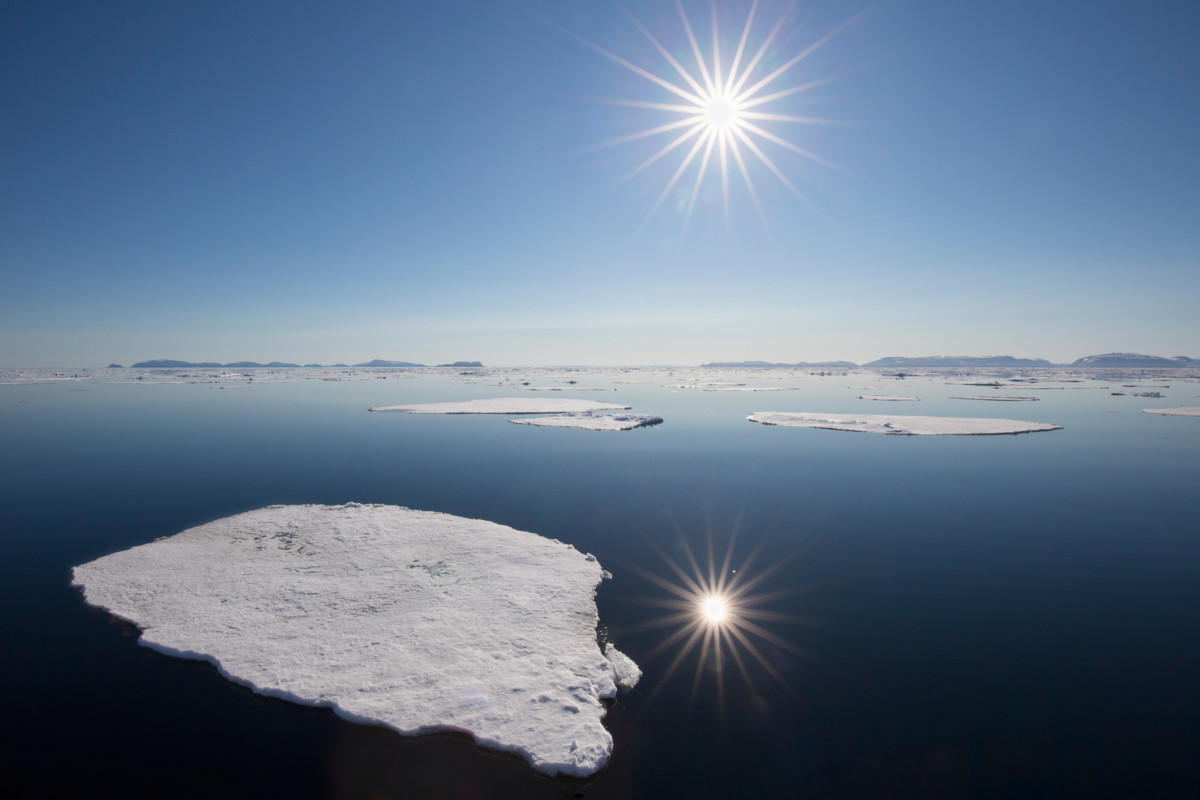
Midnight sun shines over the Arctic Ocean with drifting ice floes, north of the Arctic Circle in Nordaustlandet, Svalbard / Spitsbergen, Norway.ARTERRA / UIG VIA GETTY IMAGES
If you think this summer has been intense as far as record warm temperatures, wildfires, drought, and flooding events around the Northern Hemisphere, you haven’t seen anything yet — unless you happen to live in the Arctic.
According to the US National Oceanic and Atmospheric Administration (NOAA), air temperatures there are increasing at an “unprecedented rate” — twice as fast as they are around the rest of the globe. NOAA’s 2017 Arctic Report Card states unequivocally that the Arctic “shows no sign of returning to reliably frozen region of recent past decades.”
The Executive Summary of the report also adds, “Arctic paleo-reconstructions, which extend back millions of years, indicate that the magnitude and pace of the 21st century sea-ice decline and surface ocean warming is unprecedented in at least the last 1,500 years and likely much longer.”
A recent report from National Geographic revealed that some of the ground in the Arctic is no longer freezing, even during the winter. Along with causing other problems, this will become yet another feedback loop in the Arctic, causing yet more greenhouse gasses to be released from permafrost than are already being released and impacting the entire planet.
The simplest explanation for a positive climate feedback loop is this: The more something happens, the more it happens. One of the most well-known examples is the melting of sea ice in the Arctic during the summer, which is accelerating. As greater amounts of Arctic summer sea ice melt away, less sunlight is reflected back into space. Hence, more light is absorbed into the ocean, which warms it and causes more ice to melt, and on and on.
Dr. Ira Leifer is an academic researcher who specializes in bubble-related oceanographic processes (such as subsea bubble plumes emanating from the ocean floor), satellite remote sensing, and air pollution. Working closely with NASA on some of his projects, Leifer uses the agency’s satellite data to study methane in the Arctic and its role in climate disruption.
One of his concerns about a feedback loop already at play in the Arctic is how the heating of that region is already being amplified by ocean currents that transport warmer, more southerly waters northwards into Arctic seabed waters where it can affect methane deposits in submerged permafrost and sub-seabed methane hydrates.
“The release of this methane contributes powerfully to overall warming – methane is a very potent greenhouse gas, which actually has a bigger effect [on] the atmosphere’s radiative balance than carbon dioxide on decadal timescales,” Dr. Leifer told Truthout.
Although climate is generally thought to occur on century timescales, human timescales and ecological adaptation timescales are measured in decades instead of centuries, and this is now how many climate processes are being monitored given the rapidity of human-forced planetary warming.
Dr. Peter Wadhams is a world-renowned expert who has been studying Arctic sea ice for decades.
His prognosis for the Arctic sea ice is grim: He says it is in its “death spiral.”
“Multi-year ice is now much less than 10 percent of the area of the ice cover; it was 60 percent or more before 2000,” Dr. Wadhams told Truthout. “[Sea ice] extent in summer is down to 50 percent of its value in the 1980s.”
Dr. Wadhams, who is also the President of the International Association for the Physical Sciences of the Ocean (IAPSO), noted that this primary feedback loop is much further along than most of us realize.
“I see the summer sea ice disappearing by the early 2020s,” Wadhams said. He noted that the change of albedo (a measure of reflection of solar radiation) due to the loss of sea ice and snowline retreat across the Arctic “is sufficient to add 50 percent to the warming effect of CO2 emissions alone.”
Alarmingly, on August 21, Arctic scientists told The Guardian that the oldest and strongest sea ice in the Arctic had broken up for the first time in recorded history. One of them described the event as “scary,” in part because it occurred off the north coast of Greenland, which is normally frozen year-round. The region has long been believed to be “the last ice area”: It was thought, at least until now, to be the final place that would hold out against the melting impacts from an increasingly warmer planet.
Abrupt Acceleration
Temperatures are rising most strongly in the Arctic, with some areas already showing an increase of as much as 5.7 degrees Celsius (10.26 degrees Fahrenheit).
Dr. Michael MacCracken, Chief Scientist for Climate Change Programs with the Climate Institute in Washington, DC, explained to Truthout how, now that the Arctic is warmer, the temperature gradient between the tropics and the traditionally cold Arctic is reduced.
With a reduced gradient, the movement of warmth from low to high latitudes is slowed. As Earth rotates, this leads to a wavier jet stream that can carry low latitude warmth up to Alaska and elsewhere in the Arctic, and the southward reach of cold air in the Arctic to lower latitudes. This explains why New Orleans, for example, has recently experienced unusual freezing winter weather.
“In addition, the waves in the jet stream that result are shifting to the east less rapidly, which means the unusual weather patterns that are more frequently occurring are moving eastward less rapidly,” Dr. MacCracken explained. “So both wet and dry periods are lasting longer, contributing to both excessively wet (e.g., flooding) and excessively dry (e.g., wildfire) conditions.”
Dr. Wadhams is concerned about this as well.
“The jet stream effect is because Arctic air is warming faster than tropical air, so the temperature difference is decreasing,” he explained. “This reduces the driving force on the jet stream, so it then meanders, which brings hot air to the higher latitudes (and cold air to some low latitudes).”
Summer weather patterns are now increasingly likely to become stalled out over places like North America, portions of Asia, and Europe, according to a recent climate study that showed how a warming Arctic is causing heatwaves in other places to become more intense and persistent due to a slowing of the jet stream.
Dr. Leifer warned that as these processes continue and the Arctic continues to heat up faster than the tropics, the pole-equator temperature difference that controls our weather and causes three major weather circulation “cells” — tropical, mid-latitude, and arctic — will merge into a single weather cell. A similar merging of weather cells occurred during the time of the dinosaurs.
“The jet stream, which controls seasonal storms in the midlatitudes, is a result of these three cells, and would disappear in a single weather cell planet, dramatically altering rain patterns and almost certainly heralding an ecosystem catastrophe,” Leifer explained. “The plants that underlie the food chain would be replaced by others that the local animals (insects to apex predators) could not utilize — in short, an abrupt acceleration of the current Great Anthropocene Extinction event.”
The diminishment of the jet stream also contributes to another potentially catastrophic feedback loop within the Arctic seabed: Changes to the jet stream are causing longer and more intense heat waves to occur across the Arctic, which of course causes the Arctic Ocean to warm further.
Kevin Lister, an associate with the Climate Restoration Foundation in Washington, DC, co-authored a paper with Dr. MacCracken for the United Nations that addressed the crisis in the Arctic, among other climate disruption-related issues.
Unlike the most commonly accepted idea that global temperatures should not be allowed to increase by more than 1.5°C, Lister told Truthout that the planet reaching 1.5°C above baseline “is fundamentally dangerous and that the rate of change we are seeing today means we will not even be able to stop the temperature at this level.”
Lister said this conclusion was reached, in part, due to initial observations from Dr. Wadhams regarding how the loss of sea ice was amplifying rates of change in the Arctic.
Lister told Truthout that “methane emissions [in the Arctic] are already a severe risk,” and that he and Dr. MacCracken’s UN paper shows that once temperatures started rising they would be largely unstoppable due to the interacting nature of the feedback mechanisms.
“Thus, one feedback mechanism, such as sea ice melting, can trigger another, such as methane releases, which then accelerates the first in a tightening spiral,” he explained. “In reality, there are many critical feedback mechanisms and the interlocking effects between them means that the climate is far more unstable and irreversible than we are led to believe, and the climate’s change is likely to follow a super exponential progression once the temperature rises above a certain level.”
“There is the potential for seabed methane deposits off Greenland to be destabilized by the input of warm melt water and also heat transport,” he said, in addition to having pointed out that this process has been occurring in other areas around the Arctic for many years.
As I have written in the past, we are currently facing the very real possibility of a major methane release in the Arctic. Such a release would be a catastrophe for the global climate — and the survival of humans and other species.
Could a Dire Situation Lead to a “War for Survival”?
Lister and Dr. MacCracken both believe that the global focus on a maximum allowable temperature increase target of 1.5°C above baseline is both dangerous and unachievable. Most media and governmental attention has centered on keeping the Earth from warming 2°C over pre-industrial revolution baseline temperatures, and ideally limiting warming to 1.5°C. This is based on a politically agreed upon goal set forth during the 2015 Paris Climate talks, which were nonbinding.
“It reflects the way that intergovernmental climate change policy has been managed which has been to arbitrarily set a temperature target, which was firstly 2°C and then latterly 1.5°C, and then to see if economic and political policy can deliver an appropriate carbon budget,” Lister explained. “This is clearly not a rational way to develop climate change policy.”
Lister and Dr. MacCracken both believe that, in an ideal world, the process would be the other way round; governments would decide a safe temperature rise based on the best science and then set an appropriate climate change policy. But this is not the world we live in.
Mark Serreze, the director of the US National Snow and Ice Data Center at the University of Colorado, Boulder, recently pointed out how the Arctic climate system has entered uncharted territory, so that even computer models are “no longer providing a reliable guide to the future.”
Dr. Leifer said that even if we prepare for the inevitable sea level rise from Greenland melting alone, accelerated melting there is “very bad,” as it reduces the time to implement plans. However, he noted, most countries are not in preparation mode to begin with.
“For example, a forward-looking society would encourage relocation through, say, tax incentives and disincentives from, say, most of Florida, to higher ground — even purely on a hurricane insurance basis,” he said. “Sadly, forward-looking is incompatible with our political system’s biannual money festival, aka elections. Still, very few other countries are doing better — excepting some northern European countries, like Holland — despite differences.”
The impacts of climate disruption aren’t waiting for our preparations, or lack thereof. Dr. Leifer believes that, sooner or later, the sea levels will rise dramatically.
Once this happens, he believes coastal cities will have to be abandoned due to sea level rise and increasingly destructive hurricanes. He believes that the sooner that departure happens, the less destruction and loss of human lives we will experience.
Dr. MacCracken told Truthout that his greatest concern about Arctic feedback loops is that of the melting of the plateau of the Greenland Ice Sheet. He explained that the meltwater and warmth at the surface is penetrating down into the ice sheet, softening it enough that the glacial ice has started flowing outward, and as this happens, the surface of the ice sinks to lower altitudes.
This kicks in a feedback loop that ultimately causes warming to accelerate, which causes the ice to flow faster, which further accelerates the melting.
“The ice making up the Greenland Ice Sheet holds about the equivalent of 6-7 meters (~20 feet) of global sea level rise, and glaciological evidence makes clear that an order of approximately half of that melted during the last interglacial about 125,000 years ago, contributing significantly to the 4-8 meter rise in sea level at that time,” Dr. MacCracken said.
He pointed out that this rise was caused by a 1°C temperature increase, similar to the temperature increase Earth is experiencing right now (1.16°C above baseline).
“At that time, the atmospheric CO2 concentration was near 300 ppm and the warming was due to differences in the Earth’s orbit around the Sun; today, the orbital parameters are less favorable to significant warming, but the CO2 concentration is a good bit higher and growing,” Dr. MacCracken said. “And its warming influence acts all year long, making it not surprising that the loss of mass of ice from the Greenland Ice Sheet is going up rapidly with a stronger and stronger influence on sea level around the world.”
The rapidly melting Greenland Ice Sheet is precisely what is causing the AMOC to slow.
Moreover, an Arctic that is continuing to warm could lead to the failure of the Gulf Current, Dr. Leifer said.
“The resultant deep freeze that would hit Europe would destroy European agriculture and likely lead to a massive war for survival,” he warned.
A rise of seven degrees Fahrenheit, or about four degrees Celsius, compared with preindustrial levels would be catastrophic, according to scientists. Many coral reefs would dissolve in increasingly acidic oceans. Parts of Manhattan and Miami would be underwater without costly coastal defenses. Extreme heat waves would routinely smother large parts of the globe.
But the administration did not offer this dire forecast, premised on the idea that the world will fail to cut its greenhouse gas emissions, as part of an argument to combat climate change. Just the opposite: The analysis assumes the planet’s fate is already sealed.
The draft statement, issued by the National Highway Traffic Safety Administration (NHTSA), was written to justify President Trump’s decision to freeze federal fuel-efficiency standards for cars and light trucks built after 2020.
While the proposal would increase greenhouse gas emissions, the impact statement says, that policy would add just a very small drop to a very big, hot bucket.
“The amazing thing they’re saying is human activities are going to lead to this rise of carbon dioxide that is disastrous for the environment and society. And then they’re saying they’re not going to do anything about it,” said Michael MacCracken, who served as a senior scientist at the US Global Change Research Program from 1993 to 2002.
The document projects that global temperature will rise by nearly 3.5 degrees Celsius above the average temperature between 1986 and 2005 regardless of whether Obama-era tailpipe standards take effect or are frozen for six years, as the Trump administration has proposed.
The global average temperature rose more than 0.5 degrees Celsius between 1880, the start of industrialization, and 1986, so the analysis assumes a roughly four degree Celsius or seven degree Fahrenheit increase from preindustrial levels.
The world would have to make deep cuts in carbon emissions to avoid this drastic warming, the analysis states.
And that “would require substantial increases in technology innovation and adoption compared to today’s levels and would require the economy and the vehicle fleet to move away from the use of fossil fuels, which is not currently technologically feasible or economically feasible.”
The White House did not respond to requests for comment.
World leaders have pledged to keep the world from warming more than 2 degrees Celsius compared with preindustrial levels, and agreed to try to keep the temperature rise to 1.5 degrees Celsius.
But the current greenhouse gas cuts pledged under the 2015 Paris climate agreement are not steep enough to meet either goal. Scientists predict a 4 degree Celsius rise by the century’s end if countries take no meaningful actions to curb their carbon output.
Trump has vowed to exit the Paris accord and called climate change a hoax. In the past two months, the White House has pushed to dismantle nearly half a dozen major rules aimed at reducing greenhouse gases, deregulatory moves intended to save companies hundreds of millions of dollars.
The vehicle rule alone would put 8 billion additional tons of carbon dioxide in the atmosphere this century, more than a year’s worth of total US emissions, according to the government’s own analysis.
Administration estimates acknowledge that the policies would release far more greenhouse gas emissions from America’s energy and transportation sectors than otherwise would have been allowed.
The statement is the latest evidence of deep contradictions in the Trump administration’s approach to climate change.
Despite Trump’s skepticism, federal agencies conducting scientific research have often reaffirmed that humans are causing climate change, including in a major 2017 report that found “no convincing alternative explanation.”
In one internal White House memo, officials wondered whether it would be best to simply “ignore” such analyses.
In this context, the draft environmental impact statement from NHTSA – which simultaneously outlines a scenario for very extreme climate change, and yet offers it to support an environmental rollback – is simply the latest apparent inconsistency.
David Pettit, a senior attorney at the Natural Resources Defense Council who testified against Trump’s freeze of car mileage standards Monday in Fresno, Calif., said his organization is prepared to use the administration’s own numbers to challenge its regulatory rollbacks.
He noted that NHTSA document projects that if the world takes no action to curb emissions, current atmospheric concentrations of carbon dioxide would rise from 410 parts per million to 789 ppm by 2100.
“I was shocked when I saw it,” Pettit said in a phone interview. “These are their numbers. They aren’t our numbers.”
Conservatives who condemned President Barack Obama’s climate initiatives as regulatory overreach have defended the Trump administration’s approach, calling it a more reasonable course.
Obama’s climate policies were costly to industry and yet “mostly symbolic,” because they would have made barely a dent in global carbon dioxide emissions, said Heritage Foundation research fellow Nick Loris, adding: “Frivolous is a good way to describe it.”
NHTSA commissioned ICF International Inc., a consulting firm based in Fairfax, Va., to help prepare the impact statement.
An agency spokeswoman said the Environmental Protection Agency “and NHTSA welcome comments on all aspects of the environmental analysis” but declined to provide additional information about the agency’s long-term temperature forecast.
Federal agencies typically do not include century-long climate projections in their environmental impact statements. Instead, they tend to assess a regulation’s impact during the life of the program – the years a coal plant would run, for example, or the amount of time certain vehicles would be on the road.
Using the no-action scenario “is a textbook example of how to lie with statistics,” said MIT Sloan School of Management professor John Sterman.
“First, the administration proposes vehicle efficiency policies that would do almost nothing [to fight climate change]. Then [the administration] makes their impact seem even smaller by comparing their proposals to what would happen if the entire world does nothing.”
This week, UN. Secretary-General António Guterres warned leaders gathered in New York, “If we do not change course in the next two years, we risk runaway climate change . . . Our future is at stake.”
Federal and independent research – including projections included in last month’s analysis of the revised fuel-efficiency standards – echoes that theme.
The environmental impact statement cites “evidence of climate-induced changes,” such as more frequent droughts, floods, severe stormsand heat waves, and estimates that seas could rise nearly three feet globally by 2100 if the world does not decrease its carbon output.
Two articles published in the journal Science since late July – both co-authored by federal scientists – predicted that the global landscape could be transformed “without major reductions in greenhouse gas emissions” and declared that soaring temperatures worldwide bore humans’ “fingerprint“.
“With this administration, it’s almost as if this science is happening in another galaxy,” said Rachel Cleetus, policy director and lead economist for the Union of Concerned Scientists’ climate and energy program. “That feedback isn’t informing the policy.”
Administration officials say they take federal scientific findings into account when crafting energy policy – along with their interpretation of the law and Trump’s agenda.
The EPA’s acting administrator, Andrew Wheeler, has been among the Trump officials who have noted that US emissions of carbon dioxide and other pollutants have fallen over time.
But the debate comes after a troubling summer of devastating wildfires, record-breaking heat and a catastrophic hurricane – each of which, federal scientists say, signals a warming world.
Some Democratic elected officials, such as Washington Governor Jay Inslee, said Americans are starting to recognize these events as evidence of climate change.
On Feb. 25, Inslee met privately with several Cabinet officials, including then-EPA chief Scott Pruitt, and Western state governors.
Inslee accused them of engaging in “morally reprehensible” behavior that threatened his children and grandchildren, according to four meeting participants, who spoke on the condition of anonymity to provide details of the private conversation.
In an interview, Inslee said that the ash from wildfires that covered Washington residents’ car hoods this summer, and the acrid smoke that filled their air, has made more voters of both parties grasp the real-world implications of climate change.
“There is anger in my state about the administration’s failure to protect us,” he said. “When you taste it on your tongue, it’s a reality.”
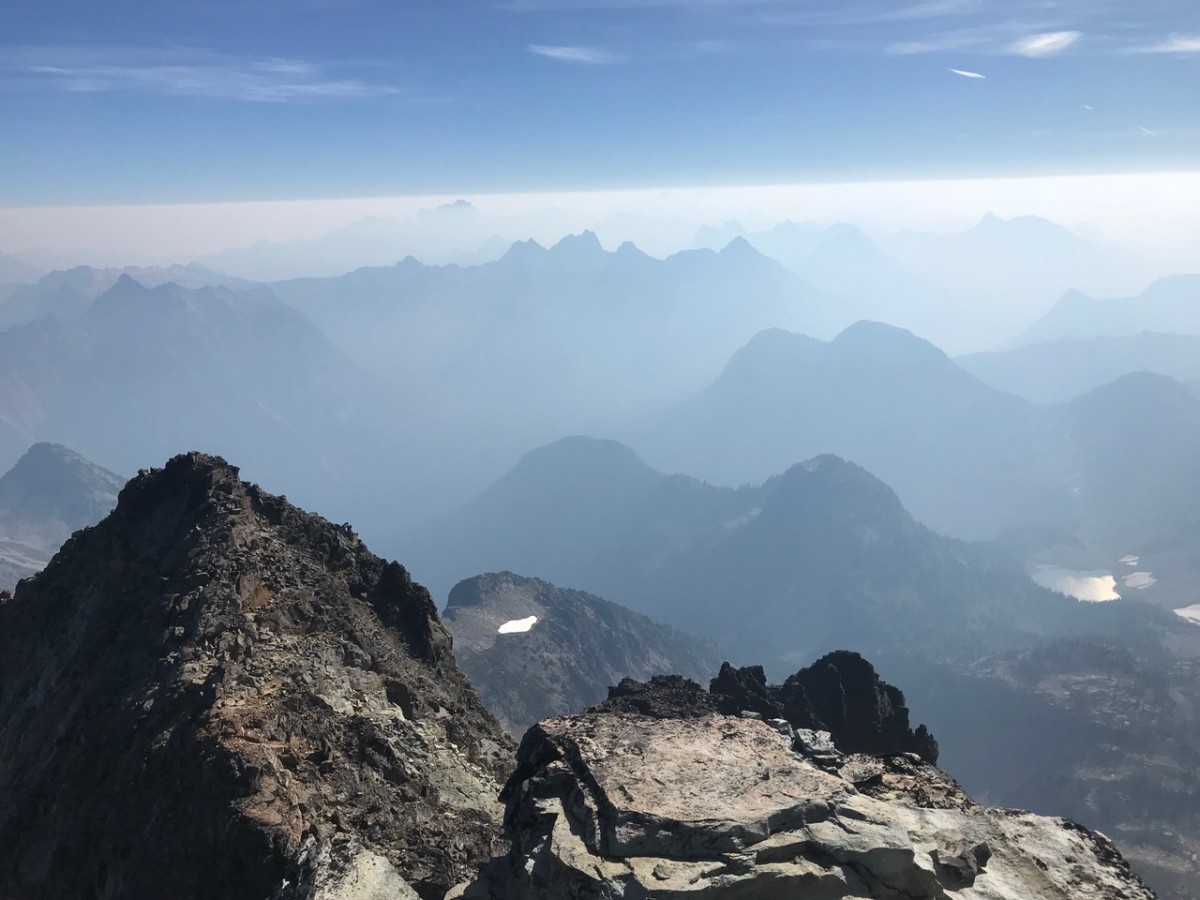
Smoke from wildfires in British Columbia, Eastern Washington and Montana enshrouds the Cascade Mountains of Washington State. In the Pacific Northwest, experiencing weeks on end of wildfire smoke during the summer months has become the “new normal.”DAHR JAMAIL
Over the years, writing these climate disruption dispatches has often weighed heavily on my soul. I’ve struggled to find a delicate balance between tracking this information, which these days means reporting on the demise of the biosphere, and living a meaningful life.
Recently, I again failed to achieve that balance, and needed to take a short respite from work to find my inner footing. I headed into my sanctuary, the mountains, for solace. I backpacked up into the northeastern Cascade Mountains of Washington State, where I live, and pitched a camp on the banks of a clear, turquoise alpine lake at 6,900 feet. I was surrounded by snowfields, high peaks, and mountain larch that will soon be turning from green to yellow as autumn rapidly approaches.
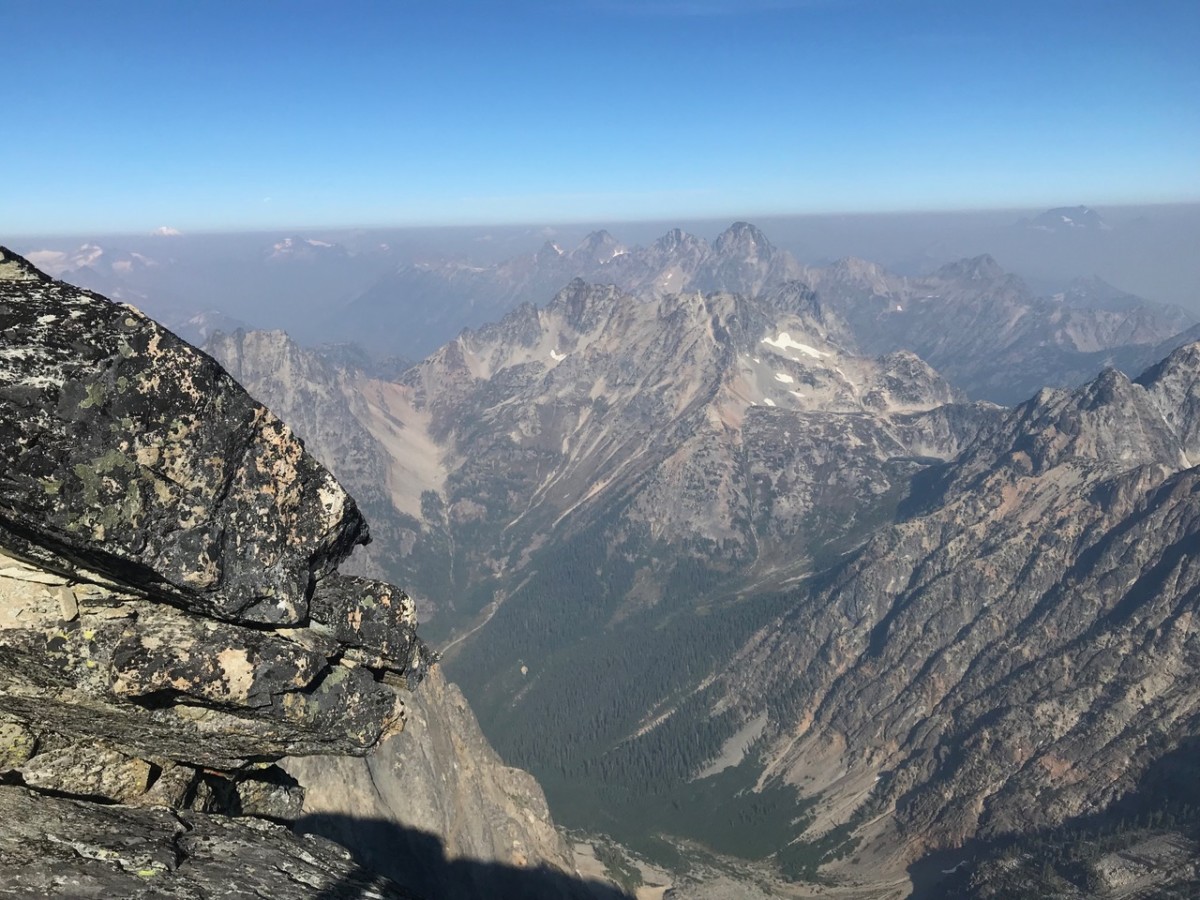
Despite smoke in the air from wildfires in Canada, eastern Washington, and beyond, conditions were beautiful. The next day I scrambled to the top of nearby Black Peak, but did so as the smoke became increasingly thick. My lungs felt scratchy, my eyes burned, and I could tell it was affecting my thinking. Atop the peak at 8,975 feet found me at roughly the elevation of the smoke line. Above were crystal clear blue skies; below, everything was shrouded in a brownish-grey sooty haze.
Wildfire smoke covering the Cascade Mountains from 9,000 feet and below. As anthropogenic climate disruption progresses, science shows wildfires becoming larger, burning hotter and occurring far more frequently.DAHR JAMAIL
After taking lunch on the summit and reveling in the majestic yet smoky views, I headed back down to camp, where the smoke was rolling in by way of thick clouds. I decided to break camp a day early and hike down to the trailhead to head to my home near the west coast, hoping the smoke might not be as thick closer to the Pacific.
Don’t miss a beat
Get the latest news and thought-provoking analysis from Truthout.
Two hours of driving later, the haze wasn’t as thick, but remained present. Not until I boarded the ferry and crossed the Strait of Juan de Fuca across Puget Sound did I finally emerge from the suffocating wildfire smoke.
The feeling of entrapment within the smoke, the coughing and wheezing while trying to breathe, the primal urge to escape it, all underscored to me how dire our situation is globally. Arriving back home, out of the smoke, I thought of future summers. Even up here in the verdant Pacific Northwest, wildfire smoke will be the norm. Yet, compared to those who’ve already lost their homes to the fires, or those who’ve had everything they own submerged by storm surges from hurricanes, or refugees fleeing war-torn countries destabilized by drought and climate disruption impacts, smoke inhalation is a minor problem. Such is the climate-triage of our new world.
Moreover, the impacts of runaway anthropogenic climate disruption (ACD) will assuredly continue to worsen.
In one of the more important recent scientific studies, published in the journal Science, researchers warn that ACD could cause many of the planet’s ecosystems to become unrecognizable.
“Our results indicate that terrestrial ecosystems are highly sensitive to temperature change and suggest that, without major reductions in greenhouse gas emissions to the atmosphere, terrestrial ecosystems worldwide are at risk of major transformation, with accompanying disruption of ecosystem services and impacts on biodiversity,” reads the abstract of the study.
Stephen Jackson, the lead author of the study, told The Washington Post, “Even as someone who has spent more than 40 years thinking about vegetation change looking into the past … it is really hard for me to wrap my mind around the magnitude of change we’re talking about.”
This summer’s extraordinary heat wave across the Northern Hemisphere was and is in no way an anomaly. Another recent study warned that there will be at least four more years of extreme temperatures. This means temperatures are expected to be warmer than expected, even above and beyond the abnormal warming being generated by ACD.
Given the fact that there are already places in the Arctic where the ground no longer freezes, even during the winter, this does not bode well.
Another recent report, What Lies Beneath: The Understatement of Existential Climate Risk by Australian researchers with the independent think tank National Centre for Climate Restoration, is blunt about the fact that we are rapidly leaving the safe zone for human habitability on the planet. They note that ACD poses an “existential risk to human civilization,” with dire consequences unless dramatic actions are taken toward mitigation. The paper also points out how climate research, including the work of the Intergovernmental Panel on Climate Change (IPCC), has consistently underplayed these risks and leaned towards conservative projections. The paper even goes on to call the IPCC “dangerously misleading” regarding its low-ball predictions of accelerating ACD.
“Climate change is now reaching the end-game,” the foreword to the report reads, “where very soon humanity must choose between taking unprecedented action, or accepting that it has been left too late and bear the consequences.”
One only need look at this past summer to see that we have, indeed, reached the end-game.
Earth
You know the Earth’s climate is warming extremely dramatically when a tree that used to grow in a warmer Alaska several million years ago is once again growing there. The tree requires warmer temperatures to grow, which are now once again occurring in Alaska.
Warming is now putting our food supply in grave danger. Globally, we are already seeing a weaker wheat crop this year due to record-breaking high temperatures around the world. It’s been well known for quite some time that higher carbon dioxide (CO2) levels in the atmosphere cause crops to be less nutritious, but researchers recently warned that the scope of the problem means hundreds of millions more people than previously thought will now be nutrient deficient as temperatures continue to climb. The research showed that 1.4 billion women of childbearing age, along with children less than five years old, will be living in regions with the highest risk of iron deficiency.
Making matters worse, another recent study warned that global crop losses due to increasing pests will soar as temperatures continue to climb. The study projects that increasing heat causes the number of insects — and the amount they eat — to grow, so that nearly 50 percent more wheat will be destroyed from just a 2°C increase in temperatures, along with 30 percent more maize and 20 percent more rice.
Another recent report revealed how in the Mojave Desert region in California and Nevada, there has been a precipitous (42 percent) decline in bird species in the past century alone, likely due to the impacts of ACD.
The heat in Europe this summer was intense enough that 22 people died from the West Nile virus there, as experts warned of more mosquito and tick-borne disease outbreaks as temperatures there continue to increase.
Another report warned of how high temperatures and increasing air pollution may well increase the risk of mental illnesses and suicide. Having recently spent days living amidst the thick smoke of wildfires, I can understand this warning, given the way in which experiences of this nature affect the psyche.
Water
Climate impacts across the Arctic continue to sound alarm bells with scientists.
At the time of this writing, at least 36 people have died from the impacts (mostly flooding) from Hurricane Florence that struck the US east coast.Days after it made landfall, rainfall persisted — 40 inches of rain in North Carolina alone — and rivers continued to swell, as thousands of homes and businesses were affected by record flooding that besieged several states. As the atmosphere warms, hurricanes now generate increasingly severe rain events, along with packing stronger winds from the increased energy produced by the warmer air and warmer waters over which they travel.
The oldest, thickest and strongest sea ice in the Arctic, which has never opened up in recorded history, has melted open twice this year … an occurrence that scientists have described as “scary.” Sea ice in that region is shrinking so much now that over the summer, for the first time, a container ship took the Arctic sea route.
Researchers recently announced that a pocket of warm ocean water under the surface of the Canada Basin could melt a large portion of the region’s sea ice, warning that the situation is a “ticking time bomb.”
Back on land, mountaineers in Europe are bemoaning the fact that ACD is literally melting the French Alps, causing rocks to become unstable and more prone to collapse as permafrost and ice melt.
Meanwhile, the oceans continue to warm unabated. In August off the coast of San Diego, scientists recorded an all-time high temperature of seawater, causing scientists to warn that much sea life is now “in peril.” The number of marine heatwaves doubled between 1982 and 2016.
Scientists have also warned of “unprecedented” changes to Japan’s marine life as atmospheric CO2 and acidification both continue to increase.
As land-ice melts and oceans warm, sea levels continue to rise unabated as well.
Jakarta, a mega city of more than 10 million, has now become known as the fastest-sinking city in the world. Large parts of the capital of Indonesia will be completely submerged by just 2050, and parts of it are already disappearing underwater. As Jakarta and other major coastal cities begin to be swallowed by the seas, we must ask: Where will these millions of people go?
Things aren’t much better in Europe, where a recent analysis showed that the cost of coastal flooding there could reach $1 trillion annually by 2100 if current trends continue. At the moment, there is no reason to think they will not.
Bangkok, another city of at least 10 million, is struggling to stay above water as some forecasts warn that large portions of it could be submerged in just over 10 years.
In India, while the monsoon is a regular event and always brings flooding, it is clearly amped up due to ACD impacts. Flash flooding in the southern Indian state of Kerala resulted in the death of at least 324 people, which officials there declared to be the worst in at least the last century.
In the US, historic flooding hit the northeast that same month, causing New Jersey to declare a partial state of emergency and evacuations occurred.
A recent study warned that the US West could experience three times as much destructive flooding if ACD is left unchecked, with communities in the Rocky Mountain and Sierra Nevada ranges at particular risk from rapidly flooding rivers and “rain-on-snow” flash floods that are predicted to become more frequent.
Meanwhile, droughts continue around the world.
A drought in Switzerland was bad enough this summer that the Swiss army had to airlift water to thirsty cows in pastures that were plagued with drought amidst the intense heat wave that swept that continent this summer.
You don’t need to read this dispatch to know this summer has been exceptional for wildfires.
At one point, Canada’s British Columbia had 566 wildfires burning across it, causing the province to declare a state of emergency that prompted thousands of people to evacuate. That declaration was then extended as the fires continued, with 2018 becoming the worst fire season on record(breaking the previous record, set just last year) for British Columbia. The warmer the atmosphere becomes, the longer, hotter and drier wildfire season becomes in British Columbia, as well as around the rest of the world.
Smoke from those fires, along with hundreds of others across the US West was visible from, literally, a million miles away in space.
In California something occurred never before seen in the history of wildfires in that state: A literal tornado of fire the size of three football fields emerged, as vast areas of that state burned in what has become a normal situation there during the summers, thanks largely to ACD.
Things were bad enough in Washington State that at one point western Washington saw its worst air quality on record. Because of the wildfires, in late August, Spokane had worse air quality than Beijing and Delhi combined.
Air
It is only a matter of time before several cities begin to see 50°C (122°F) temperatures — which is halfway to boiling — on a regular basis. This spring, Nawabshah, Pakistan, and two years before that Phalodi, India, both experienced 50°C. Bear in mind that even 35°C (95°F) temperatures, along with humidity, can be fatal to humans after just a few hours. A recent report warns that temperatures of at least 35°C will likely become common across India, Pakistan, southeast Asia and China sooner rather than later, with half the world’s population exposed to potentially deadly heat for 20 days a year by 2100.
Simultaneously, increasingly warm temperatures around the globe have sparked yet another feedback loop: Warmer temperatures are causing soil to release more CO2 into the atmosphere, which then causes temperatures to increase further.
Lastly in this section, to give you an idea of the intensity of this summer’s heat wave, Korea’s Ministry of Agriculture, Food and Rural Affairs reported recently that 4.53 million cows, ducks, pigs, chickens and other farm animals died from the heat wave that swept that country. This was a 56.5 percent increase over the number of animals killed by the heat last year during the same time period.
Denial and Reality
The usual ACD denial from the Trump administration continues, despite the planet spiraling deeper into abrupt ACD impacts daily.
During a visit to the apocalyptic Redding fire zone in California, Trump administration officials Agriculture Secretary Sonny Perdue and Interior Secretary Ryan Zinke refused to talk about ACD when it came to how to address the worsening wildfires.
The Trump administration also proposed a new rule that relaxes carbon limits on power plants, which allows the plants to run longer. The EPA’s own analysis has shown that this step could lead to 1,400 more premature deaths by 2030 due to the pollution. Explicit warnings about ACD impactswere also cut from the Trump administration plan to weaken curbs on power plant emissions.
Meanwhile, big oil has asked the federal government to protect its infrastructure from the impacts of ACD, as Texas aims to acquire billions of dollars of federal funding to build up its coast in an effort to protect its oil infrastructure from hurricanes, flooding and sea level rise.
On the reality front, the State of California recently passed legislation, including steps to take to make it happen, geared toward the cessation of using fossil fuels to generate electricity by the year 2045.
Yale’s climate change communication program released an up-to-date visualization showing that the vast majority of Americans believe ACD is real, as well as a graphic that enables one to focus in on the parts of the country where willful ignorance is the most rampant.
Things are already dire enough that several countries in the Caribbean recently pleaded with the Trump administration to grasp the dire threats that accompany ACD and do something about it. So far, of course, their pleas have not been answered with action.
A fascinating graphic was also published by The Revelator, which provides an interactive map you can use to zoom in on where you live to see how much your temperatures will increase by the year 2050. I strongly recommend looking at the map, paying particular attention to the US Midwest, given the realities of crop loss and decreasing nutrition in crops.
To conclude this month’s dispatch, a UN official recently announced that governments are “not on track” to cap global temperatures to below 2°C, the goal of the 2015 Paris climate talks. Many scientists have long warned that a 1°C warming was already enough to lock in catastrophic ACD impacts. We are already over 1°C. The ongoing failure of the world’s governments to face these facts guarantees a lasting and devastating impact for all species on Earth, including humans.
Breached swine lagoons. Overflowing coal waste ponds. Sewage in the streets. The hellish aftermath of climate-fueled Hurricane Florence.
By Hayley Miller and Chris D’Angelo
JASON MICZEK/GREENPEACE
This image provided by Greenpeace shows a damaged structure on a hog farm surrounded by floodwaters in White Oak, North Carolina, after Hurricane Florence battered the area.
FAYETTEVILLE, N.C. — Florence’s rain came down in sheets ― unrelenting, and for days on end.
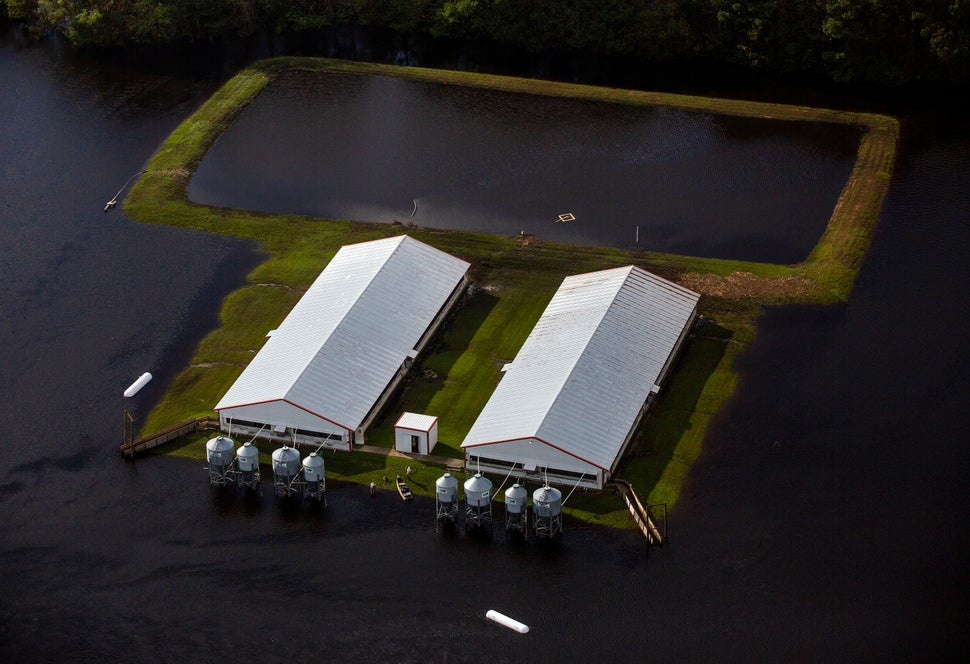
The water inundated homes, many still boarded up from Hurricane Matthew two years earlier. It swallowed farm operations, killing millions of chickens and turkeys and overflowing open pits full of hog feces. It flooded coal ash ponds, sending the toxic byproduct of burning coal into area waterways. The smell of human waste tainted neighborhoods; in the small town of Benson, 300,000 gallons of raw sewage spilled into the streets.
On Friday, Charlotte-based Duke Energy reported that a dam containing a lake at one of its power plants in Wilmington had been breached by floodwaters, potentially spilling coal ash from a nearby dump into the Cape Fear River.
Many parts of North Carolina are still unnavigable, with entire stretches of highway turned to rivers. Rural roads have been washed out.
From a bridge in east Fayetteville on Monday afternoon, residents watched as a plastic barrel, basketballs, fishing gear and a decapitated duck decoy floated down the swollen Cape Fear River toward the Atlantic Ocean, some 80 miles away. Along the bank, mattresses, a dog kennel, a frying pan and scores of garbage bobbed among the trees.
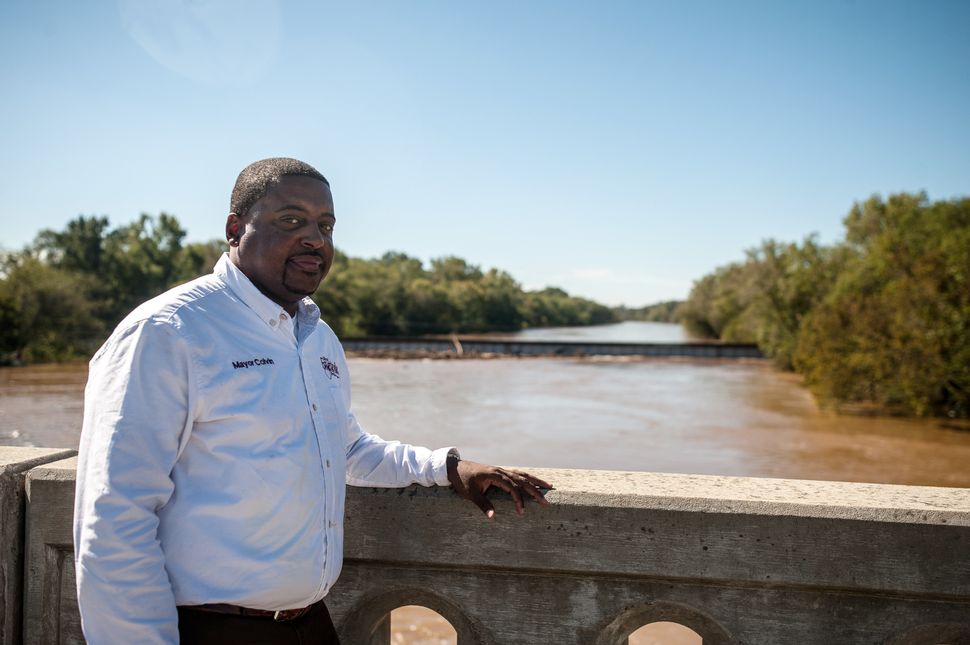
Mitch Colvin, the mayor of this inland city of more than 200,000, spoke with members of the media and law enforcement officials on the bridge Tuesday and marveled at the height of the river. By that point it had reached the bottom of a railroad bridge, causing trees and debris to pile up behind it.
Colvin told HuffPost he’s no expert on climate change, but the frequency and magnitude of recent storms have made it clear that “something has happened.”
“You know, this is our second 500-year storm in two years,” the 45-year-old mayor said as he leaned against the bridge’s concrete railing. “We need to reassess the classification of these storms. But we also need to plan as a community and as a region for how to prepare for this.”
JOSEPH RUSHMORE FOR HUFFPOST
In Fayetteville, Mayor Mitch Colvin stands atop the Person Street bridge on Tuesday, which spans the Cape Fear River.
Hurricanes like Florence aren’t simply natural disasters ― they’re catastrophic events made worse by anthropogenic climate change, events that threaten human health and safety long after the storm has passed.
As it happened, industries that are among the biggest contributors to the climate crisis were some of the hardest hit in Florence’s aftermath.
Livestock production accounts for 14.5 percent of global human greenhouse gas emissions, according to the United Nations’ Food and Agriculture Organization. The Environmental Protection Agency estimates the agricultural sector, including livestock and crop production, is responsible for 9 percent of all carbon emissions in the United States.
North Carolina is the second-largest pork producing state in the country, behind Iowa. Nearly 9 million hogs are raised for slaughter on the state’s 2,100 hog farms, where the animals’ waste is dumped into massive open-air cesspools called lagoons.
By Friday, flooding had caused structural damage to at least six of the state’s 3,300 hog waste lagoons. Three of these damaged pits were breached and another 30 had overflowed, causing swine fecal matter to spill into and potentially contaminate the surrounding waterways with toxic hydrogen sulfide and ammonia.
One hog farmer in Duplin County reported the flooding resulted in a “total loss” of at least 2.2 million gallons of waste from a single lagoon, according to North Carolina’s Department of Environmental Quality.
“It’s yet another problem that is posed by this industrial model of production,” Waterkeeper Alliance attorney Will Hendrick told HuffPost. “It should be the case that we can produce food without putting our people in jeopardy.”
The North Carolina Pork Council has downplayed the significance of the lagoon overflow.
“While we are dismayed by the release of some liquids from some lagoons, we also understand that what has been released from the farms is the result of a once-in-a-lifetime storm and that the contents are highly diluted with rainwater,” the hog farm advocacy group said in a statement Wednesday.
CASEY TOTH /THE NEWS OBSERVER VIA AP
This Sept. 17, 2018, photo shows flood waters from Hurricane Florence surround two hog houses and it’s lagoon near Kinston, North Carolina.
But the increasing frequency of severe weather events in the last few years due to climate change suggests Florence is in no way a “once-in-a-lifetime” storm. And since most of the state’s hog farms sit on coastal plains, and climate change is producing bigger, wetter storms, it’s likely these swirling cesspools of hog waste will continue to pose a threat to waterways and their surrounding communities for years to come.
“This industry has shown its vulnerabilities in terms of these weather events for decades and has still resisted the need for change,” Hendrick said. “They continue to prioritize profit over people who are affected by their operations.”
The storm has also wreaked havoc on North Carolina’s energy sector, causing coal ash containment ponds in at least two sites to swell. The ash, which is the residue left behind by burning coal, contains toxic elements like arsenic, mercury and lead and is often doused with water and left in containment ponds for years.
In 2017, coal accounted for 69 percent of all carbon emissions from the U.S. energy sector.
Duke Energy, one of the world’s largest utility companies, has 31 coal ash basins across North Carolina, holding 111 million tons of waste. It has decommissioned several of its coal power plants in the last few years, and earlier this month announced plans to shutter its remaining seven by 2048.
Many of those coal ash ponds are dangerously positioned next to rivers and lakes and are highly vulnerable to flooding in an event like Florence. Like hog waste lagoons, heavy rains can cause these coal ash landfills and ponds to overflow into waterways ― and Florence did just that, even as Duke downplayed the risk in advance of the storm.
This New World
The current capitalist system is broken. Get updates on our progress toward building a fairer world.
DUKE ENERGY
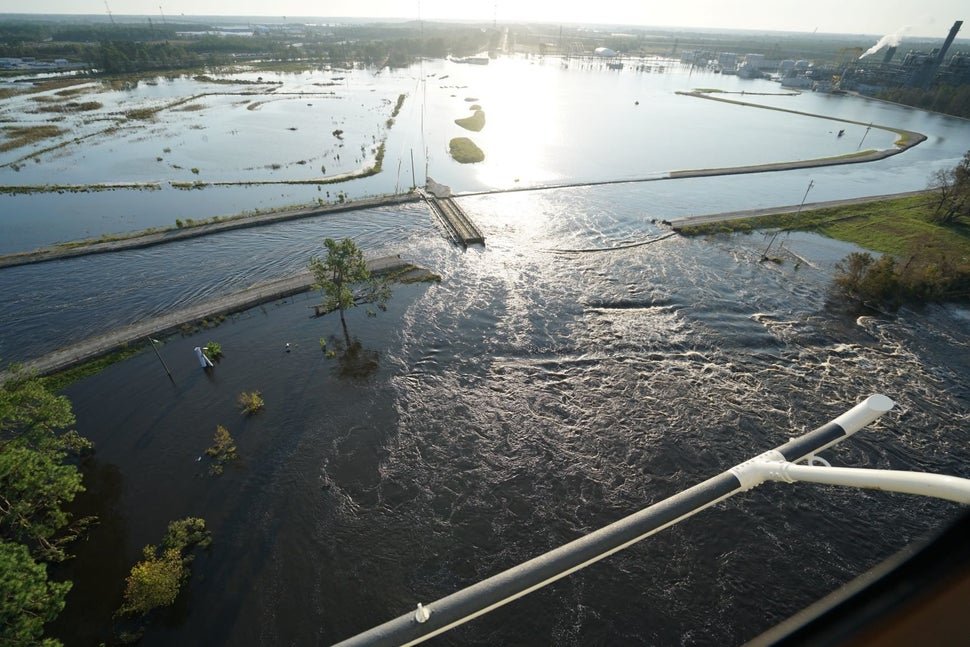
This image provided by Duke Energy shows Sutton Lake flowing into the Cape Fear River.
Duke Energy reported last Saturday that 2,000 cubic yards of coal ash had poured into Sutton Lake from an adjacent coal ash pond. The lake, constructed by Duke Energy in 1972 as a cooling pond for its power plant, has also been designated as a recreational boating and fishing area by the state.
On Friday, the company said floodwaters breached a dam containing Sutton Lake and that it could not rule out that coal ash was flowing into the Cape Fear River.
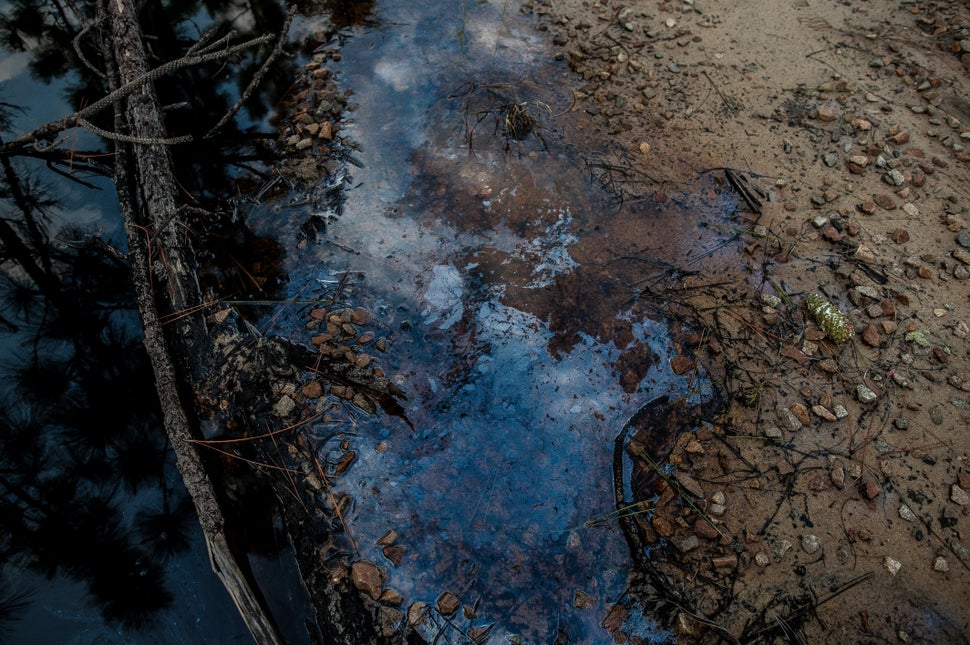
Spillage from three inactive coal ash ponds was also reported at the H.F. Lee Plant in Goldsboro on Monday. Duke Energy said visual inspections suggested low-hanging vegetation allowed only “a small amount” of coal ash to be displaced. But Waterkeeper Alliance pushed back on the company’s assessment after visiting the site.
“Floating coal ash is clearly visible because flood waters have eroded the vegetative cover and are steadily washing ash downstream,” Donna Lisenby, global advocacy manager for Waterkeeper Alliance, shared in a Facebook post on Wednesday. “Duke Energy is falsely telling news reporters and the public that the tree cover on the ash ponds at Lee are preventing ash releases.”
Frank Holland, an attorney with the Southern Environmental Law Center, said this was an entirely unnecessary catastrophe that could have been prevented by evacuating the coal ash ponds and moving its contents uphill.
“Duke could have greatly reduced the risk to North Carolina and its rivers during Hurricane Florence if it had spent years removing the ash from these sites rather than spending years spending money on lawyers and lobbyists,” Holland said.
In 2014, a drainage pipe burst at a Duke Energy coal ash pond in Eden, North Carolina, causing 39,000 tons of the contaminant to flow into the Dan River. It was the third-largest such spill in U.S. history and resulted in Duke Energy pleading guilty to criminal negligence. The company agreed to pay $102 million in fines and restitution, the largest federal criminal fine in state history.
But Holland said Duke Energy has continued to drag its feet in cleaning up other coal ash basins, pushing back on demands from the state and environmental activists to evacuate its toxic ponds and landfills.
“This is a danger nobody should have to worry about,” Holland told HuffPost. “The only reason this ash is sitting in these unlined pits next to these rivers is because Duke Energy … made a choice to flush this ash downhill and create water pollution and a public safety hazard purely for their own convenience and to save some marginal dollars.”
Hurricanes Matthew and Florence have highlighted the urgency of removing coal ash from Duke Energy’s ponds as quickly as possible, Lisa Evans, an attorney for environmental advocacy group Earthjustice, told HuffPost.
“If the water level rises sufficiently ― and it doesn’t have to rise very much in [Sutton Lake] ― it’s going to flood the ponds that hold 2.1 million cubic yards of coal ash,” she said. “It’s a huge danger.”
JOSEPH RUSHMORE FOR HUFFPOST
Floodwaters fill the wooded area near the Duke Energy Sutton Steam Plant near Wilmington, North Carolina.
Scientists have also revealed there’s been a marked slowdown in hurricanes’ speed over both water and land, which increases the risk of heavy rain, flooding and storm surges. And a 2016 study found that climate change has caused hurricanes in the North Atlantic to migrate farther north ― a trend that is expected to continue as temperatures rise.
Most scientists are careful not to attribute any single storm to our changing climate. But Florence, in many ways, exemplified hurricane behavior in a warming world.
The storm slammed into Wilmington, North Carolina, last Friday as a Category 1 hurricane, pushing storm surge up Pamlico Sound and into connecting rivers where it devastated cities like New Bern and Washington. The damage could have certainly been less extensive if not for sea level rise brought on by climate change. (In 2012, conservative North Carolina lawmakers chose to ignore the threat of sea level rise, passing a bill that barred policymakers and developers from using up-to-date climate science to plan for rising waters on the state’s coast.)
Then the storm stalled over the Carolinas, taking a slow-motion route that reminded many experts of Hurricane Harvey, which dumped an estimated 24.5 trillion gallons of rain over southern Texas and Louisiana last year. Over a four-day period, Florence dumped as much as 35 inches of rain in some areas, breaking the state’s tropical cyclone rainfall record.
“There is simply more water filling these rivers because of the duration of these storms,” Evans said. “What we’re seeing ― what we saw in 2016 with Matthew and what we’re seeing right now with Florence ― is that this is having a tremendous impact on the storage of toxic waste in basins.”
“The injustice is that climate change was, in part, caused by these industries ― but who pays? It’s the communities whose drinking waters are contaminated and harmed by these spills,” she added. “It’s an unjust situation when these communities bear all the risk and all the harm.”
Estimated global greenhouse gas emission (GHG) targets to keep within a 1.5°C rise in temperature compared to emissions from global meat and dairy production based on business-as-usual growth projections. Credit: Emissions impossible
Researchers at the Institute for Agriculture and Trade Policy and GRAIN have released a report titled “Emissions impossible – How big meat and dairy are heating up the planet.” The report is a discussion regarding an analysis the groups did on the impact the meat and dairy industries have on global warming. One of their major findings is that large meat and dairy corporations are set to overtake large oil companies as the largest emitters of greenhouse gases. In the report, the researchers also suggest that it is time to expand the field of corporations that get the major share of attention surrounding global warming. They make the case that that meat and dairy producers have flown under the radar for years, and that now, the time has come to include them.
Researchers for the two groups report that they conducted an extensive review of production numbers released by the largest meat and dairy producers and used those numbers to calculate greenhouse gas emissions. They note that very few of the largest meat and dairy corporations offer emissions data and that those that do fail to include data regarding the supply chain. They suggest further that the supply chain in the industry typically accounts for up to 80 percent of greenhouse gas emissions—it typically includes emissions from activities related to growing crops as well as methane emitted directly from livestock.
The researchers also report that a very large share of meat and dairy production occurs in just a few regions: Argentina, Brazil, the U.S., the European Union, Canada, Australia and New Zealand. They also claim that five of the biggest meat and dairy corporations are already responsible for more greenhouse gas emissions than BP, ExxonMobil or Shell. They further claim that their analysis of the industry showed that approximately 80 percent of the global allowable greenhouse gas emissions budget would be taken up by just the meat and dairy industry by 2050, if production is not reduced.
The researchers conclude their report by suggesting that soon there will be no choice—if we are to curb greenhouse gas emissions to meet targets set by agreed upon protocols, meat and dairy production will have to be greatly reduced.
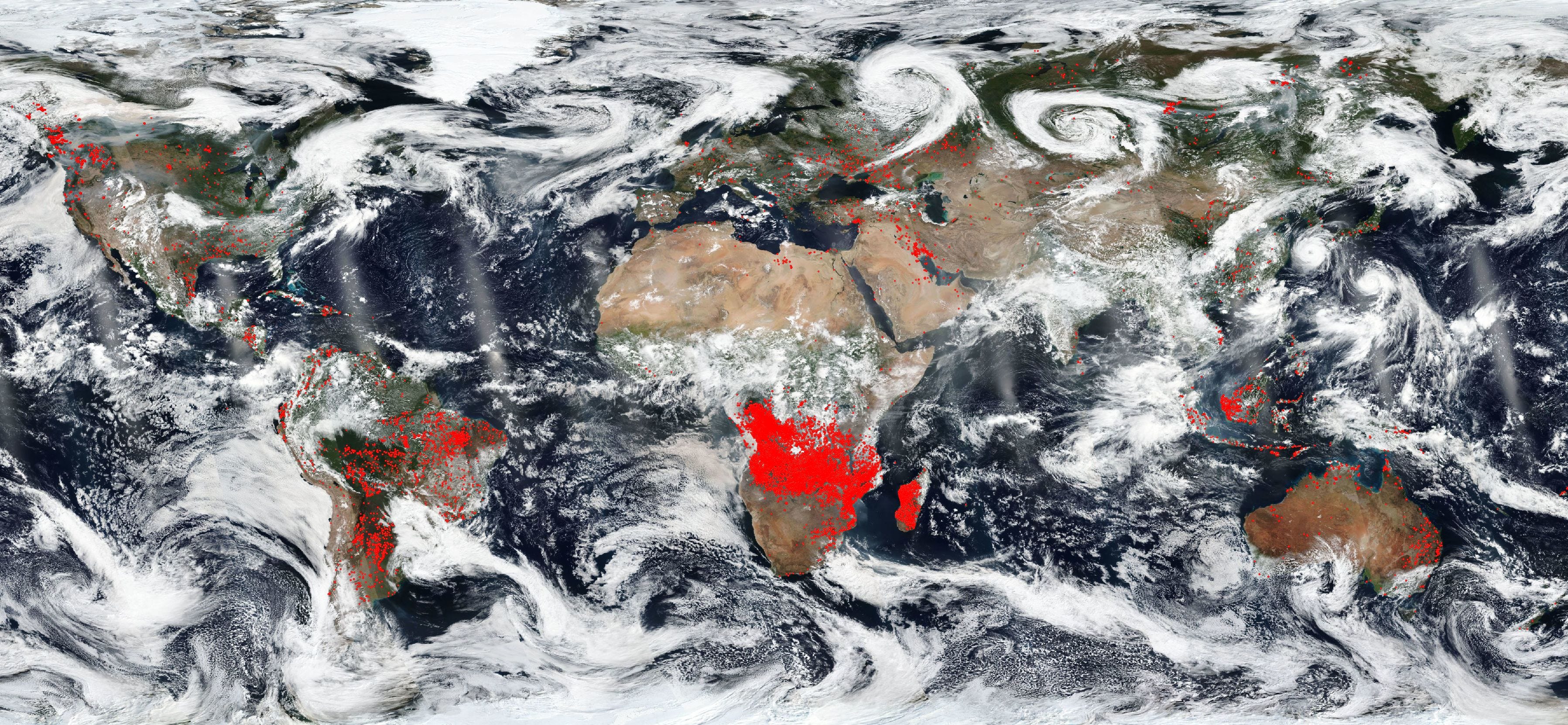
Satellite imagery of Earth is cool because it gives us a different perspective of our home, but it can also be quite disturbing. This week on Twitter, NASA shared an image that shows not only brown and green continents, vast oceans, and swirling white clouds, but also red dots that show a large number of fires currently burning over the world.
The red blobs are most concentrated in central Africa, but extend to parts of every other continent except for Antarctica. “The world is on fire,” read NASA’s tweet. In a blog post, the agency explained that the image was taken using the Earth Observing System Data and Information System (EOSDIS) Worldview, and that the areas that appear to be completely engulfed in flames were detected by thermal bands and are likely from agricultural burns. “The location, widespread nature, and number of fires suggest that these fires were deliberately set to manage land,” NASA writes. “Farmers often use fire to return nutrients to the soil and to clear the ground of unwanted plants. While fire helps enhance crops and grasses for pasture, the fires also produce smoke that degrades air quality.”
Other areas of red are likely wildfires, like the ones that continue to ravage parts of California. Northern Africa is largely untouched because there is not much to burn in the Sahara, and the poles are fine because of the low temperatures. NASA’s Worldview website allows users to go back in time to see how the burning areas have changed over the course of the summer, and there is even a feature that will animate a set period of time so that you can watch the red dots accumulate. The site also tracks major events like volcano eruptions, iceberg splits, and typhoons. The purpose is obviously not to revel in the destruction of the Earth as seen from above, but there is something cool about seeing the planet from this perspective and being able to witness its changes over time while tracking their natural and human causes.
Top: Small bucket is the only water source for numerous large animals in enclosure at Marineland.
Bottom: Animals at Marineland struggle to find shade from the blazing hot sun during heatwave.
My last two blogs were accompanied by photographs of animals I saw imprisoned at Marineland, Niagara Falls, Ontario, when I went there with Zoocheck’s Rob Laidlaw last July 5th, during a blistering heat wave. The harbor seals were not affected by record temperatures, being in a small pool in a cool interior, but at no time when we observed them did they open their eyes, an unnatural condition as verified by an expert on seal eyes, not to mention all memories I have of wild harbor seals with their soulfully bulbous eyes wide open. There have been concerns raised about the effects of chlorine on eyes and I thought I could smell chlorine, but whatever the reason, seeing the animals so confined, eyes tightly shut, certainly depressed me.
But, no more so than conditions out in open paddocks where there waslittle or no shade for numbers of large, hoofed herbivores, and water only appearing to be available in containers about the size of a bucket or pail.
On August 8, I received an email from Stephanie Littlejohn, Law Clerk, Hunt Partners LLP, a Toronto-based law firm calling itself “a unique blend of corporate and civil advocacy” consisting of “recognized litigation leaders and trusted advisors.” Ms. Littlejohn wrote: “Please find attached a Notice of Trespass for Marineland of Canada (Inc.), which is being served upon you.”
The notice prohibited me from entering Marineland’s property “At any time for any reason whatsoever” under the Trespass to Property Act. “I got one too,” laughed Rob, when I called to tell him.
Doubtless, Ms. Littlejohn and her colleagues are very professional corporate and civil advocates. Their opinions on animal welfare may differ from their client’s. Ms. Littlejohn might never even have been to Marineland or know much about animal husbandry. But, Rob’s and my expertise includes animal welfare and we both passionately care about animals. Whether any others care about animals with only pots of water and little or no shade in searing heat, or seals with eyes tightly shut, Rob and I do care how animals are treated.
Ironically, I actually don’t want to ever visit Marineland. I was so depressed by my first time there that I avoided the place for 37 years, only returning to see an exhibit that had been falsely advertised; it wasn’t there. Having paid admission, Rob and I looked at the other animals. I’m happy to wait another 37 years, by which time Ms. Littlejohn will probably be a retired lawyer and I’ll be long gone.
For now, I would gladly pay the maximum trespass fine of two thousand bucks if I thought it would eliminate my concerns, or better yet, that Marineland simply had no animals for me to worry about. If Ms. Littlejohn, Hunt Partners LLP, and Marineland want to keep me out, just eliminate the concerns I addressed &ndahs; or better yet, stop imprisoning animals – and I promise to never again cross Marineland’s doorstep. Honest.
IMAGE: METHANE BUBBLES UP FROM THE THAWED PERMAFROST AT THE BOTTOM OF THE THERMOKARST LAKE THROUGH THE ICE AT ITS SURFACE. view more
CREDIT: KATEY WALTER ANTHONY/ UNIVERSITY OF ALASKA FAIRBANKS
New NASA-funded research has discovered that Arctic permafrost’s expected gradual thawing and the associated release of greenhouse gases to the atmosphere may actually be sped up by instances of a relatively little known process called abrupt thawing. Abrupt thawing takes place under a certain type of Arctic lake, known as a thermokarst lake that forms as permafrost thaws.
The impact on the climate may mean an influx of permafrost-derived methane into the atmosphere in the mid-21st century, which is not currently accounted for in climate projections.
The Arctic landscape stores one of the largest natural reservoirs of organic carbon in the world in its frozen soils. But once thawed, soil microbes in the permafrost can turn that carbon into the greenhouse gases carbon dioxide and methane, which then enter into the atmosphere and contribute to climate warming.
“The mechanism of abrupt thaw and thermokarst lake formation matters a lot for the permafrost-carbon feedback this century,” said first author Katey Walter Anthony at the University of Alaska, Fairbanks, who led the project that was part of NASA’s Arctic-Boreal Vulnerability Experiment (ABoVE), a ten-year program to understand climate change effects on the Arctic. “We don’t have to wait 200 or 300 years to get these large releases of permafrost carbon. Within my lifetime, my children’s lifetime, it should be ramping up. It’s already happening but it’s not happening at a really fast rate right now, but within a few decades, it should peak.”
The results were published in Nature Communications.
Using a combination of computer models and field measurements, Walter Anthony and an international team of U.S. and German researchers found that abrupt thawing more than doubles previous estimates of permafrost-derived greenhouse warming. They found that the abrupt thaw process increases the release of ancient carbon stored in the soil 125 to 190 percent compared to gradual thawing alone. What’s more, they found that in future warming scenarios defined by the Intergovernmental Panel on Climate Change, abrupt thawing was as important under the moderate reduction of emissions scenario as it was under the extreme business-as-usual scenario. This means that even in the scenario where humans reduced their global carbon emissions, large methane releases from abrupt thawing are still likely to occur.
Permafrost is ground that is frozen year-round. In the Arctic, ice-rich permafrost soils can be up to 260 feet (80 meters) thick. Due to human-caused warming of the atmosphere from greenhouse gas emissions, a gradual thawing of the permafrost is currently taking place where the upper layer of seasonally thawed soil is gradually getting thicker and reaching deeper into the ground. This process wakes up microbes in the soil that decompose soil organic matter and as a result release carbon dioxide and methane back into the atmosphere. This gradual thaw process is accounted for in climate models and is thought to have minimal effect as thawed ground also stimulates the growth of plants, which counterbalance the carbon released into the atmosphere by consuming it during photosynthesis.
However, in the presence of thermokarst lakes, permafrost thaws deeper and more quickly. Thermokarst lakes form when substantial amounts of ice in the deep soil melts to liquid water. Because the same amount of ice takes up more volume than water, the land surface slumps and subsides, creating a small depression that then fills with water from rain, snow melt and ground ice melt. The water in the lakes speeds up the thawing of the frozen soil along their shores and expands the lake size and depth at a much faster pace than gradual thawing.
“Within decades you can get very deep thaw-holes, meters to tens of meters of vertical thaw,” Walter Anthony said. “So you’re flash thawing the permafrost under these lakes. And we have very easily measured ancient greenhouse gases coming out.”
These ancient greenhouse gases, produced from microbes chewing through ancient carbon stored in the soil, range from 2,000 to 43,000 years old. Walter Anthony and her colleagues captured methane bubbling out of 72 locations in 11 thermokarst lakes in Alaska and Siberia to measure the amount of gas released from the permafrost below the lakes, as well as used radiocarbon dating on captured samples to determine their age. They compared the emissions from lakes to five locations where gradual thawing occurs. In addition, they used the field measurements to evaluate how well their model simulated the natural field conditions.
Team members with the Alfred Wegener Institute (AWI) for Polar and Marine Research in Germany then used U.S. Geological Survey-NASA Landsat satellite imagery from 1999 to 2014 to determine the speed of lake expansion across a large region of Alaska. From this data they were able to estimate the amount of permafrost converted to thawed soil in lake bottoms.
“While lake change has been studied for many regions, the understanding that lake loss and lake gain have a very different outcome for carbon fluxes is new,” said co-author Guido Grosse of AWI. “Over a few decades, thermokarst lake growth releases substantially more carbon than lake loss can lock in permafrost again [when the lake bottoms refreeze].”
Because the thermokarst lakes are relatively small and scattered throughout the Arctic landscapes, computer models of their behavior are not currently incorporated into global climate models. However, Walter Anthony believes including them in future models is important for understanding the role of permafrost in the global carbon budget. Human fossil fuel emissions are the number one source of greenhouse gases to the atmosphere, and in comparison, methane emissions from thawing permafrost make up only one percent of the global methane budget, Walter Anthony said. “But by the middle to end of the century the permafrost-carbon feedback should be about equivalent to the second strongest anthropogenic source of greenhouse gases, which is land use change,” she said.
Disclaimer: AAAS and EurekAlert! are not responsible for the accuracy of news releases posted to EurekAlert! by contributing institutions or for the use of any information through the EurekAlert system.





 Top: Small bucket is the only water source for numerous large animals in enclosure at Marineland.
 Exposing the Big Game