| Washington Post | – |

| Washington Post | – |
from NRDC.org
Shock and disappointment. Like you, that’s how all of us here at NRDC are feeling after witnessing last night’s election results.
Hillary Clinton, a climate champion, lost. Donald Trump, who embraces fossil fuels, has vowed to roll back the Paris accord and calls climate change a hoax, has won. Feeling shell-shocked is an appropriate response.
But we will not let that shock linger or, worse yet, turn to despair. We are going to transform it into concrete, planet-affirming action.
Know this: NRDC will fight for our environment, for our climate, and for our shared clean energy future — harder than we ever have fought before.
Donald Trump ran on one of the most stridently anti-environment platforms of any recent major-party nominee, but now he is the president-elect.
Analysts will sort out why people pulled the lever for this man. However, this much is equally clear. Whatever Americans voted for, it was not to turn back the clock on the environmental progress we’ve achieved over the last eight years under President Barack Obama.
It was not to continue allowing big polluters and their climate-denying allies in Congress to pillage our natural heritage and our planet for profit. It was not to walk away from the Paris climate agreement, the promise of clean energy and desperately needed progress on fighting climate change here at home. And it certainly was not to deny our fellow Americans their basic right to safe drinking water, clean air and healthy communities simply because of their income or skin color.
So it’s time for every American — Republican, Democrat and Independent alike — to stand and defend our environment and health.
Yes, today shock will prevail. But prepare yourself, because tomorrow the battle for all the environmental values we hold dear will begin. And we must be ready.
…
Sincerely,
Rhea Suh
President, NRDC
P.S. We are moving swiftly to lay the groundwork for a tenacious defense of our environment in the courts, in Congress and in the public sphere. Building a war chest to fund that fight is of paramount importance. Please consider donating today so that NRDC is fully prepared come January to fend off Donald Trump’s coming attacks.
http://www.huffingtonpost.com/entry/donald-trump-climate-change-policy_us_581f57bde4b0e80b02caa351

GOP presidential nominee Donald Trump has said very little about climate change during this campaign. We’ve mostly had to rely on his numerous pre-candidacy tweets declaring it a “bullshit” “hoax.”
But last week Trump finally did say something real about climate change ― that he would cut all federal spending on the issue in order to save $100 billion over two terms in office. Bloomberg BNA caught this particular nugget buried in the “New Deal for Black America” plan Trump released last week, which pledges to “cancel all wasteful climate change spending.”
He made a similar pledge at a Michigan rally a few days ago: “We’re going to put America first. That includes canceling billions in climate change spending for the United Nations, a number Hillary wants to increase, and instead use that money to provide for American infrastructure including clean water, clean air and safety.”
The BNA article suggests that number is bonkers, but doesn’t say it directly. But it is ― to get anywhere near $100 billion, one would have to cut all the money the Department of Energy spends on technology development and deployment. That’s on top of cutting funding for climate science research, international development funding and funding to help U.S. communities deal with climate-related changes, and all that still probably wouldn’t get you to $100 billion in savings. Climate Progress’s Joe Romm spells out why this is bad math, as well as bad policy.
The fact that this pledge is included in his plan for black Americans is also absurd. Non-whiteAmericans are actually much more concerned about climate change than white Americans. They’re also more likely to feel its impacts.
But Trump’s proposal doesn’t even jibe with things the candidate has previously said. In September he said that there’s “still much that needs to be investigated in the field of ‘climate change.’” He also said that “perhaps we should be focused on developing energy sources and power production that alleviates the need for dependence on fossil fuels.” Perhaps!
In some ways, Trump’s pledge is useful in that it is a real policy statement on climate, and those have been hard to come by in his campaign (other than that he wants more coal, more oil, and more natural gas.) Democratic nominee Hillary Clinton, meanwhile, has released extremely detailed policy proposals. People may agree with them or not, but at least they exist.
But what we do know about Trump’s policies is that they would be a real disaster.
It is particularly notable that this week is the start of a very important climate summit in Marrakech, Morocco, where negotiators from around the world are working out an implementation plan for last year’s Paris climate agreement. Trump has said he would “renegotiate” the Paris deal, prompting even China to criticize the Republican’s position last week.
John Morton, the director for energy and climate change for the White House’s National Security Council, mostly skirted the Trump question in a call with reporters last week heading into the Marrakech meeting. “Obviously, I think there is a great deal of interest not just domestically but internationally,” said Morton. “The candidates have very different views on climate.”
You don’t say.
Editor’s note: Donald Trump regularly incites political violence and is a serial liar, rampant xenophobe, racist, misogynist and birther who has repeatedly pledged to ban all Muslims — 1.6 billion members of an entire religion — from entering the U.S.

JOSH EDELSON / AFP / GETTY IMAGES
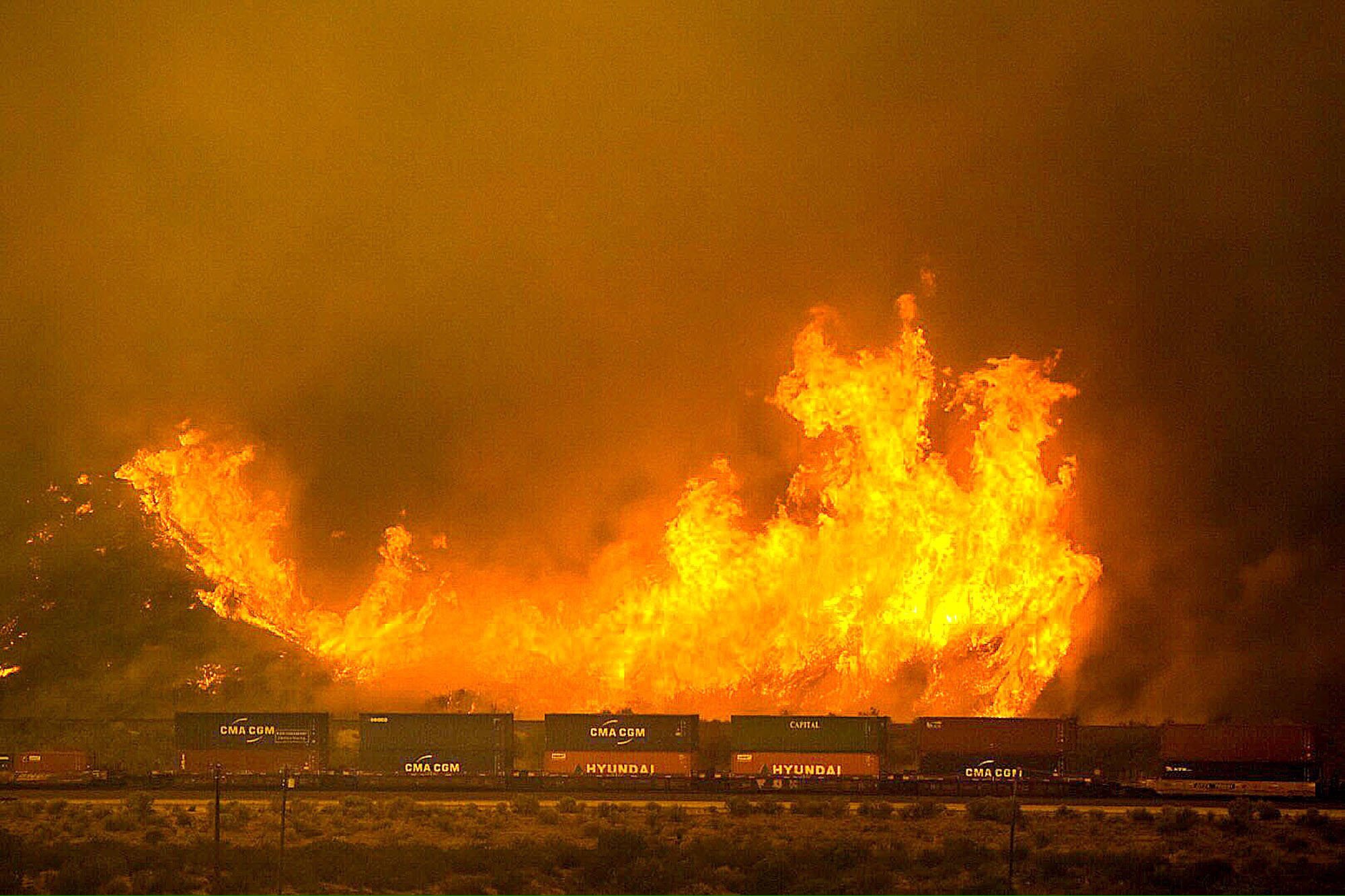
So far this year, wildfires have scorched nearly 5 million acres in the U.S. That sounds like a lot, but compared to 2015, the season has been downright tame. Last year at this time, more than 9 million acres had already burned, and by the end of the year, that number would rise to more than 10 million — the most on record. In 2015, the Okanogan grew into the largest fire Washington had ever seen, breaking a record set just the year before. California recorded some of its most damaging fires, including the Valley Fire, which torched around 1,300 homes. More than 5 million acres burned in Alaska alone. But that’s not to say that this year has been without drama. For instance, California’s Soberanes Fire, which was sparked by an illegal campfire in July, is still smoldering. The effort it took to contain that blaze is believed to be one of the most expensive — if not the most expensive — wildfire-fighting operations ever.
With wildfire, such superlatives have, paradoxically, become normal. Records are routinely smashed — for acreage burned, homes destroyed, firefighter lives lost and money spent fighting back flames. A study published earlier this year found that, between 2003 and 2012, the average area burned each year in Western national forests was 1,271 percent greaterthan it was in the 1970s and early 1980s.
Like the extreme hurricanes, heat waves and floods that have whipped, baked and soaked our landscape in recent years, such trends raise the question: Is this what climate change looks like?
In the Proceedings of the National Academies of Science this month, two researchers took on the tricky task of apportioning blame. “People have sort of thrown conjecture out there, saying that the big fire seasons we’ve had since 2000 are attributable to climate change,” said John Abatzoglou, the lead author of the new study and a climatologist at the University of Idaho. “But we wanted to go out and make an effort to try to quantify it.” How much of the recent uptick in fire activity is due to climate change versus other factors, like the natural drought cycle?
Abatzoglou and his co-author, Park Williams, a bioclimatologist at Columbia University’s Lamont-Doherty Earth Observatory, estimate that human-caused climate change was responsible for nearly doubling the area burned in the West between 1984 and 2015. If the last few decades had been simply dry, instead of some of the hottest and driest on record, perhaps 10.4 million fewer acres would have burned, they say.
Wildfire is particularly responsive to temperature increases because heat dries things out. It sucks moisture from twigs and needles in the forest the same way it does from clothes in a dryer, turning this vegetation into the kindling, or “fine fuel,” that gets wildfires going. In arid environments, small increases in temperature dramatically hasten this process, helping to prime the forest for a spark. Abatzoglou and Williams’s models simulated the relationship between temperature and the dryness of forest fuels under multiple scenarios, including ones that reflected the uptick in temperature that humans have caused according to climate models and ones that factored out human-caused changes.
To shore up confidence in their estimates, they repeated the analyses in their study using eight different fuel-aridity metrics and then averaged the results. “One thing that gives me confidence is that all eight of these essentially lead to the same conclusion,” Williams said. “All eight have been increasing. All correlate well with fire.”
In the end, they found that more than half of the observed increase in the dryness of fuels could be attributed to climate change. Fuel aridity, in turn, correlated very closely with fire activity for the time period they looked at — it explained about 75 percent of the variability in acreage burned from year to year. “That means that it is a top dog,” Williams said. “Correlation is not causation, but the correlation is so strong that it’s very hard to get a relationship like this if it’s not real.”
Williams added that as aridity increased, wildfire activity increased exponentially. “This isn’t a gradual process. Every few years we’re kind of entering a new epoch, where the potential for new fires is quite a bit bigger than it was a few years back.”
This isn’t the first study to warn that climate change is increasing the risk of wildfires, and fire scientists generally agree on that point. What’s still up for debate is exactly how much climate change has influenced recent fire activity, and this study is the first attempt at a hard answer. Bob Keane, a research ecologist with the U.S. Forest Service in Missoula, Montana, says the methods are solid and represent the best available science for tackling the question. The basic takeaway is also sound. “It’s a big proportion,” said Keane, who was not involved in the research. But the precise numbers Abatzoglou and Williams produced? Keane wouldn’t take them to the bank.
Fire modeling is full of uncertainty because “fire is a complex process,” Keane said. “It’s hard for any of us to wrap our heads around it and say something that’s meaningful.” Actual fire behavior is influenced by both large-scale processes, such as climate, and smaller factors, such as the slope of a hillside or the strength of the wind on a given day.
And then there’s Smokey Bear. Smokey was the public face of a longstanding and ecologically backward federal fire policy. “Only you can prevent forest fires,” Smokey told us. Some of those ads even characterize wildfire as “shameful waste” that “weakens America.” In fact, fire is a natural and essential process in Western forests. Certain trees, including many lodgepole pine, even need fire to reproduce — their cones only open and release their seeds when heated by flames. But for decades, land managers did their damnedest to prevent and suppress fire, allowing many forests to become overstocked with trees. Those trees became the fuels that set the stage for larger blazes. They also influence a fire’s severity, which can affect the ability of some types of forests to recover from fire.
More: http://fivethirtyeight.com/features/the-west-is-burning-and-climate-change-is-partly-to-blame/
http://www.panarmenian.net/eng/details/223617/
Pollution and weather
Animals are dying all over the world in huge numbers because of the polluted seas and air. Millions of fish and massive numbers of various marine creatures are washing ashore dead. Birds are falling dead from the sky, and millions of poultry and wildlife are dying from avian flu. Land animals are also dying in large numbers from disease.
< http://static.pn.am/images/l_art1_eng.gif> October 19, 2016
PanARMENIAN.Net – Peru’s environmental agency is investigating the deaths of some 10,000 frogs whose bodies have been found in a river in the south of the country. According to a BBC report, a campaign group says pollution in the River Coata is to blame for the deaths. It says the government has ignored pleas for the construction of a sewage treatment plant in the area.
The Titicaca water frog is an endangered species that is found only in the huge freshwater lake shared by Peru and Bolivia and its tributaries.
The cases of mass deaths across the world are not rare. And here are some of them:
Southern blackbirds
On December 31, 2010, about 2,000 red-winged blackbirds fell dead out of the sky over a small town in Arkansas, U.S. There were so many that it took workers two days to remove all the birds’ carcasses from the town’s streets, sidewalks and lawns. The deaths were all the more mysterious because the birds in question don’t normally fly at night. So, they should have been asleep in their roost. None of the dead birds were found on the ground of the wooded area where they roosted, so officials ruled out disease or poisoning as the cause of their deaths, reports said. Instead, it was assumed a weather-related event caused the mysterious mass die-off. Despite that assumption, however, workers cleaning up the birds’ carcasses wore environmental-protection suits just in case.
Bats with white-nose syndrome
An estimated 6.7 million bats have died since 2006 because of an outbreak of white-nose syndrome, a fast-moving disease that has wiped out entire colonies and left caves littered with the bones of dead bats. The epidemic is considered the worst wildlife disease outbreak in North American history and shows no signs of slowing down. It threatens to drive some bats extinct and could do real harm to the pest-killing services that bats provide, worth billions of dollars each year, in the United States. Typically the disease kills 70 percent to 90 percent of bats in an affected hibernaculum (the area where bats gather to hibernate for the winter). In some cases, the mortality rate has been 100 percent, wiping out entire colonies. Some caves that once hosted hundreds of thousands of bats are now virtually empty.
< http://media.pn.am/media/issue/223/617/textphoto/photo_223617_7f725650f.jpg>
Pilot whales
In late 2008, 60 pilot whales beached themselves along the rocky coast of the southern Australian island state of Tasmania. A week later, 150 long-finned pilot whales did the same. Then, in early January 2009, 45 sperm whales perished when they stranded themselves on a Tasmanian sandbar. And, lastly, in the most egregious in the string of incidents, 194 pilot whales and a handful of bottleneck dolphins beached themselves along the same coastline in March. By the time officials arrived at the scene, 140 were dead. Using stretchers, small boats and jet skis, more than 100 volunteers managed to save 54. But with four beaching incidents in as many months, scientists found themselves at a loss to explain why the majestic mammals had gone ashore.
Pink flamingos
Over 50 pink flamingos have been found dead in southern France, victims of freezing weather conditions that have gripped Europe in February 2012. The birds succumbed to the cold after being trapped in the frozen water and left unable to fly away. Rescuers were able to save several weakened flamingos and send them to a bird park.
Hippopotamuses
In 2004, an estimated 300 hippopotamuses in Uganda’s Queen Elizabeth National Park died after drinking water contaminated with anthrax. The lethal bacteria can frequently be found in the pools of stagnant water that form during Uganda’s dry season. The country has suffered from occasional anthrax outbreaks since the 1950s and because of their semiaquatic nature, hippos are particularly vulnerable to contamination.
Magellan Penguins
In July 2010, for example, about 500 dead Magellan Penguins washed up on the shores of Brazil over the course of just 10 days. Autopsies on the animals revealed that their stomachs were entirely empty, indicating that they likely starved to death.
Livestock
In early 2010, a bitterly cold and snowy winter followed a summer drought, preventing many species in Mongolia from grazing adequately. The disaster resulted in the deaths of millions of camels, goats, sheep, cows, yaks and horses.
Saiga antelopes
In May 2015, 60,000 saiga antelopes died in just four days, and no one really knows why. Saiga – a species of dog-sized antelope with Gonzo-like noses, native to central Asia – are critically endangered. Saigas live in a few herds in Kazakhstan, one small herd in Russia and a herd in Mongolia. The herds congregate with other herds during the cold winters, as well as when they migrate to other parts of Kazakhstan, during the fall and spring. The herds split up to calve their young during the late spring and early summer.
Piglets
In May 2013, a virus never before seen in the U.S., called porcine epidemic diarrhea, quickly spread to 27 states and claimed the lives of six million piglets in less than a year. Scientists think the virus, which does not infect humans or other animals, came from China, but it’s unclear how it got into the country and wiped out at least three percent of the nation’s pig herd.


Sardines
In March 2011, boaters awakened to find millions of dead anchovies and sardines washed up around their vessels in a Southern California marina. The fish were so thick in some places that boats couldn’t get out of the marina.
Turtles
In late 2005 and January 2006, 200 endangered sea turtles were found dead along beaches on the coast of El Salvador. Scientists’ best guess at to the cause of this mysterious die-off is that the turtles fell victim to harmful algal blooms, known as a red tide.
Brown Pelicans
In January 2009, hundreds of Brown Pelicans were found dead or acting peculiar along the California coast. Though researchers were unclear as to what exactly triggered the birds’ illness, the mysterious mass die-off may have been due to unseasonable weather patterns that threw off the Pelicans’ eating habits.
http://www.ecowatch.com/james-hansen-climate-change-2030724330.html
Oct. 05, 2016 08:42AM EST
Many hail the Paris agreement—set to cross the threshold this week to come into effect—as a panacea for global climate change. Yet tragically, this perspective neglects to take into account the scientific reality of our climate system, which tells a much different story.
Our latest research, Young People’s Burden: Requirement of Negative CO2 Emissions, appeared Monday as a “Discussion” paper in Earth System Dynamics Discussion, and outlines how—if national governments neglect to take aggressive climate action today—today’s young people will inherit a climate system so altered it will require prohibitively expensive—and possibly infeasible—extraction of CO2 from the atmosphere.
Global temperatures are already at the level of the Eemian period (130,000 to 115,000 years ago), when sea level was 6-9 meters higher than today. Considering the additional warming “in the pipeline,” due to delayed response of the climate system and the impossibility of instant replacement of fossil fuels, additional temperature rise is inevitable.
Continued high fossil fuel emissions place a burden on young people to undertake “negative CO2 emissions,” which would require massive technological CO extraction with minimal estimated costs of $104-$570 trillion this century, with large risks and uncertain feasibility.
Continued high fossil fuel emissions unarguably sentences young people to either a massive, possibly implausible cleanup or growing deleterious climate impacts or both, scenarios that should provide incentive and obligation for governments to alter energy policies without further delay.
The paper provides the underlying scientific backing for the Our Children’s Trust lawsuit against the U.S. government, which argues that climate change jeopardizes the next generation’s inalienable rights under the U.S. Constitution to life, liberty and the pursuit of happiness.
The paper offers an opportunity to examine the current state of the planet with respect to climate change. Four key takeaways include:
1. The Paris Climate Accord is a precatory agreement, wishful thinking that mainly reaffirms, 23 years later, the 1992 Rio Framework Convention on Climate Change. The developing world need for abundant, affordable, reliable energy is largely ignored, even though it is a basic requirement to eliminate global poverty and war. Instead the developed world pretends to offer reparations, a vaporous $100B/year, while allowing climate impacts to grow.
2. As long as fossil fuels are allowed to be held up as the cheapest reliable energy, they will continue to be the world’s largest energy source and the likelihood of disastrous consequences for young people will grow to near certainty.
3. Technically, it is still possible to solve the climate problem, but there are two essential requirements: (1) a simple across-the-board rising carbon fee collected from fossil fuel companies at the source, and (2) government support for RD&D (research, development and demonstration) of clean energy technologies, including advanced generation, safe nuclear power.
4. Courts are crucial to solution of the climate problem. The climate “problem” was and is an opportunity for transformation to a clean energy future. However, the heavy hand of the fossil fuel industry works mostly in legal ways such as the “I’m an Energy Voter” campaign in the U.S. Failure of executive and legislative branches to deal with climate change makes it essential for courts, less subject to pressure and bribery from special financial interests, to step in and protect young people, as they did minorities in the case of civil rights.
For a deeper dive, click here.
Despite their sharp contrast on climate change, the subject has not been a major topic of discussion in the 2016 presidential election between Hillary Clinton and Donald Trump.
In the first debate between Clinton and Trump on Sept. 26., only one minute and 22 seconds was spent on climate change and other environmental issues.
In comparison with presidential debates since 2000, this is the second least amount of time spent on environmental policy. Although it has been a hot-button issue, it was not discussed at all in the 2012 presidential election between President Barack Obama and Mitt Romney.
The high point for green issues came during the 2000 presidential debates between Al Gore and George W. Bush.
2016: so far: 1 minute, 22 seconds in one presidential debate.
2012: 0 minutes.
2008: 5 minutes, 18 seconds in two presidential debates. An additional 5 minutes, 48 seconds in a vice presidential debate.
2004: 5 minutes, 14 seconds in a single presidential debate.
2000: 14 minutes, 3 seconds in three presidential debates. 5 minutes, 21 seconds in a vice presidential debate.
This data is provided by grist.com.
While Clinton believes that it is an urgent issue, Trump has called climate change a “hoax” in the past.
In the first debate, Clinton accused Trump of believing that climate change is “a hoax perpetrated by the Chinese.”
Trump interjected and said that was false. However, as social media users quickly discovered, he had said exactly that in a 2012 tweet.
In a previous AccuWeather poll from February 2016, 58 percent of voters said that a candidate’s stance on climate change would not influence their vote in the election.
Though Trump’s rejection of climate science will not influence everyone’s vote, it may help Clinton reach millennial voters. According to a Harvard study, three out of four millennials believe in climate change.
“… Never thought when I gave my acceptance speech at the Democratic National Convention that I would have to put in the following sentence: I believe in science,” Clinton said to the University of New Hampshire campus on Sept. 28.
Young voters have consistently ranked climate change as an important issue, and Clinton’s position is a major divide with both Trump and Gary Johnson, the libertarian candidate.
Clinton’s environmental allies are urging her campaign and debate moderators to keep climate change in the spotlight as the political campaign continues.

Former vice president Al Gore will start campaigning for Democratic nominee Hillary Clinton, according to individuals briefed on the plan, in an effort to mobilize young voters who see climate change as a key issue.
The decision by Gore to plunge into the campaign during the final weeks shows the extent to which Democrats remain concerned that Clinton has yet to connect with many millennials, some of whom are backing third-party candidates this year. The former vice president, a climate activist, will speak about not just Clinton’s plan to address global warming, but also the idea that voting for an independent presidential candidate could deliver the White House to Republicans in the same way that Ralph Nader’s candidacy helped undermine his presidential bid in 2000.
CNN first reported Gore’s plans Monday evening.
I’m casting my vote against Donald Trump. There are countless reasons why, not least of which is that his sons are trophy hunters, responsibe for the deaths of elephants, leopards and untold other African animals.
But, ‘they are not him,’ you might say. No, and George W was not George Bush, Sr. But W would never have been eletected (or even thought of running) if his father wasn’t first. One sport hunter in the upper echelons of government is bad enough (and we already have one in speaker of the house Paul Ryan).
That doesn’t mean Hillary is the perfect choice either, though. Back when she rejected overpopulation as an issue by telling China (as Secretary of State) that their one-child policy was was wrong, I swore I’d never vote for her if she ran for office in the future. (At least her husband and daughter are veg.)
But Trump is clearly the wrong choice, with his statement that he “believes” climate change is a “hoax” and his selection of a fellow denialist for his cabinet.
I mean, it’s not like we’re talking about god, the easter bunny, or bigfoot; climate change is a well-documented, well-proven fact, and the most urgent issue of our time.


Mere mention of the Paris climate talks is enough to make James Hansen grumpy. The former Nasa scientist, considered the father of global awareness of climate change, is a soft-spoken, almost diffident Iowan. But when he talks about the gathering of nearly 200 nations, his demeanour changes.
“It’s a fraud really, a fake,” he says, rubbing his head. “It’s just bullshit for them to say: ‘We’ll have a 2C warming target and then try to do a little better every five years.’ It’s just worthless words. There is no action, just promises. As long as fossil fuels appear to be the cheapest fuels out there, they will be continued to be burned.”
The talks, intended to reach a new global deal on cutting carbon emissions beyond 2020, have spent much time and energy on two major issues: whether the world should aim to contain the temperature rise to 1.5C or 2C above preindustrial levels, and how much funding should be doled out by wealthy countries to developing nations that risk being swamped by rising seas and bashed by escalating extreme weather events.
But, according to Hansen, the international jamboree is pointless unless greenhouse gas emissions are taxed across the board. He argues that only this will force down emissions quickly enough to avoid the worst ravages of climate change.
Paris talks overlooking immediate threats, say climate change activists
Hansen, 74, has just returned from Paris where he again called for a price to be placed on each tonne of carbon from major emitters (he’s suggested a “fee” – because “taxes scare people off” – of $15 a tonne that would rise $10 a year and bring in $600bn in the US alone). There aren’t many takers, even among “big green” as Hansen labels environment groups.
Hansen has been a nagging yet respected voice on climate change since he shot to prominence in the summer of 1988. The Nasa scientists, who had been analyzing changes in the Earth’s climate since the 1970s, told a congressional committee that something called the “greenhouse effect” where heat-trapped gases are released into the atmosphere was causing global warming with a 99% certainty.
A New York Times report of the 1988 testimony includes the radical suggestion that there should be a “sharp reduction in the burning of coal, oil and other fossil fuels that release carbon dioxide”, a plea familiar to those who have watched politicians who have traipsed up to the lectern or interviewer’s microphone in Paris over the past two weeks.
After that, things started to get a little difficult for Hansen. He claims the White House altered subsequent testimony, given in 1989, and that Nasa appointed a media overseer who vetted what he said to the press. They held practice press conferences where any suggestion that fossil fuels be reduced was considered political and unscientific, and therefore should not be uttered.
“Scientists are trained to be objective,” Hansen says. “I don’t think we should be prevented for talking about the the implications of science.” He retired from Nasa in 2013. “That was a source of friction. I held on longer than I wanted, by a year or two. I was in my 70s, it was time for someone else to take over. Now I feel a lot better.”
A man rides his bicycle on yellow paint poured on the street during a protest by activists from environmental group Greenpeace on the Champs-Elysee in Paris, ON Friday.
Facebook Twitter Pinterest
A man rides his bicycle on yellow paint poured on the street during a protest by activists from environmental group Greenpeace on the Champs-Elysee in Paris. Photograph: Christophe Ena/AP
From being possibly America’s most celebrated scientist, Hansen is now probably its most prominent climate activist. He’s been arrested several times in protests outside the White House over mining and the controversial Keystone pipeline extension.
He is also an adjunct professor at Columbia University. When he’s in New York, he lives near the campus, surrounded by books piled on groaning shelves. Hansen’s not slowing down – he’s involved in a climate lobbying group and still undertakes the sort of scientific endeavor which helps maintain his gravitas.
One particular paper, released in July, painted a particularly bleak future for just about anyone living near the coast. Hansen and 16 colleagues found that Earth’s huge ice sheets, such as those found in Greenland, are melting faster than expected, meaning that even the 2C warming limit is “highly dangerous”.
The sea level could soon be up to five meters higher than it is today by the latter part of this century, unless greenhouse gases aren’t radically slashed, the paper states. This would inundate many of the world’s cities, including London, New York, Miami and Shanghai.
“More than half of the world’s cities of the world are at risk,” Hansen says. “If you talk to glaciologists privately they will tell you they are very concerned we are locking in much more significant sea level rises than the ice sheet models are telling us.
“The economic cost of a business as usual approach to emissions is incalculable. It will become questionable whether global governance will break down. You’re talking about hundreds of million of climate refugees from places such as Pakistan and China. We just can’t let that happen. Civilization was set up and developed with a stable, constant coastline.”
The paper has yet to be fully peer reviewed and some of Hansen’s colleagues, including his protege at Nasa, Gavin Schmidt, have voiced their doubts whether sea level rise will be quite this bad, with the IPCC projecting up to a meter by 2100.
Brickbats are thrown in a bipartisan way. Hansen feels Obama, who has made climate change a legacy issue in his final year in office, has botched the opportunity to tackle the issue.
COP21 environmental photography exhibition – in pictures
View gallery
“We all foolishly had such high hopes for Obama, to articulate things, to be like Roosevelt and have fireside chats to explain to the public why we need to have a rising fee on carbon in order to move to clean energy,” he says. “But he’s not particularly good at that. He didn’t make it a priority and now it’s too late for him.”
Hansen is just as scathing of leading Republicans who have embraced climate science denialism to the chagrin of some party elders.
Leading presidential candidates Donald Trump, Marco Rubio and Ben Carson have all derided evidence that the world is warming due to human activity while Ted Cruz, another contender, has taken time out from his campaign to to sit on an inquiry into climate science that has heard testimony from a rightwing radio host who has no scientific background.
“It’s all embarrassing really,” Hansen says. “After a while you realise as a scientist that politicians don’t act rationally.
“Many of the conservatives know climate change is not a hoax. But those running for president are hamstrung by the fact they think they can’t get the nomination if they say this is an issue. They wouldn’t get money from the fossil fuel industry.”
There is a positive note to end on, however. Global emissions have somewhat stalled and Hansen believes China, the world’s largest emitter, will now step up to provide the leadership lacking from the US. A submerged Fifth Avenue and deadly heatwaves aren’t an inevitability.
“I think we will get there because China is rational,” Hansen says. “Their leaders are mostly trained in engineering and such things, they don’t deny climate change and they have a huge incentive, which is air pollution. It’s so bad in their cities they need to move to clean energies. They realise it’s not a hoax. But they will need co-operation.
This article was amended on 14 December 2015 to clarify that Hansen believes taxes on greenhouse gas emissions are essential to the Paris climate talks.
 Exposing the Big Game