Pakistan turns to coal to keep factories running

http://climatenewsnetwork.net/pakistan-turns-to-coal-to-keep-factories-running/

January 19, 2016, by Kieran Cooke

Tharparkar

Tharparkar, in Sindh, where Pakistan and China will exploit an opencast mine
Image: Zaferauf via Wikimedia Commons

Share on FacebookShare on Google+Tweet about this on TwitterShare on LinkedIn

To tackle chronic energy shortages Pakistan plans to mine and burn millions of tonnes of coal, helped by China’s money and expertise.

LONDON, 19 January, 2016 – Till now, Pakistan has not used the bulk of its coal reserves – some of the largest in the world – for power generation. Not any more.

Within the last month the government in Islamabad has signed a number of financial and technological agreements with China aimed at exploiting massive coal reserves at the Tharparkar mine in Sindh province, in the south of the country.

Under the terms of the agreements, 3.8 million tonnes of coal will be produced each year at the Tharparkar open-cast mine to fuel a 660MW power plant and other facilities.

The estimated cost of the project is US$2bn: China’s banks and private companies will supply US$1.5 billion in loans, while Pakistan will contribute US$500 m in both private and public finance.

High risk

Scientists say the mining and burning of coal is one of the main drivers of climate change from human causes. The coal at Tharparkar is mainly lignite – one of the least energy-intensive and most polluting types of coal. 

Pakistan is thought to be one of the countries most at risk from climate change: in recent years it has endured a number of floods and droughts, and in the summer of 2015 more than 1,200 people died in a searing heatwave

Despite government declarations that it would prioritise climate change, Pakistan has shown little appetite for tackling the issue.

At the recent climate summit in Paris, Pakistan pledged to reduce its emissions of climate-changing greenhouse gases by 5% over 2012 levels by 2030 – a figure sharply criticised as being far too modest by a number of the countrys own climate experts.  

The energy produced by the lignite deposits at Tharparkar will be mainly directed at helping alleviate serious power shortages in Karachi, a city of more than 20 million people which is Pakistan’s main industrial centre.

Oil and water

At present Pakistan depends on imported oil for 65% of its energy, while hydro makes up an additional 30% of the national energy mix: there are also three nuclear power plants, and wind and solar are fast-growing energy sources.

Environmentalists say the new coal-powered power plants will only worsen the country’s serious pollution problem. Karachi is already among the world’s most polluted cities

The development of the Tharparkar coal field is part of an ambitious multi-billion dollar Pakistan/China economic development programme aimed at linking the remote western provinces of China to Karachi and other ports on the Arabian Sea. 

China – the world’s biggest emitter of greenhouse gases – has pledged to cut back on the use of coal for power generation.

But critics say Beijing is pursuing contradictory policies – cutting back on pollution at home, while encouraging heavily polluting projects abroad. – Climate News Network

December auto sales soar 9% in record year

[It seems some folks aren’t getting the message about climate change…]

by Nattan Bomey and , USA TODAY 7:08 p.m. EST January 5, 2016

Automakers posted a solid 9% sales gain in December, an exclamation point that sealed 2015 as the biggest sales year ever for the industry, they reported Tuesday.

All told, automakers sold 17.47 million new vehicles for the year, Autodata reported, besting the previous record set in 2000 by 68,138 vehicles. Low gas prices, cheap credit, low unemployment, soaring consumer confidence and warm weather fueled a rush into showrooms in December.

“The U.S. economy continues to expand, and the most important factors that drive demand for new vehicles are in place, so we expect to see a second consecutive year of record industry sales in 2016,” said Mustafa Mohatarem, GM’s chief economist, in a statement.

Meanwhile…

Porter Ranch Methane Leak Spreads Across LA’s San Fernando Valley

http://ecowatch.com/2016/01/15/porter-ranch-methane-leak-spreads/

It now looks like the catastrophic Porter Ranch gas leak, which has spewed more than 83,000 metric tons of noxious methane for nearly three months, has spread across Los Angeles’s San Fernando Valley.

On Wednesday, Los Angeles City Councilman Mitchell Englander called on the Southern California Gas Co. to extend residential relocation assistance to residents in Granada Hills, Chatsworth and Northridge who live near the Aliso Canyon gas leak above Porter Ranch. These residents reported symptoms related to the exposure of natural gas such as nausea, vomiting, headaches and respiratory problems.

porterranchgasleakmap
The researchers have developed the Valley’s first comprehensive map of methane exposure. Photo credit: HEET

More: http://www.usatoday.com/story/money/cars/2016/01/05/auto-sales-2015/78302038/


The Dangers of Willful Denialism

A good friend and blog reader posited that perhaps humankind allowing anthropogenic global warming to run further and further amok is facilitated by the same ingrained denial that people employed as they saw Nazi Germany take control of more and more of Europe and carry out their brutal holocaust.

Maybe what the modern human world is doing to Nature by changing the climate so fast that wild species can’t adapt in time—resulting in mass extinction—is just too unbearable to comprehend or believe. Denial, she theorized, is “our forte”—the traditional fallback position.

I have to take it a step further by adding that such denial is willful. I read the blasé reactions to the shattering, unprecedented news that tropical wintertime hurricanes were now invading the arctic. CNN and FOX News set the tone by sounding a collective “ho hum.” Who can be bothered by calls to halt our carbon goose-steps? We humans have an appointment with a brick wall and nothing’s going to stop us until D-day.

Willful denialism allows folks to look the other way while the animal holocaust provides them with their methane-marinated meals of tortured beef cows, or tormented pigs, fish and chickens.

Possibly the epitome of willful denialism: the more people degrade their environment, the more they want to have babies.

1451324_650954518277931_1616731734_n

The Real Climate Change Hoax‏

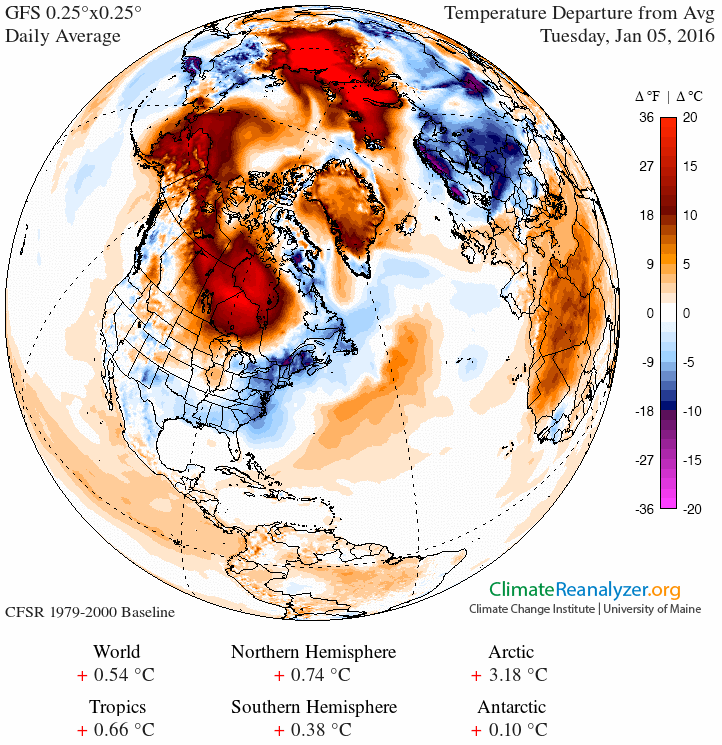
Extreme Arctic Warmth on January 5 2016

http://www.huffingtonpost.com/john-sanbonmatsu/the-real-climate-change-hoax_b_8920048.html

As a performing magician, I naturally take a keen interest in deception. So it was also with a professional, not merely personal, interest that I watched the spectacular fraud perpetrated on the world’s public in Paris last month, as political leaders from nearly 200 nations signed the first universal treaty to limit the carbon gases causing global warming.

Politicians described the agreement in triumphal terms, as a “turning point” in history. Humanity had dodged a bullet, they said. Now, we could all breathe easier. “Climate justice has won & we are all working towards a greener future,” as President Modi of India put it in a Tweet.

In reality, the happy talk by elites in Paris resembled a skilled magician’s use of patter to misdirect his audience, only on a global scale. A top stage illusionist like David Copperfield can make a Lamborghini vanish right under the noses of his audience. But that is nothing compared to what played in Paris, where the world’s political elites made the global warming crisis itself disappear — by creating the illusion of decisive action, where in fact there was nothing.

Ostensibly, the Paris agreement commits its signatories to hold warming of the earth’s atmosphere to 1.5% degrees Celsius above preindustrial levels. But as Bill McKibben recently pointed out, even if the signatories stay true to their promises — and the agreement has no enforcement mechanism to ensure that they do — the earth’s atmosphere is still expected to warm to at least 6.3 degrees Fahrenheit above preindustrial levels.

How bad would that be? Consider that today we are at just one degree Celsius, or about 1.5 degrees Fahrenheit, above preindustrial levels. That one degree has already melted many of the world’s glaciers, turned the North Pole into a temperate zone, and produced droughts, floods, and wildfires of Biblical proportions across the globe. One degree has radically increased the acidity of the world’s oceans — by 30% — and imperiled the planet’s fresh water resources.

Here in Boston, I spent a surreal Christmas Eve bicycling around my neighborhood clad in jeans and a T-shirt. It was the same story throughout much of the US, where nearly 6,000 temperature records were shattered over the holidays. Tornadoes ravaged parts of Texas, Arkansas, Mississippi, and Tennessee, rivers flooded their banks throughout the Midwest. Meanwhile, portions of England, Ireland, Scotland, Wales, Argentina, Brazil, and Uruguay lay submerged under floodwaters.

The most frightening news, though, came out of the Arctic, where temperatures on New Year’s Day were projected to be more than 60 F. degrees above normal. That made the North Pole, as one reporter observed, “hotter than Chicago, Vienna or Istanbul.”

Such radical gyrations in the climate are already causing unseen suffering and hardship for countless of the earth’s inhabitants. Millions of people have been displaced from their homes or lost their livelihoods as a result of one degree of warming. Farmers in Bangladesh have watched helplessly as ocean water inundates their rice fields. Whole Inuit communities had to be relocated after melting permafrost caused their homes to sink into the ground. In Iraq this summer, the temperature soared to 120 degrees Fahrenheit — 159 degrees with humidity factored in — and remained there for days. Scientists believe that large portions of the Middle East, currently home to 200 million people, will be inhospitable to human life by the end of the century.

But it is the other beings we share the earth with who are losing the most. Everywhere, animals are struggling in vain to adapt to the rapidly changing climate. In Europe and Asia, bears have stopped hibernating. In Alaska, walruses are crowding on shore, and trampling each other, because the sea ice they depend upon to survive has vanished. Whales and dolphins are dying in droves. Sea lions in California are starving. Penguins, lost and disoriented, have washed up on the beaches of Rio de Janeiro. Tens of millions of bats have perished from white nose fungus. Hundreds of monkeys in Costa Rica starved to death, or succumbed to illness, when ceaseless winter rains kept them from coming down from their trees to forage.

And on and on, across the phylogenetic spectrum. Homo sapiens is causing the greatest mass species extinction event in over 60 million years. And global warming is radically accelerating the process.

All of this, and much more, from atmospheric warming of less than 1.5 degrees Fahrenheit. Now, imagine ratcheting that up by an additional five, or six, degrees. Or, in all likelihood, more than that. Because there is no reason to believe that the countries that signed the Paris agreement will fulfill even their existing inadequate promises.

What will so hot a world look like? Which of the many thousands of species clinging today to the knife’s edge of survival will survive?

In the absence of decisive international action, clearly, we are going to turn the planet into a living Hell. Meanwhile, the closer one looks at the details of the Paris accord, the more the latter resembles a stage illusion — a hollow shell carefully constructed to resemble something solid.

Much has been made of the pledge of the wealthy nations to help poorer ones offset the cost of shifting to renewable energy sources. But the same promises have been made by the wealthy countries before, and they have not been kept. Though vague about how they are going to help the peoples of the global South, wealthy nations were nonetheless careful to include language in the treaty allowing them to offset future C02 emissions through so-called “carbon sinks” — planting trees to recapture CO2. However, since it takes decades for forests to mature, such “sinks” are viewed by most experts as the equivalent of the magician’s legerdemain, a clever manipulation to create the appearance of something out of nothing.

The agreement also says nothing about animal agriculture — the second leading cause of global warming, responsible for more emissions than all cars and trucks combined. The absence of any recommendation to reduce or eliminate animal agriculture is a clear concession to the factory farming and cattle ranching lobbies, which doubtlessly worked hard to keep animal agriculture off the table in climate negotiations.

And so on. Such omissions led James Hansen, the former NASA scientist and a leading authority on climate change, rightly to denounce the Paris agreement as a “fraud” and a “fake.” As Hansen and others suggest, the illusion of action in Paris may in fact prove worse than no action at all. For it has left the public with the mistaken impression that the climate crisis is now going to be dealt with, perhaps even solved, on the cheap, in half-measures, and without disturbing the powerful economic and social forces that profit from ecological destruction. And that is the greatest deception of all.

CORRECTION: This post has been updated to clarify the language used to describe the role of animal agriculture in reference to climate change.

GOP Candidates Receive Failing Grades on Climate as 2015 Smashes Global Temperature Records


by Dahr Jamail, Truthout: With the Paris climate conference concluded, none of the pledges by countries to cut emissions are binding, causing leading climate scientist James Hansen to label them a “fraud.” Meanwhile, sea level rise, Arctic melting, temperature records and the climate disruption denial movement – including much of the GOP presidential field – continue to increase.

More: http://www.truth-out.org/news/item/34090-gop-candidates-receive-failing-grades-on-climate-as-2015-smashes-global-temperature-records

Paris talks a fraud: Watered down climate agreement is too little, too late

by Sea Shepherd’s Captain Paul Watson

COP 21 – The Positives and the Negatives

The positive: (1) The attention of the world has been focused on the issue of climate change. (2) The issue has been given great credibility through the recognition and participation of 195 nations. (3) there will most likely be a surge in support for alternative energy technologies. (4) It could have been worst.

The negatives: (1) Having attended these international conferences since 1972 I’ve yet to see any past agreements translated into action. So we shall see. Promises are cheap. (2) the Ocean was virtually ignored. (3) Oxygen depletion was completely ignored as was phytoplankton diminishment. (4) the issue of animal agriculture was not only ignored it, the food concessions at the events contradicted that concern 100%. Serving fish and chips during an ocean forum and hamburgers at forums dealing with greenhouse gas emissions was a disconnect that was painfully obvious. You would think the delegates and the NGO’s could have weathered a meat free two weeks considering that the animal agriculture industry slaughtering 65 billion animals a year produces more greenhouse gas emissions than the entire transportation industry. (5) and no one wanted to hear about cutting off the 75 + billion dollar government subsidies to the industrialized fishing industry.

In the agreement signed in the COP21 climate deal: the words “fossil fuels” do not appear. Neither do the words “oil” or “coal.” I find that quite revealing.

My two solutions to address climate change were two solutions that no one wanted to hear. (1) shut down industrialized fishing and allow the ocean ecosystems to repair themselves. And (2) convert the majority of the 7.5. billion humans on the planet to a plant based diet.

My summation is that this watered down agreement is too little, too late, and what is on paper will most likely not see any realistic application in practice.

Hopefully I will be proven wrong.

11214207_829677830435133_118593585578390559_n

Also: James Hansen, father of climate change awareness, calls Paris talks ‘a fraud’

The former Nasa scientist criticizes the talks, intended to reach a new global deal on cutting carbon emissions beyond 2020,

“It’s a fraud really, a fake,” he says, rubbing his head. “It’s just bullshit for them to say: ‘We’ll have a 2C warming target and then try to do a little better every five years.’ It’s just worthless words. There is no action, just promises. As long as fossil fuels appear to be the cheapest fuels out there, they will be continued to be burned.”

Are we disarming a bomb that’s already gone off?

Excerpt from: Why the Paris talks won’t prevent 2 degrees of global warming

 http://www.pbs.org/newshour/updates/why-the-paris-talks-wont-prevent-2-degrees-of-global-warming/

BY Nsikan Akpan, William Brangham and Eric Osman  December 2, 2015

…the planet will inevitably surpass the 2 degree Celsius benchmark during this century, even with the calculations and intended pledges of the officials involved with the UN Convention on Climate Change and this week’s talks.

“These calculations show that even if countries fulfill their pledges, emissions will keep rising globally through 2030, and without any sign of stopping,” Barrett said. “And there’s no way you can meet any temperature target as long as emissions keep rising. The only way you can stabilize the climate is if global emissions head toward zero.”

Oppenheimer said the tipping point for reaching zero emissions greenhouse gases comes somewhere near the mid-century.

“The projections suggest that sometime after 2050 or 2060, but perhaps as late as 2100, we need to get close to zero emissions,” Oppenheimer said.

Man-made contributions to the global carbon budget. Illustration by the Global Carbon Project

Man-made contributions to the global carbon budget. Illustration by the Global Carbon Project

By then, humans need to have stopped emitting greenhouse gases, figured out how to sap these pollutants from the atmosphere or established some combination of the two.

The first option would require a massive shift to clean energy, and there are hints that this transition has started. A European report issued last week says the global growth of greenhouse gas emissions almost stalled in 2014. This shift was mainly due to China’s slow economic growth and switch to clean energy, though declining emissions in Europe, Japan and Australia helped too. The U.S. mirrored China in almost reaching stable levels.

Despite these achievements, emissions still grew and the planet still broke the world record for greenhouse gas concentrations in 2014, according to the The World Meteorological Organization. Renewable energy has made tremendous strides. Solar energy has boomed over the last decade, and wind energy has taken off in the United States, China, Europe and many other places around the world. On some days, Germany produces almost all its electricity with renewable energy.

Yet the U.S. Energy Information Administration (EIA) estimated in 2013 that only 11 percent of world’s marketed energy consumption came from renewable energy sources – biofuels, biomass, geothermal, hydropower, solar, and wind — and project that this value will only rise to 4 percent by 2040.

The prospects look grim for the second option of remediation: sucking carbon out of the sky. Carbon sequestration could, in theory, solve global warming. But the technology to date is too expensive and not ready for action on a global or regional scale, Oppenheimer said. Environmental reporter David Roberts takes things even further for Vox:

The mechanism for negative emissions is supposed to be bioenergy — burning plant mass — coupled with carbon capture and sequestration. The combo is called BECCS, and in theory, it buries more CO2 than it emits.

If you work enough BECCS into your model, you can almost double humanity’s “carbon budget” — the amount of carbon we can still pump in the atmosphere without passing 2°C. After all, if you can suck half the carbon out, you can afford to pump twice the carbon in.

But is large-scale BECCS plausible? There’s the problem of finding a source of biomass that doesn’t compete with food crops, the harvesting of which does not spur additional emissions, and which can be found in the enormous quantities required. The IPCC scenarios that come in below 2°C require BECCS to remove between 2 and 10 gigatons of CO2 a year from the atmosphere by 2050. By way of comparison, all the world’s oceans combined absorb about 9 gigatons a year; all the world’s terrestrial carbon sinks combined absorb about 10 gigatons a year.

That’s daunting given that the technology isn’t available. Investment in these innovations may be the champion of this week’s deliberations. On Monday, Bill Gates, Mark Zuckerberg and other business entrepreneurs announced a new fund to boost private sector interests in clean energy technology. A sister program recruited 20 nations to promise $20 billion for similar projects in the public sector. And on Tuesday, France pledged 2 billion euros over the next four years to African countries to develop in renewable energy sources.

Shutting off lights when you leave a room, switching to solar or driving a hybrid can help the cause. But cutting the emissions to zero would require an international commitment on par with the World Wars. Unlike the Kyoto agreement, the Paris talks are non-binding from a legal perspective.

“I think countries will come to an agreement in Paris because the obligations are based on voluntary pledges,” Barrett said. “It’s easy to agree to something when you know you’re not really going to be held accountable. And it’s somewhat I think deceptive to think that this is a success.”

But even binding agreements, like Kyoto, have failed to stop emissions in many nations. Plus, three of the biggest perpetrators — the U.S., China and India — wouldn’t ratify or wouldn’t agree to binding emissions targets with the Kyoto protocol.

Oppenheimer compares the situation to the threat of nuclear annihilation in 1950s and 1960s, which never came to fruition because of international diplomacy.

“We haven’t completely put the [nuclear weapon] genie back in the bottle, but cooler heads prevailed in countries that found a way to see their mutual interest in not annihilating each other,” Oppenheimer said.

But oddly, the atomic bomb provides a historical example of the type of innovation needed to save the planet from greenhouse gases. The Manhattan Project took five decades of atomic research and created a weapon in just four years that quite literally shook the world. The globe would see a tidal shift — either in renewable energy or carbon capture — on par with the scale of the atomic bomb to rectify our current situation.

That could happen with a major investment in renewable and carbon capture technology, Oppenheimer said, adding that he remains hopeful, despite the challenges:

As a whole, I think humans will in their own messy way start dealing with the problem. We throw up lots of obstacles for ourselves, create lots of mess, and then we clean up after ourselves. Climate change is like that. Some of the clean up is ugly and some of the mess really doesn’t go away, but my expectation is if you look back a century from now on what happened, we’ll probably say this is the period of time where we actually got seriously started, and we averted the worst kinds of outcomes.

Cattlemen fed up with fires

Capital Press

Published:November 19, 2015 8:12AM

Courtesy of Nicole Kuchenbuch
Rancher Casey Kuchenbuch herds cattle toward his home field during the Okanogan fire on Aug. 18. Ranchers in Washington are critical of how state and federal officials fought summer fires.

<!–

–>

Washington cattlemen blame state and federal agencies for their livelihoods being jeopardized by large wildfires.


CLE ELUM, Wash. — A panel of ranchers at the Washington Cattlemen’s Association annual meeting unloaded frustration and anger at state and federal agencies, saying their land management practices and inept fire fighting are to blame for massive losses of rangeland, cattle and fencing in the last two years.

The losses threaten the cattle industry, particularly in Okanogan County where more than 1 million acres burned in the last two summers.

That totals one third of the entire acreage of the county which, at 5,315 square miles, is larger than some states. Millions of dollars of public and private timber have been lost. About 1,000 head of cattle died in the Carlton fire last year in Okanogan County while the tally so far this year is under 300. Hundreds of miles of fencing were lost both years but probably the biggest impact is loss of grazing on thousands of acres for several years causing ranchers to buy more hay and sell off cattle.

“There’s got to be some change or this will ruin our industry,” said Vic Stokes, a Twisp rancher, who lost 250 head of cattle and 90 percent of his grazing in the Carlton fire.

The convention panel, Nov. 12 at Suncadia Resort, faulted the U.S. Forest Service and state agencies for not thinning forests and not allowing grazing which would reduce fire fuel loads.

The ranchers said local firefighters do good work but are restrained when state and federal agencies take over. The panel cited multiple examples of state Department of Natural Resources and USFS-led interagency fire teams refusing to attack fires last summer, watching them burn and in two cases backburning private timber and pastures without permission of the landowner or in direct defiance of their pleas not to do it.

Contacted later, USFS and DNR spokespeople said those agencies are working to reduce fire loads by thinning and prescribed burns.

Cathy Dowd, a USFS Okanogan-Wenatchee National Forest spokeswoman, said when the USFS doesn’t attack a fire its because there is no safe place from which to do so.

“Folks may not think we are doing anything, but we are definitely managing and monitoring from the air and in other ways and looking for ways to engage and suppress it,” Dowd said. “All this year’s fires were suppression fires, meaning the goal was to put them out,” she said.

DNR Northeast Region Manager Loren Torgerson said it was the toughest fire season the state has experienced, that firefighters risk their lives daily and three died doing so. “We saved many people, homes and ranches and earned their heartfelt thanks,” he said.

He said DNR needs more resources for preventative thinning and fire fighting and urged the Cattlemen’s Association to support that request.

Traditional fire suppression slowly begins behind fires and fire lines are built along flanks, Jim DeTro, Okanogan County commissioner and a smoke jumper from 1967 to 1973, said at the meeting.

“Eventually, the beast wanes. They encircle it and claim victory but only when nature allows. But the dragon takes its toll. Firefighters earn overtime and hazardous duty pay and they accept failure and loss with no regard to how the loss could be prevented on the next event,” DeTro said.

In Pine Creek, Gerald Scholz and other ranchers built a fire line with bulldozers that held, but agencies wanted to backburn the area, including private ground, DeTro said. They did so even after they promised not to in response to Scholz’s pleas, he said.

The next day DeTro confronted the official who said he wouldn’t backburn and he “said I didn’t understand the difference between backburn and backfire,” DeTro said.

A backburn is suppose to be relatively small, but the area was not tied together by fire lines, he said. “We warned them about the wind, but they did it anyway and it got away from them,” he said.

“Guys are getting way to happy with their drip torches (for backburning). If these agencies have that kind of attitude they might as well backfire to the Pacific Ocean,” DeTro said.

One third of the 600,000 acres burned this year in the Okanogan, Tunk Block and North Star fires was caused by backburning, he said.

Craig Vejraska, an Omak rancher and former Okanogan County commissioner, said agencies burned his private timber, which is his bank account, without asking permission and just a week ago burned what grass he had left to complete a blackened area.

“It could have saved our bacon and now we have 700 cattle looking for a home,” he said.

“We should take the incident command away and give it and the money to the Riverside Fire Department. They put out a hell of a lot more fire than DNR,” he said.

He yelled at two USFS officials for being part of the problem. Earlier they talked about forest management and they responded that was their arena, not fire fighting.

Dowd, of the USFS, didn’t know anything about Scholz and Vejraska’s claims. DNR spokeswoman Sandra Kaiser said DNR staff contacted Scholz but he was unable to provide any names or details about his claims. Scholz could not be reached for comment, but his wife, Bobbi, said she’s not aware of DNR contacting him. The fire had been stopped, then DNR backburned in the wind despite their pleas not too, destroying their timber and shed full of hay, she said.

“We can blame USFS all we want. USFS is dysfunctional, but who makes it so?” asked state Rep. Joel Kretz, R-Wauconda, and a rancher. He said Congress has to change forest management.

“We are in a critical situation right now where virtually every rancher is burned out. We need every inch of WDFW land made available for grazing to maintain an industry,” Vejraska said.

While state agencies are asking for more money to fight fires, Kretz said they shouldn’t get any until they perform.

In the 2014 Carlton fire, “huge (public) resources sat in town,” Brewster, while Gebbers Farms bulldozers and 180 Gebbers orchard sprayers with water saved the town, Kretz said.

“If you look at a map of that fire, you see a big green donut hole in the middle. Part of it was private (Gebbers) and part of it was public that had been thinned. But the big difference was Gebbers crews got in there and actually fought fire,” Kretz said.

“I went up on the fire with Gebbers folks. We saw occasional state rigs looking at maps and smoke and when they did see any smoke they headed for town. Gebbers headed toward the fire,” he said.

“What you hear from the state is that it’s catastrophic. That they can’t fight them. They talk safety. You can’t go in when its crowning out (in tree tops) at 40 mph winds, but watching Gebbers they didn’t go into the teeth of the fire but got ahead of it and didn’t put in scratchy thin fire lines but two D-8s (Caterpillar dozers) side by side,” Kretz said.

“I saw a complete and utter inability (by fire officials) to make a decision. They would say you can put in a fire line but can you use a D-4, not a D-8? They’re worried about environmental impacts, but it’s a fire,” he said.

DNR officials have a “smug” attitude when questioned later, saying they’ve heard stories and will have to run them down to see if they are true, he said.

Local residents had a fire line around the Cougar Flat fire, which became part of the Carlton fire, but were waived off by the DNR which then let it get out of hand, Alex Thomason, a Brewster attorney has said.

The DNR is directed by state Public Lands Commissioner Peter Goldmark who is also an Okanogan rancher. There’s “a lot of sentiment against him” in Okanogan over politics, DeTro said.

“We have the crown jewel of initial attack in our backyard, the North Cascades Smoke Jumper base in Winthrop, but it’s under-utilized because of too much bureaucracy,” DeTro said.

He has audio tapes, he said, proving smoke jumpers on their way from the base to Oregon spotted the starts of the Carlton fire from the air but were told to keep going to Oregon by interagency dispatchers in Wenatchee.

Kretz said he passed a bill in the Legislature last year that allows people to fight fires on public lands.

“We have to get back to locals grabbing their tools and fighting fires. I had a bill to let counties opt out of (the state) fire suppression tax and use it for their own resources. We will run more bills this year,” he said.

Doug Grumbach, a Ferry County rancher near Curlew, said a decision was made to let large portions of the Colville National Forest burn, including 33 percent of his grazing allotment. He said he’s suspicious but doesn’t know if proposals to designate the area as wilderness had anything to do with letting it burn.

He said he lost 21 cows and miles of fencing.

“You do everything you can to save these animals and to lose them is devastating. There needs to be a change. I don’t ever want to go through this again. It ages you real fast,” Grumbach said.

Neil Kasyer, a Centerville rancher near Mt. Adams in southcentral Washington, said he was moving cattle out of the way of fire for four days before he saw anyone trying to put it out.

“DNR and tribal were bickering over who was in charge. Neither wanted to step up because they didn’t know if they would get reimbursed until it was big enough,” he said.

The fire burned some 55,000 acres around the base of the mountain for 20 days until rain put it out, he said.

He’s still looking for some of his 700 head of cattle, he said. A lot of riparian wildlife habitat has been destroyed for years by the wildfires, he said. 
“More money (for fire suppression) won’t help. What will help is controlling the fuel load, changing forest practices and getting locals back on initial attack,” Kasyer said. “Sitting there watching it for four days, deciding which way it will go and how big you want it to get is not the answer.”

Excerpt from: Will Paris Climate Talks Be Too Little, Too Late?

By Dahr Jamail, Truthout | Report

The faux goal of 2 degrees Celsius continues to be discussed. Meanwhile, the planet burns.

During the first week of December, delegations from nearly 200 countries will convene in Paris for the 21st Conference of the Parties (COP21) climate conference. It has been billed, like the last several, as the most important climate meeting ever. The goal, like that of past COPs, is to have governments commit to taking steps to cut carbon dioxide emissions in order to limit planetary warming to within 2 degrees Celsius above the preindustrial temperature baseline.

Yet this is a politically agreed-upon limit. It is not based on science.

Climate Disruption DispatchesRenowned climate scientist James Hansen and multiple other scientists have already shown that a planetary temperature increase of 1 degree Celsius above preindustrial baseline temperatures is enough to cause runaway climate feedback loops, extreme weather events and a disastrous sea level rise.

Furthermore, the UK meteorological office has shown that this year’s global temperature average has already surpassed that 1 degree Celsius level.

Well in advance of the Paris talks, the UN announced that the amount of carbon dioxide already in the atmosphere has locked in another 2.7 degrees Celsius warming at a minimum, even if countries move forward with the pledges they make to cut emissions. Hence, even the 2 degree Celsius goal is already unattainable. However, similar to the way in which national elections in the United States continue to maintain the illusion that this country is a democracy, and “We the People” truly have legitimate representation in Washington, DC, illusions must be maintained at the COP21.

Thus, the faux goal of 2 degrees Celsius continues to be discussed. Meanwhile, the planet burns.

Japan’s meteorological office announced that this past September was, by far, the warmest September on record, and records now show that October has also become the hottest recorded October. As a whole, 2015 remains easily on course to become the hottest year ever recorded.

As if to place an exclamation point on all of this information, atmospheric carbon dioxide levels hit a new milestone in excess of 400 parts per million in early 2015 – a 45 percent increase over preindustrial levels.

Extreme weather events propelled by anthropogenic climate disruption (ACD) abound in this month’s dispatch.

Hurricane Patricia tore into the West Coast of Mexico, becoming the strongest hurricane ever recorded, with sustained winds of 200 miles per hour.

Yemen was struck by its first hurricane in recorded history, dumping what is normally a decade’s worth of rain in a matter of merely two days. As if that is not enough to show how intensely ACD is ramping up global weather events, less than a week later the second hurricane in Yemen’s recorded history made landfall, bringing fresh hurricane-force winds, torrential rains, flash flooding and death.

ACD is, quite literally, extinguishing oceanic life across the planet.

An ACD-driven El Niño brought October storms that wreaked havoc across southern California. Record storms in the high desert and mountains of the southern part of that state brought massive mudflows across major highways, which trapped hundreds of vehicles in mud that was 20 feet deep in places, stranding motorists overnight. The rainfall from the storm, which in one area fell at a rate of 1.81 inches in just 30 minutes, was described by the National Weather Service as a “1,000-year event.”

Meanwhile, a recent report shows that marine food chains are at risk of collapse due to ACD impacts, overfishing and pollution. ACD is literally erasing species from coral reefs, the open ocean, Arctic and Antarctic waters, and the tropics.

Moreover, another recent report reveals that bleaching and disease are combining to destroy the largest coral reef in the continental United States, a 150-mile reef found off the coast of Florida. According to the National Oceanic and Atmospheric Administration, it is the third-largest barrier reef ecosystem on the planet.

Read more: http://www.truth-out.org/news/item/33756-cop21-too-little-too-late-temperature-co2-thresholds-breached-as-climate-disruption-intensifies