Exposing the Big Game

Forget Hunters' Feeble Rationalizations and Trust Your Gut Feelings: Making Sport of Killing Is Not Healthy Human Behavior

Exposing the Big Game

Obama defends Arctic drilling decision on eve of Alaska climate change trip

Barack Obama has been forced to defend his decision to allow the hunt for oil in the last great wilderness of the Arctic, on the eve of an historic visit to Alaska intended to spur the fight against climate change.

The three-day tour – which will include a hike across a shrinking glacier and visits to coastal communities buffeted by sea-level rise and erosion – was intended to showcase the real-time effects of climate change.

But a defensive White House was forced to push back against campaigners who accuse Obama of undermining his environmental agenda by giving the go-ahead to Shell to drill for oil in the Chukchi Sea, only weeks after rolling out his signature climate change plan.

Obama would use the visit to draw public attention to those consequences: the retreat of sea ice, land loss due to melting permafrost and coastal erosion, increasingly severe storms and growing risk of wildfires.

http://www.theguardian.com/environment/2015/aug/29/obama-arctic-drilling-alaska-trip-climate-change?CMP=ema_565

At current melt rate, Mt. Baker glacier to disappear in 50 years

At current melt rate, Mt. Baker glacier to disappear in 50 years

In this Aug. 7, 2015, photo a team of scientists climb Sholes Glacier in Mount Baker, Wash. (AP Photo/Manuel Valdes)

http://www.komonews.com/news/local/Scientists-tribe-study-shrinking-Washington-state-glacier-323230421.html

Scientists Baffled as 30 Large Whales Die in Mild Alaska Waters

http://www.accuweather.com/en/features/trend/dead_whales_washing_up_stranded_alaska_gulf_warmer_water_pacific/52033116

<!–

–>

By Katy Galimberti, AccuWeather.com Staff Writer
August 26, 2015; 4:33 PM ET

Scientists are baffled as to what may be causing a high volume of whale deaths in the Gulf of Alaska this summer.

From May 2015 to mid-August, 30 large whales have stranded in the region, triggering an investigation into the cause of the “unusual mortality event,” the National Oceanic and Atmospheric Administration’s National Marine Fisheries Service said in a statement.

“To date, this brings the large whale strandings for this region to almost three times the historical average,” NOAA said.

The 11 fin whales, 14 humpback whales, one gray whale and four unidentified cetaceans have stranded along the shores of the Gulf of Alaska where water temperatures have consistently been above average for the four-month period.

Bears feed on a fin whale carcass in Larson Bay, Alaska, near Kodiak. Adult fin whales in the Northern Hemisphere measure up to 78 feet, roughly the size of an eight-story building. (Photo/NOAA)

In all of 2014, just five large whale strandings were reported in the western Gulf of Alaska.

Out of the 30 spotted whales, only one has been sampled as of Aug. 14. Most carcasses were floating and irretrievable, NOAA said.

While different species of whales prefer various climates, the fin whale and humpback whale can be found in most of the world’s oceans. Humpback whales migrate to temperate and even polar waters during the summer before migrating back to tropical waters in the winter, according to the American Cetacean Society (ACS).

RELATED:
Record-Setting Toxic Algae Bloom Wreaks Havoc in Pacific From Alaska to California

While fin whales are believed follow a similar pattern, taking to colder areas in the summer for feeding, the ACS said recent evidence suggests they may disperse across deep ocean waters.

In May when the strandings began, water temperatures in the region hovered a couple of degrees above normal in the mid-40s F, AccuWeather Senior Meteorologist Tom Kines said.

“Current water temperatures are also couple of degrees above normal,” he said.

Coinciding with well above-normal sea surface temperatures, a record-setting algae bloom has been plaguing the Pacific from Alaska to California. The algae can produce a potent toxin that can be harmful to people, fish and marine mammals, NOAA said.

Global Warming: The Future is NOW! Part 1


Looking at the news on the subject lately, it would seem that the Pacific Coast is climate change central. Starting with the sad excuse for a snowpack last winter and the near total lack of rains since then that’s led to the current and ongoing drought, which in turn is contributing to the catastrophic fires across the West, it’s looking like Nature has set her sights on our part of the planet.

But the fact is, global warming is a worldwide problem. July has joined a dozen or more previous months in getting overall “hottest on record” nods—like it or not.

If you’ve been following this blog recently, you might have had your fill of Okanogan Complex fire updates, or general articles with anecdotes about the other changes to predictable patterns the Earth is undergoing thanks to Anthropogenic Climate Disruption (or simply, too many humans creating too many tons of carbon). And if you’re any kind of self-respecting misanthrope like me, you may be wondering why it all matters. Certainly not so any future generations of humans can enjoy this wonderful place in the cosmos.

No, there’s much more than just us that’s worthy of our concern in this climate change catastrophe.

Global warming is about more than our comfort level or success. The harsh reality is that climate change is a major factor in the ongoing biodiversity emergency contributing to our current extinction spasm, namely The Sixth Great Mass Extinction–the one that we humans are causing and will more than likely be our undoing.

All of the West’s weather woes lead back to a blocking ridge of high pressure which is associated with the massive “blob” of warm water that’s been stuck for some time now off the West Coast and wreaking havoc with otherwise dependable patterns. A March 2008 interpretive handout from the USFWS, “Seabirds of the Pacific Northwest,”  that I picked up at Haystack Rock, Cannon Beach, Oregon, actually does a surprisingly good job of spelling out the situation we’re in.

Changing Ocean Conditions

Weather is a major factor in sea bird success on the North Pacific coast. In productive breeding years, ocean winds cause an upwelling of cold, nutrient-rich water which results in a plankton bloom. Plankton are the base of the food chain upon which larger fish and ultimately sea birds depend. In El Nino years the ocean warms which alters ocean currents and prevents upwelling. This results in a crash in prey populations causing large-scale breeding failure and adult mortality in sea birds.

Expected rises in ocean temperature due to global climate change may be similar in effect to El Nino events. However, unlike El Nino which is short-term natural phenomena that disrupts marine food webs periodically, global climate change represents a more pervasive and permanent change in the ecosystem, the consequences of which are unknown. In fact, climate change is often perceived to be a future threat, but the reality for our marine wildlife is that it is happening now and scientists are struggling to unravel the interrelationships within marine ecosystems to predict how those systems will respond.

In 2015, the warm water has spread from Alaska to Mexico

I was going to title this post “Connecting the Dots on Climate Change,” but since this map only has one dot and it happens to be centered over “the blob” –climate change’s tie-in to everything that’s actively plaguing the West–I’ll let Canada’s The Weather Network explain it in excerpts from their article, “This weird ocean blob is linked to our worst weather. Here’s how”: Rodrigo Cokting Staff writer   Wednesday, April 15, 2015

The devastating winter in Atlantic Canada, the drought in California and the lack of snow in many BC ski resorts all have one thing it common: The Blob, an unusually warm mass of water in the Pacific Ocean that stretches from Alaska to Mexico.

The Blob, past and present, plays a key role in extreme weather and disruptions to the natural world across North America during the past two years, and is likely to do so for another year at least.

Described first by University of Washington climate scientist Dr. Nicholas Bond, The Blob is a large body of water sitting off the west coast, stretching from the American state of Alaska all the way to Baja California, Mexico. This anomaly first appeared in the Pacific ocean during the winter of 2013 to 2014, about 800 kilometres off the coast and brought remarkably warm water to the region. Peak temperatures anomalies at one point were greater than 2.5C.

The Blob has since moved towards the coast and is connected to some of the biggest environment stories since the shift. Snow regularly appeared as rain on the west coast, leaving plenty of ski resorts wondering where all the snow went. Cities all across the Maritimes broke snowfall records in 2015 with places like Saint John, New Brunswick exceeding their previous record high by nearly 70 centimeters. California finds itself in the middle of the worst drought to affect the state in more than 100 years. Salmon are changing their natural pathways. Birds are showing up dead along both coasts. It’s at the point now where meteorologists consult its position and importance when compiling forecasts.

Scientists are taking a closer look at the extent that The Blob can affect the world. Meteorologists at The Weather Network have been factoring in the warm water since it first appeared in the Pacific.

“This phenomena was a very important consideration in developing our past several seasonal outlooks and it is a significant factor as we look at the upcoming summer,” The Weather Network’s Dr. Doug Gillham said. “[These new studies] identify a key variable that we used to make our predictions.”

But to understand the Blob, you need to take a step back and look at the bigger picture.

“The actual wave pattern that causes the anomaly in the east originates in the equatorial pacific,” University of Washington’s Dennis Hartmann said. “It’s kind of like El Niño except in a different location. It’s characterized by a high pressure centre off the west coast of North America.”

Hartmann says that this pattern, often called pseudo-El Niño follows a large arc trajectory to affect North America, and has many consequences including the formation of the Blob.

In 2015, the warm water has spread from Alaska to Mexico

In 2015, the warm water has spread from Alaska to Mexico

The warmer water of The Blob, in turn, has a direct relationship with air temperatures and humidity levels over the nearby land, which contributed to the warm and dry winter that much of the West Coast saw the last couple of years.

“I’m confident this effect is extending to British Columbia,” he said. “It doesn’t make much of a difference in circulation patterns like wind but it does seem to impact the temperature and moisture properties over the area.”

The lack of moisture could have affected the wildfire season that plagued the northwestern parts of North America.

“When there are warmer winters the landscape dries out that much faster and the fire season becomes longer,” Bond said, explaining how the Blob could have had a secondary impact on the West Coast. “Oceans also affected humidity so conceivably it could have an effect on likelihood of thunderstorms but right now that’s just pure speculation.”

While the West Coast has had winter with above average temperatures, the East Coast suffered from the opposite problem.

“The pattern set up a weather dipole along North America. Cold and snow in the east while keeping things dry in the west,” Hartmann said. “The combination of the ridge to the west and through in the east pulled the cold air into places like Chicago.”

And it’s not just Canada feeling the consequences of the pattern. California has been going through a rough time, struggling to find water. Hartmann believes that recently, the drought may have a link to all these weather problems.

“This pattern contributed to the drought in California,” Hartmann said. “They’ve been having it for four years but the pattern made it worse during the last two years.”

But it’s not just people feeling the effect of the Blob. The anomaly is having troubling consequences on the wildlife according to Dr. Ian Perry, a research scientists with Fisheries & Oceans Canada.

“October and November saw some the highest water temps we’ve ever seen in certain locations along the B.C. coast. The temperatures in that warm body of water are about 3.5 to 4 degrees above normal. It’s the kind of temperature excursion we might statistically expect once every 400 years,” Perry said. “Coastal temperatures in some locations have been recorded since the 1930s and we’ve never seen some of these numbers.”

These warm waters have led to interesting changes in the wildlife including a redistribution of some species.

“The warm water has brought a lot of animals that we might usually see further south into B.C. and into Alaska,” Perry said. “We’ve seen albacore tuna as far up as into Alaska. Normally they might go as far north as Washington.”

The Pacific salmon has an even more peculiar behavior change due to the Blob. The species usually returns to the Fraser river in B.C. via one of two routes. Most of them come in through the southern part of Vancouver Island, swimming through the Strait of Juan de Fuca, the international boundary between Canada and the United states.

But due to the warm water, the salmon are taking the longer route home swimming around northern B.C. and back down. The warm water is acting like a big plug and forcing the fish to bypass their preferred way back home.

“This has implications because we have a treaty with the U.S., that allows them to fish Pacific salmon. They get a certain amount of the catch because the normal route goes through the Strait of Juan de Fuca which is accessible to both U.S. and Canadian fishermen,” Perry said. “This time it’s been mostly Canadian fishermen that had access to the fish.”

If the Blob continues it could affect more than just swimming patterns. Perry says it could also lead to decreased populations in the following years.


“The salmon coming back spent much of their winter route in the north Pacific. They might come back a little bit skinnier but we don’t really expect major impact in the numbers,” Perry said. “The real question will be the fish going out in 2015. If these warm conditions stay along the coast, the juvenile salmon going out may starve and not survive well. There could be fewer salmon coming back in 2015, then 2016, then 2017.”

Warm water spells trouble for young salmon due to the difference in the zooplankton it contains,much smaller and less nutritious than the type that inhabits cold water.

“It’s the difference between having a roast beef dinner every night versus eating a stalk of celery every night,” Perry explained.

While we’ll have to wait and see if the salmon will be affected by the Blob, a bird commonly seen in B.C. is already suffering the devastating effect of the less nutritious water.

Cassin’s auklet is a small, chunky seabird that commonly breeds off the northern tip of Vancouver Island. After a successful breeding period during the spring of 2014, the birds have washing up dead all across the shore between Washington and Oregon at rates as high as 100 times the normal amount.

“It’s a combination of two things: the good breeding that happened in spring and the warm water that came toward the coast. A lot of these young birds were not familiar enough with how to find food in a different environment,” Perry said. “A lot of the birds that wash up ashore appear to be starving.”

It’s becoming clearer with every passing day that The Blob is going to have serious ramifications for as long as it stays in the ocean, and at least for now it seems to be comfortably parked off the west coast.

“It’s still there now and still pretty anomalous so the coastal weather and coastal biology will continue to be affected by that,” Hartmann said before adding that other conditions could mitigate the effect.

____________________

A pair of August 25, 2015 articles in the Daily Astorian hint to the dire straits we’re all in today:

Last fall, tens of thousands of the Cassin’s auklet, a small seabird, died. Parish said there was a correlation between warmer waters and a change in the distribution of food. 

“We’re kind of hoping we don’t have another repeat season,” she said. “The North Pacific is pretty darn warm and has been for some time,” Parish said.  

But there is usually upwelling, making it cooler along the coast and providing the common murre “a fair amount of food.”  

Josh Saranpaa, assistant director of the Wildlife Center of the North Coast in Astoria, said the center has received about 12 birds a day over the past month, many from Cannon Beach. The majority, about 90 percent, are common murres. 

“Every bird we’re seeing is starving to death,” he said. “It’s pretty bad.” 

With warming ocean temperatures, fish are diving deeper than the birds can handle in some areas, he added.

The high number of starving adults along the North Coast, even experienced scavenger birds, indicates a “serious sign of a stressed ecosystem,” Parish said.

Saranpaa said seabirds are biological indicators, a way to check an environment’s health…

Richard Leakey, in his book, the Sixth Extinction: Patterns of Life and the Future of Humankind, points out that, “marine regression” is associated with nearly all the previous mass extinctions. With warming, ocean acidification, jellyfish and toxic algae replacing plankton blooms throughout the areas, it’s starting to look like marine regression is happening here. Perhaps I should have titled this post, Mass Extinction: The future is now.

Stay tuned for Part 2


The West’s Wildfire Season Gets Worse

Over 7 million acres have burned [so far…The smoke has spread all across the state]

http://www.theatlantic.com/national/archive/2015/08/west-wildfire-drought-climate-change/402071/

by Matt Ford  Aug 22, 2015

A historic wildfire season in the Western United States and Canada claimed more victims last week. Three firefighters battling the Twisp Fire in central Washington State died Wednesday after their vehicle crashed and was overtaken by the flames, NBC News reported. Four other firefighters were also injured.

The three firefighters’ deaths marked a dangerous week for fire crews battling blazes throughout the West. Over 7.2 million acres have burned this year, according to the federal National Interagency Fire Center, with 1.3 million of those acres actively burning on Thursday. In the Pacific Northwest alone, wildfires grew from 85,000 acres to 625,000 acres in only a week. Canadian firefighters also struggled with blazes this summer, with over 690,000 acres burned in British Columbia as of August 4, according to the Globe and Mail.

Fire season is a difficult time for Western states in any year, but the dire lack of rainfall in recent years has exacerbated the current threat. Most news outlets refer to the crisis as “the California drought.” In fact, the drought exists in some form across the entire Western United States:

One hundred percent of the state of Nevada is in drought — with 40 percent in the extreme drought category. Over to the southeast, 93 percent of Arizona’s territory is in some form of drought. Even Washington state, far to the north, finds all of its territory in drought and 32 percent of its land in extreme doubt.

Although some media outlets have focused on almonds, a much larger contributor to warming temperatures and drying landscapes is climate change. A study published in Geophysical Research Letters on Thursday estimated that climate change’s effects exacerbated the Western drought by an additional 15 to 20 percent. That same day, NOAA announced that July 2015 was the hottest month since recordkeeping began in January 1880. As climate change continues to worsen, longer and more intense droughts are likely.

More: http://www.theatlantic.com/national/archive/2015/08/west-wildfire-drought-climate-change/402071/

How Can We Make People Care About Climate Change?

  Thursday, 20 August 2015 00:00
Written by 
Richard Schiffman By Richard Schiffman, Yale Environment 360 | Interview

Per Espen Stoknes, a Norwegian psychologist and economist, has been doing a lot of thinking about a question that has bedeviled climate scientists for years: Why have humans so far failed to deal with the looming threat posed by climate change?

That question is the focus of his recent book, What We Think About When We Try Not To Think About Global Warming, in which he analyzes what he calls the five psychological barriers that have made it difficult to deal realistically with the climate crisis. Those include: the distant nature of the problem (it’s far off in time and often in other parts of the globe); the doom-and-gloom scenarios about the impacts of climate change, which make people feel powerless to do anything about it; and the psychological defenses that people have to avoid feeling guilty about their own contributions to fossil fuel emissions.

In an interview with Yale Environment 360, Stoknes – who co-founded three clean energy companies and helps lead the BI Center for Climate Strategy at the Norwegian Business School – talks about these barriers and about how the discussion of climate change needs to be reframed. “We need a new kind of stories,” he says, “stories that tell us that nature is resilient and can rebound and get back to a healthier state, if we give it a chance to do so.”

Yale Environment 360: Scientists and journalists have been warning us for years about climate change. But you say the message is not getting across. Why not?

Per Espen Stoknes: My work starts with what I call the psychological climate paradox. Long-term surveys show that people were more concerned with climate change in wealthy democracies 25 years ago than they are today. So the more science, the more Intergovernmental Panel on Climate Change (IPCC) assessments we have, the more the evidence accumulates, the less concerned the public is. To the rational mind this is a complete mystery.

You’re suggesting that the initial impact of news about climate change actually moved the meter a bit, but after the initial alarm the meter went back to the default position, and people became unconcerned again?

Absolutely. In the late 1980s this was a novel scare, we hadn’t heard much about it before. [Scientist] Jim Hansen really broke the story in the international news media in 1988. … At that point there was a wave of environmental concern. The earth came to seem fragile in a new way. But as this news was out there for longer, we started habituating to it. And when it began to be clear that our own lifestyle was responsible for these new threats, then several psychological barriers started to introduce themselves and create a backlash of denial.

Why did you write this book?

It gradually became clear that the time has come when we need to shift from talking about the climate system to talking about people’s responses to climate science. How can it be that we are behaving in such a self-destructive way, that we are seemingly inevitably pushing the planet way beyond the 2-degree [Celsius] limit that scientists have proposed [for avoiding dangerous climate change]?

Climate scientists have been trying to educate us on this for so long that they are frustrated and exhausted and feeling exasperated. Some have become cynical saying that it seems as if humans are wired to self-destruct, maybe our genes aren’t well equipped to deal with these long-term issues. It seems we prefer to eat all our cake today and not care about the coming decades.

Is there any way around this inability to think in the long term?

The question that really drives me and that fuels my research is: Is humanity up to the task, or are we inevitably short-term thinkers? Or to put it a bit more constructively, what are the conditions under which humans will begin to think and act for the long term as far as the climate is concerned? Is it possible to pinpoint the mechanisms or functions in the human psyche that would enable us to act for the long term? And if so, what are they and how can they be strengthened?

Is the rejection of climate science a global phenomenon?

We need to be clear that this is a cultural phenomenon. Because in countries like Thailand and the Philippines, or in Latin America and countries in Southern Europe, the concern about climate change is very high. So it is an issue that particularly pertains to people in wealthy democracies. It is much more difficult for somebody in Bangladesh who is acutely vulnerable, who lives on the coast, to say that sea level rise is not happening, because they are actually experiencing it. If a drought takes away a farmer’s crops or a monsoon fails, it means destitution. But here [in the United States and Western Europe], we can always go to a store and buy stuff produced elsewhere, because we have the money to distance ourselves from the immediate impact of weather disruptions.

It is much more difficult to allow that cultural psychology to interfere when you are face-to-face with a failed monsoon or a drought, and your seeds are lost.

Why is it so hard for people in the developed world to come to terms with climate change?

There are five main psychological barriers: distance, doom, dissonance, denial, and identity. This is what the book is about. And the reason climate science communication is so difficult is that it triggers these barriers one after the other.

The first barrier is distance. If you look at the IPCC report or other science, they are using graphs charting different variables which typically end with the year 2100. So you are positioning the facts in a way that creates a psychological distance – it is so far in the future that it feels less important, and the sense of urgency goes down. I mean, when is the last time you made a decision for the next century?

People think this is far off – it is not here and now, it’s also up there in the Arctic or Antarctica, it affects other people, not me, I’ll be old before this really happens, other people are responsible, not me. We distance ourselves from it in so many ways that the pure facts are not sufficient to generate a sustained sense of risk.

Another factor that discourages people from dealing with climate change is the fact that it is so often presented as a doom-and-gloom scenario. Studies show that more than 80 percent of news articles relating to the IPCC assessment reports primarily employed the catastrophe frame. Only 2 percent were using what I call the opportunity frame.

What we know from psychological studies is that if you overuse fear-inducing imagery, what you get is fear and guilt in people, and this makes people more passive, which counteracts engagement. This includes creativity as well. If you give people a guilt or fear-inducing message and then ask them to solve a problem that requires creative thought, there is a statistically significant reduction in the amount of creativity that people come up with to formulate solutions.

Another of the barriers you cite is dissonance. What do you mean by that?

Dissonance is the inner discomfort when I feel like a hypocrite – when my knowledge of climate change is not matched by my actions to stop it. We know that our fossil energy use contributes to global warming, yet we continue to drive, fly, eat beef, or heat with fossil fuels, then dissonance sets in.

Psychologists have found that people are pretty creative in finding ways to defuse this tension between thoughts and deeds. One strategy to deal with this might be to say, “Well, I don’t personally emit that much carbon, it’s the Chinese, the corporations or somebody else who does that. It’s my neighbor with the big SUV, or my friend who flies more than I do.” Another strategy is to doubt. So we say that it is really not certain that C02 causes global warming. Or some physicist said that it’s the sun activity that is causing it.

We can understand why the fossil fuel industry might have an economic interest to spread such ideas, but why do people want to believe this misinformation? If I can believe the doubters, then my dissonance goes away. I don’t need to feel bad about myself.

That’s where denial fits in?

Yes. The next level is the full out denial, where we negate, ignore, or otherwise avoid acknowledging the unsettling facts about climate change. The word denial has perhaps been overused as a pejorative against the other side who are [portrayed as] immoral, or ignorant, or the enemy. But psychological denial is a process that we all have and use. It is a way that we defend ourselves.

Those who reject climate change are getting back at those who criticize their lifestyles, and want to tell them how to live. So when Ted Cruz or Marco Rubio talk about climate change, they are not necessarily stupid or ignorant or immoral, but they are reinforcing a social contract that says this is an issue that we are not supposed to take seriously.

This ties into our sense of identity. Each of us has a sense of self that is based in certain values – a professional self, a political self, a national identity. We just naturally look for information that confirms our existing values and notions, and filter away whatever challenges them.

Psychologists know that if you criticize people to try to make them change, it may only reinforce their resistance. This has been empirically demonstrated by Dan Kahan at Yale, who found that the more science conservative ideologues know, the more likely they were to get it wrong on climate change. They use all they know about science to criticize climate science and defend their values.

So what are your recommendations in terms of how we need to reframe the discussion of climate change to be more effective in reaching people?

We need a new kind of stories, stories that tell us that nature is resilient and can rebound and get back to a healthier state, if we give it a chance to do so. We need stories that tell us that we can collaborate with nature, that we can, as Pope Francis has urged, be stewards and partners of the natural world rather than dominators of it. We need stories about a new kind of happiness not based on material consumption.

Since we have a pretty good understanding of the barriers, that is a good place to start. We need to flip the barriers over so they become successful strategies. Rather than something distant, communicators need to make climate change feel like something that is near, personal, and urgent. Rather than doom, we need to emphasize the opportunities that the crisis affords us.

Climate change is an opportunity for economic development – an entire energy system has to be redesigned from the wastefulness of the previous century to a much smarter mode of doing things. It’s a great opportunity to improve global collaboration and knowledge sharing and to create a more just society. So climate change is a fantastic opportunity to encourage our global humanity to emerge. We need to be talking about this.

http://www.truth-out.org/opinion/item/32445-can-we-make-people-care-about-climate-change

Half of Columbia River sockeye salmon dying due to hot water

http://www.msn.com/en-us/weather/topstories/half-of-columbia-river-sockeye-salmon-dying-due-to-hot-water/ar-AAdxQ7H?ocid=sf

By KEITH RIDLER, Associated Press7/27/2015

Amid California drought, fears rise of trees dying, falling
Sockeye salmon battle their way upstream as part of their annual migration.© Alex Mustard/Solent News/REX Sockeye salmon battle their way upstream as part of their annual migration. BOISE, Idaho — More than a quarter million sockeye salmon returning from the ocean to spawn are either dead or dying in the Columbia River and its tributaries due to warming water temperatures.

Federal and state fisheries biologists say the warm water is lethal for the cold-water species and is wiping out at least half of this year’s return of 500,000 fish.

“We had a really big migration of sockeye,” said Ritchie Graves of the National Oceanic and Atmospheric Administration. “The thing that really hurts is we’re going to lose a majority of those fish.”

He said up to 80 percent of the population could ultimately perish.

Elsewhere in the region, state fisheries biologists in Oregon say more than 100 spring chinook died earlier this month in the Middle Fork of the John Day River when water temperatures hit the mid-70s. Oregon and Washington state have both enacted sport fishing closures due to warm water, and sturgeon fishing in the Columbia River upstream of Bonneville Dam has been halted after some of the large, bottom dwelling fish started turning up dead.

Efforts by management teams to cool flows below 70 degrees by releasing cold water from selected reservoirs are continuing in an attempt to prevent similar fish kills among chinook salmon and steelhead, which migrate later in the summer from the Pacific Ocean.

The fish become stressed at temperatures above 68 degrees and stop migrating at 74 degrees. Much of the basin is at or over 70 degrees due to a combination that experts attribute to drought and record heat in June.

“The tributaries are running hot,” Graves said. “A lot of those are in the 76-degree range.”

In Idaho, an emergency declaration earlier this month allowed state fisheries managers to capture endangered Snake River sockeye destined for central Idaho and take them to a hatchery to recover in cooler water. Of the 4,000 fish that passed Bonneville Dam on the Columbia River, less than a fourth made it to Ice Harbor Dam on the Snake River. An average year is 70 percent.

“Right now it’s grim for adult sockeye,” said Russ Kiefer of the Idaho Department of Fish and Game. He said sockeye will often pull into tributary rivers in search of cooler water, but aren’t finding much relief.

“They’re running out of energy reserves, and we’re getting a lot of reports of fish dead and dying,” he said.

Thirteen species of salmon and steelhead are listed as endangered or threatened in the Columbia River basin.

Don Campton of the U.S. Fish and Wildlife Service said fish congregating in confined areas trying to find cool water makes them a target for pathogens.

“When temperatures get warm, it does stress the fish out and they become susceptible to disease,” he said.

Graves said that this year’s flow in the Columbia River is among the lowest in the last 60 years. But he said the system has experienced similar low flows without the lethal water temperatures. He said the difference this year has been prolonged hot temperatures, sometimes more than 100 degrees, in the interior part of the basin.

“The flow is abnormally low, but on top of that we’ve had superhot temperatures for a really long time,” he said.

Half of Columbia River sockeye dying due to hot water

Half of Columbia River sockeye dying due to hot water
BOISE, Idaho (AP) – More than a quarter million sockeye salmon returning from the ocean to spawn are either dead or dying in the Columbia River and its tributaries due to warming water temperatures.

Federal and state fisheries biologists say the warm water is lethal for the cold-water species and is wiping out at least half of this year’s return of 500,000 fish.

“We had a really big migration of sockeye,” said Ritchie Graves of the National Oceanic and Atmospheric Administration. “The thing that really hurts is we’re going to lose a majority of those fish.”

He said up to 80 percent of the population could ultimately perish.

Elsewhere in the region, state fisheries biologists in Oregon say more than 100 spring chinook died earlier this month in the Middle Fork of the John Day River when water temperatures hit the mid-70s. Oregon and Washington state have both enacted sport fishing closures due to warm water, and sturgeon fishing in the Columbia River upstream of Bonneville Dam has been halted after some of the large, bottom dwelling fish started turning up dead.

Efforts by management teams to cool flows below 70 degrees by releasing cold water from selected reservoirs are continuing in an attempt to prevent similar fish kills among chinook salmon and steelhead, which migrate later in the summer from the Pacific Ocean.

The fish become stressed at temperatures above 68 degrees and stop migrating at 74 degrees. Much of the basin is at or over 70 degrees due to a combination that experts attribute to drought and record heat in June.

“The tributaries are running hot,” Graves said. “A lot of those are in the 76-degree range.”

In Idaho, an emergency declaration earlier this month allowed state fisheries managers to capture endangered Snake River sockeye destined for central Idaho and take them to a hatchery to recover in cooler water. Of the 4,000 fish that passed Bonneville Dam on the Columbia River, less than a fourth made it to Ice Harbor Dam on the Snake River. An average year is 70 percent.

“Right now it’s grim for adult sockeye,” said Russ Kiefer of the Idaho Department of Fish and Game. He said sockeye will often pull into tributary rivers in search of cooler water, but aren’t finding much relief.

“They’re running out of energy reserves, and we’re getting a lot of reports of fish dead and dying,” he said.

Thirteen species of salmon and steelhead are listed as endangered or threatened in the Columbia River basin.

Don Campton of the U.S. Fish and Wildlife Service said fish congregating in confined areas trying to find cool water makes them a target for pathogens.

“When temperatures get warm, it does stress the fish out and they become susceptible to disease,” he said.

Graves said that this year’s flow in the Columbia River is among the lowest in the last 60 years. But he said the system has experienced similar low flows without the lethal water temperatures. He said the difference this year has been prolonged hot temperatures, sometimes more than 100 degrees, in the interior part of the basin.

“The flow is abnormally low, but on top of that we’ve had superhot temperatures for a really long time,” he said.

It’s time to make your final plans

And you thought I was negative…

http://itisoverforhumanity.blogspot.ca/

You are not going to like this news

 Lately in the Climate News (the real stuff that they are afraid to print or talk about) there has been new developments.  It comes down to this.  It is WORSE than we thought.  Although this video clip may be just a well done simulation, perfect for a Movie on the subject, it is more true, than it is really just a play, a show, a piece of entertainment, a shocker.

Some people do not want to go through hours of a PowerPoint Presentation, and for that purpose I will give you both.  First a short film that IS factual and relating the small amount that anything called “Mainstream Media” is reporting on
 
Then I am going to give you the actual Document of FACTS for more intensive study here:

 
Then I will give you a brief explanation right here which is NOT so detailed, but get’s to the point.  This is no longer about Fossil Fuels and releasing CO2 into the atmosphere.  It is not about Polar Bears or other Species going Extinct on a Grand Scale.  This is OLD news now.  Yesterday stuff.  So 1990 ok?
 
What we have learned in the past decade is that the Climate Deniers, with all their “Al Gore Rants” from quoting stuff he said more than a Decade Ago, were full of crap (of course) and simply proving themselves as Sheep of the Energy Cartel Propaganda.  All brought to you (of course) by the likes of the Koch Brothers and their addiction to wealth.  Money.  This seems to be a worse addiction than any of the other ones that we might see as destructive.  Worse than heroin, or cocaine, this addiction does not show in the deterioration of the body.  Or the face.  It destroys the mind.  Something that does not show. It is far more destructive obviously, as is pays no mind to extinction of all of mankind.
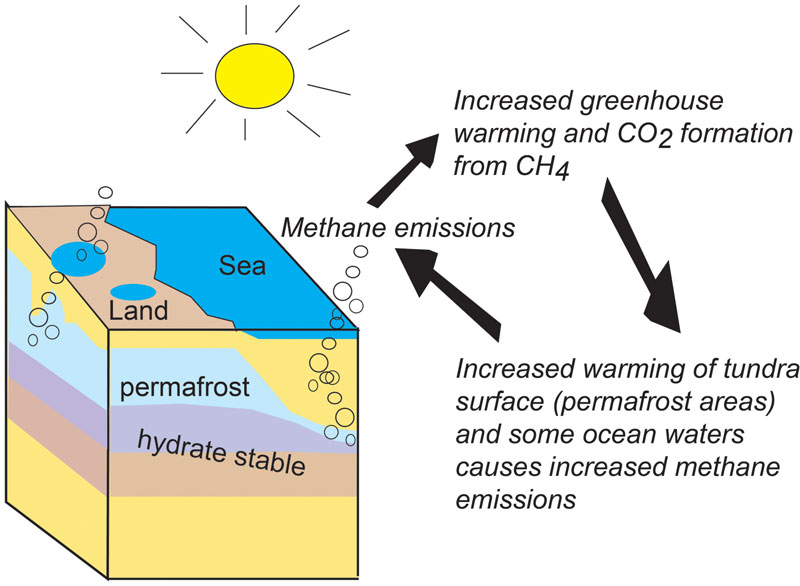
As it does here.  Basically it comes down to this.  Methane is a far greater greenhouse gas than that of CO2.  It is given off in many forms (gas from every living creature) but it is kept in Vast Amounts in Ice.  This Ice is most easily found in the Arctic and Antarctic, but also deep down on the Ocean floor.  It consists of decomposed plant and animal life, since the Earth began.  If the permafrost begins to melt (as it is melting) it releases its methane, and when it does, it is 100 times the greenhouse gas that CO2 is.  After some time, it’s potency lowers to 25 times the greenhouse gas effect of CO2 (which is often what  people wanting to lower the alarm on quote) but that in effect will take effect, long after the major warming has been done by the methane.
 
This in turn warms the Ice (containing Methane Hydrate) more, with Global Warming, making more Ice melt, causing a runaway effect which never ends, and will not end, until virtually all human life no longer exists on this Planet.  This is no longer in dispute.  We ARE in the process of the Earth’s sixth mass extinction.  How soon can it happen?  You had better HOPE that Guy McPherson has overestimated, but then again, he does not make up his OWN data.
So this is what is happening, while Mainstream Media ignores it.  Not really WORTH news-play is it?  I mean if you were expecting some decent reporting on an important issue, what do you think it might be?  Harper’s new pitch on Child Care Benefits?  The Senate?
 
Since we are talking Politicians, let’s not forget that there is not just The Harper running in this upcoming Federal Election.  No in fact, there are others running as well.  Now given YOUR LIFE depends on what they are doing about this, what are THEY talking about?  The OTHER Candidates?  Home Mail Delivery?  Are they talking Senate too?  Are these important issues? 
 
So important that they should not mention
 
The End of all Life on this Planet?

Sockeye fishing closure considered as half of Upper Columbia’s run apparently dies in warm waters

http://www.spokesman.com/blogs/outdoors/2015/jul/24/sockeye-fishing-closure-consider-half-upper-columbias-run-apparently-dies-warm-waters/

JULY 24, 2015

By Rich Landers

UPDATE, 2:20 p.m.:  Sockeye closure has been announced starting Sunday, July 26, a half our after sunset  upper Columbia from Rocky Reach Dam upstream to Chief Joseph Dam.  More details coming.

FISHING — Despite an early facade of excellent sockeye fishing success, the third-largest run on record is in dire straits and Washington fish managers are considering a possible early closure of the prized season in the upper Columbia River.

About half the sockeye run appears to have perished in the low flows and warm water conditions they’ve endured this year in their taxing migration up the Columbia toward spawning areas, says Jeff Korth, Washington Department of Fish and Wildlife regional fisheries manager based in Ephrata.

State fish managers have not responded so far today regarding the status of the proposal.

Oregon and Washington have both enacted emergency fishing rules for some waters that might help fisheries to some degree in this freak year of low snowpack and early runoff that’s ravaged the region’s summer river flows.

Sturgeon fishing was closed this month after dozens if not hundreds of the decades-old giants were found dead in mid-Columbia reservoirs. The sturgeon were stuffed with sockeye and at least some of those sockeye were suffering from bacterial infections promoted by the warm waters.

In early July, biologists were already trying to figure out why 200,000 of the sockeye counted over Bonneville Dam did not make it upstream with their peers to swim over McNary Dam.

  • To date, 503,000 sockeye have been counted swimming over Bonneville, the first dam they encounter on the Columbia on their migration from the ocean.  About 270,000 have been counted over McNary as they enter the upper Columbia at the Tri-Cities.

Last week, government fish scientists monitoring the Columbia, Snake and Southwest British Columbia sockeye returns began coming up with enough evidence to describe the situation among themselves in terms such as “catastrophic.”

Columbia water temperatures have started to tick downward a degree or two and may continue in cooler weather forecast through this weekend. Whether that’s enough change to enable more sockeye to survive remains to be seen.

Korth said the forecast weatehr isn’t going to be enough. “We desperately need the cooler weather,” he said in an email, “but it’s to get the remaining fish up the Okanogan River and through Osoyoos Lake.”

Idaho began trucking some of its endangered Snake River sockeye upstream to hatcheries in hopes of saving enough broodstock to continue a run they’ve had encouraging results in rebuilding from virtually nothing.

The salmon seasons attract thousands of anglers to the Columbia system rivers. A closure would be a huge blow to local economies in towns such as Brewster.

Summer chinook, which are moving up the Columbia in record numbers, apparently are not suffering so much in the warm flows and there’s been no discussion of closing chinook fishing.

But the sockeye run is hurting and future sockeye runs may be in jeopardy, Korth said.

On July 1, Korth had a gut feeling things could get bad as I interviewed him for a story about the upper Columbia salmon season opener, which produced very good success rates.

“More than three salmon per angler is darned good opening-day fishing,” Korth said. But he couldn’t ignore the other numbers on his radar.

Even then, the sockeye were stalled below the mouth of the Okanogan River, which was far above mean temperatures and well above the 72-degree threshold that prevents the fish from continuing their run. Normally the fish rush when they can uptream to the deep, cool waters in Canada’s Osoyoos Lake where they hunker until conditions are right for them to spawn.

This week, Columbia River water out of Wells Dam below Brewster was a livable 65 degrees for sockeye (71 at Bonneville).  However, Okanogan River temps were as high as 84 degrees.

“We had 15,000 (sockeye) try to make the run up (the Okanogan) the other day and they all died,” Korth says in a story Thursday about the proposed closure by Northwest Sportsman editor Andy Walgamott.

Korth knew anglers would do well in catching the sockeye stacking up below the Okanogan and looking for a cool place to go.

“It’s going to be a dicey year for managing that stock – but a good year for fishing,” he said.

Now he’s wondering how fish managers can assure that enough sockeye survive disease and fishermen to make it upstream to spawn and continue the run for the future.

Korth, who says he’s waiting today for a response from fisheries officials in Olympia, explained to Northwest Sportsman:

  • With the hot water providing ideal conditions for culimnaris bacteria to thrive, a fish’s wounds from scraping on rocks and fish ladders are quickly infected, leading to lesions.
  • Migrating salmon need more oxygen because of the high metabolic rate needed to swim against currents, but warm waters tend to have less dissolved oxygen.
  • Lake Wenatchee sockeye may not even meet escapement goals, much less return in numbers high enough for a fishing season, which had been scheduled to open last weekend. Korth believes half of the Lake Wenatchee run has died, too. Fewer than 12,000 of the 106,000 forecast have returned so far over Tumwater Dam.
  • Half of the sockeye in the Brewster pool are likely to die instead of reaching Canada’s Okanagan and tributaries to spawn in September and October.
  • Upper Columbia salmon anglers so far have caught around 20,000 sockeye during a fishery that’s been described as “nothing short of fantastic.”  (Anglers caught about 40,000 during the entire 2014 season.)

“I just hope it’s not too much,” Korth told Walgamott. “Just a couple months ago we were all rejoicing because of the (salmon) forecasts.” 

Korth says he’s proposed closing the Upper Columbia for sockeye, but a final decision is up to state fishery managers in Olympia.

They have not responded to queries this morning.