Climate Change is a Bore; Shooting Poachers, a Turn-On

This blog is living proof that, as the media tells us, “we’re bored with climate change” (The BBC suggests today that we’ve moved on from caring about climate change because we’re tired of it). It’s not that there’s nothing new to learn about the issue of whether we, and the Earth, will survive to see another century.

An overview, Melting Accelerates in Antarctica: So Far, 2015 Is Hottest Year Yet, in Truthout.org by Dahr Jamail posted just last night spells out what’s new, and will fill you in on what you may have missed. If you haven’t read the latest reports on anthropogenic climate disorder (or even if you have), I highly recommend it: http://truth-out.org/news/item/30063-melting-accelerates-in-antarctica-so-far-2015-is-hottest-year-yet It can begin to give you an appreciation of the magnitude of this dire situation.

Coincidentally, on April 7th I wrote a semi-satirical post about the lack of interest in climate change and how business as usual will bring it on, entitled, “C’mon Nature, Show Us a Sign!”  https://exposingthebiggame.wordpress.com/2015/04/07/cmon-nature-show-us-a-sign/  As if to prove my point, so far it’s been read by only 31 people. That could almost make one wonder if overpopulation itself is just a hoax. How can there be 7 and a quarter billion people on the planet when only 31 read that post?

Meanwhile the post, “Chorus of Outrage as Obama Administration Approves Arctic Drilling for Shell Oil” only received 23 views.

Now, compare those figures to the 53,436 people so far (6,652 on the first day, followed by 15,094 the next) who have read the article I posted on April 1 about a woman who hunts poachers in Africa.

(Note to anyone writing to spread the word about climate change: You might want to include a photo of a lady cradling a machine gun in front of an American flag, they seem to attract an awful lot of interest.)

Poacher-Hunters-6

C’mon Nature, Show Us a Sign!

Sometimes I find myself wishing that Mother Nature would hurry up and get serious about this global warming thing already.

No, not just because I secretly want to see the human scourge shed off the face of the Earth. (Not today, anyway.)

What I am talking about is the fact that the very things that should be ending to stave off catastrophic climate change—as well as the ongoing sixth mass extinction—are actually increasing.graph

For example, breeding. Okay, that’s a given, but let’s talk specifics.

Here in the Pacific Northwest, logging the rainforest is not coming to a close in acknowledgement of a warming planet needing all the carbon sequestering (not to mention oxygen—oh yeah, and shade) she can get. Indeed, everywhere I look there’s a fresh new clear-cut, while load after load of precious trees are hauled off in carbon-spewing log trucks to massive ships bound for China.

Now, if timber companies were increasing their “harvest” of evergreens to make way for more fast-growing, deciduous trees like alders or maples that would be one thing. But considering that they routinely use Agent Orange defoliant to kill the natural progression of plants on their “tree farms,” I don’t think they have saving the planet on their minds. Quite the opposite.

As long as there are global warming deniers out there, loggers can continue cutting down the forests like there’s no tomorrow. And anyway, who knows, maybe there won’t be one. I’d call it a self-fulfilling prophecy, but they’re certainly not prophets (profit-makers, maybe).

Another obvious example of an industry that should be calling it quits, but is instead expanding its ruinous ways: Big Oil. While climate scientists are warning us that it’s time to just STOP, Shell has plans to start drilling in the fragile Chukchi Sea (crucial feeding grounds for the grey whales, just south of the Arctic Ocean). Meanwhile, the President is allowing offshore drilling in the Atlantic for the first time.

Perhaps, like the logging companies, the oil barons are seeing the writing on the wall that their days are numbered, so they’re out to get it while they can—before the damned enviros slap them with enough restrictions or regulations to put them out of business for good.

So when I say I wish Nature would show us a sign, I don’t mean another massive hurricane or super typhoon, world record drought or raging inferno. Apparently those aren’t enough to shake some people up and out of their denial-induced torpor. I’m not sure what it’ll take. A total reversal of the jet stream? The icecaps melting and Florida sinking overnight? Spontaneous combustion of the White House?

Whatever it’s gonna be I hope it happens soon, before business as usual makes the whole mess worse than it already is.

page20

Chorus of Outrage as Obama Administration Approves Arctic Drilling for Shell Oil

http://www.commondreams.org/news/2015/04/01/chorus-outrage-obama-administration-approves-arctic-drilling-shell-oil

Thanks to a government ruling on Tuesday, Shell may soon be able to continue drilling in the Arctic, despite risks to the environment and animals who live there. (Photo: Day Donaldson/flickr/cc)

Environmental activists expressed shock and outrage on Tuesday after the U.S. Department of the Interior upheld a 2008 lease sale on the Arctic’s Chuchki Sea, opening the door for continued oil exploration in a region long eyed for drilling by Shell Corporation and increasingly strained under the effects of climate change.

The decision opens up 30 million acres in the Chuchki Sea to fossil fuel exploration and drilling, a move which state and national green groups called “unconscionable.”

“Our Arctic ocean is flat out the worst place on Earth to drill for oil,” said Niel Lawrence, Alaska director of the Natural Resources Defense Council. “The world’s last pristine sea, it is both too fragile to survive a spill and too harsh and remote for effective cleanup.”

In January 2014, the Court of Appeals for the Ninth Circuit ruled that the Interior Department had violated the law when it sold those 2008 leases—a deal that came about during George W. Bush’s presidency, but was upheld two years later by the Obama administration.

The 2014 decision ordered the Interior Department to reconsider the leases. A month later, the department admitted that drilling in the Chucki Sea was likely to have devastating consequences, with a spill risk of 75 percent or more.

“It is unconscionable that the federal government is willing to risk the health and safety of the people and wildlife that live near and within the Chukchi Sea for Shell’s reckless pursuit of oil,” said Marissa Knodel, a climate campaigner with Friends of the Earth. “Shell’s dismal record of safety violations and accidents, coupled with the inability to clean up or contain an oil spill in the remote, dangerous Arctic waters, equals a disaster waiting to happen.”

“Ignoring its own environmental review, the U.S. Department of the Interior has opened the door for drilling in the remote and iconic Arctic Ocean,” said the Sierra Club on Tuesday.

“It’s shocking that the Department of the Interior would knowingly move forward with a plan that has a 75 percent chance of creating a major spill in the Chukchi Sea. We can’t trust Shell or any other oil company with America’s Arctic,” Cindy Shogan, executive director of the Alaska Wilderness League, added. “Shell has proposed an even dirtier and riskier Arctic drilling program for this summer. The Obama administration has seen the impacts of what a major oil spill looks like.”

The Bureau of Ocean Management will next conduct an environmental assessment on Shell’s exploration plan for the Chuchki Sea, which could take 30 days or more.

The Chuchki Sea is home to an estimated 2,000 polar bears and serves as the feeding grounds for migratory gray whales.

“The industrial oil development that Interior hopes will flow from its decision to approve the Chukchi lease sale gives us a 75 percent chance of a large oil spill and a 100 percent chance of worsening the climate crisis,” Rebecca Noblin, Alaska director for the Center for Biological Diversity, added. “I don’t like those odds.”

This chart of rising ocean temperatures is terrifying

http://grist.org/news/this-chart-of-rising-ocean-temperatures-is-terrifying/

This year’s biggest climate change news was that 2014 was hottest year on record. Turns out, there’s bigger news: It was also the hottest year in the oceans, which are warming so fast they’re literally breaking the NOAA’s charts.

Don’t think you mind a little jacuzzification in your ocean? You’re wrong. Warmer oceans matter because “global warming” doesn’t just mean above average air temperatures over the course of a year — it actually refers to an increase in the total amount of heat energy contained in the Earth’s systems. While air temperatures can fluctuate on any given year, they are usually matched by an increase or decrease of the amount of heat stored in the oceans (which, by the way, absorb around 90 percent of total global warming heat). To know whether the system as a whole is getting warmer or not, scientists need to take into account the temperatures of the atmosphere, land, AND oceans.

Luckily, NOAA has been tracking ocean energy data for decades, updating its charts every few months. Unluckily, the newest data shows that, on top of 2014’s record-breaking air temperatures, ocean temperatures have also increased — to put it in layman’s terms — a shit ton. The spike is so significant that NOAA will have to rescale its heat chart.

Ocean heat content data to a depth of 2,000 meters
NOAA

OK, people. We don’t want to sound like a broken record about the reality of climate change … and actually this time we don’t have to. This is one broken record that speaks for itself.

From sea lions to penguin chicks, adorable animals are dying in droves

http://grist.org/science/from-sea-lions-to-penguin-chicks-adorable-animals-are-dying-in-droves/?utm_source=newsletter&utm_medium=email&utm_term=EDIT%20Weekly&utm_campaign=weekly

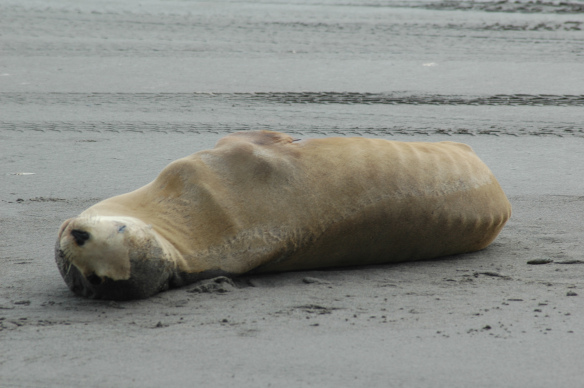
We know and love sea lions for their soulful eyes and playful antics — they’re basically the golden retrievers of the ocean. But recently, sea lionsdsc_0224 have been making headlines for much sadder reasons: Droves of malnourished sea lion pups have been washing up all over the Southern Californian coast. More than 1,450 pups have stranded without their mothers since January, reported the Washington Post.

The cause? Starvation.

Warmer waters off the coast of California are likely driving away sea lions’ prey such as squid, anchovies, and sardines, said Justin Viezbicke, stranding services coordinator for the National Oceanic and Atmospheric Administration (NOAA). As a result, mother sea lions are having to go further from birthing grounds — usually around the Channel Islands — to forage for food, meaning that pups probably don’t get enough nutrients from their mothers when they return. The pups then wean off their mothers earlier and are underweight when they leave the island, likely to find food of their own.

“They’re leaving with a low tank of gas and there’s really not much out there to help them out,” said Viezbicke. “They’re jumping into … a challenging environment and then they’re ending up washing ashore on the mainland, starving.”

Organizations like NOAA and other animal rescue programs have been taking in pups and feeding them — but that’s only a stopgap measure.

“This is something that’s naturally occurring out there, so there’s really not much we can do other than watch and learn from the situation,” Viezbicke said. “We can’t really prevent or stop it, unfortunately.”

Left to their own devices, these stranded sea lion pups probably wouldn’t make it. (No judgement if you need a tissue here. I’ll wait.)

As sad as it sounds, starvation events and mass mortality events (in which vast numbers of animals die), are becoming more and more common in this wacky, warming world. Thanks to a number of large-scale, systemic alterations (lookin’ at you, El Niño and warming ocean temps), the world’s ecosystems hang in a delicate balance.

Meet the Cassin auklet — a pudgy, fist-sized seabird with crescent-shaped eye markings and pale blue feet. They’re pretty dang cute. And thousands of them are washing up dead along the West Coast — all the way from Northern California to British Columbia.

“My volunteers alone … have found 7,000 carcasses [over the last four months],” said Julia Parrish, executive director of the Coastal Observation and Seabird Survey Team (COASST) at the University of Washington. “It’s a scary big number.”

Like the sea lions, auklets are literally dying for a meal. The birds primarily feed on zooplankton or krill. However, in the last year, a mass of warm water — very scientifically named “the blob” — drove the usual Pacific krill into deeper waters and brought in a host of zooplankton that the auklets don’t eat, reported Audubon Magazine.

When a high number of birds wash ashore dead, the events are called “wrecks.” Generally speaking, smaller wrecks are fairly normal, Parrish explained. If there’s a storm out at sea, it’s not unusual for seabirds caught in its path to die, whether from starvation or storm conditions, and later wash up on beaches. That’s just how it goes.

But this time, something is different. “This is the biggest wreck we’ve ever seen in the 16 years we’ve been doing this work,” Parrish said. “I think it’s probably the largest wreck we’ve seen on West Coast … That makes me sit up and take notice.”

This winter’s wreck could be especially bad if enough of the dead auklets turn out to be adults, because an entire reproductive group may have been wiped out. They won’t know for sure until the birds return to their breeding grounds. Until then, it’s a lot of waiting and counting dead birds.

beachedaucklets
D. Derickson/COASST

So is this climate change at play? Scientists are hesitant to say.

Dee Boersma, a conservation scientist and founder of the Penguin Sentinels Project at UW, compares the vulnerability of seabirds to weather and climate to the vulnerability of a human crossing a busy street: You could get hit by a truck, but it doesn’t happen every time. And just as it’s hard to predict exactly how likely you are to survive a street-crossing as a human, the same goes for storms and their effects on Magellanic penguins, she said.

In 2014, Boersma and other penguin researchers published a study in PLOS ONE which found that climate change was directly responsible for the deaths of more than 200 Magellanic penguin chicks from 1983 to 2010 in Punta Tombo, Argentina. There, climate change is increasing the intensity and frequency of storms, while lowering the reproductive success of Magellanic penguins, the study reported.

During the 27-year-long study, young penguins perished at a high rate due to a combination of starvation and overexposure during exceptionally rainy and hot seasons. The chicks’ feather coats keep them cozy when they are dry, but that changes when they get wet: The fluffy down isn’t waterproof, like adult penguin feathers. So if a penguin chick gets caught in the rain during a storm, it’s like a human “being stuck outside and naked in a wet sleeping bag … the penguins basically die of hypothermia like you or I would,” said Boersma.

Plus, a lack of food leaves the chicks unprepared to cool themselves down when things heat up, since they rely on the food their parents bring them for all of their water. Without adequate hydration, the chicks can’t depend on evaporation to keep cool and become vulnerable to heat stress.

It’s a lethal combination: Over the course of the study, an average of 65 percent of the Punta Tombo chicks died every year, with about 40 percent dying of starvation.

Chicks that died of hypothermia after a rainstorm.
Dee Boersma / University of Washington

So what was that about climate change again? Mass animal die-offs and starvation epidemics are shocking no matter what, even to hardened scientists. Climate change is just exacerbating these kinds of things.

“The fact is that we have populations responding to warming events, whether the warming is temporary or inexorable,” said Parrish, the researcher studying the dying auks.

The world’s ecosystems are hanging on as best they can, but small things can throw them out of balance. It’s unfair to compare the temperatures that a wild ecosystem can withstand to the temperatures humans can, because we have tools and technology on our side. “Wildlife needs habitat,” Parrish said. “In today’s crowded world, habitat only exists in certain places — places that we protect. And when the climate warms, those places change.”

“[Even one degree] is a huge deal,” Parrish points out. To understand and support conservation efforts, humans need to “think like a fish, a clam, or an oyster, and not like a person.”

Leave fossil fuels buried to prevent climate change, study urges

Fracking for Oil within 100 miles of Williston North Dakota. Along the Missouri River and the Bakken shale formation. Gas burning off from newly tracked well, there is no infrastructure to capture any of this gas.

New research is first to identify which reserves must not be burned to keep global temperature rise under 2C, including over 90% of US and Australian coal and almost all Canadian tar sands

http://www.theguardian.com/environment/2015/jan/07/much-worlds-fossil-fuel-reserve-must-stay-buried-prevent-climate-change-study-says

Also see: http://www.theguardian.com/world/2015/mar/03/too-much-human-poo-on-mount-everest-says-nepal

Global warming helped trigger Syria’s bloody civil war

[Watch for more of this kind of news in the coming years as anthropogenic climate change leads to more drought, weather disruption and food scarcity…]

http://mashable.com/2015/03/02/global-warming-syria-civil-war/

by Andrew Freedman

Manmade global warming helped spark the brutal civil war in Syria by doubling to tripling the odds that a crippling drought in the Fertile Crescent would occur shortly before the fighting broke out, according to a groundbreaking new study published on March 2.

The study, published in the journal Proceedings of the National Academy of Sciences, is the first to attribute the drought in Syria in large part to global warming.

In doing so, it provides powerful evidence backing up the Pentagon and intelligence community’s assessments that climate change is likely to play the role of a “threat multiplier” in coming decades, pushing countries that are already vulnerable to upheaval over the edge and into open conflict.

Previous studies had shown that the drought, along with other factors such as an influx of refugees from the Iraq War next door, helped prime Syria for conflict by 2011, when the uprising began, before transitioning into an all-out civil war. Today, once-cosmopolitan Syria has been reduced to rubble, with the terrorist group known as ISIS taking over large swaths of territory.

At least 200,000 people are estimated to have died in this conflict so far.

A Syrian refugee woman is seen between a line of tents in a refugee camp near Azaz, north of Aleppo province, Syria, Sunday, Feb 17, 2013.

AP Photo / Manu Brabo

Turkey, Lebanon, Israel and Jordan may face an even more tenuous security situation in the coming decades.

The drought, which gripped the country between 2007 and 2010, forced 1.5 million farmers and herders in northeastern Syria to flee their lands and travel to urban areas in search of food and work.

This profound demographic shift helped further destabilize the country, the study says.

The study also found that much of the eastern Mediterranean, including Syria, parts of Turkey, Lebanon, Israel and Jordan — no bastions of stability today — may face an even more tenuous security situation in the coming decades as global warming increases temperatures and reduces rainfall throughout much of the region.

According to this study and others, global warming along with unsustainable water use is causing the Fertile Crescent, where agriculture and animal herding first began 12,000 years ago, to lose its fertility.

“This region is going to continue to get drier and continue to get hotter, so this is only a problem that is going to continue to get worse in that region,” says Colin Kelley, the study’s lead author and a postdoctoral researcher at the University of California at Santa Barbara.

Although the drought did not directly cause the war and subsequent rise of ISIS, which the U.S. and its allies are combating using military force, it formed a significant part in the cascading series of events that led to the deadly Syrian conflict.

Government policies that encouraged the unsustainable use of water resources and provided inadequate aid to displaced persons, among other factors, also ratcheted up Syria’s vulnerability to conflict around the time of the drought.

“We would not say and did not even attempt to say that the uprising was caused by climate change,” Kelley says. Rather, the drought was one in a chain of events that led to the breakout of hostilities.

“[Syria’s] vulnerability was so acute that all it took was something to push them over the edge,” he said in an interview.

Kelley says the drought set in motion a series of events that wound up sparking one of the deadliest conflicts of the 21st century to date. “A lot of these farming communities abandoned their villages and went to the cities at the same time that Iraqi refugees were coming in,” Kelley says.

“There was a very big population shock to these urban areas.”

Urban areas in Syria saw a population jump of 50% between 2002 to 2010, from 8.9 million to 13.8 million, as a result of refugees fleeing fighting in Iraq as well as those who were abandoning their land in northeastern Syria.

“That’s a tremendous increase in people to these urban areas over this period,” Kelley told Mashable. “It’s not at all surprising that the uprising happened shortly after this.”

Richard Seager, a climate scientist at Columbia University’s Lamont-Doherty Laboratory in New York and a co-author of the study, told Mashable that farmers were prepared to cope with a one-to-two-year dry spell, but three years exceeded their ability to cope.

“The length and severity of this drought [that was] made more likely by human climate change was absolutely key in driving the agricultural community toward a threshold where they had no other opportunity but to pick up and leave,” Seager says.

Tuesday Is Soylent Green Day Again

Last night I watched the timeless 1973 movie, Soylent Green, again and was again impressed (unfavorably) by how much the futuristic world that it depicted mirrored the world we’re headed for now. The temperature of the overcrowded New York of the future was a constant 90 degrees; the oceans were dying (presumably from overfishing and pollution, they hadn’t heard of acidification at the time); and the world was running out of food..

Spoiler Alert:

Set in 2022, the film opens with a slide show of earlier eras, back when the Earth was covered with forests and open fields, and there were only a few scattered settlements of people who travelled in horse-drawn wagons.

As the images pass quickly by, we see the first automobiles (tail pipes spewing toxic climate-changing carbon gases), followed by a massive blacktop parking lot jam packed with Model Ts. The pictures begin to flash almost more rapidly than we can focus, but we catch glimpses of factories with smokestacks billowing and crowds of people barely able to

move without trampling one another. (Come to think of it, what we are witnessing looks a lot like the inside of an average modern-day poultry barn, where chickens and turkeys are forced to live out their lives in intense confinement.)

The first scene of action takes place in a cramped little New York City apartment, the dwelling of the film’s two main characters, Thorn, a semi-corrupt detective, and his elderly room-mate and research partner, Sol, who is constantly going on about the good old days—a world that Thorn can’t possibly envision or relate to.

They are among the lucky few; most people sleep on the stairways or in the hallways or anywhere they can find shelter from the oppressive heat caused by an out of control greenhouse effect. We overhear a program on their worn out old TV which is an interview with the governor of New York, touting a new food product called “Soylent Green,” ostensibly made from the ocean’s plankton. (Everyone in that day and age knows that the land is used up, but they’re told the oceans can still provide for them).

Food in this depressing, human-ravaged world comes in the form of color-coded wafers, distributed under strict government supervision. Hordes of people stand in line for their ration of Soylent yellow or blue made from soy, or other high protein plants grown behind the fortress-walls of heavily guarded farms.

Signs remind the throng that “Tuesday is Soylent Green day.”

The multitudes are exceptionally unruly on Tuesday. Brimming with anticipation, they can’t wait to obtain a ration of the special new product. When the food distributors run out of soylent green, people start rioting and things get out of hand. “Scoops” (garbage trucks fitted with backhoe-like buckets on the front) are called in to scrape up the angry masses and haul them off…

By the end of the film, Thorn learns that the oceans are dead and the actual ingredients of Soylent Green are something a bit harder to stomach than plankton. In the final scene, a mortally-wounded Thorn is carried away on a stretcher as he desperately tries to tell bewildered onlookers, “Soylent Green is People!” “They’re making our food out of people. Next thing, they’ll be breeding us like cattle for food!”

Could it ever happen? Could the human race ever stoop so low? If the scenario seems too hard to swallow­, consider this: the conditions animals are forced to endure on today’s factory farms would have seemed unimaginable to people living a hundred years ago.

Are Humans Going Extinct?

Monday, 01 December 2014 09:45
Written by 
Dahr Jamail By Dahr Jamail, Truthout | Interview

Some scientists, Guy McPherson included, fear that climate disruption is so serious, with so many self-reinforcing feedback loops already in play, that humans are in the process of causing our own extinction.

August, September and October were each the hottest months ever recorded, respectively. Including this year, which is on track to become the hottest year ever recorded, 13 of the hottest years on record have all occurred in the last 16 years.

To see more stories like this, visit “Planet or Profit?”

Coal will likely overtake oil as the dominant energy source by 2017, and without a major shift away from coal, average global temperatures could rise by 6 degrees Celsius by 2050, leading to devastating climate change.

“Across two decades and thousands of pages of reports, the world’s most authoritative voice on climate science has consistently understated the rate and intensity of climate change and the danger those impacts represent.”

This is dramatically worse than even the most dire predictions from the Intergovernmental Panel on Climate Change (IPCC), which predicts at least a 5-degree Celsius increase by 2100 as its worst-case scenario, if business continues as usual with no major mitigation efforts.

Yet things continue growing worse faster than even the IPCC can keep up with.

Scientific American has said of the IPCC: “Across two decades and thousands of pages of reports, the world’s most authoritative voice on climate science has consistently understated the rate and intensity of climate change and the danger those impacts represent.”

And there is nothing to indicate, in the political or corporate world, that there will be anything like a major shift in policy aimed at dramatically mitigating runaway anthropogenic climate disruption (ACD).

Guy McPherson is a professor emeritus of natural resources, and ecology and evolutionary biology, with the University of Arizona, who has been studying ACD for nearly 30 years.

Near-term human extinction could eventually result from losing the Arctic sea ice, which is one of the 40 self-reinforcing feedback loops of ACD.

His blog Nature Bats Last has developed a large readership that continues to grow, and for six years McPherson has been traveling around the world giving lectures about a topic that, even for the initiated, is both shocking and controversial: the possibility of near-term human extinction due to runaway ACD.

As McPherson has told Truthout: “We’ve never been here as a species, and the implications are truly dire and profound for our species and the rest of the living planet.” He told Truthout that he believes that near-term human extinction could eventually result from losing the Arctic sea ice, which is one of the 40 self-reinforcing feedback loops of ACD. “A world without Arctic ice will be completely new to humans,” he said.

At the time of our interview less than one year ago, McPherson had identified 24 self-reinforcing positive feedback loops. Today that number has grown to 40.

A self-reinforcing feedback loop can also be thought of as a vicious circle, in that it accelerates the impacts of ACD. An example would be methane releases in the Arctic. Massive amounts of methane are currently locked in the permafrost, which is now melting rapidly. As the permafrost melts, methane, a greenhouse gas 100 times more potent than carbon dioxide on a short timescale, is released into the atmosphere, warming it, which in turn causes more permafrost to melt, and so on.

In the near term, earth’s climate will change 10 times faster than during any other moment in the last 65 million years.

While McPherson’s perspective might sound way-out and like the stuff of science fiction, similar things have happened on this planet in the past. Fifty-five million years ago, a 5-degree Celsius rise in average global temperatures seems to have occurred in just 13 years, according to a study published in the October 2013 issue of the Proceedings of the National Academy of Sciences. A report in the August 2013 issue of Science revealed that in the near term, earth’s climate will change 10 times faster than during any other moment in the last 65 million years.

Prior to that, the Permian mass extinction that occurred 250 million years ago, also known as “The Great Dying,” was triggered by a massive lava flow in an area of Siberia that led to an increase in global temperatures of 6 degrees Celsius. That, in turn, caused the melting of frozen methane deposits under the seas. Released into the atmosphere, those gases caused temperatures to skyrocket further. All of this occurred over a period of approximately 80,000 years. The change in climate is thought to be the key to what caused the extinction of most species on the planet. In that extinction episode, it is estimated that 95 percent of all species were wiped out.

Today’s current scientific and observable evidence strongly suggests we are in the midst of the same process – only this time it is anthropogenic, and happening exponentially faster than the Permian mass extinction did.

We are likely to begin seeing periods of an ice-free Arctic by as soon as this coming summer, or the summer of 2016 at the latest.

Once the summer ice begins melting, methane releases will worsen dramatically.

Our current extinction event is already greatly exceeding the speed, and might eventually even exceed the intensity, of the Permian mass extinction event.

We are currently in the midst of what most scientists consider the sixth mass extinction in planetary history, with between 150 and 200 species going extinct daily – a pace 1,000 times greater than the “natural” or “background” extinction rate. Our current extinction event is already greatly exceeding the speed, and might eventually even exceed the intensity, of the Permian mass extinction event. The difference is that ours is human caused, isn’t going to take 80,000 years, has so far lasted just a few centuries and is now gaining speed in a nonlinear fashion.

Is it possible that, on top of the vast quantities of carbon dioxide from fossil fuels that continue to enter the atmosphere in record amounts yearly, an increased release of methane could signal the beginning of the sort of process that led to the Great Dying? Some scientists, McPherson included, fear that the situation is already so serious and so many self-reinforcing feedback loops are already in play that we are in the process of causing our own extinction. Worse yet, some are convinced that it could happen far more quickly than generally believed possible – even in the course of just the next few decades.

Truthout caught up with McPherson at the Earth at Risk conference in San Francisco recently to ask him about his prediction of human extinction, and what that means for our lives today.

Dahr Jamail: What are some of the current signs and reports you’re seeing that are disconcerting, and really give you pause?

Guy McPherson: I’ve been traveling, so I’m out of date for the last 10 days. But starting with the snowstorm in Buffalo, New York, that was the biggest snowstorm ever recorded in Buffalo, at 6 feet 4 inches in 24 hours. It’s the largest one ever recorded in the United States.

Australia, meanwhile, is on fire. I just came back from New Zealand, and spring had just turned there because it’s the Southern Hemisphere. The whole time I was there people were commenting on how hot it was, and “how far into summer we already are,” and it was early to mid-spring when I was there.

So there’s all kinds of observational evidence.

“It’s hard for me to imagine we make it into the 2030s as a species.”

We triggered another self-reinforcing feedback loop, number 40, just about two weeks ago; then just a week ago there was a [scientific] paper that came out indicating that for every 1-degree temperature rise, there is 7 percent more lightning strikes. So that contributes to a previously existing self-reinforcing feedback loop, that of fires, especially in the Northern Hemisphere, and especially in the boreal forests. So, as it gets warmer and drier, there are more and bigger fires, and that kicks more carbon into the atmosphere, which of course contributes to ongoing, accelerating climate disruption.

So lightning is yet another piece of that. As there is more moisture in the atmosphere and more heat going into the atmosphere and warming the planet, we have more lightning. The whole atmosphere becomes more dynamic. So, those are things that come to mind.

From your analysis, how long do you think humanity has before extinction occurs?

That’s such a hard question, and we are such a clever species. It’s clear that abrupt climate change is underway. Methane has gone exponential in the atmosphere. Paul Beckwith, climate scientist at University of Ottawa, indicates we could experience a 6-degree Celsius temperature rise in the span of a decade. He thinks we’ll survive that. I can’t imagine how that could be. He’s a laser physicist and engineer, so I think he doesn’t understand biology and requisite habitat that we need to survive.

So it’s difficult for me to imagine a scenario where we’ll survive even a 4-degree Celsius [above pre-industrial baseline] temperature rise, and we’ll be there in the very near future, like by 2030, plus or minus. So it’s hard for me to imagine we make it into the 2030s as a species.

But when I deliver public presentations I try not to focus on any particular date; I just try to remind people that they are mortal. That birth is lethal, and that we don’t have long on this planet even if we live to be 100, so we might want to pursue what we love, instead of pursuing the next dollar.

A more micro-look from that question – what do you see happening in the US, if Beckwith and other scientists who are predicting that rapid a rise of temperatures in such a short time frame are correct?

The interior of continents heats at least twice as fast as the global average. So a 6-degree Celsius rise in the global average means at least 12 degrees Celsius in the interior of continents – that means no question there is no habitat for humans in the interior. So you would have to be in a maritime environment.

“It’s difficult for me to imagine a situation in which plants, even land plants survive, because they can’t get up and move.”

I think even before we get to 6 degrees Celsius above baseline, we lose all habitats. We lose all or nearly all the phytoplankton in the oceans, which are in serious decline already as the result of an increasingly acidified ocean environment. It’s difficult for me to imagine a situation in which plants, even land plants survive, because they can’t get up and move. So without plants there is no habitat.

At a 6-degree Celsius temperature rise in the span of decades, there’s no way for evolution by natural selection to keep up with that. Already, climate change – which at this point has been pretty slow and what we would call linear change – already climate change is outpacing evolution by natural selection by at least a factor of 10,000, so I don’t see any way the planet is going to keep up.

More:

http://www.truth-out.org/news/item/27714-are-humans-going-extinct

Also read:  The Methane Monster Roars

http://www.globalresearch.ca/the-methane-monster-roars/5426116

1795497_611414028914288_1804650880_n


Half of the members of the US Senate don’t believe humans cause climate change

1795497_611414028914288_1804650880_n

The votes are in, and … half of the members of the US Senate don’t believe humans cause climate change.

This is a national embarrassment. Differences of opinion are one thing, but it’s far more troubling when half of the members of our most distinguished legislative body simply ignore facts supported by overwhelming scientific consensus.

Let’s take the Senate to school. Sign the climate science petition — when we get 50,000 signatures, Avaaz will run a poll quizzing schoolchildren on climate, then launch ads in the biggest papers showing that the US Senate is failing science class compared to middle schoolers. Sign now:

https://secure.avaaz.org/en/schooling_the_senate_on_climate_science_re/?bVYyJab&v=52978

Things are bad in Washington. The first real legislation the new Senate passed this year? To build the climate-wrecking Keystone XL pipeline. The new chair of the Senate’s environmental committee is James Inhofe, the Senate’s climate denier-in-chief who quotes the Bible to claim humans can’t change the planet. But the climate science report from the National Academies of Science — commissioned by Congress itself — says the exact opposite!

The report’s #1 finding was that “Climate change is occurring, is very likely caused primarily by human activities, and poses significant risks to humans and the environment.” Going against this is like asking mathematicians for a number line, then saying that 1 is smaller than zero.

Deep down, most of the Senators who voted against scientific fact must know they’re full of it. The American people do — a new report just found that a majority want Congress to do more on climate. And our best shot at changing the game is to publicly embarrass them.  Sign on now, and help teach Congress a lesson that even 8th graders know:

https://secure.avaaz.org/en/schooling_the_senate_on_climate_science_re/?bVYyJab&v=52978

Human-caused climate change is no joke. That so many of our supposed leaders are so out of step with basic science, settled years ago, means that the people are going to have to lead on this one. That’s a role the Avaaz community knows how to fill — we did it in New York in September with the People’s Climate March, and we can do it again now.

With hope,

Terra, David, John, Nataliya, Fatima, Ricken, and the Avaaz team

SOURCES
National Academy of Sciences “Climate Choices” Report summary
http://dels.nas.edu/Report/America-Climate-Choices-2011/12781

So Much Senate Climate Change Trolling (Think Progress)
http://thinkprogress.org/climate/2015/01/21/3614028/so-much-senate-climate-change-trolling/

US Senate refuses to accept humanity’s role in global climate change, again (The Guardian)
http://www.theguardian.com/environment/2015/jan/22/us-senate-man-climate-change-global-warming-hoax

Most Americans support government action on climate change (NY Times)
http://www.nytimes.com/2015/01/31/us/politics/most-americans-support-government-action-on-climate-change-poll-finds.html