In Case You Haven’t Noticed Yet, Global Warming Is Real

If you’re one of the lucky few who live somewhere as yet relatively unaffected by climateunderwear change, or you spend all your time indoors listening to Rush Limbaugh and watching Donald Trump on Fox News, I’m here to tell you, global warming is real.

It may be hard to accept that the Earth’s overall temperature is rapidly warming up if your state has just experienced a polar vortex, but if you live in California or the Pacific Northwest you know all too well the drastic effect climate change is having on winter weather—especially if you’re a skier like me.

As an avid powder skier I’ve been closely following the snow reports for the mountains in the western United States and I’m seeing a depressing trend toward shallower snow packs and away from our normal winter wonderland.

Why is this happening? As the San Jose Mercury News reported it, “Meteorologists have fixed their attention on the scientific phenomenon they say is to blame for the emerging drought: a vast zone of high pressure in the atmosphere off the West Coast, nearly four miles high and 2,000 miles long, so stubborn that one researcher [Swain] has dubbed it the ‘Ridiculously Resilient Ridge.’ Like a brick wall, the mass of high pressure air has been blocking Pacific winter storms from coming ashore in California, deflecting them up into Alaska and British Columbia, even delivering rain and cold weather to the East Coast.” Much to the dismay of skiers, this stubborn high pressure ridge is pushing the jet stream, and our winter moisture, along a much more northerly track.

Ok, but what does this, and the lack of winter storms (for us here in the West) have to do with global warming? In an article in ThinkProgress.org, “Leading Scientists Explain How Climate Change Is Worsening California’s Epic Drought,” we learn that “Beyond the expansion and drying of the subtropics predicted by climate models, some climatologists have found in their research evidence that the stunning decline in Arctic sea ice would also drive western drought — by shifting storm tracks…Scientists say this anomaly looks very much like what the models predicted as sea ice declined. The storm track response also looks very similar with correspondingly similar impacts on precipitation (reduced rainfall in CA, increased precipitation in SE Alaska).”

In addition to California’s record-breaking drought and water rationing, you probably heard on the national news about their destructive January brush fires. But even more shocking than those unseasonable fires are a recent pair of 300 acre wildfires on the normally soggy North Oregon Coast, which burned nearly to the beach. January fires in the Pacific Northwest rain forest are almost unheard of, as anyone who has tried to light a campfire in winter there will attest. In an article about the forest fires, The Daily Astorian (North Oregon Coast ’s local paper) reported that the National Weather Service in Portland issued a “red flag” warning in response to conditions (strong dry east winds and humidity as low as 25%) that can contribute to wildfires burning out of control. Instead of the 25% humidity, coastal Oregon humidity on a winter’s day should be more like 125%.

Whether you choose to “believe in” global warming or not, I urge any of you enjoying this mild, dry winter weather to please think snow!

DSC_0098

What Goes Up…

To all those of breeding age who are considering starting a family or adding yet another human child to this already dangerously over-crowded world, I politely urge you, with all due respect, to please think again. If not for the fragile planet’s sake or for the sake of every other struggling life form headed for mass extinction, then for the child’s sake, your sake and for sanity’s sake. Go ahead and adopt, whether human or non-human, but please don’t add to every environmental woe known to—and caused by—man by falling prey to the ill-advised notion that propagating is our duty or prerogative.

The world as we know it is headed for collapse. Do you really want your precious offspring to witness the unraveling of all of Earth’s systems or suffer the reckoning that’s soon to befall those unfortunate enough to be here when humankind’s self-serving environmental crimes come back on them? Can’t you see that the sheer weight of the human race is crushing everything and everyone else?

As a good friend, a young woman wise beyond her years, put it, those who consider reproducing to be a positive prospect for the twenty-first century “must be closing their eyes, plugging up their ears, and singing ‘Lalalala!’ very loudly.”

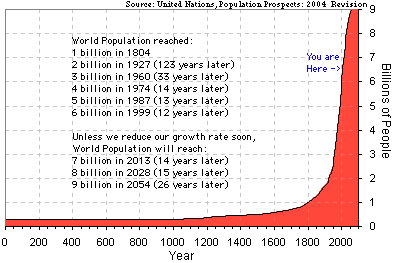
What goes up must come down, people; and for the past couple of hundred years or so, the human population has been accelerating skyward—breaking all sound barriers in a headlong quest to defy gravity, burst out of the Earth’s atmosphere and sail on to oblivion—taking all of creation with it.

graph

Large carnivore decline puts humans at risk

http://www.nbcnews.com/science/cry-wolf-large-carnivore-decline-puts-humans-risk-study-says-2D11880999

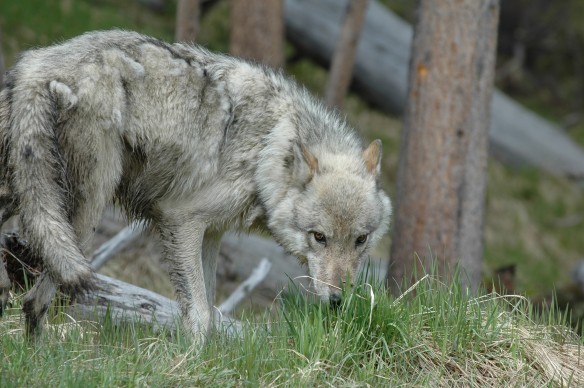
copyrighted Hayden wolf walking

by John Roach

A few years after wolves were reintroduced to the Northern Rockies in 1995, fifth-generation Montana rancher Rick Jarrett gave up on the parcel of federal land near Yellowstone National Park that he grazed for 20 years. The carnivores harassed his cattle so much that they stopped gaining weight. Skinny cattle don’t sell.

“It wasn’t worth being there anymore,” he told NBC News. To turn a profit, he now confines his livestock to several thousand acres on and around his ranch in Big Timber, where his cattle and sheep are free to pack on the pounds — for now. The wolves, he said, will eventually get there, too.

While Jarrett is bitter about having to live with wolves, such coexistence is increasingly necessary if the world hopes to reverse a downward spiral of its largest carnivores such as wolves as well as lions, tigers, and bears, according to a review study published Thursday in the journal Science.

As the carnivores decline, ecosystems and food chains that humans depend on for survival are unraveling and, in many cases, adding to the economic woes of everyone from farmers to ecotourism companies.

“We should be thinking of ourselves in the end because if enough important species go extinct and we lose enough ecosystem services and economic services, then humanity will suffer,” William Ripple, an ecologist at Oregon State University in Corvallis and the study’s lead author, told NBC News.

What to do? Ripple and 13 colleagues from around the world found that more than three quarters of Earth’s largest carnivores are in population declines. Most occupy only a fraction of their historic ranges and more than half are threatened with extinction.

 The paper’s main finding is familiar to wildlife conservationists — large carnivores are in trouble — but pays scant attention to the most important problem: “What are we going to do about it?” Craig Packer, an ecologist at the University of Minnesota who was not involved with the study, told NBC News.”I think that is a huge challenge.”

Finding solutions is complicated, Ripple noted. The study, he said, is meant to illustrate the plight of carnivores and what humans stand to lose if the creatures go extinct — information that could steer policy via, for example, a global committee focused on carnivore conservation.

In the paper, the researchers argue that humans are ethically obligated to conserve large carnivores — the animals have an intrinsic right to exist on planet Earth. They then back the argument with examples of the way the role carnivores play in the ecosystem help humans.

In Africa, for example, loss of leopards and lions has translated to an increase in baboon populations, which in turn are raiding farmers’ livestock and crops for food. “In extreme cases, the farm family needs to keep their children home to guard the crops instead of go to school,” Ripple said.

Other benefits of carnivores noted in the study include control of deer, elk, and moose populations, which in turn keep forest plants healthy for other critters, limit erosion, and enhance water quality. Parks full of wolves and bears also attract tourists, whose dollars boost local economies.

Wolf-specific tourism in Yellowstone National Park, the paper notes, brings in $22 to $48 million per year.

What’s more, the scientists add, regions where carnivores keep other animal populations in check are full of plants that soak up carbon from the atmosphere, helping to slow global climate change. Jarrett, the Montana rancher, doubted such arguments would foster better feelings toward wolves.

“Granted carbon sequestration is important,” he said, “but the benefit we are going to get from wolves … is so insignificant it isn’t even funny.”

Legitimate fears The reality, noted Packer, who is an expert on human-carnivore interactions and deeply involved in African lion conservation, is that humans naturally fear these animals, often for good reason.

“You cannot expect somebody living in rural Africa or rural Asia to risk being eaten by a lion or a tiger so that your moral sense is gratified back in California or Texas or New York,” he said. “Conservationists need to recognize that there are legitimate reasons why people want to get rid of these animals.”

To reduce human predation on lions, Packer advocates the controversial use of patrolled and maintained fences that serve as a physical barrier between people and wildlife.

Ultimately, he said, the conflict among humans about our relationship with carnivores comes down to emotion versus intellect. While arguments such as carnivores’ ability to buffer ecosystems against climate change are “interesting,” in the end, he said, emotion usually wins.

“You have to find ways that people feel safe and that people benefit economically.”

John Roach is a contributing writer for NBC News.

Reducing Gas Emissions from Livestock Key to Curbing Climate Change: Study

By James A. Foley

Jan 03, 2014

A study published recently in the journal Nature Climate Change highlights both the need for policy changes and greater emphasis on livestock management in order to curb climate change.

Although it’s well known that significant quantities of methane are produced by the burps and excrement of the world’s livestock, the study authors contend that inadequate attention is being paid to to the greenhouse gasses associated with ruminant animals such as cows, sheep, goats and buffalo.

“Because the Earth’s climate may be near a tipping point to major climate change, multiple approaches are needed for mitigation,” study leader William Ripple, a professor in the College of Forestry at Oregon State University. said in a statement. “We clearly need to reduce the burning of fossil fuels to cut CO2 emissions. But that addresses only part of the problem. We also need to reduce non-CO2 greenhouse gases to lessen the likelihood of us crossing this climatic threshold.”

Ripple and his colleagues suggest that an effective way to mitigate the effects these greenhouse gasses have on the environment is to reduce global populations of ruminant livestock.

At approximately 3.6 billion heads, the world population of ruminant livestock is about half the global human population. Moreover, about 25 percent of the Earth’s land area is dedicated to livestock grazing, and a third of all arable land is used to grow feed crops for livestock, the researchers write.

On the basis of pounds of food produced, cattle and sheep generate between 19 and 48 times more greenhouse gasses than protein-rich plant foods such as beans, grains, or soy products, the researchers found.

More: http://www.natureworldnews.com/articles/5514/20140103/reducing-gas-emissions-livestock-key-curbing-climate-change-study.htm#

15242-333e1363ed3eb6b53508d726e22a5fecb3cbcb4a168d4cea6cce61d8_w_240_px

2013: The Year of the Big Backslide?

The year of our lord, 2013, could be known as the year of the big backslide, at least in terms of attitudes toward animals and the environment, as well as the general acceptance of scientific fact.

For example, CBS News reports that the number of Republicans who believe in evolution today has plummeted compared to what it was in 2009, according to new analysis from the Pew Research Center. A poll out Monday shows that less than half – 43 percent – of those who identify with the Republican Party say they believe humans have evolved over time, plunging from 54 percent four years ago. Forty-eight percent say they believe “humans and other living things have existed in their present form since the beginning of time,” up from 39 percent in 2009.

I can’t help but think this is because many people still aren’t comfortable admitting they’re animals. And this supremacist attitude is reflected in everything they do in regard to our fellow species.

Anyone who has been following the wolf issue since gray wolves were removed from the Endangered Species List in a handful of backward states has certainly noticed a rapid backslide pertaining to how wolves are perceived, treated and “managed” by those bent on dragging us back to the dark ages for animals—the Nineteenth Century—when concepts like bounties, culls and contest hunts were commonplace. Hunters and ranchers in the tri-state area surrounding Yellowstone National Park, as well as in the Great Lakes region, are doing everything they can to resurrect the gory glory days of the 1800s, and wolves are paying the ultimate price.

Meanwhile, in spite of great efforts to educate people about the myriad of problems associated with factory farming and the dependence on meat consumption in an ever more crowded human world, the number of ruminants raised for food on the planet today is at an all-time high of 3.6 billion, double what is was 50 years ago. Regardless of or our burgeoning human population, not only do we have a chicken in every pot in this country, we now have cow and sheep parts in every freezer and pig parts in practically every poke. This, of course, is all thanks to ever-worsening living conditions for farmed animals.

Professor William Ripple and co-authors of a research paper, “Ruminants, Climate Change, and Climate Policy,” prepared in Scotland, Austria, Australia and the United States, noted that about 25 percent of the earth’s land area is dedicated to grazing, and a third of all arable land is used to grow food for livestock, according to the report. Reducing the number of cattle and sheep on the planet, and thereby reducing the methane gas emissions they produce, is a faster way to impact climate change than reducing carbon dioxide alone, the report concluded. The researchers concluded that greenhouse gas emissions from cattle and sheep are 19 to 48 times higher per pounds of food produced than the gas emitted in the production of plant protein foods such as beans, grains or soy.

To get an idea of how unnatural and unsustainable 3.6 billion large ruminants is, think back to when vast bison herds blackened the plains. At that time there were only 50 million bison in all of North America. There are over 300 million human beef-eaters in the United States, every one of them expecting to see a fully stocked steak house, Subway or McDonald’s on every street corner.

Meanwhile, the media’s busily cooking up a spin to answer to meat’s culpability in this planet’s climate crisis. Articles on how methane from grass-eaters is a primary greenhouse gas are often accompanied by the suggestion that pigs and chickens don’t produce as much. In other words, don’t worry your little meat-addicted heads if this beef-cow-causing-global-warming thing becomes a recognized issue, you can just switch over to other non-ruminants’ carcasses—no one really expects you to become a vegetarian, after all.

One of the most outrageous spins ever concocted aired on a “Ted Talk” just last March. Allan Savory, a former Rhodesian provincial Game Officer, has been spreading the counterintuitive notion that to control desertification and stop global warming we need to turn even more cattle out onto arid land. This notion comes from a man who, as late as 1969 advocated for the culling of large populations of elephants and hippos because he felt they were destroying their habitat. Savory participated in the culling of 40,000 elephants in the 1950s, but he later concluded it did not reverse the degradation of the land and called the culling project “the saddest and greatest blunder of my life.” Now he’s trying to sell us on another blunder with even more destructive consequences. What will this guy do for an encore? Never mind, I don’t want to know.

Speaking of Africa, 2013 saw the fastest growing and second most populous continent on its way to adding another billion people to the planet. By the end of this century, 3/4 of the world’s growth is expected to come from Africa, and projections put its population at four billion—one billion in Nigeria alone. Most African countries will at least triple in population, as there are very high fertility rates and very little family planning in most regions. No one is quite sure how the continent will provide for that many hungry humans; only time will tell.

And even though China’s overwhelming population is already well past a billion, in 2013 they abandoned their one child policy and affectively doubled it by implementing a two child policy at the stroke of a pen.

Sorry, but this shit is scary, at least if you care about the plight of non-human species on this planet. Sure, cultural diversity is important—to people. But it sure as hell doesn’t trump biological diversity in the scheme of things. Regardless of what you may or may not believe about whether we were created in the image of a god, life on Earth as we know it will not go on if we humans are one of the only species left around.

The coming decades are going to test just what Homo sapiens are made of. Are we progressive and adaptable enough to learn to share the planet with others and become plant eaters, as some people have? Or is our incessant breeding and meat consumption going to put us into an all new classification—planet eater?

1535443_10151792030721493_1254752217_n

If the Global Warming Doesn’t Kill the Humans…

I trust you’re all familiar with the Onion news, right? Good. In that case you’ll get it as you read my parody on the following “article” from
America’s finest news source, the Onion:

If The Heat Doesn’t Kill The Elderly, I Will
Jul 13, 2005
By Rudolph Milner

It is now high summer, and the sun is broiling the American Southwest, sending temperatures soaring upwards of 110 degrees. The heat has struck hardest among the elderly, dozens of whom have died of heatstroke, heat exhaustion and dehydration. If you, like me, are a right-thinking person, your mind recoils in horror at this fact: The old and decrepit are dying by mere dozens?

Fifty years ago, a heat wave of this magnitude and duration would have claimed the lives of hundreds, perhaps thousands of shriveled-up old codgers. The streets would have been littered with their withered carcasses. Unfortunately, this is no longer the case. By providing today’s elderly with unprecedented access to air conditioning and situating them in safe, supervised retirement communities, we have thrown Mother Nature’s natural-selection process completely out of sync. And don’t look for winter to solve the problem, either: Even more old people have heating than have air-conditioning, and more and more are getting it every day.

Like you, I had high hopes for this summer. Like you, I am deeply disappointed in the low death toll among the elderly…

Call me warped, but I have to confess I got a good chuckle or two from this piece of pseudo news. Still, as much as I envied the Onion’s ability to make light of a serious issue like human mortality, I felt they were unfairly picking on the elderly when it’s actually the whole of the human race who deserves lampooning. Therefore, in the spirit of fairness to decrepit old codgers everywhere, I’m going to hereby restate this piece and edit out all the ageist rhetoric in hopes it will come across a bit more senior-neutral:

If the Global Warming Doesn’t Kill the Humans…

It is now high summer, and the sun is broiling the American Southwest, sending temperatures soaring upwards of 110 degrees. The heat has struck humans by the dozens, some of whom have died of heatstroke, heat exhaustion and dehydration. If you, like me, are a right-thinking person, your mind recoils in horror at this fact: Homo sapiens are dying by mere dozens?

Fifty years ago, a heat wave of this magnitude and duration would have claimed the lives of hundreds, perhaps thousands of humans. The streets would have been littered with their carcasses. Unfortunately, this is no longer the case. By providing today’s humans with unprecedented access to air conditioning and situating them in safe, supervised communities, we have thrown Mother Nature’s natural-selection process completely out of sync. And don’t look for winter to solve the problem, either: Even more people have heating than have air-conditioning, and more and more are getting it every day.

Like you, I had high hopes for this summer. Like you, I am deeply disappointed in the low death toll among humans…

291789_400428663360054_2105335387_n

Exposing that Other Big Game: Cannibalism

People were appropriately appalled at recent news that Syrian rebel leader, Abu Sakkar, ate part of a government soldier’s innards in a primitive display of human evil possibly unrivaled on film (aside from those clandestine videos taken in slaughterhouses to expose animal cruelty, or the footage wolf hunters themselves spread around the internet to impress their buddies and sicken wolf-advocates).

Cannibalism, an abhorrent, aberrant act practiced by carnivorous humans in one form or another the world over since the earliest of times (according to archaeological finds), has fallen out of fashion today for all but the most warped, serial killer-types.

In a new, almost apologetic article called Face-to-face with Abu Sakkar, Syria’s ‘heart-eating cannibal,’ BBC’s Paul Wood tells of his meeting with the Hannibal Lecter of the Mid-East (safely restrained in a straightjacket and hockey mask, one would hope)……

It sounded like the most far-fetched propaganda claim – a Syrian rebel commander who cut out the heart of a fallen enemy soldier, and ate it before a cheering crowd of his men. The story turned out to be true in its most important aspect – a ritual demonstration of cannibalism – though when I met the commander, Abu Sakkar, in Syria last week, he seemed hazy on the details.

“I really don’t remember,” he says, when I ask if it was the man’s heart, as reported at the time, or liver, or a piece of lung, as a doctor who saw the video said. He goes on: “I didn’t bite into it. I just held it for show.”

[A quasi-denial reminiscent of Bill Clinton’s bogus, “But I didn’t inhale” defense.]

The video says otherwise. It is one of the most gruesome to emerge from Syria’s civil war. In it, Abu Sakkar stands over an enemy corpse, slicing into the flesh.

“It looks like you’re carving him a Valentine’s heart,” says one of his men, raucously. Abu Sakkar picks up a bloody handful of something and declares: “We will eat your hearts and your livers you soldiers of Bashar the dog.”

Then he brings his hand up to his mouth and his lips close around whatever he is holding. At the time the video was released, in May, we rang him and he confirmed to us that he had indeed taken a ritual bite (of a piece of lung, he said).

Now, meeting him face-to-face, he seems a bit more circumspect, though his anger builds when I ask why he carried out this depraved act.

“I didn’t want to do this. I had to,” he tells me. “We have to terrify the enemy, humiliate them, just as they do to us…”

Before the uprising, he was working as a labourer in Baba Amr. He joined the demonstrations when they started in the spring of 2011. Then, he says, a woman and child were shot dead at a protest. His brother went to help. He, too, was shot and killed.

Abu Sakkar seems unsure how to respond to his notoriety. He is, by turns, sheepish, nervous, angry and bitter. He definitely has the look of a man who has seen too many bad things. At the end of our interview he says he is an “angel of death” coming to cash in the souls of the enemy.

It is possible that Abu Sakkar was mentally disturbed all along. Or perhaps the war made him this way. War damages men – and Syria is no different.

As the poet W H Auden wrote: “Those to whom evil is done, do evil in return.”
…………………………..       HumanWeapons_170
Where will it all end?   Eating human organs (whether heart, lung or liver) out of hatred, rage, to steal another’s life force or to terrify one’s enemies, definitely amounts to evil in my book.

With very few exceptions, most animal species don’t eat others of their own kind. (Some species of gulls will scavenge on the remains of another washed up on the beach; on the other hand, wolves may kill wolves from other packs, but will not eat them.) But cannibalism is not such a stretch for a species like Homo sapiens which eats or has eaten everything that creepeth, swimeth or otherwise moveth on the Earth—from snails to whales and everyone in between.

Indeed, if ancient humans had video cameras, Abu Sakkar’s stunt would seem like small potatoes.

As recently as the early 1800s, New Zealand’s Maori people practiced warfare-related cannibalism, such as the type Sakkar resurrected. New Zealand was blissfully human-free until only a thousand years ago. The Maori were the first settlers of the islands, arriving by canoe several centuries before Europeans. Known for practicing cannibalism in the heat of “battle rage,” the Maori made it onto the list of the Top Ten cases of human cannibalism:

In October 1809 a European convict ship was attacked by a large group of Maori warriors in revenge for the mistreatment of a chief’s son. The Maori killed most of the 66 people on board and carried dead and alive victims off the boat and back to shore to be eaten. A few lucky survivors who were able to find a hiding spot inside the mast of the boat were horrified as they watched the Maori devour their shipmates through the night until the next morning.

North of Australia, an anthropologist studying the Mianmin, a mountain-dwelling tribe in Papua New Guinea, witnessed them carrying off the dead of a neighboring tribe, the Atbalmins, after a successful lethal raid and asked them, “Why?” The Mianmins told the scientist they considered them “good meat.” The Atbalmins were outsiders, different from the Mianmins, who thought of them as “game.”
Also in New Guinea, during the 1950s and ’60s, How Stuff Works tells us: anthropologists studying the Fore people of Papua New Guinea documented an outbreak of kuru, a degenerative spongiform brain disease. The Fore contracted the disease by consuming the brain of their relatives as part of a funerary ritual. Kuru, which is the human version of mad cow disease, is highly contagious.

The only reason cows ever acquired “mad cow disease” is that “beef” producers began the capitalistic ritual of grinding up animal flesh and mixing it with their feed to produce a high protein gruel, thus creating unwitting cannibalistic cattle (possibly the only thing more bizarre than human cannibalism itself).

Ted Turner (the T.V mogul, oldies colorizer, big-time bison-flesh-peddler and former hubby to fellow activist Jane Fonda) predicted in 2008 that unless we drastically curb global warming, by 2040 “…none of the crops will grow. Most of the people will have died and the rest of us will be cannibals,”

Turner also said the population is another problem that must be handled. “We’ve got to stabilize the population,” he told PBS interviewer, Charlie Rose, “We’re too many people. That’s why we have global warming. We have global warming, because too many people are using too much stuff. If there were less people, they’d be using less stuff,” he said.

He also launched verbal offensives against the U.S. war on terror, describing war as senseless and suggesting a cutback in military budgets. “Right now the U.S. is spending $500 billion a year on the military, which is more than all [other] 190 countries in the world put together.

The timing of Turner’s prediction might be a bit off the mark as far as complete crop failure, mass starvation and rampant cannibalism, but one thing’s for certain: as long as people continue to feed their taste for the flesh of others—whether hunted venison, free-range bison, grass-fed beef or factory-farmed pig meat—the thought of moving laterally to include their fellow man in their bill of fare will be much easier to swallow.

It certainly stands to reason that starving humans in future decades might eventually turn to the most numerous flesh foods available—other humans—for survival. But the vegan diet cuts out the middle man (so to speak), allowing for more plants and grains to go to feeding human beings themselves, rather than cows, pigs and chickens. The only solution to avoid a nightmarish future that includes the depravity of cannibalism and is to move beyond the evils of animal exploitation.

264431_455824994498980_1177070538_n

Stop the Global Climatic Train Wreck, I Want Off

Here’s a timely article on climate change that ran in a local paper, followed by my response letter…

All aboard for the global train wreck

By Solveig Torvik

It blew right by you, didn’t it? The biggest news of the month, I mean. Arguably the biggest news in millions of years.

But you surely can’t be held responsible for missing it. It was gone from the news cycle in the blink of an eye. Really, it was no contest, what with the riveting disclosure that President Obama had the audacity to ask his U.S. Marine guard to hold an umbrella over him and Turkey’s visiting Prime Minister Recept Tayyip Erdogan during a rain-soaked press conference.

Still, on May 10 came startling though briefly noted news confirming that heat-trapping carbon dioxide (CO2) in the Earth’s atmosphere has reached a level that hasn’t existed in 3 million years – before humans came on the scene. Just as those nagging scientists long have foretold.

The recent readings of more than 400 parts per million CO2 came from Hawaii’s Mauna Loa observatory, where rising CO2 levels have been tracked for nearly 50 years. The Hawaii measurement matched levels first recorded in the Arctic in 2012.

There’s general agreement by the polluting nations that 450 ppm is the maximum level of CO2 damage the Earth as we know it can withstand. Yet there’s precious little discernible preventive action by these most guilty of parties in this tiresome, disheartening saga. China et al continue to spew CO2 while President Obama shilly-shallies on fossil fuels and other miscreants such as Norway’s rapacious latter-day Vikings relentlessly sink their drill bits into every curved corner of the globe. Oil rules.

The time is soon coming, scientists warn, when no measurement of ambient air anywhere on Earth in any season will register below 400 ppm. “Unless things slow down, we’ll probably get there in well under 25 years,” said Dr. Ralph Keeling of the Scripps Institution of Oceanography of the dreaded 450 ppm.

The unpleasant news about CO2 buildup followed hard on the heels of the sobering March announcement by Oregon State University researchers in the journal Science that annual average global temperatures are higher than they’ve been in 4,000 years.

Wobbles in the Earth’s orbit increased the amount of sunlight reaching the planet about 12,000 years ago, causing the ice sheets to melt, according to the researchers, who reconstructed temperature shifts over the last 11,300 years using evidence from sensitive ocean creatures and other environmental indicators.

By 8,000 years ago, a stabilized warmer climate was allowing human civilizations to develop. If natural forces still controlled the amount of sunlight reaching Earth, eventually we’d be wobbling back to another ice age, scientists say. But the huge send-up of greenhouse gases produced by 200 years of industrialization will prevent that, according to climate experts.

So what’s wrong with that? Who needs another ice age, for pity’s sake? Hello?

It’s the speed of increase in CO2 buildup that should stand your hair on end. It’s unprecedented, say climate scientists. “We and other living things can adapt to slower changes,” said Michael E. Mann, a researcher at Pennsylvania State University. “It’s the unprecedented speed with which we’re changing the climate that’s so worrisome.”

We are conducting a huge, uncontrolled experiment on the systems that regulate life on Earth. For instance: Arctic seas have absorbed half of the CO2 emissions we’ve spewed out since the Industrial Age began, and they’re 30 percent more acidic than 200 years ago.

But now, rapidly melting ice sheets are pumping ever more fresh water into Arctic seas, making them less able to neutralize the acid attack. By 2100, those seas will be at least 50 percent more acidic, Arctic scientists say. And then what? They don’t know yet. But they do know this:

“We have already passed critical thresholds. Even if emissions stop now, acidification will last tens of thousands of years. It is a big experiment,” says Richard Bellerby, who chaired the Arctic Monitoring and Assessment Programme’s recent Arctic waters study.

So, people, here’s where we are: Our nibbling at the edges of this problem over the last 30 years hasn’t worked. It’s glaringly obvious that there’s an utter absence of appetite for major, meaningful reductions in production of heat-trapping gases by those who can make it happen.

What’s urgently needed, apparently, is to admit defeat and shift our focus to adaptive strategies for sustaining human life on a fossil fuel-fed planet that’s radically, and rapidly, changing.

Unless unforeseen events intrude on our population growth trajectory, when the sand really hits the fan around 2050, nine billion humans – equivalent to two more Chinas – will be demanding water and food.

The Environmental Protection Agency has looked into what all this means for the Pacific Northwest. Over the last century, our average annual temperature already has risen by 1.5 degrees Fahrenheit and as much as 4 degrees in some places. By the end of this century, it will be 3 to 10 degrees warmer hereabouts.

We’ll have more rain, less snow, the EPA reports. The Cascade snowpack will be diminished by 40 percent by the 2040s and will melt 20 to 40 days sooner. This means more drought, less irrigation water and stress on hydropower supplies from our dams, which supply 70 percent of our electricity. Expect more insect attacks in apple orchards and forests. More forest fires. And happily, some higher crop yields – if temperature extremes don’t kill them. Salmon will lose one-third of their habitat by 2100. And so on.

All manner of species will move northward in our direction; dozens of ocean fish stocks worldwide already have moved to cooler waters. These creatures, at least, have a response strategy to cope with our onrushing global train wreck.

But not us, the apex instigator species, lords of the planet.

_______________

Dear Editor,

I was shocked and appalled that last week’s Methow Valley News devoted so much ink to a boring subject like the fact that anthropogenic heat-trapping carbon dioxide in the Earth’s atmosphere has reached 400 parts per million the for first time since humans were created.

When I sit down to read a paper I expect to be entertained. Whether or not our species can adapt to the unprecedented rate of climate change hardly seems newsworthy to me. I mean, the paper didn’t print a word about whether or not Geraldo Rivera will be tapped for the New Jersey senate, if JLO’s outfit was too revealing, or how Michael Douglas thinks he acquired throat cancer.

Seriously though, “All aboard for the global train wreck” (May 29, 2013) was a great article, thanks for printing it.

Jim Robertson

nov2012cartoon-large

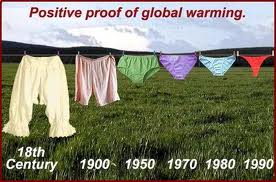
The People Have Spoken: Global Warming, Real—Magic Underpants, Not

Well, the votes are in and counted; a decision has been made. The people have spoken: global warming is real—magic underpants are not. And bowhunters are not fit to hold higher office, much to the disappointment of Paul Ryan and his role model, Ted Nugent. By shunning the diehard deer hunter, the voters have made it clear that the animals of the Earth are not mere playthings for the rich and famous, the powerful and perverse.

Perhaps now that the election is over we can forget about magic underpants and begin to focus our attention on the real issue that affects all our lives—namely, how human actions are changing the planet’s climate.

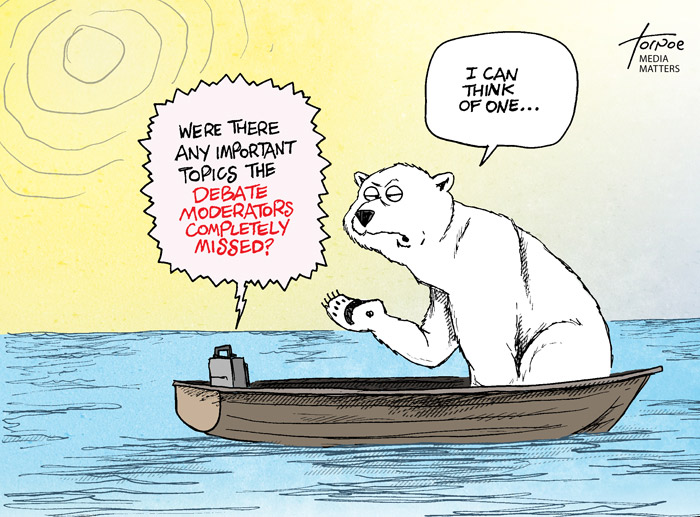
According to Kevin Knobloch, with the Union of Concerned Scientists, “President Obama has won another four years in office. In the wake of destruction left by Hurricane Sandy, the country may have experienced its first election disrupted by global warming. What makes this even more troubling is that the urgent crisis of climate change was never meaningfully discussed in the debates or on the campaign trail. After a year of punishing droughts in our nation’s breadbasket, extreme heat across most of the country, and wildfires that devastated our forests and property, it is now time to turn up the heat on our political leaders. Even with the continued polarization in Washington D.C., there is much President Obama can do to adopt science-based solutions that permanently drive down our carbon emissions and more effectively prepare for the climate-related disasters that will continue to threaten our lives and livelihoods.”

The trick will be making sure our lives and livelihoods don’t compound the problems of global warming. For example, shipping freighter-loads of coal across the ocean to be burned in Chinese power plants might provide a few jobs here for some, but is it worth the trade-off of carbon emissions produced?  Is the hedonism of the Western diet worth the continued suffering of billions of animals and the methane they produce? “Real change” will take real commitment and real innovation, rather than business as usual.

Cartoon © Rob Tornoe, 2012. All Rights Reserved

On to Other Important Issues

It’s Election Day and you’re probably on pins and needles waiting to find out which lucky candidate will be the next President of the United States. But I want to talk about something more important.

I don’t have anything in particular in mind. It could be the weather (or more specifically, how the weather is changing because of global warming). Or, it could be the rhino poaching problem in Africa, the dolphin slaughter going on right now in Japan or the perilously low numbers of big cats left on the planet. Or how, for some people, attitudes towards wolves haven’t changed since the barbarically backwards days of dark ages past.

The point is, no matter how this hyped-up human election turns out, there are other important issues going on at the same time that aren’t getting the media attention they deserve.

Text and Wildlife Photography ©Jim Robertson