It’s Not Rocket Science, Warmer Oceans = Stronger Hurricanes

Meteorologists have for the most part been ducking the topic of global warming in relation to Hurricane Sandy in the same way that biologists try to steer clear of the subject of animal sentience or the AMA avoids any mention of the link between the consumption of animal products and the increased rate of heart disease, diabetes and cancers in this country.

History’s greatest scientists have all been free-thinkers, unafraid of pushing the limits of human understanding. But it seems most out there today are content in their mediocrity—let’s not have anything groundbreaking or earthshattering interfere with business as usual, interrupt the flow of funding or threaten a precious reputation.

Yet, a few scientists are beginning to tip-toe gingerly into the fray by tentatively linking “Superstorm” Sandy to the effects of the unprecedented anthropogenic increase of carbon in the atmosphere and the subsequent weather extremes we’ve been seeing in recent decades.

According to an October 30th blog post in Scientific American, “Scientists have long taken a cautious stance, but more are starting to drop the caveat and link climate change directly to intense storms and other extreme weather events, such as the warm 2012 winter in the eastern U.S. and the frigid one in Europe at the same time. They are emboldened because researchers have gotten very good in the past decade at determining what affects the variables that create big storms.”

In answer to just how Hurricane Sandy was intensified by global warming, Scientific American explains: “Climate change amps up other basic factors that contribute to big storms. For example, the oceans have warmed, providing more energy for storms. And the Earth’s atmosphere has warmed, so it retains more moisture, which is drawn into storms and is then dumped on us.”

Additionally, climate scientists, such as Charles Greene at Cornell University, have recently shown that as more Arctic sea ice melts in the summer—because of global warming—the Jet Stream is more likely to take the kind of big southward dip in the U.S., Canada and the Atlantic that occurred during hurricane Sandy.

The term, “global warming,” adds to the confusion of naysayers who point to wintertime cold temperatures and freak blizzards as “proof” that the Earth is not really getting warmer. A clearer name for the contentious phenomenon would be “atmospheric warming” or “ocean warming,” since that’s what’s really happening and because that’s scientifically indisputable. Warming ocean temperatures are responsible for the climate changes affecting us all on the land, but of course, one overly-successful species, who shall remain nameless (okay, it’s Homo sapiens), is ultimately responsible for heating up the atmosphere and the oceans to begin with.

Humans can no longer plead ignorance. Back in 2007 a Scientific American article by Kevin Trenberth, a senior scientist at the National Center for Atmospheric Research, wrote an article titled, “Warmer Oceans, Stronger Hurricanes.” He concluded that although the number of Atlantic hurricanes each year might not rise, the strength of them would. And according to Munich Re, one of the world’s largest insurance firms, “Climate change particularly affects formation of heat-waves, droughts, intense precipitation events, and in the long run most probably also tropical cyclone intensity.”

Oliver Stone, the acclaimed writer/director of pioneering films such as Platoon, JFK, Nixon, and W, called Sandy “punishment for Obama and Romney ignoring climate change.” In an interview with HuffPost Live on Tuesday, the filmmaker expressed dismay that neither presidential candidate has been willing to talk about global warming, either before or after the superstorm that ravaged the entire East Coast and beyond. Stone hopes the storm’s silver lining is that President Barack Obama and his Republican challenger, Mitt Romney, pull a U-turn on climate change.

“I was a little disappointed at the third debate when neither of them talked about climate control and the nature of the situation on earth,” Stone said. “I think there’s a kind of a weird statement coming right after it. This is a punishment. Mother Nature cannot be ignored.”

There Was Magic in the Underwear

There was magic in the air last night—magic underpants, that is. Mitt Romney must have been wearing a crisp new pair for the debate. It’s not likely he would have beaten an intelligent, popular incumbent president without them.

Special skivvies aside, Mitt’s disregard for the environment showed through in the first few minutes with the line, “I like coal” and his promise to approve the Keystone pipeline. It was if he was saying, “Bring it on!” to the disastrous impacts of global warming. And by boasting about having five sons, he was clearly thumbing his nose at the problem of over-population.

For the sake of the natural world, Mr. Romney should trade in his magic undies for a crystal ball—or a dose of reality. Maybe then he’ll be able to see what rampant coal and shale oil extraction and burning are doing to the Earth and the atmosphere and how unbridled breeding is threatening this, the one and only planet we’ll ever know.

Text and Wildlife Photography ©Jim Robertson

Words of Wisdom from Captain Watson

The following quotes from Captain Paul Watson are from a recent interview on the Sea Shepherd website:

“The world would not be in the situation it is in now if not for the kind of anti-nature, anti-activist mentality of pretty much half the population. It seems that half the population of society is awake and the other half believes in angels, magic underwear, and Wal-mart.”

“overall the media in general cannot be expected to report factually on much anymore. This last week, one of the biggest stories is the controversy over topless pictures of Kate Middleton. Not a single question has been asked to the U.S. Presidential candidates on climate change, the dying oceans, species extinction or any other ecological issue. It is like if your house was burning and the firemen were still in the station discussing baseball scores and the media was reporting that the woman in the house next to you was sun bathing in the nude.”

“We humans are killing our oceans, we are diminishing bio-diversity, we are over heating the planet, we are pouring poisons into the sea and air. I cannot accept that meekly and I know with absolute certainty that if we kill the oceans, we kill ourselves. If the oceans die, we die and the oceans are dying in our time. My greatest fear is that people simply accept that fact.”

“In a comfortable environment where everything is safe and convenient, great things are not accomplished. It is from within an environment of controversy, uncertainty, and challenge that great things can be accomplished.”

This quote is from Captain Watson’s foreword in my book, Exposing the Big Game:

“Hunters are guilty of crimes against nature, against future generations and against humanity because diminishment leads to collapse and to extinction and we forget that we as animals, as primate hominids, will commit collective suicide if we continue with our barbaric traditions and behavior in the face of a global ecological collapse.”

from the back cover of Jethro Tull’s “Stormwatch” album

Hey Humans, Slow the Fuck Down

The following is the first of a series on Deniers and the Damage They Do…


By now you’ve more than likely read that the Arctic Ocean’s floating sea ice has already retreated to a record minimum.  And you’ve probably heard that every scientist who hasn’t been bought off agrees: global warming is to blame. And you might have even heard that Greenpeace activists have been staging protests and attaching themselves to oil rigs and ice breakers en-route to the polar region. You may already be one of the 1.6 million people who have signed the group’s online petition urging world leaders to declare the Arctic a global sanctuary, off limits to oil exploration and industrial fishing. And there’s an off-chance you’re one of the dozens of celebrities, including Robert Redford, Paul McCartney and Penelope Cruz, who have announced your support for Greenpeace’s campaign.

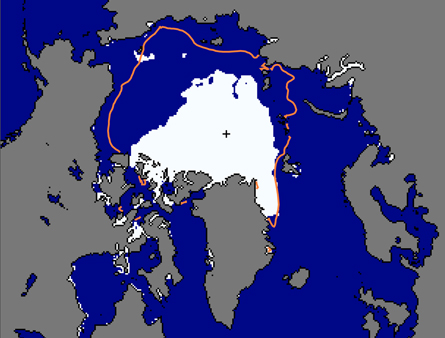
The following map and excerpt from a Science News article titled, “Arctic sea ice hits record low and keeps going,” reveals the present status of the Arctic ice cap. The average ice coverage for the 21 years between 1979 and 2000 is demarked by the orange line that can be seen running from the Greenland Sea, west and north of Svalbard, through the Laptev Sea to Russia’s Wrangel Island and through the Beaufort Sea to the Canadian Archipelago. The difference between that area and the area presently covered by ice is at best, shocking. … 

The six lowest sea-ice extents on satellite record have occurred in just the last six years. More melt means more open water exposed to sunlight. In turn, that water absorbs more heat and causes feedback loops that heat the Arctic even more.

As of August 26, Arctic sea ice covered 70,000 square kilometers below the previous satellite-era record from 2007, according to the National Snow and Ice Data Center in Boulder, Colo.

“The ice cover is now just so thin and weak in the springtime that large parts of it can’t survive the melt season,” says NSIDC director Mark Serreze.

Arctic sea ice grows in winter and melts partly away each summer. Overall, more sea ice has been lost each year as temperatures rise. From 1979 to 2011, the amount of sea ice left in September at the end of each melt season dropped by an average of 12 percent per decade.

The ice isn’t just shrinking; it’s also thinning. The Arctic used to contain lots of thick ice — some 3 to 4 meters thick — that survived year after year. Now it’s dominated by thinner ice only 1 to 2 meters thick and just one to two summers old. “It’s almost like parts of the Arctic have become a giant slushee at this time of year,” says Walt Meier, a sea ice expert at NSIDC.

In 2007, the previous record year, winds, cloud cover and other weather conditions were just right for a lot of ice to melt away. “There were a number of people saying [2007] was a one-off and you’ll never see this perfect storm again,” says Serreze. “What Mother Nature is telling us is that you don’t need a perfect storm anymore, just because the ice is so thin now.” …

_____________________________________

Meanwhile, in answer to these new conditions, oil companies are poised to begin installing offshore oils rigs and drilling in the backyards of walrus and polar bears. Greenpeace and other environmental groups say an oil spill in the Arctic could cause irreparable damage to wildlife and marine ecosystems. That’s no shit. With a brief growing season and comparatively little seawater circulation, the Arctic Ocean must be one the most delicate environs on the planet.

Fears that the oil industry is unprepared to operate in the hostile conditions of the far north where storms are frequent were accentuated when a floating oil rig capsized off eastern Russia last December, killing more than 50 workers.

Surely halting any new oil and gas drilling in the fragile north is an important step in solving the world’s problems. But considering that the loss of the polar ice cap is a direct result of global warming, and global warming is a direct result of human activities (chiefly the burning of fossil fuels for energy, transportation and meat production), wouldn’t the real answer be to put a halt to ALL further oil exploration and drilling everywhere? When you take into account that further planetary warming could well result in a steady flow of cold Arctic melt-water into the North Atlantic, thereby disrupting the deep sea conveyer that cycles weather as we know it, while fueling the very vitality of the living oceans, the answer must be a resounding, if reluctant “Yes!”

So what does all this have to do with deniers and the damage they do?

Chances are if you’ve heard of global warming, you’ve heard of global warming deniers. Maybe you are one yourself. If so, it’s time to wake up and smell the methane! The planet can’t wait for people to quit bickering and decide to make some major changes. If we don’t curtail our daily carbon output and change our consumptive ways, the climate is going to change for us, and leave our mechanized world in the dust.

Like “young Earth” creationists who still deny evolution because they don’t like to think of humans as mere animals, or hunters who don’t want to admit their species’ role in the ongoing extinction spasm, global warming deniers don’t want to accept humankind’s hand in radically changing the climate—to the detriment of all who’ve adapted to it over the eons. It’s time to evolve out of this hyper age of planes, trains and automobiles, put away our motorbikes, jet boats and snowmobiles along with the rest of our gas-burning toys, slow the fuck down and try to live at pace more in keeping with the rest of this living planet—while we still have one.

Text and Wildlife Photography ©Jim Robertson

The Smallest Particle in the Universe

Hooray, hooray. After sinking tens of billions of dollars into giant underground “atom-smashers,” scientists think they’ve discovered the smallest thing in the universe, the so-called “God particle” (a more appropriate name would be the “humans-playing-god-particle”). But for the most part, scientists haven’t yet discovered how seven billion human beings can live sustainably on (i.e., in lasting harmony with) this, our home planet. 

With triple-digit temperatures arriving earlier than ever across the United States, it appears the specter of global warming is stepping out of the shadows and thumbing its nose at anyone who still doubts its existence. Not to be deterred by a few heat-related deaths, out of control fires raging across the Rockies or apocalyptic thunderstorms knocking out power to those dependent upon air conditioning, the unrelenting, singe-minded machine known (paradoxically) as “progress” (intent on burning the last stores of carbon over the shortest possible time period) continues to tear open vast wounds in the Canadian arctic in search of tar sands and slurp up the last pools of crude from the most fragile of onshore and offshore environments. 

Meanwhile, more people than ever are eating more animals than ever. By clearing off the life-giving, naturally carbon-sequestering rain forests that slow the pace of climate change and replacing them with over-crowded cattle feedlots, human’s taste for flesh foods now surpasses even their thirst for oil in increasing the earth’s average overall annual temperature. 

Ironically, when the dust settles on humankind’s reign of terror, those costly underground atom-smashers may serve an important function after all. They can be put to use in the search for what must be the real smallest particle in the universe: the minute speck of human concern for anything beyond short-term gratification.