Exposing the Big Game

Forget Hunters' Feeble Rationalizations and Trust Your Gut Feelings: Making Sport of Killing Is Not Healthy Human Behavior

Exposing the Big Game

Revealed: Google made large contributions to climate change deniers

Google logo
 Google helps bankroll more than a dozen organisations that have pushed against moves to stop climate change. Illustration: Guardian Design

Google has made “substantial” contributions to some of the most notorious climate deniers in Washington despite its insistence that it supports political action on the climate crisis.

Among hundreds of groups the company has listed on its website as beneficiaries of its political giving are more than a dozen organisations that have campaigned against climate legislation, questioned the need for action, or actively sought to roll back Obama-era environmental protections.

The list includes the Competitive Enterprise Institute (CEI), a conservative policy group that was instrumental in convincing the Trump administration to abandon the Paris agreement and has criticised the White House for not dismantling more environmental rules.

Q&A

What is the polluters project?

Google said it was disappointed by the US decision to abandon the global climate deal, but has continued to support CEI.

Google is also listed as a sponsor for an upcoming annual meeting of the State Policy Network (SPN), an umbrella organisation that supports conservative groups including the Heartland Institute, a radical anti-science group that has chided the teenage activist Greta Thunberg for “climate delusion hysterics”.

SPN members recently created a “climate pledge” website that falsely states “our natural environment is getting better” and “there is no climate crisis”.

Google has defended its contributions, saying that its “collaboration” with organisations such as CEI “does not mean we endorse the organisations’ entire agenda”.

It donates to such groups, people close to the company say, to try to influence conservative lawmakers, and – most importantly – to help finance the deregulatory agenda the groups espouse.

A spokesperson for Google said it sponsored organisations from across the political spectrum that advocate for “strong technology policies”.

“We’re hardly alone among companies that contribute to organisations while strongly disagreeing with them on climate policy,” the spokesperson said. Amazon has, like Google, also sponsored a CEI gala, according to a programme for the event reported in the New York Times.

CEI has opposed regulation of the internet and enforcement of antitrust rules, and has defended Google against some Republicans’ claims that the search engine has an anti-conservative bias.

But environmental activists and other critics say that, for a company that purports to support global action on climate change, such tradeoffs are not acceptable.

“You don’t get a pass on it. It ought to be disqualifying to support what is primarily a phoney climate denying front group. It ought to be unacceptable given how wicked they have been,” said Sheldon Whitehouse, a Democratic senator from Rhode Island who is one of the most vocal proponents of climate action in Congress.

“What all of corporate America should be doing is saying if you are a trade organisation or lobby group and you are interfering on climate, we are out. Period,” he added.

On its website, Google says it is committed to ensuring its political engagement is “open, transparent and clear to our users, shareholders, and the public”.

But the company declined to answer the Guardian’s questions on how much it has given to the organisations.

On a webpage devoted to “transparency”, it describes the groups – among hundreds of others, including some progressive advocates such as the Center for American Progress – as having received “substantial” contributions.

Apart from CEI, they include the American Conservative Union, whose chairman, Matt Schlapp, worked for a decade for Koch Industries and shaped the company’s radical anti-environment policies in Washington; the American Enterprise Institute, which has railed against climate “alarmists”; and Americans for Tax Reform, which has criticised companies who support climate action for seeking out “corporate welfare”.

It has also donated undisclosed sums to the Cato Institute, which has voiced opposition to climate legislation and questioned the severity of the crisis. Google has also made donations to the Mercatus Center, a Koch-funded thinktank, and the Heritage Foundation and Heritage Action, a pressure group that said the Paris agreement was supported by “cosmopolitan elites” and part of Barack Obama’s “destructive legacy”.

Bill McKibben, a prominent environmentalist who has been on the frontline of the climate crisis for decades, said Google and other companies were engaged in a “functional greenwashing” given the contradiction in their public pronouncements and private donations. He said Google and other technology companies had also not used their own lobbyists to advocate for change on climate.

“Sometimes I’ll talk to companies and they will be going on and on about their renewable server farm or natural gas delivery, and I say thank you, but what we really need is for your lobbying shop in Washington to put serious muscle behind it. And they never do,” McKibben said. “They want some tax break or some regulations switch and they never devote the slightest muscle behind the most important issue of our time or any time.”

A spokesperson for Google said: “We’ve been extremely clear that Google’s sponsorship doesn’t mean that we endorse that organisation’s entire agenda – we may disagree strongly on some issues.

“Our position on climate change is similarly clear. Since 2007, we have operated as a carbon neutral company and for the second year in a row, we reached 100% renewable energy for our global operations.”

The company said it called for “strong action” at the climate conference in Paris in 2015 and helped to sponsor the Global Climate Action summit in San Francisco last year.

But that position is at odds with the support it gives to CEI.

The group’s director of energy and environment policy, Myron Ebell, helped found the Cooler Heads Coalition 20 years ago, a group of libertarian and rightwing organisations that have sowed the seeds of climate denial with funding from the fossil fuel industry.

When Donald Trump was elected to the White House in 2016, Ebell joined the transition team and advised the new president on environmental issues, successfully lobbying Trump to adhere to a campaign promise and abandon the Paris agreement.

Kert Davies, the founder of the Climate Investigations Center, a research group that examines corporate campaigning, said Ebell had led the anti-climate-action crusade for decades.

“They’re extremists,” he said, referring to the Cooler Heads Coalition. “They are never finished,” he said. “Myron has taken a lot of credit for Trump’s actions and is quite proud of his access.”

Recently, however, Ebell – who declined a request for an interview – has criticised the White House for not rolling back environmental protections aggressively enough, even though the Trump administration has gutted every major environmental act established under Obama.

His wishlist now includes reversing a 2009 finding by the Environmental Protection Agency that CO2 and other greenhouse gases endanger the health and welfare of Americans.

CEI said it “respects the privacy of its donors” and declined to answer questions about Google. A CEI spokesperson told the Guardian: “On energy policy, CEI advances the humanitarian view that abundant and affordable energy makes people safer and economies more resilient. Making energy accessible, especially for the most vulnerable, is a core value.”

One source who is familiar with Google’s decision-making defended the company’s funding of CEI.

“When it comes to regulation of technology, Google has to find friends wherever they can and I think it is wise that the company does not apply litmus tests to who they support,” the source said.

How fast can climate change? Too slowly for humans to *notice*, according to most scientists of the 20th century

Physics Today 56, 8, 30 (2003);
 
The Discovery of Rapid Climate Change
Only within the past decade have researchers warmed to the possibility of abrupt shifts in Earth’s climate. Sometimes, it takes a while to see what one is not prepared to look for.
Spencer Weart directs the Center for History of Physics at the American Institute of Physics.
Opening paragraphs
 
How fast can our planet’s climate change? Too slowly for humans to notice, according to the firm belief of most scientists through much of the 20th century. Any shift of weather patterns, even the Dust Bowl droughts that devastated the Great Plains in the 1930s, was seen as a temporary local excursion. To be sure, the entire world climate could change radically: The ice ages proved that. But common sense held that such transformations could only creep in over tens of thousands of years.
In the 1950s, a few scientists found evidence that some of the great climate shifts in the past had taken only a few thousand years. During the 1960s and 1970s, other lines of research made it plausible that the global climate could shift radically within a few hundred years. 
In the 1980s and 1990s, further studies reduced the scale to the span of a single century. Today, there is evidence that severe change can take less than a decade. A committee of the National Academy of Sciences (NAS) has called this reorientation in the thinking of scientists a veritable “paradigm shift.” The new paradigm of abrupt global climate change, the committee reported in 2002, “has been well established by research over the last decade, but this new thinking is little known and scarcely appreciated in the wider community of natural and social scientists and policymakers.” 1
Much earlier in the 20th century, some specialists had evidence of abrupt climate change in front of their eyes. The evidence was meaningless to them. To appreciate change occurring within 10 years as significant, scientists first had to accept the possibility of change within 100 years. That, in turn, had to wait until they accepted the 1000-year time scale. The history of this evolution gives a good example of the stepwise fashion in which science commonly proceeds, contrary to the familiar heroic myths of discoveries springing forth in an instant. The history also suggests why, as the NAS committee worried, most people still fail to realize just how badly the world’s climate might misbehave.
 
~~~~~~~~~~~~~~~~~~~~~~~~~~~~~~
IPCC
“Limiting global warming to 1.5°C would require rapid, far-reaching and unprecedented changein all aspects of society.” First sentence of IPPC Special Report on 1.5C Summary for Policy Makers.
Greta Thunberg
“So if we are to stay below the 1.5 degrees of warming limits …, we need to change almost everything.”
Greta Thunberg boils the basics down to just 5 words: “… and it will get worse”
Scientists had been stressing that same point:
Camilo Mora: “ ….  our choices for deadly heat are now between more of it or a lot more of it.”
Michael Mann: A new normal makes it sound like we have arrived in a new position, and that’s where we’re going to be. But if we continue to burn fossil fuels … we are going to … get worse and worse droughts, and heat waves, and super storms, and floods, and wildfires.”
Kate Marvel: “The whole idea that everything’s going to work out isn’t really helpful because it isn’t going to work out ” said Kate Marvel a climate scientist at the NASA Goddard Institute for Space Studies. Climate change is going to worsen to a point where millions of lives, homes, and species are put at risk she said.

Football coach sacked for calling activist Greta Thunberg, 16, a ‘w***e’ in vile Facebook rant

A FOOTBALL coach in Italy has been sacked for a vile rant calling 16-year-old climate change activist Greta Thunberg a “w***e” who is old enough to “take a pounding”.

Tommaso Casalini was given the axe from his role at Serie D side US Grosseto 1912 for his sick attack after Thunberg delivered a passionate speech at the UN.

 Tommaso Casalini was sacked as coach of the Italian Serie D side

2
Tommaso Casalini was sacked as coach of the Italian Serie D side

The young Swedish activist grabbed the world’s attention last month when she addressed the UN climate action summit and hit out at world leaders for their “empty words.”

But Casalini was far from impressed and used a Facebook post to slam her intervention.

He wrote: “This w***e! A 16-year-old can take a pounding, she’s at the right age.”

US Grosseto 1912 play in the country’s fourth tier and local media report the club sacked the manager shortly after the post was made.

The club wrote: “Unione Sportiva Grosseto 1912 communicates the dismissal of the assistant trainer, the very young Tommaso Casalini for behaviour that does not keep in line with the one laid out by the company that values morals over management skills.”

After his dismissal from the club, Casalini made a second post apologising and assuring he regretted the entire incident.

Casalini wrote: “I would like to publicly apologize to everyone, starting with Greta Thunberg, for the post I wrote on Facebook last week, containing the phrase: ‘This w***e! A 16-year-old can take a pounding, she’s at the right age.’

“It was a post written in a moment of anger against the young Swedish activist, with absolutely the wrong language and with content that I regret. I have never thought or could never really think about those things, especially with regards to a minor.

“However, when one makes a mistake, it is right that one takes responsibility for that mistake, so I willingly accept the decision of U.S. Grosseto to remove me from my role as assistant coach of the Giovanissimi A, and I apologise to the club for the obvious embarrassment provoked by my gesture.”

 Tommaso Casalini responded to Greta Thunberg's speech at the UN climate summit

2
Tommaso Casalini responded to Greta Thunberg’s speech at the UN climate summitCredit: Reuters

Al Gore claims his climate-change predictions about 2016 have now come true

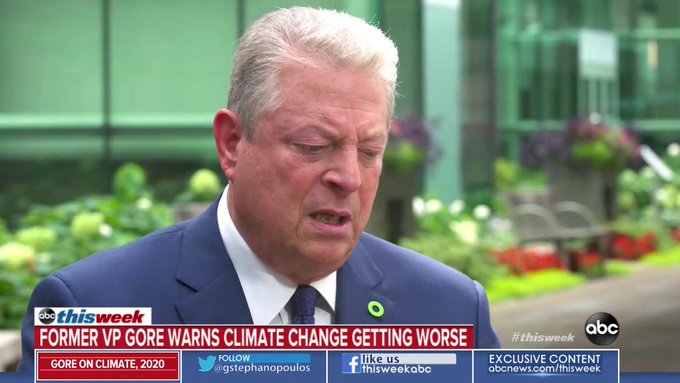
Former Vice President Al Gore said his predictions from 2006 about climate change over the next ten years have come true and claimed part of the damage has been irreversible.

“You said back in 2006 that the world would reach the point of no return if drastic measures weren’t taken to reduce greenhouse gases by 2016. Is it already too late?” ABC News’ Jonathan Karl asked during “This Week with George Stephanopolous” on Sunday.

“Well, some changes, unfortunately, have already been locked in place,” Gore replied. “Sea level increases are going to continue no matter what we do now. But, we can prevent much larger sea level increases — much more rapid increases in temperatures. The heat wave was in Europe. Now, it’s in the Arctic, and we’re seeing huge melting of the ice there.”

JESSE WATTERS: JUST LIKE THE MUELLER REPORT, EVERYONE SHOULD READ ‘TYPICAL LIBERALISM’ IN GREEN NEW DEAL

Gore, who wrote and starred in the 2006 climate documentary “An Inconvenient Truth,” expressed optimism about minimizing the damage, however, and praised the field of Democrats aiming to unseat President Trump in 2020 for making the environment a central issue in many of their campaigns.

More from Media

“So, the warnings of the scientists 10 years ago, 20 years ago, 30 years ago, unfortunately, were accurate,” he said. “Here’s the good news… In the Democratic contest for the presidential nomination this year, virtually all of the candidates are agreed that this is either the top issue or one of the top two issues.”

CLICK HERE TO GET THE FOX NEWS APP

“There’s both bad news and good news. The problem’s getting worse faster than we are mobilizing to solve it,” Gore added.

“However, there’s also good news. We now have an upsurge in climate activism at the grassroots in all 50 states here in this country, and in every country in the world.”

Why we must cut out meat and dairy

Jonathan Safran Foer: why we must cut out meat and dairy before… https://www.theguardian.com/books/20 19/sep/28/meat-of-the-mat. c#ftian Jonathan Safran Fo€r: why we must cut out meat and dairy before dinner to save theplanet Animal products create more greenhouse gas emissions than the entire transportation sector, but we don’t want to confront this inconvenient truth: our eating habits are a problem

The Guardian

Jonathan Safran Foer

Sat 28 Sep 2019 03.00 EDT

Our planet is facing a crisis. But even when we know that a war for our survival is raging, we don’t feel that it is our war. Although many of climate change’s accompanying calamities – extreme weather events, floods and wildflres, displacement and resource scarcity chief among them – are vivid,

1of 8 912812019,1:00 PM

Jonathan Safran Foer: why we must cut out meat and dairy before https ://www.theguardian. com lbooks/2019 / sep 128 I meat-of-the-mat.

personal and suggestive of a worsening situation, they don’t feel that way in aggregate. The distance between awareness and feeling can make it very difficult for even thoughtful and politically engaged people – people who want to act – to act.

So-called climate change deniers reject the conclusion that97% of climate scientists have reached: the planet is warming because of human activities. But what about those of us who say we accept the reality of human-caused climate change? We may not think the scientists are lying, but are we able truly to believe what they tell us? Such a belief would surely awaken us to the urgent ethical imperative attached to it, shake our collective conscience and render us willing to make small sacrifices in the present to avoid cataclysmic ones in the future.

In zot8, despite knowing more than we have ever known about human-caused climate change, humans produced more greenhouse gases than we’ve ever produced, at a rate three times that of population growth. There are tidy explanations – the growing use of coal in China and India, a sttong global economy, unusually severe seasons that required spikes in energy for heating and cooling. But the truth is as crude as it is obvious: we don’t care. So now what?

Of course there are some moments when the planetary crisis is acutely felt. Watching Al Gore’s An Inconvenient Truth was an intellectual and emotional revelation for me. When the screen went dark after the final image, our situation seemed perfectly clear, as did my responsibility to participate in the struggle. And when that film’s credits rolled, at the moment of greatest enthusiasm to do whatever was asked to work against the imminent apocalypse that Gore had just delineated for us, suggested actions appeared on the screen. ‘Are you ready to change the way you live? The climate crisis can be solved. Here’s how to start.”

Among the suggestions were: tell your parents not to ruin the world that you will live in; if you are a parent, join with your children to save the world they will live in; switch to renewable sources of energy; plant trees, iots of trees; raise fuel economy standards; require lower emissions from automobiles.

A[ Gore in An inconvenient Sequel: Truth to Power. Photograph: Participant Media/Paramount Pictures

2 of 8 912812019, 1:00 PM

Jonathan Safran Foer: why we must cut out meat and dairy before.. https ://www.theguardian. com,/books/20 19 / sep 128 I meat-of-the-mat..

There is a glaring absence in Gore’s list, and its invisibility recurs in 2017’s An Inconvenient Sequel: Truth to Power, with one minuscule exception. It is impossible to explain this omission as accidental without also accusing Gore of a kind of radical ignorance. In terms of the scale of the error, it would be equivalent to a doctor prescribing physical exercise to a patient recovering from a heart attack without also telling him he needs to quit smoking, reduce his stress and stop eating burgers and fries twice a day.

So why would Gore deliberately choose to leave this particular issue out? Almost certainly for fear that it would be distractingly controversial and dampen the enthusiasm he had just worked so hard to ignite. It has also been largely absent from the websites of leading environmental advocacy organisations – although this now seems to be changing. It is unmentioned in the celebrated book Dire Predictions, written by the climate scientists Michael E Mann and Lee R Kump. After forecasting existential climate disasters, the authors recommend that we substitute clotheslines for electric dryers and commute by bicycle. Among their suggestions, there is no reference to the everyday process that is, according to the research director of Project Drawdown – a collection of nearly zoo environmental scientists and thought leaders dedicated to identifying solutions to address climate change – “the most important contribution every individual can make to reversing global warming”.

What I am thinking of is the fact that we cannot save the planet unless we significantly reduce our consumption of animal products. This is not my opinion, or anyone’s opinion. It is the inconvenient science. Animal agriculture produces more greenhouse gas emissions than the entire transportation sector (all planes, cars and trains), and is the primary source of methane and nitrous oxide emissions (which are 86 and 3ro times more powerful than CO2, respectively). Our meat habit is the leading cause of deforestation, which releases carbon when trees are burned (forests contain more carbon than do all exploitable fossil-fuel reserves), and also diminishes the planet’s ability to absorb carbon. According to a recent report from the Intergovernmental Panel on Climate Change, even if we were to do everything else that is necessary to save the planet, it will be impossible to meet the goals of the Paris Climate Accord if we do not dramatically reduce our consumption of animal products.

Why is this subject avoided? Conversations about meat, dairy and eggs make people defensive. They make people annoyed. It’s far easier to vilify the fossil fuel industry and its lobbyists – which are without a doubt deserving of our vilification – than to examine our own eating habits. No one who isn’t a vegan is eager to go there, and the eagerness of vegans can be a further turnoff. But we have no hope of tackling climate change if we can’t speak honestly about what is causing it, as well as our potential to change in response.

It is hard to talk about our need to eat fewer animal products both because the topic is so fraught and because of the sacrifice involved. Most people like the taste of meat, dairy and eggs. Most people have eaten animal products at almost every meal since

3 of 8 9/2812019,1:00 PM

Jonathan Safran Foer: why we must cut out meat and dairy before… https://www.theguardian.com/books/2019/sepl28/meat-of-the-mat

they were children, and it’s hard to change lifelong habits, even when they aren’t freighted with pleasure and identity. Those are meaningful challenges, not only worth acknowledging but necessary to acknowledge. Changing the way we eat is simple compared with converting the world’s power grid, or overcoming the influence of powerful lobbyists to pass carbon-tax legislation, or ratifying a significant international treaty on greenhouse gas emissions – but it isn’t simple.

I certainly haven’t found it to be effortless. In my early 3os, I spent three years researching factory farming and wrote a book-length rejection of it called Eating Animals.I then spent nearly two years giving hundreds of readings, Iectures and interviews on the subject, making the case that factory-farmed meat should not be eaten. So it would be far easier for me not to mention that in difficult periods over the past couple of years – while going through some painful personal experiences, while travelling the country to promote a novel when I was least suited for self-promotion – I ate meat a number of times. Usually burgers. Often at airports. Which is to say, meat from precisely the kinds of farms I argued most strongly against. And my reason for doing so makes my hypocrisy even more pathetic: they brought me comfort. I can imagine this confession eliciting some ironic comments and eye-rolling, and some grddy accusations of fraudulence. I wrote at length, and passionately, about how factory farming tortures animals and destroys the environment. How could I argue for radical change, how could I raise my children as vegetarians, while eating meat for comfort?

I wish I had found comfort elsewhere but I am who I am. Even as my commitment to vegetarianism, driven by the issue of animal welfare, has been deepened by a full awareness of meat’s environmental toll, rarely a day has passed when I haven’t craved it. At times I’ve wondered if my strengthening intellectual rejection of it has fuelled a strengthening desire to consume it.

Confronting my hypocrisy has reminded me how difficult it is to even try to live my values. Knowing that it will be tough helps make the efforts possible. Efforts, not effort. I cannot imagine a future in which I decide to become a meat-eater again, but I cannot imagine a future in which I don’t want to eat meat. Eating consciously will be one of the

‘Rarely a day has passed when I haven’t craved meat’ Jonathan Safran Foer. Photograph: Christopher Lane

4 of 8 912812019,1:00 PM

Jonathan Safran Foer: why we must cut out meat and dairy before… [https://www.theguardian.com,/books/2019lsepl28lmeat-ofthe-mat]https://www.theguardian.com,/books/2019lsepl28lmeat-ofthe-mat.

struggles that span and define my life.

We do not simply feed our bellies, and we do not simply modify our appetites in response to principles. We eat to satisfy primitive cravings, to forge and express ourselves, to realise community. We eat with our mouths and stomachs, but also with our minds and hearts. All my different identities – father, son, American, New Yorker, progressive, Jew, writer, environmentalist, traveller, hedonist – are present when I eat, and so is my history. When I first chose to become vegetarian, as a nine-year-old, my motivation was simple: do not hurt animals. Over the years, my motivations changed because the available information changed, but more importantly, because my life changed. As I imagine is the case for most people, ageing has proliferated my identities Time softens ethical binaries and fosters a greater appreciation of what might be called the messiness of life.

There is a place at which one’s personal business and the business of being one of seven billion earthlings intersect. And for perhaps the first moment in history, the expression “one’s time” makes little sense. Climate change is not a jigsaw puzzle on the coffee table, which can be returned to when the schedule allows and the feeling inspires. It is a house on fire. The longer we fail to take care of it, the harder it becomes to take care of, and because of positive feedback loops – white ice melting to dark water that absorbs more heat; thawing permafrost releasing huge amounts of methane – we will very soon reach a tipping point of “runaway climate change”, when we will be unable to save ourselves, no matter how much effort we make.

We do not have the luxury of living in our time. We cannot go about our lives as if they were only ours. In a way that was not true for our ancestors, the lives we live will create a future that cannot be undone. The word “crisis” derives from the Greek krusls, meaning “decision”.

Future generations will almost certainly look back and wonder why on earth – why on Earth – did we choose our suicide? Perhaps we could plead that the decision wasn’t ours to make: as much as we cared, there was nothing we could do. We didn’t know enough at the time. Being mere individuals, we didn’t have the means to enact consequential change. We didn’t run the oil companies. We weren’t making government policy. The ability to save ourselves, and save them, was not in our hands. But that would be a lie.

Our attention has been fixed on fossil fuels, which has given us an incomplete picture of the planetary crisis and led us to feel that we are hurling rocks at a Goliath far out of reach. Even if they are not persuasive enough on their own to change our behaviour, facts can change our minds, and that’s where we need to begin. We know we have to do something, but “we have to do something” is usually an expression of incapacitation, or at least uncertainty. Without identifying the thing that we have to do, we cannot decide to do it.

5 of 8 912812019, 1:00 PM

Jonathan Safran Foer: why we must cut out meat and dairy before… htps ://www.theguardian. com/books/20 19 I sep 128 I meat-of-the-mat.

Forest fires in A[tamira, Para state, Brazil[ … ‘Our meat habit is the leading cause of deforestation, which releases carbon when trees are burned’ Photograph: JoSo Laet/AFP/Getty images

Climate change is a crisis that will always be simultaneously addressed together and faced alone. The four highest impact things an individual can do to tackle the planetary crisis are: have fewer children; live car-free; avoid air travel; and eat a plant-based diet. Most people are not in the process of deciding whether to have a baby. Few drivers can simply decide to stop using their cars. A sizable portion of air travel is unavoidable. But everyone will eat a meal relatively soon and can immediately participate in the reversal of climate change. Furthermore, of those four high-impact actions, only plant-based eating immediately addresses methane and nitrous oxide, the most urgently important greenhouse gases.

Some argue that plant-based eating is elitist. They are either misinformed, or knowingly taking the favorite emergency exit of privileged, performatively thoughtful people who don’t want to change what they eat. It is true that a healthy traditional diet is more expensive than an unhealthy one – about $SSo (f44o) more expensive over the course of a year. And everyone should, as a right, have access to affordable healthy food. But a healthy vegetarian diet is, on average, about $ZSo (f6oo) Iess expensive per year than a healthy meat-based diet. In other words, it is about $2oo (f16o) cheaper per year to eat a healthy vegetarian diet than an unhealthy traditional diet. Not to mention the money saved by preventing diabetes, hypertension, heart disease and cancer – all associated with the consumption of animal products. Nine per cent of Americans making less than $3o,ooo per year identify as vegetarian, whereas only 4% of those making more than $75,ooo are. People of colour are disproportionately vegetarian. It is not elitist to suggest that a cheaper, healthier, more environmentally sustainable diet is better. But what does strike me as elitist? When someone uses the existence of people without access to healthy food as an excuse not to change, rather than as a motivation to help those people.

Different studies suggest different dietary changes in response to climate change, but the ballpark is pretty clear. The most comprehensive assessment of the livestock industry’s environmental impact was published in Nature in October 2018. After analysing food-production systems from every country around the world, the authors

6 of 8 9/2812019,1:00 PM

Jonathan Safran Foer: why we must cut out meat and dairy before… htps://www.theguardian.com/books/2019lsepl28lmeat-of-the-mat…

concluded that while undernourished people living in poverty across the globe could actually eat a little more meat and dairy, the average world citizen needs to shift to a plant-based diet in order to prevent catastrophic, irreversible environmental damage. The average US and UK citizen must consume 90% less beef and 6o% less dairy.

No animal products for breakfast or lunch would come close to-achieving that. It might not amount to precisely the reductions that are asked for, but

Report: Climate Change Is Hurting Oceans — And Us — More Than Expected

The effects of climate change are bad, and they’re getting worse — especially when it comes to the world’s oceans.

But if unprecedented action is taken soon to reduce planet-warming emissions, it will greatly ease some of the worst impacts and make adaptation less painful.

That’s the underlying message in a landmark report by more than 100 scientists from 36 countries. The Intergovernmental Panel on Climate Change on Tuesday approved the Special Report on the Ocean and Cryosphere in a Changing Climate, which was three years in the works.

Ehukai Beach clouds during winter 2018 ocean sea level rise.

Ehukai Beach clouds during winter 2018 ocean sea level rise.

Cory Lum/Civil Beat

“The open sea, the Arctic, the Antarctic and the high mountains may seem far away to many people,” said Hoesung Lee, IPCC chair, in a statement Wednesday. “But we depend on them and are influenced by them directly and indirectly in many ways — for weather and climate, for food and water, for energy, trade, transport, recreation and tourism, for health and wellbeing, for culture and identity.”

If people prevent the planet from warming more than 2 degrees Celsius (3.6 degrees Fahrenheit) above pre-industrial levels by 2100 — as world leaders agreed to in Paris in 2015 — the effects of climate change will still threaten livelihoods, alter ecosystems and disrupt weather patterns. But it won’t be nearly as bad as a warmer world.

The latest report says marine heatwaves, for instance, will be 20 times more frequent at 2 C. But it could be 50 times more frequent if greenhouse gas emissions continue to increase.

Marine heatwaves don’t just affect the oceans, though the warmer waters are also putting corals in peril and reducing the abundance of certain fish. They are also making it hotter on land.

Meteorologists blame heatwaves for the record heat Hawaii has experienced this summer, and they may exacerbate wildfires.

In July, firefighters on Maui were responding to their first big wildfire of the season — about 9,000 acres — when they realized the equipment they set out with to tackle the blaze wasn’t going to do the job as it had for similar fires in years past, according to University of Hawaii wildland fire researcher Clay Trauernicht.

That’s because it was so hot out that it had driven the humidity down to a point where the grasses were so crispy that the fire behaved differently, burning up the fuels faster and shifting directions less predictably, he said.

Marine heatwave

Trauernicht said his biggest takeaway from the IPCC report was the “ginormous” difference between cutting greenhouse gas emissions or continuing to burn fossil fuels when it comes to the severity of the impacts of climate change.

“Whatever extent we can reduce this, we’ve got to do it,” he said.

The report cites marine heatwaves as just one of the impacts of climate change. Scientists project stronger hurricanes, faster eroding coastlines, hotter summers, more flooding, increased sea level rise, more extreme weather and less productive fisheries.

The rate of sea level rise is increasing primarily because glaciers and ice sheets in polar and mountain areas are melting faster than expected. It’s also rising faster because the ocean is expanding as it gets warmer, the report says.

Sea levels rose globally about a half foot last century. Now they’re rising more than twice as fast and getting faster. Sea level could rise 1 to 2 feet by 2100 even if global warming is limited to well below 2 C, but it could rise 2 to 3.6 feet if greenhouse gas emissions continue to escalate.

That’s a big deal for Hawaii, where most of the state’s 1.4 million residents live close to the coast and it’s also where major infrastructure is located. The tourism industry that the overall economy depends on also depends on the coastal environment.

We are in a critical set of years for the entire history of humanity,” University of Hawaii climate researcher Chip Fletcher said. “But we can never give up. We can never stop. It’s always going to be a crisis until we decarbonize.”

Sea level rise will also increase the frequency of extreme events during high tides and intense storms, the report cautions. With any degree of additional warming, the report says events that happened once per century will happen every year by 2050, heightening the risk for low-lying coastal cities like Honolulu and small islands like those in the northwestern reaches of the Hawaiian Archipelago.

East Island, about 600 miles northwest of Oahu, almost entirely disappeared after an unprecedented hurricane passed over it last year. It was the primary nesting ground for the bulk of the threatened Hawaiian green sea turtle population and a sizable chunk of critically endangered Hawaiian monk seals.

Sea level rise, increasing faster due to climate change, has accelerated erosion in Hawaii, such as Sunset Beach on the north shore of Oahu.

Anthony Quintano/Civil Beat

The IPCC has a reputation for being conservative because it requires 100% agreement, Fletcher said. That tends to water down its reports, compared to peer-reviewed literature that offers the latest science.

But knowing this is the voice of the scientific community speaking is important, he said.

It’s a sentiment shared by Josh Stanbro, who heads Honolulu’s climate change office. He said the IPCC offers an important “rear view mirror approach” whereas the Honolulu  climate commission’s appointed members, which include Fletcher, are looking out the front window.

“If there’s anything heartening in this it’s that we have really smart sharp local climate change commissioners giving us good information, making projections and looking at cutting-edge research,” he said.

Still, Stanbro found some aspects of the report to be unnerving. He is concerned about how it leaves as an “x factor” the impact of methane gas that may be released when permafrost thaws. And he was taken aback by how the report underscores how small island nations are exposed to the impacts of climate change.

“We know that as island people,” he said. “But it’s a little unnerving to see that in plain sight where world leaders are saying we’re the canaries in the coal mine.”

Members of the working groups who developed the report said it arms communities and governments with the information they need to act.

It highlights the urgency of “timely, ambitious, coordinated and enduring action,” Ko Barrett, vice chair of the IPCC, told reporters.

Hawaii agencies are among those looking to it for guidance.

Scott Glenn, who heads the state Office of Environmental Quality Control, said he is interested in how it affects baseline assumptions that agencies are making, such as maps showing sea level rise exposure areas.

“With climate change, it’s affecting so many parameters at the same time that it becomes very hard,” he said. “How do you translate that into something like design or engineering if you know there’s this science coming out with these big uncertainty brackets around it?”

IPCC working group members said that reducing carbon emissions enough to matter will require a global effort across all sectors.

“We will only be able to keep global warming to well below 2 C above pre-industrial levels if we effect unprecedented transitions in all aspects of society, including energy, land and ecosystems, urban and infrastructure as well as industry,” Debra Roberts, an IPCC working group co-chair, said in a statement.

The report, which was unanimously approved, provides crucial information going into the United Nations Framework Convention on Climate Change Conference in December in Chile, known as COP25.

Read the full report below.

Why the right’s usual smears don’t work on Greta Thunberg

Activist Greta Thunberg seated at a microphone at a press conference.
Frankly, she is skeptical.
 KENA BETANCUR/AFP/Getty Images

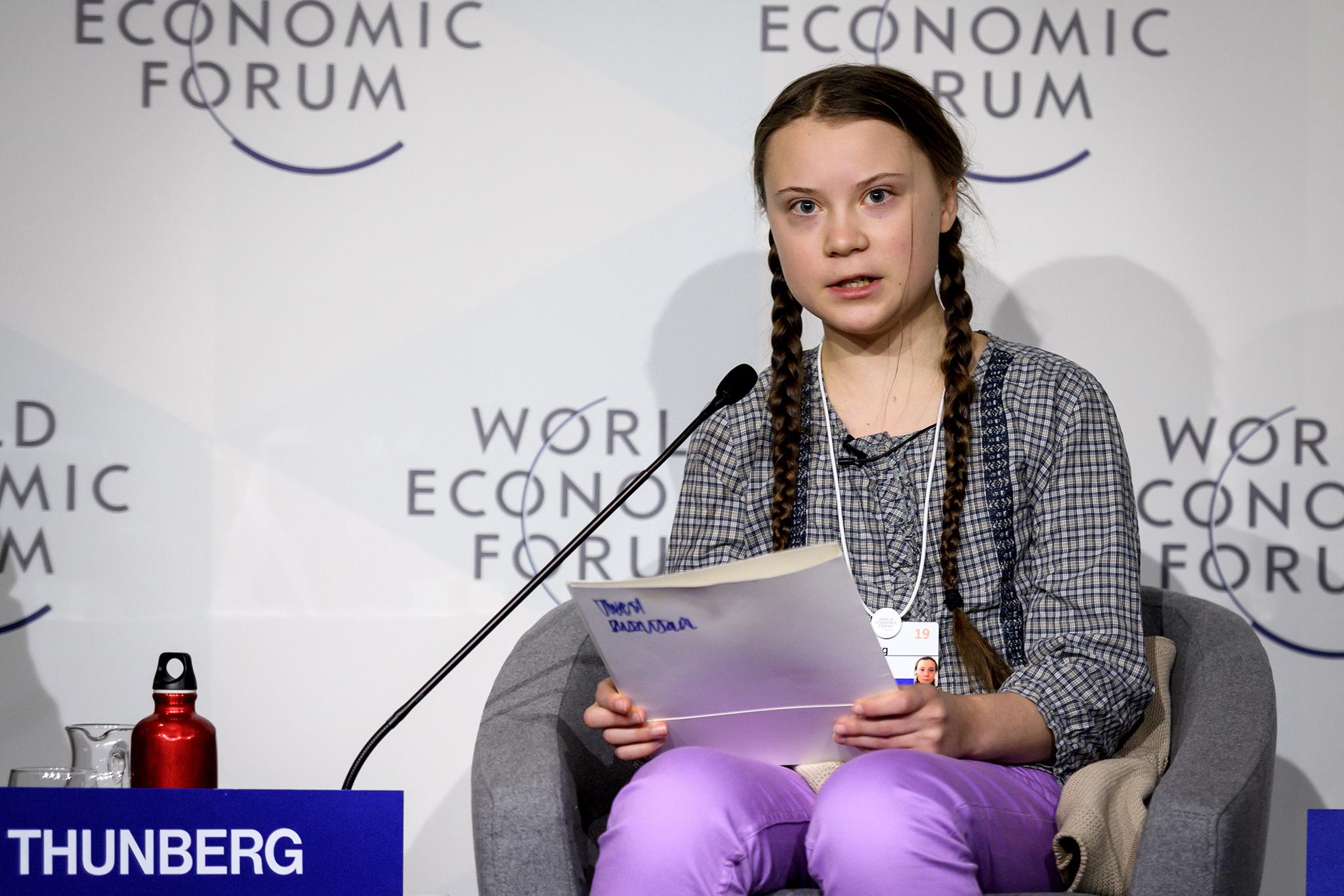
To her considerable and growing list of accomplishments, 16-year-old Swedish climate activist Greta Thunberg can now add another mark of distinction: She has been attacked by the troll-in-chief.

On Monday night, in response to Thunberg’s coruscating, impassioned speech to the UN, President Trump tweeted sarcastically, “[s]he seems like a very happy young girl looking forward to a bright and wonderful future. So nice to see!” (Thunberg promptly edited her Twitter bio to read: “A very happy young girl looking forward to a bright and wonderful future.”)

Trump’s sneering attack came amid a torrent of often misogynist and ableist abuse hurled at Thunberg since the speech, with conservatives attacking her demeanor, her looks, her mental health (she has autism), and above all her autonomy, claiming she is “brainwashed” or a victim of child abuse. Several have compared her speeches to Nazi propaganda.

“She’s ignorant, maniacal and is being mercilessly manipulated by adult climate bedwetters funded by Putin,” ranted C-list climate denier Steve Milloy, somehow fitting all the mutually contradictory stereotypes about powerful women into his pea brain at once.

John Ocasio-Nolte@NolteNC

I can’t tell if Greta needs a spanking or a psychological intervention…

Probably both. https://twitter.com/mailonline/status/1176169250525995010 

1,262 people are talking about this

What’s remarkable about this is not that the right-wing slime machine has gone to work against a new progressive threat. That’s what it was made for. What’s remarkable is how ineffective it’s been, how little it has affected Thunberg and her extraordinary influence.

The right-wing tabloid Daily Wire has published some of the vilest stuff about Thunberg. But when it sent Michael Knowles to Fox News to say Thunberg is a “mentally ill Swedish child who is being exploited by her parents and by the international left,” Fox took the rare step of apologizing to viewers and saying it would no longer book Knowles.

These moments of accountability on the right are rare, of course — there are dozens, hundreds more examples of attacks far uglier than this that have brought no pushback at all. But they help illustrate that Thunberg has the rare ability to tap into something human, something that, at least sporadically, can break through the media filter pushing the public into partisan camps.

As for Thunberg, her reaction to her attackers remains as bemused and clinical as ever:

Greta Thunberg

@GretaThunberg

I honestly don’t understand why adults would choose to spend their time mocking and threatening teenagers and children for promoting science, when they could do something good instead. I guess they must simply feel so threatened by us. ->

37.8K people are talking about this

Even against the nuttiness of current events, Thunberg’s story is remarkable, in both human and political terms, as David Wallace-Wells masterfully captures in his recent New York magazine piece. He taps into the heady sense of a movement exploding but also offers a clear glimpse of the intently focused, achingly vulnerable teenager who finds herself at its white-hot center. Everyone should read it.

Here I just want to dwell on one theme of that piece, namely the unlikely confluence of personal history and characteristics that have made Thunberg so politically potent and so resistant to the right wing’s familiar smears.

It’s important to note, as she frequently does, that Thunberg has not single-handedly created this movement. She stands on the shoulders of generations of activists before and alongside her, many of them people of color, who are, to say the least, less likely to be adopted as icons by Westerners. (Check out this great thread on other young climate activists.)

But she has proven extraordinarily potent in crystallizing and focusing what has been a somewhat diffuse activist energy. She has brought a directness and simplicity to the movement that has been lacking. Her influence is growing, even as the right ramps up its barrage, and it is driving them out of their minds.

Let’s look at why their usual tricks don’t work.

Gilles Goguen@GillesGoguen

@GretaThunberg in Aug of 2018 alone in her fight. She is not alone anymore!!

View image on TwitterView image on TwitterView image on Twitter
184 people are talking about this

Greta avoids the trap of recommending specific policies

Across the world, businesses, scientific institutions, investors, and governments are effectively unanimous in recognizing the urgent need for action on climate change. The science has made it inescapably clear that business as usual leads to disaster. Many debates remain over the best path forward, but the basic case for action has become unassailable.

And so for the most part, opponents of action — generally far-right coalitions fueled by a mix of fossil-fuel cronyism and populist ethnonationalism — don’t assail it. They do everything they can to distract from it.

That almost always involves attacking the messengers (“Al Gore has a big house”) and their proposed solutions (“the Green New Deal will take away your hamburgers”). The scientists are after grant money; the activists are undercover socialists; the leaders are hypocrites; the marchers litter. Casting doubt on the motives and authenticity of people fighting for progressive causes is the right’s primary political tool, with efforts now led out of the White House.

For climate scientists and advocates, it’s a familiar trap. Any political program sufficient to address climate change at scale is, almost by definition, going to be radical, which allows the right to dismiss it as “far left.” The go-to attack on the climate movement is that it’s a “watermelon,” green on the outside and socialist red on the inside — that climate change is just a cover story for the political program.

Thunberg has sidestepped attacks on her motives by almost entirely refraining from endorsing specific political reforms or policies. “I can’t really speak up about things like [politics],” she told Wallace-Wells, “no one would take me seriously.”

Her insistence on this point was illustrated when she submitted the IPCC’s report on limiting warming to 1.5 degrees Celsius in lieu of testifying to the House. Attached was a short letter that said: “I am submitting this report as my testimony because I don’t want you to listen to me. I want you to listen to the scientists. And I want you to unite behind the science. And then I want you to take action.” She refuses to allow her opinions to become the focus.

United Nations

@UN

“The eyes of all future generations are upon you. And if you choose to fail us, I say we will never forgive you.”

@GretaThunberg at UN Summit. http://bit.ly/2l2M7pn 

Embedded video

11.3K people are talking about this

Coming from almost any adult, this strategy would be vulnerable. Adults have political worldviews and very few have the discipline to keep them entirely hidden. But Thunberg is, in her own words, an “uneducated teenager.” She’s 16 years old! She can’t be expected to know what actions government agencies need to take and she doesn’t pretend to.

She just drags the focus back, again and again, to the subject grown-ups want to avoid: the need for immediate action and their longstanding failure to take any.

(The right has been circulating a picture of Thunberg with her parents in matching “antifascist all-star” T-shirts, claiming that it exposes her far-left politics. Ponder for a moment what it says about the right that it considers opposition to fascism politically compromising.)

Attempts to personally smear Greta have backfired

Right-wing media’s first instinct is to smear the messenger, to find some behavior on which to hang a charge of hypocrisy or some venal motive that allegedly undercuts moral authority. They have done it to everyone who has stuck their head up on climate change (beginning, famously, with Al Gore) for many decades now, snooping through stolen emails, filing lawsuits, and ruining careers.

But this is where Thunberg’s autism has proven, as she has put it, a kind of superpower. She has Asperger syndrome, an autism spectrum disorder that makes her indifferent, often blind, to social cues and incentives as well as inclined to focus intently on a single subject, a tendency Thunberg says is exacerbated by obsessive-compulsive disorder.

As Wallace-Wells notes, Thunberg fell into a depression when she was younger, after she learned about climate change, and spent a few friendless years eating and speaking little, barely motivated to leave the house. In her own words, her climate activism gave her a sense of focus and meaning that helped lift her out of depression.

(I’m far from the first to draw a connection between Thunberg’s autism, her authenticity, and her effectiveness. Steve Silberman wrote about it here on Vox; Naomi Klein and Liza Featherstone, among others, have made the point. Indeed, Thunberg herself has made it.)

In characteristically vile fashion, the right in both Europe and the US has attempted to use Thunberg’s mental health against her, but the attempt has largely backfired. For one thing, it is virtually impossible to watch her speak for any length of time and maintain a good-faith belief that she is responding to social pressure from adults. She is manifestly authentic, direct in a way unique among public figures, no more subject to flattery than to coercion.

ET Panache

@ETPanache

Greta Thunberg submitted a climate report during the House Foreign Affairs subcommittee hearing, along with the testimony of three other youth climate change advocates | https://tinyurl.com/y2yprgoz 

See ET Panache’s other Tweets

Witness Thunberg’s utterly indifferent reaction to the plaudits lavished on her by congressional Democrats. “Please save your praise,” she said. “We don’t want it. Don’t invite us here to tell us how inspiring we are without doing anything about it. It doesn’t lead to anything.”

She’s not intimidated or dazzled by social hierarchy. She just drags the focus, again and again, back to her fixation, what the grown-ups don’t want to talk about: the need for immediate action and their long-standing failure to take any.

However the right tries to twist it, her personal story remains perfectly relatable. She’s a child who found out that the world she was born into is sliding headlong into crisis and suffering, and nobody’s doing much of anything about it. It depressed her. And it eventually motivated her to act.

The question is not why she was depressed and driven to action but why more children aren’t.

When Greta disregards social cues, it sends a social cue

The reason is simple: social cues. Children don’t see the adults around them acting like climate change is a crisis, so they don’t either. For most people, those social signals and affiliations — the building blocks of identity — are much more significant than “the facts” as conveyed by distant, disinterested authorities.

But, in part through their indifference to social cues, people with autism have a unique capacity to face the facts clearly. And the facts about climate change are fucking terrifying.

This, I think, helps explain why Thunberg has inspired so many people, especially so many young people: There’s a kind of courage in ignoring the pervasive social pressure to calm down about climate change. She takes the facts seriously, even when very few adults are modeling how to do so, even when it’s uncomfortable or inconvenient for those around her. She’s vegan, she won’t fly, and she’s devoting her young life to prodding adults into action; the default right-wing accusations of hypocrisy and duplicity simply don’t stick.

The right has established a social environment in which speaking up on climate change leads to bullying and shaming, but those tactics just don’t seem to work on Thunberg. And without them, the right has nothing to fall back on (not one of the hundreds of attacks launched at her has the courage to directly dispute the IPCC report she submitted).

In ignoring social cues, Thunberg has become one: A signal to other young people around the world that, yes, this really is an emergency, and yes, they really can and should speak up.

US-GLOBAL-CLIMATE-STRIKE-MARCH-meteorology-environment
Making more Gretas.
 Photo credit should read TIMOTHY A. CLARY/AFP/Getty Images

Greta’s power will be in making more Gretas

So far, Thunberg has played her game expertly — mostly by being almost entirely oblivious to the other games being played around her — and I hope she does this as long as possible. I hope she continues to refrain from policy recommendations, live a low-carbon life, and drag the spotlight back to science. She has pulled off something like a political miracle, and I don’t want it to end any more than anybody else.

But the thing is, as much as Thunberg might now seem like a transparent lens, directing focus at climate science without the distractions of personal baggage, she is in fact a human being, one 16-year-old girl, and she cannot remain forever in the strange social position where she finds herself. Sooner or later, she’ll do something, join something, or say something that forces her out of the improbably apolitical space she now occupies — and the public tends to be unforgiving of females who disappoint their expectations, even young white ones. No human being can survive the full intensity of the right-wing smear machine undamaged.

If Thunberg is to have a meaningful long-term effect, it can’t be through staying in the spotlight. It must come from others adopting some of her focus, determination, and courage, learning to disregard the social pressures that suppress their fear and anger and prevent them from speaking up, connecting, and finding hope in one another. It will come from others, especially those in positions of power, listening to her and treating the threat to her generation’s future as a crisis.

Trump mocks teen climate activist

U.N. GENERAL ASSEMBLY

Updated 

President Donald Trump mocked 16-year-old climate activist Greta Thunberg on Twitter late Monday.

Posting a fatalistic statement the Swedish teen had made earlier Monday at the United Nations’ special meeting on climate change, Trump tweeted: “She seems like a very happy young girl looking forward to a bright and wonderful future. So nice to see!“

Trump briefly attended the Climate Action Summit in New York but left after 14 minutes. The president has consistently expressed skepticism about the notion of man-made climate change, and his administration has declined to make the issue any sort of priority.

Thunberg acknowledged Trump’s tweet on Tuesday, changing her Twitter biography to read, “A very happy young girl looking forward to a bright and wonderful future.”

Thunberg has developed an international following for her persistent efforts to get the international community to combat climate change, particularly winning support among young people. Trump’s tweet contained one of her quotes from her U.N. remarks Monday: ”People are suffering, people are dying, entire ecosystems are collapsing. We are in the beginning of a mass extinction and all you can talk about is money and fairytales of eternal economic growth.”

Thunberg did not mention Trump or any other leaders by name in her remarks, but she did scold the world’s leaders.

“You are failing us,” she said to the assembled leaders. “But the young people are starting to understand your betrayal. The eyes of all future generations are upon you. And if you choose to fail us, I say: We will never forgive you.“


Last Wednesday, Thunberg addressed a congressional committee in Washington. “I want you to listen to the scientists,” she said. “And I want you to unite behind the science. And then I want you to take real action.”

Trump was not alone Monday in mocking Thunberg. On Fox News, Michael Knowles referred to Thunberg as “a mentally ill Swedish child who is being exploited by her parents and by the international left,” then doubled down and called her “mentally ill” a second time. The network subsequently apologized for his remarks.

Abbey Marshall contributed to this report.

Greta Thunberg glares at Donald Trump arriving at United Nations after scolding international politicians over climate change

https://www.independent.co.uk/environment/climate-change/greta-thunberg-trump-glare-united-nations-climate-change-a9117476.html?utm_medium=Social&utm_source=Facebook&fbclid=IwAR3YLMOxMzn29Z1K4IuEEHMr3PAqwTrRTZRkTrzKvabQSYfgf1htRpecpcI#Echobox=1569267470

The 16-year-old activist’s reaction to the world’s most powerful climate change denier seems to speak volumes

A clip showing climate activist Greta Thunberg giving Donald Trump an ice-cold glare has gone viral, just after the Swedish 16-year-old told the United Nations that the leaders of the generations before hers had stolen her childhood and her dreams.

The video of Ms Thunberg shows her standing in the United Nations lobby in New York, just as Mr Trump arrived.

Cameras captured the moment in which the 16-year-old’s expression changes from a slight curiosity to what looks like steely anger as the American president walked by.

Ms Thunberg had just delivered a speech to the United Nations in which she called for urgent action on climate change.

“How dare you continue to look away, and come here saying that you are doing enough, when the politics and solutions needed are still nowhere in sight,” she told the United Nations.

She continued: “You say you ‘hear’ us and that you understand the urgency. But no matter how sad and angry I am, I don’t want to believe that. Because if you fully understood the situation and still kept on failing to act, then you would be evil. And I refuse to believe that.”

Mr Trump, for his part, has challenged the idea that climate change — which is supported by the vast majority in the scientific community, of which the American is not a member  — exists, and has openly mocked the idea, on one occasion suggesting it was a Chinese hoax.

Since taking office, Mr Trump has overseen an expansive effort to destroy his predecessor’s policies aimed at slowing the rate of climate change, including by easing up on restrictions for greenhouse gas emissions and bringing up new oil and gas leases.

Climate change protests snarl DC traffic as bizarre scenes unfold in capital

Climate activists demonstrating to coincide with the 2019 U.N. Climate Action Summit blocked intersections and snarled morning-commute traffic across Washington, D.C., Monday morning as they called on officials to take action on global warming.

The group, called “Shut Down D.C.,” has planned a week of activities to bring attention to climate change and convince national and international leaders to act. Monday’s continuation of the “Global Climate Strike” follows worldwide climate protests on Friday, including a demonstration in New York City led by Swedish teenager Greta Thunberg.

“Parents, workers, college students, and everyone who is concerned about the climate crisis will skip work and school and put off their other responsibilities to take action on the climate crisis,” the organization says on its website.

But the demonstrations across D.C. Monday morning also angered the city’s commuters as the scattered marches caused gridlock and detours. District of Columbia police reported making more than two-dozen arrests as of Monday afternoon.

D.C. blogger posted one photo of a mass of cars halted behind a line of protesters a few blocks northwest of Mount Vernon Square. The same blogger also tweeted a picture of a literal dumpster fire on Massachusetts Ave.

At another protest site, police were using a saw to cut protesters out of chains attached to a painted boat.

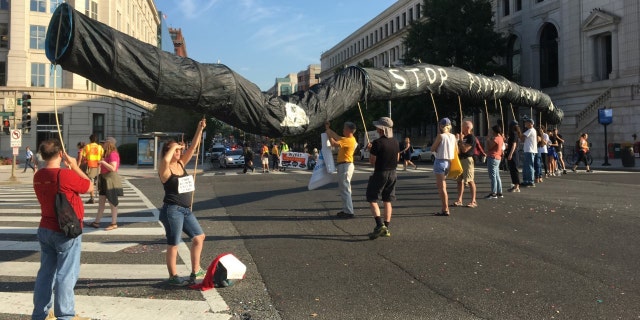
Another group of about 30 protesters blocked an intersection near Union Station, holding up a large mock pipeline that read “stop pipelines now.” Police stopped traffic about a block in each direction and were moving vehicles around the area demonstrators had occupied.

The “Shut Down D.C.” protesters read testimonials from anti-pipeline activists in Oregon before chanting, “Hey-hey! Ho-ho! LNG has got to go.” LNG is an acronym for liquified natural gas.

Protesters also adapted the famous song “When The Saints Go Marching In” for their purposes.

Sept. 23, 2019: Protesters hoist up a fake pipeline near Union Station in Washington, D.C. (Tyler Olson/Fox News) 

Sept. 23, 2019: Protesters hoist up a fake pipeline near Union Station in Washington, D.C. (Tyler Olson/Fox News)

“Oh how I’d love to live in that future — when the frackers go to jail,” they sang.

While some passersby seemed to back the “Shut Down D.C.” demonstrators, others were not so supportive. One woman walking by yelled at the demonstrators that there was a handicapped woman walking down the street because they’d blocked traffic. The protesters responded by saying people were dying because of the climate crisis.

“You tell that to the woman walking with the cane up the street,” the woman shot back.

At approximately 9:45 a.m., the Twitter account purporting to represent the “Shut Down D.C.” group claimed they were still blocking traffic at eight locations across the city, including Logan Circle and Dupont Circle.