Researchers used radiocarbon dating of eye proteins to determine the ages of 28 Greenland sharks, and estimated that one female was about 400 years old. The former vertebrate record-holder was a bowhead whale estimated to be 211 years old.
As lead author Julius Nielsen, a marine biologist from the University of Copenhagen, put it: “We had our expectations that we were dealing with an unusual animal, but I think everyone doing this research was very surprised to learn the sharks were as old as they were.”
Greenland sharks swim through the cold waters of the Arctic and the North Atlantic at such a sluggish pace that has earned them the nickname “sleeper sharks.” Image credit: Julius Nielsen
Greenland sharks are huge and can grow up to 5m in length. Yet, they grow at just 1cm a year. They can be found, swimming slowly, throughout the cold, deep waters of the North Atlantic.
The team believes the animals only reach sexual maturity when they are 4m-long. And with this new, very lengthy age-range, it suggests this does not occur until the animals are about 150 years old.
A newly tagged Greenland shark returns to the deep and cold waters of the Uummannaq Fjord in western Greenland. Image credit: Julius Nielsen
The research was made possible, in part, by the atmospheric thermonuclear weapons tests conducted during the 1960s, which released massive amounts of radiocarbon that were then absorbed by organisms in ocean ecosystems. Sharks that showed evidence of elevated radiocarbon in the nucleus of their eye tissue were therefore born after the so-called “bomb pulse,” and were younger than 50 years old, while sharks with lower radiocarbon levels were born prior to that, and were at least 50 years old or older, the study authors wrote.
The scientists then calculated an age range for the older sharks based on their size, and on prior data about Greenland sharks’ size at birth and growth rates in fish.
A Greenland shark near the ocean surface after its release from research vessel Sanna in northern Greenland. Image credit: Julius Nielsen
According to the results of the analysis – which has a probability rate of about 95 percent – the sharks were at least 272 years old, and could be as much as 512 years old (!) with 390 years as the most likely average life span, according to Nielsen.about:blank
But why do Greenland sharks live so long?
Their longevity is actually attributed to their very slow metabolism and the cold waters that they inhabit. They swim through the cold waters of the Arctic and the North Atlantic at such a sluggish pace that has earned them the nickname “sleeper sharks.” Seal parts have been found in their bellies, but the sharks move so slowly that experts have suggested that the seals must have been asleep or already dead when the sharks ate them.
Greenland’s ice sheet is seven times the area of the UK and up to 2-3km thick in places. It stores so much frozen water that if the whole thing melted, it would raise sea levels worldwide by up to 7m.
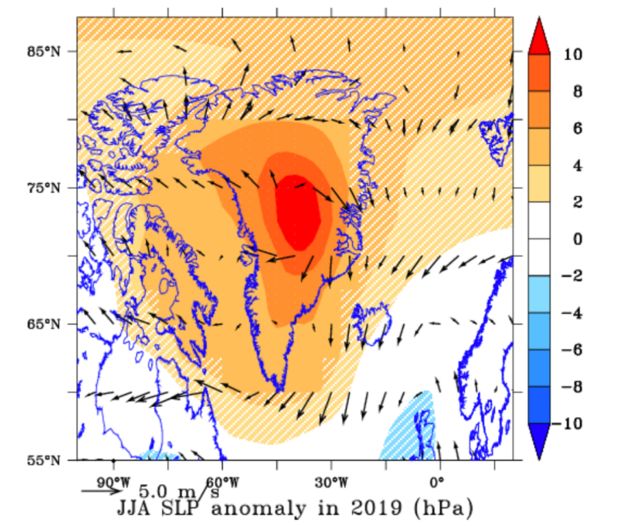
Image copyrightTEDESCO & FETTWEISImage captionAverage pressure over Greenland in summer 2019, with arrows showing wind direction
In recent weeks, an analysis of last year’s melting said the 600 billion tonnes of ice added 2.2mm to global sea levels in just two months.
This new study says that while rising global temperatures played a role in the events last year, changes in atmospheric circulation patterns were also to blame.
Researchers found that high pressure weather conditions prevailed over Greenland for record amounts of time.
They believe this is connected to what’s termed the “waviness” in the jet stream, the giant current of air that mostly flows from west to east around the globe.
As the current becomes more wobbly, it bends north, and high pressure systems that would normally move through in a few days become “blocked’ over Greenland.
These systems had different impacts depending on the part of Greenland you were in.
In the southern part of the island, the authors say, it caused clearer skies with more sunlight hitting the surface.
The cloud-free days brought less snow, which meant that 50 billion fewer tonnes were added to the ice sheet.
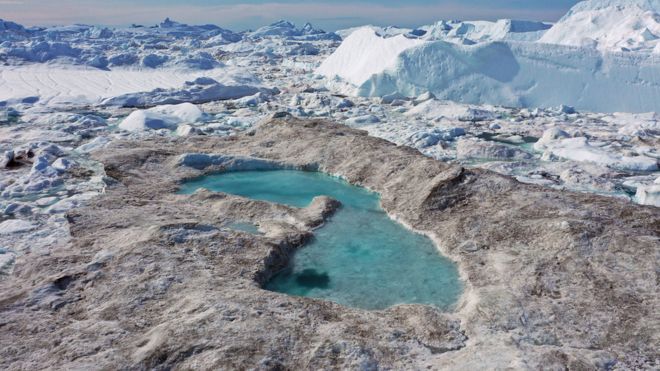
The absence of snow also exposed bare, dark ice in some place which absorbed more heat – contributing to the melt.
Image copyrightGETTY IMAGES
In other parts of Greenland, the changing atmospheric patterns had different but equally damaging impacts.
In northern and western region, the swirling but stuck high pressure systems pulled in warm air from southern latitudes.
“You can imagine that a sort of vacuum cleaner that is spinning clockwise and sucking all the warm and moist air from New York City for example,” said lead author Dr Marco Tedesco from Columbia University in New York, US.
“And because of the rotation, it deposits this warm, moist air high in the northern part. It forms clouds, and they behave like a greenhouse, trapping the heat that would normally radiate off the ice.”
Dr Tedesco explained that Greenland in 2019 experienced the largest drop in surface mass balance since records began in 1948.
The term surface mass balance describes the overall state of the ice sheet after accounting for gains from snowfall and losses from surface melt-water run-off.
The authors believe their study explains why, despite the fact that 2019 was not as warm as 2012, last year produced a record drop in surface mass balance.
“This is really pushing Greenland into the red,” said Dr Tedesco.
Other researchers working in this field agreed that the new paper is a good explanation of what happened last year in Greenland.
“The main message of the paper is that the very high melt was mostly driven by clear skies and direct melting rather than necessarily being attributable to unusually high temperatures over the ice sheet – a radiatively-driven, rather than thermally-driven, melt season as they put it,” said Dr Ruth Mottram, a climate scientist at the Danish Meteorological Institute in Copenhagen.
“In some ways, the weather pattern is rather similar to the great blocking high that lodged over Scandinavia for weeks in 2018, giving us the most extreme drought on record in much of northern Europe.”
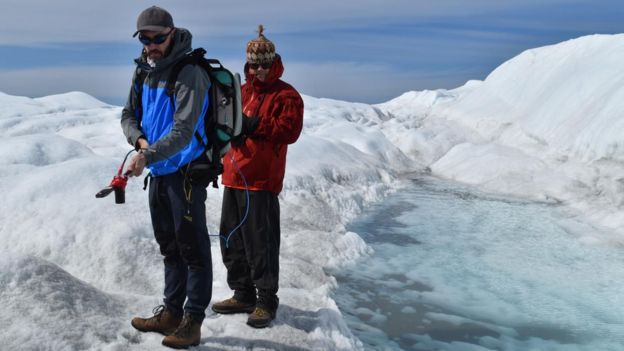
Image copyrightKEVIN KRAJICK/EARTH INSTITUTEImage captionMarco Tedesco (left) and a colleague measure reflectance on the Greenland ice sheet during a 2018 expedition
The exact mechanism by which climate change affects the jet stream isn’t understood. But the view is that as the Arctic warms, the temperature differences between the region and the mid-latitudes that drive the air current are reduced. This slows down the stream, making it wander further.
“The more CO2 we pump out, the more divergence starts to emerge between the behaviour of the Arctic and the mid-latitudes and this behaviour is accelerating and enhancing some of the differences. It is a crucial part of what is creating this waviness and the consequences,” said Dr Tedesco.
The authors also argue that climate models in general need to take account of this impact of the wavy jet stream. Others in the field say this issue needs addressing.
“These results imply that the climate models we use for future projections of sea level rise from Greenland are underestimating the extreme years at present and therefore likely also the rate at which the ice sheet melts and the oceans will rise in the future,” said Dr Mottram.
“The only ray of light is that as processor power increases and we can do higher resolution simulations with climate models, the representation of these processes does seem to improve and not just in Greenland but in other areas of the world where persistent blocking patterns can have an important influence on the season.”
The study has been published in the journal The Cryosphere.
When the Greenland ice sheet went into a record meltdown in the summer of 2019, it raised a very terrifying specter of the future. Here was a 12.5-billion-ton mass of ice—one that’s been melting at a quickening pace since the 1980s—melting in a way scientists didn’t expect to happen for decades.
While the ice sheet won’t completely disappear for centuries, any further increase in its melt will put coastal communities at risk of inundation. There’s an argument to be made that we should do everything possible to save the ice, and a new study explores a very controversial idea to that end: cooling the planet.
The findings, published last month in Earth’s Future, explore what would happen if the world pumped particles high into the atmosphere that would reflect sunlight back into space. This high-altitude air conditioning scheme, known as solar radiation management or SRM, would bring down the global average temperature. The paper’s results show that cooling would help slow—though not stop—the melting of the ice sheet. That could buy coastal regions time but also change the climate in other ways that may end up hurting other regions around the world.
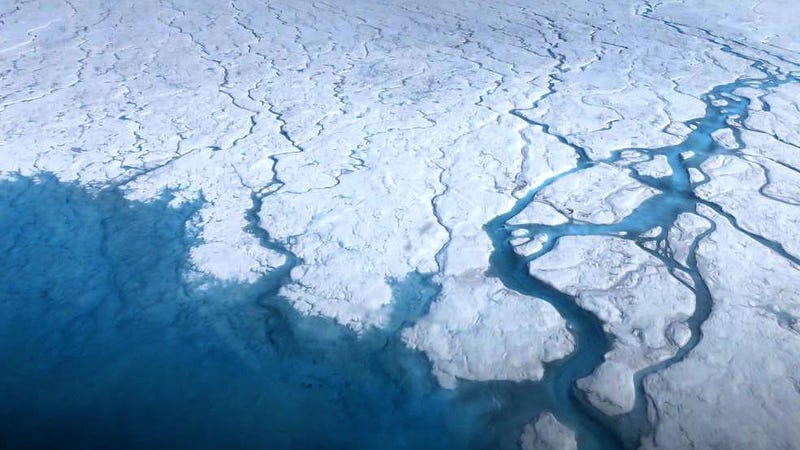
The threats to Greenland ice are coming from seemingly all directions. Relatively hot water has undercut the glaciers tumbling down from the ice sheet, while rising air temperatures have melted it from above. Recent wildfires have also left a cake of dark soot that absorbs more sunlight, enhancing surface melt. And then there are surface pools of water that funnel into cracks in the ice, further destabilizing it. In short, climate change is engaged in an all-out war on the ice sheet that will only intensify in the coming century. Projections indicate the ice sheet melting could lead to anywhere from 10 to 20 centimeters (4 to 8 inches) of sea level rise this century, with much higher rates of rise in the Pacific.
To understand the impact geoengineering could have on Greenland, scientists ran models that simulate the climate throughout the century under a few different scenarios. In some scenarios, greenhouse gas pollution increased throughout the century or peaked by mid-century. They then took those same scenarios and added in a splash of geoengineering. The models they ran basically shot particles into the stratosphere around the equator that then dispersed around the globe. The impacts are based in part on what happens after volcanic eruptions, and the study used the equivalent a quarter of a Pinatubo eruption every year.
The results show that the planet-cooling properties of the particles would extend to Greenland, lowering air temperatures there by about 1.1 degrees Celsius (2 degrees Fahrenheit) compared to the scenarios without geoengineering. Runoff from melt would drop anywhere from 20 to 32 percent, with the biggest difference coming under the high greenhouse gas emissions scenario. All that means sea level rise would slow.
Doug MacMartin, a Cornell scientist who has studied geoengineering, told Earther the study’s findings were in line with you’d expect from solar radiation management but that the findings used older models. Future work updated with new models could go a long way to building on the findings, and the study itself notes that some key aspects of atmospheric circulation are simplified.
But it’s not all puppies and unicorns. Geoengineering alone wouldn’t be able to stop ice from melting. It could also wreak havoc with weather in other parts of the globe, potentially pitting nations against each other. And then there’s the most concerning aspect of geoengineering, which is that once we start in on cooling the planet, stopping it could risk sudden, catastrophic climate change. So any plan to do this requires a long, hard think and making sure everyone has a say, not just rich countries with tons of coastal real estate.
“Could geoengineering affect the Arctic? How effective would it be at offsetting projected polar changes due to climate change? Would there be any side effects or unintended consequences?” Ben Kravitz, a geoengineering researcher at Indiana University, told Earther in an email. “Answering these questions is critical, and this study is a welcome step in addressing such questions.”
Indeed, as the world continues to put off the best climate change solution (which would be cutting emissions), it moves closer to considering more risky ways to address the changes set in motion by decades of unbridled fossil fuel use. That makes exploring these ideas in the scientific literature terrifying and important all at once.
“We don’t know enough about [solar radiation management] today, but we don’t want to be in a position of making hasty choices some point in the future—which is exactly why studies like this one are so important,” MacMartin told Earther in an email.
Equally important, and something that MacMartin emphasized as well, is actually doing the hard work of cutting carbon emissions. As the results make clear, blocking out sunlight is nowhere near enough to protect the coasts.
SHARE THIS STORY
GET OUR NEWSLETTER
Subscribe
MORE FROM EARTHER
Turns Out a Wild Geoengineering Plan to Refreeze Arctic Sea Ice Isn’t the Best Idea
What Would It Be Like to Live in an Era of Geoengineering?
Great news! Humankind’s greatest-ever engineering project is nearing completion. Soon we will have warmed the Earth enough to get rid of all those pesky ice sheets and other frozen areas. The finish line is in sight.
If we all work together for the next thousand years, we’ll finally reach our goal!
NASA has been tracking our progress and in a recent press releaseconfirmed what optimists have been thinking quietly to themselves for a while now. At our current rate of global carbon emissions, significant portions of the planet will be ice free in a quick-as-a-wink millennium.
Not only that, but humanity’s parallel effort to raise the sea levels are looking real good, too.
New data from NASA’s Operation IceBridge program shows that the melting Greenland ice sheet will raise global sea levels more than previously thought. According to a computer model in a new study, only 200 years of melting at the present rate could contribute from .48 to 1.6 meters (19 to 63 inches) to global sea level rise.
This is fantastic news for the project, because these numbers are at least 80 percent higher than previous estimates, which only forecast up to 35 inches of sea level rise from Greenland’s melting ice.
If this sounds too good to be true, and makes you question the methods behind this new study, read on.
The team ran their computer model 1500 times, to the year 3,000. There were three groups of 500 simulations for different climate scenarios. In each scenario, the parameters were adjusted for key land, ice, ocean and atmospheric variables. The outcome is largely dependent on human emissions.
The most optimistic scenario shows that if humanity can just hold on for another thousand years at our current rate of emissions, the nuisance ice sheet in Greenland will be gone for good. But we can’t rest; there’s lots of work for us to do.
If pesky environmentalists get their way, and our emissions are stabilized by the end of this century, then ice loss will fall to 26-57 percent of total mass by 3000. Even more worrisome is the scenario where we drastically reduce our emissions and they begin to decline by the end of this century. Then we’d only lose between 8 and 25 percent of Greenland’s ice, and that would mean a sea level rise of only 1.8 meters (six feet.) Nobody wants that.
The data behind the study largely comes from the specialized fleet of aircraft in NASA’s Operation Ice Bridge. That fleet is documenting the changing nature of the Earth’s polar regions, filling the observational gap in between the end of ICESat in 2010, and the beginning of its successor, ICESat 2. (ICESat 2 launched in November, 2018.)
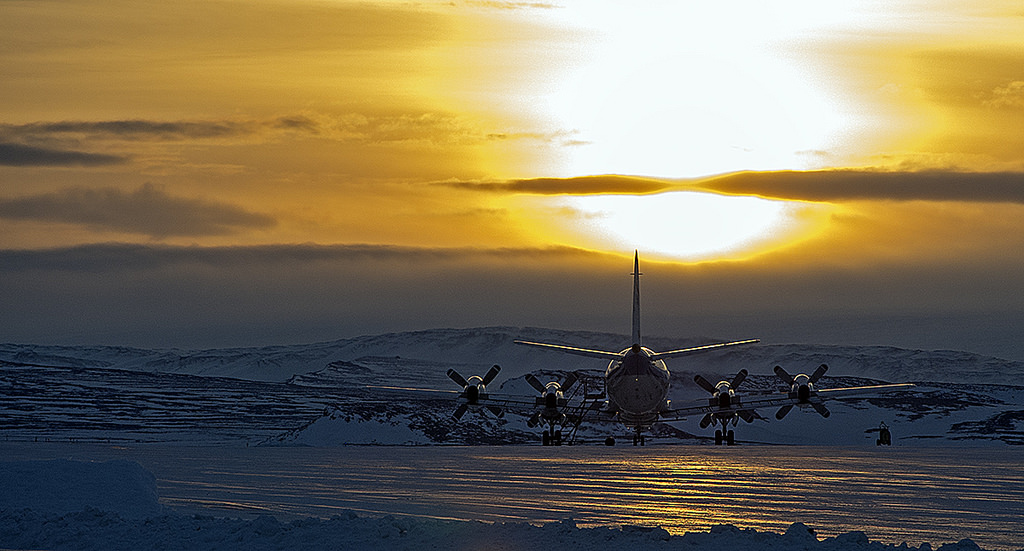
NASA P-3B waits outside the hangar at Thule Air Base with the Greenland Ice sheet in the background. The aircraft is set to begin the 2013 season of NASA’s Operation IceBridge mission to survey Earth’s polar ice sheets in unprecedented three-dimensional detail. The plane just arrived from NASA Wallops Flight Facility in Virginia – see my P-3B photos below. Credit: NASA/Goddard/Michael Studinger
There’s a reason that an ice-free Greenland has remained only a beautiful dream for so long. It’s because it’s high enough to create its own weather. Reaching up to an altitude greater than 10,000 feet above sea level, the ice sheet is like a mountain, sticking up so high into the atmosphere that it affects weather patterns. Each year, it generates almost enough snowfall to replace the ice lost to melting.
But it can’t hold out forever. Inevitably, as long as we continue to emit enough GHGs, the interior of the ice sheet will thin, and snowfall will decline. Eventually, there won’t be enough snowfall to replenish the sheet, and victory will be at hand.
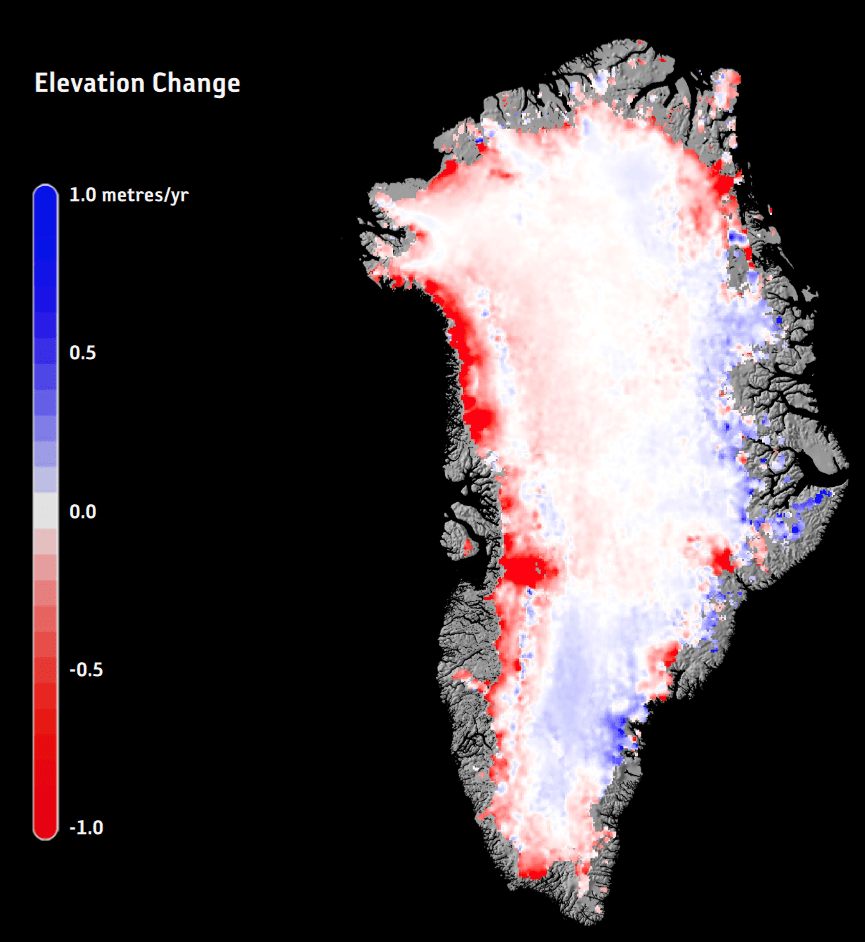
This image shows the change in Greenland ice thickness in just one year, 2015. Image Credit: ESA/Planetary Visions.
“In the warmer climate, glaciers have lost the regions where more snow falls than melts in the summer, which is where new ice is formed,” said Mark Fahnestock, research professor at the Geophysical Institute and the study’s second author. “They’re like lumps of ice in an open cooler that are melting away, and no one is putting any more ice into the cooler.”
“If we continue as usual, Greenland will melt,” lead author Andy Aschwanden said. “What we are doing right now in terms of emissions, in the very near future, will have a big long-term impact on the Greenland Ice Sheet, and by extension, if it melts, to sea level and human society.”
Without NASA, and programs like Operation IceBridge, we’d be operating in darkness. We’d never know how close we are to the end of the project. Luckily, keen scientists are keeping an eye on the ice.
This helpful video explains in less than a minute the amazing progress being made on Operation Greenland Ice Melt. Credit: NASA/Goddard Space Flight Center Scientific Visualization Studio
“NASA’s space and airborne campaigns, like IceBridge, have fundamentally transformed our ability to try and make a model mimic the changes to the ice sheet,” Fahnestock said. “The technology that allows improved imaging of the glacier bed is like a better pair of glasses allowing us to see more clearly. Only NASA had an aircraft with the instruments and technology we needed and could go where we needed to go.”
The scientists have done their part. They’re keeping track of the melting ice sheet, and preparing frequent progress reports. Even so, some people feel left behind.
Some people feel discouraged over climate change. They think that there’s not much they can as an individual to have a positive effect. But it’s not true. There’s plenty you can do!
Here are a few suggestions:
Buy a huge pickup truck and drive it around on meaningless, aimless journeys, like to get milk.
Drive to far away stores, even when there’s one closer, just to get the kind of cheese you like.
Buy a house much larger than you need, tear out the insulation and the double-pane windows. Then run the heating system with the doors and windows open.
Lobby your political representatives for more pipelines.
There’s a lot more you can do, but that’s enough to get started.
A major warm spell has caused nearly half the surface of the Greenland ice sheet to start melting, something that’s highly unusual for this time of year. And while this spike may pass, the gears could already be in motion for record-setting melt on the ice sheet’s western flank.
Greenland has been scorching (by Greenland standards) for the past few days, with temperatures rising 10-20 degrees Celsius (18-36 degrees Fahrenheit) above normal across the island. Ruth Mottram, a climate scientist with the Danish Meteorological Institute, told Earther that the weather station at the top of the ice sheet saw temperatures reach above freezing on Wednesday and they were headed that way again on Thursday. That puts them just a degree or so away from setting the all-time heat record for June, which is currently held by June 2012.
The spike in temperatures has caused a spike in melt. Roughly 45 percent of the ice sheet surface has been melting. Normally, less than 10 percent of the ice sheet surface is melting at this time of year. According to data from the National Snow and Ice Data Center, Wednesday set a daily record for the widest melt area on that date, with 275,000 square miles—an area bigger than Texas—of the ice sheet’s surface becoming a slushy, watery mess. Mottram said the much of the ice is likely to refreeze once the heat breaks, but it will be more primed to melt later in the season.
Indeed, there are a number of factors working against Greenland’s ice right now. A spurt of heat in April kickstarted the second-earliest start to the melt season on record. Mottram noted that the weather station on the summit of Greenland read minus-1.2°C [29.8 degrees Fahrenheit] on April 30, its warmest ever April recording. May continued a trend of warmer than normal weather.
That doesn’t look right.
Image: NSIDC
“In fact, one of my weather forecaster colleagues rather drolly remarked that you would have been more successful growing tomatoes outside in Kangerlussuaq [in western Greenland] than in most of Denmark this May, due to the very warm May without frosts there,” she wrote in an email.
This going-on-three months of warm temperatures comes after a very dry winter for Greenland, particularly on the ice sheet’s western edge. Ice sheets need snow to gain mass but also to act like a bright, white shield that reflects sunlight away, something scientists call the albedo effect. The low snowpack means the ice sheet’s protection is much weaker than normal. Greenland’s ice also has all sorts of schmutz on it as wildfire soot and other forms of black carbon that darken its surface and absorb more of the sun’s energy. Xavier Fettweis, a Greenland researcher at the University of Liege, called this situation “exceptional.”
“Due to a lower winter accumulation than normal, the bare ice area has been exposed very early in this area enhancing the melt due to the melt-albedo feedback,” he told Earther. “Therefore, at the beginning of the melt season, the snowpack along the west coast is now preconditioned to break records of melt.”
And unfortunately, record melt is likely to be in Greenland’s future due to the weather. The Arctic is warming twice as fast as the rest of the world, but certain natural climate patterns can enhance that warmth over Greenland. In particular, the North Atlantic Oscillation (NAO), a seesaw of high and low pressure areas, can really crank up the heat on Greenland when it’s in a negative phase. In that setup, higher than normal pressure plops itself over Greenland and parts of the Arctic and can lock in warm weather and sunny skies. The NAO is negative right now and forecasts indicate it’s like to stay negative all summer.
The Handmaid’s Tale’s Ann Dowd Says ‘Put Your Phone Down and Protest’ New Anti-Abortion Laws
Wednesday 2:00PM
Which means this is almost certainly not the last heat wave Greenland will see. It remains to be seen if we’ll get a meltdown like July 2012 when the entire ice sheet’s surface destabilized, but regardless, it’s a disconcerting June for an ice sheet that, if it completely melted away, would raise sea levels by about 24 feet.


 Exposing the Big Game