After my post, Killing Wolves Provides “a Level of Tolerance”?, the director of a Canadian animal rights group, Lifeforce, sent me this press release, which, like my post, is a semi-satirical statement about turning the tables on trophy hunters…
Animal Rights Group To Booth: Let Us Hunt You
An animal rights group is challenging Vancouver Canucks forward David Booth to see what it feels like to be hunted in the wilderness. Peter Hamilton, director of the B.C.-based advocacy group Lifeforce, took umbrage with a picture Booth tweeted last week of the left winger posing next to a freshly-killed mountain goat.
He responded with a dare. “We’re challenging David Booth to put himself in the position of a hunted wildlife,” Hamilton told CTV News. “He would be subjected to the same plight that wildlife are, in hopes that he will reflect upon the suffering and pain of innocent animals.”
A draft version of the “Booth Hunt” plan indicates the Canuck would be sent into the wild unarmed, alone and without rations. A team of hunters with dogs and high-tech equipment would then attempt to track and capture him within an agreed-upon time limit. Naturally, Booth would not be harmed by his chasers.
“He would rely on any of his woodsman skills, as do the wildlife who are forced to rely on their abilities while being ruthlessly pursued,” the draft plan reads. Hamilton described trophy hunting as “barbaric,” and said it’s a practice that must be stopped.
“A trophy is an inanimate object. These are sentient beings,” he said. “One has to question anyone’s motive in getting any kind of pleasure out of killing an animal in this manner.” …
…
I certainly have to agree with Peter Hamilton on that last point—their motive mirrors that of a serial killer—but as I told him, the fact that he’d know he wouldn’t be harmed by his pursuers would make Booth’s experience only a watered-down version of what a hunted animal fearing for its life goes through. Mr. Hamilton concurred; of course his proposition had to sound non-lethal in order to get the barbaric Booth to even consider going along with it.
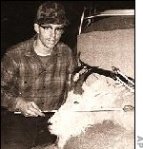 Ironically, another infamous celebrity who posed with murdered mountain goats is Anchorage, Alaska baker, serial killer and renowned trophy hunter, Robert Hansen (now serving a 461 year prison sentence for the murder of at least 17 women, ranging in age from 16 to 41.) Well-liked by his neighbors and famed as a local hunting champion, Hansen even broke several records for trophy (nonhuman) kills, documented in the Pope & Young’s book of world hunting records.
Another bit of irony: like the Connecticut school shooter, Adam Lanza, and the D.C. Beltway snipers, John Allen Mohammed and John Lee Malvo, he used a .223-caliber semi-automatic hunting rifle to make his kills (both human and non-human).
Whenever Hansen got a victim under his control, he would fly her in his private plane to his remote cabin where they would be subjected to torture and then set free in the woods, naked and sometimes blindfolded. Hansen would give his victims a brief head start and then hunt them down with a hunting knife or a high-powered rifle. In describing his hunts to investigators, Hansen said that it was like “going after a trophy Dall sheep or a grizzly bear.”
As world renowned FBI profilers, John Douglas and Roy Hazelwood correctly surmised, Hansen was compelled to keep trophies of his murders, such as a victim’s jewelry. According to Douglas, the abuse of prostitutes is a way for perpetrators to get back at women. Hansen was probably using his victims as a way to get revenge (much like the motive of good ol’ boys who kill wolves).
Several investigators who were familiar with Hansen said that he was known around the area as a proficient hunter. He earned this reputation after taking down a wild Dall sheep with a crossbow. Douglas concluded that Robert Hansen must have tired of elk, bear and Dall sheep, and instead turned his attention to more interesting prey.
When investigators first heard Hansen’s confession, they couldn’t help but think of the popular fictional story “The Most Dangerous Game” by writer Richard Connell. In the story, a shipwrecked trio find themselves stranded on an uncharted island, where they meet a Russian Count, known only as General Zaroff. The group’s initial delight turns to terror when they realize that the shipwreck was no accident and the good general had lured them there so he could hunt them down.
According to the Huffington Post, Anchorage police and FBI investigators just released information about another Alaskan serial killer, Israel Keyes, who authorities said never showed any remorse but said he got a rush out of hunting for victims and killing them. He also tortured animals as a child, investigators said.
Again, the serial killer’s motive and behavior closely parallels a trophy hunter’s:
“Israel Keyes didn’t kidnap and kill people because he was crazy. He didn’t kidnap and kill people because his deity told him to or because he had a bad childhood,” Anchorage homicide Detective Monique Doll said. “Israel Keyes did this because he got an immense amount of enjoyment out of it; much like an addict gets an immense amount of enjoyment out of drugs. In a way, he was an addict, and he was addicted to the feeling that he got when he was doing this.”
While researching for this blog post, I dug up an article by lion conservationist, Gareth Patterson, entitled “The Killing Fields.” In it, Patterson compares the uncanny similarities between trophy hunters and serial killers.
Here are some excerpts…
Certainly one could state that, like the serial killer, the trophy hunter plans his killing with considerable care and deliberation. Like the serial killer, he decides well in advance the type of victim–that is, which species he intends to target. Also like the serial killer, the trophy hunter plans with great care where and how the killing will take place–in what area, with what weapon. What the serial killer and trophy hunter also share is a compulsion to collect trophies or souvenirs of their killings. The serial killer retains certain body parts and/or other trophies for much the same reason as the big game hunter mounts the head and antlers taken from his prey…as trophies of the chase.
Hunting magazines contain page after page of (a) pictures of hunters, weapon in hand, posing in dominating positions over their lifeless victims, (b) advertisements offering a huge range of trophy hunts, and (c) stories of hunters’ “exciting” experience of “near misses” and danger. These pages no doubt titillate the hunter, fueling his own fantasies and encouraging him to plan more and more trophy hunts.
Trophy hunters often hire a camera person to film their entire hunts in the bush, including the actual moments when animals are shot and when they die. These films are made to be viewed later at will, presumably for self-gratification purposes and to show to other people–again the longing “to be important” factor?…
…
And finally, while on the subject, here’s an excerpt from the chapter, “Inside the Hunter’s Mind,” in my book, Exposing the Big Game: Living Targets of a Dying Sport:
A hunter’s true impetus is to serve the evil master in custody of his soul: his ravening ego. His self-interests are consistently placed far above those of his animal victims, whom he depersonalizes and views as objects rather than individuals. Reducing living entities to lifeless possessions and taking trophies of their body parts—without the slightest hint of guilt, remorse or other higher sentiment—is standard practice for the sport hunter…and the serial killer.
The sportsman keeps his malignant, murderous obsession concealed within the hollow confines of his psyche…until the next hunting season. Beneath a façade of virtuosity he’s driven by an urge to obtain surrogate victims, or stand-ins, representative of some perceived injustice he imagines he underwent at the hands of someone who didn’t let him have his way at some time in his life.
Maybe as a young child he felt he was undeservedly reprimanded, and so he terrorized the family pet, threw rocks at pigeons or turned to some other form of animal abuse to lift his sense of worth and gain a feeling of control. Over the years, he may have found that same kind of ego boost in killing animals for sport, partially satiating his savagery until the next legal opportunity to kill again. Imagining he’s reaping the power of the bear or the stately bull elk temporarily boosts his floundering self-esteem or relieves his sense of inadequacy. But his pride is a shallow pool, constantly in need of refreshing…

Text and Wildlife Photography ©Jim Robertson, 2012. All Rights Reserved


 Exposing the Big Game