Exposing the Big Game

Forget Hunters' Feeble Rationalizations and Trust Your Gut Feelings: Making Sport of Killing Is Not Healthy Human Behavior

Exposing the Big Game

Report: Climate Change Is Hurting Oceans — And Us — More Than Expected

The effects of climate change are bad, and they’re getting worse — especially when it comes to the world’s oceans.

But if unprecedented action is taken soon to reduce planet-warming emissions, it will greatly ease some of the worst impacts and make adaptation less painful.

That’s the underlying message in a landmark report by more than 100 scientists from 36 countries. The Intergovernmental Panel on Climate Change on Tuesday approved the Special Report on the Ocean and Cryosphere in a Changing Climate, which was three years in the works.
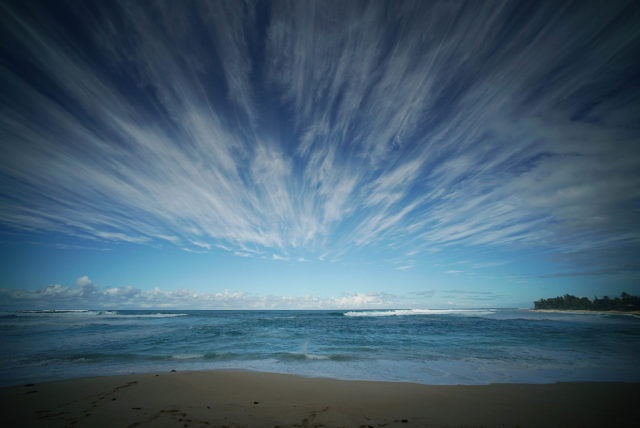
Ehukai Beach clouds during winter 2018 ocean sea level rise.

Ehukai Beach clouds during winter 2018 ocean sea level rise.

Cory Lum/Civil Beat

“The open sea, the Arctic, the Antarctic and the high mountains may seem far away to many people,” said Hoesung Lee, IPCC chair, in a statement Wednesday. “But we depend on them and are influenced by them directly and indirectly in many ways — for weather and climate, for food and water, for energy, trade, transport, recreation and tourism, for health and wellbeing, for culture and identity.”

If people prevent the planet from warming more than 2 degrees Celsius (3.6 degrees Fahrenheit) above pre-industrial levels by 2100 — as world leaders agreed to in Paris in 2015 — the effects of climate change will still threaten livelihoods, alter ecosystems and disrupt weather patterns. But it won’t be nearly as bad as a warmer world.

The latest report says marine heatwaves, for instance, will be 20 times more frequent at 2 C. But it could be 50 times more frequent if greenhouse gas emissions continue to increase.

Marine heatwaves don’t just affect the oceans, though the warmer waters are also putting corals in peril and reducing the abundance of certain fish. They are also making it hotter on land.

Meteorologists blame heatwaves for the record heat Hawaii has experienced this summer, and they may exacerbate wildfires.

In July, firefighters on Maui were responding to their first big wildfire of the season — about 9,000 acres — when they realized the equipment they set out with to tackle the blaze wasn’t going to do the job as it had for similar fires in years past, according to University of Hawaii wildland fire researcher Clay Trauernicht.

That’s because it was so hot out that it had driven the humidity down to a point where the grasses were so crispy that the fire behaved differently, burning up the fuels faster and shifting directions less predictably, he said.

Marine heatwave

Trauernicht said his biggest takeaway from the IPCC report was the “ginormous” difference between cutting greenhouse gas emissions or continuing to burn fossil fuels when it comes to the severity of the impacts of climate change.

“Whatever extent we can reduce this, we’ve got to do it,” he said.

The report cites marine heatwaves as just one of the impacts of climate change. Scientists project stronger hurricanes, faster eroding coastlines, hotter summers, more flooding, increased sea level rise, more extreme weather and less productive fisheries.

The rate of sea level rise is increasing primarily because glaciers and ice sheets in polar and mountain areas are melting faster than expected. It’s also rising faster because the ocean is expanding as it gets warmer, the report says.

Sea levels rose globally about a half foot last century. Now they’re rising more than twice as fast and getting faster. Sea level could rise 1 to 2 feet by 2100 even if global warming is limited to well below 2 C, but it could rise 2 to 3.6 feet if greenhouse gas emissions continue to escalate.

That’s a big deal for Hawaii, where most of the state’s 1.4 million residents live close to the coast and it’s also where major infrastructure is located. The tourism industry that the overall economy depends on also depends on the coastal environment.

We are in a critical set of years for the entire history of humanity,” University of Hawaii climate researcher Chip Fletcher said. “But we can never give up. We can never stop. It’s always going to be a crisis until we decarbonize.”

Sea level rise will also increase the frequency of extreme events during high tides and intense storms, the report cautions. With any degree of additional warming, the report says events that happened once per century will happen every year by 2050, heightening the risk for low-lying coastal cities like Honolulu and small islands like those in the northwestern reaches of the Hawaiian Archipelago.

East Island, about 600 miles northwest of Oahu, almost entirely disappeared after an unprecedented hurricane passed over it last year. It was the primary nesting ground for the bulk of the threatened Hawaiian green sea turtle population and a sizable chunk of critically endangered Hawaiian monk seals.

Sea level rise, increasing faster due to climate change, has accelerated erosion in Hawaii, such as Sunset Beach on the north shore of Oahu.

Anthony Quintano/Civil Beat

The IPCC has a reputation for being conservative because it requires 100% agreement, Fletcher said. That tends to water down its reports, compared to peer-reviewed literature that offers the latest science.

But knowing this is the voice of the scientific community speaking is important, he said.

It’s a sentiment shared by Josh Stanbro, who heads Honolulu’s climate change office. He said the IPCC offers an important “rear view mirror approach” whereas the Honolulu  climate commission’s appointed members, which include Fletcher, are looking out the front window.

“If there’s anything heartening in this it’s that we have really smart sharp local climate change commissioners giving us good information, making projections and looking at cutting-edge research,” he said.

Still, Stanbro found some aspects of the report to be unnerving. He is concerned about how it leaves as an “x factor” the impact of methane gas that may be released when permafrost thaws. And he was taken aback by how the report underscores how small island nations are exposed to the impacts of climate change.

“We know that as island people,” he said. “But it’s a little unnerving to see that in plain sight where world leaders are saying we’re the canaries in the coal mine.”

Members of the working groups who developed the report said it arms communities and governments with the information they need to act.

It highlights the urgency of “timely, ambitious, coordinated and enduring action,” Ko Barrett, vice chair of the IPCC, told reporters.

Hawaii agencies are among those looking to it for guidance.

Scott Glenn, who heads the state Office of Environmental Quality Control, said he is interested in how it affects baseline assumptions that agencies are making, such as maps showing sea level rise exposure areas.

“With climate change, it’s affecting so many parameters at the same time that it becomes very hard,” he said. “How do you translate that into something like design or engineering if you know there’s this science coming out with these big uncertainty brackets around it?”

IPCC working group members said that reducing carbon emissions enough to matter will require a global effort across all sectors.

“We will only be able to keep global warming to well below 2 C above pre-industrial levels if we effect unprecedented transitions in all aspects of society, including energy, land and ecosystems, urban and infrastructure as well as industry,” Debra Roberts, an IPCC working group co-chair, said in a statement.

The report, which was unanimously approved, provides crucial information going into the United Nations Framework Convention on Climate Change Conference in December in Chile, known as COP25.

Read the full report below.
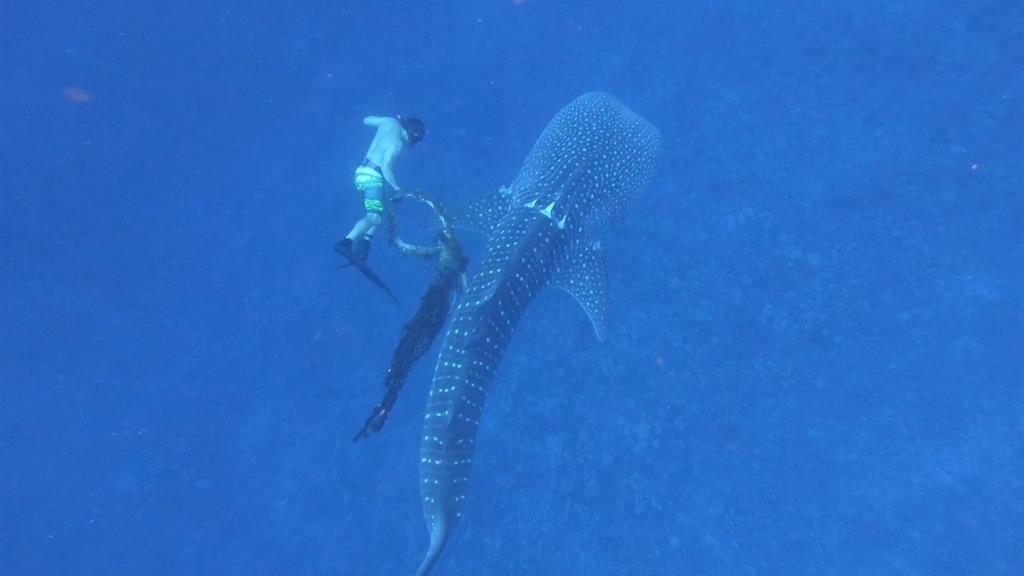
Free-Diving Family Saves Whale Shark Stuck in a Fishing Net

While free-diving off of Hawaii, a family encounters a whale shark with a gigantic rope around its neck and decides to try to free it.

A family encountered an endangered whale shark in Hawaii with fishing rope around its neck—so the father dove to cut the rope with a knife.

While free-diving off the shore of Kaunolū on Hawaii’s island of Lanai, a Hawaiian family saw something they’d never seen before: A young whale shark.

Even for people who spend a lot of time in Hawaii’s crystalline waters, this endangered animal—the world’s largest fish—is a rare and joyous sight.

But the initial wonder faded as Kapua Kawelo and her husband Joby Rohrer, both of whom work on endangered species for the O‘ahu Army Natural Resources Program, noticed the creature had a thick, heavy rope wrapped around its neck.

“It looked really sore,” says Rohrer. “There were these three scars from where the rope rubbed into the ridges on her back. The rope had cut probably three inches into her pectoral fin.”

After filming the shark for a while, the family decided to try to cut the rope with a dive knife. Using only his experience as a free-diver and a small, serrated dive blade, Rohrer dove down again and again at depths of 50 to 60 feet for spans of up to two minutes at a time.

Finally, after about half an hour of careful work and a little bit of support from the couple’s son Kanehoalani and from Jon Sprague, a wildlife control manager for Pūlama Lānaʻi, the shark was free.

Then the family’s 15-year-old daughter, Ho’ohila, swam the 150-pounds worth of rope to shore.

“It’s a family story,” says Kapua.

Will It Survive?

Clearly, the whale shark is better off now that it’s without “an unbreakable rope lei,” as Kapua puts it. But will the whale shark be able to recover from the ordeal?

According to Brad Norman, a National Geographic Explorer and one of the world’s foremost experts on whale sharks, you can tell the rope had been strangling the animal for at least a few months because of all the barnacles that had colonized it. Hawaii’s Department of Land and Natural Resources had actually been alerted to the shark’s plight in mid-July by SCUBA divers and had since sent out a call for people to report any future sightings.

But Norman says that, all things considered, the shark appeared to be in pretty good condition. He also estimated that the animal was at least 20 years old, giving it excellent odds to survive.

“Although globally, all whale sharks are endangered and threatened with extinction,” says Norman. “If we don’t reverse the declining trend in their numbers, it’s dire for the species as a whole.”

What’s more, lost fishing gear doesn’t just harm whale sharks. According to a recent report by World Animal Protection, more than 700,000 tons of new gear enters earth’s oceans each year. (Read National Geographic’s special series “Planet or Plastic”)

Did The Whale Shark Come To Humans For Help?

Whale sharks typically swim away when they’re touched, says Norman, so the fact that the shark remained even after Rohrer began to saw at the rope is evidence that it was comfortable with the situation. Norman calls it “amazing to see.”

“The shark appears to allow the diver to assist,” says Norman, “seemingly knowing he’s helping.”

Kapua credits her husband’s zen-like demeanor and heroic free-diving ability for allowing him to be able to free the entangled shark.

“We all wanted to help but none of us could hold our breath that long,” she says.

But there was also something else about the experience, she says. In Hawaiian mythology, ancestors sometimes come back as guardian animals, called ʻaumakua. These guardians are thought to protect families, who also must help protect them.

“And we’ve never seen a whale shark before but, just like native peoples around the world, you feel like you have a special connection to the resources that surround you and your family,” says Kapua.

“I like to think that we were there for a reason and that the least we could do for having that amazing experience, seeing that beautiful creature, was to help it survive.”

Hawaiian monk seal pup rescued from Molokai

https://apnews.com/e46cc6a32b7e4b26844e3156ec61ed24/Hawaiian-monk-seal-pup-rescued-from-Molokai

KAILUA-KONA, Hawaii (AP) — A Hawaiian monk seal pup found malnourished on Molokai is now in the care of the Marine Mammal Center’s hospital on the Big Island.

The pup named Sole is in stable condition at the Ke Kai Ola facility in Kailua-Kona after it was rescued last week.

The male pup born in late June was prematurely weaned from its mother earlier this month, the center said. The short nursing time caused the pup to have low body weight and minimal reserves, creating concern for wildlife officials.

“After several consultations with the patient-residents and the Kalaupapa community, the decision was made to rescue the animal,” said Eric Brown, Marine Ecologist at Kalaupapa National Historic Park.

Center veterinarians, supported by the U.S. Coast Guard, the National Park Service and the National Oceanic and Atmospheric Administration, rescued the pup and flew it from Molokai to the Big Island animal hospital.

“With only a few hundred monk seals living in the main Hawaiian Islands, the survival of each individual is critical to the recovery of the population,” said Claire Simeone, the center’s hospital director. “Conservation takes a village. We are so grateful to our partners for their support in achieving our mission, and ensuring this pup made it safely to Ke Kai Ola.”

The pup is now feeding on a blended fish mash, and it will transition to eating whole fish as it grows stronger, Simeone said. The center plans to keep minimal human contact with the seal, so it can have the best chance of survival in the wild.

The center has rehabilitated 23 monk seals and returned them back to the wild since the facility opened in 2014.

A Brain-Invading Parasite Is Believed to Be Spreading Because of Humans

http://gizmodo.com/a-brain-invading-parasite-is-believed-to-be-spreading-b-1794144135

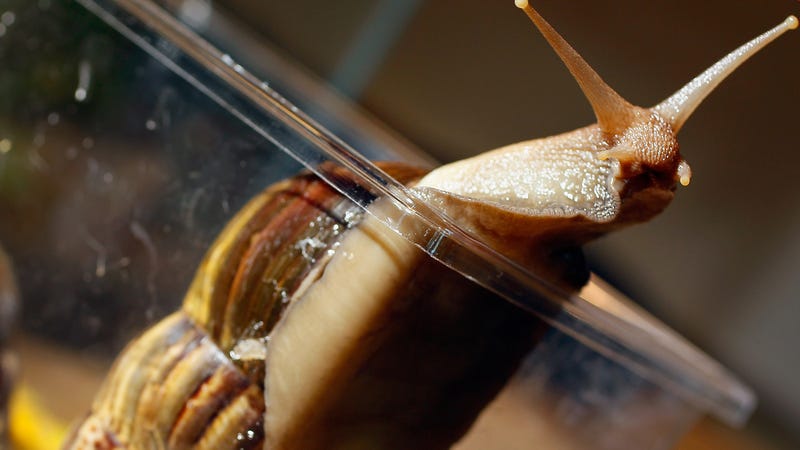
Snails are a known carrier of rat lungworm disease Photo: Getty

Health officials in Hawaii have been warning residents not to touch snails or slugs with their bare hands because of an increase in cases of people coming into contact with a rare parasitic infection known as a rat lungworm. Experts are blaming its sudden spread across the United States on climate change and globalization.

In the last two decades, there have only been two documented cases of rat lungworm infections in Hawaii. But in the past three months, six more cases have occurred in rapid succession. Other states where it has recently popped up include California, Alabama, Louisiana and Florida. According to the Atlantic, the first known case of the disease occurred in Taiwan in 1944 but in the past few years, it’s believed to have spread to the U.S. by way of rats in cargo ships.

Pretty much everything about this disease is nasty. Rat lungworm is a parasitic nematode (Angiostrongylus cantonensis) that begins its life as an infection in rat’s lungs, blood, and brains. From there, the rats defecate worm larvae that are spread to other creatures like snails, slugs, and freshwater shrimp. Humans might eat one of these infected hosts or they might eat produce that has had the worm transferred to it by a host. Next thing you know, your brain is being invaded and it doesn’t sound good at all. Once rat lungworm disease moves into the brain it can cause meningitis and its symptoms include tremors, pain, and inflammation. It is often fatal.

The Maui News reported on the recent cases this week and spoke with local residents about the spread of the invasive semi-slug on the island, and the infectious disease that it carries. Locals say that they’ve become increasingly paranoid about eating produce and they line their yards with slug bait. And for an area that thrives on tourism, paranoia about eating the local food can be an economic nightmare.

A local preschool teacher described her experience with parasitic meningitis that was a result of rat lungworm to the Honolulu Civil Beat:

The parasites are in the lining of my brain, moving around. Because I work with children I try to tell stories through word pictures. My visual graphic for what’s happening is that every once in a while somebody opens the top of my head, sets a hot iron inside my brain, then pushes the steam button.

I have a half dozen medicine bottles, several for pain because any movement of my head spikes my pain level to 12. I don’t see any improvement, just that every day is a different day, different pain.

The severity of the disease can vary wildly, there’s no known treatment, and it’s notoriously difficult to diagnose.

Cases of rat lungworm infections have been documented in over 30 countries and health officials are worried about its appearance in areas where previously the habitat was believed to be unsuitable. One recent surprise location was in Oklahoma. Scientists fear that this is just another consequence of climate change. A 2004 World Health Organization report warned that “most new infections seem to be caused by pathogens already present in the environment, which have been brought out of obscurity, or given selective advantage, by changing ecological or social conditions.”

Infectious disease researchers say that some low-income areas of the globe are perfectly situated as transmission zones for tropical diseases that are on the rise. The fear is that these countries are the least prepared to deal with an outbreak. But that doesn’t mean that they aren’t worried about wealthy countries like the United States. We have our own problems because our leaders constantly refuse to acknowledge the threats that come along with climate change. The current head of the Environmental Protection Agency doesn’t believe in climate change and has vowed to destroy environmental regulations. The current budget proposal is hoping to cut the EPA’s funding by 31 percent by focusing on killing climate change programs. And just yesterday, it came to light that the agency was eliminating its climate adaptation program which helps states and localities adjust to the changes that are already occurring their areas. Unfortunately, these fools don’t appear to have a brain parasite, they simply don’t give a shit.

[The Atlantic, The Maui News, Honolulu Civil Beat, Ars Technica]

Federal regulators want to ban swimming with dolphins in Hawaii

http://www.cbsnews.com/news/federal-regulators-want-to-ban-swimming-with-dolphins-in-hawaii/

 In this handout photo provided by SeaWorld San Diego, Sadie, a 13-year-old bottlenose dolphin at SeaWorld San Diego, swims with her newborn calf at the marine park’s Dolphin Stadium October 20, 2014 in San Diego, California.

HANDOUT, GETTY IMAGES

HONOLULU — Federal regulators are proposing to ban swimming with dolphinsin Hawaii, a move that could imperil one of the Aloha State’s most popular tourist activities and the industry that has sprung up around it.

The National Marine Fisheries Service says spinner dolphins — the playful nocturnal species that humans in Hawaii routinely frolic with — are being deprived of rest during the day and becoming stressed out.

Swimming with dolphins is popular with visitors and some locals, with dozens of companies on Kauai, Oahu, Maui and the Big Island operating dolphin tours daily.

The proposed rule could shut down or greatly disrupt the industry as it now operates. That’s because the ban would cover waters out to 2 nautical miles, which is where 98 percent of Hawaii’s spinner dolphins rest after they’ve spent the night feeding. Tour companies take customers to these close-to-shore waters to find dolphins.

Ann Garrett, assistant regional administrator of the National Marine Fisheries Service’s protected resources division for the Pacific Islands, said dolphins have been found to be burning calories at a higher rate because they are forced to be vigilant as people approach their pods.

“All of these things can contribute to a reduction of fitness over time — this kind of chronic level of stress. That’s what we’re concerned about,” Garrett said.

Scientists have not done any studies on how frolicking with humans has affected the dolphins’ numbers. But they fear the stress will harm the animals’ ability to reproduce.

The federal agency plans to hold public meetings on the regulations next month and expects to make a final decision next year.

Garrett said Tuesday that the agency aims to require swimmers, snorkelers and others in the water to stay at least 50 yards from the animals.

She said tour operators can follow this rule and still make a living. She said some already do so voluntarily.

Under the proposed rules, “those that are putting their people in the water to interact with dolphins, this would change the nature of what they’re doing,” she said. “They could still do snorkeling for other reasons – it’s just not setting their people within a pod of dolphins or within 50 yards of a dolphin.”

Hawaii’s spinner dolphins get their name from their habit of leaping in the air and spinning around. Some scientists say such behavior is not always playfulness and can instead be an attempt by a dolphin to alert others to danger.

Spinner dolphins eat fish and small crustaceans that surface from the ocean depths at night. At daybreak, they gather in shallow bays to hide from tiger sharks and other predators.

When they sleep, they rest half their brains and keep the other half awake so that they can surface and breathe. As a result, they can look awake and active even when asleep.

Unlike the better-known bottlenose and other dolphin species in Hawaii waters, they are highly predictable in their behavior, returning to the same general area every day. That makes them easy for tour groups to find.

The prohibitions would cover waters up to 2 miles off the main Hawaiian Islands. It would also apply farther from shore in certain waters between Maui, Lanai and Kahoolawe islands.