Exposing the Big Game

Forget Hunters' Feeble Rationalizations and Trust Your Gut Feelings: Making Sport of Killing Is Not Healthy Human Behavior

Exposing the Big Game

The Arctic Is Unraveling as a Massive Heat Wave Grips the Region

It wouldn’t be spring in the climate change era without a massive heat wave in the Arctic.

Freakishly warm air has billowed up from Siberia over the Arctic Ocean and parts of Greenland, and the heat will only intensify in the coming days. The warmth is helping to spread widespread wildfires and to kickstart ice melt season early, both ominous signs of what summer could hold.

The Arctic has been on one recently. Russia had its hottest winter ever recorded, driven largely by Siberian heat. That heat hasn’t let up as the calendar turns to spring. In fact, it’s intensified and spread across the Arctic. Last month was the hottest April on record for the globe, driven by high Arctic temperatures that averaged an astounding 17 degrees Fahrenheit (9.4 degrees Celsius) above normal, according to NASA data.

Now, a May heat wave has pushed things into overdrive. Martin Stendel, a climate scientist at the Danish Meteorological Institute, told the Washington Post that the mid-May warmth is “quite extraordinary…there is no similar event so early in the season.”

Top ArticlesUber Has Now Laid Off a Quarter ofIts Workforce

Siberia has been one of the blistering hot spots on the globe all year, and heat is pushing out of the region and traversing the Arctic. Plumes of abnormally warm air have snaked over the North Pole. Norway’s weather service is forecasting temperatures there will approach freezing in the coming days. That might not sound hot, but remember, this is the North Pole. The warmth could pose a threat to sea ice, which saw its fourth-lowest extent on record for April.

Heat has also gripped portions of Greenland, where the ice sheet’s annual melt got started two weeks early. According the Polar Portal run by three Danish research institutions, including the Danish Meteorological Institute, the western and southern margins of the ice sheet saw abnormal melt over the weekend, and more warmth could spur more melt this week as well. The season is still early, and the spike in melt is relatively small compared to previous sudden upticks in melting (See: last summers’s record-setting meltdown).

Still, early melt is never a good thing, and doubly so given this year’s lower-than-normal snowfall. That means more crusty, dirty snow on the surface could absorb more warmth in summer, something that helped spur record mass loss last year. And when there’s less mass added to the ice sheet, it can set up more mass loss year over year. The ice sheet is already losing six times more mass than it was in the 1980s, so this setup is not good!

Siberian wildfires within the Arctic Circle
Image: Pierre Markuse (Flickr)

Adding to the not-goodness are the massive wildfires raging in Siberia. The region has quietly been ablaze since last month, and flames have continued to spread across millions of acres. While most have burned below the Arctic Circle—or 66.5 degrees North—the warmth has allowed at least some flames to spread north of it. Satellite monitoring expert Pierre Markuse tweeted an image on Monday showing fires creeping across the tundra in the Republic of Sakha that makes up most of eastern Siberia. There are also signs that some “zombie” fires from last fire season have reignited after smoldering underground in peat-rich soil. Congrats if you had that on your climate crisis bingo card.

The Arctic is the fastest-warming region on the planet, and these types of heat waves have become a seasonal occurrence. But that shouldn’t make them any less shocking or alarming, particularly since the changes happening there could actually cause the rest of the glove to warm up even more quickly. Melting sea ice exposes darker ocean waters that can absorb more heat, while fires cough up more carbon dioxide into the atmosphere, trapping yet more heat. The zombie fires are even more worrisome, since peat is extremely rich in carbon. The stubborn heat looks to be locked in until at least next week, so we’ll get to see all these horrible feedbacks on display through at least then.

Climate change: Blue skies pushed Greenland ‘into the red’

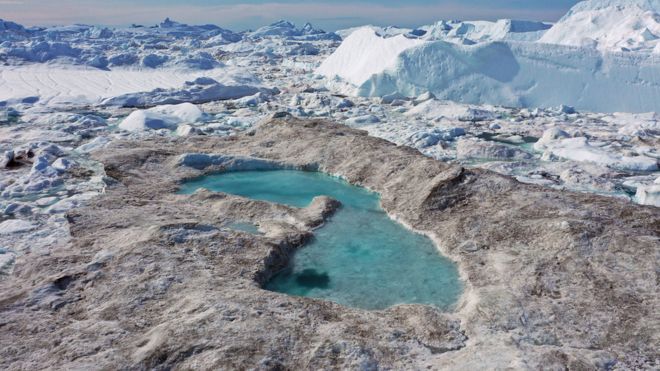
meltingImage copyrightGETTY IMAGES
Image captionMelting in Greenland in 2019

While high temperatures were critical to the melting seen in Greenland last year, scientists say that clear blue skies also played a key role.

In a study, they found that a record number of cloud free days saw more sunlight hit the surface while snowfall was also reduced.

These conditions were due to wobbles in the fast moving jet stream air current that also trapped heat over Europe.

As a result, Greenland’s ice sheet lost an estimated 600 billion tonnes.

Current climate models don’t include the impact of the wandering jet stream say the authors, and may be underestimating the impact of warming.

Greenland’s ice sheet is seven times the area of the UK and up to 2-3km thick in places. It stores so much frozen water that if the whole thing melted, it would raise sea levels worldwide by up to 7m.

Last December, researchers reported that the Greenland ice sheet was melting seven times faster than it had been during the 1990s.

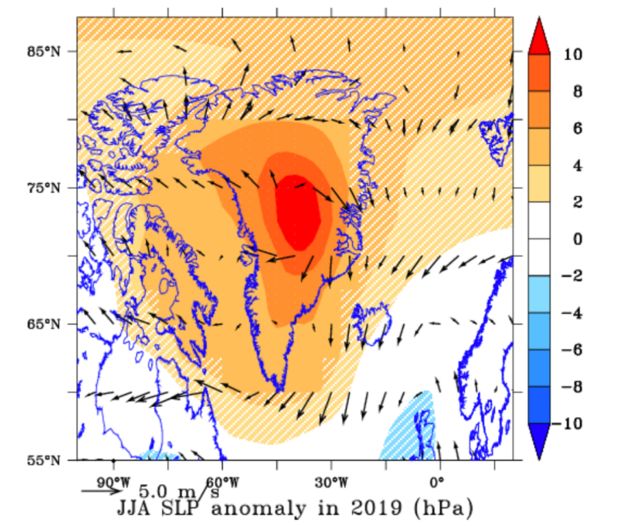
graphicImage copyrightTEDESCO & FETTWEIS
Image captionAverage pressure over Greenland in summer 2019, with arrows showing wind direction

In recent weeks, an analysis of last year’s melting said the 600 billion tonnes of ice added 2.2mm to global sea levels in just two months.

This new study says that while rising global temperatures played a role in the events last year, changes in atmospheric circulation patterns were also to blame.

Researchers found that high pressure weather conditions prevailed over Greenland for record amounts of time.

They believe this is connected to what’s termed the “waviness” in the jet stream, the giant current of air that mostly flows from west to east around the globe.

As the current becomes more wobbly, it bends north, and high pressure systems that would normally move through in a few days become “blocked’ over Greenland.

These systems had different impacts depending on the part of Greenland you were in.

In the southern part of the island, the authors say, it caused clearer skies with more sunlight hitting the surface.

The cloud-free days brought less snow, which meant that 50 billion fewer tonnes were added to the ice sheet.

The absence of snow also exposed bare, dark ice in some place which absorbed more heat – contributing to the melt.

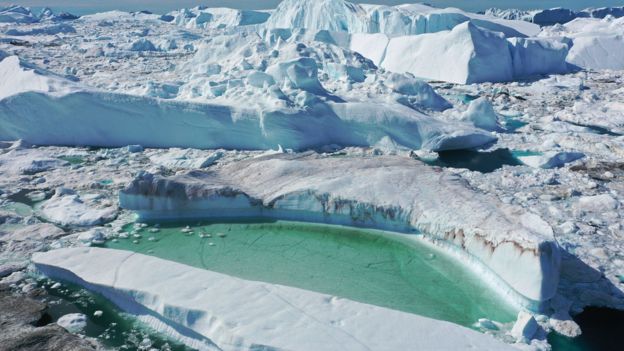
meltingImage copyrightGETTY IMAGES

In other parts of Greenland, the changing atmospheric patterns had different but equally damaging impacts.

In northern and western region, the swirling but stuck high pressure systems pulled in warm air from southern latitudes.

“You can imagine that a sort of vacuum cleaner that is spinning clockwise and sucking all the warm and moist air from New York City for example,” said lead author Dr Marco Tedesco from Columbia University in New York, US.

“And because of the rotation, it deposits this warm, moist air high in the northern part. It forms clouds, and they behave like a greenhouse, trapping the heat that would normally radiate off the ice.”

Dr Tedesco explained that Greenland in 2019 experienced the largest drop in surface mass balance since records began in 1948.

The term surface mass balance describes the overall state of the ice sheet after accounting for gains from snowfall and losses from surface melt-water run-off.

The authors believe their study explains why, despite the fact that 2019 was not as warm as 2012, last year produced a record drop in surface mass balance.

“This is really pushing Greenland into the red,” said Dr Tedesco.

Other researchers working in this field agreed that the new paper is a good explanation of what happened last year in Greenland.

“The main message of the paper is that the very high melt was mostly driven by clear skies and direct melting rather than necessarily being attributable to unusually high temperatures over the ice sheet – a radiatively-driven, rather than thermally-driven, melt season as they put it,” said Dr Ruth Mottram, a climate scientist at the Danish Meteorological Institute in Copenhagen.

“In some ways, the weather pattern is rather similar to the great blocking high that lodged over Scandinavia for weeks in 2018, giving us the most extreme drought on record in much of northern Europe.”

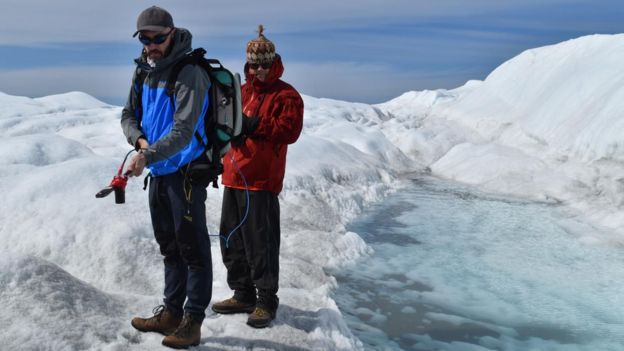
scientistsImage copyrightKEVIN KRAJICK/EARTH INSTITUTE
Image captionMarco Tedesco (left) and a colleague measure reflectance on the Greenland ice sheet during a 2018 expedition

The exact mechanism by which climate change affects the jet stream isn’t understood. But the view is that as the Arctic warms, the temperature differences between the region and the mid-latitudes that drive the air current are reduced. This slows down the stream, making it wander further.

“The more CO2 we pump out, the more divergence starts to emerge between the behaviour of the Arctic and the mid-latitudes and this behaviour is accelerating and enhancing some of the differences. It is a crucial part of what is creating this waviness and the consequences,” said Dr Tedesco.

The authors also argue that climate models in general need to take account of this impact of the wavy jet stream. Others in the field say this issue needs addressing.

“These results imply that the climate models we use for future projections of sea level rise from Greenland are underestimating the extreme years at present and therefore likely also the rate at which the ice sheet melts and the oceans will rise in the future,” said Dr Mottram.

“The only ray of light is that as processor power increases and we can do higher resolution simulations with climate models, the representation of these processes does seem to improve and not just in Greenland but in other areas of the world where persistent blocking patterns can have an important influence on the season.”

The study has been published in the journal The Cryosphere.

Climate change: What could be wiped out by temperature rise

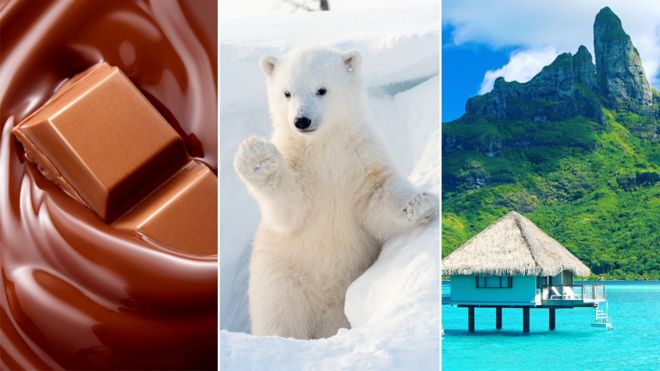
Chocolate, a polar bear and a South Pacific islandImage copyrightGETTY IMAGES

Scientists have described the serious concept of “Hothouse Earth”.

An international team of researchers suggest that global warming will have severe consequences for the planet.

They paint a picture of boiling hot climates and towering seas in years to come if temperatures rise by just 2C.

That means it could turn some of the planet’s natural forces – that currently protect us – into our enemies.

Dr Sarah Cornell is an environmental scientist and one of the researchers behind the report for the Stockholm Resilience Centre.

She’s described some of the big changes which could happen with a 2C temperature rise – which is the globally accepted amount, according to the Paris climate agreement.

Chocolate is under threat

Cacao pods growing on a tree in IndonesiaImage copyrightGETTY IMAGES
Image captionCacao pods, from which we get cacao beans for making chocolate, grow in countries around the equator

This is something that is very close to Dr Cornell’s (and everyone else’s) heart.

“Chocolate is just one example of a globally important crop that grows in warm and humid climates,” she says.

But global warming doesn’t mean that there will be more places to grow cacao beans – in fact, it’s the opposite.

A rise in global temperatures causes weather systems to be unpredictable and inconsistent, which would put cacao growing at risk.

“It is about the really intricate pattern of temperature, water flow, light intensity, the nutrients already available in the soil,” says Dr Cornell.

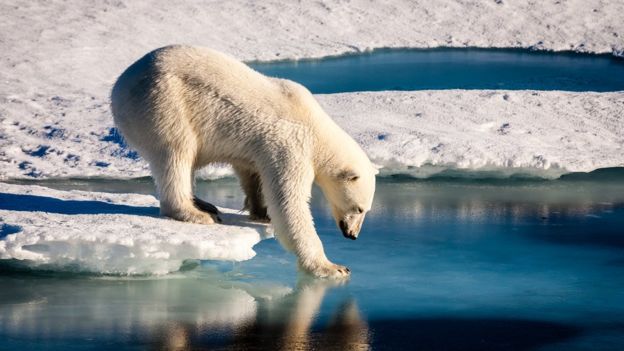
The Arctic could melt

A polar bearImage copyrightGETTY IMAGES

Ice in the areas around the North Pole could melt completely, says Dr Cornell.

But it’s not just the animals living there which are under threat.

“When you melt the Arctic, you’re changing the way that the whole Earth works,” she says.

“You’re changing ice that reflects heat back into space into dark seawater that absorbs incoming solar radiation.”

So it’s a vicious circle – the less ice there is to reflect heat away from the Earth, the more global warming accelerates.

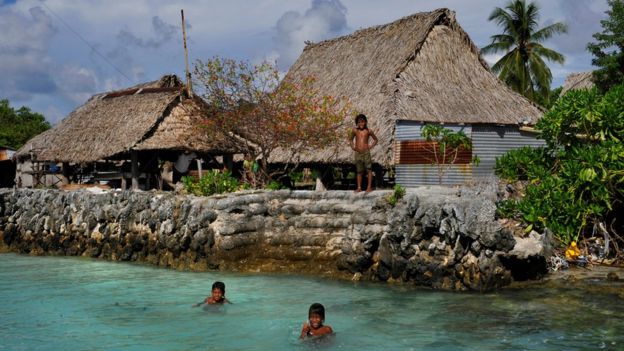
Entire nations might have to move

Tebunginako on the Island of Abaiang, KiribatiImage copyrightGETTY IMAGES
Image captionThis village in Kiribati, in the Pacific Ocean, had to relocate because of rising sea levels

How can you be a country if you don’t have any land?

Melting ice means rising sea levels – which could put low-lying island nations, such as the Maldives, under the sea.

“It will have all kinds of social consequences because the people who live in these low-lying areas will have to go somewhere,” says Dr Cornell.

“There are already lots of discussions with people in low-lying Pacific islands talking with Australia and New Zealand about where they can live, and how they can have nationhood while renting land from another country.”

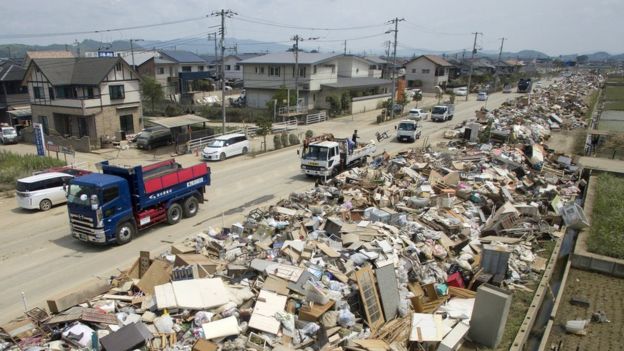
Unpredictable rain

The aftermath of floods in JapanImage copyrightEPA
Image captionRecent floods in Japan left hundreds of people dead and millions had to evacuate their homes

Combine rising temperatures with other human activity such as deforestation, and you have drastic effects on the water cycle.

“When you change landscapes, you change where water can flow,” says Dr Cornell.

“When you warm the planet and are simultaneously changing the landscape, you’re changing the water cycle… in a much less predictable way than it was before.”

Extreme changes to the water cycle can lead to severe floods – and severe droughts.

How a tree frog affects a whole ecosystem

Toughie the frogImage copyrightATLANTA BOTANICAL GARDEN
Image captionToughie the frog was originally from a forest in Panama

Two years ago, a little brown treefrog called Toughie died in Atlanta, USA, at the age of 12.

He was the last known living Rabbs’ fringe-limbed treefrog to exist.

Toughie’s story is a symbol of the rate of extinction that is being caused as a result of climate change.

The extinction of a species even as small as a frog has consequences which we don’t yet fully understand.

“We could lose treefrogs, and that doesn’t sound important but it’s vitally important because it’s what we lose with it,” says Dr Cornell.

“When we’re killing species, we probably won’t know in advance what the consequences are.

“But we already know that we’re making ecosystems much more vulnerable”.

Ocean temperatures hit record high as rate of heating accelerates

 The heat in the world’s oceans reached a new record level in 2019, showing “irrefutable and accelerating” heating of the planet. Photograph: Modis/Terra/Nasa

Oceans are clearest measure of climate crisis as they absorb 90% of heat trapped by greenhouse gases

by  Environment editor

The heat in the world’s oceans reached a new record level in 2019, showing “irrefutable and accelerating” heating of the planet.

The world’s oceans are the clearest measure of the climate emergency because they absorb more than 90% of the heat trapped by the greenhouse gases emitted by fossil fuel burning, forest destruction and other human activities.

The new analysis shows the past five years are the top five warmest years recorded in the ocean and the past 10 years are also the top 10 years on record. The amount of heat being added to the oceans is equivalent to every person on the planet running 100 microwave ovens all day and all night.

Hotter oceans lead to more severe storms and disrupt the water cycle, meaning more floods, droughts and wildfires, as well as an inexorable rise in sea level. Higher temperatures are also harming life in the seas, with the number of marine heatwaves increasing sharply.

The most common measure of global heating is the average surface air temperature, as this is where people live. But natural climate phenomena such as El Niño events mean this can be quite variable from year to year.

“The oceans are really what tells you how fast the Earth is warming,” said Prof John Abraham at the University of St Thomas, in Minnesota, US, and one of the team behind the new analysis. “Using the oceans, we see a continued, uninterrupted and accelerating warming rate of planet Earth. This is dire news.”

“We found that 2019 was not only the warmest year on record, it displayed the largest single-year increase of the entire decade, a sobering reminder that human-caused heating of our planet continues unabated,” said Prof Michael Mann, at Penn State University, US, and another team member.

The analysis, published in the journal Advances In Atmospheric Sciences, uses ocean data from every available source. Most data is from the 3,800 free-drifting Argo floats dispersed across the oceans, but also from torpedo-like bathythermographs dropped from ships in the past.

The results show heat increasing at an accelerating rate as greenhouse gases accumulate in the atmosphere. The rate from 1987 to 2019 is four and a half times faster than that from 1955 to 1986. The vast majority of oceans regions are showing an increase in thermal energy.

This energy drives bigger storms and more extreme weather, said Abraham: “When the world and the oceans heat up, it changes the way rain falls and evaporates. There’s a general rule of thumb that drier areas are going to become drier and wetter areas are going to become wetter, and rainfall will happen in bigger downbursts.”

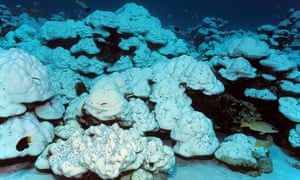
Bleached coral on the Great Barrier Reef, Australia.
 Bleached coral on the Great Barrier Reef, Australia. Photograph: Helmut Corneli/Alamy Stock Photo

Hotter oceans also expand and melt ice, causing sea levels to rise. The past 10 years also show the highest sea level measured in records dating back to 1900. Scientists expect about one metre of sea level rise by the end of the century, enough to displace 150 million people worldwide.

Dan Smale, at the Marine Biological Association in the UK, and not part of the analysis team, said the methods used are state of the art and the data is the best available. “For me, the take-home message is that the heat content of the upper layers of the global ocean, particularly to 300 metre depth, is rapidly increasing, and will continue to increase as the oceans suck up more heat from the atmosphere,” he said.

The new analysis assesses the heat in the top 2,000m of the ocean, as that is where most of the data is collected. It is also where the vast majority of the heat accumulates and where most marine life lives.

The analysis method was developed by researchers at the Chinese Academy of Sciences in Beijing and uses statistical methods to interpolate heat levels in the few places where there was no data, such as under the Arctic ice cap. An independent analysis of the same data by the US National Oceanographic and Atmospheric Administration shows that same increasing heat trend.

Reliable ocean heat measurements stretch back to the middle of the 20th century. But Abraham said: “Even before that, we know the oceans were not hotter.”

“The data we have is irrefutable, but we still have hope because humans can still take action,” he said. “We just haven’t taken meaningful action yet.”

How fast can climate change? Too slowly for humans to *notice*, according to most scientists of the 20th century

Physics Today 56, 8, 30 (2003);
 
The Discovery of Rapid Climate Change
Only within the past decade have researchers warmed to the possibility of abrupt shifts in Earth’s climate. Sometimes, it takes a while to see what one is not prepared to look for.
Spencer Weart directs the Center for History of Physics at the American Institute of Physics.
Opening paragraphs
 
How fast can our planet’s climate change? Too slowly for humans to notice, according to the firm belief of most scientists through much of the 20th century. Any shift of weather patterns, even the Dust Bowl droughts that devastated the Great Plains in the 1930s, was seen as a temporary local excursion. To be sure, the entire world climate could change radically: The ice ages proved that. But common sense held that such transformations could only creep in over tens of thousands of years.
In the 1950s, a few scientists found evidence that some of the great climate shifts in the past had taken only a few thousand years. During the 1960s and 1970s, other lines of research made it plausible that the global climate could shift radically within a few hundred years. 
In the 1980s and 1990s, further studies reduced the scale to the span of a single century. Today, there is evidence that severe change can take less than a decade. A committee of the National Academy of Sciences (NAS) has called this reorientation in the thinking of scientists a veritable “paradigm shift.” The new paradigm of abrupt global climate change, the committee reported in 2002, “has been well established by research over the last decade, but this new thinking is little known and scarcely appreciated in the wider community of natural and social scientists and policymakers.” 1
Much earlier in the 20th century, some specialists had evidence of abrupt climate change in front of their eyes. The evidence was meaningless to them. To appreciate change occurring within 10 years as significant, scientists first had to accept the possibility of change within 100 years. That, in turn, had to wait until they accepted the 1000-year time scale. The history of this evolution gives a good example of the stepwise fashion in which science commonly proceeds, contrary to the familiar heroic myths of discoveries springing forth in an instant. The history also suggests why, as the NAS committee worried, most people still fail to realize just how badly the world’s climate might misbehave.
 
~~~~~~~~~~~~~~~~~~~~~~~~~~~~~~
IPCC
“Limiting global warming to 1.5°C would require rapid, far-reaching and unprecedented changein all aspects of society.” First sentence of IPPC Special Report on 1.5C Summary for Policy Makers.
Greta Thunberg
“So if we are to stay below the 1.5 degrees of warming limits …, we need to change almost everything.”
Greta Thunberg boils the basics down to just 5 words: “… and it will get worse”
Scientists had been stressing that same point:
Camilo Mora: “ ….  our choices for deadly heat are now between more of it or a lot more of it.”
Michael Mann: A new normal makes it sound like we have arrived in a new position, and that’s where we’re going to be. But if we continue to burn fossil fuels … we are going to … get worse and worse droughts, and heat waves, and super storms, and floods, and wildfires.”
Kate Marvel: “The whole idea that everything’s going to work out isn’t really helpful because it isn’t going to work out ” said Kate Marvel a climate scientist at the NASA Goddard Institute for Space Studies. Climate change is going to worsen to a point where millions of lives, homes, and species are put at risk she said.

Netherlands and Belgium record highest ever temperatures

All-time records in Germany and Luxembourg could also fall in continent-wide heatwave

Water is sprayed on a taxiway at Schiphol airport in Amsterdam, the Netherlands
 Water is sprayed on a taxiway at Schiphol airport in Amsterdam during extreme heat. Photograph: Robin van Lonkhuijsen/AFP/Getty Images

The Netherlands and Belgium have recorded their highest ever temperatures as the second extreme heatwave in consecutive months to be linked by scientists to the climate emergency advances across the continent.

The Dutch meteorological service, KNMI, said the temperature reached 39.1C(102F) at Gilze-Rijen airbase near the southern city of Tilburg on Wednesday afternoon, exceeding the previous high of 38.6C set in August 1944.

In Belgium, the temperature in Kleine-Brogel hit 38.9C, fractionally higher than the previous record of 38.8C set in June 1947. Forecasters said temperatures could climb further on Wednesday and again on Thursday.

“The most extreme heat will build from central and northern France into Belgium, the Netherlands and far-western Germany into Thursday,” said Eric Leister of the forecasting group AccuWeather, with new all-time highs also possible in Germany and Luxembourg.

After several cities in France broke previous temperature records on Tuesday, including Bordeaux, which hit 41.2C, the national weather service, Météo France, said Paris was likely to beat its all-time high of 40.4C, set in July 1947, with 42C on Thursday.

City records in Amsterdam and Brussels are also expected to fall. Cities are particularly vulnerable in heatwaves because of a phenomenon known as the urban heat island effect, in which concrete buildings and asphalt roads absorb heat during the day and emit it again at night, preventing the city from cooling.

The latest heatwave, caused by an “omega block” – a high-pressure pattern that blocks and diverts the jet stream, allowing a mass of hot air to flow up from northern Africa and the Iberian peninsula – follows a similar extreme weather event last month that made it the hottest June on record.

Quick guide

What is causing Europe’s heatwaves?

Show

The highest ever June temperatures were recorded in the Czech Republic, Slovakia, Austria, Andorra, Luxembourg, Poland and Germany, while France registered an all-time record high of 45.9C in the southern commune of Gallargues-le-Montueux.

Clare Nullis, a World Meteorological Organization spokeswoman, said the heatwaves bore the “hallmark of climate change”. The extreme events were “becoming more frequent, they’re starting earlier and they’re becoming more intense”, she said. “It’s not a problem that’s going to go away.”

The 26-28 June heatwave in France was 4C hotter than a June heatwave would have been in 1900, according to World Weather Attribution, a new international programme helping the scientific community to analyse the possible influence of climate change on extreme weather events.

A study published earlier this year by the Swiss Federal Institute of Technology in Zürich said the summer heatwave across northern Europe last year would have been “statistically impossible” without climate change driven by human activity.

Rail passengers in Paris are given bottled water
Pinterest
 Rail passengers in Paris are given bottled water as temperatures on the city’s transport network soar. Photograph: Dominique Faget/AFP/Getty Images

KNMI has issued a code orange extreme temperature warning for everywhere except the offshore Wadden Islands and implemented its “national heat emergency” plan, while Belgium has taken the unprecedented step of placing the entire country on a code red warning.

Spain has also declared a red alert in the Zaragoza region, where the worst wildfires in 20 years took place last month. The EU’s Copernicus Emergency Management Service warned of an “extreme danger” of further forest fires in France and Spain on Thursday, with a high or very high threat level in Portugal, Italy, Belgium and Germany.

Twenty French départements were also placed on red alert. Agnès Buzyn, the health minister, said: “Nobody is immune in the face of such extreme temperatures. There are risks even if you are not particularly vulnerable.” Britain’s Met Office issued similar advice and said the UK all-time high of 38.5C, recorded in Faversham, Kent, in August 2003, could also be exceeded on Thursday.

Local authorities in France have placed restrictions on water usage in 73 of the country’s 96 départements following dramatic falls in ground and river water levels. “It’s tricky but under control, but we need to be very vigilant,” said the junior environment minister, Emmanuelle Wargon.

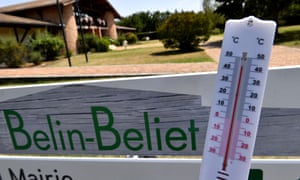
A thermometer outside the town hall of Belin-Béliet, south-western France
Pinterest
 A thermometer shows the temperature outside the town hall of Belin-Béliet in south-western France. Photograph: Georges Gobet/AFP/Getty Images

The French energy company EDF said it was shutting down two reactors at its Golfech nuclear power plant in the southern Tarn-et-Garonne region in order to limit the heating of water used to keep the reactors cool.

Scientists have said such heatwaves are closely linked to the climate emergency and will be many times more likely over the coming decades.

Last month, the Potsdam Institute for Climate Impact Research said Europe’s five hottest summers since 1500 had all occurred in the 21st century – in 2018, 2010, 2003, 2016 and 2002.

Monthly records were now falling five times as often as they would in a stable climate, the institute said, adding that this was “a consequence of global warming caused by the increasing greenhouse gases from burning coal, oil and gas”.

How to keep your pets safe in this weekend’s extreme heat

5 hr 18 min ago

https://www.cnn.com/us/live-news/heat-wave-july-2019/index.html

About 185 million people across the US are under a heat watch, warning or advisory as of Friday morning –– and forecasts say it’s only going to get hotter.

This means it’s important to make sure your furry, four-legged friend doesn’t overheat.

Here are some tips from the ASPCA on how to keep your pets cool:

  • Make sure they get plenty of fresh, clean water all day. They can get dehydrated quickly when it’s hot or humid out.
  • Be sure your pet has a shady place to go or keep them indoors.
  • Animals with flat faces, like Pugs and Persian cats, are more susceptible to heat stroke since they cannot pant as effectively. Keep them, along with pets that are elderly, overweight or have a heart or lung disease, in air-conditioned rooms as much as possible.
  • Never leave your pet alone in a parked car.
  • You can trim longer hairs, but never shave your dog. The layers of dogs’ coats protect them from overheating and sunburn, according to the ASPCA.
  • If you put sunscreen on your pet, make sure it specifically says it’s for animals.
  • Don’t let your dog be on hot asphalt for long. Their body can heat up quickly because they are so close to the ground. The pads on their paws can also burn if the pavement has been in the sun.

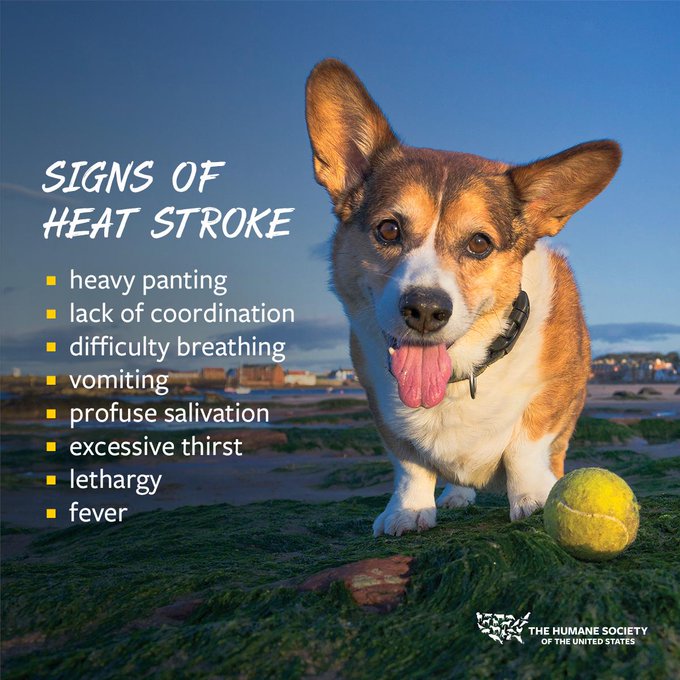
Another important aspect to keeping your pet safe in extreme heat is knowing the signs of heat stroke.

The Humane Society of the United States tweeted some of the signs to watch for:

  • Heavy panting
  • Lack of coordination
  • Difficulty breathing
  • Vomiting
  • Profuse salivation
  • Excessive thirst
  • Lethargy
  • Fever

Read the tweet:

The Humane Society of the United States

@HumaneSociety

Extreme temperatures can cause heatstroke. Pets that are very old, very young, overweight, have short muzzles, or have heart or respiratory disease will have a much harder time breathing in extreme heat. https://hsus.link/yq8zlo 

View image on Twitter
69 people are talking about this

The Climate Crisis Is Also a Health Emergency

For already vulnerable populations, the health risks of extreme weather events can be deadly

An ambulance races through a flood in Mumbai, India (Photo: Shutterstock)

An ambulance races through a flood in Mumbai, India (Photo: Shutterstock)

Rising global temperatures are intensifying the effects of extreme weather events across the United States and around the world. Wildfires, hurricanes, tornadoes, tsunamis, floods, and severe storms are becoming the norm, not the exception.

Extreme weather events don’t just hurt people with blunt force—they also spread disease and other serious health impacts. For already vulnerable populations, the health risks can be deadly.

Extreme heat can cause cardiovascular, cerebrovascular, and respiratory effects, and even death.  Urban heat islands amplify impacts on cities, while long hours in the heat put farm workers and other outdoor laborers at severe risk too.

Extreme cold can cause hypothermia, cardiovascular and respiratory illnesses, and (as with heat) death. Prolonged exposure due to homelessness or housing insecurity puts transient populations at extreme risk for cold exposure in particular.

Then there’s hunger, which twice as many people are at risk of suffering by 2050, due to droughts and infectious diseases.

Then there’s hunger, which twice as many people are at risk of suffering by 2050, due to droughts and infectious diseases.

“Climate change is already contributing to the burden of disease and premature mortality,” reports the European Academies Scientific Advisory Council. “Without prompt and effective action, the problems are forecast to worsen considerably.”

Too many communities are still recovering from extreme weather events, only to get hit again—and again, and again. From flooded farmlands in the Midwest to rising sea levels on the coasts, communities across America face the loss of their livelihoods, homes, and lives, with little time to recover before the next disaster strikes.

The challenges are starker still in places already facing limited access to health and medical resources. A lack of health insurance and local doctors, plus poverty and remote locations, makes access to care particularly difficult for the majority of rural Americans, who may have to travel several hours to the nearest provider.

Many of these areas are highly vulnerable to natural disasters. In California alone, according to McClatchy, more than 2.7 million residents live in “very high fire hazard severity zones,” at risk of devastating wildfires like the Woolsey Fire or Camp Fire.

When weather-related disasters strike, accessing health services—particularly emergency services—can become almost impossible. When roads close due to floods or fires, mild health scares can become life-threatening emergencies.

Indeed, thanks to climate change, natural disasters are claiming even more lives. Who gets hit hardest?

Rural communities. Farmers and farm workers. Island communities. Coastal communities. Towns in low-lying areas in flood country and flat-area towns in tornado country, but also towns that haven’t experienced so-called “100 year storms” until now.

Particularly at risk are low-income communities, who already have limited resources to respond. So are people of color, who disproportionately experience not only the impacts of climate change, but also exposure to pollution, methane emissions, and toxins.

LGBTQ people on the margins of society, particularly LGBTQ youth—who face discrimination and violence at high rates—are more likely to experience homelessness, exposing them disproportionately to extreme heat and cold.

In short, the climate crisis is a health crisis. That’s why organizations like Physicians for Social Responsibility are mobilizing with everything we’ve got to tackle this like any other health emergency.

With a coordinated mass response from everyone from health care providers to policy makers to ordinary citizens, we can save our future. Our communities are already paying the price every second we fail to act swiftly and comprehensively.

This threat is literally in our backyards.

This Summer’s Heat Waves Could Be the Strongest Climate Signal Yet

‘In many places, people are preparing for the past or present climate. But this summer is the future.’

Extreme heat killed more than 80 people in Japan in July, just a few weeks after flooding from downpours was blamed for more than 200 deaths there. Martin Bureau/Getty Images

Extreme heat killed more than 80 people in Japan in July, just a few weeks after flooding from downpours was blamed for more than 200 deaths there. Martin Bureau/Getty Images

Sign up to receive our latest reporting on climate change, energy and environmental justice, sent directly to your inbox. Subscribe here.

https://insideclimatenews.org/news/27072018/summer-2018-heat-wave-wildfires-climate-change-evidence-crops-flooding-deaths-records-broken

Earth’s global warming fever spiked to deadly new highs across the Northern Hemisphere this summer, and we’re feeling the results—extreme heat is now blamed for hundreds of deaths, droughts threaten food supplies, wildfires have raced through neighborhoods in the western United States, Greece and as far north as the Arctic Circle.

At sea, record and near-record warm oceans have sent soggy masses of air surging landward, fueling extreme rainfall and flooding in Japan and the eastern U.S. In Europe, the Baltic Sea is so warm that potentially toxic blue-green algae is spreading across its surface.

There shouldn’t be any doubt that some of the deadliest of this summer’s disasters—including flooding in Japan and wildfires in Greece—are fueled by weather extremes linked to global warming, said Corinne Le Quéré, director of the Tyndall Centre for Climate Change Research at the University of East Anglia.

“We know very well that global warming is making heat waves longer, hotter and more frequent,” she said.

“The evidence from having extreme events around the world is really compelling. It’s very indicative that the global warming background is causing or at least contributing to these events,” she said.

Extreme Summer: Some of 2018's Most Extreme Events

The challenges created by global warming are becoming evident even in basic infrastructure, much of which was built on the assumption of a cooler climate. In these latest heat waves, railroad tracks have bent in the rising temperatures, airport runways have cracked, and power plants from France to Finland have had to power down because their cooling sources became too warm.

“We’re seeing that many things are not built to withstand the heat levels we are seeing now,” Le Quéré said.

Penn State climate scientist Michael Mann said this summer’s extreme weather fits into a pattern he identified with other researchers in a studypublished last year. The jet stream‘s north-south meanders have been unusually stationary, leading to persistent heat waves and droughts in some areas and days of rain and flooding in others, he said. “Our work last year shows that this sort of pattern … has become more common because of human-caused climate change, and in particular, amplified Arctic warming.”

Deadly Heat Waves from Canada to Japan

There are many ways to define a heat wave, but the conditions in many areas of the planet this summer have been universally recognized as severe, said Boram Lee, a senior research scientist with the World Meteorological Organization.

“From around end of June, many countries in Europe, Asia and North America have issued severe warnings,” she said. The UK, U.S., Japan and Korea all had long-lasting warnings, and Japan declared the recent heat wave a natural disaster, she added.

In Europe, scientists on Friday released a real-time attribution study of the heat wave that has baked parts of northern Europe since June. They found that global warming caused by greenhouse gas pollution made the ongoing heat wave five times more likely in Denmark, and twice as likely in Ireland.

In El Salvador, many farmers have lost their lost corn crops to drought this summer. Agriculture is suffering in the high heat and drought conditions in several parts of the world. Credit: Oscar Rivera/AFP/Getty Images

In El Salvador, many farmers have lost their lost corn crops to drought this summer. Agriculture is suffering in the high heat and dry conditions in several parts of the world. Credit: Oscar Rivera/AFP/Getty Images

“Near the Arctic, it’s absolutely exceptional and unprecedented. This is a warning,” said French heat wave expert Robert Vautard, who worked on the study for World Weather Attribution. The group previously determined that global warming made last summer’s “Lucifer” heat wave in southern Europe 10 times more likely.

“In many places, people are preparing for the past or present climate. But this summer is the future,” he said.

The geographic scope and persistence of the European heat wave stands out. An area stretching from the British Isles to Eastern Europe and north to the Arctic is bright red on European heat wave and drought maps, covering an area about as big as Texas and California combined.

Crop damage is being reported in parts Norway through Sweden, Denmark and the Baltics. Depending on conditions during the next month, more widespread crop failures could raise global food prices.

With the Jet Stream stuck well to the north, most of Europe has been feeling the heat. Credit: Met Office

In mid-July, temperatures reached all-time record highs above the Arctic Circle, around 90 degrees Fahrenheit, and hovered in the 80s for weeks at a time. In the Norwegian glacier area that Lars Holger Pilø studies, the average temperature has been 9 degrees Fahrenheit above average for the past 30 days.

“I have been working here since 2006, and we have snow records going back 60 years, and there’s nothing like what we’re seeing right now,” said Pilø, part of team of ice archaeologists who are measuring the snow and ice loss and recovering historic artifacts like arrowheads and skis that were buried for millennia.

“I’m watching with a mixture of excitement and dread. I try not to think too much about it and stick to what we do, which is rescuing the artifacts coming out of the warming. I call it dark archaeology,” he said. “I look at the ice and I think, dead man walking.”

Norwegian Meteorological Institute climate scientist Ketil Isaksen said the extreme situation in Scandinavia fits with the pattern of global warming.

“There are so many extremes now from all over the world. We’re seeing a very common pattern. For me this is a strong climate signal. Ice that’s several thousand years old, melting in the matter of just a few weeks,” he said.

Isaksen is finalizing some studies that find heat is penetrating between 30 and 50 meters deep into the ground through cracks in the rocky mountains around Norway’s fjords. Instead of just a thin skin of permafrost melting, those mountains could fall apart in large chunks when autumn rains start, threatening coastal communities with tsunamis.

“Now we have a new extreme this summer. This will probably affect slope stability, and we can expect mass movement events like debris flows and landslides in late summer,” he said.

He said the studies help define new geologic hazard areas with knowledge that some of the melted mountains will see wholesale slope failure when strong rains hit. Based on the information, emergency managers are developing new early warning systems.

The Increasing Influence of Global Warming

About the same time the Norwegian researchers were uncovering ancient tools in the Arctic tundra this summer, heat records were being set in many other parts of the world.

Temperatures in Algeria reached 124 degrees Fahrenheit, setting a record for the African continent. A few weeks earlier, a city in Oman is believed to have broken a global record when it went more than 24 hours with temperatures never falling below 108 degrees. Japan set a national record of 106 amid a heat wave that has been blamed for more than 80 deaths.

Regional western heat events are becoming so pronounced that some climate scientists see the current extremes in the U.S. as a climate inflection point, where the global warming signal stands out above the natural background of climate variability.

Global Warming's Growing Role in Extreme Heat Waves, by U.S. Region

In mid-July, a week of temperatures in the high 80s and up to 96 degrees Fahrenheit in normally cool Quebec killed more than 50 people, and while that heat wave was waning, another was building in Asia, where the Japan Meteorological Agency said that 200 of its 927 stations topped the 35 degree Celsius (95 degrees Fahrenheit) on July 15. Since then, at least 80 people have died and thousands have gone to hospitals with heat-related ailments.

“There are irrefutable scientific evidences that climate change alters both the intensity and frequency of such extreme phenomena as heat waves, and ongoing efforts are dedicated to understand how big the impact of man-made climate change is,” said the WMO’s Boram Lee.

Across social media, climate scientists are responding with a collective “we warned about this,” posting links to 10 years’ worth of studies that have consistently been projecting increases in deadly heat waves. If anything, the warnings may have been understated.

“The rise in heat waves is stronger than many climate models project,” said World Weather Attribution’s Geert Jan van Oldenborgh, who measured a record high temperature outside his office in the Netherlands on July 26, then tweeted that global warming is making the heat there 20 times more likely than in 1900.

Wildfires Out of Control

Hot and dry weather also makes forests more flammable. In Greece, after a month of record and near-record heat, flames ran wild through the community of Mati on July 23, killing at least 80 people. On July 26, a blaze in Northern California jumped the Sacramento River and spawned fire tornadoes, forcing the evacuation of parts of Redding, a city of 92,000. And in Germany, residents of southern Berlin awoke Friday to the sight of smoke on the horizon, an event that will also become more common in that part of the world.

Although climate scientists are reluctant to link any one particular fire to climate change, there is plenty of scientific evidence showing how heat-trapping greenhouse gases contribute to increased fire danger.

“Weather is a product of the climate system. We are drastically altering that system, and all the weather we observe now is the product of that human-altered climate system. One result is an increase in the frequency, size and severity of large fire events,” University of California, Merced researcher Leroy Westerling wrote on Twitter.

Residents watch as fires burn into the city of Rafina, near Athens, on July 23. Credit: Angelos Tzortzinis/AFP/Getty Images

Residents watch as fires burn into the city of Rafina, near Athens, on July 23. The blazes moved quickly through the drought-parched area, killing more than 80 people. Credit: Angelos Tzortzinis/AFP/Getty Images

University of Arizona climate researcher and geographer Kevin Anchukaitis publicized several wildfire studies from the last 10 years that all show how and why global warming is making fires bigger, more destructive and longer-lasting. “Is climate change the only factor influencing wildland fire? No, of course not—but climate change is influencing area burned and fuel aridity,” he wrote.

Tyndall Centre Director Le Quéré said she faulted some media for failing to connect global warming to the current global heat wave. “This signal is very clear,” she said, adding that some of the early stories about the deadly fire in Greece almost seemed to downplay a link to climate change.

On Friday, the WMO released a new statement highlighting the links between global warming and wildfires and reminding readers that “heat is drying out forests and making them more susceptible to burn.”

Extreme Rainfall and Flooding

There is also still reluctance to link individual extreme flood events with global warming, despite plenty of scientific evidence that today’s global atmosphere—1 degree Celsius warmer than 100 years ago—holds much more moisture that can be delivered by regional storm systems.

Those warnings were not enough to help the more than 200 people who died in Japan in late June amid a series of record-setting torrential rain storms. Regional weather patterns certainly played a role, but ocean currents and an atmosphere juiced up by global warming likely boosted moisture for the storm.

Extreme rainfall unleashed landslides and flooding that knocked homes off their foundations in Kumano, Japan. The storms and floods in early July were blamed for more than 200 deaths. Credit: Martin Bureau/AFP/Getty Images

Two years ago, Alfred Wegener Institute climate researcher Hu Yang showed how climate change is strengthening ocean currents that carry moisture from the ocean toward Japan. The research showed the currents have been getting stronger and warmer in tandem with rising atmospheric CO2 levels. Eventually, that heat is released to the atmosphere during storms, as wind or rain or both.

Yang said his continuing research is finding similar evidence that a powerful current near Japan may be “a super hotspot under global warming.” As the current strengthens, it will release its energy as water vapor, fuel for storms that can cause extra heavy rains in Japan and other parts of Asia, he said.

In the U.S., June flooding in the Midwest fits a detected pattern of increasing extreme rainfalls in that region. And in late July, 10 million people in the East, from Pennsylvania to North Carolina, were under various types of flood warnings with soggy air sloshing from the Gulf of Mexico and the Caribbean over the overheated Northeastern Atlantic toward the coast.

What Can We Do About It?

In some cases, the scientific warnings about global warming impacts have resonated. At least parts of Europe are better prepared for heat waves now than they were in 2003, when extreme heat killed up to 70,000 people, said Le Quéré.

More cities know what they need to do to protect vulnerable people in an extreme event, she said, but they lack the money to do things  like building more cooling shelters, or cooling core urban areas with green spaces and ponds.

“Maybe this is an opportunity, in a grim way, to prepare for events that will be longer and hotter,” she said. “It’s not just a case of holding our breath for three weeks and saying ‘it’s soon winter.’ It’s a time to push and protect vulnerable people and infrastructure.”

Comparing global temperature anomalies between the UK's 1976 heat wave and 2018. Credit: Simon Lee

To prepare for the new normal, people must act in the next five to 10 years, said environmental scientist Cara Augustenborg, chairperson of Friends of the Earth Europe.

“We have to consider how every new infrastructure, agricultural or development project from now on will be impacted by climate change. We need to look at planned retreat from coastlines and developing further inland, building infrastructure that is more resilient to the effects of climate change such as sea level rise and temperature extremes.

“We’ve had several years now where airport runways have melted on extremely hot days,” she continued. “That’s something we need to factor in to future construction as it’s a problem that won’t go away.”

Society also needs to think about food security, she said.

“That’s what I really lose sleep over,” she said. “Our available arable land is declining now as our global population is booming. It doesn’t take much in the way of extreme weather to have a major impact on food supplies.”

Listen to a conversation about the extreme heat and climate change with ICN Managing Editor John H. Cushman, Jr., at On Point.