
Earth’s ‘megafauna’ vanished as tribes spread. Now palaeontologists are asking if early humans were the cause
[What the hell do they mean “Now?” We’ve known about the mass extinction of megafauna known as the American Blitzkrieg for decades…]
Robin McKie, science editor
- The Observer, Saturday 15 March 2014
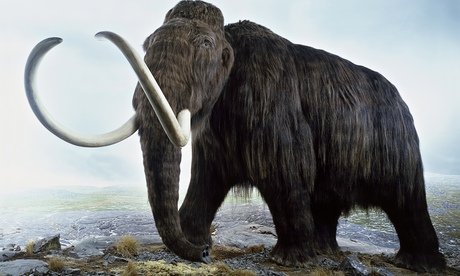
They were some of the strangest animals to walk the Earth: wombats as big as hippos, sloths larger than bears, four-tusked elephants, and an armadillo that would have dwarfed a VW Beetle. They flourished for millions of years, then vanished from our planet just as humans emerged from their African homeland.
It is one of palaeontology’s most intriguing mysteries and will form the core of a conference at Oxford University this week when delegates will debate whether climate change or human hunters killed off the planet’s lost megafauna, as these extinct giants are known.
“Creatures like megatherium, the giant sloth, and the glyptodon, a car-sized species of armadillo, disappeared in North and South America about 10,000 years ago, when there were major changes to climates – which some scientists believe triggered their extinctions,” said Yadvinder Malhi, professor of ecosystem science at Oxford, one of the organisers of the conference, Megafauna and Ecosystem Function.
“However, it is also the case that tribes of modern humans were moving into these creatures’ territories at these times – and many of us believe it is too much of a coincidence that this happened just as these animals vanished. These creatures had endured millions of years of climate change before then, after all. However, this was the first time they had encountered humans.”
Modern humans emerged from Africa around 70,000 years ago, travelled across Asia and reached Australia 50,000 years ago, a time that coincides with a wave of extinctions of creatures there, including the diprotodon, a species of wombat that grew to the size of a modern hippopotamus. By about 14,000 years ago, humans had reached North America by crossing the land bridge that then linked Siberia and Alaska. Then they headed south.
By 10,000 years ago, Homo sapiens had conquered North and South America at a time that coincided with major megafauna extinctions, including those of the giant sloth and the glyptodon.
“We think of Africa and south-east Asia – with their lions, elephants and rhinos – as the main home of large animals today, but until very recently in our planet’s history, huge creatures thrived in Australia, North America and South America as well,” said Professor Adrian Lister of the Natural History Museum in London. “The question is: why did they disappear in the new world but survive in the old world?
“Some believe it is because large animals in Africa and south-east Asia learned to become wary of human beings and decided to avoid them at all costs. However, I also think climate change may have been involved in the Americas and Australia and that humans only finished off these big animals when they were already weakened by loss of habitats and other climate-related problems.”
The idea that humans were involved in any way in eradicating dozens of species of giant animal when we were still hunter-gatherers has important implications in any case. It was thought, until relatively recently, that it was only when humans invented agriculture several thousand years ago that our species’ relationship with the natural world become unbalanced. Until then, humans had a close affinity with nature. But if ancient hunter-gatherers played a part in wiping out these species of huge animals as long as 50,000 years ago, humanity’s supposed innate harmony with the living world appears misplaced.
More to the point, humanity is still paying the price for the disappearance of the megafauna of the Americas and Australia, the Oxford conference will hear. “There is now a lot of evidence to suggest that large herbivores like gomphotheres, a family of elephant-like animals that went extinct in South America around 9,000 years, played a key role in spreading nutrition in areas like the Amazon. They would eat fruit in the forest, including avocados, and their excrement would then fertilise other areas. That no longer happens and places like the Amazon are today affected by low nutrition as a result,” Malhi said.
Another example is provided by the giant wombat, the diprotodon, which some scientists have argued browsed bush across Australia and kept biomass levels very low. When the diprotodon vanished, plants and shrubs across the outback grew unhindered. The result was major bush fires which, archaeologists have discovered, became a serious problem just after the giant wombat disappeared from Australia.
 Diprotodon, the largest known marsupial, which used to roam Australia. Photograph: AlamySimilarly, creatures such as the mammoth played a key role in trampling tundra and maintaining healthy grasslands in high latitudes such as Siberia. When the mammoth became extinct, the tundra took over to the detriment of the landscape.
“It is now becoming clear that lots of our understanding of contemporary ecology is incomplete because it does not take into account that ecosystems were adopted to having giant animals like the mammoth or the diprotodon,” added Malhi. “These are not natural systems today because they are missing key components to which most plants had adopted.”
This awareness has led some scientists to propose moving populations of the planet’s surviving large animals into regions where they could help restore the ecologies to their previous healthy conditions. One such experiment is being carried out by the ecologist Sergey Zimov at a nature reserve called Pleistocene Park in Siberia. Zimov has reintroduced musk ox, moose and other large animals and is attempting to find out if their browsing will restore the landscape to its previous healthy, grassy state. Zimov is also scheduled to speak at the Oxford conference. Other researchers go even further and have proposed bringing extinct megafauna back to life. For example, several scientists have suggested that it could be possible to clone a mammoth from frozen remains found in Siberia using an Asian elephant as a surrogate mother.
Lister was cautious about the prospects of such work, however. “I think people greatly underestimate the incredible difficulties involved. The mammoth corpses we have found are thousands of years old and we have yet to find one that possesses an entire, intact cell with a nucleus. Without that, you are going to find it very difficult to bring an animal like a mammoth back to life.”
In fact, the real lesson from the fate of the Earth’s megafauna is to appreciate how important surviving species are to our planet. Oxford University ecologist Emily Read, a conference organiser, said: “We need to protect the megafauna that we have. More than 20,000 elephants were killed in 2012 for ivory and rhino numbers are declining because their horns are traded, illegally, at more than the price of gold. It’s not just the cultural value of these large animals that we need to think about, but the fact that removing them affects the whole ecosystem.”







 Exposing the Big Game