Exposing the Big Game

Forget Hunters' Feeble Rationalizations and Trust Your Gut Feelings: Making Sport of Killing Is Not Healthy Human Behavior

Exposing the Big Game

Help animals = Help the earth

Factory farming is one of the leading causes of global warming and environmental damage

SHARE

https://www.humanesociety.org/resources/help-animals-help-earth

The HSUS

We live in a pivotal moment. Billions of animals and people around the world are affected by global warming and environmental damage. If we don’t start making small changes now, the consequences will be anything but. Millions of animals already die each year in climate change-fueled hurricanes and wildfires; it’s estimated that 50% of all the world’s species could go extinct by the year 2100. The primary culprits to this widespread destruction are among the most unexpected.

Factory farming is an alarming contributor. Did you know …

… that factory farms are one of the largest sources of powerful methane emissions, which have 86 times the global warming effect of carbon dioxide? Altogether, the food we eat makes up nearly 30% of our total greenhouse gas footprint—more than all of the emissions from cars, buses and airplanes combined!

… that confined farm animals generate 500 million tons of manure annually? On most factory farms, chemical-laced feces and urine are funneled into massive waste lagoons, making them a major source of water pollution and contamination that threatens approximately 119,948 miles of rivers and streams and 450,892 acres of lakes, reservoirs and ponds in the U.S.

… that animal agriculture is a leading cause of deforestation? Nearly 80% of the world’s agricultural land is used to raise livestock or to grow feed for livestock. More than two million hectares of tropical forest are cleared each year for animal agriculture—an area the size of the state of Massachusetts. In the U.S. alone, 10 billion animals are raised for dairy, meat and eggs each year.

It’s up to us to protect our planet. This Earth Day, pledge to make one (or all!) of three small changes to your lifestyle and eating habits that will have a lasting impact on the future of our environment. By committing to help animals, you’ll help our planet too—not just on Earth Day, but every day of the year.

How will you choose to change the world?

Even the smallest changes can make a big difference. 

  • Commit to reducing or replacing meat in your diet, whether by participating in Meatless Mondays eliminating meat from one meal per day. If every American ate a plant-based diet just one day a week, it would be the equivalent to cutting 500,000 cars’ worth of greenhouse gas emissions!

Pledge to Reduce Your Greenhouse Gas Footprint

  • Take action on state and federal legislation that cracks down on factory farming and promotes a more humane food system. Mass confinement has profound effects on animal welfare, human health and the environment; several states now have laws banning extreme confinement of farm animals. (Text EARTH to 30644* to receive text message updates so you know when it’s time to act!)

Pledge to Help Us Crack Down on Factory Farming

  • Be savvy with your support and consider buying directly from more humane producers who reject the factory farm model. Not all farms are created equal! If you consume meat, eggs or dairy, take the time to understand how different farms and suppliers treat their animals and the land. Make sure you know the meaning of different labels on meat, eggs and dairy, such as “free-range,” “grass-fed” and “pasture-raised.”

Pledge to Be a Compassionate Shopper

How will you choose to change the world?

This Earth Day, commit to reducing your meat consumption, advocating for higher standards in factory farming and shopping smart to help animals and in turn, help our planet.

Take the Pledge

*Message and 

The Humane Society of the United States accepts the resignation of Wayne Pacelle as president and CEO

The Humane Society of the United States announced that it has accepted the resignation of Wayne Pacelle, as president and CEO, effective immediately.  Wayne has served in this capacity since 2004, and previously served for 10 years as the organization chief political and communications operative.

The HSUS has named Kitty Block as acting president and CEO. Ms. Block, an attorney, is currently president of Humane Society International, The HSUS’s global affiliate.

“The last few days have been very hard for our entire family of staff and supporters,” said Rick Bernthal, Chairman of the Board of The HSUS.  “We are profoundly grateful for Wayne’s unparalleled level of accomplishments and service to the cause of animal protection and welfare.”

“We are most grateful to Kitty for stepping forward to lead the organization as we continue to advance our mission, which has never been more important,” added Bernthal.

Ms. Block has served at The HSUS since 1992, first as a legal investigator to the investigations department, then to oversee international policy work related to international trade and treaties. In 2007, she was promoted to Vice President of Humane Society International, later to Senior Vice President, and last year became President of this affiliate overseeing all HSI international campaigns and programs. Ms. Block received a law degree from The George Washington University in 1990 and a bachelor’s degree in communications and philosophy from the University of New Hampshire in 1986.

Additionally, The HSUS announced the resignation of Board member Erika Brunson.

http://www.humanesociety.org/news/press_releases/2018/02/humane-society-of-the-united-states-accepts-wayne-pacelle-resignation.html?credit=web_hpfs1_020217?referrer=http://news.url.google.com/url?sa=j&url=http%3A%2F%2Fwww.humanesociety.org%2Fnews%2Fpress_releases%2F2018%2F02%2Fhumane-society-of-the-united-states-accepts-wayne-pacelle-resignation.html%3Fcredit%3Dweb_hpfs1_020217&uct=1508175977&usg=AUWVE-py-gbxUxBNkmibzDEk6-s.

CEO Of The Humane Society Resigns Amid Allegations of Sexual Harassment

 https://www.npr.org/sections/thetwo-way/2018/02/02/582904576/ceo-of-the-humane-society-resigns-amid-allegations-of-sexual-harassment

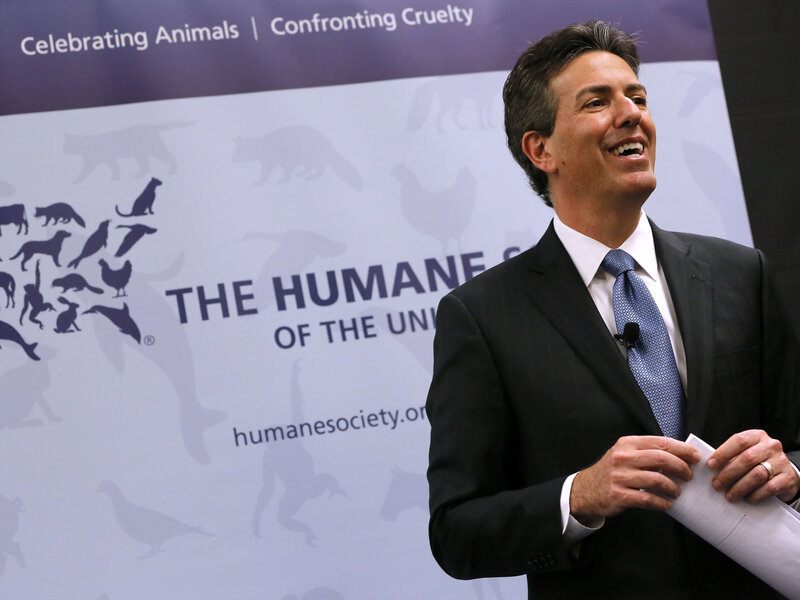
Wayne Pacelle, former CEO of the Humane Society of the United States, at a 2015 news conference. Pacelle resigned Friday.

Jonathan Bachman/AP Images for The Humane Society of the United States

The president and CEO of the Humane Society of the United States, Wayne Pacelle, has resigned effective immediately, the nonprofit group announced Friday.

Pacelle had been at the center of a controversy over allegations that he had sexually harassed three female subordinates at the Humane Society, one of the country’s largest animal charities.

The move came a day after the group’s board of directors had voted to keep Pacelle despite the allegations dating to 2005.

In a statement, Humane Society Board Chair Rick Bernthal said:

“The last few days have been very hard for our entire family of staff and supporters. We are profoundly grateful for Wayne’s unparalleled level of accomplishments and service to the cause of animal protection and welfare.”

Bernthal said that the president of the Humane Society’s international affiliate, Kitty Block, has been named as acting chief executive.

The development came just hours after Bernthal had defended the group’s decision yesterday to allow Pacelle to remain as CEO. In a statement, Bernthal said that after an investigation:

“The board reviewed the information assembled and determined that there was not sufficient evidence to remove Wayne Pacelle from his position as CEO.

“Many of the allegations were explosive in nature, and reading or hearing about them is a shock to anyone. It was to us, too. But when we sifted through the evidence presented, we did not find that many of these allegations were supported by credible evidence.”

Bernthal also denied that his group had offered settlements to three other workers who said they were dismissed or demoted after raising concerns about Pacelle’s alleged sexual misconduct. “The Board concluded that there was no motivation behind severance agreements to silence women who had spoken up or raised concerns,” he said.

After the board voted to retain Pacelle, the CEO acknowledged that the controversy was taking a toll.

Pacelle had told the New York Times earlier on Friday that he was assessing his future professional life:

“‘I’m going to take stock of everyone’s opinion and assess where I go and where the organization goes from here,’ he said. ‘I think leadership changes at organizations are often very healthy and renewing, and I’m going to talk with staff and board members and find the best course that [contributes] to our mission of fighting for all animals.’ ”

Yet pressure was building for Pacelle’s dismissal from both inside and out the organization, with major donors announcing that they were withdrawing their support from the group.

In a statement earlier Friday, the president of the National Organization for Women, Toni Van Pelt, had called for Pacelle’s firing:

“Like Donald Trump, the Humane Society is engaged in a cover up in plain sight. Instead of trying to enable a sexual abuser, they should dismiss him. Instead of making excuses, they should be making reparations. Instead of silencing or attacking women who’ve suffered abuse, and those who defend them, the Humane Society should change its own culture.

“The Humane Society needs to know this. Women are watching. We know when a charity deserves our support, and when it fails the most basic obligations of trust.

“The Humane Society has no humanity. Fire Wayne Pacelle. Do it now.”

The initial decision to retain Pacelle also had led to the resignation of seven protesting board members.

Humane Society CEO is subject of sexual harassment complaints from three women, according to internal investigation

 https://www.washingtonpost.com/business/economy/humane-society-ceo-is-subject-of-sexual-harassment-complaints-from-three-women-according-to-internal-investigation/2018/01/29/12c8961e-053b-11e8-94e8-e8b8600ade23_story.html?hpid=hp_hp-top-table-main_humane-10pm%3Ahomepage%2Fstory&utm_term=.e97e383d8bb7

Humane Society chief executive Wayne Pacelle and his dog Lily at work in Washington in August 2016. (Linda Davidson/The Washington Post)
An internal investigation by a law firm hired by the Humane Society of the United States has identified three complaints of sexual harassment by chief executive Wayne Pacelle and found that senior female leaders said their warnings about his conduct went unheeded, according to two people familiar with the matter and a Humane Society memo describing the investigation.

The investigation also found the nonprofit agency, one of the country’s biggest animal charities, had offered settlements to three other workers who said they were demoted or dismissed after reporting Pacelle’s alleged behavior, according to the Humane Society memo.

Investigators from the law firm Morgan Lewis, who interviewed 33 people, including Pacelle, also reported that there was a perception within the Humane Society that certain women owed their career success to romantic relationships with the chief executive.

Pacelle denied the complaints from all three women in an interview Monday with The Washington Post. “This is a coordinated attempt to attack me and the organization,” he said. “And I absolutely deny any suggestion that I did anything untoward.”

He denied allegations he had consensual sex with donors and volunteers as “just ad hominem attacks.” And he said no senior women had warned him about his conduct. “Absolutely not. I enjoy the support of senior women throughout the organization. No one has ever warned me of such a thing, ever.”

A spokesperson for the Humane Society declined to comment on the findings of the investigation, referring The Post to a statement made Thursday by Eric Bernthal, chairman of the organization’s board of directors. His remarks came shortly after the charity announced it was launching an investigation.

“We do not have information that can be shared regarding the investigation, its findings, or board actions at this time,” the statement said. “We believe it is important to deal in substance and not rumors, and our process is designed to ensure confidentiality and fair consideration of these issues.”

The decision to launch an investigation was first reported by the Chronicle of Philanthropy.

Pacelle said that he was aware of the investigation but added: “There are allegations only. Beware of rumors and other unsubstantiated claims.”

The earliest complaint against Pacelle dates to 2005, when an intern said the chief executive asked to meet outside of work at a public coffee shop, according to the memo reviewed by The Post.

According to her account, Pacelle pulled her close, started slow dancing with her and gave her an unwanted kiss, the investigation document said.

Another woman told investigators she regularly traveled with Pacelle on business and that donors mentioned his sexual interest in her, remarking that dating him would be good for her career.

On one such work trip in 2006, she told investigators Pacelle asked her to stop by his hotel room after an event. He asked if he could masturbate in front of her, requested that she take off her clothes and offered to perform oral sex on her, according to two people briefed on the matter and the memo. When the woman refused, Pacelle told her not to tell anyone or she would destroy the Humane Society and lose her job, according to the memo.

A third woman, who joined the Humane Society in 2012 but has since left the organization, told investigators that Pacelle stopped by her office late one night when she was working alone, started salsa dancing on his own and asked her to join him.

Pacelle denied all three complaints. “The one complaint about the salsa dancing, I simply had a conversation with a person and it turned into that,” he told The Post. “The person with the hotel — I’m familiar with that. I worked with the person eight years after that allegation. The person never said a thing to me about any harassment, and I certainly never invited her to a hotel room.”

Pacelle also denied the complaints to investigators, according to the memo.

The investigation began on Dec. 20 after the Humane Society received an anonymous complaint about Pacelle’s behavior. The organization then hired Morgan Lewis, a Washington law firm, to look into the matter.

The investigation also found that Pacelle had maintained a sexual relationship with a female subordinate and exchanged more than 100 emails with her. The woman told the investigation that she became afraid of Pacelle after the relationship ended, describing him as abusive and controlling, according to the memo.

Pacelle denied having a relationship with the subordinate. He also disputed there was anything inappropriate in the relationship to investigators, according to the memo.

The investigation’s findings are based on interviews, evidence provided by witnesses and emails on Pacelle’s work computer, according to the memo.

Since taking the helm at the Humane Society, which has its headquarters in the District, Pacelle’s salary rose to nearly $380,000 in 2016, according to IRS filings.

Some employees defended Pacelle to investigators, describing him as someone who engaged in consensual relationships with adults. Others said the chief executive created a toxic environment at the Humane Society in which workers thought they had to sleep with Pacelle to get ahead, or suspected women who achieved career success of dating him in secret, according to the memo.

The people briefed on the investigation told The Post they wanted to come forward to repair the culture at the Humane Society, which they believe does important work to help animals.

The organization is focused on ending animal cruelty, abolishing “puppy mills” and banning seal slaughter, among other causes.

The people briefed on the investigation said they worried that money going to address Pacelle’s actions was misdirected from protecting wildlife.

One woman said she received a settlement from the Humane Society after she complained about Pacelle’s alleged girlfriend joining her team without proper qualifications and was shut out of work opportunities, according to the memo.

Two more received payouts after they leveled retaliation charges against the organization, asserting they lost their jobs after speaking up about Pacelle’s office romance and sexual behavior in the office, according to the memo.

Pacelle said he would not comment on any settlements.

The amounts of the settlements were not disclosed.

Fighting to stop trophy hunting of lions in the West

https://blog.humanesociety.org/wayne/2017/11/fighting-stop-trophy-hunting-lions-west.html

by Wayne Pacelle

Trophy hunting organizations and state fish and wildlife agencies are in cahoots in the Southwest in executing ruthless mountain lion killing programs, typically involving radio telemetry equipment, packs of hounds, and rifles and bows they use to shoot lions they’ve driven into trees to kill at point-blank range. The trophy hunters are motivated by bragging rights and taxidermy (they are head hunters, and don’t eat the lions). And the states, in addition to catering to that small subset of hunters and enabling their unsporting methods of killing, view the lions as competitors with human hunters for deer and elk. In their economic calculus, every deer or elk lost to a lion is one less hunting license fee paid to the states, to paraphrase an observation from the esteemed outdoor writer Ted Williams.

But The HSUS and other wildlife protection groups are fighting back, and taking a stand for lions—in Arizona, Colorado, and New Mexico. Last week, after legal maneuvers by WildEarth Guardians, the Center for Biological Diversity, and Western Environmental Law Center, state and federal authorities temporarily halted a massive mountain lion “control” program in Colorado ostensibly designed to inflate mule deer populations, pending further environmental review.

Colorado Parks and Wildlife had entered into an agreement with U.S. Department of Agriculture’s Wildlife Services to kill hundreds of mountain lions and dozens of black bears on two study sites to determine if these massive predator-control projects could revive the Centennial State’s flagging mule deer population.

These sorts of programs are a fool’s errand. Across the Western U.S., mule deer struggle because of habitat destruction and corridor loss. In Colorado, this has been exacerbated by rampant oil and gas drilling in western Colorado with its spider web of roads and drill pads that have degraded tremendous amounts of former mule deer habitat and migration routes.

And in New Mexico, a federal judge recently rejected the State’s second attempt to dismiss a lawsuit filed by The HSUS and Animal Protection of New Mexico challenging the state’s Department of Game and Fish’s 2016 decision to open a cougar trapping season on public lands—for the first time in almost 50 years. Even though hounding is bad enough, it’s all the more outrageous to allow trapping and snaring programs for lions, since the lions suffer in the traps and the traps catch whatever creature is unlucky enough to trigger the device.

The Commission’s 2016 Cougar Rule radically expands cougar trapping on more than nine million acres of public trust land, including key Mexican wolf habitat, as well as expanding opportunities for trapping on private land. The risk of a cougar trap injuring or killing a Mexican wolf is high due to the similarity in size and habitat preference between the species.

Meanwhile, in Arizona, we are in full battle mode, as we conduct the signature-gathering campaign to qualify a ballot measure to halt any trophy hunting of lions in the state. The measure would also forbid trophy hunting of bobcats, jaguars, ocelots, and lynx, in a state with the richest diversity of wild cat species in the United States.

Despite Western states’ claim of using science, their arguments amount to no more than fake news and faux science. When trophy hunters kill an adult male lion, his females and kittens are susceptible to mortality from incoming males, as many other studies from Utah, Montana, and Washington have shown. Killing one male lion results in the death of numerous other lions, particularly dependent kittens, who are cannibalized by incoming males. And if a trophy hunter kills an adult female, any kittens under 12 months of age will likely die from starvation, predation, or exposure.

Two summers ago, Americans reacted with outrage in seeing an American trophy hunter grinning over an African lion he killed in Zimbabwe. He conducted that hunt for no other reasons than bragging rights and the trophy. The people who kill mountain lions here in the Southwest are motivated by the same purposes.

Lions strengthen population of deer and elk. They are needed apex predators in intact ecosystems. The states have no idea how many lions they have, and their programs are a relic of antiquated attitudes towards predators.

It’s one thing to kill animals for meat. It’s another to do it just for the heads. To paraphrase Oscar Wilde, it’s the unspeakable in full pursuit of the uneatable.

P.S. Using cutting-edge, remote-camera technologies, Panthera discovered that mountain lions are far more social than biologists ever realized—despite 60 years’ research. Females share their kills with other females and their kittens and even with the adult territorial male. In return, the adult males protect the females and all of his kittens from immigrating males. If left undisturbed, mountain lions have a stable social society where reciprocity between individuals is shared. A revolutionary finding.

Ballot measure launched to ban trophy hunting of America’s lions

https://blog.humanesociety.org/wayne/2017/10/ballot-measure-launched-ban-trophy-hunting-americas-lions.html

October 12, 2017

Two summers ago, a color photograph of Minnesota dentist Walter Palmer and his hunting guide kneeling over Cecil, an African lion they’d slain, found its way onto social media platforms and ricocheted across the planet. In response, 45 of the world’s biggest airlines – including all major U.S. carriers – said they’d no longer ship lion trophies in the cargo holds of their planes.

These companies knew that the public found the practice of trophy hunting of African lions and leopards and other rare wildlife repugnant.

With the launch of an Arizona ballot measure yesterday to stop the trophy hunting of mountain lions and bobcats, voters in the Grand Canyon State will have an opportunity to stop the same sort of pointless, cruel killing practices on a big patch of land on this side of the globe.

Specifically, The HSUS and a coalition of about 60 organizations have filed a ballot initiative to stop the trophy hunting of mountain lions and bobcats in Arizona. The measure would also ban trapping of bobcats, currently killed by the thousands every year in this state for their fur. In addition, the ballot measure would codify a no-trophy-hunting policy on jaguars, ocelots, and lynx, in case these rare cats establish healthy populations in Arizona and trophy hunters see them as future targets.

The question that millions of people asked in the wake of the killing of Cecil is the same one that people should ask in Arizona: Why would a person of wealth and privilege shoot a lion he isn’t even going to eat? An animal whose hunting behavior keeps prey populations in check and whose presence is a reminder that there are still wild places in our world where all kinds of beautiful animals, including native carnivores, should be allowed to flourish.

This will be the sixth ballot measure in the west to stop the unsporting trophy hunting of mountain lions, and voters have sided with establishing or maintaining protections for lions in every single one of them. It is also the seventh statewide ballot measure on animal protection issues in Arizona since 1994, and voters have sided with the animal protection position in six of six cases.

There are perhaps few things as senseless as the trophy hunting of mountain lions; no one eats these animals, and that makes killing them easy to classify as trophy hunting in its purest form.

What makes it even worse is that the primary method of hunting the lions is with packs of dogs and radio telemetry equipment, in what amounts to a high-tech search-and-destroy mission. A trophy hunter releases a pack of hounds, fitted with radio transmitters on their collars, and then tracks the chase with a handheld directional antenna. Once the dogs pick up a scent and careen after the lion, the quarry flees, but sometimes turns to fight – resulting in a situation that pits animals in violent combat. If the cat doesn’t kill the dogs, or the dogs don’t overtake and kill the cat (including young kittens), the cat will scamper up a tree.

The hunter will then follow the radio signal to the base of the tree or cliff face, and shoot the lion at close range.

It’s about as sporting as shooting an animal in a cage at the zoo.

Trophy hunting clubs like Arizona-based Safari Club International have, in recent years, promoted the killing of mountain lions by offering awards, certificates, and killing contests to reward and encourage trophy hunters. SCI’s award categories like “North American 29,” “Cats of the World,” and “Trophy Animals of North America” include mountain lions.

Mountain lions pose an immeasurably small risk to humans and do their best to avoid us. Lions have attacked just a handful of people in the United States in the last 30 years, even as we’ve invaded their traditional habitats with developments, agriculture, and recreational activities.

On the other hand, trophy hunters have killed more than 78,000 mountain lions during that same period – an average of 2,500 a year in 10 western states, according to a report we released earlier this year in cooperation with the Summerlee Foundation: State of the Mountain Lion: A Call to End Trophy Hunting of America’s Lion.

These native carnivores provide all sorts of benefits to their ecosystems. Mountain lions keep deer and elk herds healthier, taking weak, sick, and diseased animals. They leave carrion for black bears, grizzly bears, and other scavengers. They are highly sentient and familial. A mother will care for her kittens for up to 24 months, and if she is killed, the kittens could die from starvation, predation, or exposure.

In cases where lions cause an actual problem or pose a perceived or actual threat, the ballot measure allows selective killing of those individuals. The measure, on the other hand, is designed to stop trophy hunters from chasing down and killing unoffending lions – lions who aren’t bothering anyone, and like any creature, are just trying to live and get through another day.

This ballot measure is about our humanity. It’s about ending unsporting methods, killing for no good reason, or killing as a head-hunting exercise. It’s about letting animals have small slices of land where they don’t have to worry about the threat of premeditated human violence.

Join us in this fight to protect America’s own iconic lion and other wild cats of the west. Their future depends on our decision to act on their behalf.

The HSUS goes to federal court on behalf of Yellowstone’s grizzly bears

Sixty days ago, The HSUS told Interior Secretary Ryan Zinke that we’d see him in courtif his agency did not reconsider a wrong-headed decision to strip federal protections from grizzly bears in the Greater Yellowstone Ecosystem. We made good on that promise today.

Joined by our affiliate The Fund for Animals, The HSUS filed a complaint in the federal court for the District of Montana in Missoula. The complaint alleges multiple violations of the Endangered Species Act and the Administrative Procedure Act – the latter a statute that provides a critical backstop to ensure that federal agency decisions are well-reasoned and that they properly evaluate scientific data.

Litigating this case in Missoula has special significance because it lies within the corridor connecting the two largest remaining grizzly bear populations in the lower 48 states: the Greater Yellowstone Ecosystem (GYE) and the Northern Continental Divide Ecosystem (NCDE). Before they were nearly wiped out in the early 20th century, grizzly bears numbered in the tens of thousands and roamed across much of the North American continent. ESA protections beginning in 1975 rescued grizzlies from the precipice of extinction. But the fact is that much work remains. The GYE population still numbers fewer than 700 grizzlies, fragmented populations are disconnected, and staple foods like whitebark pine nuts and cutthroat trout remain in sharp decline. Each of the last two years saw record numbers of bears poached, run over on highways, and killed by state agents in so-called “management actions” as the bears have been forced to range further and further outside Yellowstone and Grand Teton national parks in search of food.

There is clear scientific evidence to necessitate maintaining protections and continued federal monitoring for the grizzly bear population. But instead, the U.S. Fish and Wildlife Service has ignored expert data and conducted a tortured statutory analysis to turn over management of bears to states eager to align with the narrow interests of trophy hunters, ranchers, and other consumptive users of our nation’s shared natural resources. Wyoming, Idaho, and Montana have already begun the process of planning trophy-hunting seasons on bears, just as they have done after federal protections for the gray wolf were removed. Now, with federal protections eliminated for the Great Bear and hunting seasons looming, serious-minded scientists honestly wonder whether Yellowstone’s bears will ever again connect with populations in northern Montana and Idaho and establish a viable population of grizzly bears in the United States.

While the decision to strip protections for Yellowstone grizzly bears is rickety as a matter of law and science, it’s also wrong on economics and the values of America’s great majority of citizens. As I’ve argued in this context and others, grizzlies are more valuable alive than dead. They are responsible for bringing in tens of millions of dollars into local economies in and around the Yellowstone and Grand Teton national parks. The GYE states, acting through unelected and unaccountable game commissions, are shooting themselves in the foot by ignoring the guides, photographers, hoteliers, and small business people whose livelihoods depend on live grizzlies. Recently, the newly elected government in British Columbia, relying largely on a concern for animal welfare and for the economic health of rural communities, pledged to bar the trophy hunting of grizzly bears in the province by the end of November.

Delisting and trophy hunting this iconic species is more than just an attack on principles of conservation, science-based decision-making, indigenous rights, government accountability, and animal welfare. It’s an assault on one of America’s most iconic species, situated in America’s most storied ecological region. The HSUS is proud to stand with an enormous range of stakeholders to defend the grizzly bear.

https://blog.humanesociety.org/wayne/2017/08/hsus-goes-federal-court-behalf-yellowstones-grizzly-bears.html?credit=blog_post_082417_idhome-page

Daily Harvey Update: Watch this happy reunion

HSUS logo
Jim, the Animal Rescue Team is going above and beyond to be a light in Harvey’s dark destruction. The devastation is difficult to witness, but we’re trying to deliver as many happy endings as possible. We rescued an English bulldog and poodle and just yesterday, they were reunited with their family. The rescue aired on CNN’s Anderson Cooper 360. Watch the heartwarming moment:

Rescued dogsToday, two additional boat teams and veterinary support are on the ground to assess ill and injured animals and prepare hundreds of animals for transport from Dickinson and League City to our partners at the Houston Humane Society and Emancipet.

Families and pets alike have experienced life-shattering loss at the hands of Harvey. The HSUS community is one of compassion and love, and we stand by these impacted families today.

We will continue to serve these communities and their animals, and pull these pets to safety.

We are here for you, Texas.

Katie Jarl
Texas Senior State Director, The Humane Society of the United States

P.S. As an important member of The HSUS community, please make an emergency gift to our Disaster Relief Fund today to make our preparedness, rescue and relief work during this and future disasters possible. If you’ve recently donated to our Disaster Relief Fund, thank you so much! We’re still processing gifts.

HSUS Harvey Update: Search and rescue operations underway

HSUS logo
Our Animal Rescue Team is on the ground right now helping animals impacted by the massive flooding and destruction caused by Hurricane Harvey.

Upon our arrival in Texas City, we learned that the most urgent needs were in Dickinson and League City, where our help was requested by officials. My team is conducting animal search and rescue missions with Dickinson Animal Control. We are responding in flooded areas where roads remain impassible to rescue pets from their deluged homes.

ART van driving through floodThe flooding is so severe that road closures will have our team marooned in place until some flooding subsides.

But we’ve purchased food and crates to temporarily house animals who are rescued from the field—and we’ll ensure they have a soft and warm place to rest.

We’re also transporting animals who were available for adoption before the storm in San Antonio to other states to make room for displaced pets.

Thank you so much for your support, and please stay tuned for another update tomorrow.

Sara Varsa
Sára Varsa
Senior Director, Animal Cruelty, Rescue and Response

More than 350 animals

Matted dogs

From HSUS.org

We are finding dogs living in inches of their own urine and feces, with coats matted so heavily that they can barely walk, puppies choking on toxic fumes and many animals suffering from a variety of skin and eye conditions.

Animals rescued from neglect

Sadly, it isn’t just dogs and puppies who are suffering.

So far, our Animal Rescue Team has found more than 350 neglected animals — including cats, donkeys, a horse, bunnies, chickens, ducks, geese, goats, sheep and an alpaca.

Jim, the cruelty we’re witnessing is heart-wrenching. We will stay here until every animal is on their way to a better life.

This rescue is only possible with the help of compassionate supporters like you.
Thank you so much,
Sára Varsa
Senior Director, Animal Cruelty, Rescue and Response