Outrageous Anti-Animal Acts Planned for Alaska

From: HSUS.org

Earlier this week, the U.S. Senate chose to turn nightmare into reality for animals living in our nation’s wildlife refuges — federal land in Alaska specifically set aside for them to thrive, not to become targets of inhumane and unsporting killing methods.

By a 52 to 47 party-line vote, Senators voted to repeal a 2016 U.S. Fish and Wildlife Service rule forbidding the most outrageous acts:

Black bears being caught in painful snare traps while foraging for food …

Wolf pups being shot point-blank in their dens …

Grizzly bears being chased by plane or helicopter before being shot down by trophy hunters …

All this cruelty and suffering for trophies.

With this heartbreaking vote, Congress enabled 76 million acres of our national wildlife refuges to become killing fields for trappers, baiters and spring trophy hunters.

The politicians in Washington who voted to allow these cruel practices do not represent the views of regular Americans on animal welfare or wildlife conservation. They sided with the special interests who want to kill wolf pups and hibernating grizzly bears for pleasure.

And this is only one of the recent attacks on animals:

  • Congress is trying to cherry-pick wolves from the federal list of endangered species, exposing them to trophy hunting, commercial trapping and hounding.
  • The Department of the Interior will allow millions of birds and other animals to suffer from lead poisoning by reversing an order restricting the use of toxic lead ammunition on U.S. Fish and Wildlife Service lands.
  • Tennessee walking horses are still at risk of having chemicals burned into their skin until the anti-soring rule is unfrozen under the new administration.
  • And the U.S. Department of Agriculture has purged its website of government inspection reports on thousands of puppy mills, roadside zoos and other facilities.

Super-size problem

http://www.humanesociety.org/news/magazines/2017/03-04/super-size-problem-broiler-chickens.html?referrer=https://outlook.live.com/

Americans’ demand for cheap meat has forced factory-farm broiler chickens to grow faster and larger than ever before

All Animals magazine, March/April 2017

by Karen Lange

  • Click or tap the image to enlarge.

Fresh from the trauma of World War II, mid-century Americans imagined a peaceful, prosperous future. They dreamed of moon rockets and flying cars. They envisioned house-cleaning robots. And, after years of rationing, they hoped for bountiful meals. Most particularly, they hungered for chicken. But not the scrawny, spent laying hens, exhausted from their lives producing eggs, that Americans ate when beef and pork were scarce. Instead, they looked forward to the bird of the future—bigger, better.

The A&P grocery chain invited poultry producers to enter a nationwide contest. Farmers sent eggs from their plumpest birds to a U.S. Department of Agriculture station on Maryland’s eastern shore. Researchers selected and bred birds who were larger and faster- growing to create a new type of chicken, “a broad-breasted bird with bigger drumsticks, plumper thighs and layers of white meat,” according to writer and broadcaster Lowell Thomas, who narrated a documentary sponsored by Texaco. It would be, proclaimed the film’s title, “The Chicken of Tomorrow.”

Over decades, America got all that and more.

As the winning chicks, hatched in 1948, were used to breed the strains now used by large-scale commercial farms, the time needed to raise a “broiler”—a chicken raised for meat—dropped from 12 weeks to six or less, the feed required fell by half and the growth rate multiplied by four. The amount of breast meat on an individual bird rose by nearly 70 percent. By 1978, a pound of chicken, which in 1922 had cost around $5.50 in today’s dollars, cost just $2.46. Per capita, chicken consumption grew four-fold, and a whole new industry emerged, dominated by factory farms controlled by corporations such as Tyson and Pilgrim’s Pride.

  • At 56 days old, when chickens are typically sent to slaughter, today’s broilers are much larger than broilers of the past. Photo by Poultry Science Association.

A recent paper shows the consequences: Scientists at a research farm in Alberta that has continued to breed earlier strains of chickens took pictures of a 1956 type broiler, a 1978 broiler and a 2005 broiler, all 8 weeks old, and placed the photos side by side. The result is unsettling: On the left, a comparatively fit bird (1956), in the center a plump chicken (1978) who appears “normal” (if you don’t know how chickens used to look), and on the right, the “chicken of tomorrow,” a morbidly obese bird (2005) who appears monstrous next to the others. By modern standards, she’s a week or two past the date when she would be slaughtered for meat, and she’s at high risk for heart failure. She’s a juvenile, but the size of her body has outgrown the capacity of her bones and joints, muscles and organs to support it, says John Webster, professor emeritus of animal husbandry at the University of Bristol.

“If [broilers] weren’t killed at 42 days, they wouldn’t survive another two weeks,” he says.

During the last days of their lives, about a third of broiler chickens suffer leg problems so severe they struggle to walk. Factory-farm workers move through buildings to collect dead birds and break the necks of lame ones. Survivors huddle on the floor, trapped by their own bodies. Unable to escape the pain, they lie in litter strewn with their own waste. Ammonia burns their breasts and often blisters their skin and feet.

In 2016, The HSUS launched a campaign to end these kind of conditions. In June, Perdue became the first major producer to commit to reform. Major buyers followed.

The initiative comes after years of research have documented the suffering produced by the birds’ genetics. Before joining HSUS-affiliate Humane Society International, Sara Shields studied whether farmers could encourage broilers to dustbathe and improve their welfare through increased exercise. But she found that because of their size, dustbathing was not enough, and by the time the birds approached the market weight they did not engage in much behavior beyond sitting and eating.

What has taken place is the opposite of Darwinian selection, Webster says. “They’ve destroyed the fitness of the bird in order to produce the most meat.”

With approximately 9 billion broilers raised and slaughtered each year in the U.S. alone (60 billion worldwide), Webster calls the broiler industry the single greatest example of human inhumanity toward another animal. It’s why Shields chose chickens as the subject of her doctoral dissertation.

“If an animal only has six weeks to live, it’s really important that they have a positive experience,” she says, “because that’s all they’ve got—six weeks.”

Chickens raised for meat spend their days in dark barns where they often sit on the floor in their own waste. Photo by Mercy for Animals.

But to improve quality of life, breeders must change broiler genetics so birds grow more slowly and can live longer, Webster, Shields and other experts say. Fortunately, breeders still have small supplies of slower- growing chicks that can be used to reform the industry. In the United Kingdom, grocery stores competing for customers are already selling birds that take 10 weeks to reach market weight. In the United States, at the urging of The HSUS and other animal welfare groups, producers and buyers are beginning to shift toward this. There is also hope that researchers can eventually breed a faster-growing bird that is healthy and walks without pain.

The HSUS has worked with Perdue, one of the country’s largest producers, to develop a reform plan that includes changing the type of broilers farmers raise and offering birds more room. Late in 2016, the five largest food service companies in the country, which together buy more than 115 million chickens a year—Compass Group, Sodexo, Aramark, Delaware North and Centerplate—announced with The HSUS that by 2024 they will adopt a new Global Animal Partnership standard for healthier breeds of chickens, better living conditions and increased space per bird.

Starbucks and Panera Bread have announced a similar policy. Aside from ensuring better lives for the chickens, the companies are also mandating a slaughter method that avoids excessively inhumane practices and instead uses a multistep controlled-atmosphere processing system that renders chickens unconscious so they suffer less.

Josh Balk, HSUS vice president of farm animal protection, says the organization is meeting with other major companies. “It will take years to make these changes happen,” he says. “We have to start now.”

Modern broilers are raised in starkly different ways: Factory farms stock the fastest- growing birds, while some smaller farms let slower-growing birds roam outside. As The HSUS transforms the industry, bigger farms will switch to healthier birds able to lead better lives, even if they are still indoors.

  • Due to their unnatural size, many chickens suffer painful injuries and are unable to walk. Photo by Compassion Over Killing.

Suffering silently

Walk into one of the windowless, dimly lit factory farms where most U.S. broilers are raised, and you’re likely to see tens of thousands of obese birds, barely stirring, sitting on the floor in their own waste. They have been selected for massive appetites, bred to eat and sit. Many of the birds have painful leg and joint problems that make walking difficult. They’re confined so close together that they jostle one another. This, plus the absence of a natural light-dark cycle, prevents sleep, which is critical for young, growing animals. It’s a scene of quiet misery. There’s a stench of ammonia. The birds’ bodies are on the brink of giving out. So extreme is the stress that in order for breeder broilers to survive long enough to lay eggs (about 20 weeks), producers must restrict their feed intake, sometimes feeding them only every other day. Broilers raised to be eaten usually die at 6 weeks, says Shields. “They still peep like baby chicks when they’re slaughtered.”

Ranging freely

The chickens at White Oaks Pastures, owned by HSUS state agriculture advisory council member Will Harris in Bluffton, Georgia, are very different because of their genetics, behavior and environment. Place a factory farm broiler outside to forage for food and move with a flock, and that chicken probably would not survive, Harris says. Using chicks who genetically resemble birds from the 1950s, Harris puts his birds out on pasture to do what chickens evolved to: search out insects and other edible morsels by scratching the soil, all the while fertilizing dirt with their manure. They walk miles each day before they roost in mobile houses that are towed to different spots. At 12 weeks, they reach 3 to 4 pounds and are slaughtered on the farm. The price consumers pay, via the White Oak Pastures website, is around $4 per pound—more than three times what conventional chicken meat costs. It’s a struggle to find people to spend that, says Harris, who has turned a profit with pasture-raised cows and pigs but not so far with chickens: “Consumers will either support humane production, and it will thrive, or they will not, and it will perish.”

On Will Harris’ farm in Georgia, broiler chickens grow at a healthier rate and have room to roam. Photo by Julie Busch Branaman/For The HSUS.

A more humane future

The HSUS is encouraging producers to breed healthier broilers who live free from pain and engage in typical chicken behaviors— in other words, to be like chickens were until the push for maximum efficiency altered their genetic makeup. Given a modest increase in space (at least 1 square foot per six pounds of animal) along with more natural light, better litter quality and hay bales, their lives will be substantially altered. They will walk around, dust bathe, peck and perch. For the birds, a lifetime of misery will be turned into an existence that allows for a little bit of pleasure. Webster, the professor in the U.K., has seen it happen. Chickens there live in conditions that allow them to demonstrate their intelligence and engaging personalities. When a human visitor arrives, they rush forward to great him. “The big movement is to get a better bird,” he says. “Once you’ve got a better bird, you can give it a better life.”

TELL THE USDA TO STOP PROTECTING ANIMAL ABUSERS

Animal welfare advocates rely on the transparency of the United States Department of Agriculture (USDA) to publicly post regular inspection reports on thousands of commercial dog breeding operators, Tennessee Walking horse show participants, roadside zoos, aquariums, circuses, research labs, and other facilities regulated under the federal Animal Welfare Act (AWA) and Horse Protection Act (HPA).

On February 3, the USDA purged its website of all these reports with no warning or explanation. This outrageous action undermines longstanding consensus about public access to information concerning these laws and frustrates public interest, state, local, and industry efforts to help enforce them.

Animals held in research facilities and puppy mills are shielded from public view, therefore these records are essential to ensure that these dogs, monkeys, rabbits, and other animals are receiving basic care.

The USDA is changing the equation for the worse for animals and the public with this abrupt and destructive move. Your voice is needed to ensure that these records are restored.

TAKE ACTION
Please send a message to the USDA and let them know, in no uncertain terms, that they should not be permitted to withhold this vital information and should instead continue to keep those who are responsible for complying with federal law accountable for their actions.

Share to Facebook  Twitter

Your Message

*Subject:

Dear United States Department of Agriculture,

I was shocked and concerned to learn that all inspection reports on thousands of commercial dog breeding operators, Tennessee Walking horse show participants, roadside zoos, aquariums, circuses, research labs, and other facilities regulated under the federal Animal Welfare Act (AWA) and Horse Protection Act (HPA) were scrubbed from your website on February 3.

These reports are crucial to those of us who wish to protect animals from exploitation and abuse. Furthermore, they are the product of taxpayer dollars and there is no justifiable reason for these regularly requested public records to not be posted online.

*Please personalize your message

Sincerely,
[Your Name]
[Your Address]
[City, State ZIP]

Your Information

*Required fields
*Title:

Mr.
Ms.
Mrs.
Miss
Dr.

*First Name:

*Last Name:

*Your Email:

*Address 1:

 Address 2:

*City:

*State / Province:

Choose a State
AK
AL
AR
AZ
CA
CO
CT
DC
DE
FL
GA
HI
IA
ID
IL
IN
KS
KY
LA
MA
MD
ME
MI
MN
MO
MS
MT
NC
ND
NE
NH
NJ
NM
NV
NY
OH
OK
OR
PA
RI
SC
SD
TN
TX
UT
VA
VT
WA
WI
WV
WY
AS
FM
GU
MH
MP
PR
PW
VI
AB
BC
MB
NB
NL
NS
NT
NU
ON
PE
QC
SK
YT
None
*ZIP / Postal Code:

 Phone Number:

This action alert is for U.S. residents only. International advocates, please visit Humane Society International for ways you can take action for animals.

After you take action, you’ll receive updates by email on how you can help animals. You can easily opt-out at any time.

A Guy Who Exists Purely to Troll the Humane Society Was Just Hired by Donald Trump

http://www.motherjones.com/environment/2016/12/trump-usda-klippenstein-heitkamp

USDA transition leader Brian Klippenstein heads a group that literally defends puppy mills.

Update (12/13/2016): The buzz around Heidi Heitkamp as USDA chief continues to dissipate—Politico reports that “Donald Trump’s closest rural advisers are trying to torpedo” the push to choose her; and speculation that she would turn down the offer anyway is mounting. Meanwhile, Breitbart News, a far-right online journal whose former executive chair is a top Trump adviser, is pushing Rep. Timothy A. Huelskamp (R-Kansas), who lost his primary race this year and will soon be available for a new job. Huelskamp, a tea party stalwart, would represent quite a departure from Heitkamp.

Like a calf lurching about a rodeo field to evade a rope, President-elect Donald Trump’s transition has taken a chaotic course. And nowhere is that truer than at the US Department of Agriculture, the sprawling agency that oversees everything from food aid programs to farm policy to food safety at meat inspection plants.

I asked Paul Shapiro, vice president for farm animal protection at HSUS, whether his group opposes the keeping of pets. “That would certainly be news to the vast numbers of our staff who bring their dogs to work here,” he replied.

On Saturday, Politico reiterated a rumor that’s been circulating for weeks that Sen. Heidi Heitkamp (D-N.D.) is Trump’s likely pick to take the USDA helm. Wait, a Democrat? She was a big supporter of the 2014 reauthorization of the farm bill, the twice-a-decade legislation that shapes US food and ag policy. Like all farm bills since the 1980s, this one was generally Big Ag friendly, but Heitkamp supported some measures that contradict meat industry interests, which seem to hold plenty of sway at Trump Tower. She took credit for “beat[ing] back efforts to repeal Country of Origin Labeling,” which tells consumers where their meat is raised and is hated by big meatpacking companies. She also helped fend off an effort to kill the farm bill’s Grain Inspection, Packers and Stockyards (GIPSA) Act rules, which charge the USDA with curbing the market power big meat-packers can deploy against farmers. Nor has Heitkamp particularly been a magnet for ag industry cash, though she has only run one campaign for federal office. But she’s a conventional Democratic farm state senator, not an ag radical.

Choosing a centrist Democrat like Heitkamp would be quite a departure from earlier versions of Trump’s USDA short list, which included wild cards like Texas Agriculture Commissioner Sid Miller, who unapologetically shares fake news stories on his office’s Facebook page and once tried to bill taxpayers for a trip to take a medical procedure called a Jesus shot. Charles Herbster has also appeared as a prime candidate for USDA chief—he’s a man who currently runs a a multilevel marketing operation (a highly controversial business model that relies on a network of individual “distributors” to sell products) and who finances and helps lead a Big Ag federal super-PAC also funded by Monsanto, DuPont, Archer Daniels Midland, and other agribusiness giants.

Indeed, a day before the Politico piece hailing Heitkamp as the likely pick, Trump veered in a quite different direction, announcing a new member of the team overseeing the transition of the USDA: Brian Klippenstein, executive director of a group called Protect the Harvest. The brainchild of Forrest Lucas—a right-wing oil magnate and cattle rancher who has himself emerged as a contender to serve as Trump’s secretary of the interior—Protect the Harvest seems to exist mainly to troll the Humane Society of the United States.

On its website, Protect the Harvest warns that HSUS seeks to “put an end to animal ownership.” This is nonsense—the Humane Society is by no means coming for your furry friend. Its website features “tools you need to help the pets in your home and beyond.” I asked Paul Shapiro, vice president of policy at HSUS, whether his group opposes the keeping of pets. “That would certainly be news to the vast numbers of our staff who bring their dogs to work here,” he replied.

Protect the Harvest’s real beef with HSUS appears to be that the group promotes legislation that curtails some of the harsher aspects of factory-scale animal farming. The two groups recently clashed over a Massachusetts ballot measure this fall to ban tight cages in egg and pork production. Lucas personally donated nearly $200,0000 to defeat the measure, and Klippenstein actively campaigned against it. The measure passed with overwhelming support on November 8.

Protect the Harvest’s zeal to fight regulation of animal farming extends even to “puppy mills“—large facilities that churn out dogs like factory farms churn out pigs. Back in 2010, the year before Protect the Harvest was founded, Lucas vigorously opposed a Missouri ballot measure to “require large-scale dog breeding operations to provide each dog under their care with sufficient food, clean water, housing and space; necessary veterinary care; regular exercise and adequate rest between breeding cycles,” and to “prohibit any breeder from having more than 50 breeding dogs for the purpose of selling their puppies as pets.” In 2014, Protect the Harvest opposed an Illinois bill banning the retail sale of puppy-mill dogs.

Klippenstein isn’t the only member of Trump’s USDA transition team. Recall that back in November, Trump picked a lobbyist whose clients include Little Ceasar’s Pizza, the soda and snack industries, and the Illinois Soybean Association to lead the agency’s transition. He soon abruptly quit after Trump announced a ban on registered lobbyists serving in the transition.

But then, a few days later, Trump tapped Joel Leftwich, Republican staff director for the Senate Agriculture Committee, to help lead the USDA transition. Leftwich took the Senate job in 2015—after having spent the previous three years as the director of government affairs for Pepsi. In 2010—just before another stint on the Senate ag committee staff—Leftwich had worked as a lobbyist for seed and chemical giant DuPont. In other words, Team Trump pushed out a current lobbyist for Big Soda and Big Ag—only to replace him with a guy who basically lives in the revolving door between government and agribusiness, and whose latest turn as a lobbyist ended way back in 2015.

So basically, we’ve got a two-time industry lobbyist and an anti-animal-welfare zealot teaming up to choose the next USDA chief.

What that means for the prospect of Heitkamp taking the USDA reins is unclear. She narrowly won her North Dakota Senate seat in 2012, and Trump won the statein 2016 with 63 percent of the vote. As a Democrat, she faces a hard fight for reelection in 2018, which may be why she agreed to meet with Trump on December 2, in what was widely read as a job interview. If she exits the Senate now, North Dakota would have to hold a special election to replace her, and the winner would almost certainly be a Republican. On Monday, Sen. Harry Reid (D-Nev,), the soon-to-retire former Democratic leader of the Senate, sought to throw water on the Heitkamp-to-USDA rumor, telling CNN that “I would doubt very seriously” that she’d agree to join the Trump administration. Whether he has knowledge of Heitkamp’s intentions, or is just hoping to keep a Senate seat in the party fold, is unclear.

But as a centrist Dem, she seems like a bit of a vanilla pick, given the characters who are running Trump’s USDA transition.

Founder of “Protect the Harvest” considered for Interior Secretary position

“A few months ago, President-elect Donald Trump identified Forrest Lucas as
a possible consideration for Secretary of the Interior — a position that is
responsible for protecting the nation’s natural land resources.

What is it exactly that makes Lucas qualified for this position? That is a
very good question.

Forrest Lucas is founder of Lucas Oil Products (a manufacturer of
lubricants and fuel and oil additives), sponsor of the Touring Pro Division
of the Professional Bull Riders, Inc. and several national cow and horse
events and owner of tracks located in California, Missouri and
Indianapolis, as well as the Lucas Oil Off Road Racing Series.

Lucas created Protect the Harvest, an innocuous-sounding group with its own
super PAC that animals rights activists consider the most aggressive and
best-funded anti-animal advocacy group. Established in 2010 with an initial
investment of more than $600,000, Protect the Harvest targets policy makers
and activists who stand up for animal rights, welfare and protections. And
Protect the Harvest’s biggest target is the Humane Society of the United
States (HSUS).”

Read more:
http://www.nuvo.net/indianapolis/from-lucas-oil-to-interior-secretary/Content?oid=4393759

Forest Service disputes Humane Society’s Washington wolves claim

Wolf advocates protest Sept. 1 in Olympia the shooting of wolves in the Colville National Forest. The U.S. Forest Service and Washington Department of Fish and Wildlife dispute a claim by the president of the Humane Society of the United States that state wildlife managers asked the Forest Service to withdraw a grazing permit to prevent conflicts between wolves and livestock.

DON JENKINS/CAPITAL PRESS Published on September 13, 2016

Wolf advocates protest Sept. 1 in Ol

http://www.capitalpress.com/20160913/forest-service-disputes-humane-societys-washington-wolves-claimympia the shooting of wolves in the Colville National Forest. The U.S. Forest Service and Washington Department of Fish and Wildlife dispute a claim by the president of the Humane Society of the United States that state wildlife managers asked the Forest Service to withdraw a grazing permit to prevent conflicts between wolves and livestock.

The Colville National Forest issued a statement Monday contradicting a claim by the national head of the Humane Society of the United States that state wildlife managers asked the Forest Service to cancel grazing to prevent conflicts between cattle and wolves.

In a Humane Society blog post Sept. 9, Wayne Pacelle, the organization’s president and CEO, wrote that the state Department of Fish and Wildlife “saw a problem brewing and asked the U.S. Forest Service to withdraw the grazing permit, but the federal agency rebuffed the request.”

Through a forest spokesman, the Forest Service said it was not asked to pull permission to graze. The agency said it has been working with state officials and advisers to prevent wolves from attacking livestock.

“There has been no request made by the Washington Department of Fish and Wildlife or the Washington Wolf Advisory Group to withdraw the grazing permit. The Colville National Forest will continue working closely with these organizations to help reduce predator/cattle conflicts,” the Forest Service stated.

A WDFW spokesman said the department didn’t ask the Forest Service to withdraw grazing allotments.

“We know of no request from WDFW staff — even at the field level — for the USFS to withdraw grazing permits in the allotments associated with the Profanity Peak pack,” he said in an email.

Efforts to reach the Humane Society’s national office and Washington state director Dan Paul were unsuccessful.

A member of the Wolf Advisory Group, Paul agreed last spring to a policy that allows for state-protected wolves to be killed if efforts by ranchers to prevent depredations have failed.

The policy is under attack by animal-rights activists and environmental groups, some of whom have accused ranchers of willfully putting their livestock at risk.

Washington State University wolf researcher Rob Wielgus told The Seattle Times a rancher turned out cattle “on top” on a wolf den. WSU officials rebuked Wielgus and said the comment was inaccurate.

In his blog post, Pacelle said cattle were placed “right in the center” of the pack’s range.

According to WDFW, 198 cow-calf pairs cows were released 4 miles from the pack’s den in early June. The whereabouts of the den was unknown at the time, according to WDFW.

Wolves have attacked since early July at least eight cattle in the national forest and probably attacked five others, though there too little evidence to rule out another predator, according to WDFW.

Livestock have been attacked as far away as 10 miles from the pack’s den and rendezvous sites, according to WDFW.

The department has announced shooting six wolves and says it intends to kill the Profanity Peak pack’s other five members.

Although its policy calls for at least weekly reports on the number of wolves killed, WDFW has not provided an update since Sept. 2.

Pacelle stated that the Humane Society of the U.S. wants the Washington’s wolf policy to be re-examined. “We are urging that the idea of killing an entire pack be taken off the table entirely.”

WDFW’s lethal-control policy emerged from lengthy meetings between Washington ranchers, environmentalists, hunters and animal-rights activists.

The agreement has helped ease tensions and made future collaboration on managing Washington’s growing wolf population more promising, Washington Cattlemen’s Association Executive Vice President Jack Field said.

“I know there is a lot of attention and focus on the removal effort, but the department is following the protocol to a T,” he said.

The Wolf Advisory Group will meet Wednesday and Thursday in Issaquah. The two-day meeting was scheduled before WDFW started removing the Profanity Peak pack.

Field said he hoped conservationists on the advisory panel can withstand the pressure exerted by other environmental groups. “Because if not, we’re right back where we started,” he said.

Empathy and Anger

The following are quotes regarding animal rights advocates, from the late John A.Livingston’s 1994 book, Rogue Primate “…their motives are simple enough: empathy for living beings of sentience and sensibility, wrath at their maltreatment. There is nothing in the least puzzling about that; the activities of animal rights advocates are fueled in equal measure by two of the most powerful of human emotions–compassion and anger…
“The liberation of animals would be a conscious and unilateral act on the part of humans. It would not require the perception of ‘rights’ inhering in animals; it would arise from the evaluation of human behavior, wherever and however directed.”
In other words, do humans have the right to treat other animals like shit whenever, wherever and however they feel entitled?
Livingston goes on to talk about Peter Singer, author of Animal Liberation, who “…systematically disposes of traditional ‘deviousness’ in such egalitarian philosophic positions as the ‘intrinsic’ dignity and worth of the human individual, which, as every observer of our activity well knows, do not stand up even in intrahuman affairs. Conventional philosophy’s further use in maintaining the human/non-human moral separation he finds ‘outrageous,’ calling our attention to ‘the ease with which not only ordinary people, but also those most skilled in moral reasoning, can fall victim to a prevailing ideology’.”
Such is the case with the romance between today’s Humane Society of the United States and the paleo foodie movement.
1173835_594069293967592_2141908188_n
“…to discriminate against beings solely on account of their species is a form of prejudice, immoral and indefensible in the same way that discrimination on the basis of race is immoral and indefensible.” — Peter Singer

Wolves Under Attack

From HSUS.org (it’s good to see the leading the charge on this issue):

There is an all out war on our nation’s wolves — and in Michigan, they just took another hit.

Last week, in a charade of a vote, the Michigan House passed the unconstitutional “Scientific Fish and Wildlife Conservation Act” — a misleadingly named bill that will allow a group of seven political appointees to open up a hunting season on wolves or any other protected species in the state without citizens having any say whatsoever.

This is a direct attack on citizen lawmaking and another big blow to Michigan’s fragile wolf population.

This is the third time in two years that Michigan lawmakers have voted to authorize a hunting season on Michigan’s small wolf population. It’s a slap in the face to the nearly half a million Michiganders who signed petitions to put two referendums on the ballot, and to all Michigan voters who are being told by the politicians that their votes shouldn’t count when it comes to what animals are hunted.

But we are far from backing down to these politicians. Our coalition partners at Keep Michigan Wolves Protected plan to challenge the “Scientific Fish and Wildlife Conservation Act” in court, and we are confident that Michigan courts will reject this unconstitutional Act and instead respect the voice of the people. And if citizens successfully vote down the two referendums in November, we will block a hunting season this fall and stop dozens or perhaps even hundreds of wolves from being pointlessly killed by trophy hunters.

copyrighted Hayden wolf walking

WTF HSUS?

You could say that I am more than a bit peeved at the HSUS these days. Their shameless promotion of meat-eating—especially their sponsoring the hedonistic “Hoofin’ It” event—has me downright pissed off. 

I have to wonder if they can even see above the bullshit they’ve sunk into this time. 

For years I was an ardent supporter of their policies—until they went out of their way to join Whole Foods in perpetuating the myth of “humane” meat. Instead of sticking to their guns and helping to usher in an era of evolution that takes us beyond animal agriculture, they’re bent on reviving the “Old McDonald’s Farm” fantasy.

I live next door to Old McDonald, and I’ve seen how he treats his farm animals. It isn’t pretty.

One of the flesh food purveyors featured in the “Hoofin’ It” event (the ranch that raises bison) waxes poetic about their “product” as though it were a hand-crafted ale or fine wine: “Our bulls are…finished with a natural diet of whole corn, sunflower pellets…” and “are harvested and processed at the prime age of 24-30 months, weighing approximately 1,100 pounds.” 


Photo Copyright Jim Robertson

Photo Copyright Jim Robertson

Prime age for whom? Certainly not for the Bison! Bison don’t even reach maturity until 3 years of age and can live well over 30 years in the wild when allowed to. The bison whose flesh they’re selling are still babies. In the wild, male bison remain with their mothers for at least 3 years before joining in with groups of other bulls. It’s like eating a lamb who is never allowed to grow up to be a sheep. And who the fuck eats a lamb anyway, HSUS? 

The big question is, how does one “humanely” kill (“harvest” or “process”) a 1000 pound, gregarious, empathetic herd animal who relates enough to others to make a habit of mourning over their dead? “Processing” day must be a real sad, morbid, not to mention horrifying day for those waiting in line for their turn to get slaughtered. 

This whole alternative “humane” meat issue reminds me of the popular new micro-brewery that cropped up in the small town of Twisp, WA, where I used to live. Their menu featured grass-fed, organic beef from a local rancher who turned out to be none other than wolf-hater/poacher Bill White. White, along with his son, was responsible for baiting and killing off most of Washington State’s first wolves, the Lookout Pack. (Yes, they’re the same folks who got caught trying to send a bloody wolf hide through the mail to Canada.) 

Is the HSUS being led down the garden path by other (possibly wolf-hater/poacher) ranchers who are eager to sell a higher-priced product to a new generation of starry-eyed foodies who think the sentient animals they’re eating were happy to know they were “sustainably” harvested? 

It was partly because of the wisdom of a few friends working for the HSUS on wildlife issues that my wife and I went vegan 16 years ago. Those friends are still as dedicated to the animal rights cause as ever, but somehow the HSUS as a group must have lost its nerve, its soul and now, its ever-loving mind.

1173835_594069293967592_2141908188_n

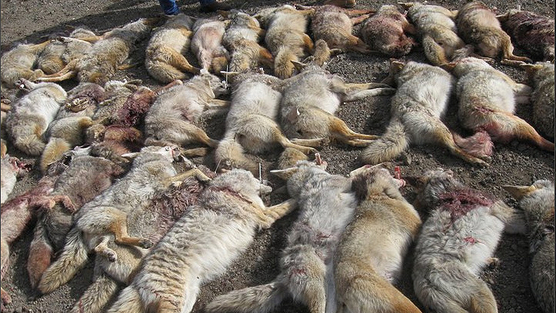
24/7/365 Coyote Extermination Contest? Are Some People Really That Tweeked?

Announcing the first FOREVER 24/7/365 Coyote Extermination Contest

by Brent Reece 

I was more than a little disturbed to read the other day this disturbing little footnote in history. 

xVHAyLEawJsheWD-556x313-noPad

by Associated Press

kgw.com

Posted on July 25, 2014 at 3:23 PM

Updated Friday, Jul 25 at 3:23 PM

PORTLAND, Ore. – An animal-rights group and the organizer of an annual coyote-killing contest in southeast Oregon have settled competing lawsuits with an agreement that there will be no more hunting contests.

Coyotes are classified as predatory animals under Oregon law, and there are no limits on killing them.

Faced with that reality, the Animal Legal Defense Fund sued on the grounds that the contest violated anti-gambling laws.

Organizer Duane Freilino said Friday he agreed to the contest-ending settlement because he ran out of money to pay attorneys.

Stephen Wells, executive director of the animal-right group, says the agreement means hundreds of coyotes can live peacefully in the wilderness.

Freilino said he started the contest almost a decade ago to increase winter tourism in the sparsely populated region and to help ranchers by reducing coyote numbers before calving season.


Well folks I was inspired to snub the “anti’s” on this one. Especially in light of the fact that HSUS is here in Maine trying to steal my Bear Hunt using lies, deception, and half-truths to get the uninformed to back them. On November 4th we are facing the loss of our bear hunting tradition in Maine under the guise of more SPORTSMAN-like euphemistic terms like fair chase/stalking/still hunting.  The anti-group is trying to repeal our right to hunt over bait, use dogs , and to legsnare/trap. (Old school toothy bear traps are illegal and have not been used in decades.) They have made no bones that if they can steal the bear hunt from us they are after an end to all hunting…and the consumptive use of all animals. So first bear hunting goes , and eventually farming.


In direct response to the events in Oregon, and to HSUS interfering in hunting here. I am hosting the first of it’s kind……FOREVER 24/7/365 COYOTE EXTERMINATION CONTEST.


The rules are simple……….KILL AS MANY COYOTES AS YOU CAN …..WHEN AND WHERE YOU CAN…24/7/365!! This contest has no end date, and costs nothing to enter so it cannot violate any gambling laws.


One, the deer and small critters need a break here in Maine. Two, they are an invasive species not natural to this or any area now that they have been hybridized with dogs and wolves. THIS IS A GENETIC FACT HERE IN MAINE!!


The cute little 35 lb. coyote of the great plains and Texas has been replaced with 65+ pound coy/dog/wolves. That will kill humans and attack pets/kids and eats “anything” including it’s own kind. (Taylor Mitchell in Cape Breton was the first documented death here in the Northeast, but not the only or the last.)


How to Enter:


  1. Kill the coyote!!!
  2. Take it’s picture with you holding it or standing/kneeling /sitting near it. (You have to be in the picture.)
  3. Email the picture along with a brief story about the hunt with the usual who/what /where/when…. To northwoodswanderings@yahoo.com (Subject: Coyote Exterminator) OR….Snail Mail: Mail your printed pic and a note to Brent Reece: 25 Garfield Street #2A, Madison Me 04950
  4. I will post all pictures on my blog and on NWW’s Facebook page. I will select one picture each month for cudos and possible prizes. Once per year..like in June I will select a YEARLY WINNER from the previous MONTHLY WINNERS.


It costs nothing to enter and I will except pictures from all 48 states and Canada!!! But they must comply with the #2 rule!!


PLEASE LIKE Northwoods Wanderings on FACEBOOK…..Visit the blog: www.skinnymoose.com/wanderings or comment on TWITTER @aroostookbasser


AS in all contests I am looking for sponsors/prizes and support …….you can help me here or you can look up the great folks listed below and help us beat back HSUS and save our hunting traditions!


Here’s a link to the good folks at SAVE Maine’s Bear Hunt, who are leading the fight to save Maine’s bear hunt.


http://savemainesbearhunt.com/about/

Read more: http://www.skinnymoose.com/wanderings/2014/07/30/announcing-the-first-forever-247365-coyote-extermination-contest/#ixzz39ijro2i7