


UPC’s Hope for the Animals Podcast Episode 7 is packed with great information. Hope starts us off by exposing the contradictions inherent in labeling meat “humane.” Classifying the flesh of slaughtered animals as humane, or implying in the product marketing that the animals had a happy life, is a cognitive dissonance that most people don’t think about or don’t want to think about.

Hope then has an informative interview with journalist and animal activist Martha Rosenberg who talks about her decades of reporting on the use of pharmaceuticals in animal agriculture. Martha and Hope discuss numerous aspects of animal agribusiness including: meat treated with ammonia gas, arsenic in turkey feed, antibiotic abuse and the potential impending catastrophe of human antibiotic resistance, and how conditions are so bad in slaughterhouses that even prisoners won’t work there.
We hope you are enjoying our new podcast. You can support the Hope for the Animals Podcast by leaving a positive rating or review wherever you listen to your podcasts. We appreciate the endorsement!
With the COVID-19 outbreak shutting down, at least temporarily, an estimated 20 major slaughterhouses and processing plants in North America, millions of farm animals are left in limbo with nowhere to go.
In Iowa, the nation’s biggest pork-producing state, farmers are reportedly giving pregnant sows abortions by injection and composting dead baby pigs to be used for fertilizer. Amid supply chain bottlenecks, local political leaders warn that producers might be forced to “euthanize” around 70,000 pigs a day.
In Minnesota, JBS, the world’s largest slaughter operation, reopened its Worthington plant last month for the sole purpose of killing and dumping excess pigs. The meat processing plant partially reopened for business last week. Roughly one-quarter of the facility’s 2,000 workers have tested positive for the coronavirus.
And in Delaware and Maryland, Allen Harim Foods depopulated 2 million chickens last month, citing a 50% decline in its workforce.
Using the terms “slaughter” or “euthanasia” to describe the rapid destruction of farm animals is a misnomer. Slaughter is killing for human consumption; to ensure meat quality, the animal typically dies from blood loss. Under the federal humane slaughter law, animals (except birds) are first stunned, which means they are rendered insensible to pain.
Euthanasia literally means “a good death.” It involves ending an animal’s life in a way that minimizes or eliminates pain and distress, according to the American Veterinary Medical Association.
The AVMA defines the term “depopulation” as “the rapid destruction of a population of animals in response to urgent circumstances with as much consideration given to the welfare of the animals as practicable.”
Among the depopulation methods deemed acceptable is using a layer of water-based foam to drown and suffocate birds. During ventilation shutdown, operators flip a switch to turn off the airflow in a barn and ratchet up the heat to as high as 120 degrees, leaving trapped birds and pigs to die from a combination of heat stress and suffocation. The process can take hours and likely results in severe suffering. In fact, other than burning animals to death or burying them alive, it is difficult to imagine a more horrific end.
The last time such gruesome depopulation methods were widely used was in 2015 in response to highly pathogenic bird flu, the worst animal disease outbreak in U.S. history, which killed nearly 50 million chickens and turkeys. In that case, birds were sick and suffering, and the justification given for the extreme step of depopulation was that it would slow the spread of the disease in the shortest time possible.
During the current pandemic, however, animals are not suffering from disease, nor are they at risk of transmitting disease to other animals or to humans. Instead, they are being killed, and their bodies disposed of, because meat companies failed to protect their workers properly from exposure to COVID-19.
The meat industry is using depopulation as a quick fix for its lack of emergency preparedness. The conventional animal agriculture industry operates a highly consolidated system that has a hard time adjusting in response to a crisis. It routinely runs slaughter lines at dizzying speeds, provides the lowest level of care to animals crammed in stressful, unsanitary environments, and extends minimal health and safety protections to its workers — to date, thousands have become ill or been exposed to the coronavirus, and some have died. This intensive, high-production system leaves no room for error, yet giant corporations give little consideration to how animals will fare in emergency situations — from disease outbreaks to natural disasters to devastating barn fires.
That hasn’t stopped industrial agriculture from begging for federal assistance, warning of meat shortages and skyrocketing prices. Farmers are also asking the federal government to bankroll depopulation efforts, along with compensating them for their losses.
Already, the Department of Agriculture has pledged that government officials and veterinarians will step in, if necessary, to “advise and assist on depopulation and disposal methods.” Because there are no federal or state regulations governing farm animal euthanasia or depopulation, more than 20 members of Congress sent a letter last week to Agriculture Secretary Sonny Perdue urging his department to curb extreme measures, including ventilation shutdown and water-based foam methods.
We simply cannot trust powerful industry players and federal regulators to safeguard animal welfare. According to a recent report by the Animal Welfare Institute, JBS’s Worthington plant, a Smithfield Foods plant in Sioux Falls, South Dakota, and a Tyson Foods plant in Waterloo, Iowa, were the top three worst large livestock slaughter plants in the country for animal welfare violations from 2016 to 2018. These three facilities account for 12% of all U.S. hog production. Violations included multiple incidents of failing to stun animals before shackling and hanging them to be dismembered, likely causing the animals excruciating pain.
Depopulation during the current pandemic is being pursued solely as a consequence of the meat industry’s failure to protect its workers, not because the animals present any real risk to human or animal health. These blatantly inhumane killing methods are completely unjustifiable.
Because these animals cannot be brought to market, millions of animal lives will be wasted. At the very least, we should spare them a cruel death.
Dena Jones is the farm animal program director for the Washington-based Animal Welfare Institute.
Small Families
Human population growth underlies the climate change, deforestation, desertification, pollution and other factors responsible for the ongoing sixth mass extinction.
Vegetarian and Vegan Diets
Vegetarians and vegans greatly reduce the suffering of farm animals and environmental damage done by the agriculture industry.
 Meat, Egg and Dairy Alternatives
Soy milk, veggie burgers and other faux products available for sale in many supermarkets and convenience stores.
Energy Usage
Greenhouse gasses greatly contribute to habitat loss.
Consumption and Recycling
Reduced use of natural resources and increased recycling decrease forest destruction, occean pollution, etc. and thereby benefit wild animals.
Guide to Compassionate Clothing
Stores that sell clothing not made with fur, leather or other animal products.
Companies that Don’t Test on Animals
Firms that don’t test finished products, formulations or ingredients on animals and do not do business with suppliers that do.
Animal-Friendly Tourism
Make sure that your vacation plans don’t include causing animals to suffer.
Alternatives to Classroom Dissection
Computer simulations, clay models and other means of teaching anatomy that do not involve the use of animals.
Animal Welfare Organizations
There are thousands of animal welfare organizations throughout the world almost all of which rely heavily on donations and volunteers.
Petitions
There are numerous online petitions intended to promote animal welfare.
Legislation
Contacting elected officials at all levels of government in order to urge them to ban retail sales of dogs obtained from puppy mills, oppose efforts to criminalize undercover investigations at slaughterhouses, prohibit use of wild animals in circuses, etc. can be very helpful in promoting animal welfare.
 Companion Animal Adoption
Adopting a cat or dog or some other animal from a shelter or rescue group helps to reduce animal homelessness.
Spaying and Neutering
Spaying and neutering yield a variety of benefits.
Humane Wildlife Control
A variety of nonlethal methods can be employed to help prevent conflicts with wild animals.
Humane Rodent Control
A number of nonlethal methods of preventing rodents from entering homes are available.
Events
Events throughout the world that are held to promote animal welfare.
Spreading the Word
Increasing awareness of wildlife poaching, factory farm practices, the treatment of animals in laboratories, homeless cats and dogs and related issues helps to improve the well-being of animals.
By Hope Bohanec, Projects Manager for United Poultry Concerns
I live in a rural area of Sonoma County, California in the small town of
Penngrove. It’s farm country and there isn’t much more in the tiny downtown
block than a burger joint and bars. But it’s a beautiful, peaceful area. The
golden hills glimmer in the distance, and mature, majestic oak trees shade
the
wild turkeys and deer in our neighborhood. My husband and I have been in
this
area for over a decade, and while a miniature horse or a goat in a field is
a
common sight, chickens were not, up until a few years ago. The popularity of
having chickens at home has grown, and now we see flocks of chickens
everywhere.
Across the street, there is a chicken “tractor” (a mobile chicken coop) in a
sprawling field. We often see a colorful collection of chickens here and
there,
wandering and scratching around front yards as we take our evening walk.
So when our new neighbors built a chicken coop in their backyard, I wasn’t
surprised, but I was concerned. Our four duplexes share a laundry, and I
walk
directly in front of this neighbor’s house on a regular basis. He is often
outside in a cloud of cigarette smoke. When the chickens first came, I
braved
inhaling a haze of second-hand smoke to inquire about the birds. He said he
got
them for eggs. I said, “You’re not going to kill them, are you?” He said no,
that he had them just for the eggs. I reminded him that coops need to be
cleaned
daily and that he should adopt chickens if he was going to get any more, but
doubted that he would care one way or the other about something like this
as he
blew smoke away from my direction.
A few months later, I was walking some laundry out to the machines. As I
glanced
in this neighbor’s front yard, he and two other men were standing around a
tall,
green, plastic garbage can. There was a scuffle and I couldn’t quite figure
out
what was happening at first, until I saw his arms spotted in blood and a big
black bird flapping her wings furiously as she was being held upside down by
both men in the garbage can. Her large ebony wings beat desperately against
his
arms. The third man was skinning the sandy colored feathers off another
chicken
and there was a third little body, colorless, headless, featherless, with
her
feet cut off, balanced on the top of the garbage can. I dropped my laundry
basket and screamed, “What are you doing!?!?!” The neighbor was immediately
uncomfortable. He said, “Oh, sorry Hope.” One of the other men looked at me
and
said, “We’re gonna BBQ!”
I ran back to my apartment and grabbed my cell phone and then back to the
scene
of the horror and with trembling hands started taking pictures while I
pleaded
with him to stop. There wasn’t another bird out there, just the three now
still
and silent. The neighbor said these three were the “old ass chickens.” I
assume
he meant they were not laying eggs as frequently as the others in his
backyard.
Through my tears, I reminded him that he had promised he wasn’t going to
kill
the chickens. He didn’t say much, just apologized again. He knows my
feelings as
he sees my vegan bumper stickers every day, and we have talked on a couple
of
occasions about veganism and not killing animals. It seemed to me like he
felt
“caught in the act.” I can only hope that he does feel a degree of guilt
and not
just embarrassment about doing something his neighbor disapproves of.
I was so upset I forgot my laundry basket which sat out in the driveway for
hours and I cried my eyes out. It was sickening to witness. My neighbor
literally had blood on his hands from taking a precious life not fifty feet
from
my front door, and there was nothing I could do about it. The fact that
these
men were executing this repulsive act in a garbage can felt terribly
symbolic of
how they seemed to feel about these birds. They treated them like garbage
and
left their heads, feet, feathers, and other parts of their little bodies to
be
thrown away with the trash.
I called our mutual landlord to complain. He sympathized with me but said
only
that he would tell the murdering neighbor that he should do his killing in a
more private and secluded area of his backyard in the future. I know that
it is
legal to kill animals who are your “property” as long as you do it
“humanely.”
But what can be humane about taking a sentient being’s life? And although
throat
cutting and beheading are considered “humane” methods of killing, they
certainly
are not. Throat slashing is a painful, traumatic way to die, and it can take
agonizing, frightening minutes for someone to bleed out. Killing an animal
who
wants to live can never be humane. This idea that we can “humanely” take the
life of another animal is an outrage. And I am outraged that it is
happening in
my backyard . . . in anyone’s backyard.
The idea that it is somehow better to “kill your own” baffles me. One
argument
my neighbor might use is that his bird had a good life and this was her
“one bad
day.” But what about all the other days of life you are depriving her of?
What
about all the days of sunshine, eating, dustbathing, playing with friends,
and
loving being alive? It’s not just one bad day; it’s denying someone a
lifetime
of experience, robbing them of the full knowledge of life. If we don’t want
our
human life cut short, how can we justify taking the life of another sentient
being who wants to live when it is completely unnecessary and we live
healthier
as vegans?
Another position that people who kill animals themselves take is that the
person
is now aware of the process and “knows where their food comes from.” But
this is
useful only to that person. The animal receives no benefit from this
concept. If
they took care of the animal, fed and cleaned and provided for this animal,
then
a bond of trust was formed between the caregiver and the dependent. To turn
on
someone you care for, and then mercilessly kill them, is a terrible
betrayal of
trust. In fact, it’s the ultimate betrayal. This phrase is the title of my
book
on the subject of small scale animal agriculture, *The Ultimate Betrayal*.
For a
broader, in depth analysis of this issue, I encourage you to read my book
<https://www.amazon.com/Ultimate-Betrayal-There-Happy-Meat/dp/1475990936/ref=tmm_pap_swatch_0?_encoding=UTF8&qid=1372963043&sr=8-1>
.
I haven’t seen my neighbor since that horrible day, which is unusual as he
is
typically out in his haze of smoke several times a day. I think he has
moved his
habit to the backyard so he doesn’t have to look me in the eye. I hope that
my
reaction made him think deeply about what he did. There is a different
energy
now when I walk past his place and out to the laundry. It feels somber and
sad
knowing what occurred there. It’s horrible to live with but only
strengthens my
resolve to fight for these beautiful birds and help bring about the day when
they no longer suffer at the hands of our neighbors.
__________
Hope Bohanec is the Projects Manager for United Poultry Concerns and author
of
*The Ultimate Betrayal: Is There Happy Meat?*
<http://www.the-ultimate-betrayal.com>
—
United Poultry Concerns is a nonprofit organization that promotes
the compassionate and respectful treatment of domestic fowl.
Don’t just switch from beef to chicken. Go Vegan.
http://www.UPC-online.org/ http://www.twitter.com/upcnews
http://www.facebook.com/UnitedPoultryConcerns
View this article online
<http://upc-online.org/alerts/170901_not_in_my_backyard.html
Trump represents the greatest threat ever to federal policy-making and implementation of animal protection laws, and a threat to animals everywhere.
*The following is an opinion column by R Muse*
It is probably the case that there are few Americans that actually hate animals, and if there are very many at all, they are certainly outnumbered by the uncivilized Americans that actually hate other Americans. Of course at this particular juncture in time there is plenty of evidence that the Americans exuding hatred for American people who aren’t white, aren’t evangelical fundamentalists, aren’t wealthy, and aren’t male all support Donald Trump. What is fairly certain is that even the barbaric savages that support Trump likely support efforts to protect animals from people with a predilection to abuse and slaughter innocent animals, and it is also fairly certain they are unaware that animal rights groups have endorsed Hillary Clinton for president and slammed Donald Trump as “a threat to animals everywhere.”
The national animal rights and protection group, the Humane Society Legislative Fund, announced that it was taking the “unusual step” of wading into the presidential race to endorse Democratic presidential nominee Hillary Clinton. The reason the animal rights group gave was because they believe “Trump represents the greatest threat ever to federal policy-making and implementation of animal protection laws, and we are taking the unusual step of wading actively into a presidential campaign.” The group made it very clear that it “evaluate[d] candidates based on a single, non-partisan criterion—their support for animal protection—and did not default to one party or the other.
The HSLF is a lobbying affiliate of the Humane Society of the United States that also said that Ms. Clinton’s Republican opponent was “a threat to animals everywhere.”
On the exact same day the HSLF announced their endorsement of Hillary Clinton, they launched a vicious anti-Trump ad campaign (video here) that cited his past record on animal protection; a record that should sicken any animal lover, even Trump supporters. The group also explained that its biggest concern was that a Trump administration would be stocked with anti-animal rights barbarians.
The HSLF said that based on potential policy decisions under the aegis of the U.S. Department of Fish and Game, Fish and Wildlife Service, National Park Service, Bureau of Land Management, National Institutes of Health, and various other executive level agencies, the stakes are just too high to allow a Trump presidency. The HSLF also noted that “there could not be a greater contrast among the White House hopefuls” that guarantees either the “potential for advancing animal welfare reforms at the federal level, or rolling back the recent gains and rule-making actions” that will have devastatingly adverse effects on animals. They also, rightly noted, that where Hillary Clinton has a clear, compelling record of support for animal protection, the opposition has already assembled a team of advisors and financial supporters “intricately tied to trophy hunting, puppy mills, factory farming, horse slaughter, and other abusive industries.”
The names that Trump’s campaign has floated to run the Interior and Agriculture Department issues are a veritable “who’s who” of vicious anti-animal welfare activists. One of those names,according to Politico, is an oil magnate considered to be the front-runner for Trump’s Secretary of the Interior as well as currently serving on Trump’s agriculture advisory committee. The man, Forrest Lucas is the funding machine providing money for the front group, Protect the Harvest, behind every attack on every organization in the nation involved with protecting animals and defending wildlife.
As HSLF noted, “Lucas has never met a case of animal exploitation he wouldn’t defend,” and he is a fierce advocate “for trophy hunting, puppy mills, and big agribusiness.” Lucas also personally provided the funding for attacks on a Missouri ballot measure (Prop. B) because its purpose is insuring there are “humane breeding standards for dogs” and regulations on horrendously inhumane puppy mills; something Lucas will not allow even though it has no impact on his oil business. Lucas opposes humane treatment of animals so ardently that he personally financed the attack on Missouri’s Prop. B because it is one of the animal welfare movement’s most important ballot measures designed to enact humane breeding standards for dogs and crack down on puppy mills.
more: http://www.politicususa.com/2016/10/24/leading-animal-rights-group-attacks-trumps-inhumanity-clinton-endorsement.html

People tend to paint all wildlife-killers with a single brush stroke, referring to them all simply as “hunters.” Yet close scientific observation reveals that there are at least five different categories, or sub-species, of the mutation of Homo sapiens known as the North American hunter (Homo hunter horribilis). Oddly, members of some sub-species don’t like to be associated with others. They can’t all be bad apples, can they? Read on…
1) Sport Hunter
This category can actually be applied to all the other sub-species, including the universally maligned trophy hunter, as well as the so-called subsistence hunter, since nearly no one in this day and age really has to kill wild animals to survive anymore. Lately we’ve been hearing from a lot of hunter apologists quick to make a distinction between sport and subsistence hunters. Truth is there’s not all that much difference between the two. Sport hunters and subsistence hunters are often so closely related, they’re practically kissin’ cousins. Rare is the hunter who doesn’t justify his sport by boasting about “using the meat.” By the same token, you hardly ever find one who openly admits to being just a sport hunter.
But, being by far the largest sub-class, there are obviously plenty of adherents. For reasons known only to them, they like to refer to themselves as “sportsmen” (or “sportswomen”). When not out killing, they are often seen petitioning Congress to enshrine their perceived right to kill animals (meanwhile mocking the very notion that non-human animals have rights).
Tracks: On the rare occasion that these good ol’ boy traditional sport hunters get out of their vehicles (usually a pickup truck with a bench seat, so they can sit on their camo-clad asses three abreast), you’ll find their tell-tale boot tracks weaving along the roadway—a sure sign the Schmidt-swilling hunter has spotted a deer, or needs to take a pee.
Other spoor to watch for: spent shotgun shells and cigarette butts in parking lots, or 16 ounce beer cans and empty fried pork rind bags ejected out the truck window, along forest roadways.
2) Subsistence Hunters
 This category includes the holier than hemp types who use words like “foodie,” and all those others who claim to hunt mainly for food. Subsistence types conveniently ignore the fact that there are 7 billion human meat-eaters on the planet today, and if they all followed their model for “living off the land,” there would be no wildlife left on Earth.
Like sport hunters, subsistence hunters do what they do because they want to; they enjoy the “outdoor lifestyle.” But not many self-proclaimed “subsistence” hunters are willing to give up modern conveniences—their warm house, their car, cable TV or the ever-present and attendant “reality” film crew—and live completely off the land like a Neanderthal…at least not indefinitely.
While everyone has a right to feed themselves and their family, what gives them the right to exploit the wildlife is unclear. Sure, all people need some form of protein, yet millions have found a satisfying and healthful way to eat that doesn’t involve preying on others. And they don’t seem to understand that dead is dead and it doesn’t matter to the victim whether their killer eats every part of them or just sticks their head on a wall.
Call: Often overheard uttering feeble catch-words like “management,” “sustainability,” “population control” or “invasive species.” Unfortunately, they never think to apply those same concepts to the species, Homo sapiens.
3) Trophy Hunters
This group can be confused with other “sportsmen,” but though both types are clearly in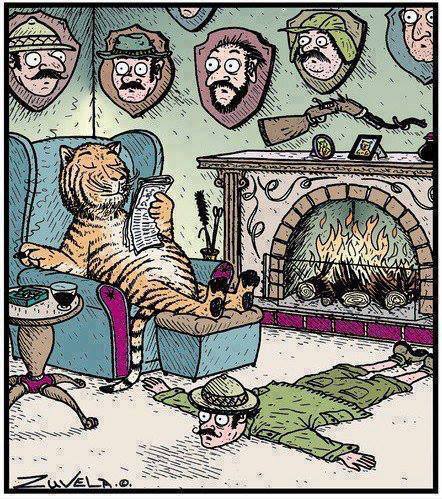 it for the fun, trophy hunters are obsessed with every aspect of the so-called sport. These are the kind of people who hold “contest hunts” on anything seen as competition, yet ironically are intent on recruiting more hunters, including women and young people, encouraging them to take up the “sport.” Although their professed enemies are predators like wolves and mountain lions, their most dreaded foe are the anti-hunters.
The trophy hunters’ fixation with horn curl or antler spread is in fact causing a reversal of evolution in the species whose heads they covet.
Breeding plumage: Camouflage from head to tail; flashy orange vest. Mates primarily with themselves.
4) Sadists
 This category includes bow-hunters, trappers and wolf hunters. Often seen on reality T.V. shows or in homemade snuff-film videos on U-Tube. Hunters who consider themselves in one of the other categories would do well to self-police their kind, lest normal people (non-hunters) think all hunters are sadists who enjoy the act of killing and are turned on by watching animals suffer and struggle under their power.
Habitat: Disgusting personal websites or Facebook pages where they parade around in camo, showing off their evil deeds for anyone who’ll give them the time of day.
5) “Ethical” Hunters
This is the category that virtually all hunters want to be included in. Unfortunately, the phrase “ethical hunter” is an oxymoron, like “humane slaughter,” “virgin mother,” “fair chase,” “free-range poultry” or “friendly neighborhood serial killer.” As with UFOs, Bigfoot and the Loch Ness monster, no one has ever been able to locate one of these mythical phantoms.
Spoor: This make-believe subspecies leaves no tracks or scat because, well, they’re fictitious. The only impression they make is in the minds of the easily influenced. There’s simply no way an animal-killer can be considered ethical, unless of course he gives up hunting.

It’s common knowledge that we’re losing species and habitats at an unprecedented rate in a geological epoch known as the “anthropocene” – the age of humanity. While the term has not been formally recognized as official nomenclature, we know we’re deep into a time when humans are devastating numerous species and their homes and we are behaving in the most inhumane and selfish ways. Simply put, we humans are the cause of such massive and egregious ecocide because as big-brained, big-footed, overproducing, overconsuming, arrogant, and selfish mammals we freely move all over the place recklessly, wantonly, and mindlessly trumping the interests of countless nonhuman animals (animals). Every second of every day we decide who lives and who dies; we are that powerful. Of course, we also do many wonderful things for our magnificent planet and its fascinating inhabitants, but right now, rather than pat ourselves on the back for all the good things we do, we need to take action to right the many wrongs before it’s too late for other animals and ourselves.
I see at least two ways out of the environmental and moral muck in which we’re mired that is responsible for widespread and increasing ecocide. The first centers on paying careful attention to the rapidly growing international and interdisciplinary field called “compassionate conservation” and the second is our choosing to go through a personally transformative process that I call “rewilding our hearts”. Rewilding our hearts calls for a global paradigm shift, a social revolution, in how we interact with other animals and with other humans.
Compassionate conservation
The goals of compassionate conservation are clearly stated in the mission statement for a recently established Centre for Compassionate Conservation (see also) at the University of Technology, Sydney (Australia) and in a book I edited called Ignoring nature no more: The case for compassionate conservation.
The mission statement for the Centre for Compassionate Conservation promotes the protection of captive and wild animals as individuals within conservation practice and policy. Finding ways to compassionately and practically share space (coexistence), via trade-offs among different values, is vital if we are to reduce harm to animals.
A simple and morally acceptable approach is to utilize the universal ethic of compassion (and empathy) to alleviate suffering in humans and other animals to resolve issues of land sharing. A compassionate and practical ethic for conservation that focuses on individual well being, in combination with other values, provides a novel framework of transparency and robust decision-making for conservation that will benefit all stakeholders.
Compassionate conservation stipulates that we need a conservation ethic that prioritizes the protection of other animals as individuals: not just as members of populations of species, but valued in their own right. This is important because of what we now know about their cognitive and emotional lives (consciousness and sentience).
Because compassionate conservation requires that we must protect animals as individuals, they are not merely objects or metrics who can be traded off for the good of populations, species or biodiversity.
A paradigm shift in our approach to other animals is vital because of what we now know about the cognitive and emotional capacities of other animals and their ability to suffer (sentience).
With a guiding principle of “first do no harm“, compassionate conservation offers a bold, virtuous, inclusive, and forward-looking framework that provides a meeting place for different perspectives and agendas to discuss and solve issues of human-animal conflict when sharing space. Peaceful coexistence with other animals and their homes is needed in an increasingly human-dominated world if we are to preserve and conserve nature the best we can.
Surely, adhering to the principles of compassionate conservation will go a long way toward reducing the ecocide in which we are now engaged and for which we all are responsible.
Rewilding our hearts
My forthcoming book called Rewilding our hearts: Building pathways of compassion and coexistence lays out the details for a much-needed social movement and paradigm shift that also can help extricate us from our ecocidal ways and help to maintain our hopes and dreams for a more peaceful world for all beings in very trying times. Some of the basic ideas are reviewed here. We live in a world in which “unwilding” is the norm rather than the exception. If we didn’t unwild we wouldn’t have to rewild.
The word “rewilding” became an essential part of talk among conservationists in the late 1990s when two well-known conservation biologists, Michael Soulé and Reed Noss, wrote a now classic paper called “Rewilding and biodiversity: Complimentary goals for continental conservation” that appeared in the magazine WIld Earth (Fall 1998, 18-28. 15).
In her book Rewilding the World conservationist Caroline Fraser noted that rewilding basically could be boiled down to three words: Cores, Corridors, and Carnivores. Dave Foreman, director of the Rewilding Institute in Albuquerque, New Mexico, a true visionary, sees rewilding as a conservation strategy based on three premises: “(1) healthy ecosystems need large carnivores, (2) large carnivores need bug, wild roadless areas, and (3) most roadless areas are small and thus need to be linked.” Conservation biologists and others who write about rewilding or work on rewilding projects see it as a large-scale process involving projects of different sizes that go beyond carnivores, such as the ambitious, courageous, and forward-looking Yellowstone to Yukon Conservation Initiative, well known as the Y2Y project. Of course, rewilding goes beyond carnivores, as it must.
The core words associated with large-scale rewilding projects are connection and connectivity, the establishment of links among geographical areas so that animals can roam as freely as possible with few if any disruptions to their movements. For this to happen ecosystems must be connected so that their integrity and wholeness are maintained or reestablished.
Regardless of scale, ranging from huge areas encompassing a wide variety of habitats that need to be reconnected or that need to be protected to personal interactions with animals and habitats, the need to rewild and reconnect centers on the fact that there has been extensive isolation and fragmentation “out there” in nature, between ourselves and (M)other nature, and within ourselves. Many, perhaps most, human animals, are isolated and fragmented internally concerning their relationships with nonhuman animals, so much that we’re alienated from them. We don’t connect with other animals, including other humans, because we can’t or don’t empathize with them. The same goes for our lack of connection with various landscapes. We don’t understand they’re alive, vibrant, dynamic, magical, and magnificent. Alienation often results in different forms of domination and destruction, but domination is not what it means “to be human.” Power does not mean license to do whatever we want to do because we can.
Rewilding projects often involve building wildlife bridges and underpasses so that animals can freely move about. These corridors, as they’re called, can also be more personalized. I see rewilding our heart as a dynamic process that will not only foster the development of corridors of coexistence and compassion for wild animals but also facilitate the formation of corridors within our bodies that connect our heart and head. In turn, these connections, or reconnections, will result in positive feelings that will facilitate heartfelt actions to make the lives of animals better. These are the sorts of processes that will help the new field of compassionate conservation further develop. When I think about what can be done to help others a warm feeling engulfs me and I’m sure it’s part of that feeling of being rewilded. To want to help others in need is natural so that glow is to be expected.
Rewilding is an attitude. It’s also a guide for action. As a social movement, it needs to be proactive, positive, persistent, patient, peaceful, practical, powerful, and passionate — which I call the eight Ps of rewilding.
Compassion begets compassion and there’s actually a synergistic relationship, not a trade-off, when we show compassion for animals and their homes. There are indeed many reasons for hope. There’s also compelling evidence that we’re born to be good and that we’re natural-born optimists. Therein lie many reasons for hope that in the future we will harness our basic goodness and optimism and all work together as a united community. We can look to the animals for inspiration. So, we need to tap into our empathic, compassionate and moral inclinations to make the world a better place for all beings. We need to build a culture of empathy. We need to add a healthy dose of social justice to our world right now.
We can all make more humane and compassionate choices to expand our compassion footprint, and we can all do better. We must all try as hard as we can to keep thinking positively and proactively. Never say never, ever. We can and must keep our hopes and dreams alive (see also).
When all is said and done, and more is usually said than done, we need a heartfelt revolution in how we think, what we do with what we know, and how we act. Rewilding can be a very good guide. The revolution has to come from deep within us and begin at home, in our heart and wherever we live. I want to make the process of rewilding a more personal journey and exploration that centers on bringing other animals and their homes, ecosystems of many different types, back into our heart. For some they’re already there or nearly so, whereas for others it will take some work to have this happen. Nonetheless, it’s inarguable that if we’re going to make the world a better place now and for future generations, personal rewilding is central to the process and will entail a major paradigm shift in how we view and live in the world, and how we behave. It’s not that hard to expand our compassion footprint and if each of us does something the movement will grow rapidly.
The time is right, the time is now, for an inspirational, revolutionary, and personal social movement that can save us from doom and keep us positive while we pursue our hopes and dreams. Our planet is tired and dying and not as resilient as some claim it to be.
Rewild now. Take the leap. Leap and the net will appear. It’ll feel good to rewild because compassion and empathy are very contagious.
Let’s make personal rewilding all the rage
Ecocide is suicide. Let’s make personal rewilding all the rage. When “they” (other animals) lose, we all lose. We suffer the indignities to which we subject other animals. We can feel their pains and suffering if we allow ourselves to do so.
Compassion begets compassion and violence begets violence.
There really is hope if we change our ways. We owe it to ourselves and to future generations who will inherit the world we leave them long after we’re gone.
Note: An excellent new book on this topic is Keeping the Wild: Against the Domestication of Earth edited by George Wuerthner, Eileen Crist, and Tom Butler.
Marc Bekoff’s latest books are Jasper’s story: Saving moon bears (with Jill Robinson; see also), Ignoring nature no more: The case for compassionate conservation (see also), and Why dogs hump and bees get depressed (see also). Rewilding our hearts: Building pathways of compassion and coexistence will be published fall 2014. (marcbekoff.com; @MarcBekoff
By now you’ve probably heard about the hunter from Indiana who ended up permanently paralyzed and on a ventilator after falling from a tree. While it’s always good news to know there’s one less armed animal-killer out there trying to gun-down the innocent, this is a case of an injured hunter—rendered essentially harmless to anyone but himself and his caregivers—choosing to do the right thing.
The miracles of modern medicine include morphine and other drugs that can spare a person from the unbearable pain which often accompanies such an injury. Yet, just as not every illness can be cured, there is a limit to how much spinal damage can be reversed. At times, the most humane resolution is to allow a suffering individual to peacefully pass, or even gently hasten the passing.
Despite the national obsession with health care these days, people rarely hear a word about the choices available to patients, or the fact that one can always refuse life-prolonging treatment (as long as they’re still able to communicate, or have previously expressed your wishes in writing). Kudos to the family of the hunter who must have known his wishes well enough to ask to bring him out of it and allow him to tell the staff at the hospital that he was definitely not interested in marking time in a rehab facility, hooked up to a ventilator.
For all its marvels, modern medicine is in a big way responsible for the rapidly worsening human overpopulation crisis. I don’t know if his decision was based in part on selflessness, but if more people were to choose no to be when by all intents and purposes they really aren’t alive anymore, the human population might start to level off and eventually not be quite such a burden on the planet.
I had an unwelcome opportunity to end the suffering of a mortally wounded band-tailed pigeon (a wild, forest-dwelling bird, native to the Western North America) who showed up at my birdfeeder with her lower bill shot completely off (probably by a dumbass neighbor kid who liked to shoot at everything that moved with his 22). The pigeon was unable to ever feed herself again, so I’m not sure if she returned to this familiar territory to somehow assuage her nagging hunger, or if she was hoping I could do something to help.
Like the paralyzed hunter whose only hope of living was via a feeding tube, there was no way this poor pigeon had any real chance of long term survival without some kind of major heroics. Since medical science has yet to invent a bionic bill for lowly birds, all I could do was shoot the poor thing to instantly put an end to her misery.
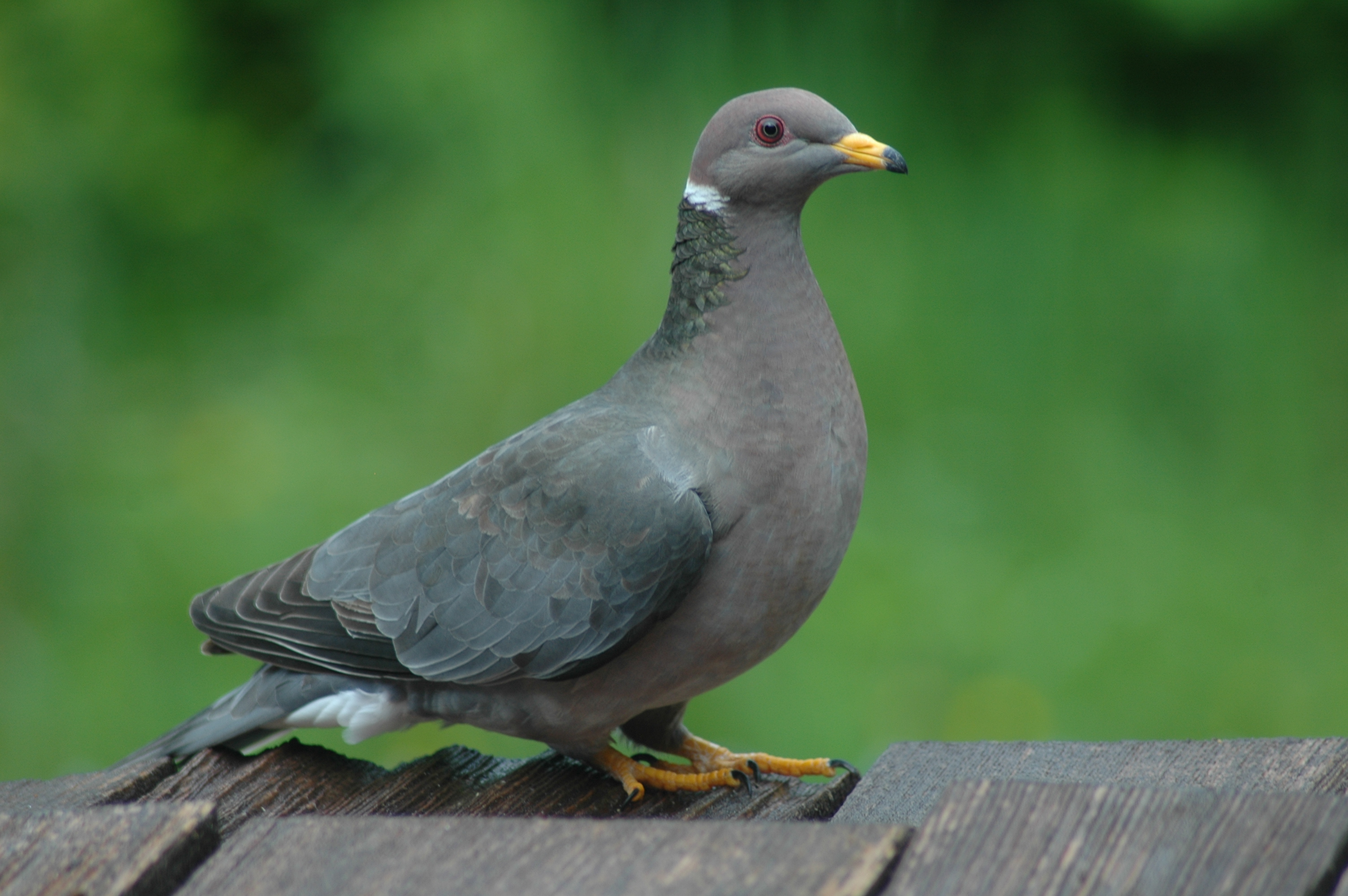
Band-tailed pigeon photo©Jim Robertson
Yesterday I received the following comment to my post, All Meat is the Product of Cruelty and Exploitation… “How can you argue with those whose response is: ‘In the natural world animals kill other animals for food and in a most painful and cruel way and if I choose to raise my animals on my own property allowing them to live in a free and natural manner just as they would live in the wild that only differs in that they have shelter from the elements should they choose to use it and they are not kept in pens or tied but in large open barns and that at some point they will be killed as quickly and humanely as possible to be eaten by my family and the excess sold to others. I love animals but choose to eat them as well. I believe that how I treat them and kill them is better than they would live in the wild and their deaths much less horrible than being ripped apart alive as is the case in the wild’. What can you say to that?”
…to which I replied: First of all, it sounds like someone has been watching too many “nature” programs that revel in prolonged scenes of wildlife predation. Most cases of natural predation happen much faster; in many cases the prey are killed instantly.
In my book, Exposing the Big Game, I wrote about a wolf kill I witnessed in Yellowstone: “Suddenly they tore out after a young mule deer who had risked leaving the cover of the forest for the lure of an open meadow. The inexperienced doe didn’t stand a chance against the incredible, greyhound-like speed of the determined wolves. One quickly caught her by the hind leg, bringing her down, and a split second later the other had her by the throat. In less than a heartbeat, a living, breathing deer was reduced to a lifeless carcass.” Not a pretty sight, but much more the norm than the horrible scenarios depicted for entertainment on cable T.V. shows.
The hypothetical argument you spelled out (above) begins by raising the naturalist fallacy, which I covered in the post, Top Ten Retorts to Hunters’ Fallacies (just substitute hunter for animal farmer/rancher):
# 9) Animals kill other animals, so we can too.
That’s an example of what’s known as the naturalistic fallacy—the notion that any behavior that can be found in nature is morally justifiable. But wolves and other natural predators need to hunt to survive, humans don’t—for them it’s nothing more than a thrill kill. Human beings have moved beyond countless other behaviors such as cannibalism or infanticide, so why can’t some people tear themselves away from hunting?
A quote from author Robert Franklin Leslie adds to this:
“It is not important that a hawk takes a robin, that a bear robs a grouse nest. That is Nature’s own salient way even if we don’t understand it…Wilderness life has gone on that way since the beginning, and the prey has withstood the predation. But when man steps in…the very soul of Nature cringes for having endowed one of her creatures with intelligence disproportionate to responsibility.”
Backyard animal farming is nothing but the revival of Old World animal husbandry, from which modern-day factory farming is an unfortunate upshot. Both the factory farmer and the backyard butcher breed animals for the sole purpose of killing them when the time is ripe. They don’t raise the animals just because they love them and want to give them a good life, and raising them does nothing to eliminate any suffering that might go on in the wild between natural predator and prey (unless a person’s intent is to eliminate all natural relationships between wild animals, and there would be a lot of suffering on the predator’s part as the human strives to eliminate them).
Killing farmed animals “quickly and humanely” is easier said than done. At some point the animal knows that the human they trusted intends to hurt or kill them, as they probably would have seen it happen to one or more of their herd-mates. And the act of ending a healthy animal’s life so you can eat their flesh is cruel no matter how you slice it, especially since people do not have to eat meat to live a long, healthy life. And in fact, a lifetime of meat-eating is unhealthy for the human primate. Also from the Top Ten list mentioned above:
8) Humans are carnivores, look at our canine teeth.
Human teeth are designed primarily for chewing plant-based foods, like our primate cousins do. Humans “fangs” are teensy compared to those of gorillas, who are strict vegetarians and only show them to appear fierce. Also, our intestinal tract is long to allow for the slow digestion of high-fiber foods, while true carnivores have short intestines as needed to process meat and dispose of the resulting toxic wastes quickly.
7) Wild game (or free-range) meat is health food.
All animal flesh is rife with cholesterol throughout, and the protein in animal flesh is acidic, causing bone calcium losses as it is metabolized. According to the American Dietetic Association, a diet high in animal products has been linked to obesity, diabetes, colon and other cancers, osteoporosis, kidney stones, gallstones, diverticular disease, hypertension and coronary artery disease. New studies have found that another culprit in causing heart disease may be a little-studied chemical that is burped out by bacteria in the intestines after people eat meat.
Again, wolves and other predators need to eat meat to survive—modern humans do not. Natural predators don’t hate their prey, but they don’t pretend to love them either.
Forget the 4-H Club—you can’t really claim to “love” an animal you plan to someday kill, butcher and consume.

 Exposing the Big Game