How early humans’ quest for food stoked the flames of evolution

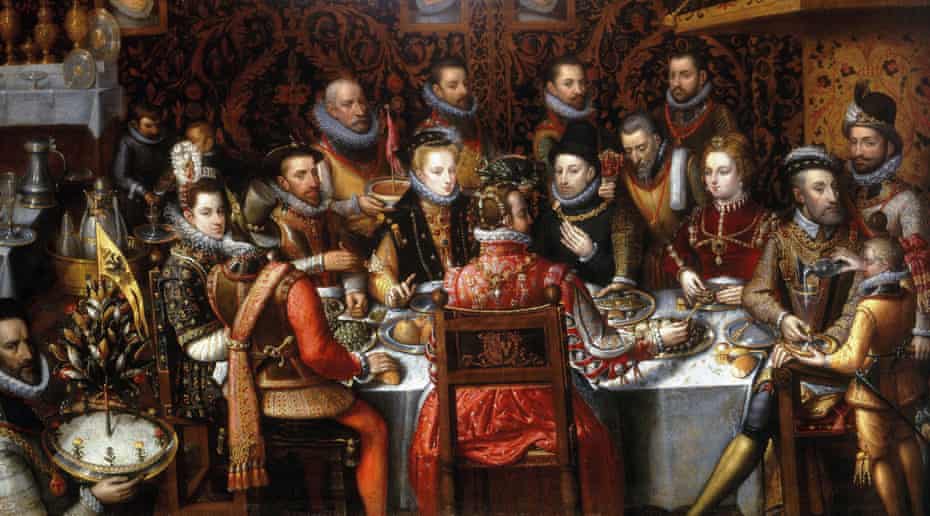
The Banquet of the Monarchs, c1579, by Alonzo Sanchez Coello
The Banquet of the Monarchs, c1579, by Alonzo Sanchez Coello: ‘high food culture’ in the middle ages. Photograph: Album/Alamy

[The painting with the elephant being burned alive tells the whole story.]

https://www.theguardian.com/science/2021/mar/07/how-early-humans-quest-for-food-stoked-the-flames-of-evolution

A love of complex smells and flavours gave our ancestors an edge and stove pped hangoversDonna FergusonSun 7 Mar 2021 01.16 EST

279

Human evolution and exploration of the world were shaped by a hunger for tasty food – “a quest for deliciousness” – according to two leading academics.

Ancient humans who had the ability to smell and desire more complex aromas, and enjoy food and drink with a sour taste, gained evolutionary advantages over their less-discerning rivals, argue the authors of a new book about the part played by flavour in our development.

Some of the most significant inventions early humans made, such as stone tools and the controlled use of fire, were also partly driven by their pursuit of flavour and a preference for food they considered delicious, according to the new hypothesis.Advertisementhttps://5037925012011699e0d1c13b2cbcd914.safeframe.googlesyndication.com/safeframe/1-0-37/html/container.html

“This key moment when we decide whether or not to use fire has, at its core, just the tastiness of food and the pleasure it provides. That is the moment in which our ancestors confront a choice between cooking things and not cooking things,” said Rob Dunn, a professor of applied ecology at North Carolina State University. “And they chose flavour.”

Cooked food tasted more delicious than uncooked food – and that’s why we opted to continue cooking it, he says: not just because, as academics have argued, cooked roots and meat were easier and safer to digest, and rewarded us with more calories.

Some scientists think the controlled use of fire, which was probably adopted a million years ago, was central to human evolution and helped us to evolve bigger brains.

“Having a big brain becomes less costly when you free up more calories from your food by cooking it,” said Dunn, who co-wrote Delicious: The Evolution of Flavour and How it Made Us Human with Monica Sanchez, a medical anthropologist.Advertisementhttps://5037925012011699e0d1c13b2cbcd914.safeframe.googlesyndication.com/safeframe/1-0-37/html/container.html

However, accessing more calories was not the primary reason our ancestors decided to cook food. “Scientists often focus on what the eventual benefit is, rather than the immediate mechanism that allowed our ancestors to make the choice. We made the choice because of deliciousness. And then the eventual benefit was more calories and fewer pathogens.”

Human ancestors who preferred the taste of cooked meat over raw meat began to enjoy an evolutionary advantage over others. “In general, flavour rewards us for eating the things we’ve needed to eat in the past,” said Dunn.

In particular, people who evolved a preference for complex aromas are likely to have developed an evolutionary advantage, because the smell of cooked meat, for example, is much more complex than that of raw meat. “Meat goes from having tens of aromas to having hundreds of different aroma compounds,” said Dunn.
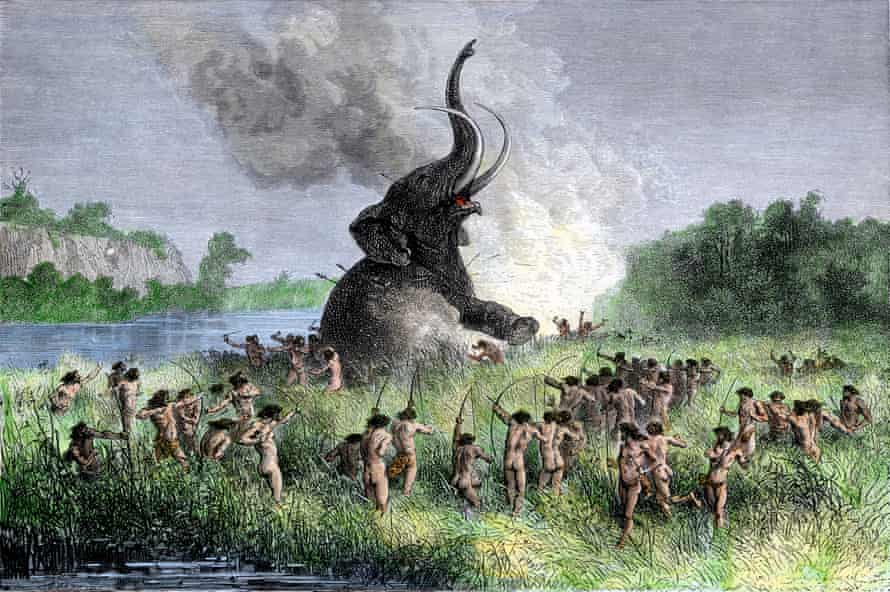
Prehistoric woolly mammoth hunters
Prehistoric woolly mammoth hunters. Photograph: North Wind Picture Archives/Alamy

This predilection for more complex aromas made early humans more likely to turn their noses up at old, rotten meat, which often has “really simple smells”. “They would have been less likely to eat that food,” said Dunn. “Retronasal olfaction is a super-important part of our flavour system.”

The legacy of humanity’s remarkable preference for food which has a multitude of aroma compounds is reflected in “high food culture” today, Dunn says. “It’s a food culture that really caters for our ability to appreciate these complexities of aroma. We’ve made this very expensive kind of cuisine that somehow fits into our ancient sensory ability.”Advertisement

Similarly, our proclivity for sour-tasting food and fermented beverages like beer and wine may stem from the evolutionary advantage that eating sour food and drink gave our ancestors.

“Most mammals have sour taste receptors,” said Dunn. “But in almost all of them, with very few exceptions, the sour taste is aversive – so most primates and other mammals, in general, will, if they taste something sour, spit it out. They don’t like it.”

Humans are among the few species that like sour, he says, another notable exception being pigs.

At some point, he thinks, humans’ and pigs’ sour taste receptors evolved to reward them if they found and ate decomposing food that tasted sour, especially if it also tasted a little sweet – because that is how acidic bacteria tastes. And that, in turn, is a sign that the food is fermenting, not putrefying.

“The acid produced by the bacteria kills off the pathogens in the rotten food. So we think that the sour taste on our tongue, and the way we appreciate it, actually may have served our ancestors as a kind of pH strip to know which of these fermented foods was safe,” said Dunn.

Human ancestors who were able to accurately identify rotting food that was actually fermenting, and therefore OK to eat, would have had an evolutionary advantage over others, he argues. If they also figured out how to safely ferment food to eat over winter, they further increased their food supply.

The negative consequence of this is that fermented, alcoholic fruit juice, a sort of “proto wine”, would also have tasted good – and that probably led to horrific hangovers.

“At some point, our ancestors evolved a version of the gene that produces the enzyme that breaks down alcohol in our bodies, which is 40 times faster than that of other primates,” added Dunn. “And so that really made our ancestors much more able to get the calories out of these fermented drinks, and it would also probably have lessened the extent to which they had hangovers every day from drinking.”Advertisementhttps://5037925012011699e0d1c13b2cbcd914.safeframe.googlesyndication.com/safeframe/1-0-37/html/container.html

Flavour also drove humanity to innovate and explore, Dunn says. He thinks one reason our ancestors were inspired to begin using tools was to get hold of otherwise inaccessible food that tasted delicious: “If you look at what chimpanzees use tools to get, it’s almost always really delicious things, like honey.”

Having a portfolio of tools that they could use to find tasty things to eatgave our ancestors the confidence to explore new environments, knowing they would be able to find food, whatever the season threw at them. “It really allows our ancestors to move out into the world and do new things.”
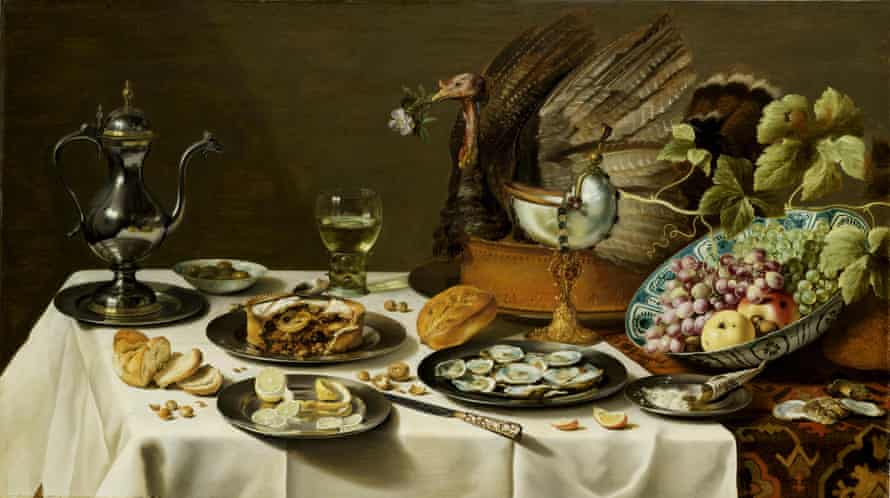
Still Life with a Turkey Pie, by Pieter Claesz, 1627.
Still Life with a Turkey Pie, by Pieter Claesz, 1627. Photograph: FineArt/Alamy

Stone tools in particular “fast-forward” the ability of humans to find delicious food. “Once they can hunt, using spears, they have access to this whole world of foods that were not available to them before.”

At this point, Dunn thinks humanity’s pursuit of tasty food started to have terrible consequences for other species. “We know that humans around the world hunted species to extinction, once they figured out how to hunt really effectively.”

Dunn strongly suspects that the mammals that first went extinct were the most delicious ones. “From what we were able to reconstruct, it looks like the mammoths, mastodons and giant sloths all would have been unusually tasty.”Paleolithic diet may not have been that ‘paleo’, scientists sayRead more

To replicate the eating habits of prehistoric humans, the book, published later this month, details how one scientist dropped a horse who had just died into a pond and assessed how it fermented over time. “He would sample some meat to see if it was safe to eat. He described it as delicious – a little bit like a blue cheese,” said Dunn.
4-MILLION-YEAR-OLD HAND DEBUNKS A POPULAR THEORY OF HUMAN EVOLUTION

New research reveals insight into the common ancestor of humans and chimpanzees.Getty ImagesTARA YARLAGADDA21 HOURS AGO

https://www.inverse.com/science/ardipithecus-ramidus-hand-fossil-study

TARZAN SWINGING FROM TREE TO TREE might seem like a Hollywood attempt at imagining the life of primitive men, but new findings suggest our ancient ancestors really were swingers.

The study seemingly resolves a long-standing scientific debate over our ancestor’s ability for brachiation — the ability to swing from tree limbs only using one’s arms. Before this ancestor experienced an evolutionary shift toward using hands for tools and legs for walking, they likely knuckle-walked on the ground and glided across canopies.https://8bd6507af59628a2d1728abcb566e967.safeframe.googlesyndication.com/safeframe/1-0-37/html/container.html

MORE LIKE THIS

SCIENCE2.23.2021 4:05 PM10,000-YEAR-OLD DOG BONE CHANGES WHAT WE KNOW ABOUT THE FIRST AMERICANSBy TARA YARLAGADDASCIENCE2.11.2021 4:00 AMLIVING FOSSILS: 6 ANCIENT ANIMALS THAT ARE STILL EVOLVINGBy BRYAN LAWVERSCIENCE2.23.2021 5:00 PMTHE SECRET TO CANCER RESEARCH MAY LIE IN THIS 1 MARINE MAMMALBy TARA YARLAGADDA

EARN REWARDS & LEARN SOMETHING NEW EVERY DAY.

SUBMIT

WHAT’S NEW — Research published Wednesday in the journal Science Advances suggests the last common ancestor of hominids — a category of great apes that includes chimpanzeesgorillasorangutans, and humans — climbed and swung in trees.

“Our findings support the view that humans and chimpanzees evolved from an ancestor that had similarities to modern apes in their locomotor adaptation,” lead author Thomas C. Prang, an assistant professor at Texas A&M University, tells Inverse.

SOME BACKGROUND — Most scientists recognize that the highly dextrous human hand seems to differ in shape and form from the hands primates use to swing from trees.

However, this evidence has given rise to a disputed hypothesis: Humans evolved from a quadrupedal ancestor that used all four limbs for movement on the ground, rather than a bipedal ancestor that suspends from trees.

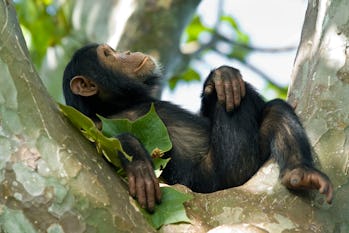
A chimpanzee in a tree. The researchers suggest the ancient ancestor of humans swung from trees like chimps. Getty

https://8bd6507af59628a2d1728abcb566e967.safeframe.googlesyndication.com/safeframe/1-0-37/html/container.html

Proponents of this hypothesis believe the last common ancestor was more “monkey-like” and less similar to, say, chimpanzees or bonobos.

The researchers in this study were skeptical of this idea and wanted to test its merits.

HOW THEY DID IT — Researchers used a sample of 400-plus specimens, encompassing both living primates and ancient hominoid fossils.

First, researchers analyzed the ancient hand bones of Ardipithecus ramidus, which believers of the disputed hypothesis use to support their idea regarding a quadrupedal last common ancestor. Ardipithecus ramidus is a human ancestor that lived nearly 4.4 million years ago. Our understanding of it is predominantly linked to a partial skeleton found in 2009, nicknamed ‘Ardi.’

The initial interpretation of this hand suggested the last common ancestors of humans and chimpanzees used a form of locomotion called “above-branch clambering,” Prang explains.

The remains of Ardipithecus ramidus.Raphael GAILLARDE/Gamma-Rapho via Getty Image

He doubts this interpretation for one reason: monkeys and lemurs are the only primates that use above-branch climbing, and their much smaller bodies use external tails to help them with tree climbing — unlike the subject of their study.

“The inference of ‘above-branch’ adaptations in Ardipithecus is somewhat problematic since it’s chimpanzee-sized and lacks an external tail [like all apes and humans],” Prang says.

To test it, Prang and his colleagues reconstructed the evolution of the hominin hand and how it may have adapted in ancient environments.

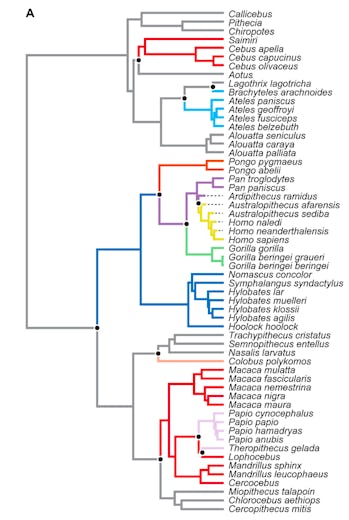
A figure from the study showing the evolution of hands in various hominoids, including humans and Neanderthals.

WHAT THEY FOUND — The results showed that Ar. ramidus was most similar to chimpanzees, bonobos, and orangutans compared to “non-suspensory” monkeys. Overall, they compared the specimen across a sample of 53 anthropoid primate species.

Ar. ramidus had these suspensory traits — which enabled them to swing from tree branches — before a significant evolutionary shift occurred with the lineages of Homo (humans) and Australopithecus, an ancient ancestor of hominins, which includes humans and chimpanzees.

“The hand of Ardipithecus suggests that the last common ancestor of humans and chimpanzees was adapted to climbing tree trunks and suspending the body beneath branches,” Prang says.

The study, in turn, is framed as a debunking of the earlier hypothesis suggesting hominins evolved from an ancestor “with a generalized hand that lacked suspensory adaptations.”

According to Prang, the study also indicates an important evolutionary step related to the development of tool use.

“We show a major evolutionary jump between the hand of Ardipithecus and all later hominins that happens to coincide with the loss of tree climbing adaptations in the foot and the earliest known stone tools and stone tool-cut-marked animal fossils,” Prang says.

This finding provides support for the idea that Ar. ramidus displayed an early form of bipedalism — or the ability to walk upright on two legs — which helps us understand how human hands and feet evolved.

“Our study provides some support for the hypothesis that human hands and feet ‘co-evolved,’ which previous studies have suggested on the basis of comparisons of patterns of hand/foot trait relationships, and evolutionary simulations, among humans and chimpanzees,” Prang says.

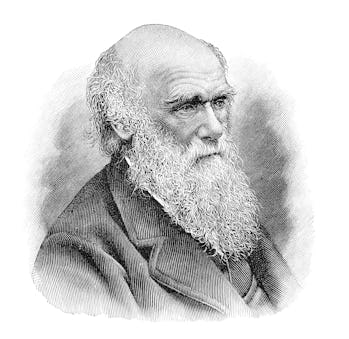
The researchers refer to Charles Darwin, the father of evolutionary theory, in discussing the implications of their findings.Getty

DIGGING INTO THE DETAILS — The researchers’ new findings harken back to the works of more historical evolutionary scholars.

“Our analysis is much more consistent with what people like Thomas Henry Huxley and Sir Arthur Keith proposed in the late 19th and early 20th century based on anatomical comparisons between humans and apes,” Prang says.

The most notable of these historical scholars is Charles Darwin, the father of evolution. Prang connects Darwin’s work to their findings on bipedalism in the ancient specimen, which can help explain human evolution.

“The classic idea attributed to Darwin is that bipedalism ‘freed the hands’ from their primary role in quadrupedal locomotion, which enabled natural selection to push hand anatomy in a new direction [directly or indirectly] related to manual dexterity, possibly useful for the manufacture and use of stone tools,” Pran says.

WHY IT MATTERS — According to the study, these findings “resolve a long-standing debate about the role of suspension in the ancestry of humans.”

Alexandros Karakostis, a hand biomechanics expert not affiliated with the study, describes the findings to Inverse as “very intriguing.” It provides a robust answer to “a heated debate,” Karakostis says — although it’s a debate that’s likely to continue.

“In this context, this new study identifies suspensory adaptations in the 4.4 million-year-old hand remains of Ardipithecus ramidus, suggesting that human hand morphology may have emerged from an evolutionary shift between Ardipithecus and Australopithecus,” he says.

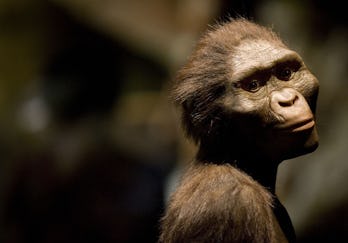
A sculptor’s rendering of the hominid Australopithecus afarensis. The researchers in this study discuss the evolution of Australopithecus. Getty

WHAT’S NEXT — In the future, the study team wants to examine the Ardipithecus hand in more detail.

Ameline Bardo, a postdoctoral research associate at the University of Kent not affiliated with the study, agrees a more detailed analysis of the hand bones would be necessary to “better understand the links between form and function of his hand.” This analysis, Bardo tells Inverse, may contribute to an understanding of the ancient creature’s movements.

Overall, Bardo views the study as “very well done” and contributes to the idea “early hominins evolved from an ancestor with a varied positional repertoire including suspension and vertical climbing.”

The study team is most excited to explore the paper’s implications for the evolution of great apes and humans

“If it is true that humans and chimpanzees evolved from an African ape-like ancestor, it implies that each African ape lineage evolved at different rates,” Prang says.

“It will be important to think about the evolutionary histories of African ape populations and how the evolutionary process might have shaped their anatomy and behavior over the last several million years.”

Abstract: The morphology and positional behavior of the last common ancestor of humans and chimpanzees are critical for understanding the evolution of bipedalism. Early 20th century anatomical research supported the view that humans evolved from a suspensory ancestor bearing some resemblance to apes. However, the hand of the 4.4-million-year-old hominin Ardipithecus ramidus purportedly provides evidence that the hominin hand was derived from a more generalized form. Here, we use morphometric and phylogenetic comparative methods to show that Ardipithecus retains suspensory adapted hand morphologies shared with chimpanzees and bonobos. We identify an evolutionary shift in hand morphology between Ardipithecus and Australopithecus that renews questions about the coevolution of hominin manipulative capabilities and obligate bipedalism initially proposed by Darwin. Overall, our results suggest that early hominins evolved from an ancestor with a varied positional repertoire including suspension and vertical climbing, directly affecting the viable range of hypotheses for the origin of our lineage.

Russia reports first human cases of H5N8 bird flu

https://www.bloomberg.com/news/articles/2021-02-20/russia-reports-first-cases-of-h5n8-bird-flu-in-humans-kldwj8sh

Avatar

Published 1 day ago


on February 20, 2021

ByBNO News

File photo (Credit: OIE)

ADVERTISMENThttps://1cfbbfa777c779f35fffbc87baf52a27.safeframe.googlesyndication.com/safeframe/1-0-37/html/container.html


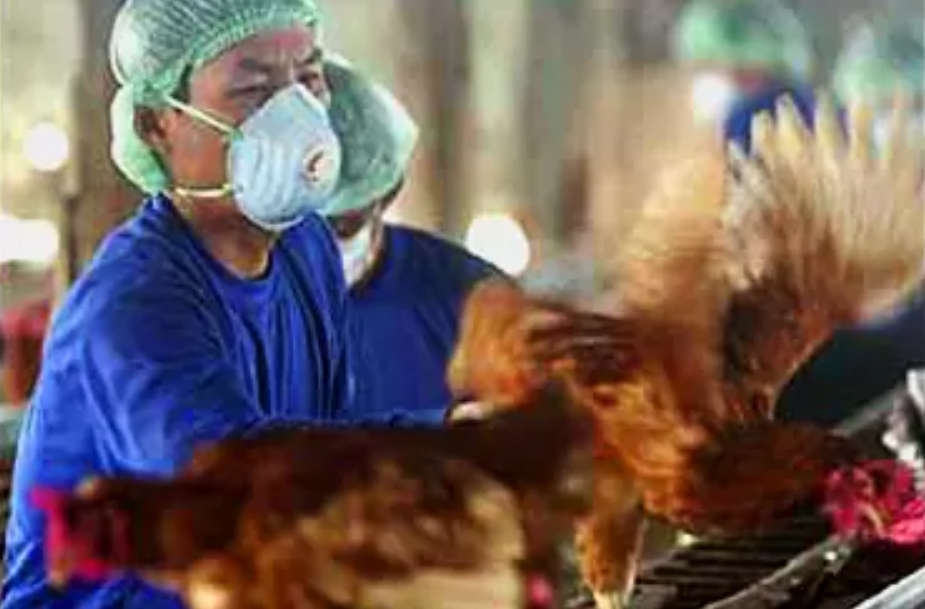
Seven people at a poultry farm in southern Russia have been infected with H5N8 bird flu, officials say, making it the first time that the highly pathogenic virus has been found in humans. There is no evidence of human-to-human transmission.

“Today, I want to inform you about an important scientific discovery made by scientists at the Vector scientific center,” Anna Popova, the head of Russia’s consumer health watchdog, said on Saturday. “The first cases of human infection with [avian influenza A(H5N8)] have been laboratory confirmed.”

The virus was found in seven employees at a poultry farm in southern Russia, where outbreaks of H5N8 were reported in the bird population in December 2020. Popova described the human cases as “mild,” according to the Interfax news agency.

“The virus can be transmitted from birds to humans, it has overcome the interspecies barrier,” Popova said. “As of today, this variant of the influenza virus is not being transmitted from person to person. Only time will tell how quickly future mutations will allow it to overcome this barrier.”


ADVERTISMENThttps://googleads.g.doubleclick.net/pagead/ads?guci=2.2.0.0.2.2.0.0&client=ca-pub-5612069200800828&output=html&h=250&slotname=3363636700&adk=1761723099&adf=864646117&pi=t.ma~as.3363636700&w=300&lmt=1613934095&psa=0&format=300×250&url=https%3A%2F%2Fbnonews.com%2Findex.php%2F2021%2F02%2Frussia-first-human-cases-of-h5n8-bird-flu%2F&flash=0&wgl=1&dt=1613934094603&bpp=11&bdt=2344&idt=881&shv=r20210211&cbv=r20190131&ptt=9&saldr=aa&abxe=1&prev_fmts=0x0%2C1123x280&nras=1&correlator=7147899621760&frm=20&pv=1&ga_vid=2109233644.1613934094&ga_sid=1613934095&ga_hid=1357983968&ga_fc=0&u_tz=-480&u_his=1&u_java=0&u_h=640&u_w=1139&u_ah=607&u_aw=1139&u_cd=24&u_nplug=3&u_nmime=4&adx=261&ady=1797&biw=1123&bih=538&scr_x=0&scr_y=0&eid=44735931%2C21068084%2C21068769%2C21068893%2C21068945&oid=3&pvsid=4342791699074456&pem=824&ref=https%3A%2F%2Fwww.google.com%2F&rx=0&eae=0&fc=1920&brdim=0%2C0%2C0%2C0%2C1139%2C0%2C1139%2C607%2C1139%2C537&vis=1&rsz=%7C%7CoeEbr%7C&abl=CS&pfx=0&fu=8192&bc=31&ifi=3&uci=a!3&btvi=1&fsb=1&xpc=QpDXEyTYKh&p=https%3A//bnonews.com&dtd=909


Popova said the discovery will help researchers prepare for the possibility of human-to-human transmission of the H5N8 virus. Detailed information about the cases has been submitted to the World Health Organization.

H5N8 has been found in birds since at least 1983 and outbreaks have occurred frequently since 2014, when it was found in breeding ducks in South Korea. Numerous outbreaks have been reported during the past 6 months, including in France, Germany, Italy, Spain, the UK, China, Japan, and South Korea.

“The H5N8 type influenza is regarded as pathogenic and is currently manifesting itself in a variety of ways, from asymptomatic and sub-clinical to highly lethal in some populations,” the World Organization for Animal Health (OIE) said in an update about recent outbreaks.

Human cases of H5 viruses are rare but are typically found in those who have contact with sick or dead birds.

239 human cases of H5N1 bird flu have been reported in China and Southeast Asia since 2003, killing 134 people, according to WHO. More recently, two people in China were infected with the H5N6 variant in January, causing the death of a three-year-old girl.

“Community awareness of the potential dangers for human health is essential to prevent infection in humans,” WHO said in a public health assessment for H5 viruses. “Surveillance should be continued to detect human cases and early changes in transmissibility and infectivity of the viruses.”

Traffic Sounds Make It Harder for Birds to Think, Scientists Find

 Olivia RosaneFeb. 05, 2021 02:08PM ESTANIMALS

Traffic Sounds Make It Harder for Birds to Think, Scientists Find

Traffic noises can impair the ability of songbirds to learn skills, a new study finds. savoilic / iStock / Getty Images Plus

If you’ve ever had a hard time thinking when a noisy truck rattles by, you’re not alone.

A study published in the Proceedings of the Royal Society B Wednesday found that traffic noises can impair the ability of songbirds to learn. In some cases, birds took twice as long to figure out new skills when listening to road sounds.

“While our expectation was that noise would reduce cognitive performance, I was a bit surprised by the extent of the effect we observed,” study coauthor and Pacific University associate professor Christopher Templeton told i. “The degree to which simply hearing cars drive by impacted cognitive performance was really striking.”https://c05e3a3397854cc4b82ca7d62da0eb95.safeframe.googlesyndication.com/safeframe/1-0-37/html/container.htmlReport Advertisement

A growing body of research shows that noise pollution can have a major impact on non-human animalsBBC News reported. A study published in September 2020 found that the relative quiet of lockdown enabled male white-crowned sparrows in San Francisco to sing a higher quality song that was more attractive to females. Under the sea, shipping noises have been shown to stop humpback whales from singing. However, Wednesday’s study was the first to show how noise pollution harms cognitive ability in animals, its authors told AFP.

To achieve their results, the researchers gave zebra finches a series of tasks that mimic the process of searching for food, BBC News explained. These included finding food beneath flipping lids designed to resemble leaves or figuring out how to access food in a cylinder. The researchers had the birds attempt the tasks without noise and also while a recording of traffic sounds played in the background. (The level of noise resembled road noise in a semi-rural area, AFP explained.)

They found that the background noise had a big impact on the birds’ ability to complete the tasks.

“In some cases, we observed that it took animals more than twice as long to learn new skills when they heard road traffic played at natural sounds levels,” Templeton told i. “For example, learning to remember the location of a hidden food reward took control birds about nine trials, but those exposed to traffic noise took on average 18 trials to learn the same task.”

The birds’ performance was also impaired on tasks that required them to control impulses, distinguish different colors and learn from each other. The only ability that was not impacted was their ability to link a color to a food reward.https://c05e3a3397854cc4b82ca7d62da0eb95.safeframe.googlesyndication.com/safeframe/1-0-37/html/container.htmlReport Advertisement

“This has significant implications for how well they can get along in life,” Templeton told AFP.

The zebra finch study was not the only research published this week that highlighted the dangers of road noise for wildlife. Another study published in Behavioral Ecology found that traffic noise impacted the mating success of the two-spotted cricket. Male crickets in this species sing by rubbing their wings together, and female crickets choose a mate based on the quality of their song. The researchers found that traffic and white noise lowered the crickets’ mating success rate from 90 to 70 percent.

“Mate choice decisions can have strong implications on the success and viability of offspring,” study lead author and University of Cambridge zoologist Adam Bent told AFP. “This could disrupt the evolution of this species.”

Bent said there was not much research on the impact of noise on insects. His study adds more evidence that the sounds we make cause disruption across the animal kingdom.

“It’s quite sad,” Templeton told BBC News. “It’s getting really, really difficult to find totally quiet environments not touched by human noise.”

However, he said there were solutions, especially to the problem of traffic sounds.

“But we can change road surfaces, think about redesigning a vehicle’s tyres. I think there’s great scope for trying to reduce noise – we just have to be clever with our engineering,” he said.https://c05e3a3397854cc4b82ca7d62da0eb95.safeframe.googlesyndication.com/safeframe/1-0-37/html/container.htmlReport Advertisement

Is our most distant animal relative a sponge or a comb jelly? Our study provides an answer

DECEMBER 14, 2020

by Max Telford, The Conversation

https://phys.org/news/2020-12-distant-animal-relative-sponge-jelly.html

The theory of evolution shows that all of life stems from a single root and that we are related, more or less distantly, to every other living thing on Earth. Our closest ancestors, as Charles Darwin recognized, are to be found among the great apes. But beyond this, confusion over the branching pattern of the tree of life means that things become less clear.

We know that life evolved from a common universal ancestor that gave rise to bacteria, archaea (other types of single-celled microorganisms) and eukaryotes (including multi-cellular creatures such as plants and animals). But what did the first animals look like? The past ten years have seen a particularly heated debate over this question. Now our new study, published in Science Advances, has come up with an answer.

Sponge vs comb jelly

From the 19th century to about ten years ago, there was general agreement that our most distant relatives are sponges. Sponges are so different from most animals that they were originally classified as members of the algae. However, genes and other features of modern sponges, such as the fact that they produce sperm cells, show that they certainly are animals. Their distinctness and simplicity certainly fit with the idea that the sponges came first.

But over the past decade, this model has been challenged by a number of studies comparing DNA from different animals. The alternative candidates for our most distant animal relatives are the comb jellies: beautiful, transparent, globe-shaped animals named after the shimmering comb-rows of cilia they beat to propel themselves through the water.

Comb jellies are superficially similar to jellyfish and, like them, are to be found floating in the sea. Comb jellies are undoubtedly pretty distant from humans, but, unlike the sponges, they share with us advanced features such as nerve cells, muscles and a gut. If comb jellies really are our most distant relatives, it implies that the ancestor of all animals also possessed these common features. More extraordinarily, if the first animals had these important characters then we have to assume that sponges once had them but eventually lost them.

Tracing the evolutionary treehttps://googleads.g.doubleclick.net/pagead/ads?guci=2.2.0.0.2.2.0.0&client=ca-pub-0536483524803400&output=html&h=280&slotname=5350699939&adk=3784993980&adf=1857921027&pi=t.ma~as.5350699939&w=753&fwrn=4&fwrnh=100&lmt=1607976000&rafmt=1&psa=1&format=753×280&url=https%3A%2F%2Fphys.org%2Fnews%2F2020-12-distant-animal-relative-sponge-jelly.html&flash=0&fwr=0&rpe=1&resp_fmts=3&wgl=1&adsid=ChEIgLfc_gUQ17atyMLI5oycARJMAOmZ4VFS9FL0yL2-5YpouilpGyW0gBryAK_J2PMyYDQ13aHc8cLYvLK_4QijpUTgyP6vWBKsOkwMsdcvhK_JcpIJj4ZhCdU6IOy9-Q&tt_state=W3siaXNzdWVyT3JpZ2luIjoiaHR0cHM6Ly9hZHNlcnZpY2UuZ29vZ2xlLmNvbSIsInN0YXRlIjowfSx7Imlzc3Vlck9yaWdpbiI6Imh0dHBzOi8vYXR0ZXN0YXRpb24uYW5kcm9pZC5jb20iLCJzdGF0ZSI6MH1d&dt=1607975993916&bpp=31&bdt=340&idt=738&shv=r20201203&cbv=r20190131&ptt=9&saldr=aa&abxe=1&cookie=ID%3D5d55f89f953c9743-226937f255c500eb%3AT%3D1607975994%3ART%3D1607975994%3AS%3DALNI_MbpNYCRwOcBkY2jqaYGvoErrRXnuQ&prev_fmts=0x0&nras=1&correlator=8200622149384&frm=20&pv=1&ga_vid=185394846.1565457508&ga_sid=1607975995&ga_hid=1008334346&ga_fc=0&u_tz=-480&u_his=1&u_java=0&u_h=640&u_w=1139&u_ah=607&u_aw=1139&u_cd=24&u_nplug=3&u_nmime=4&adx=263&ady=2397&biw=1123&bih=538&scr_x=0&scr_y=250&eid=42530671%2C21066435&oid=3&pvsid=1434179952040310&pem=466&rx=0&eae=0&fc=896&brdim=0%2C0%2C0%2C0%2C1139%2C0%2C1139%2C607%2C1139%2C537&vis=1&rsz=%7C%7CpEebr%7C&abl=CS&pfx=0&fu=8320&bc=31&jar=2020-12-14-19&ifi=1&uci=a!1&btvi=1&fsb=1&xpc=CAFvASMeBz&p=https%3A//phys.org&dtd=6692

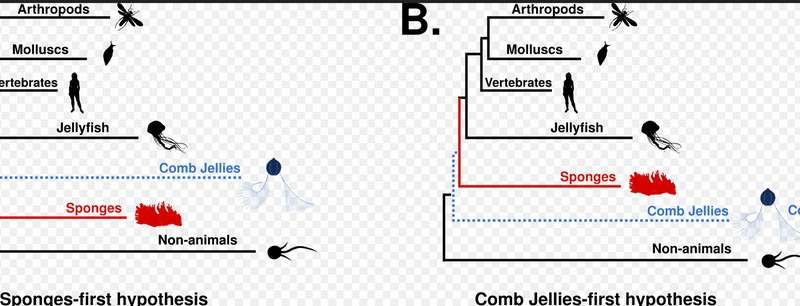
To understand how species evolved, scientists often use phylogenetic trees, in which the tips of the branches represent species. The points where branches split represent a common ancestor. The below image shows an example of a phylogenetic tree in which the sponge splits off first, and one in which the comb jelly splits off first.

Both the sponges-first and comb jellies-first evolutionary trees have been supported by different studies of genes, and the dispute seems to have resulted in a transatlantic stalemate, with most Europeans preferring the traditional sponges-first and the North Americans generally preferring the novel comb jellies-first.

The argument boils down to a question of how best to analyze the copious genetic data we now have available. One possibility put forward by the sponges-first supporters is that the animal tree that put comb jellies first is the result of an error. The problem occurs when one of the groups being studied has evolved much faster than the others. Fast evolving groups often look like they have been around for a long time. The comb jellies are one such group. Could the fast evolution of the comb jellies be misleading us into thinking they arose from an earlier split than they really did?

Are we being fooled by jellies?

We have approached this problem in a new way—directly investigating the possibility that the fast-evolving comb jellies are fooling us. We wanted to ask whether the unequal rates of evolution we see in these animals are likely to result in a wrong answer.

Is our most distant animal relative a sponge or a comb jelly? Our study provides an answer
Two different evolutionary trees. Author provided

Our new way of working was to dissect the problem by simulating how DNA evolution happens using a computer. We started with a random synthetic DNA sequence representing an ancestral animal. In the computer, we let this sequence evolve, by accumulating mutations, under two different conditions—either in accordance with the sponge-first model or the comb jelly-first model. The sequences evolve according to the branching patterns of each tree.

We ended up with a set of species with DNA sequences that are related to one another in a way that reflects the trees they were evolved on. We then used each of these synthetic data sets to reconstruct an evolutionary tree.

We found that when we built trees using data simulated according to the comb jellies-first model, we could always easily correctly reconstruct the tree. That’s because the bias coming from their fast rate of change actually reinforced the information from the tree—in this case also showing they are the oldest branch. The fact that the tree information and the bias both point in the same direction guarantees we would get the right result. In short, if the comb jellies really were the first branch, then there would be no doubt about it.

When we simulated data with the sponges as the first branch, however, we very often reconstructed the wrong tree, with the comb jellies ending up as the first branch. This is clearly a more difficult tree to get right and the reason is that the tree information—in this case showing that the sponges are the oldest branch—is contradicted by the bias coming from the fast evolving comb jellies (which supports comb jellies-first).

The long branch leading to the comb jellies can indeed cause them to appear older than they really are and this difficulty reconstructing the tree is exactly what we encounter with real data.

So, who came first? The chances are that the genetic analyzes suggesting that comb jellies came first may in fact suffer from not accounting for the bias that makes these animals look older than they really are. In the end, our work suggests that the sponges really are our most distant animal relatives.


Explore furtherComb jellies make their own glowing compounds instead of getting them from food

A Brief History of Hunting Animals to Extinction (complete text)

A Brief History of Hunting Animals to Extinction

by Jim Robertson President, Committee to Abolish Sport Hunting

I could begin this historical overview with the Big Bang and the spreading out of all matter throughout the once-empty universe, followed by the resultant formation of stars and the planets which took up orbit around them, but for the sake of promised brevity, I’ll skip ahead a few billion years and focus on the fully-formed, sufficiently-cooled Earth. And as far as the ongoing human-driven extinction spasm, our story must skip on to the final few moments of a12-hour timescale.

If you’re with me so far, we’re talking about the arrival of the most cunning, ruthless, self-aggrandizing. overly-intelligent primate species ever to reach the dead-end at which we now find ourselves, thanks to hunting. Hunting and meat-eating in general.

Evolution is the process through which dinosaurs sprouted wings and gave rise to birds, horses grew from equines the size of miniature ponies to mustangs (while controlled breeding spawned thoroughbreds and behemoth Clydesdales—and actual miniature ponies) and wolves led to dogs (resulting in pugs, poodles and Great Pyrenees).

Meanwhile, primates evolved from tree shrews not long (well, a couple of million years) after the extinction of the (un-feathered) dinosaurs some sixty-five million years ago, branching out and diversifying over time to become plant-eating specialists in their chosen niches.

Humans and their direct fore-bearers were the only primates to follow the path of carnivism and become full-time predators of everyone else they came across, including other species of primates and hominids—many of whom were likely hunted to extinction early on in human evolution. No one can say which was the first species that humans wiped off the face of the planet, or when. Chances are it was another primate, somewhere between 100,000 and a million years ago.

No doubt any other hominids around at the time were hunted down and killed as competition. Homo Sapiens may not have always eaten their conquests, but modern-day trophy hunters often don’t bother to eat their kills either.

Other species hunted to extinction partly for hubris or bragging-rights included mammoths, mastodons and any other relative of today’s elephants, as well as any early rhino or hippo human hunters could get their spears into.

Early species of giant armadillo and beaver, cave bear, camel, horse and ground sloth were all wiped out when pioneering pedestrians stumbled onto this continent full of unwary mega-fauna who had never met humans before and found their horns, hooves or bulk were no match for the weaponry of these new super-predators. This “American blitzkrieg” (as Jared Diamond, author of The Third Chimpanzee, Collapse and Guns, Germs and Steel labeled it) marked the tragic, catastrophic end of 75% of North America’s indigenous large mammals, including the American lion, dire wolves and saber-toothed cats—none of whom were prepared for humans’ hunting tactics. 

Even back in the Pleistocene, so-called “modern” humans (not the ones of today’s world, glued to their smartphones), armed only with primitive weapons, quickly wiped out the noble mega-fauna that had taken millions of years to evolve.

The Pleistocene was a time of great diversity of life—it was in fact the most diverse period the Earth has ever known—but a few centuries after our species were on the scene they had already hacked away at Nature’s masterpiece and started an unparalleled extinction event. It was the first time that one intelligent species was responsible for eternally snuffing out so many of its larger-bodied brethren. No other species had caused the kind of damage as did this cleverly destructive, self-centered, weapon-wielding primate.

Early in pre-human evolution, bipedalism became a necessity for primate-predators, if only to free up a couple of appendages to carry clubs and spears—followed by bows, rifles and harpoon cannons. It seems our species never took the time (until now?) to look back to their earliest days of living by plant-eating. But, if a 500 lb gorilla can, surely the human primate can survive without animal flesh.

One of our species’ closest relatives is the orangutan, a highly intelligent primate who, like the gorilla, wouldn’t be caught dead eating meat. Both species are among the most critically endangered animals on Earth, hunted (poached) nearly to extinction outside zoos or other captive situations.

Human beings are one of four currently living species of “great” apes, including gorillas, chimpanzees and orangutans. Only one of those species is grossly (morbidly) overpopulated and routinely eats the flesh of other animals to excess. Care to guess which one? (No fair peaking at the shiny front cover of the grocery store ads that magically end up in your mailbox or the ubiquitous golden arches on the street corner.) Of course, it’s the humans. It’s interesting that the USDA still places meat and dairy in their essential food pyramid, when no other primate really needs those things. Hmm, it seems that the government is wrong about that. Do you suppose? Perhaps they need to take another look at that in context of the situations the world now faces.

The only one of our closest ape cousins still clinging to existence on the planet who has been observed to step out of the plant eating regimen of the monkeys, non-human great apes and other primates are the chimpanzees, who, while normally peaceful plant-eaters, will on rare occasions venture out on violent forays, killing and eating monkeys or other hapless creatures they come upon. Once a kill is made, the real excitement begins for the chimps, who loudly advertise their blood lust with whoops and screams, proclaiming their conquest.

Therein lies a grim parallel and exposes the roots of modern human’s sport hunting behavior.

Continuing on our rapid flash forward, we enter the European Middle Ages and a period when animals were farmed to feed the peasantry, while hunting became a sport reserved for the “elite.” Wolf trapping, sometimes practiced by lower castes, was smiled upon by the royalty since it took out the competition for their prized game species: stags, elk and other horned “lordly game” creatures, as Teddy Roosevelt would later dub them.

Speaking of Teddy, let’s skip ahead to Roosevelt’s era. After Europeans had made it their task to “settle” the New World, they infamously hunted the plains bison to near extinction in the 1800’s. During that same period, over-zealous hunters completely killed off the once amazingly abundant passenger pigeon and Eskimo curlew (both killed en mass and sold by the cartload for pennies apiece), the Carolina parakeet (the only parrot native to the U.S.), the great auk (a flightless, North Atlantic answer to the penguin) and the Steller’s sea cow (a Coastal Alaskan relative of the manatee). Of sea cows, the 19th Century German zoologist Georg Wilhelm Steller wrote in his journal that this peaceful, plant-eating herd animal showed “…signs of a wonderful intelligence…an uncommon love for one another, which even extended so far that, when one of them was hooked, all the others were intent upon saving him.”

Meanwhile, elk, bighorn sheep, wolves, grizzly bears and prairie dogs—once hunted, trapped and poisoned down to mere fractions of their original populations—continue to be targeted today. And when certain species, such as black bears, Canada geese and coyotes prove to have adapted to the human-dominated world, they are hated, hunted and trapped with a vengeance.  

In the words of the Fund For Animals founder, Cleveland Amory, “Theodore Roosevelt…could not be faulted for at least some efforts in the field of conservation. But here the praise must end. When it came to killing animals, he was close to psychopathic.” Dangerously close indeed (think: Ted Bundy).

In his two-volume, African Game Trails, Roosevelt lovingly muses over shooting elephants, hippos, buffaloes, lions, cheetahs, leopards, giraffe, zebra, hartebeest, impala, pigs, the less-formidable 30-pound steenbok and even a mother ostrich on her nest.

But don’t let on to a hunter what you think of their esteemed idol, because, as Mr. Amory wrote in his book, Mankind? Our Incredible War on Wildlife “…the least implication anywhere that hunters are not the worthiest souls since the apostles drives them into virtual paroxysms of self-pity.” Amory goes on to write, “…the hunter, seeing there would soon be nothing left to kill, seized upon the new-fangled idea of ‘conservation’ with a vengeance. Soon they had such a stranglehold [think: Ted Nugent] on so much of the movement that the word itself was turned from the idea of protecting and saving the animals to the idea of raising and using them–for killing. The idea of wildlife ‘management’–for man, of course–was born.” 

Almost without exception, state and federal wildlife “managers” are hunters themselves. Being both delegates and lackeys for the hunting industry, they would have us believe the preposterous party line that hunting helps animals—that they won’t continue to live unless we kill them. This is particularly outrageous in light of how many species have been wiped off the face of the earth, or nearly so, exclusively by human hunting.

Nowadays, hunting season is like a bunch of weapon-wielding, over-sized pre-schoolers on an Easter egg hunt creeping around the back-roads hoping a deer will jump out in front of them and stand still long enough for them to get a shot off. It doesn’t even have to be a good, clear shot, either. I’ve heard hunters bragging about taking a few “sound shots” at whatever they heard in the bushes, as if blasting their noisy rifles is the main reason to be out there (never mind the target).

But, it’s never quite as satisfyingly thrilling for them as making an actual kill, the carcass of which they are fond of displaying on the hoods or in the open beds of their brand new $60,000 pickup trucks.

“Survival” of the fittest? Don’t even get me started…

This article includes excerpts from the book, Exposing the Big Game: Living Targets of a Dying Sport

Plant evolves to become less visible to humans

NOVEMBER 20, 2020

https://phys.org/news/2020-11-evolves-visible-humans.html

by University of Exeter

Plant evolves to become less visible to humans
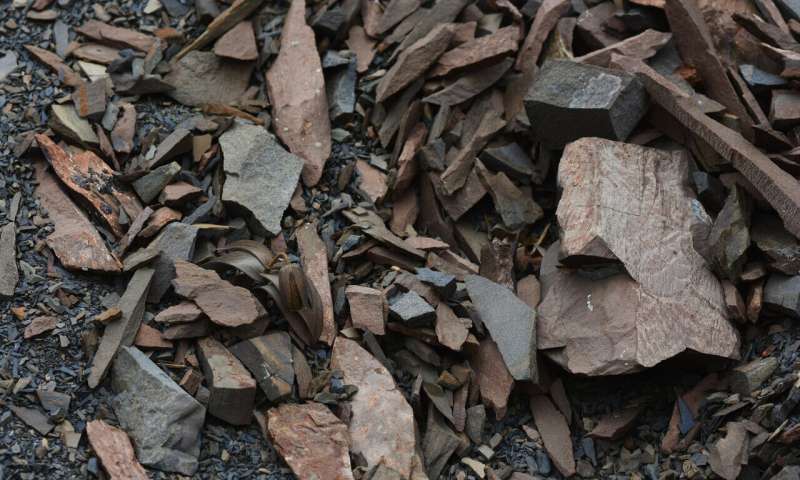
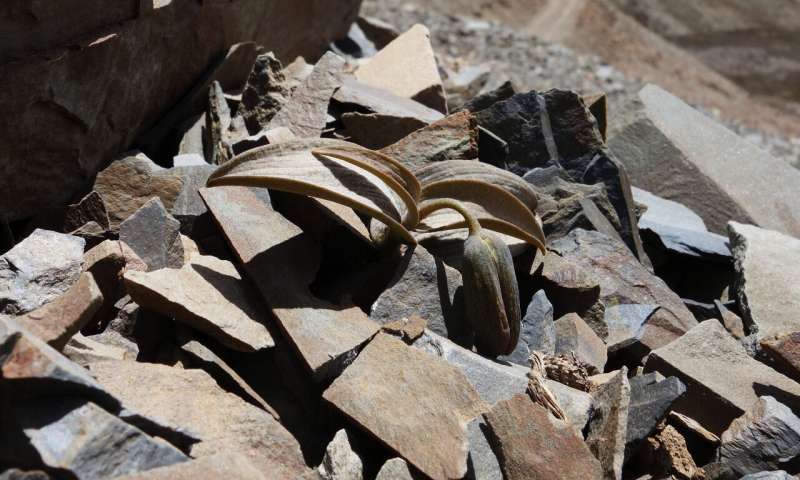
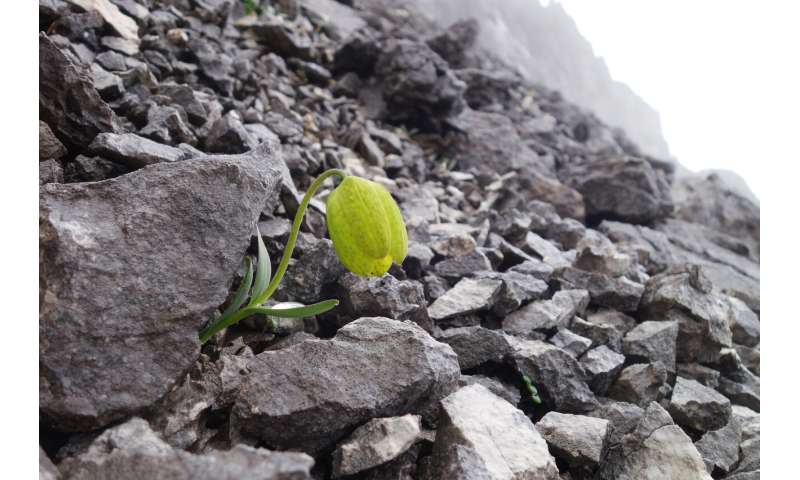
Fritillaria delavayi in a population with high harvest pressure. Credit: Yang Niu

A plant used in traditional Chinese medicine has evolved to become less visible to humans, new research shows.

Scientists found that Fritillaria delavayi plants, which live on rocky slopes of China’s Hengduan mountains, match their backgrounds most closely in areas where they are heavily harvested.

This suggests humans are “driving” evolution of this species into new colour forms because better-camouflaged plants have a higher chance of survival.

The study was carried out by the Kunming Institute of Botany (Chinese Academy of Sciences) and the University of Exeter.

“It’s remarkable to see how humans can have such a direct and dramatic impact on the colouration of wild organisms, not just on their survival but on their evolution itself,” said Professor Martin Stevens, of the Centre for Ecology and Conservation on Exeter’s Penryn Campus in Cornwall.

“Many plants seem to use camouflage to hide from herbivores that may eat them—but here we see camouflage evolving in response to human collectors.

“It’s possible that humans have driven evolution of defensive strategies in other plant species, but surprisingly little research has examined this.”

Plant evolves to become less visible to humans
Fritillaria delavayi in a population with high harvest pressure. Credit: Yang Niu

In the new study, the researchers measured how closely plants from different populations matched their mountain environment and how easy they were to collect, and spoke to local people to estimate how much harvesting took place in each location.

They found that the level of camouflage in the plants was correlated with harvesting levels.

In a computer experiment, more-camouflaged plants also took longer to be detected by people.

Fritillaria delavayi is a perennial herb that has leaves—varying in colour from grey to brown to green—at a young age, and produces a single flower per year after the fifth year.

Plant evolves to become less visible to humans
Fritillaria delavayi in a population with low harvest pressure. Credit: Yang Niu

The bulb of the fritillary species has been used in Chinese medicine for more than 2,000 years, and high prices in recent years have led to increased harvesting.

“Like other camouflaged plants we have studied, we thought the evolution of camouflage of this fritillary had been driven by herbivores, but we didn’t find such animals,” said Dr. Yang Niu, of the Kunming Institute of Botany. “Then we realised humans could be the reason.”

Professor Hang Sun, of the Kunming Institute of Botany, added: “Commercial harvesting is a much stronger selection pressure than many pressures in nature. “The current biodiversity status on the earth is shaped by both nature and by ourselves.”

The paper, published in the journal Current Biology, is entitled: “Commercial harvesting has driven the evolution of camouflage in an alpine plant.”

Jet hits brown bear mom, cub while landing in Alaska

1 hr ago

https://www.msn.com/en-us/travel/news/jet-hits-brown-bear-mom-cub-while-landing-in-alaska/ar-BB1b3RMM?ocid=msedgdhp


Guinea’s Conde says there is no ‘witch hunt’ against opponentsKylie Bunbury explores ‘Blackness in a very white’ Montana in ABC thriller…Jet hits brown bear mom, cub while landing in Alaska

In a first in Alaska Airlines history, a jet struck and killed a brown bear while landing Saturday, officials said.a large brown bear walking across a grass covered field© Provided by RADIO.COM

The Boeing 737-700 was landing at the Yakutat Airport in southeast Alaska when it struck both the mother and her cub, killing the mother and leaving the 2-year-old cub undamaged. None of the passengers or crew were injured.Works with every tool – Learndash Is OverkillUpload CaptivateEmbed RiseiFrame iSpringUpload RiseAdelearningfreak.com

According to Associated Press, although airport crew members had cleared the runway about 10 minutes before the flight was expected to land the jet landed in the dark and the staff didn’t see any signs of wildlife during their normal checks.

Only until after landing did the pilot spot the two bears, just as the jet slowed.

“The nose gear missed the bears, but the captain felt an impact on the left side after the bears passed under the plane,” Alaska Airlines said in a statement.

The pilots saw the bear lying about 20 feet (6 meters) from the center of the runway as the plane taxied to a parking area just before 6:30 p.m., the airline said.

The airport crew is accustomed to dealing with wildlife, plants have reportedly hit deer, geese, and caribou in the post, but never a bear. Employees are known to use pyrotechnics or vehicles to keep animals away from the runway.

The Alaska Department of Fish and Game was expected to collect the remains of the bear.

The left engine cowling of the jet was damaged, and the plane remained in Yakutat Sunday.

“Our maintenance technicians are working to repair the plane, which will take a couple of days,” Alaska Airlines said.

The Most Dangerous Animals in Washington

November 1, 2020 by Melissa Grant6 Comments

I’m about to give you some information you never knew you needed. This information was hard to find, took substantial screen squinting, rigorous reading of gruesome details and required me to deal with statistics. I hate statistics! So, you’re welcome!

I’m kidding. It was my curiosity that drove me to research and write this article. There seems to be a perception that our local wildlife is causing much human harm. If an alert goes out that a coyote, bear, or cougar was seen, the familiar refrain is, “Watch your kids and pets!” It is repeated so often that new residents become fearful, and even long-time residents think these animals are frequently killing and eating people.

Ask anyone what they think the number one killer animals of people in the state is, and you usually get a familiar answer: “Well, bears/cougars/wolves, of course!”

But is this the truth?

There are places on earth where people are in real danger of dying by some non-human related cause. According to the World Health Organization (WHO), the top worldwide animal killer is the mosquito.  “The estimated number of malaria deaths stood at 405,000 in 2018,” with 93% of those deaths in Africa. Southeast Asia is home to the Indian Cobra and responsible for an estimated 1.2 million deaths in India in the last 20 years. The sweetly named Kissing bug kills an estimated 20,000 people each year in Mexico, Central and South America by infecting them with Chagas disease.

Photo by Mohan Moolepetlu on Unsplash

According to the CDC, Washington State isn’t the state in which you are MOST likely to be killed by an animal. That honor goes to Montana. But it isn’t the LEAST likely either; that prize goes to Massachusetts. We fall somewhere in the middle. Surely with all our wild spaces and animals, our deadliest animal has got to be a bear or wolf, right?

Wrong.

Let’s start with our furry wild land mammals: These critters are the most talked about, after all, and should be near the top of the list.

Wolves: A recent hot topic in the area. Folks warn there was a reason our ancestors wholly extirpated this vile creature. The Gray Wolf Conservation and Management 2019 Annual Report showed 108 wolves in 21 packs, of which 10 were successful breeding pairs in 2019. The Confederated Tribes of the Colville Reservation had 37 wolves reported.  The 100-year count for fatal wolf attacks? Zero.

Coyotes: The coyote has historically resisted all efforts to exterminate its kind and flourishes in Washington with approximately 50,000 adults. Despite that high number, there have been no fatal coyote attacks in Washington, and only one confirmed in the United States ever.

Bears: Arguably, the most locally discussed animal. The Washington Department of Fish and Wildlife (WDFW) estimates their population to be about 25,000 statewide. In the past 100 years, there has been one fatal black bear attack in Washington.

Cougars: One of the most feared wild animals in the entire state. Local tales sometimes tell of school children being picked off at the bus stop. The latest WDFW census numbers estimate 2300 independent cougars (18+ months old. Adults are 24+ months) in the state. The last 100 years have seen two fatal attacks in Washington.

Well, that eliminates the big four worries. So, what are the animals most likely to cause your death in Washington State? I can’t give you a numbered list without going blind staring at the CDC wonder website, but I can tell you the most likely suspects.

Dogs: I started to count all of the fatal attacks over the last 100 years but didn’t want to read anymore. We have about 1,849,218 dogs in Washington State. There were 36 deadly dog attacks nationally in 2018

Hooved animals such as deer, elk, horses and cows: This number is likely higher nationally in places with more ranching, but our deer/elk caused traffic fatality average is about 1.5 a year. Nationally the number is about 122.

Bees and other stinging insects: Considered to be the country’s most lethal animal, bees and wasps account for 100 deaths annually nationwide. According to the CDC, the leading cause of animal caused death in Washington State.

Photo by Егор Камелев on Unsplash

There is one animal left, one that causes more deaths in Washington than any other. As of April 1, 2020, we have an estimated 7,656,200 people in the state. Our homicide mortality was 275 people. With an estimated 400,000 people dying every year from homicide, we had better take care we don’t catch up to mosquitoes and become the deadliest animal on the planet.

Photo by Jonas Koel on Unsplash

So, the next time someone regales you with how you should fear bears, cougars, and wolves, take care: you may be talking to a dangerous animal.