Exposing the Big Game

Forget Hunters' Feeble Rationalizations and Trust Your Gut Feelings: Making Sport of Killing Is Not Healthy Human Behavior

Exposing the Big Game

Humans and Big Ag Livestock Now Account for 96 Percent of Mammal Biomass

Human activity, including domesticating livestock, has had a major impact on earth’s biomass. Malcolm Morley~commonswiki

A first-of-its-kind study published Monday shows that, when it comes to impacting life on Earth, humans are punching well above our weight.

“I would hope this gives people a perspective on the very dominant role that humanity now plays on Earth,” lead researcher and Weizmann Institute of Science in Israel professor Ron Milo told The Guardian.

According to the study, human impacts are due to the combined effects of the agricultural and industrial revolutions. In particular, the domestication of livestock has caused a shift in the relative biomass of different species of mammals.

Humans account for about 36 percent of the biomass of all mammals. Domesticated livestock, mostly cows and pigs, account for 60 percent, and wild mammals for only 4 percent.

The same holds true for birds. The biomass of poultry is about three times higher than that of wild birds.

“It is definitely striking, our disproportionate place on Earth,” Milo told The Guardian. “When I do a puzzle with my daughters, there is usually an elephant next to a giraffe next to a rhino. But if I was trying to give them a more realistic sense of the world, it would be a cow next to a cow next to a cow and then a chicken.”

The study further broke down the human impact on terrestrial and marine mammals. Compared to the time before the human-abetted extinction of large megafauna, wild earth mammal biomass has decreased sevenfold. Marine mammal biomass has decreased fivefold due to commercial whaling and other exploitative hunting practices. Fish biomass has also fallen around 15 percent.

Milo told The Guardian that the results had encouraged him to reconsider his eating habits.

“I would hope people would take this [work] as part of their world view of how they consume,” he said. “I have not become vegetarian, but I do take the environmental impact into my decision making, so it helps me think, do I want to choose beef or poultry or use tofu instead?”

When it comes to the biomass of all life on earth, humans and their livestock are barely a blip. They only account for 8 percent of total animal biomass, while arthropods account for 50 percent.

Overall, animals have nothing on the other other kingdoms. Plants dominate, accounting for about 80 percent of all of the earth’s biomass, followed by bacteria at about 15 percent.

Since most plants are terrestrial, the study found that most of earth’s biomass is found on land, but most animal biomass is found in the oceans.

Biomass is different from biodiversity—insects, for example, contain a wide variety of species but account for a tiny percentage of biomass.

Researchers calculated biomass in gigatons of carbon and compiled data from a wide variety of studies to reach their conclusions.

Alyssa Milano Calls for ‘Sex Strike’ in Response to Georgia’s Anti-Abortion Law

https://www.thewrap.com/alyssa-milano-sex-strike-esponse-to-georgias-anti-abortion-law-sex-strike/

“JOIN ME by not having sex until we get bodily autonomy back,” actress-activist tweets

Last Updated: May 11, 2019 @ 9:49 AM

Alyssa Milano responded to Georgia’s anti-abortion law Friday night, calling for women to just say no to sex “until we get bodily autonomy back.”

“Our reproductive rights are being erased,” the actress-activist tweeted. “Until women have legal control over our own bodies we just cannot risk pregnancy. JOIN ME by not having sex until we get bodily autonomy back. I’m calling for a #SexStrike. Pass it on.”

ADVERTISING

The message was accompanied by a giant pink “x” and the caption “If our choices are denied, so are yours.”

Milano’s call to action by female voters kicks up her protest of Republican Gov. Brian Kemp’s signed state legislation this week banning abortions after a fetal heartbeat is detected as early as six weeks into a pregnancy. Earlier in the week, she championed a boycott of the state of Georgia as a location of filming and where the second season of Netflix’s “Insatiable” is currently in production.

“I will do everything in my power to get as many productions as possible — including ‘Insatiable’ — to move out of this state which continues to put forth oppressive, hurtful policy that contradicts everything the entertainment industry stands for,” Milano said in a statement to TheWrapThursday.

She added: “Obviously, those who are already contractually obligated to be there, should fight to get their show out of Georgia while continuing their contractual obligation. I have to be there for another three weeks but you can be sure I will fight tooth and nail to move ‘Insatiable’ to a state that will protect our rights. And if it doesn’t move to another state, I will not be able to return to the show if we are blessed with a third season. This is my leverage. I will use it for the betterment of society and our great country.”

According to Georgia Trend, the Peach State overtook California as the top location for production of feature films in 2016, leading to an economic impact of $9.5 billion in fiscal 2017 and $2.7 billion in direct spending.

Alyssa Milano

@Alyssa_Milano

Our reproductive rights are being erased.

Until women have legal control over our own bodies we just cannot risk pregnancy.

JOIN ME by not having sex until we get bodily autonomy back.

I’m calling for a . Pass it on.

The Rapid Decline Of The Natural World Is A Crisis Even Bigger Than Climate Change

A three-year UN-backed study from the Intergovernmental Science-Policy Platform On Biodiversity and Ecosystem Services has grim implications for the future of humanity.
 

Nature is in freefall and the planet’s support systems are so stretched that we face widespread species extinctions and mass human migration unless urgent action is taken. That’s the warning hundreds of scientists are preparing to give, and it’s stark.

The last year has seen a slew of brutal and terrifying warnings about the threat climate change poses to life. Far less talked about but just as dangerous, if not more so, is the rapid decline of the natural world. The felling of forests, the over-exploitation of seas and soils, and the pollution of air and water are together driving the living world to the brink, according to a huge three-year, U.N.-backed landmark study to be published in May.

The study from the Intergovernmental Science-Policy Platform On Biodiversity and Ecosystem Services (IPBES), expected to run to over 8,000 pages, is being compiled by more than 500 experts in 50 countries. It is the greatest attempt yet to assess the state of life on Earth and will show how tens of thousands of species are at high risk of extinction, how countries are using nature at a rate that far exceeds its ability to renew itself, and how nature’s ability to contribute food and fresh water to a growing human population is being compromised in every region on earth.

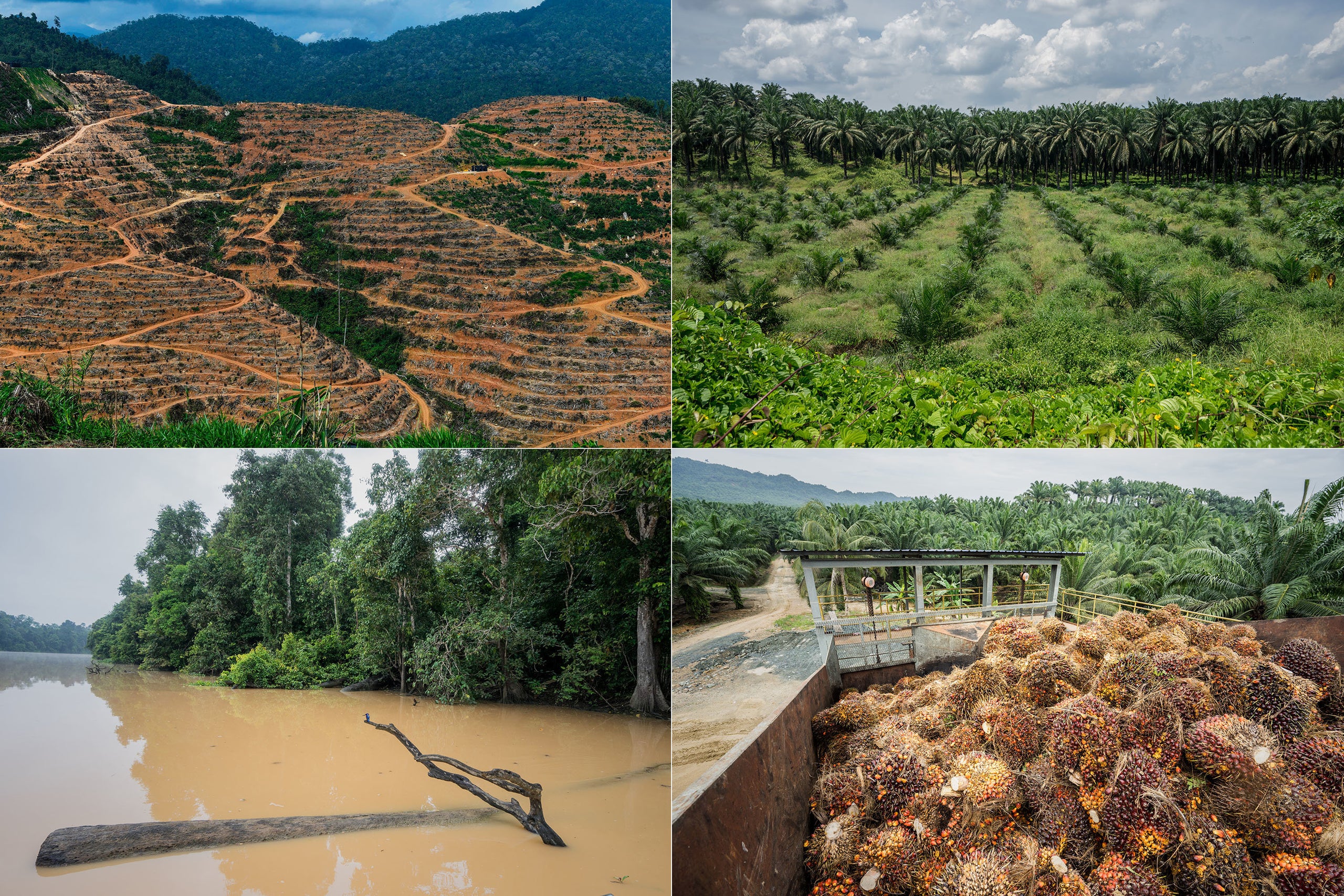
Left top: A durian plantation in Raub, on the outskirts of Kuala Lumpur. Soaring demand for durians in China is being blamed

Left top: A durian plantation in Raub, on the outskirts of Kuala Lumpur. Soaring demand for durians in China is being blamed for a new wave of deforestation in Malaysia.
Right top: A palm oil plantation encroaches on a wildlife reserve in Sabah, Malaysia.
Left bottom: The Kinabatangan River flows through a wildlife reserve in Sabah, Malaysia. The overuse of pesticides during the heavy equatorial rains creates a deadly runoff into the fragile river and its tributaries.
Right bottom: A palm oil plantation and factory in Sabah, Malaysia.

Nature underpins all economies with the “free” services it provides in the form of clean water, air and the pollination of all major human food crops by bees and insects. In the Americas, this is said to total more than $24 trillion a year. The pollination of crops globally by bees and other animals alone is worth up to $577 billion.

The final report will be handed to world leaders not just to help politicians, businesses and the public become more aware of the trends shaping life on Earth, but also to show them how to better protect nature.

“High-level political attention on the environment has been focused largely on climate change because energy policy is central to economic growth. But biodiversity is just as important for the future of earth as climate change,” said Sir Robert Watson, overall chair of the study, in a telephone interview from Washington, D.C.

“We are at a crossroads. The historic and current degradation and destruction of nature undermine human well-being for current and countless future generations,” added the British-born atmospheric scientist who has led programs at NASA and was a science adviser in the Clinton administration. “Land degradation, biodiversity loss and climate change are three different faces of the same central challenge: the increasingly dangerous impact of our choices on the health of our natural environment.”

Around the world, land is being deforested, cleared and destroyed with catastrophic implications for wildlife and people. Forests are being felled across Malaysia, Indonesia and West Africa to give the world the palm oil we need for snacks and cosmetics. Huge swaths of Brazilian rainforest are being cleared to make way for soy plantations and cattle farms, and to feed the timber industry, a situation likely to accelerate under new leader Jair Bolsonaro, a right-wing populist.

Industrial farming is to blame for much of the loss of nature, said Mark Rounsevell, professor of land use change at the Karlsruhe Institute of Technology in Germany, who co-chaired the European section of the IPBES study. “The food system is the root of the problem. The cost of ecological degradation is not considered in the price we pay for food, yet we are still subsidizing fisheries and agriculture.”

This destruction wrought by farming threatens the foundations of our food system. A February report from the U.N. warned that the loss of soil, plants, trees and pollinators such as birds, bats and bees undermines the world’s ability to produce food.

An obsession with economic growth as well as spiraling human populations is also driving this destruction, particularly in the Americas where GDP is expected to nearly double by 2050 and the population is expected to increase 20 percent to 1.2 billion over the same period.

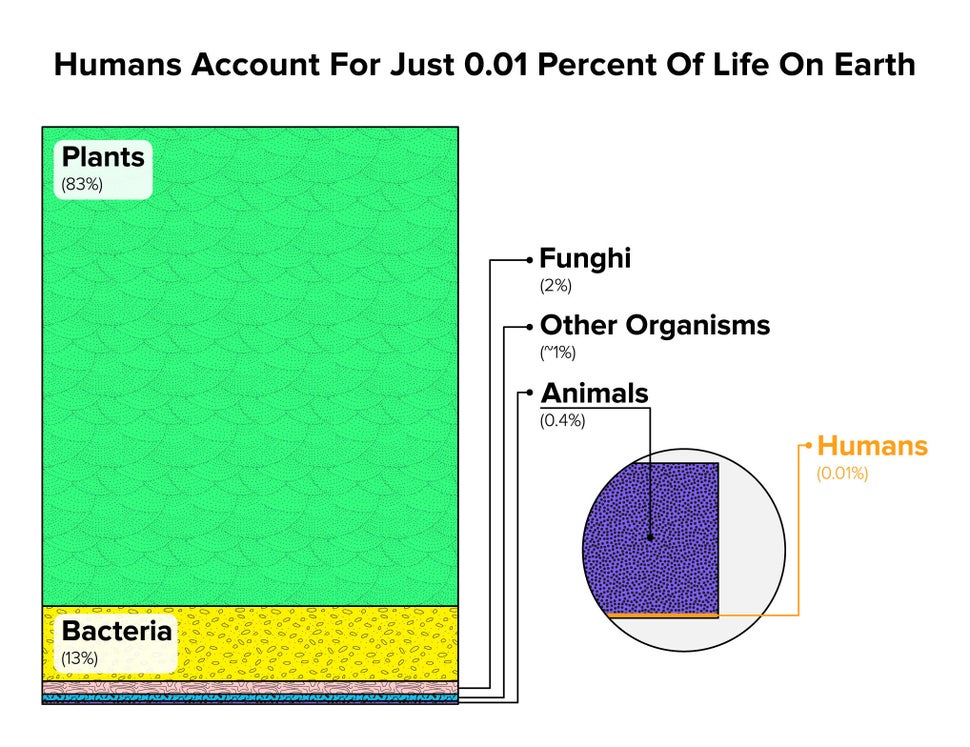
Human have had a huge impact on the world but we make up a tiny fraction of the living world. In the first ever calculation o

Human have had a huge impact on the world but we make up a tiny fraction of the living world. In the first ever calculation of the biomass of life on Earth, scientists found that humans make up just 0.01 percent of all living things. Source: Yinon M. Bar-On, Rob Phillips, and Ron Milo, PNAS, 2018

Nature is likely to be hit particularly hard over the next 30 years, said Jake Rice, chief scientist emeritus at the Canadian government’s department of oceans and fisheries, who co-chaired the Americas study. High consumption and destructive farming will further degrade land and marine ecosystems, he added, although the pace of destruction is diminishing because so much has already gone.

“The great transformation has already taken place in North America but the remote parts of South and Central America remain under threat. A new wave of destruction is transforming the Amazon and Pampas regions [of Latin America],” said Rice.

All of this comes at a huge cost and has implications for the systems that prop up life on this planet, throwing into doubt the ability of humans to survive.

Future generations will likely experience far less wildlife, said Luthando Dziba, head of conservation services at South African National Parks, who co-chaired the section of the IPBES report that focuses on Africa.

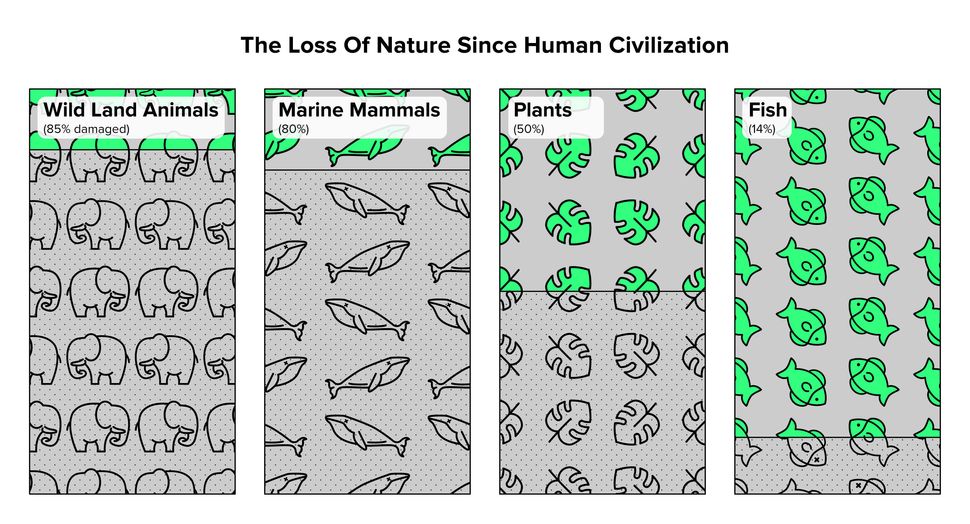
Humans have caused the loss of around 80 percent of wild land and marine mammals, and half of plants. Source: Yinon

Humans have caused the loss of around 80 percent of wild land and marine mammals, and half of plants. Source: Yinon M. Bar-On, Rob Phillips, and Ron Milo, PNAS, 2018

“Africa is the world’s last home for a wide range of large mammals but the scientific consensus is that under current scenarios to 2100 more than half of African bird and mammal species could be lost,” said Dziba.

Around 20 percent of Africa’s land surface has already been degraded by soil erosion, loss of vegetation, pollution and salinization, he said, adding that the expected doubling of the continent’s population to 2.5 billion people by 2050 will put yet further pressure on its biodiversity.

While people are familiar with the threats to whales, elephants and other beloved animals, the problem goes far deeper than that. Animal populations have declined by 60 percent since 1970, driven by human actions, according to a recent World Wildlife Fund study.

And insects, vital to the diets of other animals, as well as the pollinators of our food, are facing a bleak future as populations appear to be collapsing. Land use changes and increased pesticide use are destroying habitats and vastly reducing numbers. In Europe, up to 37 percent of bees and 31 percent of butterflies are in decline, with major losses also recorded in southern Africa, according to the pollinators section of the report.

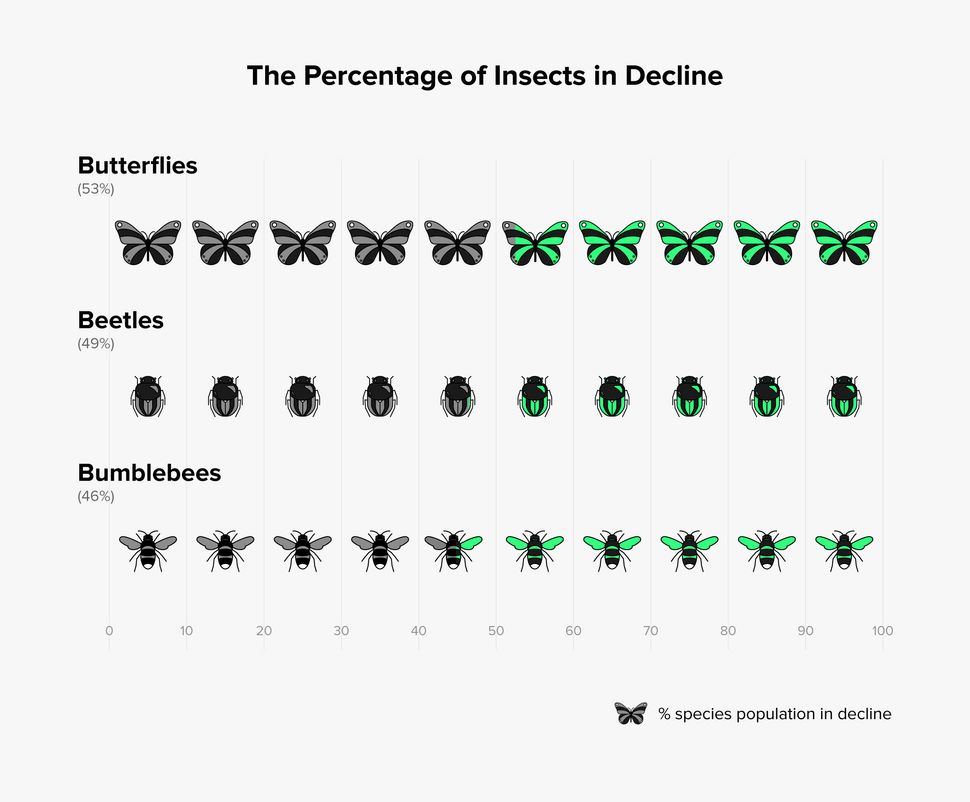
A major assessment of insect studies conducted over the last few decades found that 41 percent of insects are in decline. Sou

A major assessment of insect studies conducted over the last few decades found that 41 percent of insects are in decline. Source: Sánchez-Bayoa and Wyckhuy, Biological Conservation, 2019

“Species which are not charismatic have been politically overlooked,” said Rounsevell. “Over 70 percent of freshwater species and 61 percent of amphibians have declined [in Europe], along with 26 percent of marine fish populations and 42 percent of land-based animals … It is a dramatic change and a direct result of the intensification of farming,” he said.

This destruction is also driving mass human migration and increased conflict. Decreasing land productivity makes societies more vulnerable to social instability, says the report, which estimates that in around 30 years’ time land degradation, together with the closely related problems of climate change, will have forced 50 to 700 million people to migrate.

“It will just be no longer viable to live on those lands,” said Watson.

The study will also recognize that much of the remaining wealth of nature depends on indigenous people, who mostly live in the world’s remote areas and are on the frontline of the damage caused by destructive logging and industrial farming. According to IPBES, indigenous communities often know best how to conserve nature and are better placed than scientists to provide detailed information on environmental change.

Brazil – which nationwide hosts about 42,000 plant species, 9,000 species of vertebrates and almost 130,000 invertebrates – has an indigenous population of almost 900,000 people, says the report.

“What surprised me the most about this study was that it became clear that the older cultures, like the indigenous peoples of the Americas, have different values which protect nature better [than Western societies],” said Watson. “No one should romanticize indigenous peoples, and we cannot turn the clock back, but we can learn a lot from them on how to protect the planet.”

Indigenous people, however, continue to experience discrimination, threats and murder. In Brazil, for example, Bolsonaro’s election has cemented a pro-corporate, anti-indigenous agenda that has already started to undermine the rights of the country’s native communities.

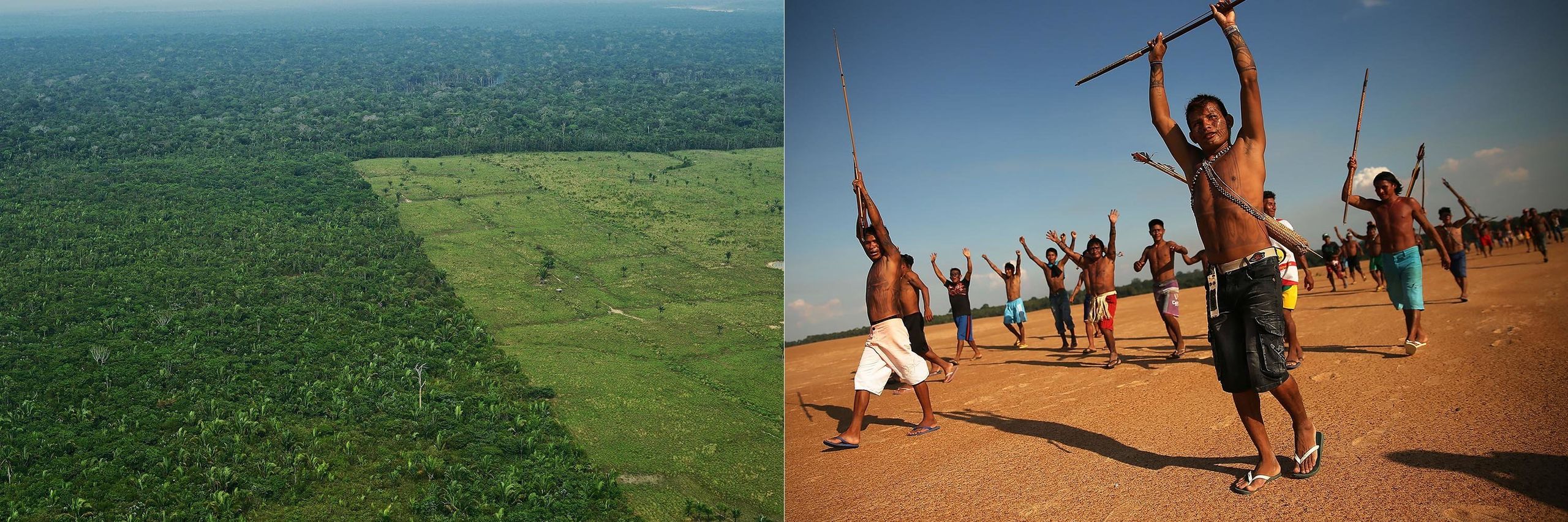
Left: Aerial view of deforestation in the Western Amazon region of Brazil.<br> Right: Members of the Munduruku indigenous tri

Left: Aerial view of deforestation in the Western Amazon region of Brazil.
Right: Members of the Munduruku indigenous tribe on the banks of the Tapajos River protest against plans to construct a hydroelectric dam on the river in the Amazon rainforest on November 26, 2014 near Sao Luiz do Tapajos, Para State, Brazil.

Although their conclusions are stark, the IPBES authors are not entirely gloomy about Earth’s prospects. In offering practical options for future action, they want to show that it is not too late to slow down or even reverse degradation.

They will also recognize that individual and community actions to plant trees, regenerate abandoned lands and protect nature can have a major positive impact.

Many other solutions to save nature have been put forward by individuals and countries.

Veteran biologist E.O.Wilson proposed that half the Earth needs to be protected to have any hope of avoiding disaster. Elsewhere, indigenous people in Latin America have argued for the creation of one of the world’s largest protected land areas, stretching from the southern tip of the Andes to the Atlantic.

Several countries are taking bold initiatives to restore land, both to help meet climate targets and to protect and enhance biodiversity. Pakistan intends to plant 10 billion trees (although its previous billion tree campaign was not without controversy), Ethiopia has mobilized communities to regenerate 15 million hectares of degraded lands and the Green Wall project is pushing for a 4,970-mile long belt of vegetation across Africa. Meanwhile, the U.N. Environment program has reported a surge in the number and size of marine protected areas.

Public awareness of the crisis is also growing, with new social movements setting up to put pressure on governments to act urgently. The Extinction Rebellion movement, which began in London in October, argues that we face an unprecedented emergency. Backed by academics, scientists, church leaders and others, including Naomi Klein, Noam Chomsky and Vandana Shiva, it claims to have spread to 35 countries in its first two months. Children too are joining in. On March 15, thousands of young people across 30 countries plan to strike from school and protest against inaction on climate change.

But despite these moves to reverse the ongoing destruction of the natural world, the big picture remains worrying. Ambitious global agreements like the Aichi targets set in Japan in 2010 and the U.N.’s Sustainable Development Goals around protecting nature, may not be met at current rates of progress, say the report authors.

Ultimately, Watson concludes that saving nature will require a major rethink of how we live and how we think about nature, but that it is possible to turn this dire situation around if governments want it to happen.

“There are no magic bullets or one-size-fits-all answers. The best options are found in better governance, putting biodiversity concerns into the heart of farming and energy policies, the application of scientific knowledge and technology, and increased awareness and behavioral changes,” Watson said. “The evidence shows that we do know how to protect and at least partially restore our vital natural assets. We know what we have to do.”

For more content and to be part of the ‘This New World’ community, follow our Facebook page.

HuffPost’s ‘This New World’ series is funded by Partners for a New Economy and the Kendeda Fund. All content is editorially independent, with no influence or input from the foundations. If you have an idea or tip for the editorial series, send an email to thisnewworld@huffpost.com

What You Can Do (for the Animals)

Small Families
Human population growth underlies the climate change, deforestation, desertification, pollution and other factors responsible for the ongoing sixth mass extinction.

Vegetarian and Vegan Diets
Vegetarians and vegans greatly reduce the suffering of farm animals and environmental damage done by the agriculture industry.

Veggie BurgerMeat, Egg and Dairy Alternatives
Soy milk, veggie burgers and other faux products available for sale in many supermarkets and convenience stores.

Energy Usage
Greenhouse gasses greatly contribute to habitat loss.

Consumption and Recycling
Reduced use of natural resources and increased recycling decrease forest destruction, occean pollution, etc. and thereby benefit wild animals.

Guide to Compassionate Clothing
Stores that sell clothing not made with fur, leather or other animal products.

Companies that Don’t Test on Animals
Firms that don’t test finished products, formulations or ingredients on animals and do not do business with suppliers that do.

Animal-Friendly Tourism
Make sure that your vacation plans don’t include causing animals to suffer.

Alternatives to Classroom Dissection
Computer simulations, clay models and other means of teaching anatomy that do not involve the use of animals.

Animal Welfare Organizations
There are thousands of animal welfare organizations throughout the world almost all of which rely heavily on donations and volunteers.

Petitions
There are numerous online petitions intended to promote animal welfare.

Legislation
Contacting elected officials at all levels of government in order to urge them to ban retail sales of dogs obtained from puppy mills, oppose efforts to criminalize undercover investigations at slaughterhouses, prohibit use of wild animals in circuses, etc. can be very helpful in promoting animal welfare.

CatsCompanion Animal Adoption
Adopting a cat or dog or some other animal from a shelter or rescue group helps to reduce animal homelessness.

Spaying and Neutering
Spaying and neutering yield a variety of benefits.

Humane Wildlife Control
A variety of nonlethal methods can be employed to help prevent conflicts with wild animals.

Humane Rodent Control
A number of nonlethal methods of preventing rodents from entering homes are available.

Events
Events throughout the world that are held to promote animal welfare.

Spreading the Word
Increasing awareness of wildlife poaching, factory farm practices, the treatment of animals in laboratories, homeless cats and dogs and related issues helps to improve the well-being of animals.

What You Can Do

Trail-Building: Habitat Destruction by a Different Name

Michael J. Vandeman, Ph.D.
September 2, 2017

“Impacts on and along trails result from the trampling of hikers and pack stock and the effects of trail construction and maintenance. … These impacts include the loss of vegetation and shifts in plant-species composition, exposure of bare mineral soil, soil compaction, and changes in microhabitats, including changes in draining and erosion. Where trail construction is carefully planned, most of these changes are of little concern; although pronounced. Most changes are localized and deliberate.” Dawson and Hendee, 2009, pp. 423-4

“The study revealed that almost 80% of extinction research in the country focused on cute marsupials such as kangaroos and koalas, whereas not-so-adorable critters such as bats and rodents held only 11% of research time, despite making up almost half of the species examined.” https://mygoodplanet.com/selective-fashion-going-extinct/

Scientists are generally honest, in what they say – but not in what they choose to study. Despite a diligent search in one of the world’s best libraries (the University of California, Berkeley), I wasn’t able to find a single book or article on the harm done by trail-building. I notice that whenever I see a picture of a trail, I think “Oh, a trail – so what?” It takes an effort of will to think about the wildlife habitat that was destroyed in order to build the trail. And the habitat destruction isn’t restricted to the trail bed. As Ed Grumbine pointed out in Ghost Bears, a grizzly can hear a human from a mile away, and smell one from five miles away. And grizzlies are probably not unique in that. In other words, animals within five miles of a trail are inhibited from full use of their habitat. That is habitat destruction! If there were no trails, we would be confronted by our own destructiveness every time we entered a park. It is only because the habitat has already been destroyed for us, that we can pretend that we are doing no harm.

So why do we build trails? It doesn’t take much experimenting with cross-country travel to see that it is extremely difficult. There are many kinds of hazards – biological (e.g. poison oak, poison sumac, poisonous snakes, etc.) and physical (e.g. blackberry thorns, cliffs, rivers, volcanos, etc.). It is extremely difficult to find a passable-, much less an efficient, route. It would be very difficult to communicate our location to emergency personnel, without trails. So it is unlikely that we will eliminate trails in the near future, except from areas designated off-limits to humans.

That leaves only one option compatible with wildlife conservation: minimizing the construction, extent, and use of trails. For example, banning the use of off-road vehicles, such as bicycles, skateboards, and motorcycles would greatly reduce the use of the trails, the distance that people travel, and the harm done to the soil and the small animals and plants found on, under, or near the trails. Mountain bikers complain about being thereby “denied access”, but of course they can still walk. They just can’t easily travel as far as they can on a bike. On public land, especially, all trail construction should be thoroughly studied, and should be built only when officially authorized by the land manager, and only by thoroughly educated, authorized builders.

By far the greatest threat to wildlife habitat in so-called “protected” areas would appear to be mountain biking. Motorized vehicles are generally not allowed in natural areas. The most destructive use of trails is mountain biking. Knobby tires are perfectly designed to rip up the soil. Mountain bikers, with rare honesty, call their riding “shredding”. They also have a much greater range than hikers, and probably also equestrians. They also frequently ride illegally – where bicycles are not allowed.

All of this is well known. But what isn’t so well known or understood is the mountain bikers’ drive to build ever more trails. All park users seem to have a need for a certain amount of stimulation. A hiker or equestrian can satisfy that need on a relatively short trail, because they experience it fully, through all of their senses. They can stop instantly, and turn 360 degrees, seeing, hearing, smelling, touching, or tasting anything they choose. Mountain bikers, on the other hand, tend to ride fast, often as fast as they can, seeking what they call an “adrenaline rush”. But even when riding slowly, the very nature of a bicycle requires one to focus almost 100% of his or her attention on the trail immediately in front of their front tire, or they will crash. The consequence is that they have to travel several times as far as a hiker, to have the same quantity of experience. And after riding the same trail a few times, they get bored with it and want to ride a new trail. And when they’ve ridden all their local trails, they begin demanding more trails to be built. Or, if their demands aren’t met, they begin secretly building illegal trails, or building illegal “trail features” (jumps, berms, log bridges, teeter-totters, etc.). The rain-forests of North Vancouver are the iconic example (which destruction continues to this day), but it has been emulated by mountain bikers all over the world.

If this were a matter of a few sites or a few trails, it wouldn’t be too significant. But it’s not restricted to one area. Mountain bikers, apparently ignorant of conservation biology, have destroyed thousands of square miles of wildlife habitat, and show no signs of slowing down or recognizing the harm that they are doing. IMBA (the International Mountain Bicycling Association) has been promoting mountain biking tourism, claiming that mountain biking brings economic benefits to communities that embrace it, of course ignoring the economic value of the intact ecosystems they are destroying. The mountain biking infrastructure is called “epic trails”, “ride centers”, “bike parks”, etc. They bait their demands with offers of volunteer trail-building and trail maintenance. (But, of course, their vision of a good trail (lots of humps, twists, and turns) is quite different from what the other trail users want.)

In the San Francisco Bay Area, projects were created to build two huge trails – the Bay Trail and Ridge Trail – each several hundred miles long, circling the bay near the water and along the ridgetops. The community enthusiastically voted for these projects, waxing poetic about all the “new opportunities” to “connect to nature”. Actually, no new habitat was created, and the trail construction (which still continues) destroyed an enormous amount of habitat. Nevertheless, I never heard anyone complain about this. People seem to think that trails somehow thread their way through the wilderness harmlessly, without touching it.

Haven’t we already destroyed far too much wildlife habitat? Isn’t it time we started telling the truth about trails and our construction and use of them?

Here are a few examples of the destructiveness of trail construction and use (for an online copy of this paper, where you can click on the links and won’t have to type them, see https://mjvande.info/scb9.htm ):

100 Seconds of Trail Destruction with Matty Miles:
https://video.search.yahoo.com/yhs/search?fr=yhs-adk-adk_sbnt&hsimp=yhs-adk_sbnt&hspart=adk&p=mountain+biking+destruction#id=5&vid=b8f9aa6796e6a78ebd127bca34017f48&action=click
(Can you imagine what would happen to you if you happened to be on this trail?!)

Mountain bike trail building: https://www.youtube.com/watch?v=TtZaUS8YreU

Illegal mountain bike trail construction, Hop Ranch Creek Squamish BC May 27,2014:
https://www.youtube.com/watch?v=tcwfT68fV0U&feature=youtu.be

IMBA promotes trail-building:
“Saturday is National Public Lands Day
Get connected with your local IMBA chapter or club to see if it is hosting a volunteer trail day this Saturday. Trails don’t build themselves…show some love for the places you love to ride!
Dig In Applications Open Through October 6
IMBA is currently accepting applications for its new Dig In Campaign – a grant program that directly supports local IMBA chhapters [sic] with actionable trail projects. The project list will be published in early October so stay tuned to see what’s happening near you.”
Vancouver’s North Shore – All Built Illegally! (The video is 51 minutes long, but every minute is worth watching. Very enlightening!):
https://www.youtube.com/watch?v=8mB_gOzG7Oc

IMBA wants to create 500 more miles of trail!:
https://www.imba.com/news/imba-launches-dig-in

669 miles of mountain biking trail:
https://oregontimbertrail.org/

San Francisco Bay Trail: 500 miles: http://baytrail.org/

Bay Area Ridge Trail: 375 miles, growing to 500 miles: http://ridgetrail.org/

Long-distance trails in the United States: https://en.wikipedia.org/wiki/Long-distance_trails_in_the_United_States

Examples of Destructive Trail-Building:
Illegal Trail Building in Whistler (I am in no way implying that legal trail building is acceptable! They both destroy wildlife habitat!):
https://www.piquenewsmagazine.com/whistler/wb-incorporates-dark-crystal-into-its-trail-system/Content?oid=4537412

Glorification of illegal trail building:
https://www.revelstokemountaineer.com/the-spokin-word-treading-the-high-seas/

IMBA: “IMBA is currently accepting applications for its new Dig In Campaign, a grant program that directly supports local IMBA chapters with actionable trail projects. We are committed to growing access for mountain bikers and increasing the pace of new builds in the U.S.” “It takes a village: that statement of wisdom is particularly true in the mountain bike community, where volunteers, experts and funders must come together to make great places to ride happen. In Wausau, WI, the Central Wisconsin Offroad Cycling Coalition (CWOCC), an IMBA chapter, recently completed a multi-year project that resulted in a pumptrack, four bike-optimized downhill trails of varying difficulty and a beginner-friendly loop, all designed by IMBA Trail Solutions.”

“How To Build A Legit DH Bike Trail”:
https://www.youtube.com/watch?v=uPoSchTxSs8&feature=youtu.be

Glorifying trail-building and mountain biking:
https://www.facebook.com/globalcivic/videos/1437735176244789/

Day in the life of a Trail Builder: https://www.youtube.com/watch?v=MekS557BEUo: the upbeat background music clearly indicates the mountain bikers’ attitude: trail building – legal or illegal – is fun and has no moral implications

Building a Mountain Bike Flow Trail:
https://www.youtube.com/watch?v=Ufswp1ABCLU
https://www.imba.com/resources/trail-building/10-most-common-trailbuilding-mistakes
https://mmbhof.org/north-shore-trail-builders/
https://www.singletracks.com/blog/mtb-trails/mountain-bike-trailbuilding-101/

10 Ways to Make Your Mountain Bike Trail Awesome! – Part 1: https://bikefat.com/10-ways-to-make-your-mountain-bike-trail-awesome-1/

10 Ways to Make Your Mountain Bike Trail Awesome! – Part 2: https://bikefat.com/10-ways-to-make-your-mountain-bike-trail-awesome-2/

Build a Mountain Bike Trail: http://www.instructables.com/id/Bulid-a-Mountain-Bike-Trail/
Trail Building: https://www.pinkbike.com/forum/trail-building/

OUR DIRT: Mountain Bike Trail Building Documentary: https://vimeo.com/65738812 no speed limit, will hit anything in the trail; too fast to appreciate anything; no knowledge of biology or conservation.
https://www.facebook.com/media/set/?set=a.10203947520996337.1073741831.1471603969&type=1&l=df5b117fa3

Don’t forget this one. This is what “rock armored” mountain bike trails turn into during heavy rains:
https://youtu.be/pOXYaYFfLyo
Because of all the damage done to our mountain slopes from too much trail building, they are building debris flow basins in our creeks, here — but the authorities won’t stop the mountain biking… It is costing us millions of dollars….

Here is more from British Columbia:

Delta, BC…
https://youtu.be/7q67O7r60fY (Illegal trail damage to riparian area)
This trail build was legitimate, but shows the damage done by too many people trail building, and pulling huge roots out, in a stupid kind of challenge race to see which team can build the most trail in the shortest time. Pure mayhem at work here (all through pristine area of forest, destroying the ground cover, and digging borrow pits to collect dirt and rocks to pack on the trails):
https://youtu.be/muicHp5kaKs (at the .24 mark, you can see a guy just tear out a large tree root…) “When Arc’teryx challenged MEC to a trail building competition, we jumped at the chance to get dirty… plus we couldn’t resist a little friendly competition. So on November 17, dozens of MEC staff and supporters met up with the NSMBA to dig, grub and mine for gold on the North Shore. Our goal was to build more trail than Arc’teryx over a few hours.”

Unauthorized bike trail damages “pristine habitat” in Forest Park:
https://bikeportland.org/2010/02/23/unauthorized-bike-trail-damages-pristine-habitat-in-forest-park-29920

Tracking the environmental impact of mountain biking in bushland:
http://www.abc.net.au/radionational/programs/offtrack/tracking-the-environmental-impact-of-mountain-biking/6559202

Mountain bikers are also degrading forests and thereby contributing to global warming:
https://www.theguardian.com/environment/2017/sep/28/alarm-as-study-reveals-worlds-tropical-forests-are-huge-carbon-emission-source

The damage mountain bikers do on Fromme Mtn. Seems one builder, MW, who left the NSMBA hasn’t gone away (still digging on the North Shore) — and the NSMBA continues to give a thumbs up to this sort of digging and building:
http://www.pictame.com/media/1472817891010303069_435668765

More trenches dug in the name of “sustainable” mountain biking…:
http://www.pictame.com/media/1553816771487873049_435668765

and this is what they dug up the forest to build (video of the jump structure in action):
http://www.pictame.com/media/1555623388244116041_435668765

How many buckets of gold dirt [mineral soil] and borrow pit digging was required to pack all that dirt on the eroded mtb trail on Mt. Fromme?:
http://www.pictame.com/media/1493117981432213889_435668765

This is what the NSMBA bragged about last year… How much more this year? For your trail building files/paper to show how devastating this all is:
https://twitter.com/MECraver/status/890267891144081408

Pleasanton Ridge Illegal Trails – Park Ranger Helicopter Incident 1-27-12 (NICA coaches taking high school mountain bikers on an illegal ride, in violation of their own “rules”; note the nasty comments from the mountain bikers):
https://www.youtube.com/watch?v=EJQJeB3hruA

Robert Moor: Only a single sentence negative on trails: “[W]e leave the most destructive trails, I think, of any group of animals” p.160

Proof That High School Mountain Bike Racing Is Environmentally Destructive:
https://norcalmtb.smugmug.com/2017-Race-4-Granite-Bay-Grinder-Folsom/i-WQ2zCCG
https://norcalmtb.smugmug.com/2017-Race-4-Granite-Bay-Grinder-Folsom/i-mxvW2BD
https://norcalmtb.smugmug.com/2017-Race-4-Granite-Bay-Grinder-Folsom/i-mVDCGbF

Trees are falling, due to erosion exposing their roots:
http://www.pictame.com/media/1657084424238301428_2237726428

Intact forests are the key to fresh water:

https://news.ok.ubc.ca/2017/12/07/forests-are-the-key-to-fresh-water/

http://www.euanforresterphotography.com/evidence-of-trail-fairies (click on each photo with cursor to see the story behind the illegal trail building…. some of it at night time, hiding under darkness.) This is now celebrated and applauded….wrong became a right, overnight… This is how mountain bikers won CMHC… This is the sordid history of mountain biking on our North Shore…

So much digging for dirt to pour over their ever eroding and compacted trails. The riding style seen in the last part of this video is the reason why the trails become that way, eroded and compacted. Anyone who tries to paint this MTB sport as benign as hiking, etc. needs to watch this until their eyes pop out!:
https://www.facebook.com/nsmba/videos/10155414065825036/

Illegal trail building a vexing problem for public land managers:

https://durangoherald.com/articles/214352-illegal-trail-building-a-vexing-problem-for-public-land-managers

An example of how a mountain biker role model rides:
https://nsmb.com/articles/trail-destruction-matty-miles/

Illegal mountain biking on Mount Royal is damaging its ecosystem, experts say. Repeatedly crossing the mountain’s soil loosens tree roots, affects Laurentian flora: http://www.cbc.ca/news/canada/montreal/mount-royal-mountain-biking-1.4675779

North Shore Mountain Biking Association Rationalizes Its Illegal Trail-Building:
https://nsmb.com/articles/bc-warns-illegal-building-could-bring-jail-time-10k-fine/

Illegal trail-building in Kelowna, BC: http://www.kelownadailycourier.ca/life/article_3c900d9e-8c75-11e8-9837-7b4caec74090.html

Endangered bees caught in middle of plan to add mountain biking trails in Minnetonka, MN:http://www.startribune.com/endangered-bees-caught-in-middle-of-plan-to-add-mountain-biking-trails-in-minnetonka/490114431/

Habitat destruction by mountain bikers using heavy equipment on Bowen Island, BC:https://www.instagram.com/explore/tags/goldendirttrails/?hl=en https://www.instagram.com/goldendirttrails/?hl=en

Photo showing the extra habitat destroyed by a winding vs. straight trail: https://www.stuff.co.nz/nelson-mail/news/110050760/nelson-mountain-bike-club-comes-of-age-as-a-big-cog-on-nz-landscape

A 2,000-km biking trail set to open in the Balkans:

https://www.thejakartapost.com/travel/2019/01/28/a-2000-km-biking-trail-set-to-open-in-the-balkans.html

Profiting from habitat destruction (trail-building):
https://www.bcbikerace.com/resources-to-recreation/
https://vimeo.com/278210701

Mountain bikers build illegal trails first, then ask permission only if they get caught!:
https://www.northamptonchron.co.uk/news/mountain-bikers-who-built-ramps-at-northampton-park-accused-of-vandalism-by-borough-council-1-8845649 The same thing happened in both Victoria, BC and LaSalle, Ontario. Kids built dirt jumps in parks without permission. The cities razed them and the mtb kids whined…

It’s not trails that disturb forest birds, but the people on them
https://www.sciencedaily.com/releases/2018/11/181112082417.htm
“We believe protected areas with forbidden access are necessary and important, and that new trails into remote forest areas should not be promoted. Visitors to existing forest trails should be encouraged to adhere to a ‘stay on trail’ rule and refrain from roaming from designated pathways.”

https://www.theage.com.au/national/victoria/anarchistic-mountain-bikers-threaten-inner-city-park-s-rare-plants-20190205-p50vt3.html : “Mountain bike riders are currently the park’s most destructive user group.”

References:

Dawson, Chad P. and John C. Hendee, Wilderness Management – Stewardship and Protection of Resources and Values. Golden, CO: Fulcrum Publishing, 2009.

Ehrlich, Paul R. and Ehrlich, Anne H., Extinction: The Causes and Consequences of the Disappearances of Species. New York: Random House, 1981.

Errington, Paul L., A Question of Values. Ames, Iowa: Iowa State University Press, 1987.

Flannery, Tim, The Eternal Frontier — An Ecological History of North America and Its Peoples. New York: Grove Press, 2001.

Foreman, Dave, Confessions of an Eco-Warrior. New York: Harmony Books, 1991.

Grumbine, R.E., Ghost Bears. Covelo, CA: Island Press, 1992.

Knight, Richard L. and Kevin J. Gutzwiller, eds. Wildlife and Recreationists. Covelo, California: Island Press, 1995.

Louv, Richard, Last Child in the Woods — Saving Our Children from Nature-Deficit Disorder. Chapel Hill, N.C.: Algonquin Books of Chapel Hill, 2005.

Moor, Robert (robertmoor.ontrails@gmail.com), On Trails. New York: Simon & Schuster, 2016.

Newsome D., C. Davies, “A case study in estimating the area of informal trail development and associated impacts caused by mountain bike activity in John Forrest National Park, Western Australia”. Journal of Ecotourism. 2009 Dec 1; 8(3):237-53.

Noss, Reed F. and Allen Y. Cooperrider, Saving Nature’s Legacy: Protecting and Restoring Biodiversity. Island Press, Covelo, California, 1994.

Reed, Sarah E. and Adina M. Merenlender, “Quiet, Nonconsumptive Recreation Reduces Protected Area Effectiveness”.Conservation Letters, 2008, 1–9.

Stone, Christopher D., Should Trees Have Standing? Toward Legal Rights for Natural Objects. Los Altos, California: William Kaufmann, Inc., 1973.

Vandeman, Michael J., https://mjvande.info, especially https://mjvande.info/ecocity3.htmhttps://mjvande.info/india3.htmhttps://mjvande.info/mtbfaq.htmhttps://mjvande.info/scb7.htmhttps://mjvande.info/sc8.htm, and https://mjvande.info/goodall.htm.

Ward, Peter Douglas, The End of Evolution: On Mass Extinctions and the Preservation of Biodiversity. New York: Bantam Books, 1994.

“The Wildlands Project”, Wild Earth. Richmond, Vermont: The Cenozoic Society, 1994.

Wilson, Edward O., The Future of Life. New York: Alfred A. Knopf, 2002.

[NOTE: This paper can be found at https://mjvande.info/scb9.htm, where you can follow the above links without having to type them.]

The Power Of Words: How We Use Language To Justify Our Consumption Of Nature

MOJO COLUMNIST SUSAN MARSH WAXES ON HOW WE ‘HARVEST’ LIVING THINGS TO AVOID ADMITTING WE’RE TAKING THEIR LIVES

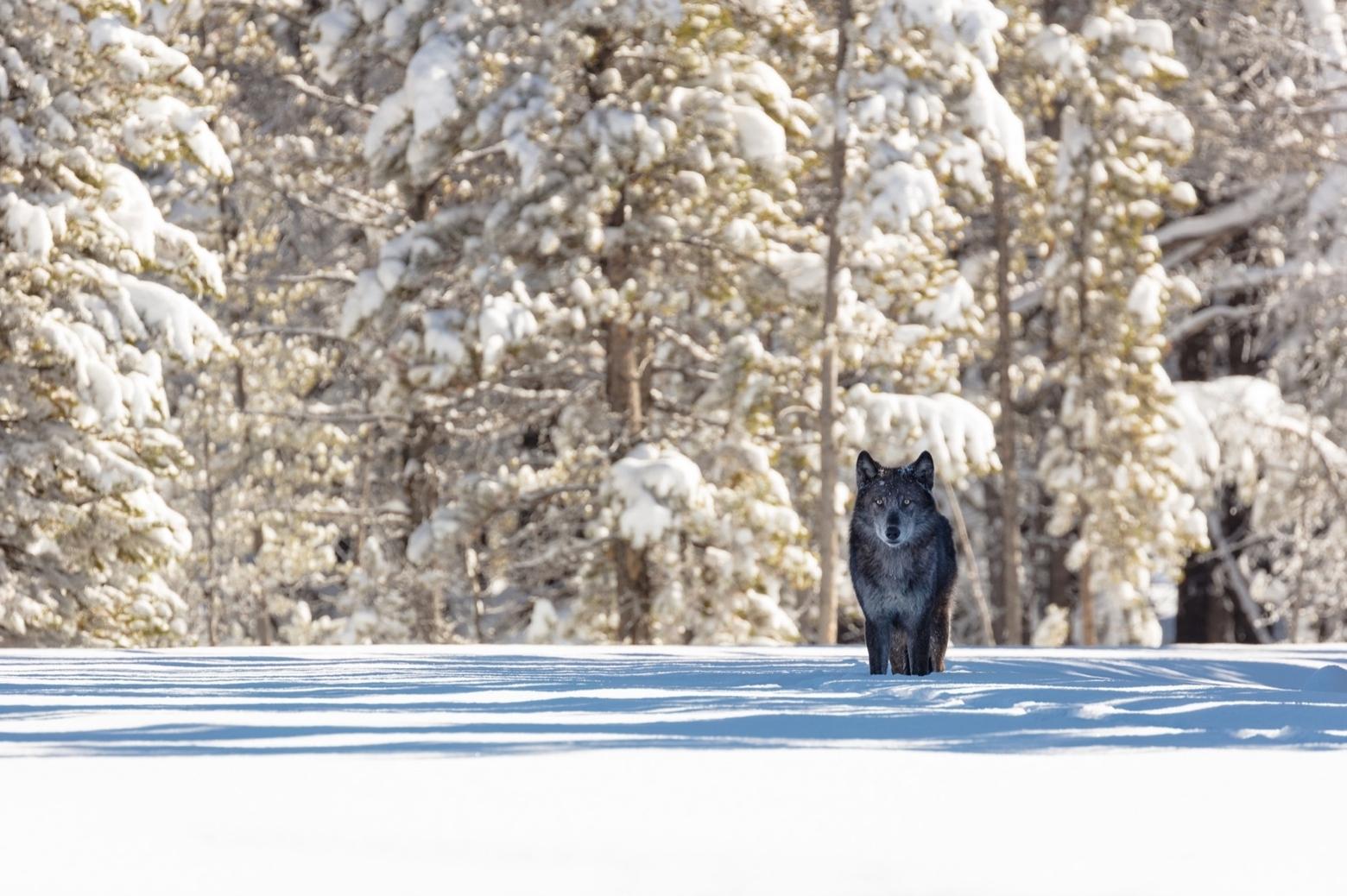
Susan Marsh asks:  why is it that if a wolf preys upon a native wild ungulate, or even a domestic calf or sheep, it is called a cold-blooded killer, yet when a human hunter shoots an elk it is considered a &quot;harvest&quot; or when thousands of beef cows are sent to slaughterhouses little thought is given, in language, to the truth that those animals are involuntarily giving up their lives to feed humans?  Photo of wolf in Yellowstone courtesy Jacob W. Frank/NPS
Susan Marsh asks: why is it that if a wolf preys upon a native wild ungulate, or even a domestic calf or sheep, it is called a cold-blooded killer, yet when a human hunter shoots an elk it is considered a “harvest” or when thousands of beef cows are sent to slaughterhouses little thought is given, in language, to the truth that those animals are involuntarily giving up their lives to feed humans? Photo of wolf in Yellowstone courtesy Jacob W. Frank/NPS
Sometimes all I have
are words and to write them means
they are no longer
prayers but are now animals.
Other people can hunt them.
…A tanka by Victoria Chang (from Narrative, February 2019)
The words we use.
Lately I’ve been wondering about how carefully we choose the words we use and whether we consider the implications and hidden baggage they carry. Subtle nuances we grew up hearing stick with us for life. Sometimes they are not so subtle and stick like pins in a voodoo doll. Sometimes they live through the ages and invade our collective belief system, the way we unconsciously agree that the sky is blue.
Frederich Nietzsche wrote that “A uniformly valid and binding designation is invented for things, and this legislation of language likewise establishes the first laws of truth.” [On Truth and Lie in an Extra-Moral Sense1873]. We can’t speak truth without submitting to authority (the dictionary) by which we agree on the word that signifies our meaning. We say the sky is blue, but the words sky and blue are cultural constructions.

In the sciences, we discover truth—until we find out something new, then we cast that adjusted knowledge into stone until the next drop of understanding leaks in. The way we look at the universe is an example: we’ve gone from believing the earth was at its center—and assassinating anyone who thought otherwise—to understanding that our solar system is on the trailing edge of a small galaxy, one among zillions. We are even able to admit that there’s a lot more going on out there than we can imagine.

Yet the truth eludes us if we’re not careful, in part because of our invented language for things. Nietzsche continues in his essay with what he might call the anti-truth: “The liar is a person,” he writes, “who uses the valid designations—the words—in order to make something which is unreal appear to be real.”
Our culture is shot through with lies we agree to accept as if they were the truth. We call it obfuscation, a way of lying to ourselves and coming to believe what we say. Most of us can sniff out deception in the way government and institutions invent euphemisms to hide rather than reveal what they are really talking about. How often do we unconsciously incorporate these terms?
I consider as an example the way we speak about the natural world. By “we” I mean people of the Western tradition, influenced by the likes of Rene Descartes. He called himself rational but denied an obvious and observable truth, that other species are sentient, intelligent, and in possession of emotions. He argued that animals lacked a soul or mind, and therefore had no emotions and could not feel pain. Unfortunately his views became prominent in Europe and North America, allowing people to treat animals as property, not other beings with whom we share this world.
How convenient. We shop for pork and beef without thinking about the suffering that brought animals to our tables. We let unwanted pets out the door and drive away. We deny any hint of kinship by referring to an animal as “it” instead of he or she.
My computer’s grammar police underlined the word whom at the end of the last paragraph. It wanted me to substitute which.
Let’s hope we’re becoming more enlightened about the status of other species as we learn how intelligent they are, from whales to ravens. On second thought, perhaps not. In Wyoming it’s still a time-honored sport to run down coyotes with snowmobiles.

Let’s hope we’re becoming more enlightened about the status of other species as we learn how intelligent they are, from whales to ravens. On second thought, perhaps not. In Wyoming it’s still a time-honored sport to run down coyotes with snowmobiles.

Genome sequencing has placed us in the midst of the pantheon of earthly life: we share 99 percent of our genes with chimps, 90 percent with mice, and 84 percent with dogs—presumably including coyotes. A billion year old ancestral life form that gave rise to both plants and animals left us each with commonalities in our genomes. At last our rational science is helping us catch up to so-called primitive peoples and centuries-old cultures which hold that we are part of the world and all living things are our kin.
In the Western tradition we still use language to set ourselves apart, to create the illusion of superiority. Nowhere is our Cartesian reluctance to acknowledge the individuality of other life forms more prominent than in the lingo of forestry and wildlife management agencies and the land grant colleges that graduate their employees.
We don’t cut down mature lodgepole pine trees; we harvest timber. Even the tree itself is known by foresters as “standing volume” rather than a component of a complex ecosystem which provides food, shelter and oxygen to myriad species. The term ignores the complexity of the tree, an ecosystem of its own, as well as its interdependence on all that surrounds it. “Volume” refers to nothing more than the board-foot, the number of slices 12 inches square and an inch thick that are estimated in a timber stand.
I don’t argue against using lumber. We live in houses. But we treat forests like we do beef cattle, as a lifeless commodity. Private forest-product companies are at least honest about their purpose: they call their forests tree farms.
Those who create useful and beautiful things from wood, who select and cut a tree from their property or a neighbor’s and use it for an object of quality and endurance show a different attitude. Those who cut their own firewood remember and thank the tree whenever they set a log on the fire.
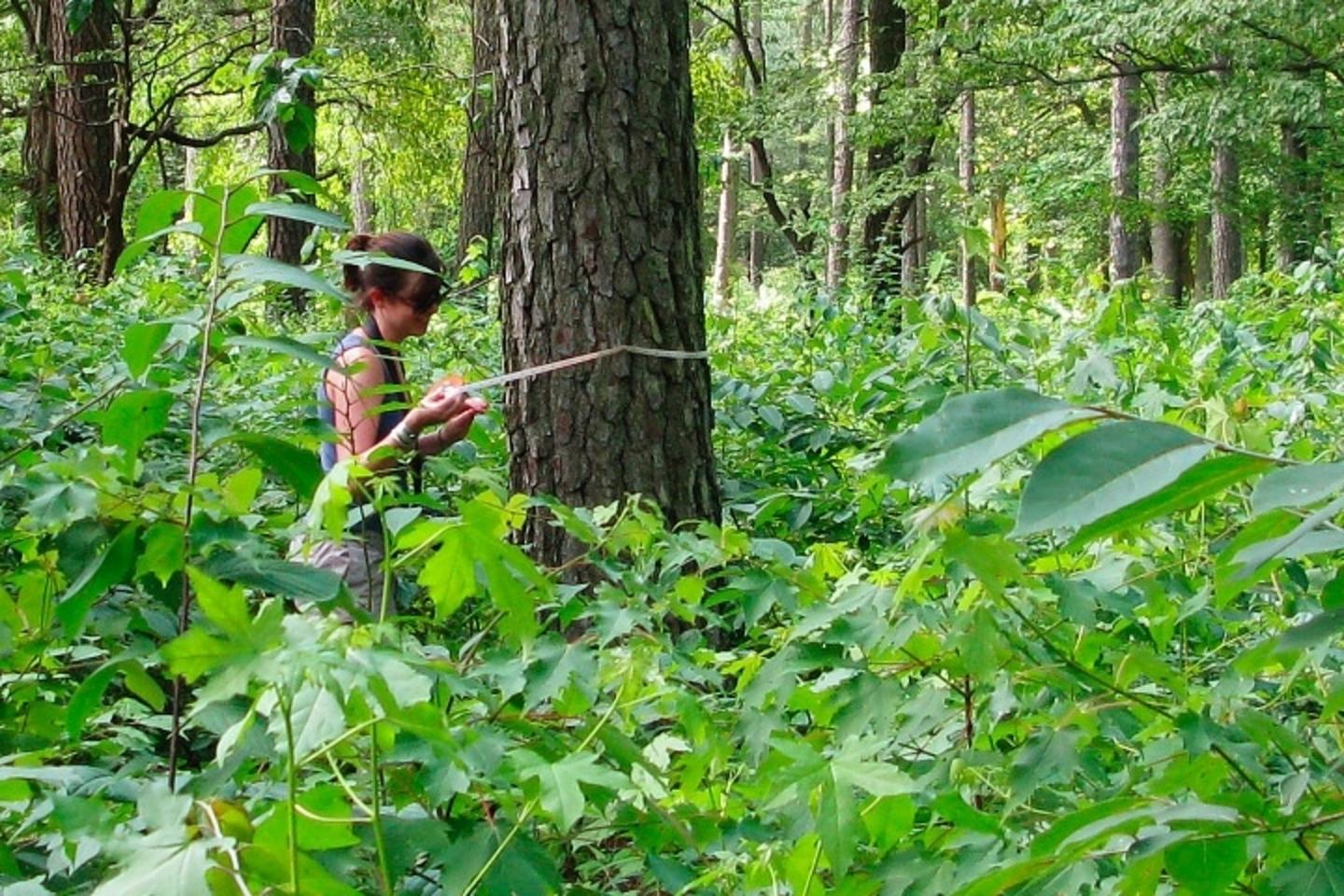
A researcher examines a tree in the middle of a forest to assess how much carbon dioxide it might be sequestering. While touting the vital role trees play in nature is a departure from them being valued only for their stumpage or human uses, it often falls short of recognizing their intrinsic sense of being. Recent studies have shown that trees actually possess their own kind of awareness to things happening the environment around them. It might not be on the level that humans attribute to higher sentience but it is a radical departure from the way trees have been regarded merely as objective commodities that exist to be harvested.  Photo courtesy Lola Fatoyinbo/NASA
A researcher examines a tree in the middle of a forest to assess how much carbon dioxide it might be sequestering. While touting the vital role trees play in nature is a departure from them being valued only for their stumpage or human uses, it often falls short of recognizing their intrinsic sense of being. Recent studies have shown that trees actually possess their own kind of awareness to things happening the environment around them. It might not be on the level that humans attribute to higher sentience but it is a radical departure from the way trees have been regarded merely as objective commodities that exist to be harvested. Photo courtesy Lola Fatoyinbo/NASA
George Nakashima, famed architect, woodworker, and author of The Soul of a Tree has this to say about his work. “It is an art- and soul-satisfying adventure to walk the forests of the world, to commune with trees, to bring this living material to the work bench, ultimately to give it a second life.” This was a man who did not waste wood.
Where language is concerned wildlife fare no better than forests. Hunters don’t shoot deer or elk, they harvest them, as if the creatures of field and forest were planted like corn. Beware when you hear that we must “manage” predators: that means only one thing—kill them.
Some creatures are planted, with the express purpose of harvest. Often these are alien species that wreak havoc with the natives. Fish farms pass diseases to wild salmon and pollute the local waters. Lake trout gobble the fry of native cutthroats, robbing Yellowstone’s grizzly bears of a needed protein source in summer. Rocky Mountain goats, introduced to the Snake River Range in Wyoming for sport hunting, have increased and spread into Grand Teton National Park where native bighorn sheep are struggling to survive.
Wildlife professionals employ terms best suited to the stockyard. Most of us are thrilled to hear the first warbler of spring or the bugle of a bull elk at the end of summer. Biologists refer to these as “territorial behavior.” While accurate enough, notice how much distance between ourselves and our relatives is placed by the use of such bloodless professional diction.
We engage in fine dining while wildlife “feeds.” In my experience, wolfing down a sandwich at work while typing on the computer and answering the phone more closely resembles feeding than dining.
It’s been ten years since a citizen science effort began in our local area (Nature Mapping Jackson Hole). I was part of the group that set protocols for data entry, and I remember a particular conversation about how to describe what the creature observed was doing. We were trying to make our data compatible with that of the Wyoming Game and Fish Department so the entire body of information could be accessed in one place.
We started out with the activity list of Game and Fish, whose focus was somewhat limited. The activity descriptors included walking, standing, running, loafing (resting), and feeding. Breeding and territorial behavior rounded out the list, and if none of these applied we could simply say the creature’s activity was undetermined.
Immediately hands went up in the meeting room. What if it’s a duck? Wouldn’t it be swimming? What if the duck is flying?
The Game and Fish activity list was intended for use in cervids, meaning elk in our corner of the state. Surprisingly, there was a fairly heated argument about whether flying and swimming could be added, since this was an established data base and we were a bunch of upstart volunteers. But we weren’t just counting elk. Our purpose was to gather observations of mammals, birds, reptiles and amphibians. Some of them swam, some of them flew.
Reluctantly, the Game and Fish representatives agreed to consider the additions. If nothing else, we could add them to our data sheets and if they didn’t fit into the statewide one, there was always the category of undetermined. Who cared, I wondered to myself, what the animal was doing anyway? In the space of a minute a magpie could be walking, flying, feeding, and generally raising hell. Which should I choose?
The debate took another turn when someone asked, “What if the animal is playing?”
Silence. The Wyoming Game and Fish Department habitat biologist squinted as if to ask, are you serious?
The stories of encounters with wildlife began to fill the room, presented slowly and shyly at first and then with more insistence: the elk calf seen kicking up his heels and jumping in circles through a muddy slough. The fox kits chasing one another in a meadow. A raven sliding down a frosty metal roof, flying back to the ridge, and doing it again. A wolf lying on his stomach at the top of a snowy slope and with a gentle kick of his hind feet glissading to the bottom. No one mentioned otters since we all knew they did nothing but play.
The group sorted ourselves into camps: pro-play and anti-play. We’ve seen this with our own eyes, some said. How can we not record it? Couldn’t this information be useful to know under what circumstances wild creatures felt at ease enough to play?
This was foreign territory to the wildlife experts and soon the discussion ended with a resounding No. They’d already given enough ground in accepting flying and swimming, and who knew what kind of crazy activity the rest of us would come up with next? Play remained off the list.
It wasn’t a big deal, yet in a deeper sense it is. Why are we so afraid, especially those of us trained in the sciences, to acknowledge parallels between our behavior and that of other animals? In modern times our aversion to anthropomorphism is drummed into us to the point of feeling innate, but humans have always used it as a bridge between ourselves and others. Medieval renderings of the sun and moon give them human faces. Myths give animals godlike powers and human traits. These have helped us make sense of the world, at least until science shoved them all aside.

We’ve created a culture insulated from wild nature, encouraging us to stop caring that we are adrift. We speak of the land, forests, and wildlife not as aspects of home but of natural resources. We give serious consideration to colonizing the moon or even Mars rather than try to clean up the mess we’ve made of our own planet.

A shared behavior isn’t the same thing as a false attribution of human traits to others. I walk, my dog walks. Do we walk the same way? No. We each do what we do in our own way but there are many things we share, in addition to a good number of our genes, which help us relate to pets and wildlife alike. Seeing ourselves in others, whether people or other species, is the basis for empathy.
How do we unravel the words used to describe, name, tell the truth or tell lies? How do we keep a sharp ear for the subtleties of words that don’t quite hit the mark? And most of all, how do we salvage a scrap of humility as a species whose interactions with other forms of life usually place us on top? We place ourselves above other people as well, in cultures old and new. We areThe People, the chosen ones, the ones whose creed is the only true religion.
We’ve created a culture insulated from wild nature, encouraging us to stop caring that we are adrift. We speak of the land, forests, and wildlife not as aspects of home but of natural resources. We give serious consideration to colonizing the moon or even Mars rather than try to clean up the mess we’ve made of our own planet.
These are diversions, as dangerous as the euphemisms used to distance our relationship with animals and trees. Understanding what we really mean to say requires us to slow down, be more deliberate, seek to communicate and connect. To witness what is before our eyes before we open our mouths.
“If an animal does something, we call it instinct; if we do the same thing for the same reason, we call it intelligence.” – Will Cuppy
 
EDITOR’S NOTE:  Mountain Journal congratulates Susan Marsh for being honored with the Raynes Citizen Conservation Award given by the Northern Rockies Conservation Cooperative at its 2019 Wildlife Symposium in Jackson Hole. The award, created in honor of naturalists Bert Raynes and his late wife, Meg, recognizes citizens who have made significant contributions to advancing public understanding and appreciation for the natural world.
Marsh, whose art is at right, shares some thoughts after receiving the Raynes Citizen Conservation Award at the 2019 Northern Rockies Conservation Cooperative Wildlife Symposium in Jackson Hole.  Photo by Todd Wilkinson
Marsh, whose art is at right, shares some thoughts after receiving the Raynes Citizen Conservation Award at the 2019 Northern Rockies Conservation Cooperative Wildlife Symposium in Jackson Hole. Photo by Todd Wilkinson

Waste Trapping More Wild Animals

https://sacramento.cbslocal.com/2018/08/15/waste-trapping-more-wild-animals/

PLACER COUNTY (CBS13) — There are new wildlife worries for local animal rescue workers after another wild animal was spotted with its head trapped inside a plastic jar.

This is the third time in recent months an animal has been found trapped in a container.

Cellphone video shows a fox with its head inserted inside a jar, leaving it disoriented, and struggling to survive.

ALSO: Deer With Mouth Stuck In Jar Tranquilized And Freed

The fox, found Sunday after being spotted by a person who lives in the Placer County hills, is the third rescue of its kind here in 6 months.

A coyote was caught with its head stuck in a jar in February. A deer was found in July. Now the fox this month.

Gregg Grimm works at Gold Country Wildlife Rescue, which has helped in each animal’s rescue and recovery.

In Grimm’s six years here he had never seen a single case like this. Now suddenly, this spike.

“The fact that people are seeing it is also interesting because a lot of times when this happens the animals goes off and hides and people won’t necessarily see them and so they die,” Grimm said.

Grimm attributes the trouble in part to more people living near Placer County wildlife, and more people not carefully discarding waste. But why the sudden spike? He isn’t sure.

“I don’t know what triggered it, to be honest,” Grimm said. “I really don’t know what triggered it.”

The fox most recently rescued is being treated for starvation and infections.

Gold Country Wildlife Rescue is hoping it will be healthy enough to release back into the wild in a few weeks.

Climate Change Has Run Its Course

Its descent into social-justice identity politics is the last gasp of a cause that has lost its vitality.

Climate Change Has Run Its Course
ILLUSTRATION: DAVID GOTHARD

Climate change is over. No, I’m not saying the climate will not change in the future, or that human influence on the climate is negligible. I mean simply that climate change is no longer a pre-eminent policy issue. All that remains is boilerplate rhetoric from the political class, frivolous nuisance lawsuits, and bureaucratic mandates on behalf of special-interest renewable-energy rent seekers.

Judged by deeds rather than words, most national governments are backing away from forced-marched decarbonization. You can date the arc of climate change as a policy priority from 1988, when highly publicized congressional hearings first elevated the issue, to 2018. President Trump’s ostentatious withdrawal from the Paris Agreement merely ratified a trend long becoming evident.

A good indicator of why climate change as an issue is over can be found early in the text of the Paris Agreement. The “nonbinding” pact declares that climate action must include concern for “gender equality, empowerment of women, and intergenerational equity” as well as “the importance for some of the concept of ‘climate justice.’ ” Another is Sarah Myhre’s address at the most recent meeting of the American Geophysical Union, in which she proclaimed that climate change cannot fully be addressed without also grappling with the misogyny and social injustice that have perpetuated the problem for decades.

The descent of climate change into the abyss of social-justice identity politics represents the last gasp of a cause that has lost its vitality. Climate alarm is like a car alarm—a blaring noise people are tuning out.

This outcome was predictable. Political scientist Anthony Downs described the downward trajectory of many political movements in an article for the Public Interest, “Up and Down With Ecology: The ‘Issue-Attention Cycle,’ ” published in 1972, long before the climate-change campaign began. Observing the movements that had arisen to address issues like crime, poverty and even the U.S.-Soviet space race, Mr. Downs discerned a five-stage cycle through which political issues pass regularly.

The first stage involves groups of experts and activists calling attention to a public problem, which leads quickly to the second stage, wherein the alarmed media and political class discover the issue. The second stage typically includes a large amount of euphoric enthusiasm—you might call it the “dopamine” stage—as activists conceive the issue in terms of global peril and salvation. This tendency explains the fanaticism with which divinity-school dropouts Al Gore and Jerry Brown have warned of climate change.

Then comes the third stage: the hinge. As Mr. Downs explains, there soon comes “a gradually spreading realization that the cost of ‘solving’ the problem is very high indeed.” That’s where we’ve been since the United Nations’ traveling climate circus committed itself to the fanatical mission of massive near-term reductions in fossil fuel consumption, codified in unrealistic proposals like the Kyoto Protocol. This third stage, Mr. Downs continues, “becomes almost imperceptibly transformed into the fourth stage: a gradual decline in the intensity of public interest in the problem.”

While opinion surveys find that roughly half of Americans regard climate change as a problem, the issue has never achieved high salience among the public, despite the drumbeat of alarm from the climate campaign. Americans have consistently ranked climate change the 19th or 20th of 20 leading issues on the annual Pew Research Center poll, while Gallup’s yearly survey of environmental issues typically ranks climate change far behind air and water pollution.

“In the final stage,” Mr. Downs concludes, “an issue that has been replaced at the center of public concern moves into a prolonged limbo—a twilight realm of lesser attention or spasmodic recurrences of interest.” Mr. Downs predicted correctly that environmental issues would suffer this decline, because solving such issues involves painful trade-offs that committed climate activists would rather not make.

A case in point is climate campaigners’ push for clean energy, whereas they write off nuclear power because it doesn’t fit their green utopian vision. A new study of climate-related philanthropy by Matthew Nisbet found that of the $556.7 million green-leaning foundations spent from 2011-15, “not a single grant supported work on promoting or reducing the cost of nuclear energy.” The major emphasis of green giving was “devoted to mobilizing public opinion and to opposing the fossil fuel industry.”

Scientists who are genuinely worried about the potential for catastrophic climate change ought to be the most outraged at how the left politicized the issue and how the international policy community narrowed the range of acceptable responses. Treating climate change as a planet-scale problem that could be solved only by an international regulatory scheme transformed the issue into a political creed for committed believers. Causes that live by politics, die by politics.

Mr. Hayward is a senior resident scholar at the Institute of Governmental Studies at the University of California, Berkeley.

What Caused Washington’s Cougar Attack?

One cyclist was killed and another injured by a mountain lion near Seattle, Washington, on Saturday. Such attacks are exceptionally rare, and the circumstances of this one belied typical mountain lion behavior. So what happened? Well, there are a number of theories about the incident. To find out which ones are the most valid, I called up a handful of cougar experts and emergency responders. Here’s what they said. 

Theory #1: The Cougar Was Starving

The three-year old male mountain lion weighed just 103 pounds, according to the Washington Department of Fish and Wildlife—about 25 pounds less than healthy males that age typically weigh. WDFW Captain Alan Myers, who responded to the scene, describes the animal’s condition as “emaciated,” and speculates that starvation or another health problem could have lead it to seek out riskier prey.

But Lynn Cullens, the executive director of the Mountain Lion Foundation, disagrees. “One hundred pounds is certainly on the low end for adult males, but it’s not necessarily starving,” she tells me, going on to say that the cougar’s body does not look notably thin or unhealthy in photos from the scene. “It could have just been a small cougar,” she says.

Washington State University is performing a necropsy on the animal to determine if disease, injury, or starvation could have been a factor in the mountain lion’s behavior. Myers tells us he expects to see the results in a couple weeks. Both Cullens and Myers are skeptical that rabies could have been a factor, as the disease is unheard of in the Pacific Northwest’s cougar population.

Theory #2: The Victims’ Behavior Triggered the Attack

The pair was mountain biking at the time, potentially triggering the cougar’s predatory instincts by mimicking the behavior of fleeing prey. “These guys go flashing by on their bikes at an extreme speed, maybe 20 miles an hour, and this animal goes into predatory mode,” wildlife expert Jeff Corwin told CNN.

Cullens agrees the cat likely thought the riders were prey. “I think it’s likely that it mistook the [riders] for deer,” she says. “Mountain lions don’t see well in bright sunlight.”

Yet that doesn’t mean the cyclists did anything wrong. In fact, “They did everything right,” Myers says. When the cougar initially started to pursue the riders, they stopped, shouted at it, and swung their bikes in the air to scare it off. And it worked, at first. “They did what they were supposed to, which is make noise and distract the cougar,” Ryan Abbott of the King County Sheriff’s Office told the Seattle Times. “The cougar ran away.”

But what happened next was the really odd part. Cougars are timid creatures who usually avoid humans and are known to shy away from any aggressive behavior. I’ve encountered cougars in the same area where this attack took place, and they fled upon seeing me. But, this cougar came back after being initially scared away.

As the pair talked about how scary it had been seeing the cougar, the animal reappeared and attacked them. “He jumped the first victim and attacked him,” says Abbott. “The second victim turned and started to run away. The cougar saw that and went after the second victim. The first victim saw his friend being pulled by the cougar. He got on his bike and started to bike away.” The man rode two miles before he found cell reception and called for help.

Theory #3: The Victims Could Have Done More to Stop the Attack

I spoke with Chris Morgan, a local wildlife ecologist and filmmaker, who received first-hand reports from the scene, and describes indications of a violent brawl. “There was hair from the cougar stuck in the bike’s chainwheel,” he says. Myers says the victim who ended up escaping had his head trapped in the jaws of the mountain lion before it saw the other rider fleeing, and dropped the first victim to pursue the second.

So what else could the pair have done after the attack started? Carrying bear spray might have helped, says Morgan. He also advises that people venturing into mountain-lion country carry a whistle or bell with them, then regularly using it to warn animals that humans are around.

They also shouldn’t have run away, says Cullens, of the Mountain Lion Foundation. “We advise people to hike or bike in pairs when they’re recreating in mountain lion country,” she says. “The hope is that if one of you is attacked, both of you fight. You should never run away from a mountain lion. If you see one, you should leave the area immediately, not stand around and talk about it.”

Theory #4: Suburban Expansion Is Increasing the Chances of Cougar Encounters 

North Bend, Washington, the town where the attack took place, lies at the foot of the Cascades. It’s surrounded by dense forest and it’s nearly quadrupled its population since 1980. Washington state has grown from 4.1 million to 7.4 million residents in that same time. The Outdoor Industry Association reports that 72 percent of Washington residents participate in outdoor recreation activities each year.

Every fall, I travel from Los Angeles to the North Bend area to bow-hunt deer, black bear, and elk. Using archery equipment, my friends and I are able to hunt areas that are immediately adjacent to human habitation, which is good for us, because those areas seem to contain the most wildlife. A few years ago, I took a deer just yards from a popular hiking trail outside North Bend, and when we returned to the site the next day, there were cougar tracks in the dried blood. Friends text me photos of bears eating from the fruit trees in their front yards.

My point: All of these people live in an area that was totally wild just a few decades ago, and which still supports massive wildlife populations.

“Every weekend, there’s hundreds of cars parked at the popular trailheads,” says Chase Gunnell, an area resident. “With so many people recreating where there’s so much wildlife, it’s inevitable that conflicts will occur.”

The Washington Department of Fish and Wildlife reports that, as of 2015, there’s about 1,800 to 2,100 adult cougars in the state, spread out at about two cats per 39 square miles in areas of suitable habitat. They may be sneaky, but they’re out there.

Theory #5: Hunting Is Altering Cougars’ Behavior 

“When human beings get involved in it, such as killing predators, it backfires,” Brooks Fahy, an anti-hunting advocate, told Seattle’s local NBC affiliate. “What we’ve learned is with wolves, cougars, and coyotes is actually killing them…throws them in what scientists refer to as social chaos.” He went on to explain that trophy hunting of older male mountain lions can artificially skew the population younger. “Stereotypically, these are the animals that tend to let themselves be seen, and in quite a few of the attacks that have happened, it’s been younger animals,” he said.

I asked Morgan, the ecologist, if this theory held water. “While social chaos does occur in cougar populations, it’s a function of their natural behavior,” he says. Male cougars compete with each other to hold territory, causing young males to disperse to new areas, where they may have less success hunting.

WDFW records back up Morgan’s assertion. No cougars have been killed in Game Management Unit 460 (which covers the North Bend area) since the 2013-2014 season. Harvest guidelines dictate that five to seven cougars may be taken annually in the area. That the cougar involved in this attack was a young male could have been a factor in the attack. But the fact that a young male was present in the area likely doesn’t have anything to do with hunters removing older, adult cougars.

(As an interesting aside, this dispersal of young males is what’s fueling the return of cougars to states east of the Rockies.)

Theory #6: The Attack Is Part of a Broader Trend 

While cougar populations across the country are growing, with the species returning to more of its historic range, Washington has actually seen its big cat population nearly halve since 2003. Conflicts with cougars remain an exceptionally rare event: this is only the second human fatality caused by a cougar in Washington in the last 94 years.

Each of the experts I interviewed emphasized this fact. While they all stated that people should remain on guard for the animals while recreating outdoors, there is no pressing danger and the vast majority of us should continue to count ourselves lucky if we ever get to see a mountain lion in the wild.

Morgan was particularly adamant about putting this attack in perspective. “Washington residents I’ve surveyed have all agreed that we are fortunate to have cougars in our forests, and that it’s the responsibility of people living and recreating near them to minimize conflicts.”

“Risk is part of the beauty and majesty of the outdoors,” he says.

Interested in learning more about staying safe in cougar country? The Mountain Lion Foundation has put together an excellent guide

Moose caught in telegraph wire euthanized by Yukon wildlife officer

Auditor General of : Demand cleanup of abandoned telegraph wire that is killing wildlife in Pacific Northwest

‘You could see that this truly epic battle between the wire and the moose had gone on,’ says Ken Knutson

CBC News Posted: Sep 15, 2015 6:30 AM CT Last Updated: Sep 15, 2015 6:30 AM CT

This moose was found caught in telegraph wire adjacent to the White Pass and Yukon Route railway on Friday. Ken Knutson, Yukon conservation officer, says it likely had been trapped for a day or two.

This moose was found caught in telegraph wire adjacent to the White Pass and Yukon Route railway on Friday. Ken Knutson, Yukon conservation officer, says it likely had been trapped for a day or two. (Claudiane Samson/CBC)

Related Stories

Something needs to be done about old telegraph wire left in the bush, says a Yukon conservation officer who had to kill a badly-entangled bull moose on Friday.

“Clearly it’s got to be cleaned up,” says Ken Knutson.

“It’s been known for a while that it’s a hazard. Something like this really brings it home where you’ve got an animal alive in front of you … and you’ve got to euthanize it.”

A dog musher called conservation officers after spotting the distressed bull moose caught in telegraph wire adjacent to the White Pass and Yukon Route railway, about three kilometres from the South Klondike Highway.

“You could see that this truly epic battle between the wire and the moose had gone on,” Knutson said.

“It was wrapped numerous times around pine trees that were five, six inches. It had mowed some of them down. On both sides of the track it was all churned up. So he’d put up quite a struggle.”

Knutson says there was no way the moose would have freed itself from the wire on its own.

“There were multiple wraps around its antlers,” he said. “It was around his neck, around its body and its hind legs — there was a big snarl.”

‘I could have literally gone up and touched him’

Ken Knutson

‘He was in the height of his glory. The kind you want out there breeding,’ says Ken Knutson, Yukon conservation officer, about the nearly 500-kilogram moose he had to euthanize last week. (Claudiane Samson/CBC)

Knutson says the animal had likely been trapped for a day or two.

“He was worn out,” he says. “I could have literally gone up and touched him and he wouldn’t have done anything, which is clearly not normal behaviour.”

Had the situation been different, he says he might have been able to save the moose. But due to the weak physical condition of the animal and the lack of extra resources available to Knutson at midnight on Friday, he made the decision to shoot it.

Knuston says although the meat will be donated, it’s a waste of a healthy 500-kilogram bull.

“He was in the height of his glory; the kind you want out there breeding.”

Knuston says he thinks White Pass and Yukon Railway may own the old telegraph line. The railway company did not immediately return calls on Monday.

Plans are in the works to clean up similar abandoned wire that has been snagging caribou and moose for years along the Canol Trail in N.W.T.

Auditor General of : Demand cleanup of abandoned telegraph wire that is killing wildlife in Pacific Northwest