Witness to the Mourning

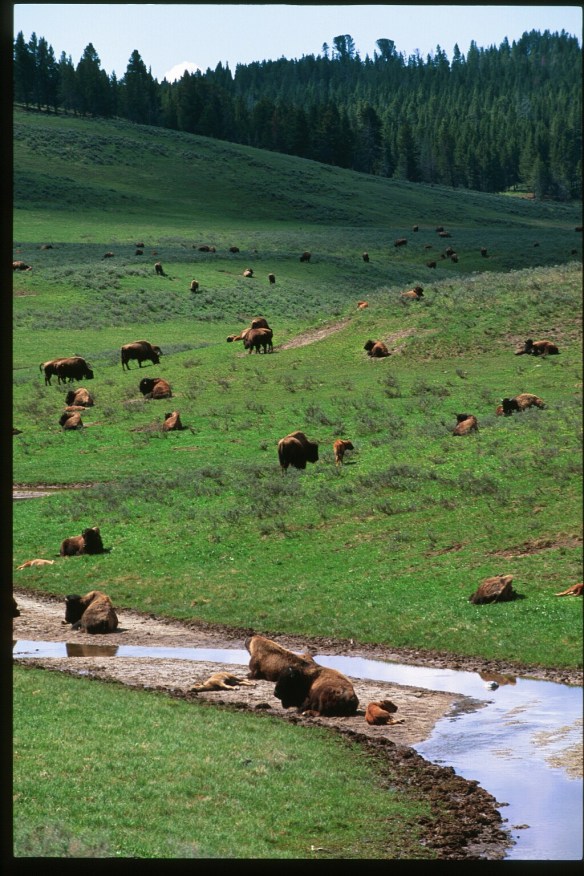
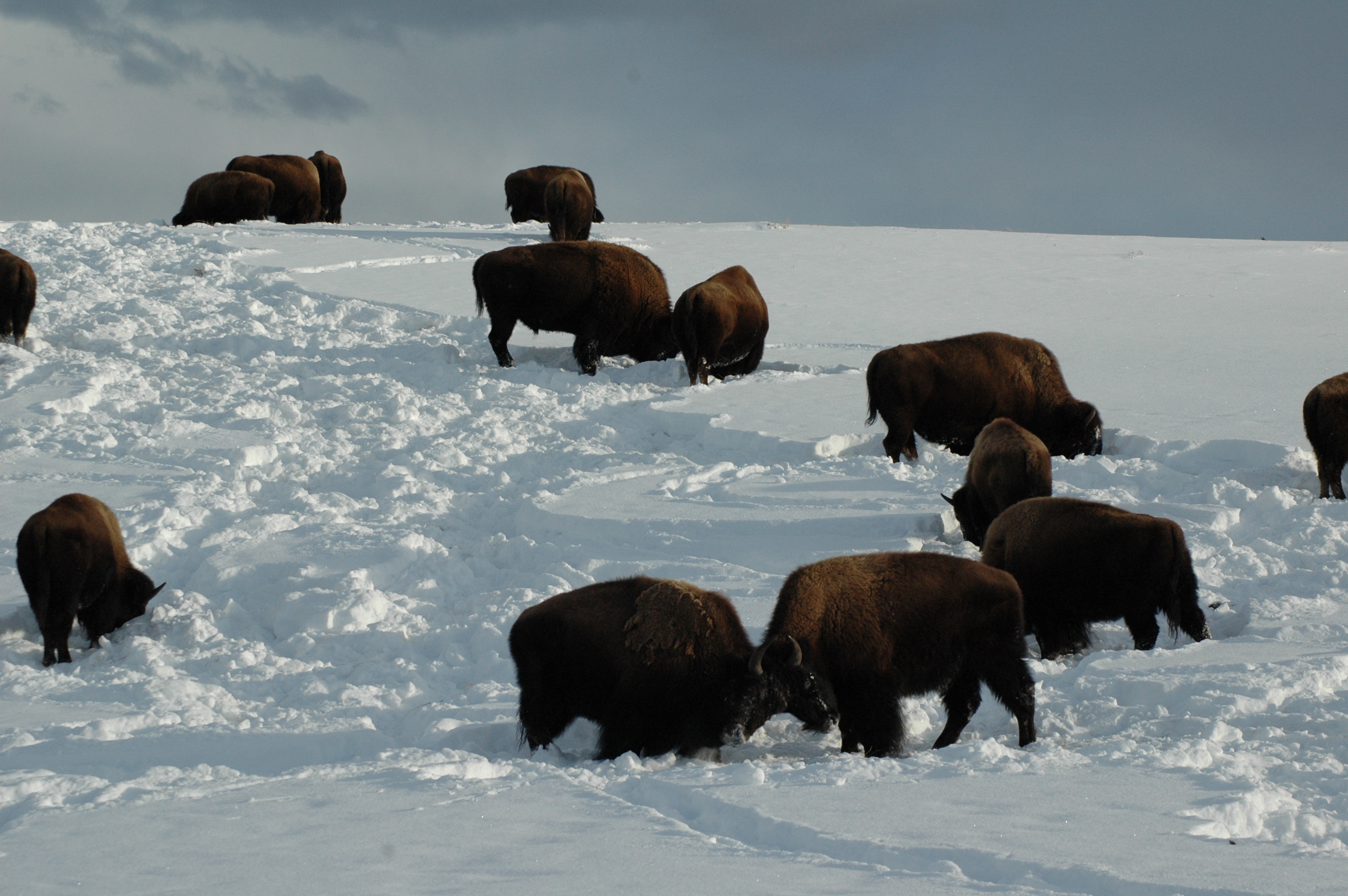
Yellowstone’s high plateaus are on average well over 5,000 feet in elevation; during the harsh winter months it can hardly be considered prime habitat for the wild grazers. Much of the park actually sits within the caldera of one the world’s largest active volcanoes.

Though Yellowstone is synonymous with the shaggy bovines, bison would prefer to spend their winters further downriver, outside the park, on lands now usurped and fenced-in by cowboys to fatten-up their cattle before shipping them off to slaughter.

The following excerpt from my book, Exposing the Big Game: Living Targets of a Dying Sport, ties in with the report by Stephany of Buffalo Field Campaign, below the photo…

Selfless and protective, bison develop lasting bonds in and outside the family, not only between cows, calves and siblings but also between unrelated individuals who grew up, traveled and learned about life together. Juveniles help mothers look after the youngsters and will gladly lend a horn to keep potential predators away from the calves. I have witnessed cooperation among bison families often in the years I’ve spent observing and photographing them. I’ve also seen them put themselves in harm’s way to defend elk from hungry wolves, and even mourn over the bones of their dead.

Wildlife Photography ©Jim Robertson

Wildlife Photography ©Jim Robertson

Report from Buffalo Field Campaign:

Between Thursday and Sunday, forty-four of America’s last wild buffalo were killed in the Gardiner Basin by hunters with the Nez Perce and Umatilla tribes. Most of these buffalo were shot less than 300 yards from the north boundary of Yellowstone National Park, on a small area of Gallatin National Forest land called Beattie Gulch.

Three of the buffalo that were shot here did not immediately fall but walked into Yellowstone, where they were not allowed to be retrieved by the Nez Perce hunters who shot them; their bodies left to the ecosystem. According to state and tribal officials, the hunters who shot these buffalo are being allowed to keep their tags to kill other buffalo. In another incident, three other buffalo were illegally shot and killed by two non-tribal members.

Two days later we watched as more than a hundred buffalo
approached these killing fields. They found the remains of their relatives strewn across the land like fleshy boulders left behind by glaciers. We watched in sorrowful awe as the buffalo approached the gut piles. Their tails shot up in the air as they ran from remain to remain, discovering what was left. Enormous bulls bellowed like roaring dragons, mouths agape, bodies arched, and pawing the ground. The buffalo placed their faces close to the flesh left behind, nuzzling their muzzles into the earth where the buffalo had fallen.

They sniffed at fetuses still sheltered in their mother’s flesh whose lives were ended before they were born. The buffalo circled and scattered, ran to each other and away again.
Sparring, bumping, running, pawing and crying out in their deep emotion of their discovery.

Watching, we could only think of it as a wake, a mighty wailing of the buffalo. Back and forth they ran, frantic, between the gut piles that had been their friends, their family. Like chieftains in their own right, fathers of their clans, the mature bulls lingered the longest, as the mothers and grandmothers lead the young ones on in an ancient procession, their deliberate footsteps slower in their sorrow.

The depth of relationship the buffalo share is timeless,
intense, and far beyond most people’s willingness or ability to accept or understand. Indeed, it is easier, more convenient, to ignore or pretend that it doesn’t mean anything. In that blindness we deny not only to other creatures, but to ourselves, the honest power of love,
the gift of respect, and the aid of wisdom. The buffalo already encompass these things, and they are patiently waiting on the brink for us to catch up…

DSC_0110

Hunters: the Brainwashed Masses

Never underestimate the power of brainwashing when it comes to transforming peaceable children into violent hunters of helpless beings. If we are to assume that most children are born innocent, with a natural affinity toward animals, then brainwashing is the only explanation for their conversion to hunting. Of course, peer pressure and the mind-numbing power of constant bombardment of violent movies, TV and video games are clearly culprits in a kid’s overall corruption; but those are all just contributors to the overall brainwashing process.

There are four basic elements involved when a person is brainwashed:

  1. A severe traumatic shock
  2. Isolation—being taken away from the people or surroundings where the person feels secure
  3. Programming—hearing what the mind controller wants the subject to believe, over and over and over
  4. The promise of a reward

Applying this formula to the average animal-loving young child, in order for them to be brainwashed into thinking hunting is a normal, acceptable activity, they first need to suffer a traumatic shock. Well, surely seeing their first living, breathing deer, elk, goose or rabbit shot down (whether by gun or bow and arrow), then bled-out and butchered right before their eyes would qualify.

The isolation they would feel would be both physical and emotional, with no one out there to relate to or share in their sorrow for the poor animal so unnecessarily murdered by someone they’ve always looked up to.

The programming would have gone on well before the child witnessed the carnage. After the kill, it would become even more intense as the father (or mother) figure struggles to make their murderous act seem justified.

And the reward comes in the form of enthusiastic praise and back-patting when the child makes their first solo kill.

Before you know it, the once caring young person is fully indoctrinated into the sportsmen’s way of looking at animals—as objects to be “harvested” or “culled,” depending on its species or the whim of its assassin.

Text and Wildlife Photography© Jim Robertson

Text and Wildlife Photography© Jim Robertson

Since when is Murder Considered Vegan?

On Monday, Salon.com was the first out of the gates with the rumor that Adam Lanza was “an organic vegan” who “didn’t want to hurt animals.” By now, with the help of Fox News and Rush Limbaugh, that news has probably made it clear around the ever-widening Bible belt, up through the armpit of Idaho to the outback outhouses of Alaska’s North Slope.

But whether or not Lanza eschewed animal flesh, he really couldn’t be considered an ethical vegan since vegans make every effort to avoid harming animals and—although some people are loathe to admit it—humans are animals. Ultimately, Adam Lanza’a  food choices have no more bearing on his decision to go on a killing spree at Connecticut’s Sandy Hook Elementary than the fascinating anecdote that he was left-handed (if he was) or that he had Asperger’s syndrome, a mild form of autism (which he did). (But, the point that his mother was a paranoid, survivalist gun-hoarder might actually have some bearing on the case).

The fact is, Lanza simply snapped. For whatever reason, the troubled twenty-year-old went completely off the deep end and acted out for no other explainable reason than insanity itself. None of his victims had anything to do with hurting animals; they were just innocent first graders minding their own business.

What concerns me is that some otherwise normal, caring vegan will snap in the name of the animals and set the entire animal rights movement back for years to come. Just today I received the following comment to one of my blog posts:

“When the subject of Wolf-murder was first mentioned, last year, I said people should put an ultimatum into the public domain to this effect: Kill ONE Wolf and TEN vermin will be randomly executed as retribution. Kill a SECOND Wolf and TWENTY MORE people will die. Kill a THIRD Wolf and FORTY more people will be slotted. For each Wolf murdered, the number of vermin ‘offed’ as retribution will be doubled, and absolutely ANYONE will become an X-Ray, with no concessions to age or gender or anything else. THAT is the way to do business…”

Although this commenter may sound like they’ve already gone postal, I think their point was to inspire others to take aggressive action. She doesn’t even live on this continent and couldn’t possibly act on her vindictive recommendations.

I’m certainly not going to argue that some of the wolf-killers out there don’t deserve a taste of their own medicine; but what if one of the hunters “randomly executed” turned out to be a good person in-the-making, such as the former hunter who recently wrote this?:

“I stopped hunting and trapping long ago. For years, I was ambivalent about speaking out because I accepted the cultural and psychological influences motivating those who grew up considering unnecessary killing a sport.  I’ve come to recognize how superficial, shallow, fleeting and self-destructive is this violent indulgence. I’ve come 180 degrees. For me, it is the senseless open seasons on wolves, bears, and in Wisconsin, even mourning doves.”

Nothing sways public opinion against someone’s cause more than when they decide to go on a shooting spree—especially if their victims are human.

Text and Wildlife Photography ©Jim Robertson

Text and Wildlife Photography ©Jim Robertson

New Review of Exposing the Big Game

Veg News, January-February, 2013 (Thanks, Claudine, for spotting this!):

A September 24, 2012 article in USA Today proclaimed “Hunting, Fishing Rebound in US.” Not so fast. Nature writer and wildlife photographer Jim Robertson would beg to differ, and does, in Exposing the Big Game.

Robertson—along with Sea Shepherd Captain Paul Watson, who penned Big Game’s foreword—puts forth a scathing critique of hunters, whose numbers are now the same as anti-hunting activists, about 5% of the population.

Big Game is a thin though powerful volume, a quick study into all that’s wrong with hunting and hunters. Robertson’s stunning black and white photos grace nearly every page and one would hope that he expand both text and (color) photography into a larger, more robust work. The material is here.

______________

Author’s Note: As the purpose of Exposing the Big Game is to shed new light on the evils of sport hunting, incite outrage and spark a firm resolve to help counter these atrocities worldwide, I decided to go with the current paperback format to keep the purchase price down, in hopes of spreading the word for wildlife as far and wide as possible. My publisher has promised to print a full-color coffee table book, once sales of this edition reach 5,000 copies. We’ve still got a ways to go…

front-cover-low-res6

Who the Hell Hunts With a Machine Gun Anyway?

While America is reeling in shock over the senseless shootings at Sandy Hook Elementary School and mourning those lost in a volley of peacetime machine gun fire, the papers are rehashing the same questions posed whenever a mass killing makes the news: “Why did this happen?” and “How can we prevent this kind of thing in the future?”

Predictably, politicians from both sides of the fence are weighing in on gun control or the culpability shared by violent Hollywood movies (and even cartoons like Family Guy and American Dad—both of which were preempted by Fox this week because of the tragedy). What we’re not hearing in the mainstream media is any mention of the leading role that sport hunting plays in promoting guns and perpetuating violence.

The latest school shooter, Adam Lanza, and the D.C. Beltway snipers, John Mohammad and John Malvo, all used a Bushmaster .223 hunting/assault rifle to carry out their killings. It was also the weapon used in the Colorado theater shooting, and in a host of other homicidal meltdowns.

The .223 semi-automatic can fire 6 rounds per second (okay, if you want to split hairs, it’s not technically considered a machine gun because you have to hit the hair-trigger with each shot), but what makes it so deadly is the way the bullet reacts on impact: It’s designed to bounce around inside the body once it makes contact with bone.

90641_Varminter

Why is such a lethal assault rifle legal for non-military civilians to own? According to the manufacturer, they are intended to be used for hunting animals. As the NRA well knows, hunting has been used to justify the private ownership of some of the most destructive weapons ever invented.

But who the Hell really hunts with a machine gun anyway? Unfortunately, some folks do. One thrill-killer describes his sport this way: “Prairie dog hunting is a blast, on both private and public lands. I like to start by clearing everything within 50 yards with an AR-15, then switch to my .223 Remington for anything out to about 150 and finally trade up to the bull barrel .22-250 for the longer shots.”

And those who mass murder coyotes seem to feel entitled to the deadliest of armaments as well. A recent “contest hunt” offered up a free shotgun or a pair of semi-automatic rifles to whoever murdered the most canines. The terms of the competition were simple: hunters in New Mexico had two days to shoot and kill as many coyotes as they could; the winner got their choice of a Browning Maxus 12-gauge shotgun or two AR-15 semi-automatic rifles. (The AR-15 is the civilian version of the military’s M16 that has been in production since Vietnam.) “Nothing’s gonna stop me,” said Mark Chavez, the hunt’s sponsor, and the owner of Gunhawk Firearms “This is my right to hunt and we’re not breaking any laws.”

Bushmaster describes their .223 as a “Varmint Rifle.” Oh really? That shines new light on what some of these politicians really mean when they say they only hunt “varmints.” I’ve never been an invited guest at George W. Bush’s ranch in Crawford Texas; therefore I can only guess that this is the type of weapon the self-proclaimed “varmint” hunter uses when he goes up against a family of scary ground squirrels, marmots or a town of talkative prairie dogs.

Larger caliber Bushmaster models are categorized as “Predator Rifles.”

90823_Pred_ATACS

Ironically, it was Lanza’s mother, Nancy, who taught young Adam how to shoot. She was an avid gun enthusiast who legally owned a Sig Sauer and a Glock (both handguns commonly used by police) and a military-style Bushmaster .223 M4 carbine, according to law enforcement officials. As it turns out, it was one of her guns that her son turned on her before using them in his attack on the students and teachers of Sandy Hook Elementary…

See also, “Honor Thy Father and Mother, Except When They Misbehave.”

Text and Wildlife Photography ©Jim Robertson, 2012. All Rights Reserved

Text and Wildlife Photography ©Jim Robertson, 2012. All Rights Reserved

Hunting Humans

After my post, Killing Wolves Provides “a Level of Tolerance”?, the director of a Canadian animal rights group, Lifeforce, sent me this press release, which, like my post, is a semi-satirical statement about turning the tables on trophy hunters…

Animal Rights Group To Booth: Let Us Hunt You

An animal rights group is challenging Vancouver Canucks forward David Booth to see what it feels like to be hunted in the wilderness. Peter Hamilton, director of the B.C.-based advocacy group Lifeforce, took umbrage with a picture Booth tweeted last week of the left winger posing next to a freshly-killed mountain goat.

He responded with a dare. “We’re challenging David Booth to put himself in the position of a hunted wildlife,” Hamilton told CTV News. “He would be subjected to the same plight that wildlife are, in hopes that he will reflect upon the suffering and pain of innocent animals.”

A draft version of the “Booth Hunt” plan indicates the Canuck would be sent into the wild unarmed, alone and without rations. A team of hunters with dogs and high-tech equipment would then attempt to track and capture him within an agreed-upon time limit. Naturally, Booth would not be harmed by his chasers.

“He would rely on any of his woodsman skills, as do the wildlife who are forced to rely on their abilities while being ruthlessly pursued,” the draft plan reads. Hamilton described trophy hunting as “barbaric,” and said it’s a practice that must be stopped.BOOTHHUNT

“A trophy is an inanimate object. These are sentient beings,” he said. “One has to question anyone’s motive in getting any kind of pleasure out of killing an animal in this manner.” …

I certainly have to agree with Peter Hamilton on that last point—their motive mirrors that of a serial killer—but as I told him, the fact that he’d know he wouldn’t be harmed by his pursuers would make Booth’s experience only a watered-down version of what a hunted animal fearing for its life goes through. Mr. Hamilton concurred; of course his proposition had to sound non-lethal in order to get the barbaric Booth to even consider going along with it.
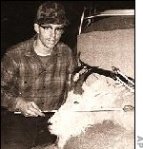
6-4Hansens-trophy-goatIronically, another infamous celebrity who posed with murdered mountain goats is Anchorage, Alaska baker, serial killer and renowned trophy hunter, Robert Hansen (now serving a 461 year prison sentence for the murder of at least 17 women, ranging in age from 16 to 41.) Well-liked by his neighbors and famed as a local hunting champion, Hansen even broke several records for trophy (nonhuman) kills, documented in the Pope & Young’s book of world hunting records.

Another bit of irony: like the Connecticut school shooter, Adam Lanza, and the D.C. Beltway snipers, John Allen Mohammed and John Lee Malvo, he used a .223-caliber semi-automatic hunting rifle to make his kills (both human and non-human).

Whenever Hansen got a victim under his control, he would fly her in his private plane to his remote cabin where they would be subjected to torture and then set free in the woods, naked and sometimes blindfolded. Hansen would give his victims a brief head start and then hunt them down with a hunting knife or a high-powered rifle. In5-2Robert-Hansens-trophy-room describing his hunts to investigators, Hansen said that it was like “going after a trophy Dall sheep or a grizzly bear.”

As world renowned FBI profilers, John Douglas and Roy Hazelwood correctly surmised, Hansen was compelled to keep trophies of his murders, such as a victim’s jewelry. According to Douglas, the abuse of prostitutes is a way for perpetrators to get back at women. Hansen was probably using his victims as a way to get revenge (much like the motive of good ol’ boys who kill wolves).

Several investigators who were familiar with Hansen said that he was known around the area as a proficient hunter. He earned this reputation after taking down a wild Dall sheep with a crossbow. Douglas concluded that Robert Hansen must have tired of elk, bear and Dall sheep, and instead turned his attention to more interesting prey.

When investigators first heard Hansen’s confession, they couldn’t help but think of the popular fictional story “The Most Dangerous Game” by writer Richard Connell. In the story, a shipwrecked trio find themselves stranded on an uncharted island, where they meet a Russian Count, known only as General Zaroff. The group’s initial delight turns to terror when they realize that the shipwreck was no accident and the good general had lured them there so he could hunt them down.

According to the Huffington Post, Anchorage police and FBI investigators just released information about another Alaskan serial killer, Israel Keyes, who authorities said never showed any remorse but said he got a rush out of hunting for victims and killing them. He also tortured animals as a child, investigators said.

Again, the serial killer’s motive and behavior closely parallels a trophy hunter’s:

“Israel Keyes didn’t kidnap and kill people because he was crazy. He didn’t kidnap and kill people because his deity told him to or because he had a bad childhood,” Anchorage homicide Detective Monique Doll said. “Israel Keyes did this because he got an immense amount of enjoyment out of it; much like an addict gets an immense amount of enjoyment out of drugs. In a way, he was an addict, and he was addicted to the feeling that he got when he was doing this.”

While researching for this blog post, I dug up an article by lion conservationist, Gareth Patterson, entitled “The Killing Fields.” In it, Patterson compares the uncanny similarities between trophy hunters and serial killers.

Here are some excerpts…

Certainly one could state that, like the serial killer, the trophy hunter plans his killing with considerable care and deliberation. Like the serial killer, he decides well in advance the type of victim–that is, which species he intends to target. Also like the serial killer, the trophy hunter plans with great care where and how the killing will take place–in what area, with what weapon. What the serial killer and trophy hunter also share is a compulsion to collect trophies or souvenirs of their killings. The serial killer retains certain body parts and/or other trophies for much the same reason as the big game hunter mounts the head and antlers taken from his prey…as trophies of the chase.

Hunting magazines contain page after page of (a) pictures of hunters, weapon in hand, posing in dominating positions over their lifeless victims, (b) advertisements offering a huge range of trophy hunts, and (c) stories of hunters’ “exciting” experience of “near misses” and danger. These pages no doubt titillate the hunter, fueling his own fantasies and encouraging him to plan more and more trophy hunts.

Trophy hunters often hire a camera person to film their entire hunts in the bush, including the actual moments when animals are shot and when they die. These films are made to be viewed later at will, presumably for self-gratification purposes and to show to other people–again the longing “to be important” factor?…

And finally, while on the subject, here’s an excerpt from the chapter, “Inside the Hunter’s Mind,” in my book, Exposing the Big Game: Living Targets of a Dying Sport:

A hunter’s true impetus is to serve the evil master in custody of his soul: his ravening ego. His self-interests are consistently placed far above those of his animal victims, whom he depersonalizes and views as objects rather than individuals. Reducing living entities to lifeless possessions and taking trophies of their body parts—without the slightest hint of guilt, remorse or other higher sentiment—is standard practice for the sport hunter…and the serial killer.

The sportsman keeps his malignant, murderous obsession concealed within the hollow confines of his psyche…until the next hunting season. Beneath a façade of virtuosity he’s driven by an urge to obtain surrogate victims, or stand-ins, representative of some perceived injustice he imagines he underwent at the hands of someone who didn’t let him have his way at some time in his life.

Maybe as a young child he felt he was undeservedly reprimanded, and so he terrorized the family pet, threw rocks at pigeons or turned to some other form of animal abuse to lift his sense of worth and gain a feeling of control. Over the years, he may have found that same kind of ego boost in killing animals for sport, partially satiating his savagery until the next legal opportunity to kill again. Imagining he’s reaping the power of the bear or the stately bull elk temporarily boosts his floundering self-esteem or relieves his sense of inadequacy. But his pride is a shallow pool, constantly in need of refreshing…

Text and Wildlife Photography ©Jim Robertson, 2012. All Rights Reserved

Text and Wildlife Photography ©Jim Robertson, 2012. All Rights Reserved
Guns, Guns and More Guns

We Americans sure love our guns. Big ones, small ones, single shot or semi-automatic, antiques or shiny new ones. This year’s Black Friday gun sales set an all-time record (The FBI said it received 154,873 calls for background checks for new gun purchases on Nov. 23, a marked increase over the agency’s previous record number of calls: 129,166 last year. The bureau was so overwhelmed with calls that outages occurred at some centers). Americans’ infatuation with guns takes a back seat only to that which they have for cars; and as you would expect, the homicidal havoc wreaked by firearms is second only to the body count chalked up to automobile accidents.

With so many avid gun hoarders out there, the rest of us would have to amass a small arsenal to try to keep up with the Joneses. It seems U.S. gun owners so outnumber those who conscientiously object to personal weapon stockpiles that non-gun owners are about as few and far between as vegans at an NRA potluck.

But while keeping a pistol or shotgun in the home to dissuade intruders is innocuous enough, this excerpt from my book, Exposing the Big Game: Living Targets of a Dying Sport, is a good example of the obsession some folks have with guns:

People in “cattle country” often entertain themselves by using the beleaguered prairie dogs as living targets, taking all the more sick pleasure in shooting an attentive mother as she pops up from her burrow to see if it’s safe for her youngsters to come out. Hunters glibly assign the term “double tap” for a shot that kills both the mother and her adoring baby. “Tap” is a particularly perverse moniker considering that the hollow point bullets they sometimes use cause their victims to literally explode on impact—a sight that must really get the shooter’s blood up. Ladies beware: there’s a demonstrated link between cruelty to animals and domestic abuse, assault and other crimes on a killer’s violence continuum [including, school-shootings and the mass murder of Christmas shoppers at the mall].

One thrill-killer describes his sport this way: “Prairie dog hunting is a blast, on both private and public lands. I like to start by clearing everything within 50 yards with an AR-15, then switch to my .223 Remington for anything out to about 150 and finally trade up to the bull barrel .22-250 for the longer shots.” The only thing stopping a sportsman with this much bloodlust is the melting point of his gun barrel…

Coincidentally (or not), an AR-15 was also the weapon of choice of Jacob Tyler Roberts, the 22 year old Portland mall gunman, and a .223 was the assault weapon used by the Connecticut school shooter, 20 year old Adam Lanza. The .223 was also the semi-automatic rifle used by the D.C. Beltway snipers, John Allen Mohammed and John Lee Malvo. While there’s truth to the saying “Guns don’t kill people, people kill people,” the fact is, those who kill the most are the people who’re the most fixated on their guns, i.e: hunters. The Columbine mass-murderers, the serial killer known as Zodiak, and untold others practiced on killing animals before graduating to people. Chances are good that when we learn the backstory of the mall shooter and the Connecticut kid-killer, we’ll find that they were quite the little nimrods as well.

Text and Wildlife Photography© Jim Robertson

Text and Wildlife Photography© Jim Robertson

Hello Mass Extinction

In yesterday’s post, “Bye Bye Biodiversity,” I mentioned the hundreds of miles of Iowa cornfields where nothing else grows or lives. Humans have seen to it that nothing else lives in that region, at first by physically killing off the birds and mammals through hunting and trapping, and next with poisons to eradicate those species they deemed “pests:” the insects and burrowing mammals, along with any competing plants, collectively known as “weeds.”

To see to it that only the resultant monoculture thrives, their chosen plants are genetically modified to repel any other life that might find its way into the wasteland 524958_3325028303604_654533903_n(also so they won’t reproduce on their own without the parent corporation’s seed stock). Much of the corn is grown to serve as feed for those other monoculture “crops:” cows, pigs and chickens stuck on factory farms.

It requires huge tracts of open, flat land to allow for this kind of whole-Earth manipulation to go on, and the Midwest, once known as The Great Plains—the former home to vast herds of migratory bison and elk, pronghorn and prairie dogs, wolves, grizzly bears and more—was just the ticket.

As long as there are still miles of farm roads to speed their pickup trucks along and an occasional deer, coyote or “planted” pheasant to hunt, folks growing up there consider it to be the “country,” blissful in their ignorance of the biological diversity that thrived across the once wild land they call home.

It’s a similar story out west, where so much of the ancient forests have been removed and replanted with single-species tree plantations. Though the slopes are still mostly green, much of the wondrous diversity of life has been lost, along with the memory of whom and what once lived there.

By the same token, anyone arriving by transatlantic schooner would have no way of knowing that mass extinction in North America had already begun with the arrival of the first human hunters to cross the Bering land bridge a dozen centuries before. The megafauna which evolved on the Western Hemisphere—in glorious isolation from predacious human primates, whose greatest achievement may well be the complete undoing of all that evolution has created during this, the tail end of the age of mammals—would have brought to mind the African savanna; an American Serengeti.

Futuristic films, such as Soylent Green and Silent Running, suggest that when humans inevitably destroy the planet, there will be absolutely nothing left. But mass extinction does not necessarily equate to a totally denuded planet. The otherwise lifeless Midwest monoculture cropland, where one or two dominant species have displaced all others, is closer to what a mass extinction looks like.

In other words, we aren’t on the “verge of causing” a mass extinction, as the mainstream media (loath to report on anything that might affect the stock market) would tell you; we are among the living-dead in the midst of a human-caused mass extinction. It may not be the “Zombie Apocalypse,” but as far as life on Earth is concerned, it’s pretty damned scary.

Text and Wildlife Photography© Jim Robertson

Text and Wildlife Photography© Jim Robertson

You Say You Want a Revolution

The Beatles’ “White Album” (arguably their finest, next to Revolver, Sergeant Pepper’s Lonely Hearts Club Band, Magical Mystery Tour, Abbey Road or Let It Be) includes a laid back acoustic version of their hit song, “Revolution,” titled, “Revolution 1” (not to be confused with the bazaar, surely drug-induced “Revolution 9”). Of course, they sound like they’re on some kind of drugs (probably downers) in “Revolution 1;” they added an exaggerated, mockingly mellow “shoo be do” between “don’t you know it’s gonna be” and “alright.”

But the main difference between that song and the well-known standard, top-40, rock version of “Revolution” (which was released at the same time as “Hey Jude”) is that in “Revolution 1,” after the line “but when you talk about destruction, don’t you know that you can count me out” John Lennon can be heard in the background adding the word “in” (almost as an afterthought).

This brings up an issue dear to the hearts of some of you readers. We all know that hunting is a war on wildlife—hunters are the terrorists, and the animals (along with those of us who care passionately about them) are the terrorized. Here’s an opportunity for a round table discussion on the pros and cons—the merits and detriments—of destruction. What’s it gonna be people, “out” or “in”?

Your comments are welcome…just remember, this is a public site, please don’t say anything too incriminating. You wouldn’t want to end up like Ted Nugent promises he’ll soon be—either “dead or in jail”—for saying something ted-fully stupid like, “We need to ride into that battlefield and chop their [Democrats] heads off,” a comment which earned him a visit from the FBI and/or the Secret Service.

Text and Wildlife Photography ©Jim Robertson

Forget the Calendar

According to the calendar, today’s my 52nd birthday. It’s hard to believe; I don’t feel any older than I was on the day I stopped eating meat and dairy 15 years ago. Though my choice to go vegan was for the sake of the animals—whose misery and death I was no longer willing to be a part of—the karmic reward (so to speak) has been the arrest of some of the detrimental conditions common among people in my alleged age group and a slowing down of the aging process all living things are subject to.

Unlike vegetables, fruits, nuts, grains and legumes, which can be kept as fresh as the day they were picked, meat begins to decompose the minute an animal is killed and their blood stops flowing. Any hunter or backyard butcher knows it’s a race against time to preserve dead meat before it spoils or is taken over by parasites (the microscopic kind as opposed to the human ones).Meanwhile, if not performed with great care, the morbid act of “gutting” an animal can spread E. coli and other intestinal nasties onto the “food.”

No matter how freshly killed the host animal was, their flesh is a product of death. It stands to reason that eating dead flesh cells, which contain no fiber and literally rot in the colon, will adversely affect whosoever consumes them. That’s why most herbivores live twice as long as the carnivorous species. And it’s why people who eschew meat and dairy* can potentially prolong their lives and find themselves feeling much more youthful and vital than most of their meat and dairy-eating counterparts.

*(For its part, dairy is rife with mucus forming pus—creating a favorable environment for respiratory contagions—as well as animal fat and acidic animal protein that leaches calcium from adult bones, while eggs are notoriously high in cholesterol.)

There’s a lot of truth in the saying, “You’re as young as you feel.” Forget the calendar, I don’t feel any older than 37. I can walk just as far, ski just as hard and chop as much wood as I did back then. I have just as much strength and stamina and am every bit as active in all ways—perhaps even more so, since I’ve had a decade and a half to recover from the ill effects of eating animal products.

Text and Wildlife Photography ©Jim Robertson