Hunters: the Brainwashed Masses

Never underestimate the power of brainwashing when it comes to transforming peaceable children into violent hunters of helpless beings. If we are to assume that most children are born innocent, with a natural affinity toward animals, then brainwashing is the only explanation for their conversion to hunting. Of course, peer pressure and the mind-numbing power of constant bombardment of violent movies, TV and video games are clearly culprits in a kid’s overall corruption; but those are all just contributors to the overall brainwashing process.

There are four basic elements involved when a person is brainwashed:

  1. A severe traumatic shock
  2. Isolation—being taken away from the people or surroundings where the person feels secure
  3. Programming—hearing what the mind controller wants the subject to believe, over and over and over
  4. The promise of a reward

Applying this formula to the average animal-loving young child, in order for them to be brainwashed into thinking hunting is a normal, acceptable activity, they first need to suffer a traumatic shock. Well, surely seeing their first living, breathing deer, elk, goose or rabbit shot down (whether by gun or bow and arrow), then bled-out and butchered right before their eyes would qualify.

The isolation they would feel would be both physical and emotional, with no one out there to relate to or share in their sorrow for the poor animal so unnecessarily murdered by someone they’ve always looked up to.

The programming would have gone on well before the child witnessed the carnage. After the kill, it would become even more intense as the father (or mother) figure struggles to make their murderous act seem justified.

And the reward comes in the form of enthusiastic praise and back-patting when the child makes their first solo kill.

Before you know it, the once caring young person is fully indoctrinated into the sportsmen’s way of looking at animals—as objects to be “harvested” or “culled,” depending on its species or the whim of its assassin.

Text and Wildlife Photography© Jim Robertson

Text and Wildlife Photography© Jim Robertson

Finding the Christmas Miracle

This is the time of year when people like to find the silver lining in things. The phenomenon is especially obvious during mainstream media newscasts, as the networks are keenly aware that their viewers might abandon them and move on to a different channel if they stick too close to the reality of a given situation on this, the holiest of nights.

So, in the spirit of silver linings, I’m going to try to be positive and find the “Christmas miracle” in everything (at least until December 26th anyway). Okay, here we go…

-Although the Earth’s climate is changing faster than scientists originally predicted—due to the ongoing, rampant, anthropogenic burning of fossil fuels like coal, oil and natural gas, resulting in worsening droughts, more intense hurricane and fire seasons and a record melt-down of the Arctic ice cap—at least we survived the Mayan Apocalypse.

-Even if Ted Nugent personally poached and otherwise killed an inestimable, undisclosed number of bear, deer, elk and other undeserving victims this year, at least his silly T.V. show was cancelled.

-Though there was an increase in the number of noble, majestic elk who were senselessly yet legally “harvested” (read: murdered) by sportsmen in Montana this year, the numbers are in from hunter check stations for the final weekend of the general big game season across the state and overall it looks like 2012 saw fewer hunters taking fewer animals….(That one was easy; I just put a positive spin on the original end of the year report by the Montana game department that read, “The numbers are in from hunter check stations for the final weekend of the general big game season across Montana and overall it looks like 2011 saw fewer hunters taking fewer animals. One bright spot seemed to be a small increase in the elk harvest in several areas.”)

-Despite widespread trapping of mink, marten, otter, raccoon, beaver, muskrat, bobcat, fox and about every other “furbearer” in the state of Montana, the wolverine are off the hit-list there…for now.

-While gun sales set a record on Black Friday and spiked even higher since the Sandy Hook school massacre, at least some of this year’s crazed gunmen did the world a favor and eventually turned their weapons on themselves.

-Although 115 wolves have been sadistically slaughtered in Wisconsin (in addition to hundreds of others shot and trapped in the Lower 48 so far this year), that state has reached its “quota,” so no more wolves there can be legally killed by hunters…at least until the next hunting season (hunters there are calling for an unlimited quota next time).

-Despite the fact that we’re in the midst of the sixth mass extinction event in the planet’s history with so many species going extinct per year that no one can possibly keep track, remote cameras recently photographed both an ocelot and a jaguar in southern Arizona.

-And on a personal note: although, due to his failing health, my 87 year old father was spaced out and barely able to whisper a word or acknowledge anything the entire day yesterday, he suddenly started smiling and became animated and engaged when he found himself winning nearly every hand at poker last night (by the end of the game, he had amassed an enormous pile of chips and the rest of us were bankrupt).

Seasons Greetings and always keep an eye out for that elusive silver lining!

Text and Wildlife Photography ©Jim Robertson

Text and Wildlife Photography ©Jim Robertson

New Review of Exposing the Big Game

Veg News, January-February, 2013 (Thanks, Claudine, for spotting this!):

A September 24, 2012 article in USA Today proclaimed “Hunting, Fishing Rebound in US.” Not so fast. Nature writer and wildlife photographer Jim Robertson would beg to differ, and does, in Exposing the Big Game.

Robertson—along with Sea Shepherd Captain Paul Watson, who penned Big Game’s foreword—puts forth a scathing critique of hunters, whose numbers are now the same as anti-hunting activists, about 5% of the population.

Big Game is a thin though powerful volume, a quick study into all that’s wrong with hunting and hunters. Robertson’s stunning black and white photos grace nearly every page and one would hope that he expand both text and (color) photography into a larger, more robust work. The material is here.

______________

Author’s Note: As the purpose of Exposing the Big Game is to shed new light on the evils of sport hunting, incite outrage and spark a firm resolve to help counter these atrocities worldwide, I decided to go with the current paperback format to keep the purchase price down, in hopes of spreading the word for wildlife as far and wide as possible. My publisher has promised to print a full-color coffee table book, once sales of this edition reach 5,000 copies. We’ve still got a ways to go…

front-cover-low-res6

Hunting Humans

After my post, Killing Wolves Provides “a Level of Tolerance”?, the director of a Canadian animal rights group, Lifeforce, sent me this press release, which, like my post, is a semi-satirical statement about turning the tables on trophy hunters…

Animal Rights Group To Booth: Let Us Hunt You

An animal rights group is challenging Vancouver Canucks forward David Booth to see what it feels like to be hunted in the wilderness. Peter Hamilton, director of the B.C.-based advocacy group Lifeforce, took umbrage with a picture Booth tweeted last week of the left winger posing next to a freshly-killed mountain goat.

He responded with a dare. “We’re challenging David Booth to put himself in the position of a hunted wildlife,” Hamilton told CTV News. “He would be subjected to the same plight that wildlife are, in hopes that he will reflect upon the suffering and pain of innocent animals.”

A draft version of the “Booth Hunt” plan indicates the Canuck would be sent into the wild unarmed, alone and without rations. A team of hunters with dogs and high-tech equipment would then attempt to track and capture him within an agreed-upon time limit. Naturally, Booth would not be harmed by his chasers.

“He would rely on any of his woodsman skills, as do the wildlife who are forced to rely on their abilities while being ruthlessly pursued,” the draft plan reads. Hamilton described trophy hunting as “barbaric,” and said it’s a practice that must be stopped.BOOTHHUNT

“A trophy is an inanimate object. These are sentient beings,” he said. “One has to question anyone’s motive in getting any kind of pleasure out of killing an animal in this manner.” …

I certainly have to agree with Peter Hamilton on that last point—their motive mirrors that of a serial killer—but as I told him, the fact that he’d know he wouldn’t be harmed by his pursuers would make Booth’s experience only a watered-down version of what a hunted animal fearing for its life goes through. Mr. Hamilton concurred; of course his proposition had to sound non-lethal in order to get the barbaric Booth to even consider going along with it.
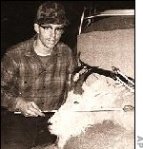
6-4Hansens-trophy-goatIronically, another infamous celebrity who posed with murdered mountain goats is Anchorage, Alaska baker, serial killer and renowned trophy hunter, Robert Hansen (now serving a 461 year prison sentence for the murder of at least 17 women, ranging in age from 16 to 41.) Well-liked by his neighbors and famed as a local hunting champion, Hansen even broke several records for trophy (nonhuman) kills, documented in the Pope & Young’s book of world hunting records.

Another bit of irony: like the Connecticut school shooter, Adam Lanza, and the D.C. Beltway snipers, John Allen Mohammed and John Lee Malvo, he used a .223-caliber semi-automatic hunting rifle to make his kills (both human and non-human).

Whenever Hansen got a victim under his control, he would fly her in his private plane to his remote cabin where they would be subjected to torture and then set free in the woods, naked and sometimes blindfolded. Hansen would give his victims a brief head start and then hunt them down with a hunting knife or a high-powered rifle. In5-2Robert-Hansens-trophy-room describing his hunts to investigators, Hansen said that it was like “going after a trophy Dall sheep or a grizzly bear.”

As world renowned FBI profilers, John Douglas and Roy Hazelwood correctly surmised, Hansen was compelled to keep trophies of his murders, such as a victim’s jewelry. According to Douglas, the abuse of prostitutes is a way for perpetrators to get back at women. Hansen was probably using his victims as a way to get revenge (much like the motive of good ol’ boys who kill wolves).

Several investigators who were familiar with Hansen said that he was known around the area as a proficient hunter. He earned this reputation after taking down a wild Dall sheep with a crossbow. Douglas concluded that Robert Hansen must have tired of elk, bear and Dall sheep, and instead turned his attention to more interesting prey.

When investigators first heard Hansen’s confession, they couldn’t help but think of the popular fictional story “The Most Dangerous Game” by writer Richard Connell. In the story, a shipwrecked trio find themselves stranded on an uncharted island, where they meet a Russian Count, known only as General Zaroff. The group’s initial delight turns to terror when they realize that the shipwreck was no accident and the good general had lured them there so he could hunt them down.

According to the Huffington Post, Anchorage police and FBI investigators just released information about another Alaskan serial killer, Israel Keyes, who authorities said never showed any remorse but said he got a rush out of hunting for victims and killing them. He also tortured animals as a child, investigators said.

Again, the serial killer’s motive and behavior closely parallels a trophy hunter’s:

“Israel Keyes didn’t kidnap and kill people because he was crazy. He didn’t kidnap and kill people because his deity told him to or because he had a bad childhood,” Anchorage homicide Detective Monique Doll said. “Israel Keyes did this because he got an immense amount of enjoyment out of it; much like an addict gets an immense amount of enjoyment out of drugs. In a way, he was an addict, and he was addicted to the feeling that he got when he was doing this.”

While researching for this blog post, I dug up an article by lion conservationist, Gareth Patterson, entitled “The Killing Fields.” In it, Patterson compares the uncanny similarities between trophy hunters and serial killers.

Here are some excerpts…

Certainly one could state that, like the serial killer, the trophy hunter plans his killing with considerable care and deliberation. Like the serial killer, he decides well in advance the type of victim–that is, which species he intends to target. Also like the serial killer, the trophy hunter plans with great care where and how the killing will take place–in what area, with what weapon. What the serial killer and trophy hunter also share is a compulsion to collect trophies or souvenirs of their killings. The serial killer retains certain body parts and/or other trophies for much the same reason as the big game hunter mounts the head and antlers taken from his prey…as trophies of the chase.

Hunting magazines contain page after page of (a) pictures of hunters, weapon in hand, posing in dominating positions over their lifeless victims, (b) advertisements offering a huge range of trophy hunts, and (c) stories of hunters’ “exciting” experience of “near misses” and danger. These pages no doubt titillate the hunter, fueling his own fantasies and encouraging him to plan more and more trophy hunts.

Trophy hunters often hire a camera person to film their entire hunts in the bush, including the actual moments when animals are shot and when they die. These films are made to be viewed later at will, presumably for self-gratification purposes and to show to other people–again the longing “to be important” factor?…

And finally, while on the subject, here’s an excerpt from the chapter, “Inside the Hunter’s Mind,” in my book, Exposing the Big Game: Living Targets of a Dying Sport:

A hunter’s true impetus is to serve the evil master in custody of his soul: his ravening ego. His self-interests are consistently placed far above those of his animal victims, whom he depersonalizes and views as objects rather than individuals. Reducing living entities to lifeless possessions and taking trophies of their body parts—without the slightest hint of guilt, remorse or other higher sentiment—is standard practice for the sport hunter…and the serial killer.

The sportsman keeps his malignant, murderous obsession concealed within the hollow confines of his psyche…until the next hunting season. Beneath a façade of virtuosity he’s driven by an urge to obtain surrogate victims, or stand-ins, representative of some perceived injustice he imagines he underwent at the hands of someone who didn’t let him have his way at some time in his life.

Maybe as a young child he felt he was undeservedly reprimanded, and so he terrorized the family pet, threw rocks at pigeons or turned to some other form of animal abuse to lift his sense of worth and gain a feeling of control. Over the years, he may have found that same kind of ego boost in killing animals for sport, partially satiating his savagery until the next legal opportunity to kill again. Imagining he’s reaping the power of the bear or the stately bull elk temporarily boosts his floundering self-esteem or relieves his sense of inadequacy. But his pride is a shallow pool, constantly in need of refreshing…

Text and Wildlife Photography ©Jim Robertson, 2012. All Rights Reserved

Text and Wildlife Photography ©Jim Robertson, 2012. All Rights Reserved

It’s Hard to Be Ethically Consistent While Tap-Dancing on Eggshells

Over the weekend I received the following question, which I’ll attempt to answer below…


Dear Mr. Robertson,

I was wondering your opinion on the subject of animal rights vs. the rights of indigenous people. What do you think about hunting by Native American tribes, or the hunting of seals by the Inuit? Also, of course, the various other tribes around the world that have their culture based off of hunting. What do you think about their participation in hunting, trapping, etc?


Hmmm, one of those questions…one of those I-wouldn’t-touch-that-with-a-ten-foot-pole kind of questions. Do I risk being called a hypocrite, or “culturally elite?” I could spend all day tip-toeing around this—tap-dancing on egg shells—but here’s an answer just off the top of my head:

My objection to hunting, trapping and seal clubbing is colorblind as well as culture-blind. I oppose cruelty to animals, no matter who is doing the shooting, trapping or clubbing. A victim doesn’t suffer any less because of the ethnicity or cultural beliefs of their executioner. An animal’s right to a life, free from harm, trumps anyone’s right to exploit or kill them (unless someone is literally starving to death and has no other options, which is not the case for most who hunt, trap, club seals, harpoon whales or trade in bushmeat).

Why oppose the Japanese or the Faeroese for slaughtering dolphins or pilot whales and not the Makah for killing grey whales, or even the Inuit for hunting bowhead whales? We’re all part of the species, Homo sapiens, and our ancestors all used to live by hunting and trapping. For better or worse, we’re all moving forward technologically, so there’s no reason we shouldn’t all move forward in our treatment of non-human animals.

That’s my humble opinion, anyway. It might not be popular, but it’s ethically consistent.

Text and Wildlife Photography© Jim Robertson

Text and Wildlife Photography© Jim Robertson

Bye Bye Biodiversity

I’ve said it before and I’ll probably say it again, you can’t really be a wolf advocate or an elk advocate, or any kind of advocate for the environment, and continue to eat beef. That message was driven home by a new Montana Fish, Wildlife and Parks Department elk “management” proposal which includes reducing the numbers of not only elk, but also of wolves (who, logically, could have done some of the “management” for them) near Yellowstone National Park, all in the name of safeguarding cattle from the negligible threat of brucellosis—a disease which, in the past hundred years, has come full circle from livestock to wildlife and now back to livestock.

So far, it’s been the bison migrating out of Yellowstone during hard winters who have suffered the brunt of the rancher’s brucellosis paranoia. “Solutions” have included “hazing” bison back into the park and creating holding areas outside the park to warehouse bison before shipping them off to slaughterhouses—those nightmarish death camps where so many of their forcibly domesticated bovine cousins meet their ends. (In a country where some 60 million bison once roamed free, 97 million beef cattle are sent to slaughter each year.) Still other Yellowstone bison are murdered during newly imposed state “hunting” seasons—right outside the park.

Speaking of hunting, it’s interesting (to put it nicely) that hunters in Montana and Wyoming have claimed that elk populations in those states have declined as a result of the wolf reintroduction programs, yet the latest report suggests that elk numbers and density are “too high” (at least for rancher’s sensitivities) in parts of Montana.

Typical of state “game” department bureaucrats and their ideas of a “solution” to any perceived wildlife/livestock “conflict,” their preferred proposal is to reduce the number of wild animals—in this case, both elk and wolves!

It’s the kind of mentality that’s destroying the planet’s biodiversity at every turn: mile after mile of monoculture cornfields in Iowa (grown primarily to fatten cattle crammed onto feedlots)—places where, a century ago, 300 species of plants, 60 mammals, 300 birds and hundreds of insects would have lived—are now devoid of all other life forms other than cornstalks and an occasional tiny ant or a mushroom the size of an apple seed; cows grazing on pastures in Pennsylvania and Louisiana are dying from toxic fracking wastes that have made their way to the surface and meanwhile, arctic ice is melting faster than previously predicted, disrupting ocean currents and weather patterns life on Earth has come to depend on.

Call it “growth” or “progress” or just “our way of life,” but this locomotive is speeding towards a brick wall—yet we keep shoveling fuel into it like there’s no tomorrow…


Not that Montana FWP are likely to listen to anyone except fellow hunters and/or their cattle baron buddies, but the public comment period is now open, so feel free to let them know what you think about their elk “management” proposal here: http://fwp.mt.gov/hunting/publicComments/2012elkMgmtGuidelinesBrucellosisWG.html

You can view the working group’s recommendations by clicking on the “Interested Persons Letter” link on this webpage. That site also includes the opportunity to submit online comments about the recommendations. Written comments can be mailed to “FWP – Wildlife Bureau, Attn: Public Comment, P. O. Box 200701, Helena, MT 59620-0701. All comments must be received by 5:00 p.m. Mountain Standard Time on December 20, 2012

Text and Wildlife Photography ©Jim Robertson

Text and Wildlife Photography ©Jim Robertson

You Say You Want a Revolution

The Beatles’ “White Album” (arguably their finest, next to Revolver, Sergeant Pepper’s Lonely Hearts Club Band, Magical Mystery Tour, Abbey Road or Let It Be) includes a laid back acoustic version of their hit song, “Revolution,” titled, “Revolution 1” (not to be confused with the bazaar, surely drug-induced “Revolution 9”). Of course, they sound like they’re on some kind of drugs (probably downers) in “Revolution 1;” they added an exaggerated, mockingly mellow “shoo be do” between “don’t you know it’s gonna be” and “alright.”

But the main difference between that song and the well-known standard, top-40, rock version of “Revolution” (which was released at the same time as “Hey Jude”) is that in “Revolution 1,” after the line “but when you talk about destruction, don’t you know that you can count me out” John Lennon can be heard in the background adding the word “in” (almost as an afterthought).

This brings up an issue dear to the hearts of some of you readers. We all know that hunting is a war on wildlife—hunters are the terrorists, and the animals (along with those of us who care passionately about them) are the terrorized. Here’s an opportunity for a round table discussion on the pros and cons—the merits and detriments—of destruction. What’s it gonna be people, “out” or “in”?

Your comments are welcome…just remember, this is a public site, please don’t say anything too incriminating. You wouldn’t want to end up like Ted Nugent promises he’ll soon be—either “dead or in jail”—for saying something ted-fully stupid like, “We need to ride into that battlefield and chop their [Democrats] heads off,” a comment which earned him a visit from the FBI and/or the Secret Service.

Text and Wildlife Photography ©Jim Robertson

Great News! The “Sportsmen’s” Act is Dead…for Now

Great news—the “Sportsmen’s” Act of 2012 did not get past the Senate. Ironically, it was the Republicans that killed the bill. Not because of any great concern for wilderness or wildlife—quite the opposite; they just didn’t like how much of the budget the bill allocated for conservation projects.

What really doesn’t make sense is why every Democrat (except for Senator Barbara Boxer) voted to approve a bill with a main goal of opening up even more public lands for hunters. Why, for instance, did my two Senators from Washington State approve of a bill that would have allowed for the importation of “trophy” polar bear carcasses from Canada, undermining the ESA? And what did they stand to gain by giving a de facto federal thumbs-up to lead buckshot and other ammunition that have already poisoned so many birds, including endangered condors?

We dodged the bullet this time, but in the years to come there are sure to be other “sportsmen’s” acts rearing their hideously ugly heads (I was just going to say “ugly heads,” until I saw that one of my regular readers used the fitting adverb “hideously” before “ugly head” in reference to these contemptible acts). We can count on more puff about allowing bowhunting in parklands where wildlife is currently protected, more trophy hunters whining against regulations and most nauseating of all, politicians of both parties waxing poetic about hunting.

Hell, some people won’t be satisfied until Ted Nugent’s (hideously ugly) head is carved into Mt. Rushmore alongside Teddy Roosevelt’s.

This Christmas, Show the Hunters that You Care

Judging by the frost on the grass and the ice on the birdbath, it’s time to start thinking about Christmas shopping. This year, your gifts can make a statement—they can show the hunters that you care.

Now don’t get me wrong, I don’t mean you should show hunters that you care about them—no, quite the opposite—I mean you can show the hunters that you care about wildlife. And what better way than purchasing a pro-wildlife/anti-hunting book, like Exposing the Big Game: Living Targets of a Dying Sport?

There’s a common misconception that hunters are the only ones who “care” about wild animals. For example, when I brought some of my framed wildlife photos (such as the trumpeter swan seen here) to a small-town art gallery, the owner said, “Well, you might be able to sell them to a hunter…” My first reaction was an under-the breath “What the hell?” quickly followed by a resolute, “Never mind, I’m not hanging them here.”

I don’t know if it’s a sign of the self-absorbed, economocentric times we live in, but it seems Black Friday is garnering more attention than Thanksgiving these days. Across the country, you’ll find headlines like, “2 seriously hurt as driver plows through crowd of shoppers,” “Massachusetts bargain hunter took home TV, left tot” or “Earlier Black Friday kicks off shopping season.”

That last article reports: “This year’s Black Friday shoppers were split into two distinct groups: those who wanted to fall into a turkey-induced slumber and those who’d rather shop instead.” I’m guessing (hoping, really) that readers of this blog fall into still another category altogether.

The article goes on to say: “Stores typically open in the wee hours of the morning on the day after Thanksgiving that’s named Black Friday because of retail folklore that it’s when merchants turn a profit for the year. But after testing how shoppers would respond to earlier hours last year, stores such as Target and Toys R Us this year opened as early as Thanksgiving evening. That created two separate waves of shoppers.

Lori Chandler, 54, and her husband, Sam, 55, were a part of the early group. By the time they reached the Wal-Mart in Greenville, S.C. early Friday, they had already hit several stores, including Target and Best Buy. In fact, they had been shopping since midnight.

‘It’s a tradition,’ Lori said as she looked at some toys she bought for her four grandchildren….”

I’m sure you get the idea.

You’re probably not the type to camp out in front of Wal-Mart for the best deals on Asian sweatshop-produced, future landfill-clogging plastic trinkets, or you wouldn’t be here reading this post. But don’t worry, you won’t have to stand in line and risk being “plowed through” by some crazed shopper driving a Humvee or lose your “tot” in a crowded superstore while attempting to purchase Exposing the Big Game. You can order copies online from the comfort of your own home. If you’re not a fan of Amazon or Barnes and Noble, feel free to email me at exposingthebiggame@gmail.com for signed copies sent directly to your doorstep. Or you can ask your local “brick and mortar” bookstore (which is more than likely on the verge of going out of business) to order in a copy or copies for you. And of course, Exposing the Big Game is also available in e-book form.

There are around a butcher’s dozen new pro-hunting books on the market this year, while Exposing the Big Game is the only anti-hunting book to come out in decades, and the only one still in print. Don’t let the hunters think you’re indifferent about this issue. Together we can put an end to the absurd misconception that they’re the only ones interested in wildlife. While we don’t have the kind of financial support that the hunting industry gets from the NRA or the Safari Club, here’s our chance to show them that we’re the ones with the passion!

The Last “Traditional” Thanksgiving

In the beginning, God created turkeys…well, that’s not exactly true—turkeys evolved in North and Central America somewhere in the neighborhood of twelve million years ago, during the Miocene/early Pliocene epoch—but it makes for a good story.

Turkeys are intelligent, highly social and easily distressed when isolated or kept from their familiar surroundings. Adults can differentiate between friends and possible foe, and have been known to go into attack mode to drive off outsiders. Benjamin Franklin described the turkey as “a Bird of Courage, and would not hesitate to attack a Grenadier of the British Guards who should presume to invade his Farm Yard with a red Coat on.”

Their size, showy feathers and territorial disposition make turkeys an easy target for anyone with a weapon and an unwholesome urge to kill. Native Americans have a long history of feasting on turkeys that began well before the first Thanksgiving—the California turkey was hunted to extinction over 10,000 years ago. Meanwhile, modern human’s industrialized abuse of turkeys is nothing short of barbaric. Man has become so proficient at playing God with the turkey that nowadays the once proudly feathered bird is hardly recognizable. The vast majority of domesticated turkeys are bred to have white feathers because their pin feathers are less visible to the feaster when the carcass is “dressed” (glib jargon meaning butchered and mechanically plucked).

Any compassionate creator would be appalled by the unimaginable scale of institutionalized abuse of turkeys on factory farms or even on pseudo “free range” feel-good farms. Yet, each year turkeys are depicted—appearing at ease or even pleased with their plight—in inane commercials meant to soothe any holiday shopper who may have inadvertently stumbled onto the ugly truth about the suffering and cruelty inherent in the meat industry.

If you’re feasting on the flesh of one of the 45 million turkeys slaughtered this Thanksgiving season, please take a minute to consider the unnecessary suffering your meal caused and make this your last “traditional” Turkey-kill Day. Next year, try celebrating the life of the turkey while you feast on Tofurky or Field Roast, cranberries, candied yams, mashed potatoes, dressing, pumpkin pie and all the other tasty non-animal fixin’s. You may end up stuffed, but at least a bird won’t have to be.

Text and Wildlife Photography ©Jim Robertson, 2012. All Rights Reserved

.