Exposing the Big Game

Forget Hunters' Feeble Rationalizations and Trust Your Gut Feelings: Making Sport of Killing Is Not Healthy Human Behavior

Exposing the Big Game

ALMOST 50 PERCENT OF LOBSTER TRAPS LOST, MISPLACED DURING IRMA

[…no mention of the fact that the lost traps will keep catching lobsters until they’re stuffed full…]

http://www.flkeysnews.com/news/local/article182028936.html

NOVEMBER 01, 2017 9:30 AM

Disasters for Us Are Disasters for Wildlife in the Modern World

http://www.bornfreeusa.org/weblog_canada.php?p=6252&more=1

Published 09/08/17

Zapata RailImage: Zapata rail
Drawing by Allan Brooks

One of many videos of the flooding in Texas resulting from Hurricane Harvey shows a herd of deer looking disoriented as they move through the water. As I was watching that, in the background, the radio was reporting on Hurricane Irma. The location of Irma’s landfall is still a guessing game, with such places as Puerto Rico, Cuba and other islands, southern Florida, and anywhere up the east coast, clearly at risk. Friends of mine in British Columbia were being warned to be ready to evacuate at short notice due to raging wildfires, the largest such fire in its history.

It all paled in compared to the news from Sierra Leone, where floods and mudslides killed over a thousand people, the damage exacerbated by deforestation and lack of infrastructure. In southern Asia, the death toll from flooding and other ecological disasters was over 12,000 people!

It’s hard for many to muster concern for animals amid such staggering amounts of human misery, but there was that photo of a dead tiger killed by floods in India, and of an Indian rhinoceros swimming in floodwaters at the Pobitora Wildlife Sanctuary in Assam, on August 17. I’ve been asked several times these last few weeks about how wildlife copes with such disasters. I believe the short answer is that plants and animals evolve within their environments, independent of the kind of technological infrastructure humans depend upon. Individual animals will be killed, but the populations, and the species to which they belong, usually will survive… until now.

Now, so many other factors are at work, including the increasing incidence of such events, and warnings by scientists about climate change. In British Columbia, there is an effort to put a moratorium on at least bear hunting, as much of the range of the brown bear has gone up in flames. As I write, Hurricane Irma threatens the Florida Keys, home of the unique, pint-sized Key deer, which has already had its population severely reduced by collisions with cars. In the thousands of years those animals lived in the Keys they must have endured many very powerful storms, but not while also facing motor traffic and development.

In Cuba, there are 28 bird species found nowhere else in the world. Some, like the critically endangered Zapata rail, are found only in a small region—in its case, the marshes on the Zapata peninsula of southern Cuba. There are numerous other species of animals in the West Indies with similarly restricted ranges, like the beautiful little Montserrat oriole, with a population comprised of, at most, a few hundred birds found only in a small part of Montserrat, in the Lesser Antilles. Critically endangered, the Montserrat oriole has already lost much of its essential habitat from Hurricane Hugo, in 1989, and from the smothering effects of ash from volcanic activity between 1997 and 1997. The pretty little Barbuda Warbler, found only on the tiny island of Barbuda, may have ceased to exist last week when Irma’s full might swept the island.

Add in the talk of nuclear weapon proliferation and the increasing number of stories of so many forms of pollution, and it becomes clear that we must do all we can to protect both people and animals—and the world that supports us all.

Hurricane Irma: Zoos, Wildlife Centers Hunker Down as Historic Storm Reaches Florida

As Hurricane Irma’s powerful winds began hitting the Florida Keys on Saturday, many animals — including howler monkeys, dingoes and turtles — were safely tucked away in their shelters or elsewhere.

Zoos and conservation centers in South Florida moved their animals to safety earlier in the week as forecasts for the Sunshine State grew increasingly dire.

At the Palm Beach Zoo & Conservation Society in West Palm Beach, workers began moving smaller animals into facilities that doubled as hurricane shelters on Wednesday morning, said its communications director, Naki Carter.

“We are prepared for the worst and hopeful for the best,” Carter said. “We are preparing for a Category 5 to make direct impact with our zoo.”

ut what about the flamingos? 3:05

The zoo’s tiger, jaguar, bear and Komodo dragon populations would be staying put, she said, because their habitats already double as hurricane shelters.

“They will be locked inside of those shelters before the storm comes,” she said, adding that the zoo’s six-person storm team would monitor Irma from the Animal Care Center, the facility’s largest hurricane shelter.

“That is our command center,” she said, adding, “also our surgery and triage center.”

The zoo has more than 150 animals, 30 percent of which had been relocated by Thursday evening, Carter said. Among them were birds and smaller mammals.

Carter said the zoo had about 10 days of food for most animals, with about a month’s worth for larger animals. The zoo had also made arrangements to get additional food after the storm passes, she said.

Image: Palm Beach Zoo
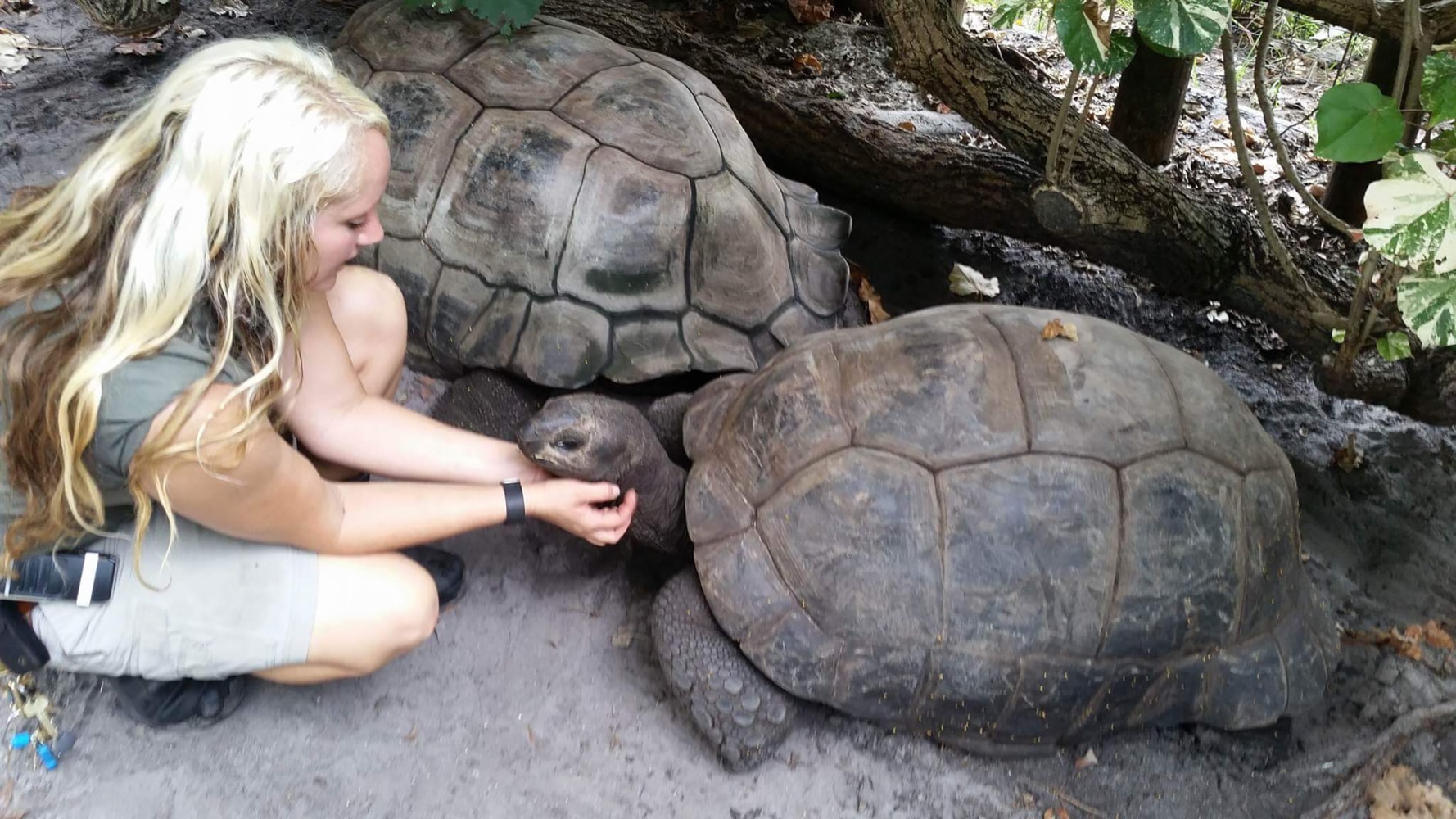
Aldabra tortoises at the Palm Beach Zoo. Palm Beach Zoo

Workers boarded up windows and put hurricane-proof shutters and glass in place throughout the 23-acre facility as well.

In a statement Wednesday, the Miami Zoo said it would not evacuate animals “since hurricanes can change direction at the last minute, and you run the risk of evacuating to a more dangerous location.”

“The stress of moving the animals can be more dangerous than riding out the storm,” the zoo said on its Facebook page.

Animals considered more dangerous will be kept in secure houses made of concrete, the statement said, adding that such animals survived the devastating Hurricane Andrew 25 years ago unharmed.

News of the hurricane conjured images of wildlife riding our previous storms from public facilities instead of their enclosures, like the iconic image of more than 50 flamingos taking shelter from Hurricane Georges in a men’s bathroom in 1998.

At the Rare Species Conservatory Foundation, a nonprofit in Loxahatchee, founder and president Dr. Paul Reillo said Thursday night that he and other staff members would ride out the storm with hundreds of rare and endangered animals.

Play

 Hurricane Irma: How will Florida’s zoo animals survive the storm? 3:10

“We’re with them every step of the way,” he said. “You can’t crate them and walk away — our prime directive is to save lives here.”

The foundation was prepared to bring smaller animals indoors before Irma hits, while larger animals may have to ride out the storm outdoors, Reillo said.

“We have large African antelope here, and unfortunately they cannot be caught up and put in small spaces,” he said. “They’re out in their environment, and hopefully they’ll hunker down and be fine.”

Reillo said many zoos and centers don’t have the space or expertise to evacuate animals that need special care, especially endangered species.

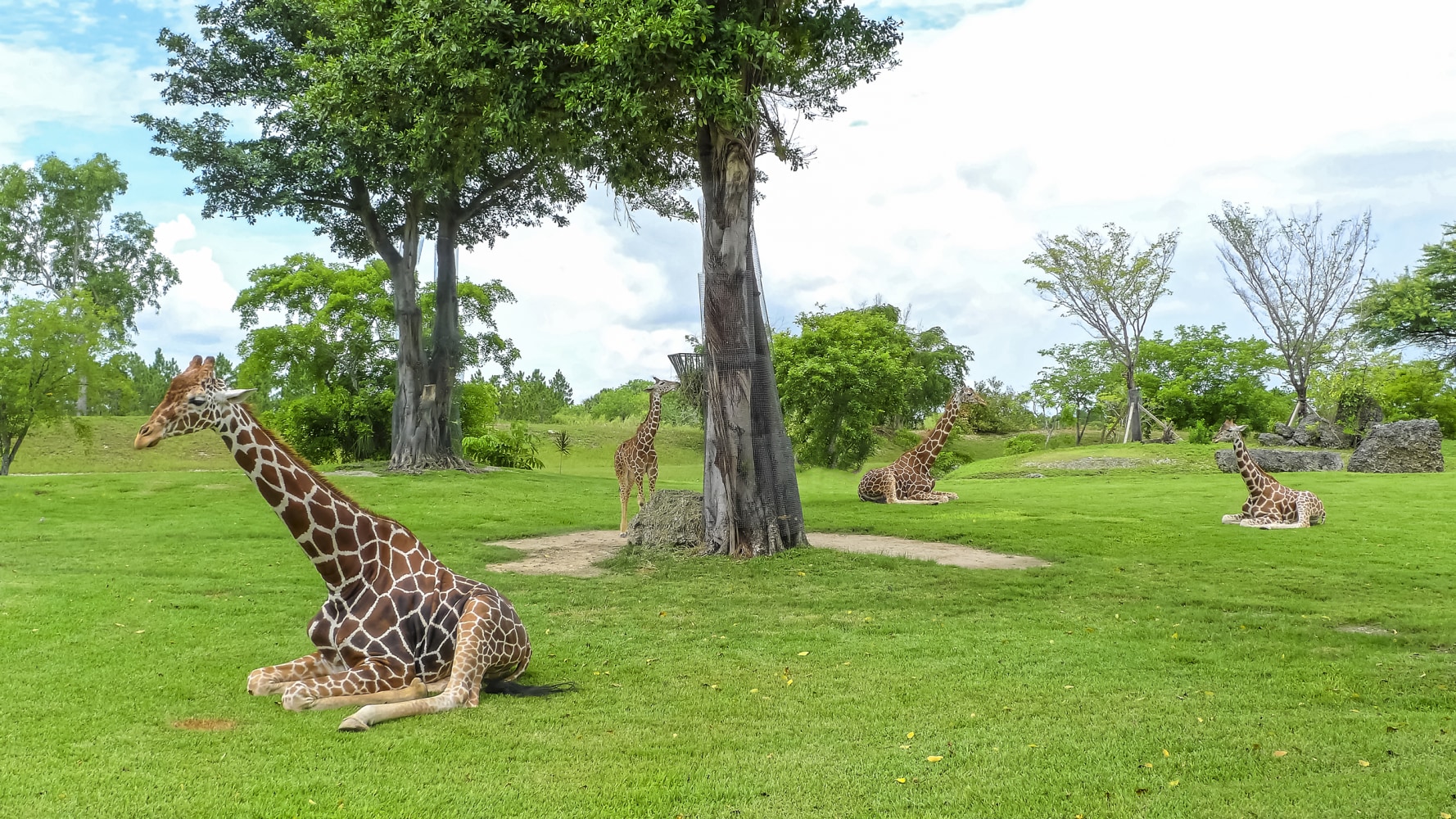
Image: Giraffes at Zoo Miami
Undated photo of giraffes at the Metro Zoo in Miami. Luis Castaneda Inc. / Getty Images

“Facilities are not provisioned to do that on normal day, much less in an emergency,” he said. “We’re kind of stuck with riding these things out.”

Reillo also said many wildlife facilities were forced into a waiting game of seeing where and how severe the hurricane would be.

“A mile or two can make a huge difference for a wildlife facility,” he said of a storm’s landfall. “It’s not just the stress on the animals of catching them up, but then realizing you have to have enclosures to release them into after the storm passes.”

Facilities in the area will also work together to help one another after the storm, he said.

“It’s our life’s work. It’s not about the people — this is bigger than us,” he said. “It’s about believing that wildlife deserves a chance for the future. We should do all we can to prevent extinction.”

CORRECTION (Sept. 8, 2017, 10:15): An earlier version of this article misstated the year 50 flamingos were pictured taking shelter in a men’s bathroom during Hurricane Georges. It was 1998, not 1988.

How the chaos of Hurricane Katrina helped save pets from flooding in Texas  

 https://www.washingtonpost.com/news/animalia/wp/2017/08/31/how-the-chaos-of-hurricane-katrina-helped-save-pets-from-flooding-in-texas/?utm_term=.7ea77055919f
 August 31

People and their pets seek shelter at the George R. Brown Convention Center in Houston on Aug. 28. (Jabin Botsford/The Washington Post)

As Hurricane Harvey pelted Houston with heavy rains over the weekend, a local television news station broadcast footage of flood evacuees sitting outsidethe George R. Brown Convention Center. The people weren’t waiting for space inside what would become a massive emergency shelter. They were choosing to remain outdoors because their pets were not allowed in with them.

That policy changed within a day, after a top elected official made clear both humans and animals were welcome at the city’s evacuation centers.

“We all saw what followed Hurricane Katrina, where people weren’t allowed to keep their pets with them, so they said, ‘Well, never mind, we’ll just stay outside,’” Harris County Judge Ed Emmett told reporters Sunday evening. “We obviously don’t want that to happen.”

Emmett wasn’t making just a passing reference to the catastrophe that hit New Orleans in 2005. During that disaster, many residents stayed put — and died in some cases — rather than heed rescuers’ instructions to leave pets behind as waters inundated homes. Others faced wrenching choices when they arrived at shelters that would not allow animals. One small white dog, Snowball, became a national symbol of these emotional separations after he was taken from the arms of a child who was boarding a bus to Texas that did not take pets. The boy cried so hard, according to an Associated Press report, he vomited.

One 2006 poll found 44 percent of people who chose not to evacuate during Katrina did so because they did not want to abandon their pets. Even so, the Louisiana SPCA estimated, more than 100,000 pets were left behind and as many as 70,000 died throughout the Gulf Coast.

A dozen years later, Katrina is viewed as a watershed moment in planning for pets during natural disasters. It changed federal and state policies — and, animal advocates and experts say, made clear Americans have widely embraced the idea of dogs and cats as family members.

“You saw pictures of dogs standing on roofs and cats swimming in these toxic waters, and there was a huge public outcry,” said journalist David Grimm, who wrote about the impact in his book, “Citizen Canine.” Katrina “was a real turning point,” he added, “where suddenly it wasn’t just, ‘This is how I view my pets.’ It’s, ‘This is how everyone views their pets.’”


Volunteers in boats rescue people and their pets from neighborhoods near Interstate 45 in Houston on Aug. 29. (Jabin Botsford/The Washington Post)

At the time, emergency management plans took only people into account. The result was an ad hoc approach to animals, with some responders flat-out turning away dogs and others agreeing to evacuate them. Animal protection groups, which quickly became overwhelmed with displaced critters separated from their owners, often found themselves at odds with local and state officials, recalled Wayne Pacelle, chief executive of the Humane Society of the United States.

The sense that systems had failed both pets and people quickly reached Capitol Hill. In 2006, Congress overwhelmingly passed legislation requiring local and state authorities who want federal emergency grants to include pets in disaster plans. It authorized the use of federal funds for pet-friendly emergency shelters.

Snowball was the impetus.

“The dog was taken away from this little boy, and to watch his face was a singularly revealing and tragic experience,” Rep. Tom Lantos said at the time. The California Democrat, who died in 2008, sponsored the House version of the Pet Evacuation and Transportation Standards (PETS) Act — legislation “born at that moment” with Snowball, Lantos said.

More than 30 U.S. states now have laws that address disaster planning for pets and service animals. Texas requires its emergency management officials to help localities devise plans “for the humane evacuation, transport and temporary sheltering of service animals and household pets in a disaster.”

Not all evacuation centers in Texas are accepting pets this week, but many are accommodating them in separate areas or coordinating with off-site shelters to house them. In San Antonio, for instance, a state-run reception center for Harvey evacuees routes pets to a city-run animal shelter, after assigning them and owners individual ID numbers that will help reunite them later.

The images and stories out of Southeast Texas — of rescue boats loaded with dogs and people — are far different from those that emerged during Katrina. Lisa Eicher’s experience offers just one example. When the Conroe, Tex., resident woke Monday, floodwaters had nearly submerged the 15 feet of steps up to the first floor of her family’s home. Before she, her husband and four children could pack more than a garbage bag of clothes, firefighters had rolled up outside in a muddy dump truck and were telling them to leave.

“We have two kids with Down syndrome, a pig and a three-legged dog,” Eicher recalled telling them.

“Sounds good,” one firefighter responded. “Let’s do this.”

Soon Eicher’s husband and a firefighter were helping Pip, a terrier mix, swim across the murky water. Next up was Penny, a mottled potbellied pig that floated on a yellow life jacket.

“A dog is one thing, but a pig is different,” Eicher said in a phone interview from Austin, where the family — pets included — are staying with friends. “I was worried that we weren’t going to be able to bring her. … The fact that they were so good with our pets was really sweet and meant a lot.”

The American Society for the Prevention of Cruelty to Animals and the Humane Society both greatly expanded their disaster response divisions after Katrina. The latter now has memorandums of understanding with many local organizations and localities — including the Houston suburbs of League City and Dickinson — that allow for more nimble and organized responses, Pacelle said.

“In a general sense, Katrina was the teaching moment in the United States for people to understand … that the lives of humans and animals in our communities are intertwined,” he said. “You couldn’t look at individuals. You had to look at the family group when you approached disaster response.”

Animals that do not remain with owners also have more places to go these days, advocates say. As Harvey approached, several Texas shelters shipped dogs and cats out to distant facilities to make room for furry refugees. Those far-off places, such as the Humane Rescue Alliance in Washington, in turn revved up adoptions to clear even more space.

“We’re working nonstop to get out every single animal that was currently adoptable in some of these cities where we know that these evacuees are going to need to come,” said Katie Jarl, senior state director in Texas for the Humane Society. The organization sent more than 100 shelter animals out of San Antonio between Monday and Wednesday.


The first rescue dog is offloaded as St. Hubert’s Animal Welfare Center in New Jersey welcomes nearly 100 dogs displaced by the hurricane in Texas. (Bob Karp/Daily Record/AP)

Much of the movement is relying on sophisticated transport networks, many of which grew out of the chaos during Katrina. On Tuesday night at 10 p.m., eight mixed-breed dogs — labs, hounds and pit bulls — arrived at the Somerset Regional Animal Shelter in Bridgewater, N.J. They had come from San Antonio on a plane flown by Wings of Rescue, a California-based charity that uses private aircraft to fly animals from high-kill southern shelters to northern areas where euthanasia rates are lower.

“We saw a lot of dogs out of that plane getting a second life,” said Brian Bradshaw, who manages the Somerset shelter. “By helping these animals, we are also helping people, and that goes hand in hand.”

The Harvey efforts are by no means “copacetic or settled,” Pacelle said. Citing health concerns, some emergency shelters are turning away people with pets, as are hotels — though both face shaming on social media when they do so. The corporation that owns Holiday Inn Express apologized this week after reportsthat its Katy, Tex., hotel rejected a family with three dogs.

And though animal advocates say arrangements have greatly improved since 2005, they are still not ideal for some pet owners. One Corpus Christi couple who evacuated to San Antonio opted to go to a hotel after learning their dog would be temporarily housed at the city-run shelter, rather than with them at an evacuation center.

“This isn’t a dog. This is a child,” Kevin Pogue told the Corpus Christi Caller-Times. “I’m not going to be separated from my child; it’s that simple.”

That Pogue’s sentiment is now enshrined in legal code, which has long viewed pets as property, is one of Katrina’s lasting legacies.

“Pets essentially became members of society: You rescue the people, and you also try to rescue the cats and dogs,” said Grimm, the journalist. “Nobody is passing laws saying you should rescue the toasters. It’s really a huge, fundamental shift that happened.”

Stephanie Kuzydym and Emily Wax in Houston contributed to this report. 

Read more:

These rescuers take shelter animals on road trips to help them find new homes

Harvey is also displacing snakes, fire ants and gators

A photo of a dog carrying a bag of food after a storm hit Texas went viral. Here’s his story.

Harvey is a 1,000-year flood event unprecedented in scale

11 unforgettable animal rescues in brutal aftermath of Hurricane Harvey

http://www.sandiegouniontribune.com/opinion/the-conversation/sd-animal-rescued-in-texas-after-hurricane-20170829-htmlstory.html
“Countless stories and images out of Texas have revealed the
generosity with which Americans are treating their neighbors in the
aftermath of Hurricane Harvey. But humans were not the only ones in
need of rescue.
“Ongoing efforts across badly flooded areas of southeast Texas also
involve saving hundreds of animals — dogs, cats, cows, donkeys, horses
and even birds — that were immediately displaced after the storm.
“Animal rescue groups outside of Texas also swooped in to take some of
those displaced animals and temporarily shelter them on dry land in
states like California. Some 100 dogs and cats arrived in San
Diegothis week.
“These 11 unforgettable images and videos show how humans came to the
aid of animals affected by the storm.”

HSUS Harvey Update: Search and rescue operations underway

HSUS logo
Our Animal Rescue Team is on the ground right now helping animals impacted by the massive flooding and destruction caused by Hurricane Harvey.

Upon our arrival in Texas City, we learned that the most urgent needs were in Dickinson and League City, where our help was requested by officials. My team is conducting animal search and rescue missions with Dickinson Animal Control. We are responding in flooded areas where roads remain impassible to rescue pets from their deluged homes.

ART van driving through floodThe flooding is so severe that road closures will have our team marooned in place until some flooding subsides.

But we’ve purchased food and crates to temporarily house animals who are rescued from the field—and we’ll ensure they have a soft and warm place to rest.

We’re also transporting animals who were available for adoption before the storm in San Antonio to other states to make room for displaced pets.

Thank you so much for your support, and please stay tuned for another update tomorrow.

Sara Varsa
Sára Varsa
Senior Director, Animal Cruelty, Rescue and Response