Exposing the Big Game

Forget Hunters' Feeble Rationalizations and Trust Your Gut Feelings: Making Sport of Killing Is Not Healthy Human Behavior

Exposing the Big Game

‘It’s like a rotting carcass of its former self’: funeral for an Oregon glacier

https://www.theguardian.com/environment/2021/may/02/its-like-a-rotting-carcass-of-its-former-self-funeral-for-an-oregon-glacier

Worried researchers hold ceremony for Clark glacier to illustrate how climate crisis is eroding icepacks
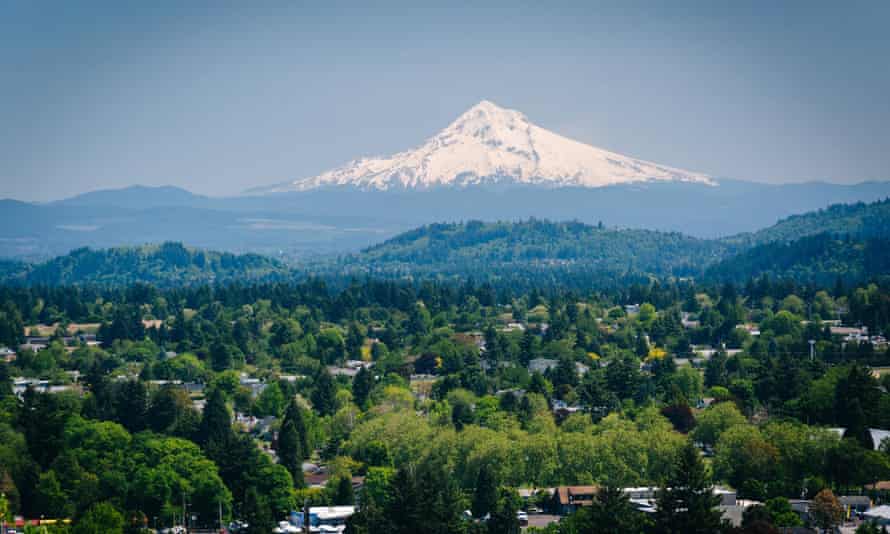
Mount Hood
Mount Hood pictured from Mount Tabor, in Portland, Oregon. The glacier provides water for drinking and growing crops. Photograph: Jon Bilous/Alamy

Oliver Milman@olliemilmanSun 2 May 2021 09.00 EDT

150

The funeral was a suitably solemn affair. The small casket was placed on a table covered in a black drape, a maudlin yet defiant speech quoted a Dylan Thomas poem, a moment’s silence was held.

Inside the casket, however, was not a body, but a vial of meltwater from Clark glacier in Oregon, once an imposing body of ice but now a shrivelled remnant.

The funeral, a stunt held by worried glacier researchers on the steps of the state capitol in Salem, illustrated how the climate crisis is rapidly gnawing away at the majestic icepacks that used to throng the mountains of the northwestern US, potentially posing a threat to the region’s water supplies.

“There is just this immense sadness because we all knew it was going to be bad, but didn’t think it would be this bad,” said Anders Carlson, president of the Oregon Glacier Institute, who read the eulogy for Clark glacier at the “funeral” in October.

Clark glacier is, or was, found if you took a moderately strenuous hike amid the Cascade mountains, a range that stretches from British Columbia in Canada down to the northern reaches of California.

Once spanning about 46 football pitches in size, the Clark glacier is now about three football pitches in area, or what Carlson calls a “stagnant scrap of ice”.
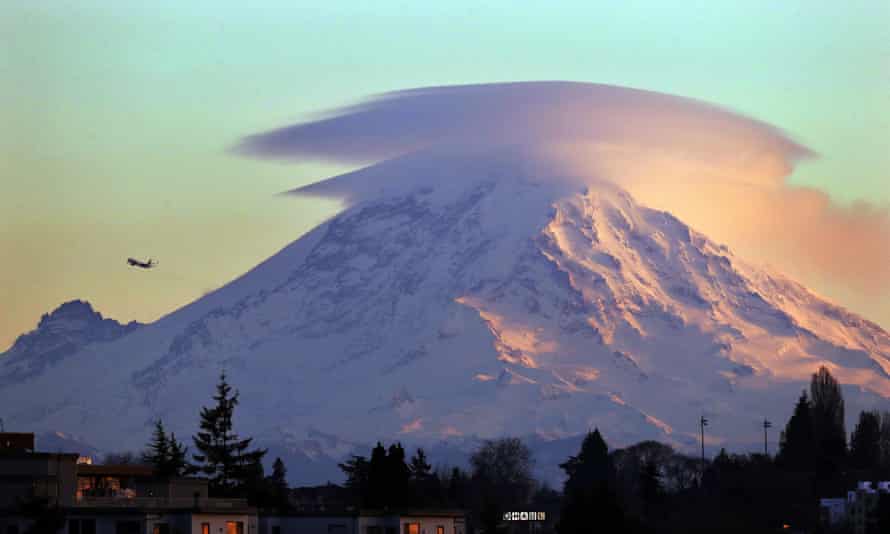
Mount Rainier
Mount Rainier Photograph: Elaine Thompson/AP

“It’s like a rotting carcass of its former self,” said Carlson. Glaciers move via gravity under their own vast weight, but once they have lost a certain amount of volume, they become dormant patches of ice. Other nearby glaciers found on the three sisters, a chain of volcanic peaks, and Mount Hood have similarly “died” in this way.Advertisementhttps://2d5c5e053b62f319ca53502bafa5e824.safeframe.googlesyndication.com/safeframe/1-0-38/html/container.html

“You go back through old photographs and glaciers have disappeared just in the last 20 years – it’s really dramatic,” said Carlson, who has calculated that at least a third of the state’s glaciers named by the US government in the 1950s are now gone.

Among their other benefits, the meltwater from glaciers each spring feeds streams and rivers that supply a water source for apple and pear orchards, vineyards and even some drinking water for towns situated in the shadows of the mountains.

Researchers have estimated that river volumes in the late summer could drop by 80% by the end of the century due to decreases in glacier and snow melt. These huge losses raise tough questions over how to replace the water.

“These glaciers are not just nice to look at – they are our water towers, where we store our water,” said Carlson.

“Places like Hood River and Eugene are drinking and growing crops with water from glaciers. If you like Oregon wine, the chances are it was grown with glacier water. If you lose that, it’s not going to be a pretty picture. You either try to get groundwater or build new dams, which is not popular with anyone.”

The decline of glaciers is part of a broader trend that has seen vast bodies of ice wither away from the Himalayas to Switzerland as global temperatures climb. The glaciers of America’s Pacific north-west aren’t as well known as those overseas, but they play an important role in the local environment and are suffering stunning losses.

Since the mock funeral, researchers have found that the Cascades are particularly vulnerable to the melting of glaciers, which can cause maladies ranging from increased wildfire risk to the loss of species such as steelhead trout that rely on the frigid cold of glacier-fed streams. In the longer term, the glaciers of the American west face almost complete obliteration.

“The glaciers in the western US continue to shrink and will largely disappear by the end of the century,” said Andrew Fountain, a geologist at Portland State University who has submitted new research that found the glaciers of the Olympic Mountains, in the state of Washington, will probably vanish by 2070.

“You might get icy remnants on the peaks of tall mountains like Mount Rainier or Mount Baker, but they will be pretty small. Rising temperatures are doing this, without a doubt.”

Beyond drastically cutting planet-warming emissions, there is little that can be done to salvage the glaciers, a sobering reality for those who have long hiked and climbed the peaks of the US north-west.

“It’s really hard to stop the decline,” said Carlson. “People don’t realise we are a glacierised country – we rely upon them, like the Swiss and Norwegians do. They are important and we need them.”
Climate Change Has Now Invisibly Shifted Earth’s Axis, New Data Reveal

https://www.sciencealert.com/earth-s-axis-has-already-been-shifted-by-climate-change-scientists-say

(den-belitsky/Getty Images)ENVIRONMENT

PETER DOCKRILL26 APRIL 2021

Humanity’s impacts on our planet’s climate are so profound, we have for decades been unwittingly shifting the very axis upon which Earth spins around, scientists say.

In a new study, researchers examined the phenomenon of polar wandering, in which Earth’s magnetic north and south poles drift around the surface of the planet, restlessly roaming from the anchored positions of their geographic counterparts.

This mysterious phenomenon is thought to be driven by many factors, including the existence of vast anomalies of molten iron under Earth’s surface. But other elements also contribute, scientists say – including, amazingly enough, the effects of anthropogenic (human-caused) climate change.

“Faster ice melting under global warming was the most likely cause of the directional change of the polar drift in the 1990s,” explains lead researcher Shanshan Deng from the Institute of Geographic Sciences and Natural Resources Research in China.

In the new study, Deng and fellow researchers examined the extent to which changes in terrestrial water storage (TWS) in recent decades contributed to the amount of magnetic polar wander recorded in the same timeframe.

Basically, TWS includes changes in water levels on Earth resulting from glaciers melting as the world gets warmer, in addition to changes also produced by the pumping of groundwater from underground reservoirs.

The reason these changes are important is because they affect the distribution of mass on Earth, and when you’re dealing with a spinning object – whether a spinning top, a yo-yo, or an entire planet revolving in space – the way its mass is distributed in turn affects the way it spins.https://1e0f390c5e99aa9b210823e4926c72d3.safeframe.googlesyndication.com/safeframe/1-0-38/html/container.html

“It brings an interesting piece of evidence to this question,” explains climate scientist Vincent Humphrey from the University of Zurich in Switzerland, who wasn’t involved with the study.

“It tells you how strong this mass change is – it’s so big that it can change the axis of the Earth.”

While polar drift is a natural phenomenon that has been observed by scientists for over a century, the wandering has rapidly picked up speed in more recent times, along with a directional change from westwards to eastwards in the magnetic north pole first seen in the 1990s.

Over time, the drifting adds up, with the poles traveling hundreds of kilometers, meaning adjustments have to be made to the World Magnetic Model, which underpins navigation systems such as GPS.

According to the team’s calculations – based on satellite data from NASA’s Gravity Recovery and Climate Experiment (GRACE) mission and estimates of glacier loss and groundwater pumping going back to the 1980s – the primary driver of polar drift change seen in the 1990s was ice melt due to climate change.

“The faster ice melting under global warming was the most likely cause of the directional change of the polar drift in the 1990s,” the researchers explain in their study.

“The other possible causes are TWS change in non‐glacial regions due to climate change and unsustainable consumption of groundwater for irrigation and other anthropogenic activities.”

While the degree of axis shift experienced so far is estimated to be so slight that humans wouldn’t be able to perceive it in daily life, the results nonetheless suggest another alarming side effect of humanity’s unsustainable usage of Earth’s resources: planetary-scale mass rearrangements significant enough to measurably affect the revolutions of the world we live upon.

Another question is how much ongoing, locked-in ice melting – and continued plundering of groundwater resources – might impact future axis shifting, and what ramifications could result from that. We’ll have to wait and see.

The findings are reported in Geophysical Research Letters.

Can extreme melt destabilize ice sheets?

https://phys.org/news/2021-04-extreme-destabilize-ice-sheets.html

APRIL 20, 2021

by Stanford University

Can extreme melt destabilize ice sheets?
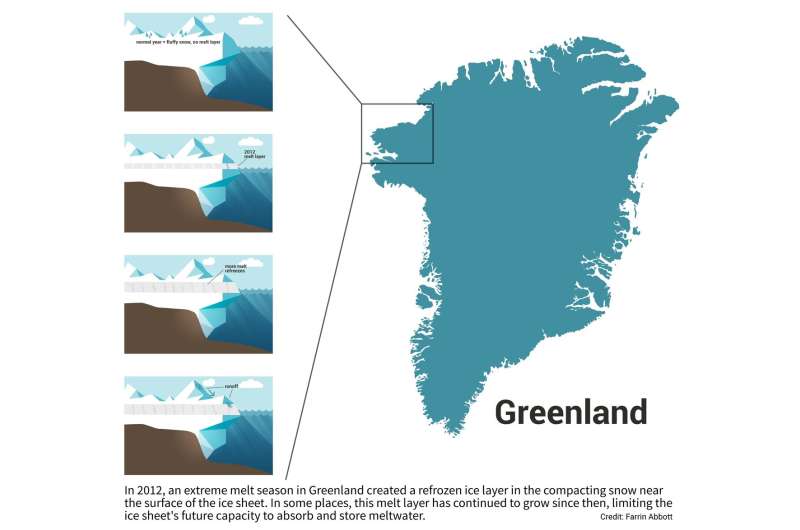
In 2012, an extreme melt season in Greenland created a refrozen ice layer in the compacting snow near the surface of the ice sheet. In some places, this melt layer has continued to grow since then, limiting the ice sheet’s future capacity to absorb and store meltwater. Credit: Farrin Abbott

Nearly a decade ago, global news outlets reported vast ice melt in the Arctic as sapphire lakes glimmered across the previously frozen Greenland Ice Sheet, one of the most important contributors to sea-level rise. Now researchers have revealed the long-term impact of that extreme melt.https://ff78faaa3101801b6a19336913e44ee5.safeframe.googlesyndication.com/safeframe/1-0-38/html/container.html

Using a new approach to ice-penetrating radar data, Stanford University scientists show that this melting left behind a contiguous layer of refrozen ice inside the snowpack, including near the middle of the ice sheet where surface melting is usually minimal. Most importantly, the formation of the melt layer changed the ice sheet’s behavior by reducing its ability to store future meltwater. The research appears in Nature Communications April 20.

“When you have these extreme, one-off melt years, it’s not just adding more to Greenland’s contribution to sea-level rise in that year—it’s also creating these persistent structural changes in the ice sheet itself,” said lead study author Riley Culberg, a Ph.D. student in electrical engineering. “This continental-scale picture helps us understand what kind of melt and snow conditions allowed this layer to form.”

The 2012 melt season was caused by unusually warm temperatures exacerbated by high atmospheric pressure over Greenland—an extreme event that may have been caused or intensified by climate change. The Greenland Ice Sheet has experienced five record-breaking melt seasons since 2000, with the most recent occurring in 2019.

“Normally we’d say the ice sheet would just shrug off weather—ice sheets tend to be big, calm, slow things,” said senior author Dustin Schroeder, an assistant professor of geophysics at Stanford’s School of Earth, Energy & Environmental Sciences (Stanford Earth). “This is really one of the first cases where you can say, shockingly, in some ways, these slow, calm ice sheets care a lot about a single extreme event in a particularly warm year.”

Shifting scenarios

Airborne radar data, a major expansion to single-site field observations on the icy poles, is typically used to study the bottom of the ice sheet. But by pushing past technical and computational limitations through advanced modeling, the team was able to reanalyze radar data collected by flights from NASA’s Operation IceBridge from 2012 to 2017 to interpret melt near the surface of the ice sheet, at a depth up to about 50 feet.

“Once those challenges were overcome, all of a sudden, we started seeing meltwater ice layers near the surface of the ice sheet,” Schroeder said. “It turns out we’ve been building records that, as a community, we didn’t fully realize we were making.”https://googleads.g.doubleclick.net/pagead/ads?client=ca-pub-0536483524803400&output=html&h=280&slotname=5350699939&adk=3784993980&adf=780081655&pi=t.ma~as.5350699939&w=753&fwrn=4&fwrnh=100&lmt=1619023952&rafmt=1&psa=1&format=753×280&url=https%3A%2F%2Fphys.org%2Fnews%2F2021-04-extreme-destabilize-ice-sheets.html&flash=0&fwr=0&rpe=1&resp_fmts=3&wgl=1&uach=WyJXaW5kb3dzIiwiMTAuMCIsIng4NiIsIiIsIjg5LjAuNDM4OS4xMjgiLFtdXQ..&dt=1619023951649&bpp=234&bdt=1319&idt=834&shv=r20210415&cbv=r20190131&ptt=9&saldr=aa&abxe=1&cookie=ID%3D5d55f89f953c9743-22c26b2345c700ef%3AT%3D1618954559%3ART%3D1618954559%3AS%3DALNI_MZ3OWJFYp0jkKQ4UWqGJ7DIn0XbLA&correlator=13910899941&frm=20&pv=2&ga_vid=185394846.1565457508&ga_sid=1619023953&ga_hid=920230398&ga_fc=0&u_tz=-420&u_his=1&u_java=0&u_h=640&u_w=1139&u_ah=607&u_aw=1139&u_cd=24&u_nplug=3&u_nmime=4&adx=263&ady=2128&biw=1123&bih=538&scr_x=0&scr_y=0&eid=21066435%2C44740079%2C31060049%2C31060839&oid=3&pvsid=3777714165350693&pem=466&ref=https%3A%2F%2Fnews.google.com%2F&eae=0&fc=896&brdim=0%2C0%2C0%2C0%2C1139%2C0%2C1139%2C607%2C1139%2C537&vis=1&rsz=%7C%7CpEebr%7C&abl=CS&pfx=0&fu=128&bc=31&ifi=1&uci=a!1&btvi=1&fsb=1&xpc=olxfgFcar4&p=https%3A//phys.org&dtd=916

Melting ice sheets and glaciers are the biggest contributors to sea-level rise—and the most complex elements to incorporate into climate model projections. Ice sheet regions that haven’t experienced extreme melt can store meltwater in the upper 150 feet, thereby preventing it from flowing into the ocean. A melt layer like the one from 2012 can reduce the storage capacity to about 15 feet in some parts of the Greenland Ice Sheet, according to the research.

The type of melt followed by rapid freeze experienced in 2012 can be compared to wintry conditions in much of the world: snow falls to the ground, a few warm days melt it a little, then when it freezes again, it creates slick ice—the kind that no one would want to drive on.

“The melt event in 2012 is impacting the way the ice sheet responds to surface melt even now,” Culberg said. “These structural changes mean the way the ice sheet responds to surface melting is going to be impacted longer term.”

In the long run, meltwater that can no longer be stored in the upper part of the ice sheet may drain down to the ice bed, creating slippery conditions that speed up the ice and send chunks into the ocean, raising sea levels more quickly.

Polar patterns

Greenland currently experiences change much more rapidly than its South Pole counterpart. But lessons from Greenland may be applied to Antarctica when the seasons shift, Schroeder said.

“I think now there’s no question that when you’re trying to project into the future, a warming Antarctic will have all these processes,” Schroeder said. “If we don’t use Greenland now to better understand this stuff, our capacity to understand how a warmer world will be is not a hopeful proposition.”


Explore furtherMelting ice sheets caused sea levels to rise up to 18 meters

Antarctica’s ice is degrading faster than we thought, and there may be no way to stop the consequences

Why can't we seem to care about the climate crisis?

JUST WATCHED

Why can’t we seem to care about the climate crisis?

PlayMuteMute

Current Time2:12
/
Duration Time2:12
Loaded: 0%

Progress: 0%

Fullscreen

Why can’t we seem to care about the climate crisis? 02:12

(CNN)There are plenty of ominous indicators of the consequences of climate change, but few are more worrying to scientists than the ice sheets of Antarctica at our planet’s southern pole.

These ice sheets have been melting for quite some time, and it doesn’t take a degree in physics to understand the risk there. As the ice melts it flows into the ocean, causing sea levels to rise. And rising sea levels are obviously a huge problem.
Don't believe these climate change lies

Don’t believe these climate change lies 02:35
Now, new NASA-funded research published in the journal PNAS reveals a concerning complication. Scientists from the Georgia Institute of Technology, NASA Jet Propulsion Laboratory and the University of Washington ran hundreds of simulations to predict how one large ice sheet, Thwaites Glacier, could degrade over the next 50 to 800 years.
The results showed the glacier was more in danger of becoming unstable that previously thought.
The Thwaites Glacier.

Small changes could lead to a watershed moment

“Unstable” here means something very specific. An “instability” in an ice sheet essentially makes it a frozen, ticking time bomb. The area of the glacier behind where it cantilevers over the water is eaten away, which can cause the glacier’s ice to break off and flow faster out to sea and add to rising sea levels.
What’s more ominous, the research finds, is that once this instability is triggered it’s hard, if not impossible, to stop.
“If you trigger this instability, you don’t need to continue to force the ice sheet by cranking up temperatures. It will keep going by itself, and that’s the worry,” lead author Alexander Robel said in a release.
In other words, even if climate change was magically reversed, it wouldn’t necessarily stop the dangerous and rapid rise in sea levels that could be triggered by unstable ice sheets.
How climate change will impact your region

Play Video

How climate change will impact your region 01:57

The ‘worst-case’ scenario

Robel, an assistant professor at Georgia Tech’s School of Earth and Atmospheric Sciences, says the “worst-case scenario” could be a rise of two or three feet from the Thwaites glacier alone.
While Robel suggests engineers and planners start building future critical infrastructure farther away from the sea-level line, you don’t need to pack up your coastal homes like it’s high tide yet. This potential acceleration of sea level rise could come into full effect 200 to 600 years from now.
This seems like a long time from now, because we will all be dead by then. But the Earth and its future generations hopefully won’t be, and climate scientists want to keep it that way.

Crews rescue lost hunter in Eldorado Marsh

https://www.fdlreporter.com/story/news/local/2018/12/31/eldorado-marsh-melting-ice-leads-hunter-rescue/2449024002/

LINKEDINCOMMENTMORE

ELDORADO – On Sunday crews rescued a hunter from the Eldorado Marsh after he repeatedly fell through the ice into thigh-deep marsh water and became disoriented, authorities said.

The Fond du Lac County Sheriff’s Office said dispatchers received a 911 call from the hunter, a 38-year-old Fond du Lac man, around 5:45 p.m. He had finished hunting for the evening and was lost and cold.

Dispatchers pinpointed his location in a patch of cattails. Recent high temperatures thawed the ice there, so crews could not easily walk onto the ice to reach him.

Law enforcement drove a utility vehicle into the icy-watery mix and rescued the man within an hour, the sheriff’s office said. They brought him to a waiting ambulance, and paramedics treated him at the scene.

Eldorado Fire Department supplied the utility vehicle while Ripon Fire Department contributed a drone to the rescue effort.