Exposing the Big Game

Forget Hunters' Feeble Rationalizations and Trust Your Gut Feelings: Making Sport of Killing Is Not Healthy Human Behavior

Exposing the Big Game

Natural resource body readies bobcat, otter trapping rules

Public comment now being accepted

By: Leslie Bonilla Muñiz – September 18, 2024 7:00 am


 Natural Resources Commission member Patrick Early (left), department Director Dan Bortner and commission Chair Bryan Poynter at a commission meeting on Tuesday, Sept. 17, 2024. (Leslie Bonilla Muñiz/Indiana Capital Chronicle)

Indiana’s Natural Resources Commission on Tuesday approved preliminary rules for a new, lawmaker-mandated bobcat trapping season, and finalized statewide river otter trapping regulations.

Commission leader Bryan Poynter called the bobcat work a “heavy lift,” speaking from the ballroom at the Fort Harrison State Park Inn in Marion County.

The Department of Natural Resource’s proposed changes would include establishing a bobcat trapping season in 40 southern Indiana counties, with a bag limit of one bobcat per trapper and a season quota of 250 bobcats. It would run November to January.

Public comments can be submitted here by clicking on “Comment on this rule.”

Biologist Geriann Albers said the department based the limits on a data model created in collaboration with Purdue University.

 Department of Natural Resources Biologist Geriann Albers speaks at a commission meeting on Tuesday, Sept. 17, 2024. (Leslie Bonilla Muñiz/Indiana Capital Chronicle)

The model’s assumptions were “very conservative,” she said.

“We’re very confident that that number is sustainable and is not going to negatively impact our bobcat population,” Albers told the commission.

The season is limited to “established” populations in the south, for example, because bobcat populations further north are still considered “emerging.”

The department also recommended other amendments: letting legally acquired bobcats and parts to be sold, letting bobcats found dead to be kept for personal use with a permit, and more.

Traps would be limited to cage, foothold and cable device traps.

“We know those three types have been tested on bobcats, and they’re humane, efficient and selective for bobcats,” Albers said.

She told the Capital Chronicle that the department’s efforts related to bobcat trapping go back at least four years. Rulemaking for a brand-new season is complex, she said, because it involves plenty of data and other moving parts.

In 2019, the department weighed a bobcat season but dropped the idea after public backlash. Lawmakers stepped in earlier this year to require a season.

The department’s Fish and Wildlife Division aimed for balance.

“People like to participate in hunting and trapping, but we also want to strike that balance of (bobcats) still being available for people to view or photograph and things like that,” Albers said. “So we’re trying to maximize the outdoor activity that’s available, but in a sustainable way.”

 Fort Benjamin Harrison State Park’s inn on Tuesday, Sept. 17, 2024. (Leslie Bonilla Muñiz/Indiana Capital Chronicle)

The commission approved preliminary adoption of the amendments by voice vote. Public comment comes before a final vote.

Animal rights activists decried the move.

Samantha Chapman, Indiana state director for the U.S. Humane Society, said the group was “deeply disappointed” in the initial approval.

“While the Commission was given no choice on proposing such an unpopular season, we urge them to recognize Hoosier’s overwhelming opposition to this inhumane and scientifically unjustifiable treatment of Indiana’s only remaining native wildcat, whose population is still recovering,” Chapman said in a Wednesday statement.

She pushed the commission to set a quota of zero bobcats, noting it has the discretion to do so.

Swimming out of extinction

Commission members separately O.K.’d final rules for an expanded river otter trapping season, a development that Poynter dubbed “one of the biggest success stories that we’ve had in Indiana in a long time.”

Hoosier river otters were few and far between by the 1900s, and were even classified as extinct in Indiana in 1942, according to Purdue University.

The department began a reintroduction program in 1995, releasing 303 river otters into the state before the new millennium, according to its website. Most came from Louisiana, per Albers.

By 2005, the population had recovered so much that river otters were removed from the state-endangered list. The department opened its first limited season for the creatures in 2015.

Now, the department estimates there are upwards of 8,000 river otters in Indiana.

“As … otters have kept expanding, we’ve upped that quota once, and we started adding more and more counties, and we were kind of at a tipping point where most of the state was already open and there was only some counties that weren’t,” Albers said.

And, Hoosiers having “otter issues” can take them during the season instead of having to get other permits. River otters commonly get into small ponds stocked with fish, she said.

“Otters see those kind of as buffets,” she remarked.

The changes establish a statewide trapping quota of 750 river otters with an individual bag limit of two. The season extends from mid-November to mid-March.

Note: This article has been updated with comments from Indiana’s chapter of the Humane Society.
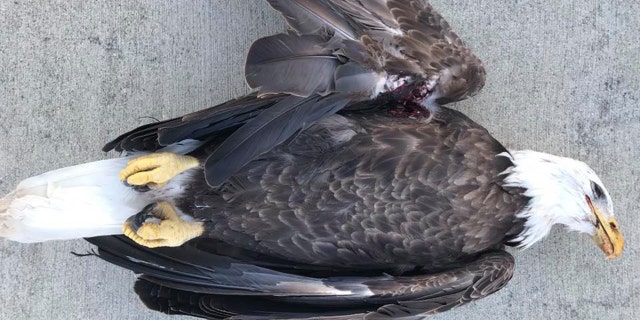
Bald eagle dies of gunshot wound in Indiana, reward offered

A bullet struck a protected bald eagle in Indiana, leading to the bird’s death, officials said Sunday.

Indiana Conservation Officer Ryan Jahn was investigating the shooting of the bald eagle Saturday in Lawrence County, officials said.

Build UP’s Ruben Morris is changing the trajectory for his students by helping them earn their high school diploma, an associate’s degree and a paid apprenticeship to …

“The eagle was found alive south of the White River near Dixie Road, but later succumbed to the gunshot wound,” Indiana Department of Natural Resources Law Enforcement said in a Facebook post on Sunday.

A bald eagle in Indiana was hit by a bullet and later died from its wound, officials said.

A bald eagle in Indiana was hit by a bullet and later died from its wound, officials said. (Indiana Department of Natural Resources Law Enforcement)

BALD EAGLE RESCUED IN MISSOURI AFTER BEING SHOT IN WING; SHOOTER COULD FACE $100G FINE

A reward was being offered for information that leads to an arrest, according to the agency.

The killing of a bald eagle is a violation of the federal Bald and Golden Eagle Protection Act. Violators face up to a year in jail and a fine of up to $100,000.

As of 2008, bald eagles are no longer considered endangered in Indiana.

Researchers still track data on bald eagles to monitor the health of the population and learn more about their behavioral patterns.

https://www.foxnews.com/us/bald-eagle-dies-of-gunshot-wound-in-indiana-reward-offered

Bobcats in Indiana Are in Danger of Being Hunted and Trapped Again

Bobcats were nearly hunted to extinction by the mid 1900s. They were finally listed as endangered species in the state by the 1960s, and hunting them has been banned ever since. That protection has helped them rebound, but what little progress has been made could be seriously jeopardized.

The Indiana Department of Natural Resources (DNR) wants to open a hunting and trapping season. They have proposed a rule that would establish a bag limit per hunter, along with a statewide quota.

Love This? Never Miss Another Story.


According to the DNR, bobcats are being increasingly killed in collisions with vehicles and caught in traps set for other animals, while there is potential for their bodies and pelts to be illegally sold in other states that have a legal hunting and trapping season. The DNR’s solution to trying to stop illegal sales is to just legalize them in the state.

The agency stated in an earlier report, “A regulated season in Indiana will address this problem and increase recreation and economic opportunities for businesses and individuals. A season will provide successful trappers and hunters the opportunity to sell bobcat pelts to licensed furbuyers who can market these furs through international fur auctions or manufacturers.”

Conservationists, however, argue that the plan is nothing more than commercial exploitation. They also worry what effect this will have on bobcat populations.

“To open up a hunting and trapping season on such a vulnerable species without scientific data to back it up is unwise,” Erin Huang, the Indiana State Director of the Humane Society of the United States told the Indy Star. “This is a species that is not causing a problem ― livestock predation is rare and there are no reported attacks on pets, so I just don’t see a reason for it.”

Hunting and trapping shouldn’t be used as a wildlife management tool, and there are other non-lethal methods to deal with any that potentially pose a danger to us.

The DNR has passed its proposal to the Natural Resources Commission, which will be accepting public comments until March 23. If you live in Indiana and can attend, there will also be two public hearings on March 14 in Mitchell and March 22 in Anderson.

Take Action!

Please sign and share the petition urging the Natural Resources Commission not to allow a hunting and trapping season for bobcats in Indiana.

Photo credit: Thinkstock

Hunters hurt in falls from tree stands

http://www.thestarpress.com/story/news/local/2017/10/29/hunters-hurt-falls-tree-stands/811483001/

LINKEDINCOMMENTMORE

PORTLAND, Ind. – For the second consecutive weekend, Jay County has been the scene of an accident involving a hunter falling from a tree stand.

According to an Indiana Department of Natural Resources release, Shawn Thobe, 44, of Fort Recovery, Ohio, on Saturday was climbing his “two-man ladder stand” when he slipped and fell backwards about 12 feet to the ground.

He was taken by ambulance to IU Health Ball Memorial Hospital in Muncie, where he was treated for internal, back and rib injuries.

RELATED:

Hunter injured in fall from tree stand

Teen shot in hunting accident

Conservation officers were called to the scene – in the 4300 block of South Jay County Road 850-E – about 4:20 p.m.

They reported Thobe was wearing a safety harness at the time of the accident, but it was not attached to the tree when he fell.

On Oct. 21, Michael G. Lee, 48, of Bluffton, was injured when he fell about 30 feet from a tree stand in a woods near Pennville.

He was flown by air ambulance to Fort Wayne’s Lutheran Hospital where he was “diagnosed with a fractured vertebrae in his lower back,” a release said.

In that case, conservation officers said, moldy straps on the tree strand had snapped. Lee was not wearing a safety harness.