Exposing the Big Game

Forget Hunters' Feeble Rationalizations and Trust Your Gut Feelings: Making Sport of Killing Is Not Healthy Human Behavior

Exposing the Big Game

SE Asia’s tigers hit hard by tourism, captive breeding

ANIMAL WELFARE

SE Asia’s tigers hit hard by tourism, captive breeding

Tiger numbers have plunged in the wild in mainland Southeast Asia while the number of animals in farms has soared. Photo: iStock

Life is bleak for tigers during ‘selfie era’ when trade in bone and parts has caused an explosion in captive-breeding and a plunge in numbers in the wild

Mainland Southeast Asia has a tiger problem. Numbers are going in completely the opposite direction that officials and animal lovers want – plunging in the wild and soaring in captivity.

Rampant mass tourism and use of tiger bone and parts in products boasting Chinese medicinal “benefits” has put a high price on these iconic animals. Never has this magnificent animal been so threatened and exploited.

A panel of experts outlined the status of tigers at a forum in Bangkok this week, detailing a disturbing outlook in Thailand and neighboring countries.

“And in Thailand, there are no conclusive recent census results, but we know that until recently tigers used to be in about 20 forest complexes. However, they can only be found now in perhaps three. It is very bleak now.”

In Indonesia two subspecies had gone extinct, he said. But there was some good news. In India, the number of tigers in the wild has risen to about 2,226 with a new census about to confirm exact figures, thanks to strong government policies such as proper funding of national parks and good work by forest and conservation groups. But even so, 51 Bengal tigers were poached in the first five months of this year.

A slide at the panel discussion shows images of tiger abuse in Thailand. Photo: Annelie Langerak.

Roads threaten forests

But a range of factors such as social media and big infrastructure projects like China’s Belt and Road Initiative were threatening to divide some of the region’s last forest complexes into small fragments “and that hastens their demise,” Redford said. “So where we have tigers, they may not be there in a few years time.”

“Poachers are traveling from Vietnam to Sumatra and Malaysia to hunt tigers. And in Laos and Thailand we see the poachers writing on trees, marking out their territory,” he said, showing a slide of a man carrying an AK47.

Thailand’s Department of National Parks was doing a very good job, he said, training rangers and boosting their capacity by bolstering their forensic skills, as shown in the notorious ‘Black panther case,’ involving a wealthy industrialist caught and charged with hunting in a wildlife sanctuary in Kanchanaburi in February 2018.

But Laos and Myanmar were “lagging behind,” he said. And others noted that officials in Laos often failed to collaborate effectively with their counterparts in adjacent countries.

Panelists discuss the plight of tigers at the Foreign Correspondents Club in Bangkok on June 19, 2019. From left: Edwin Wiek, Somsak Soonthornnawaphat, Tim Redford and Chris Perkins. Pic: Annelie Langerak

New Thai law

Edwin Wiek, founder and director of the Wildlife Friends Foundation of Thailand, said the best news was that the Thai government recently upgraded the 27-year-old Wildlife Preservation Act and the new law would come into force in a few months. The new law had tougher penalties and the option for civil cases – fines of up to 2 million baht (US$64,800) for loss of biodiversity, and up to 10 years jail for people convicted of serious wildlife crimes.

But he said: “Tourism is becoming a massive problem.” There were more than 44 places with tigers and they were often kept in small cages. He showed a short video of a tourist poking a tiger with a stick at one attraction.

Wiek said that in 2007, CITES, the world body overseeing the trade in wildlife and flora, called for an end to the captive breeding of tigers. However, it was a non-binding resolution that some Asian countries opposed and the number of tigers in captivity had soared since then, from about 600 to close to 2,000 in 69 facilities across Thailand, including many new ‘farms’ in the far northeast near Laos.

There was also a special economic zone in northern Laos backed by Chinese investors and politicians, plus facilities on either side of the Mekong that appeared to have many hundreds of tigers. Some of these facilities had zoo permits but conservationists regarded them more as ‘safe-houses’ for illegal wildlife trading.

These sites were suspected to be linked to a huge trade in lion and tiger bones, which he said was marketed as traditional medicine with health benefits and sold to Vietnamese and Chinese tourists for considerable sums.

Wiek said there was concern that tiger farms were having an impact on tigers in the wild as the trade in parts had increased the animals’ value, particularly for male tigers and cubs.

A tiger yawns while a piglet stands beside it at Sriracha Tiger Zoo, in Chonburi province, Thailand, in June 2016. Photo: Reuters/Chaiwat Subprasom/File photo

‘Selfies’ with tigers

Somsak Soonthornnawaphat, the head in Thailand of World Animal Protection, said his group wanted a ban on tourists riding elephants, people taking “selfies” with tigers and dolphin shows.

He voiced concern about the millions of tourists coming from China and East Asia and the fact “animal attractions are in high demand.” Thailand had at least 180 elephant venues, he said, plus several dozen parks where “over 600 tigers suffer from tourist activities.”

His group believed that animals should be free from hunger and thirst; pain, injury and disease; discomfort (no chains around elephants’ ankles); able to express normal behavior (not separated from their mother); and free from fear and distress.

“Life is totally different when tigers are living in captivity,” he said, noting that most of the tigers in captivity in Thailand were actually Bengal tigers from South Asia or hybrid animals bred for profit, not conservation.

Thailand has dozens of facilities where tourists can be in a picture with tigers. Image: Annelie Langerak

Chris Perkin, the regional manager for Thailand and central Asia for the UK Border Force, said the British government took wildlife crimes – such as black market trade in rhino horn, pangolins and ivory – very seriously, because it was a major facet of organized crime, worth more than $21 billion a year globally.

“People forget that at least 150 rangers are killed every year – that’s three a week – by poachers in parks and sanctuaries around the world,” he said. Authorities used high-profile figures such as Prince Charles and tennis star Andy Murray to promote their work countering wildlife trading at key sites such as Heathrow Airport.

Thai wildlife officials load a tiger into a cage on a truck after they removed it from an enclosure after the tiger was anaesthetised at the Wat Pha Luang Ta Bua Tiger Temple in Kanchanaburi province, western Thailand on May 30, 2016.Thai wildlife officials armed with a court order on May 30 resumed the treacherous process of moving tigers from a controversial temple which draws tourists as a petting zoo, but stands accused of selling off the big cats for slaughter. / AFP PHOTO / CHRISTOPHE ARCHAMBAULT
Thai wildlife officials load a tiger on a truck after they took it from an enclosure at the Tiger Temple west of Bangkok in May 2016. The center was accused of selling off big cats for slaughter. Photo: AFP / Christophe Archambault

Wiek, who was an adviser on a committee that helped the Prayut government update the wildlife law, said Thailand may do better to have a specific police unit, plus specialist prosecutors and an environmental court to handle wildlife crimes because results in many high-profile cases had been hugely disappointing.

Cases such as dozens of orangutans found smuggled from Borneo at a key tourist facility in Bangkok, plus the Tiger Temple in Kanchanaburi, had attracted huge media attention but neither site ended up losing its permit to operate.

But he said it was very difficult to change the status quo when thousands of people are employed in jobs linked to animal parks set up for tourists.

Perkin said it was important for officials in Thailand and other countries to recognize that failing to treat animals well would hurt their reputation around the world.

Other panelists agreed, saying venues need to be more animal-friendly and run by people with ethical values.

https://www.asiatimes.com/2019/06/article/se-asias-tigers-hit-hard-by-tourism-captive-breeding/

Hidden camera investigation reveals chicken slaughterhouse practices

The slaughter of chickens that end up on Canadian dinner plates is supposed to be humane and efficient. But is it? Tom Kennedy investigates.

Hidden camera video shows the often painful deaths of chickens at a Canadian poultry processing plants. Can the industry find a better way?
Published Friday, March 27, 2015 3:30PM EDT 
Last Updated Monday, March 30, 2015 11:16AM EDT

Don’t ask the question if you might not like the answer.

It is a common piece of wisdom that could apply to many things. How sausages get made for example. Or, how chickens end up on our plates.

As much as many people would probably prefer to avoid the question, Mercy for Animals Canada is trying to make them face it.

For six months, an employee of the animal rights group worked inside one of the largest chicken slaughterhouses in Canada, while using a hidden camera to secretly videotape what he was seeing.

He spoke to CTV’s W5 on the condition that we not use his real name. So, we’ll call him John.

“It is one of the ugliest places you can imagine,” he said.

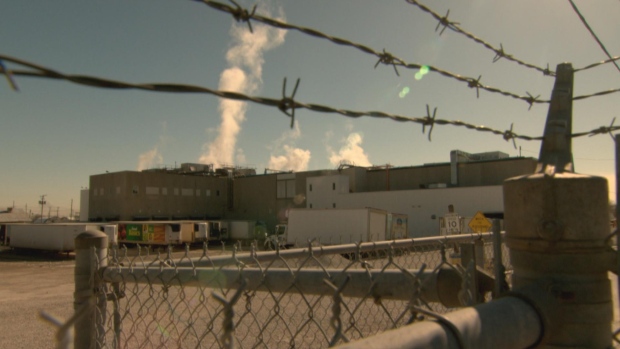
The slaughterhouse is owned and operated by Maple Lodge Farms. By any standard, the place is big, a sprawling series of factory style buildings in a field located on the edge of Brampton, Ont. near Toronto.

A steady stream of tractor trailers arrive from mostly Ontario farms that raise the chickens from hatching to slaughter.

Reading this from an app? Tap here for a better experience.

The birds are bred to grow quickly, their lives last usually no longer than two months. And the sheer numbers can be staggering.

Maple Lodge Farms plant

Nearly half a million birds are slaughtered at the Maple Lodge plant every day, feeding a Canadian market that consumes more than 650 million chickens every year, making it the most popular meat source in the country.

The Maple Lodge Farms website states that it treats the birds humanely and with respect. But the undercover video shot by Mercy for Animals Canada does show things that many viewers probably would find difficult to watch.

Harsh conditions

“There are birds that arrive dead in the hot months,” John told W5. “They die from over-heating. And in the colder months, chickens die from being too cold. They actually arrive frozen like ice blocks.”

Frozen chicken

A frozen chicekn is unloaded from a crate.

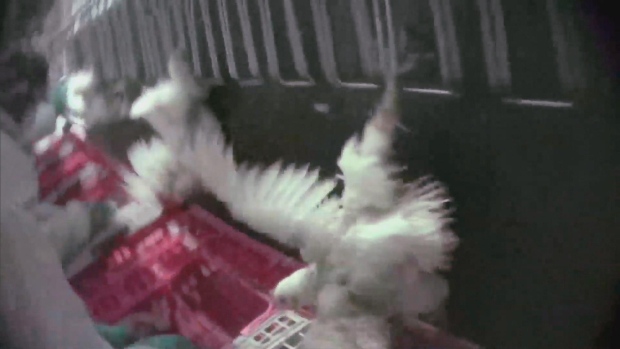
Once inside the plant, the crates of chickens are unloaded, and placed, sometimes roughly thrown, onto a conveyor belt.

Chickens unloaded

Then they arrive at the beginning of an assembly line.

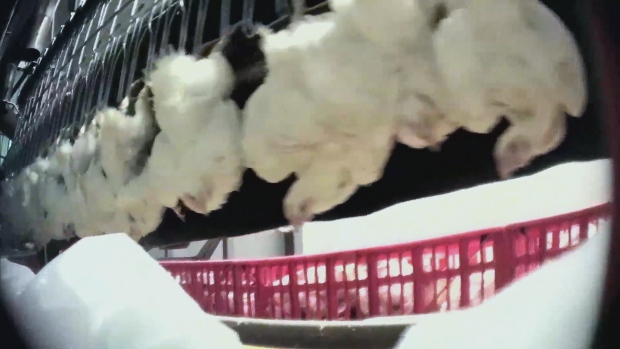
The video shows workers pulling chickens out of the crates and hanging them upside down by the legs. They have to work fast.

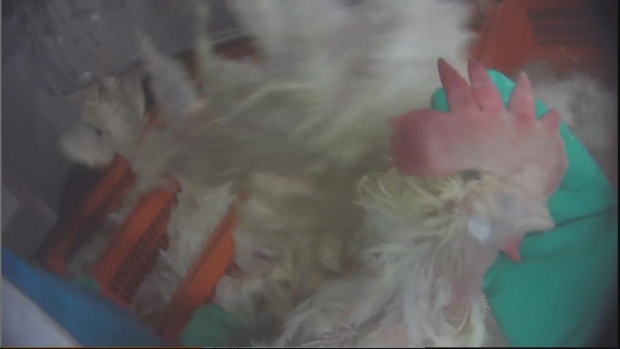
“Each employee is expected to hang 20 birds a minute,” John said. “So employees are hanging birds as fast as they can to keep up. So it’s being grabbed pretty violently. Sometimes you’ll see bones protruding out of the skin, you see toes ripped off. It’s pretty horrific.”

Chickens on the line

The line carrying the suspended birds then moves quickly through the various stages of the slaughter process.

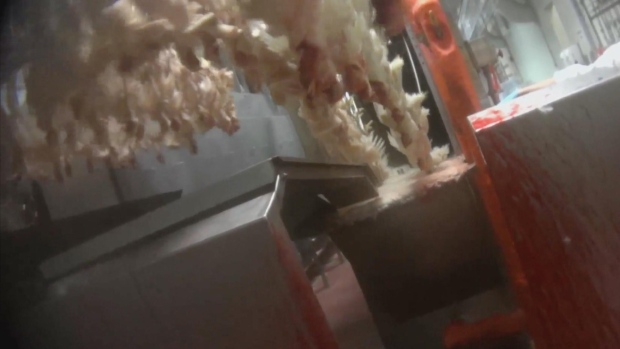
The heads are pulled through an electrified pool that stuns the animals, and then through a machine that cuts their throats, and finally into scalding tanks that make it easier for another machine to pluck out the feathers.

Scalding tanks

It isn’t pretty, but it is supposed to be efficient, and humane.

Except the Mercy for Animals Canada investigator said he often saw birds come out of the stunning pool conscious, and because of their flapping and struggles to release themselves, sometimes would miss the blade designed to cut their throats.

There is a provision for that. There are employees positioned with knives so they can manually dispatch the birds that have survived till that point.

“They told me they do a thousand a day, sometimes two thousand,” John told W5.

The technology being used at Maple Lodge Farms is standard in the industry. So the inevitable question, is the company actually doing anything wrong?

Treatment ‘unacceptable’

W5 put the question to one of Canada’s poultry experts who believes that some of the things he saw in the undercover video should not happen.

Ian Duncan

University of Guelph professor Ian Duncan, right, reviews footage with W5’s Tom Kennedy.

He is Ian Duncan, a professor at the University of Guelph. After looking at video of the way crates were loaded on to the conveyor belt, he said: “That’s unacceptable, throwing them down like that.”

On the physical appearance of some of the birds, he said, “There is a bone sticking through there. Something’s been dislocated. That is very unusual. That shouldn’t happen.”

Chickens hanging by one leg

After looking at some birds hanging by one leg instead of two, he said, “That’s unacceptable. It puts huge pressure on the hip joint and there’s also a danger that when it comes to where the bird is to be stunned, it won’t go into the stunning bath properly and won’t meet the knife that’s going to cut its neck.”

When asked if birds could live through that whole process, he answered bluntly. “Yes. Yes.”

Previous conviction

Maple Lodge Farms has had trouble before. In September of 2013, it was convicted of two offences under the Health of Animals Act and later pleaded guilty to another 18 counts, all related to “…the failure to prevent undue suffering by undue exposure to weather of a large number of chickens.”

Thousands of birds had died while being transported to slaughter at Maple Lodge Farms. A few of the counts related to inadequate ventilation.

In the ruling, the judge commented, “Economic imperatives trumped animal welfare.”

The company was fined nearly $100,000 and put on probation for a period of three years, during which it was expected to comply with numerous conditions.

And now, Mercy for Animals Canada has prepared a complaint that it has forwarded to the federal regulator, the Canadian Food Inspection Agency and the Ontario Society for the Prevention of Cruelty to Animals.

Among the accusations, Mercy for Animals Canada claims:

  • Birds continued to be exposed to freezing temperatures during transport.
  • Birds became trapped in the doors of transport crates and severely injured in the transport crates.
  • The excessive line speed made it impossible for workers to handle and hang birds humanely.

Responses

W5 exchanged several emails and left phone messages with Michael Burrows, the CEO of Maple Lodge Farms, requesting a meeting to show him the undercover video and to get his comment.

In subsequent correspondence, Mr. Burrows wrote us back to say, “Maple Lodge Farms has stringent policies and practises that govern all aspects of animal care and food safety… The humane treatment of the birds we rely on for our livelihood is a priority and a moral responsibility that we take seriously.”

He also wrote that his company was very disturbed by what W5 had told him and he had launched his own investigation of the allegations made by Mercy for Animals Canada. But he never did agree to an interview.

W5 also telephoned and emailed the federal regulator, the Canadian Food Inspection Agency. On repeated occasions, it said it would call back. It never did.

But 20 days after W5 first contacted them, the regulator did sent an email to say “The CFIA is conducting a thorough and careful review of the complaint and will take any necessary measures that it may deem appropriate.”

It added that it has the power to impose fines, and in the event of serious and repeated offences, “…the CFIA may refer non-compliance for criminal prosecution.”

Mercy for Animals Canada is also pushing for major changes to the aging technology prevalent in the business of poultry slaughter.

Instead of the electrified pools being used to stun the birds and the automated cutter used to slice throats, the animal rights organization is openly urging the adoption of what is called Controlled Atmosphere Killing, or CAK for short.

Video from a plant in Norway shows crates of birds arriving at a CAK facility, placed inside a chamber where inert gases replace oxygen causing all birds to slip into unconsciousness and then death. Only then are they handled by humans.

A major retooling of the industry would inevitably be costly and could drive up the price and therefore, reduce the demand for chicken.

Ian Duncan

But Duncan suspects the industry will take a hard look at change anyway, especially if the poultry-consuming public begins to take a critical look at how one of their favourite foods actually arrives on their plates.

“If the video showed race horses or some other animal that people valued (being killed this way), there would be a huge outcry,” Duncan said. “Chickens can still suffer.”

Congressional effort to allow killing hibernating bears and wolf pups in their dens moves to U.S. Senate

February 22, 2017

Last week’s vote on H.J. Res. 69 was one of the most disturbing actions by Congress I’ve witnessed during more than a quarter century of political advocacy for animals. By a 225 to 195 vote, a narrow majority of the U.S. House voted to rescind a rule from the U.S. Fish and Wildlife Service (FWS) to forbid the worst wildlife management practices introduced to the field in the last century – shooting hibernating bears with their cubs and denning of wolves and their pups; using airplanes to scout, land, and shoot grizzly bears; and baiting and trapping black and grizzly bears with steel-jawed leghold traps and neck wire snares.

Both obedience to and fear of the NRA and Safari Club International, along with an interest in securing campaign donations from those groups and their supporters, drove more than 200 lawmakers to vote against good sense and common decency.

Rep. Don Young of Alaska, a former board member of the NRA and a licensed trapper – who conceded on the floor that he used to kill wolf pups in their dens for a bounty paid by the federal government — initiated this action and led the charge for his terrible resolution. An identical resolution, introduced by Sen. Dan Sullivan of Alaska as S.J. Res. 18, may be taken up in the Senate next week or soon thereafter.

Let’s take a look at several of Young’s arguments brandished in the run-up to this vote.

Young and other proponents simultaneously argued that the federal rule would restrict hunting and even fishing rights, yet they also said that the practices forbidden under the rule don’t occur.

It’s almost a logical impossibility to severely restrict hunting and fishing rights for practices that aren’t occurring. So what’s really at work here, and where do the truth and these politicians lie? The state of Alaska, especially since the enactment of the Intensive Management Act, has been on a crusade to use well-heeled trophy hunters and state agents to drive down the numbers of grizzly bears, black bears, and wolves, in order to create more moose and caribou for hunters to shoot. In pursuit of this goal, it’s authorized all manner of appalling practices, including hunting and killing methods forbidden by the FWS rule on their lands. In short, if these methods weren’t legal and used, then the state, the Safari Club, and the NRA wouldn’t be clamoring for a rescinding of the measure.

Young and his allies invoked the 10th Amendment and called the battle a states’ rights issue, saying the federal government has no business managing wildlife on federal lands.

This is their most dangerous argument, since this is an attempt to supplant wildlife management by the National Park Service (NPS) and the FWS on over 170 million acres of land throughout the United States – from the refuges and national parks and preserves in Alaska to Yellowstone and Acadia and Everglades in the rest of the United States. While the U.S. Forest Service and the Bureau of Land Management have traditionally deferred to the states on wildlife management, the FWS and the NPS have for decades directly controlled the management of wildlife on land dedicated to species preservation. That power is derived from the Constitution and Congress, and the federal courts have repeatedly upheld that right. The FWS rule is aligned with the Alaska National Interests Land Conservation Act (which Young opposed in 1980) and the National Wildlife Refuge System Improvement Act, along with the Property Clause of the U.S. Constitution. The sweeping application of Congressman Young’s invocation of the 10th Amendment would upend management practices at hundreds of parks, preserves, seashores, battlefields, refuges, and other designated land holdings. This has been a long-held aspiration of the NRA and Safari Club, and lawmakers aligned with them took the ball and ran with it. If this principle had merit, then it would just be a matter of time for the state of Wyoming to open hunting seasons on grizzly bears and wolves within the boundaries of Yellowstone National Park, if state managers chose that strategy.

Young said that everybody in Alaska is in favor of his effort to repeal the federal rule.

Rep. Don Beyer of Virginia argued against H.J. Res. 69 and read excerpts from a series of letters from Alaskans opposing the rule. On top of that, there were letters from more than a dozen wildlife biologists from Alaska saying that the FWS rule is the right policy, and that the rule itself was crafted by FWS biologists who work and live in Alaska and felt duty-bound to proscribe activities at odds with the purposes of the refuges. None of these people are cranks, and it turns out, they are not in the minority. statewide pollconducted in February 2016 showed Alaskans oppose denning of wolves by more than a 2-to-1 margin. At a series of public meetings on the FWS proposed rule, many Alaskans turned out to publicly support the rulemaking actions because they want these inhumane, unsustainable, and unsporting practices to end. At the Fairbanks meeting, a clear majority supported the proposed rule. Alaskan voters have put the issue of aerial gunning of wolves on the ballot three times, and passed two of the measures (still lawmakers, violating the wishes of their own constituents, overturned those laws).

The FWS rule, years in the works, was hardly an example of the federal government running roughshod over the state. The opposite is far closer to the truth, with the state trying to bully its way into our national wildlife refuges and national preserves, authorized by Congress. Congress provided the FWS with a statutory mandate requiring the agency to conserve wildlife species, and prohibiting the denning of wolf pups and land-and-scout hunting of grizzly bears falls in line with that mandate. Yet, consistent with its policy, the FWS appealed to the Alaska Board of Game dozens of times to amend its rules to exempt National Wildlife Refuges. The Board of Game refused.

The House outcome is intolerable, and now the debate moves to the U.S. Senate. Only determined action by citizens can stop the Senate from replicating the House action. Call your U.S. Senators and urge them to oppose S.J. Res. 18, by Sens. Lisa Murkowski and Dan Sullivan of Alaska. It’s not just the lives of the wolves and bears at stake, it’s nothing less than the principle of federal control of our parks and refuges throughout the United States.

http://blog.humanesociety.org/wayne/2017/02/congressional-effort-allow-killing-hibernating-bears-wolf-pups-dens-moves-u-s-senate.html?credit=fb_postwp022217

blog.humanesociety.org
Last week’s vote on H.J. Res. 69 was one of the most disturbing actions by Congress I’ve witnessed during more than a quarter century of political advocacy for animals. By a 225 to 195 vote, a narrow majority of the U.S. House voted to rescind a rule from the U.S. Fish and Wildlife Service (FWS) . . .