Bird flu toll in Miyagi, Chiba kept down to [only?] 270,000 chickens

http://www.japantimes.co.jp/news/2017/03/26/national/bird-flu-toll-miyagi-chiba-kept-270000-chickens/#.WNgLGTsrLIU

KYODO

The chicken cull sparked by the nation’s latest bird flu outbreaks fell short of the originally planned goal of 300,000 Sunday as authorities in Miyagi and Chiba prefectures opted to settle for roughly 209,000 and 62,000 chickens, respectively.

The two prefectures north of Tokyo were spurred into action by outbreaks of the highly pathogenic H5 strain of bird flu at local poultry farms.

Agricultural officials in Chiba finished their cull on Saturday.

The Miyagi Prefectural Government will bury the carcasses underground and disinfect the poultry houses, officials said. It initially planned to kill 220,000 chickens but later reduced it by about 11,000.

The two culls began Friday, with help from Self-Defense Forces personnel.

Since November, the H5 virus has devastated poultry farms in Niigata, Aomori and Miyazaki prefectures as well as Hokkaido.

According to the Miyagi Prefectural Government, a total of 96 chickens were found dead over a three-day period through Thursday at a poultry farm in Kurihara. Six tested positive for bird flu in a preliminary screening.

In Chiba, 118 chickens were found dead over the same three-day period at a farm in Asahi and 10 tested positive in a preliminary test.

Subsequent generic exams detected the highly virulent H5N6 strain of avian influenza in both cases.


Also:  220,000 More Birds Culled in Japan’s Northeast due to Bird Flu


TOKYO – Japanese authorities announced on Friday that some 220,000 more birds in the northeast of the country have been slaughtered due to an outbreak of bird flu that has reappeared since the end of 2016.

The latest outbreak was detected on a farm in Miyagi prefecture after hundreds of dead chickens were analyzed throughout the week and were subsequently found that they were infected with the highly pathogenic avian influenza H5.

Regional authorities on Friday began slaughtering all the birds on the farm with help from the Japan Self-Defense Forces, a process that will continue until Sunday.

In addition, the transport of birds and eggs within a radius of 10 kilometers (6.2 miles) around the three affected farms has been prohibited, state media NHK television said.

According to the NHK, Miyagi Governor Yoshihiro Murai said at a press conference that this is the first outbreak of bird flu detected on a farm in this prefecture.

The outbreak of the virus in this northeastern region follows outbreaks in the country’s southwest, in Miyazaki in January and in Saga in February.

The number of birds slaughtered in Japan has reached around 1.39 million so far since the bird flu was again detected in the country in November 2016 after the 2014 outbreak, prompting the Ministry of Environment to raise the alert to the highest level.

http://www.laht.com/article.asp?ArticleId=2433443&CategoryId=13936

Fukushima clean-up falters six years after tsunami/Japan bans Fukushima rice after radiation breaches limits

Exploration work inside the nuclear plant’s failed reactors has barely begun, with the scale of the task described as ‘almost beyond comprehension’

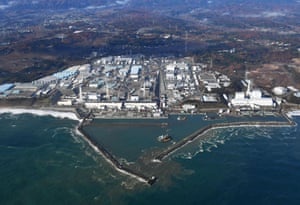
This aerial photo shows Fukushima Dai-ichi nuclear power plant in Okuma, Fukushima Prefecture
Cleaning up the Fukushima Daiichi nuclear plant is expected to take 30 to 40 years. Photograph: AP

Barely a fifth of the way into their mission, the engineers monitoring the Scorpion’s progress conceded defeat. With a remote-controlled snip of its cable, the latest robot sent into the bowels of one of Fukushima Daiichi’s damaged reactors was cut loose, its progress stalled by lumps of fuel that overheated when the nuclear plant suffered a triple meltdown six years ago this week.

As the 60cm-long Toshiba robot, equipped with a pair of cameras and sensors to gauge radiation levels was left to its fate last month, the plant’s operator, Tokyo Electric Power (Tepco), attempted to play down the failure of yet another reconnaissance mission to determine the exact location and condition of the melted fuel.

Even though its mission had been aborted, the utility said, “valuable information was obtained which will help us determine the methods to eventually remove fuel debris”.

The Scorpion mishap, two hours into an exploration that was supposed to last 10 hours, underlined the scale and difficulty of decommissioning Fukushima Daiichi – an unprecedented undertaking one expert has described as “almost beyond comprehension”.

Cleaning up the plant, scene of the world’s worst nuclear disaster since Chernobyl after it was struck by a magnitude-9 earthquake and tsunami on the afternoon of 11 March 2011, is expected to take 30 to 40 years, at a cost Japan’s trade and industry ministry recently estimated at 21.5tr yen ($189bn).

The figure, which includes compensating tens of thousands of evacuees, is nearly double an estimate released three years ago.

The tsunami killed almost 19,000 people, most of them in areas north of Fukushima, and forced 160,000 people living near the plant to flee their homes. Six years on, only a small number have returned to areas deemed safe by the authorities.

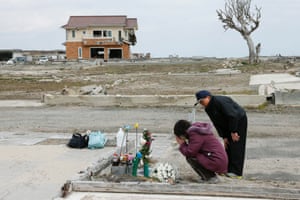
Grieving people
Pinterest
The tsunami on 11 March 2011 killed almost 19,000 people. Photograph: Kimimasa Mayama/EPA

Developing robots capable of penetrating the most dangerous parts of Fukushima Daiichi’s reactors – and spending enough time there to obtain crucial data – is proving a near-impossible challenge for Tepco. The Scorpion – so called because of its camera-mounted folding tail – “died” after stalling along a rail beneath the reactor pressure vessel, its path blocked by lumps of fuel and other debris.

Advertisement

The device, along with other robots, may also have been damaged by an unseen enemy: radiation. Before it was abandoned, its dosimeter indicated that radiation levels inside the No 2 containment vessel were at 250 sieverts an hour. In an earlier probe using a remote-controlled camera, radiation at about the same spot was as high as 650 sieverts an hour – enough to kill a human within a minute.

Shunji Uchida, the Fukushima Daiichi plant manager, concedes that Tepco acquired “limited” knowledge about the state of the melted fuel. “So far we’ve only managed to take a peek, as the last experiment with the robot didn’t go well,” he tells the Guardian and other media on a recent visit to the plant. “But we’re not thinking of another approach at this moment.”

Robotic mishaps aside, exploration work in the two other reactors, where radiation levels are even higher than in reactor No 2, has barely begun. There are plans to send a tiny waterproof robot into reactor No 1 in the next few weeks, but no date has been set for the more seriously damaged reactor No 3.

Naohiro Masuda, the president of Fukushima Daiichi’s decommissioning arm, says he wants another probe sent in before deciding on how to remove the melted fuel.

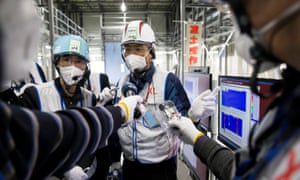
A Tepco employee speaks to the media at the company’s Fukushima Daiichi nuclear power plant.
Pinterest
A Tepco employee speaks to the media at the company’s Fukushima Daiichi nuclear power plant. Photograph: Reuters

Despite the setbacks, Tepco insists it will begin extracting the melted fuel in 2021 – a decade after the disaster – after consulting government officials this summer.

But Shaun Burnie, a senior nuclear specialist at Greenpeace Germany who is based in Japan, describes the challenge confronting the utility as “unprecedented and almost beyond comprehension”, adding that the decommissioning schedule was “never realistic or credible”.

The latest aborted exploration of reactor No 2 “only reinforces that reality”, Burnie says. “Without a technical solution for dealing with unit one or three, unit two was seen as less challenging. So much of what is communicated to the public and media is speculation and wishful thinking on the part of industry and government.

“The current schedule for the removal of hundreds of tons of molten nuclear fuel, the location and condition of which they still have no real understanding, was based on the timetable of prime minister [Shinzo] Abe in Tokyo and the nuclear industry – not the reality on the ground and based on sound engineering and science.”

Even Shunichi Tanaka, the chairman of Japan’s nuclear regulation authority, does not appear to share Tepco’s optimism that it will stick to its decommissioning roadmap. “It is still early to talk in such an optimistic way,” he says. “At the moment, we are still feeling around in the dark.”

‘The situation is not under control’

On the surface, much has changed since the Guardian’s first visit to Fukushima Daiichi five years ago.

Then, the site was still strewn with tsunami wreckage. Hoses, pipes and building materials covered the ground, as thousands of workers braved high radiation levels to bring a semblance of order to the scene of a nuclear disaster.

Six years later, damaged reactor buildings have been reinforced, and more than 1,300 spent fuel assemblies have been safely removed from a storage pool in reactor No 4. The ground has been covered with a special coating to prevent rainwater from adding to Tepco’s water-management woes.

Workers who once had to change into protective gear before they approached Fukushima Daiichi now wear light clothing and simple surgical masks in most areas of the plant. The 6,000 workers, including thousands of contract staff, can now eat hot meals and take breaks at a “rest house” that opened in 2015.

But further up the hill from the coastline, row upon row of steel tanks are a reminder of the decommissioning effort’s other great nemesis: contaminated water. The tanks now hold about 900,000 tons of water, with the quantity soon expected to reach 1m tons.

Tepco’s once-vaunted underground ice wall, built at a cost of 24.5bn yen, has so far failed to completely prevent groundwater from leaking into the reactor basements and mixing with radioactive coolant water.

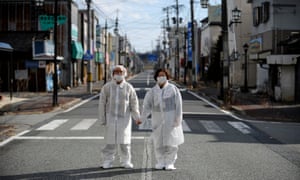
Couple hold hands on Fukushima street
Pinterest
Much has changed in Fukushima since the disaster. Photograph: Franck Robichon/EPA

The structure, which freezes the soil to a depth of 30 metres, is still allowing 150 tonnes of groundwater to seep into the reactor basements every day, said Yuichi Okamura, a Tepco spokesman. Five sections have been kept open deliberately to prevent water inside the reactor basements from rising and flowing out more rapidly. “We have to close the wall gradually,” Okamura said. “By April we want to keep the influx of groundwater to about 100 tonnes a day, and to eliminate all contaminated water on the site by 2020.”

Critics of the clean-up note that 2020 is the year Tokyo is due to host the Olympics, having been awarded the Games after Abe assured the International Olympic Committee that Fukushima was “under control”.

Mitsuhiko Tanaka, a former Babcock-Hitachi nuclear engineer, accuses Abe and other government officials of playing down the severity of the decommissioning challenge in an attempt to win public support for the restart of nuclear reactors across the country.

“Abe said Fukushima was under control when he went overseas to promote the Tokyo Olympics, but he never said anything like that in Japan,” says Tanaka. “Anyone here could see that the situation was not under control.

“If people of Abe’s stature repeat something often enough, it becomes accepted as the truth.”


Too much caesium found in rice grown near Fukushima Daiichi nuclear plant, which was hit by tsunami in March
Japan bans Fukushima rice
Japanese rice that was found contain radioactive contamination well above the legal limit is displayed in Fukushima city. Photograph: Jiji Press/AFP/Getty Images

Japan has banned shipments of rice grown near a tsunami-hit nuclear power plant, after detecting radiation exceeding the legal limit.

The cabinet secretary, Osamu Fujimura, said on Thursday that a sample of rice from a farm contained 630 becquerels of caesium a kg.

Caesium was among the radioactive materials that leaked from the FukushimaDaiichi nuclear plant after it was damaged by the earthquake and tsunami in March.

Under Japanese regulations, rice with more than 500 becquerels of caesium per kilogram must not be consumed.

Officials have tested rice at hundreds of spots in Fukushima, but none had previously exceeded the limit. Only last month Fukushima declared that rice grown in the prefecture was safe.

Radioactive boars running wild around Fukushima nuclear reactors are being shot

An Animal Rights Article from All-Creatures.org

FROM

CLG News
April 2016

wild boars

Communities in northern Japan are being overwhelmed by radioactive wild boars which are rampaging across the countryside after being contaminated by the Fukushima nuclear disaster.

The animals’ numbers are increasing as the boar breed unhindered in the exclusion zone around the stricken Fukushima Daiichi plant, and they are causing damage to farms well beyond the area poisoned by radiation.

Hunters are shooting the boars as fast as they can, but local cities are running out of burial space and incinerator capacity to dispose of their corpses.

Animal rights protestors send ‘deafening’ message to Japan to stop Taiji dolphin slaughter


Animal rights protesters demand end to the killing 

Published: Mon, November 10, 2014

Up to 1,000 furious protesters demanded an end to the dolphin ‘slaughter’

Up to a thousand furious demonstrators gathered outside the Japanese embassy in London to protest the “atrocious” killing of up to 20,000 dolphins, whales and porpoises in the country every year.

The majority of the creatures – including several thousand at the notorious Taiji Cove – are killed for meat but some are captured for zoos and aquariums.

Hunts are conducted between September and March. This year the Japanese government authorised 16,000 deaths.

The crowd, many with their hands covered in fake dolphin blood, chanted “Taiji: Set them free” and “Stop the dolphin slaughter” at the building, which was surrounded by police.

Lead activist Richard O’Barry who starred in the award winning documentary The Cove said: “It was the largest demonstration we’ve seen.

“We wanted to get the attention of the government in Tokyo and let them know that this is not acceptable. They are not their dolphins to kill.

“This is all about putting external pressure on Japan.”

http://www.express.co.uk/news/nature/533880/Animal-rights-protestors-London-tell-Japan-stop-Taiji-dolphin-slaughter

Japan mulls over Pacific research whaling

Japan is considering whether to conduct research whaling in1625686_10153991126600648_6519826837941566402_n the northwestern Pacific Ocean later this month as planned.

The International Court of Justice in The Hague ruled in March that Japan’s whaling program in the Antarctic cannot be recognized as serving research purposes in its current form.

Japan also carries out research whaling in the northwestern Pacific, including waters off the country’s coast.

This year’s activities are scheduled to start off the coast of Ishinomaki City, northeastern Japan, on April 22nd. There are plans to conduct it farther out into the northwestern Pacific next month.

The court’s decision does not directly cover Japan’s research whaling in those areas.

But the government thinks the court’s ruling could be applied to those waters depending on methods used, including the number caught.

The concern is prompting the government to assess its research procedures. It plans to decide as early as next week whether to go ahead with research whaling in the northwestern Pacific.

Some in the government claim that it should conduct the Pacific research whaling as planned. But others argue that Japan could be sued again if it continues the program without due consideration to the court’s ruling.

Apr. 10, 2014  http://www3.nhk.or.jp/nhkworld/english/news/20140411_03.html

Sea Shepherd Applauds the World Court for Protecting the Whales of the Southern Ocean Whale Sanctuary

http://www.seashepherd.org/news-and-media/2014/03/31/the-whales-have-won-icj-rules-japans-southern-ocean-whaling-not-for-scientific-research-1569

The International Court of JusticeThe International Court of Justice
Photo courtesy Wikimedia Commons

In a stunning victory for the whales, the International Court of Justice (ICJ) in The Hague announced their binding decision today in the landmark case of Australia v. Japan, ruling that Japan’s JARPA II whaling program in the Antarctic is not for scientific purposes and ordering that all permits given under JARPA II be revoked. The news was applauded and celebrated by Sea Shepherd Conservation Society USA and Sea Shepherd Australia, both of which have directly intervened against Japanese whalers in the Southern Ocean.

Representing Sea Shepherd in the courtroom to hear the historic verdict were Captain Alex Cornelissen, Executive Director of Sea Shepherd Global and Geert Vons, Director of Sea Shepherd Netherlands. They were accompanied by Sea Shepherd Global’s Dutch legal counsel.

The case against Japan was heard by the ICJ in July of last year to decide whether Japan is in breach of its international obligations in implementing the JARPA II “research” program in the Southern Ocean, and to demand that Japan cease implementation of JARPA II and revoke any related permits until Japan can make assurances that their operations conform with international law.

In a vote of 12 to 4, the ICJ ruled that the scientific permits granted by Japan for its whaling program were not scientific research as defined under International Whaling Commission regulations. It ordered that Japan revoke the scientific permits given under JARPA II and refrain from granting any further permits under that program.

A minke whale spyhops in the middle of iceA minke whale spyhops in the middle of ice
Photo: Sea Shepherd
Prior to the verdict, there had been some speculation that the ICJ would not permit the hunting of endangered fin and humpback whales, but it would compromise and allow the hunting of minke whales. However, it has been Sea Shepherd’s contention all along that — no matter the species — no whales should be killed, especially in a sanctuary. Sanctuary means “a place of refuge or safety; a nature reserve” where animals are protected. To allow killing in an internationally designated sanctuary is to make a mockery of international agreements made by those countries who established the sanctuary in 1994. At that time, 23 countries supported the agreement and Japan was the only IWC member to oppose it.

Even the Ambassador from Japan to the U.S., Kenichiro Sasae, during a public meeting in Los Angeles in December 2013 attended by representatives of Sea Shepherd USA, had this to say about whales and whaling: ”As an individual, I like whales and if you go out and see the whales, there is no reason for us to kill this lovely animal. But it’s history and it’s politics, I would say. There are a small number of Japanese people still trying to get this won. But mainstream Japanese are not eating whale anymore.” At the same meeting, Ambassador Sasae stated that Japan will abide by the ICJ ruling.

Ambassador Kenichiro Sasae

Read the transcript here

Sea Shepherd Conservation Society’s international volunteer crew stood on the frontlines in the hostile and remote waters of Antarctica for eight years and then Sea Shepherd Australia took up that gauntlet for the last two years and will keep confronting Japanese whalers in Antarctica until we can once and for all bring an end to the killing in this internationally designated “safety zone” for whales. Over the years, Sea Shepherd has been the only organization to directly intervene against Japan’s illegal commercial whaling conducted under the guise of research, with their claims of research globally questioned. Indeed, Sea Shepherd has been the only thing standing between majestic whales and the whalers’ harpoons, as these internationally protected species — many of them pregnant — migrate through Antarctic waters each year.

“With today’s ruling, the ICJ has taken a fair and just stance on the right side of history by protecting the whales of the Southern Ocean Whale Sanctuary and the vital marine ecosystem of Antarctica, a decision that impacts the international community and future generations,” said Captain Alex Cornelissen of Sea Shepherd Global.

“Though Japan’s unrelenting harpoons have continued to drive many species of whales toward extinction, Sea Shepherd is hopeful that in the wake of the ICJ’s ruling, it is whaling that will be driven into the pages of the history books,” he said.

“Despite the moratorium on commercial whaling, Japan has continued to claim the lives of thousands of the gentle giants of the sea in a place that should be their safe haven,” said Sea Shepherd Founder, Captain Paul Watson. “Sea Shepherd and I, along with millions of concerned people around the world, certainly hope that Japan will honor this ruling by the international court and leave the whales in peace.”

Sea Shepherd Global will have the ships prepared to return to the Southern Ocean in December 2014 should Japan choose to ignore this ruling. If the Japanese whaling fleet returns, Sea Shepherd crew will be there to uphold this ruling against the pirate whalers of Japan.

Earthrace Conservation, applauds International court verdict on Japanese whaling

Pete Bethune, Earthrace Conservation, applauds International court verdict on Japanese whaling.

The International Court of Justice in The Hague today (Monday, 31 March 2014) found in favor of Australia and New Zealand in the court case against Japan’s so-called Research Whaling in Antarctica.

Earthrace Conservation founder Pete Bethune, who was at the court for the original case in June 2013 and today to hear the verdict, said, “I am absolutely thrilled. Today will go down in history as a great day for whales, for conservation and for justice.”

Minke%20whale%20creative%20commons%20Smudge9000%20on%20flickrHe said, “The verdict makes Japan’s Research Whaling program, which has killed many thousands of whales in the name of science, illegal. It also halts any likely copycat programs from the likes of Russia and Korea which had the decision favored Japan had been expected to introduce research whaling programs of their own”.

Bethune had his boat, the Ady Gil, destroyed when it was run over by a Japanese security vessel in Antarctica in January 2010. He then spent five months in a maximum-security prison in Japan after he illegally boarded the vessel that had nearly taken the lives of himself and his crew.

This period saw such intense public outcry over research whaling, that the Australian government announced it was taking Japan to the International Court of Justice. Bethune remembers the day when he heard the news in prison. “I went down to meet my lawyer, and the first thing she said to me was Australia had taken the court action against Japan over whaling. I burst into tears. I was optimistic that any decent judicial system would find against Japan, and to finally see it become a realityis amazing.”

Bethune always felt that Japan’s case was weak. “They used a loophole in the original IWC regulations that allowed for nations to conduct their own research-whaling program”, he said.

“Japan argued the court had no jurisdiction to decide what legitimate research was, and that Japan could choose its research programs as it liked. They also presented some of their research findings, although none but the most one-eyed would accept them as being valued by the Scientific-community”.

The verdict is binding for all three countries and cannot be appealed. Japan has little choice now but to cease their whaling program in the Southern Ocean Whale Sanctuary.

Bethune spoke to several senior Japanese delegates after the verdict was announced and says they indicated that while they were very disappointed with the outcome, they would abide by the ruling and not go back to Antarctica.

According to Bethune, the one drawback with the court case is it only addressed Japan’s scientific whaling program in Antarctica. The verdict has now made this illegal, but it still leaves Japan free to continue with research whaling in the Northern Pacific.

Bethune said, “I have no idea why Australia and New Zealand left the Northern Pacific out of their case. If the research program in Antarctica is illegal, then by definition so is the program in the Northern Pacific but it will require another court action to make this illegal also.”

Bethune now feels that his actions back in 2010 were not in vain and hopes that in some small way what happened to him contributed to today’s verdict.
“I lost my boat, spent five months in prison for peacefully protesting against what has now been confirmed as illegal activities, and was paraded around in Japan as a dangerous criminal which was difficult to take at the time. If all that was even a small part of the means to this happy ending, then I’m bloody happy to have gone through it all.”

World Court rules Japan’s whaling not for scientific purposes

Monday March 31, 2014

The International Court of Justice has ruled that Japan’s whaling programme is not for scientific purposes, in a landmark decision tonight.

After years of protest and diplomatic wrangling, the court in The Hague ruled by 12 votes to 4 that Japan does not have the right to hunt whales in the Antarctic. The decision is binding so Japan can not appeal.

“The court concludes that the special permits granted by Japan for the killing, taking and treating of whales in connection with JARPA II are not for purposes of scientific research,” President Peter Tomka told the International Court of Justice tonight.

The court ruled Tokyo should cease its whaling programme “with immediate effect”.

New Zealand helped Australia to haul Japan before the courts accusing Japan of exploiting a loophole in the rules by saying they are hunting whales for scientific purposes.

Japan says it’s necessary to kill a small number of whales to find out more about them. In the last 20 years, 10,000 whales have been slaughtered in the name of science.

The case started in 2010 but during a three-week hearing last year, New Zealand and Australia argued Tokyo’s programme was just a commercial operation in disguise.

However, Japan argued the court didn’t have the right to decide what is and isn’t science.

Foreign Minister Murray McCully said it was a complex case.

“The big issue for us is whether we do see a pathway out of whaling in the Southern Ocean from Japan’s perspective and that’s what we’ll be looking for in the small print of the court’s decision.”

In 1986 commercial whaling was banned but several countries like Norway and Iceland continue to practise it and remain members of the commission. Japan reverted to the 1940s regulations that allow hunting for scientific purposes but there are no rules on how many whales can be killed.

The Sea Shepherd protest ship has been working to stop whaling in the Southern Ocean. The ship has collided with whaling boats, dragged ropes in the water to damage propellers and used smoke bombs.

Sea Shepherd campaigner Pete Bethune says it’s “judgment day for Japan… the stakes couldn’t be higher”.

http://tvnz.co.nz/world-news/court-rules-japan-s-whaling-not-scientific-purposes-5880814

whaling_stand_off_causes_diplomatic_waves_1721713978

Japan takes baby steps toward a proper debate about animal rights

Photo  Jim Robertson

Photo Jim Robertson

http://www.japantimes.co.jp/news/2014/02/22/national/japan-takes-baby-steps-toward-a-proper-debate-about-animal-rights/#.Uwo9mrCYZy1

by Philip Brasor Feb 22, 2014

On Jan. 10, convenience store chain Family Mart started selling a new bentō (boxed lunch) with a heavy-duty name to complement its hefty ¥600 price: Famima Premium Koroge Wagyu-iri Hamburger Bento, which “contains” high-quality Japanese ground beef. For an added touch of extravagance, it also came with a side of foie gras.

A month later, the company withdrew the product after receiving complaints about the foie gras, which is made from the fatty livers of geese. Animal welfare groups claim the manufacture of foie gras amounts to animal cruelty since the birds are force-fed. A Family Mart PR person told Tokyo Shimbun that the company only received 22 complaints, but that it was enough to persuade it to pull the item. The reporter hinted that the company may have actually withdrawn it due to bad sales, but in any case, it’s significant that complaints related to animal rights would be taken seriously by a Japanese business and picked up by the media. It’s not a topic that’s usually covered unless non-Japanese are involved.

Like Caroline Kennedy. The new U.S. ambassador to Japan recently attracted media scrutiny for a tweet expressing her and the U.S. government’s objection to the dolphin “drive hunt” taking place in Taiji, Wakayama Prefecture. Ever since “The Cove” won the Oscar for best documentary of 2009, the world has come down on the whaling town for its yearly cull, which involves scaring dolphins into a cove, separating some for sale to aquariums and marine shows, and killing others for food. Taiji says the condemnation is unfair, since this is how the town makes its living. People who object are hypocrites because humans raise cows and pigs for slaughter. What’s the difference?

Protests are viewed by the Japanese press as a form of cultural bias: Those who complain think dolphins are special, more intelligent than other animals and thus should not be killed for food. But recent editorials in the Tokyo and Asahi Shimbuns, prompted by the Kennedy tweet, downplay the cultural-chasm theory. Asahi says it is more about “how we want to live as human beings.” Why are dolphins special? The feeling is that there is “less distance” between our two species because dolphins are biologically equipped to “communicate,” thus giving them the means to display “intelligence.” And the more an animal “fulfills the condition of being human,” the greater its right to be treated the same way, meaning they should have similar rights as people do in a given society.

However, the logical pillars of this argument as erected by the Asahi were designed to be knocked down. The paper interviewed Koichi Tagami, a lecturer on ethics at Rissho University, who says human rights stem from self-consciousness, which implies “independent reasoning.” If other animals manifest self-consciousness in some way, they deserve to have their rights protected, including the right not to have pain inflicted on them. So if we grant those rights to dolphins, Tagami argues, then all animals that feel pain should have that right, including cows and pigs. Even robots, he reasons, have the right to object to being “controlled” by humans.

The editorial quotes other scholars who point out differing attitudes toward animals in other countries, and how certain animals are protected while others aren’t depending on the culture. The point seems to be that it is impossible to formulate legal guidelines that cover all aspects of animal welfare when there is no global consensus on what is basically a philosophical issue.

But the Asahi’s academic approach conveniently avoids touching on the most important aim of the animal welfare movement, which is to prevent suffering. Tagami’s theory about freedom from pain is merely a talking point. Though the average person may find advocacy of animal rights too intense at times, the worldwide trend is toward less suffering. Slaughterhouses in Europe must anesthetize livestock before they are killed. Most in the U.S. slaughter animals only after they are stunned. Last week, Denmark outlawed meat-processing techniques used for halal and kosher food, which dictate that animals be conscious when they are slaughtered. The move was met with condemnation from Muslim and Jewish groups. Even nonreligious people wondered about the law after a Danish zoo killed a perfectly healthy giraffe and fed it to lions because the giraffe could not be bred. Its genetic material was already over-represented in the captive environment.

Tokyo Shimbun’s editorial enters this realm by tying animal welfare to commerce. What’s cruel is the mass-production methods of most meat-processing businesses, which are designed to be cheaper and more efficient. Filmmaker Aya Hanabusa made a movie about a Japanese butcher that showed how he raised his livestock from birth and personally killed the animals before processing their meat for sale. She told Tokyo Shimbun that before you can call dolphin culls cruel, you have to apply the same ethical criteria to animals raised “as industrial products.”

In this regard, Taiji fishermen say they have adopted “slaughterhouse methods” to make sure the dolphins they kill “die instantly,” an assertion that anyone who has seen “The Cove” may have a problem with. In any event, they invited Kennedy to witness the cull and see for herself, since what galled them was her suggestion that it is “inhumane.”

Semantics mean something here, and both sides stretch points to their advantage. Taiji claims outsiders are interfering with their “traditional way of life,” but the town didn’t start the drive hunt until 1969, when it needed live animals for its recently opened whaling museum. The anti-cull activists, on the other hand, insist that dolphin meat is dangerous due to high levels of mercury, a contention that is incidental to the cruelty argument. In a world where meat-eating is common, it’s unlikely either side is going to budge unless the Japanese media joins the discussion in a meaningful way.

What YOU Can Do To Help Taiji Dolphins

http://www.seashepherd.org/cove-guardians/what-you-can-do.html

The slaughter of 20,000 dolphins, porpoises, and small whales occurs in Japan each year. Starting on September 1st and continuing through March of the next year, fishermen herd whole families of small cetaceans into shallow bays and mercilessly stab and drown them to death.

This annual slaughter of dolphins was virtually unknown until 2003 when Sea Shepherd globally released covertly obtained film and photographs of the now infamous bloody “Cove” in a village called Taiji. Beginning in 2010, and continuing to this day, Sea Shepherd has an ongoing presence of volunteers standing watch on site at the Cove. They are The Cove Guardians.

With your help, we will continue to pressure Japan to end this cruel and destructive slaughter of dolphins. We are passionate, dedicated, and committed – it may take time, but determination will win for the dolphins in Taiji.

We can all make a difference. If you would like your voices to be heard, please contact the respective representatives to tell them the massacre must stop!

Please help us end this slaughter. Your opinion is important – apathy allows this barbaric “tradition” to continue.

Volunteer

Consider applying to be a Cove Guardian and joining our team in Taiji. This position requires dedication, time, and resources. You must pay for your travel, lodging, food, and all other personal expenses.

Application process:

•Send e-mail to coveguardian@seashepherd.org and express your interest.

•You will be sent an information packet that includes links to the Onshore Volunteer Application and a supplemental questionnaire for Cove Guardians.

•You will submit that package either by electronic or physical mail.

•You will be notified if you are selected and provided more detailed information to help you in booking your travels to and stay in Japan.

Don’t buy a ticket!
A ticket purchased to a dolphin show buys blood in Taiji

The captive dolphin entertainment industry makes a lot of money from dolphin suffering and death. The way to shut them down is to take the profit out of their operations. By ending the demand for their shows, we can sink them economically.

Do not support these entertainment venues. Terminate your season passes. Encourage your friends and family to stay away from them. Do not include them in your holiday packages or cruises. Contact the parks and let them know how you feel about dolphins kept in captivity. Educate others on the link between the captive dolphin industry and the Taiji dolphin slaughter. Do not participate in captive dolphin programs like “swimming with the dolphins”

The Ceta-Base “Phinventory” is a list of captive dolphins world wide.

cetabase

Spread the Word

Follow Operation Infinite Patience on social media and share with your friends and family. Ask them to help us end this atrocity.

Cove Guardian Facebook
Sea Shepherd USA Facebook
Cove Guardian Twitter
Sea Shepherd USA Twitter

Contact the Authorities

Help us end the brutal Taiji dolphin slaughter by voicing your concerns to the authorities in Taiji as well as the Japanese Embassy, US Embassy to Japan, US and Japanese Ambassadors to the UN, and the US Senate members of the Committee on Foreign Relations.

PRIME MINISTER OF JAPAN
Prime Minister Shinzo- Abe
Cabinet Office, Government of Japan
1-6-1 Nagata-cho
Chiyoda-ku, Tokyo. 100-8914 JAPAN
+81-3-5253-2111

Website: http://www.kantei.go.jp/foreign/index-e.html
Online comment form #1: https://www.kantei.go.jp/foreign/forms/comment_ssl.html
Online comment form #2: https://form.cao.go.jp/kokusai/en_opinion-0001.html

Japanese Embassies Worldwide:
Websites of Japanese Embassies, Consulates and Permanent Missions

List of Embassies and Consulates-General in Japan:
List of Embassies and Consulates-General in Japan

US Embassy in Japan:
Caroline Kennedy – Ambassador of the United States to Japan
Telephone: 011-81-3-3224-5000
Fax: 011-81-3-3505-1862
Send E-mail to the U.S. Embassy in Japan
Please thank Caroline Kennedy for her defense of the dolphins

Japanese UN Representatives:
H.E. Mr Kazuyoshi Umemoto – Ambassador Extraordinary and Plenipotentiary
japan.mission@dn.mofa.go.jp

H.E. Mr. Jun Yamazaki – Deputy Representative of Japan to the UN
japan.mission@dn.mofa.go.jp

United States UN Representative:
Samantha Power – US Ambassador to the UN
Samantha Power’s Twitter
United States Mission to the United Nations Contact Form

US Senate Committee on Foreign Relations:
US Senate Committee on Foreign Relations

Wakayama Prefecture Office, Fishery Division:
E0717001@pref.wakayama.lg.jp
Telephone: +81-73-441-3010
Fax: +81-73-432-4124

International Whaling Commission (IWC)
The Red House,
135 Station Road,
Impington,
Cambridge,
Cambridgeshire CB24 9NP, UK.
Tel: +44 (0) 1223 233 971
Fax: +44 (0) 1223 232 87
Email: secretariat@iwcoffice.org

United Nations Environment Programme (UNEP) / Convention on Migratory Species (CMP)
UNEP/CMS Secretariat
Platz der Vereinten Nationen 1
53113 Bonn, Germany
Tel: (+49 228) 815 2401
Fax: (+49 228) 815 2449
Email: secretariat@cms.int

Mayor – Taiji Town Hall:
Telephone: +81-73-559-2335

Taiji Fishermen’s Union:
Telephone: +81-73-559-2340
Fax: +81-735-59-2821

Hotel Dolphin Resort/Dolphin Base:
Telephone: +81-0735-59-3514
Fax: +81-0735-59-2810

Japan Fisheries Public Content Form:
Contact the Ministry of Agriculture, Forestry, and Fisheries

WAZA: The World Association of Zoos and Aquariums
secretariat@waza.org

IMATA: The International Marine Mammal Trainers’ Association
info@imata.org

Photo  Jim Robertson

Photo Jim Robertson