Petition: No More Canned Hunts!

South Africa: No More Canned Hunts!

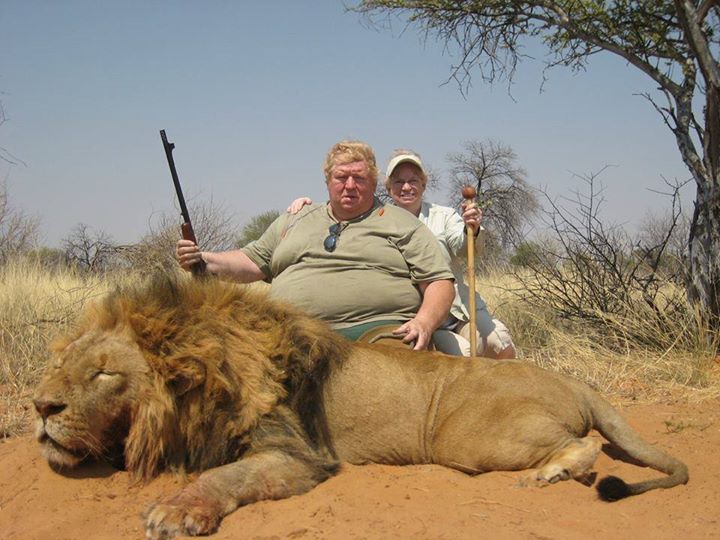
Lions are being trapped and bred for trophy hunting in South Africa. Stop the savagery!

13149_1579394132279452_7361363579790857895_n

Sponsored by:The Animal Rescue Site

Canned hunting is a type of hunting in which animals are placed in a confined area, then followed and gunned down by hunters. Also called trophy hunting, canned hunts are popular in South Africa, where lions are often bred for this purpose alone. Hunters come to these “canned” areas and pay large fees to hunt the lions.

With canned hunting, the animal is sure to die since it’s being held in an enclosed area with no chance for escape. It’s a completely unfair and brutal practice, and only exists for the entertainment of morally challenged hunters.

Sign the petition asking the head of the South African Department of Agriculture, Forestry, and Fisheries, Peter Thabethe, to put a stop to these cruel canned hunts for good.

<div class=”scriptWarning”>JavaScript is required to sign this petition!</div>

Sign Here  http://theanimalrescuesite.greatergood.com/clickToGive/ars/petition/CannedHunting


Email *
First name *
Last name *
Don’t display my name
Comments (used 0 of 255 chars max)

U.S. proposal to “protect” African lions hands their heads to hunters

U.S. proposal to “protect” African lions hands their heads to hunters

Vier Pfoten/Lionsrock Sanctuary

WASHINGTON D.C.––“Wild” African lions may in the future exist only as a species cultivated for trophy hunting, anticipates an October 29, 2014 U.S. Fish & Wildlife Service proposal to list them as a “threatened” species.

Published in the October 29, 2014 edition of the Federal Register, the U.S. Fish & Wildlife Service notice of proposed rulemaking is open for 90 days of public comment, ending in January 2015, before taking effect.

The listing proposal was hailed as a victory for the trophy hunting industry by Safari Club International, and was mourned as an at least partial defeat by the Humane Society of the U.S., Humane Society International, International Fund for Animal Welfare, Defenders of Wildlife, and Born Free USA, whose 2011 petition to the U.S. Fish & Wildlife Service initiated the “threatened” species listing process.

Lions down by half since 1980

The International Union for the Conservation of Nature estimates that there are now about 32,000 to 33,000 African lions, down from 75,000 circa 1980. Most of the remaining African lions, the IUCN believes, are concentrated in 10 regions of eastern and southern Africa. Barely 400 lions are believed to survive in the whole of west Africa.

The IUCN numbers are conservative. Laurence Frank of the University of California in a September 2003 article for New Scientist argued that the African lion population had plummeted from as many as 230,000 circa 1980 to just 23,000.

Vier Pfoten/Lionsrock Sanctuary

Accepting the IUCN figures, the U.S. Fish & Wildlife Service population analysis also took into account that, “Captive-held African lions, including those that are managed for trophy hunting in South Africa and lions held in captivity in zoos, are believed to number between a few thousand and 5,000 worldwide.”

Wild vs. captive

Failing to distinguish fully wild and free-roaming African lions from lions raised in captivity or quasi-captivity for much of their lives, the U.S. Fish & Wildlife Service lion population analysis concluded––almost by default––that lions have little or no future as a part of the African wildlife ecology, except within protected habitat.

The U.S. Fish & Wildlife Service lion population analysis also did not qualitatively differentiate between habitat protected as a complete working ecosystem, as in large national parks, and habitat protected exclusively to propagate hunted species.

In effect, the U.S. Fish & Wildlife Service lion population analysis puts animal advocates in the awkward position of having to argue against a proposal which for the most part assigns equal status to both wild and captive lions.
Animal rights and welfare philosophies, and animal rights and welfare organizations, mostly hold that wild and domesticated animals should have equivalent moral standing, with equivalent protection from exploitation.

Lion_March498a1923cfeb3274cbEffectively opposing the U.S. Fish & Wildlife Service lion population analysis would appear to require either overturning much of the scientific data it incorporates, frequently taken from some of the same sources used by the Humane Society of the U.S., Humane Society International, International Fund for Animal Welfare, Defenders of Wildlife, and Born Free USA in their petition to protect African lions, or arguing that wild and free-roaming African lions should be regarded as intrinsically different and more valuable than those raised in captivity to be shot.

Captive hunting

The animal advocacy organizations contended in petitioning for African lions to be protected that the existence of the lion trophy hunting industry jeopardized wild lions in several different ways: among others, by directly encouraging the deaths of wild lions; by encouraging African nations to allow populations of wild and free-roaming lions to be replaced by populations of short-lived captives; and by permitting the growth of a lion bone export industry which––for a time, anyhow––might be supplied by the bones of wild lions as well as those of lions who had in effect been farmed.

The petitioners hoped that obtaining a “threatened” designation for African lions from the U.S. Fish & Wildlife Service would close the U.S. to all imports of lion trophies. This would not only have protected wild African lions, but also have all but closed the “canned lion” hunting industry, a longtime focus of humane concern.

David Macdonald of the Oxford University Wildlife Conservation Research Unit, editor of the Encyclopedia of Mammals, in a September 2003 address to the Zoological Society of London mentioned that hunters caused 63% of the lion mortality he had recently documented in a five-year study of lions in Botswana and Zimbabwe.
Macdonald’s findings helped to fuel a decade of activism leading to the petition for African lions to be listed as threatened.

Lions in Kenya.  (Elissa Free photo)

Indigenous hunting

But the U.S. Fish & Wildlife Service recognized hunting as a threat to the survival of African lions as a species only in contexts involving indigenous African people.

“The lion’s prey base has decreased in many parts of its range for various reasons, “ the U.S. Fish & Wildlife Service lion population analysis said, “but a large factor is due to competition for meat from humans…Historically, subsistence hunting with spears was traditionally used to hunt wildlife, which had minimal impact to wildlife populations. Spears have since been replaced by automatic weaponry, allowing for poaching of large numbers of animals for the bushmeat trade.”

Among the species most often poached for bushmeat, most of which is exported to cities and sold for cash, are the hooved animals forming most of the African lion prey base.

The U.S. Fish & Wildlife Service also recognized threats to African lions from farmers and pastoralists trying to protect livestock.

“In Tanzania, which is home to more than 40% of the African lion population, conversion of rangeland to agricultural use has blocked several migratory routes for wildebeest and zebra populations,” the U.S. Fish & Wildlife Service observed. As both wildebeest and zebras are staples of the African lion diet, this “likely forces lions to rely more on livestock.”

Kenya Wildlife Service deputy director Samuel Kasiki and Elly Hamunyela, director of the Natural Resources Department of Namibia, estimated in April 2014 that loss of prey and retaliatory killing by pastoralists accounted for 95% of lion mortality in Kenya. Kasiki and Hamunyela reported that Tanzania had allowed trophy hunters to kill about 2,000 lions from 1999 through 2008, 870 lions had been shot for trophies in Zimbabwe during the same years, and 168 had been killed in Namibia.

Trophy hunting

As of May 2014, 18 nations allowed lion hunting for trophies, the U.S. Fish & Wildlife Service found, but only nine of them had any actual lion trophy hunting activity––possibly because they no longer had lions. Twelve nations had suspended or banned lion trophy hunting.

Vier Pfoten/Lionsrock Sanctuary

The British organization LionAid told Reuters earlier that lions have been extirpated from 25 African nations, and have nearly disappeared from 10 more, leaving only about half a dozen nations whose lion populations are not in imminent jeopardy.

“South Africa has not set a quota for the take of wild lions,” the U.S. Fish & Wildlife Service noted, “since 99% of the trophy-hunted lions [in South Africa] are reportedly not of wild origin, but captive-born.”

South Africa has about 2,800 wild lions, plus as many as 3,500 captive-bred lions, of whom 680 to 1,000 per year are shot for trophies, according to Kasiki and Hamunyela––markedly more than were killed in South Africa a decade ago, according to data reported in 2007 by Humane Society International wildlife director Teresa Telecky.

“Most of the nearly 1,200 lion trophies exported from South Africa from 1994 to 2005 went to the U.S.,” Telecky said then. “In 2005, 206 of the 322 lion trophies exported were captive-bred. One hundred twenty of those went to the U.S.”

Money talks

Altogether, 480 lions were known to have been killed in South Africa in 2006, 444 of them bred in captivity.
Hunters paid from $6,000 and $8,000 to shoot a female, and $20,000 and $30,000 to shoot a maned male.

The U.S. Fish & Wildlife Service acknowledged the amount of money involved in lion trophy hunting. “Lions are reported to generate the highest daily rate of any mammal hunted (USD $2,650 per day), the longest number of days that must be booked, and the highest trophy fee ($24,500),” the population analysis mentioned.

The United Nations Food & Agricultural Organization has separately estimated that the average price of a lion trophy is $29,000.

Vier Pfoten/Lionsrock Sanctuary

“Given the financial aspects of sport hunting,” the U.S. Fish & Wildlife Service allowed, “it is reasonable to assume that corruption and the inability to control it could have a negative impact on decisions made in lion management by overriding biological rationales with financial concerns.”

U.S. Fish & Wildlife Service director Daniel M. Ashe told media that his agency “will want to know what’s happening to the revenue” derived from hunting.

“Does it go back to support the conservation of the species in the wild?” Ashe asked. “What do [lion trophy hunting nations] have to show us to determine if there’s a clear conservation benefit?”

Habitat

But the U.S. Fish & Wildlife Service lion population analysis assigned greatest weight to the numbers of lions purportedly conserved, rather than to the conditions in which the lions exist.

“Results of modeling indicate that by 2050 about 43% of lion populations in unfenced reserves may decline to less than 10% of the carrying capacities of the unfenced reserves, including those in Botswana, Kenya, Cameroon, Ghana, Tanzania, and Uganda,” the U.S. Fish & Wildlife Service summarized, naming several of the nations––Botswana, Kenya, and Cameroon––which prohibit lion trophy hunting.

Josphat Ngonyo,  founder of Youth for Conservation in 1999 and the African Network for Animal Welfare in 2005,  has long fought the trophy hunting lobby to preserve the Kenyan ban on sport hunting.  (ANAW photo)

Kenya banned all sport hunting in 1977. The ban has been under almost constant political attack from Safari Club International, the African Wildlife Federation, and other pro-hunting organizations ever since. Botswana suspended lion hunting from 2001 to 2005, but lifted the suspension for two years after intensive lobbying by former U.S. President George H. Bush, former U.S. Vice President Dan Quayle, and retired U.S. Army General Norman Schwarzkopf, on behalf of Safari Club International. Lion hunting in Botswana was again suspended in 2008.

“According to the same modeling results,” the U.S. Fish & Wildlife Service continued, “lion populations in fenced reserves are expected to remain at or above the carrying capacity of the fenced reserves for the next 100 years, although most are small protected areas with small lion populations,” typically maintained by captive breeding among a limited gene pool.

USFWS conclusion favors hunters

Concluded the U.S. Fish & Wildlife Service, “Although there is some indication that trophy hunting could contribute to local declines in lion populations through unsustainable quotas, corruption, and possible disruption of pride structure through infanticide and take of males who are too young, we do not find that any of these activities rises to the level of a threat to the African lion subspecies at this time…Because habitat loss has been identified as one of the primary threats to lion populations, it is notable that trophy hunting has provided lion range states incentives to set land aside for hunting throughout Africa…The total amount of land set aside for trophy hunting throughout Africa exceeds the total area of the national parks, providing half the amount of viable lion habitat…Therefore, we conclude, based on the best scientific and commercial information available, that trophy hunting is not a significant threat to the species.”

The U.S. Fish & Wildlife Service rejected the idea that the lion bone export trade, supplied mainly by the captive hunting industry, might be contributing to pressure on the lion population.

Vier Pfoten/Lionsrock Sanctuary

“Lion products, such as the trade in lion bone, seem to be primarily byproducts of trophy hunting; hunters are primarily interested in the trophy and skin, and therefore the bones and other parts are sold separately,” the U.S. Fish & Wildlife Service said.

Summarized Washington Post environment reporter Darryl Fears,  “The proposal by the U.S. Fish and Wildlife Service would make the African lion the last big cat to receive federal protection under the Endangered Species Act,” but affords African lions little or no protection from trophy hunters.

“Hunting an animal listed as ‘endangered’ in Africa is legal if the host nation permits it,” Fears explained, “but the remains of the animal cannot be imported to the U.S. for a trophy. Hunting and trophies are allowed in the U.S. for ‘threatened’ animals, but hunters must apply for permits and the government can refuse a permit if it believes the plight of the species has worsened.

“Under the ‘threatened’ designation,” Fears wrote, the U.S. Fish & Wildlife Service “will put in place a new permitting system for importing lion hunting trophies. Such trophies will be permitted only from nations that [convince USFWS that they] carefully use hunting as a way to manage lions to help preserve the species. The proposal takes about a year to become final.”

Petitioners respond

Said IFAW North American regional director Jeff Flocken, “We thank the U.S. government for acknowledging that this iconic species is in grave trouble, but to allow trophy hunting to continue unabated is kicking an animal while it’s already down.”

Humane Society International wildlife department director Teresa Telecky took a more optimistic view. “While we are disappointed that the U.S. government appears poised to continue allowing the import of some lion trophies,” Telecky said, “it is vital that protective trophy import standards be put in place and that there will be transparency in that process. American hunters import about 400 trophies of wild lions each year, so we hope that the Endangered Species Act protection will significantly curtail this destructive activity.”

Pledged Born Free USA chief executive Adam Roberts, “Born Free and our partners on the ground in Africa will keep vigilant watch on lions and lion trade to ensure that the government’s decision today enhances conservation. The lion has no margin for error.”

 

Please donate to support our work: http://www.animals24-7.org/donate/

‘Breeding factory for trophy hunters’

http://www.timeslive.co.za/thetimes/2014/09/09/breeding-factory-for-trophy-hunters

Gareth Wilson | 09 September, 2014

Lions and tigers from Port Elizabeth’s Seaview Predator Park are being sold to game farms known for hunting and the exporting of animal bones.

And one of the farms has been linked to Laos-based Xaysavang Network, which has been described “as one of the most prolific international wildlife trafficking syndicates in operation”.

Although the park has refused to comment, Eastern Cape department of economic development, environmental affairs and tourism MEC Sakhumzi Somyo has confirmed that:

  • The park has sent 22 lions to Cradock hunting reserve Tam Safaris since 2008; and
  • Two tigers have been sent from the park to the country’s leading bone exporter, Letsatsi la Africa, in the Free State since 2008. Nine lions were sent last year.

Last week, Somyo responded to questions by the DA’s chief whip in Bhisho, Bobby Stevenson, regarding the transportation of lions and tigers in and around South Africa.

The revelations come after the Nelson Mandela Bay Municipality refused to give Seaview Predator Park an annual rates rebate earlier this year, saying it could not be sure the park was not participating in “canned hunting”.

Earlier this year, the Weekend Post revealed television show hosts, major league sports stars, wealthy entrepreneurs and a former US Congressman were among those who had hunted at the family-run Tam Safaris.

Departmental permits indicate there have been 86 lion hunts at the reserve over the past six years.

Tam Safaris owner Irvin Tam confirmed it had bought lions from Seaview Predator Park, owned by Janice and Rusty Gibbs.

“I have an agreement with them but can assure you that none of these lions from Seaview are used for hunting.

”They are specifically used to breed and bring new blood into our breeding projects,” he said.

“Those lions are then either sold or used for hunting.

“I must stress again that all our hunts are legal and completely by the book.”

Tam Safaris exported 32 lion carcasses to Vietnam in 2011, 738kg of lion bones and teeth in 2012 and 459kg of lion bones, claws and teeth last year.

Letsatsi la Africa has been linked to the Laos-based Xaysavang Network by former Environmental Affairs Minister Edna Molewa.

The network has also been described as “one of the most prolific international wildlife trafficking syndicates in operation” by US Secretary of State John Kerry.

Letsatsi la Africa owner Jacobus van der Westhuizen refused to comment on his company’s links with Seaview Predator Park.

“It has nothing to do with you. Ask them [Seaview] if you want to know why.”

Several requests for a meeting with Seaview Predator Park were turned down but park owner Janice Gibbs said in an e-mail: “I trust you enjoyed your visit to the Park yesterday. We do not wish to comment to the media who publish untruths and are very biased.”

The department’s findings come as no surprise to Chris Mercer of the Campaign Against Canned Hunting, who said the lion trade was fuelled by parks that disguised “lion breeding factories” as petting zoos and wildlife sanctuaries.

“We have proved that the entire industry is corrupt, full of liars and just toxic. This now proves the known link between bone exporters, canned hunters and the petting industry.

“The bottom line is that these breeders are outsourcing their lions to petting zoos to generate money and when the lions are big enough they get exchanged with cubs and sent to hunting farms,” Mercer said.

“This proves that cub petting parks sell their lions for canned hunting and are fuelling the market. They constantly hide behind smoke screens but we all know that cub petting is feeding the canned industry.

“What else happens to the lions? They [predator parks] are breeding factories who pose as conservationists but are really feeding the lion bone and canned industry.”

10527782_10152510443027086_4248475377290093494_n

Compassion in conservation: Don’t be cruel to be kind

1959301_512822552156794_8144645164928185909_n

http://www.newscientist.com/article/mg22229740.200-compassion-in-conservation-dont-be-cruel-to-be-kind.html#.U6L6w2dOVy2

June 2014 by Marc Bekoff and Daniel Ramp

Killing and harming animals in the name of conservation is not just unethical, it is counterproductive

EARLIER this year, a hunter based in Texas paid $350,000 for the dubious privilege of being allowed to kill a male black rhino in Namibia. The rhino, Ronnie, was past reproductive age and deemed to be a danger to other wild rhinos. Profits from the hunting permit are supposed to be ploughed back into conservation in the country.

A few weeks later, keepers at Copenhagen Zoo in Denmark killed Marius, a healthy young male giraffe, publicly dissected him and fed his remains to the zoo’s carnivores because he didn’t fit into their breeding programme. Several offers to rehouse him were declined on the grounds that the facilities were unsuitable.

The same zoo later killed four healthy lions because a male lion they wanted to introduce to a female may have attacked them. Then Dählhölzli zoo in Bern, Switzerland, killed a bear cub over fears his father would kill him.

These cases made headlines and caused global outrage. But they are just the tip of the iceberg. Zoos often kill healthy animals considered surplus to their needs: around 5000 a year in Europe alone. This isn’t euthanasia, or mercy killing, but “zoothanasia”.

The killing of “surplus” animals is just one example of people making life-and-death decisions on behalf of captive and wild animals. These are difficult decisions and various criteria are used, but almost without exception human interests trump those of the non-human animals.

Often, for example, animals are harmed or killed “in the name of conservation”, or for the “good of their own (or other) species”. The result is unnecessary suffering and, commonly, a failure to achieve sustainable and morally acceptable outcomes.

Increasingly, scientists and non-scientists are looking for more compassionate solutions. Compassionate conservation, a rapidly growing movement with a guiding principle of “first do no harm”, is just such an approach. It is driven by a desire to eliminate unnecessary suffering and to prioritise animals as individuals, not just as species. It is also a route to better conservation.

Although one of us, Marc Bekoff, has been writing about the importance of individual animals in conservation for more than two decades, it took an international meeting at the University of Oxford in September 2010 for compassionate conservation to get a big push. There have since been three more meetings. NGOs are becoming interested and a Centre for Compassionate Conservation has been established at the University of Technology, Sydney, Australia.

One sign that the influence of compassionate conservation is growing is that conservationists are questioning the ethics of producing captive pandas as ambassadors for their species. These animals have no chance of living in the wild and their existence is increasingly seen as indefensible.

Biologists are also re-evaluating the merits of reintroduction projects. The reintroduction of wolves into Yellowstone National Park, for example, resulted in numerous wolves dying or being killed “for the good of other wolves”. The surviving wolves also lack protection, especially when they leave the park. As a result, scientists are concerned that the project is failing.

Other reintroduction projects are being similarly reappraised. A team at the University of Oxford assessed 199 such programmes and found potential welfare issues in two-thirds of them, the most common being mortality, disease and conflict with humans.

Urban animals also get into the mix. Marc was recently asked to apply the principles of compassionate conservation to a project in Bloomington, Indiana, which proposed to kill numerous deer even when no one knew if they were causing a problem. In Cape Peninsula, South Africa, non-lethal paintball guns are being used to reduce conflicts between baboons and humans.

Compassionate conservation is also offering solutions to previously intractable conflicts. Innumerable wolves, coyotes, dogs, foxes and dingoes are killed by livestock farmers, often by trapping or poisoning. A recent study showed that poisoning dingoes by dropping tainted meat from aeroplanes changes the dynamics of the ecosystem and reduces biodiversity.

Management of this problem is being revolutionised by the use of guard animals such as Maremma sheepdogs, donkeys and llamas. These guardians bond with the livestock and protect them, not only reducing losses but also costing considerably less than shooting programmes. Even colonies of little penguins in Australia are now protected from foxes by Maremma sheepdogs.

Compassionate conservation is also changing the way researchers tag animals. This is an integral part of conservation as it enables scientists to identify individuals and estimate population sizes. But it is often harmful or painful and can reduce the animals’ fitness, which compromises the usefulness of the data collected. More researchers are now using methods that don’t stress animals or alter their behaviour, such as unobtrusive tags or remote camera traps.

There is often conflict between those interested in animal welfare and those interested in conservation, with the latter viewing concern for the well-being of individuals as misplaced sentimentalism. It is not.

Compassion for animals isn’t incompatible with preserving biodiversity and doing the best science possible. In fact, it is a must. Mistreatment of animals often produces poor conservation outcomes and bad science. It is also immoral. Only through compassion can we advance global conservation.

This article appeared in print under the headline “Cruel to be kind?”

Marc Bekoff is professor emeritus of ecology and evolutionary biology at the University of Colorado, Boulder. He edited Ignoring Nature No More: The case for compassionate conservation (University of Chicago Press). Daniel Ramp is director of the Centre for Compassionate Conservation at the University of Technology, Sydney

Botswana, Zambia Hunting Ban Boosts Zim

http://allafrica.com/stories/201404091333.html

Victoria Falls — ZIMBABWE has projected revenue from safari hunting to increase significantly this year following the ban on wildlife hunting in neighbouring Botswana and Zambia.

Hwange-Gwayi-Dete Conservancy Chairman, Langton Masunda, said the country was expecting revenue from the sector to top $60 million up from $45 million last year.

The forecasts are anchored on spill over business from the two neighbouring countries.

Botswana and Zambia have banned hunting to replenish dwindling numbers of wildlife in the two countries.

“We are expecting a 30 percent more in revenue than in the previous hunting season because of the spill overs from the Botswana ban,” Masunda said.

The conservancy is located in Matabeleland South, the heart of wildlife hunting and conservancy which is home to the Hwange National Park, the biggest wildlife animal sanctuary in the country.

It is home to the Big Five including the lion, elephant, buffalo, leopard and lion.

At the moment, he said hunting was concentrated on big animals like elephants because of easy visibility since small prey was less visible because of the thick vegetation.

Meanwhile, the Safari Operators Association of Zimbabwe President, Emmanuel Fundira, nonetheless warned the country might miss its revenue targets if Government did not resolve an impasse in the Save Conservancy.

One of the biggest conservancies in the country, it is at the centre of ownership wrangle between local people and foreigners operating in the area.

The locals want to be parceled pieces of land in the area under the indigenisation policy drive.

“The impasse also resulted in safari business missing last year’s projected targets of $60 million,” said Fundira.

00847AF6_B0E63080B13AC39D9CCC0EE6E0B44890

Copenhagen Zoo Kills Four Healthy Staff Members To Make Space For New Employees

http://www.theglobaledition.com/copenhagen-zoo-kills-four-healthy-staff-members-to-make-space-for-new-employees/

COPENHAGEN (The Global Edition) – The Copenhagen Zoo has killed several of its staff members early this morning in order to create four new job openings, the Zoo public relations sector reported.

Officials of the Zoo say that the four members of the staff were humanely executed after being put to sleep with a lethal injection, and then skinned and chopped up while visitors crowded around and the meat was fed to the lion population.

“Based on the recommendation of the European Association of Work and Organizational Psychology (EAWOP), we have decided to make space for new work positions, because the Zoo needs new workers, and we found that killing old staff members was the cheapest and the most efficient way to do it,” said Zoo spokesman Tobias Stenbaek Bro “Four of the oldest staff members, among them one female, were put to sleep with a lethal injection and then fed to the giraffes. However, the giraffes didn’t show interest in their meat, so they were fed to the lions,” explained the Zoo spokesman.

“Being that the oldest staff members could no longer keep track with the new Zoo technologies, and could not manage themselves in the fast and ever-changing job environment, we feel that the criticism coming from some of their family members is completely unfounded,” the Zoo spokesman was quoted as saying.

“Zoos do not own the staff, but they are in charge of their employment, and in that regard have the full right to do with them whatever is considered necessary when they are on the Zoo territory”, said Tobias Stenbeak Bro. “It was the only humane way to dispose of them, you know. We couldn’t just leave them without jobs in this economy, as some heartless observers suggested”.

The Zoo spokesman concluded that “considering that the Zoo animals were fed with the meat of the former employees, the food chain was virtually completed, which is totally in respect of the law of nature”.

APRIL FOOLS!!

8775_524935520889725_1949817662_n

American Trophy Hunters in Africa: Monsters of Death and Destruction

01bfb39948b2f313b238ba43f926ea25

…hunting clubs are free to regulate themselves, to decide for themselves what is ethical. And their committee decision have the force of law. The very industry which has so ill-treated wild animals has been given the power to decide how wild animals should be treated. Like giving paedophiles the right to decide what they can do to children…

USA TROPHY HUNTERS IN AFRICA – MONSTERS OF DEATH AND DESTRUCTION

They call themselves conservationists. But all they conserve are their sordid commercial interests and their sick hunting culture.

Spreading out like a deadly cancer from their HQ at Safari Club International, these insidious weapons of mass destruction infect the vulnerable third world conservation structures in Africa.

The strategy of all Big Business is to seize control of their own regulatory authorities, and Big Hunting is no exception. Using stalking horses like WWF, they take over and paralyse conservation authorities in Africa, perverting conservation policies to their own brutal ends.

This evil cult – for that is what it is when stripped of its propaganda whitewash – already controls the Internation Conservation organisations like CITES and IUCN. Let’s see how:

CITES:

CITES lists all big cats as Appendix I – except lions, who can be freely hunted under Appendix II. Why are lions excluded from Appendix 1 protection, when everyone knows that their numbers have declined by about 80% in the last five decades and that lions are clearly headed for regional extinction?

Answer: because the hunting industry lobbies, campaigns and threatens when necessary , to keep lions huntable.

Compare lions with jaguars. There are twice as many jaguars in central American jungles as there are lions in the whole of Africa.

Logically, lions should be listed as Appendix I, and jaguars left huntable under Appendix II.

But U.S. hunters have no interest in jaguars. Who wants to suffer the discomfort of struggling through foetid jungles, being bitten by leeches and mosquitos, in order to hunt jaguars? No one, it seems. So Big Hunting is quite happy to see jaguars placed on Appendix I.

Lions are a different commercial proposition altogether. Every US hunter wants to enjoy the pampered luxury of 5 star lodges in the healthy African savannah. So lions will go extinct because as long as there is a lion left to kill in Africa, Big Hunting will keep lions from being listed as Appendix I.

To hell with the numbers and to hell with conservation.

IUCN:

This is the organisation that has contributed so significantly to the decline of wild lions by adopting the hunting industry’s policy of sustainable use. This made real conservation – i.e. the preservation of natural funcioning eco-systems, irrelevant.

And when the EU was considering whether to require import permits for, inter alia, lion trophies, Dr. Rosie Cooney and the whole IUCN sustainable use gang lobbied furiously to prevent it, arguing that this would “inconvenience” the hunting industry.

TANZANIA:

Tanzanian lions are being hammered by US trophy hunters. When Dr. Luke Hunter of Panthera published research showed that the trophy hunting of lions was adversely impacting the survival of lions in Tanzania, his research permit was suddenly withdrawn. Similarly when Dr. Bernard Kissui was due to give his presentation to the Tourism Authority of Tanzania at Arusha recently, he let it be known that his talk would also refer to the damage being done to wild lions by trophy hunting. Shortly before he was due to talk, he received a threatening phone call, and felt nervous enough to delete all reference to trophy hunting out of his presentation.

Big Hunting brooks no interference!

SOUTH AFRICA:

Having wiped out wildlife populations in S.A. the hunting industry now claims credit for getting tens of thousands of farmers to stop producing food for the nation and turn to game farming in order to creat a ghastly parody of conservation – wildlife as alternative livestock. They kill off the wildlife, then bring back the lost numbers by taking the ‘wild’ out of wildlife – and have the gall to describe their obscene substitute as ‘conservation.’

For example, look at the TOPS (Threatened or Protected Species) regulations in SA. Unbelievably, hunting organisations are granted self-government. They can themselves: – ‘define criteria for the hunting of listed threatened or protected species in accordance with the fair chase principle;’

It means that the hunting clubs are free to regulate themselves, to decide for themselves what is ethical. And their committee decision have the force of law. The very industry which has so ill-treated wild animals has been given the power to decide how wild animals should be treated. Like giving paedophiles the right to decide what they can do to children.

The Protection Racket.

To protect the huntiing fraternity, SA government structures are a mouthpiece for hunting propaganda. They’ll tell you ‘canned hunting is illegal.’ They lie.

They’ll tell you that tame lion hunts “take the pressure off wild lion populations” and that if canned lion hunting were banned there would be an increase in wild lions being killed.

They lie. Actually the opposite holds true. Lion farming causes an increase in the poaching of wild lions.
Whistleblowers have come forward in Botswana to relate how, using 4 x 4 vehicles, they have chased down wild lion prides to the point of exhaustion, shot the pride adult lions, and captured the cubs for sale to unscrupulous S.A. lion farmers. The captured cubs are smuggled across S.Africa’s porous borders. Lion farmers need a constant supply of wild lions to prevent in-breeding and captivity depression in their lion stocks.

Besides, CITES scientists realized long ago that allowing captive breeding of predators for their body parts would cause an increase in the poaching of wild animals. That is why CITES decision 14.69 bans tiger farming for their body parts. So, if tiger farming is banned because it would cause the extinction of wild tigers, surely lion farming should be banned for the same reason?

Lion bone trade.
South Africa officially issued permits for the export of 1,300 dead lions from South Africa to China, Lao PDR and Viet Nam in just 5 years from 2008 to 2012 inclusive.

The SA lion skeleton is sold for US$ 1500 to a Laotian syndicate, who sells it on.
In Vietnam a 15 kg skeleton of a lion is mixed with approx. 6 kgs of turtle shell, deer antler and monkey bone and then the boiled down in large pots over a three day period.
This yields approx. 6-7 kg of tiger cake, which is worth US$60,000 – $70,000 in Vietnam.

To promote canned hunting, SA government conservation officials give permits to lion farmers to export lion bones to known wildlife crime syndicates in Asia. They seem blind to the threat of extinction to wild lions caused by the lion bone trade.

Unfortunately for lions, the Asian traditional medicine practitioners regard the bones of wild lions as being more “potent” than those of captive – bred ones. So the law of unintended consequences will apply here: as the existing lion bone trade (a spin-off from canned lion hunting) allows more and more Asians to become invested in the growing trade, so the demand for wild lion bones will grow. Prepare for a poaching frenzy of wild lions every bit as egregious as the existing slaughter of rhino.

So, US Fish and Wildife, what will you do? The case for raising the status of lions to endangered is overwhelming. Do you have the courage to break the stranglehold of the hunting bullies? If you do not, then lions will go extinct in Africa.

Chris Mercer  March 31st 2014

Campaign Against Canned Hunting. http://www.cannedlion.org