Grannies (and Friends) Against BULLIES — A Public Rally in support of our PUBLIC LANDS

http://www.malheurfriends.org/

Friends of Malheur National Wildlife Refuge (Friends of MNWR) was formed in 1999 and is an independent, non-profit 501(c)(3) corporation committed to:

    • Conserving, enhancing, and restoring fish and wildlife habitat and cultural history in the Harney Basin in southeast Oregon through the support of Malheur National Wildlife Refuge staff and programs.
    • Assisting the Refuge in providing wildlife-dependent educational and recreational opportunities while enhancing public knowledge and appreciation of the Refuge mission.
  • Advocating for support of the Refuge and the National Wildlife Refuge System.

Media Alert from the Friends of Malheur National Wildlife Refuge

Because of this potentially volatile situation, we have been asked to refer all media inquires to the Joint Command, led by the FBI who are coordinating law enforcement efforts. Here is the web page http://www.flashalertbend.net/
Date: *01/15/2016 (Fri.) *Time:* 11:30pm – 1:00pm PST (Speakers at High Noon) *Location: *Crow’s Feet Commons (downtown riverside) *RSVP: CLICK HERE< http://www.signupgenius.com/go/20f0f44afa729a5fa7-grannies> *(not required but helpful) PLEASE JOIN the *Friends of Malheur National Wildlife Refuge< http://www.malheurfriends.org/>* and the *Great Old Broads for Wilderness< http://www.greatoldbroads.org/>* to send a message to the armed militia trying to steal Malheur Wildlife Refuge: “get out, go home, and give the public back its wildlife refuge.” Speakers include Alice Elshoff, a board member of the Friends and Julie Weikel, a Harney County resident who participated in the process to develop a Comprehensive Conservation Plan for Malheur National Wildlife Refuge that included local ranchers and won a national award. Rally organizers believe PUBLIC LANDS are part of AMERICA’S HERITAGE and the government must enforce the laws that protect our public lands. These laws should be evaluated through a democratic process, not through bullying, intimidation, and armed anarchy. To RSVP CLICK HERE< http://www.signupgenius.com/go/20f0f44afa729a5fa7-grannies> or go to link http://www.signupgenius.com/go/20f0f44afa729a5fa7-grannies

Rancher Terrorists‏

by Stephen Capra

So a week has passed and we have witnessed a standoff continue that should never have started. The motley crew led by Ammon and Ryan Bundy, sons of the terrorist Cliven Bundy continue to laugh and mock the very Government that has fed their families for generations.

There remain many shocking aspects about this “armed standoff” with this group of home grown terrorists. Most of it however should be focused on the federal government response. I think it can be viewed along the lines of the “Affluenza defense.” You see in this case the government has done all it can for far too long to allow this group of its spoiled, lazy, bored and angry children to thrive. Examples include: endless subsidies, low to no interest loans, the endless destruction of public lands and waters at the hands of cattle and sheep and the well documented killing and torture of wildlife, all to appease their endless whining and inability of the majority to move cattle and employ measures to limit predator confrontations.

Let’s talk for a minute about how agencies like the BLM or forest service, lower their standards and allow endless violations and seemingly always bend over backwards to keep ranchers happy, while naturally ignoring conservation concerns. Finally, the response and this is crucial.

Some reports have said that employees at Malheur were told a week in advance that this group of radicals was coming and they cleared their offices. If true, why clear the office and leave, rather than block the entrance to the refuge with enough police and federal officials to make this ragtag group turn and leave?

Second. Given what occurred in Nevada last year, why are we waiting them out. Sure, lots of talk has been given to Ruby Ridge and other such sieges. Yet, in no other criminal activity in America with this level of publicity, have we witnessed the police or federal officials give the criminals such opportunity, such incredible leeway. This appears to be a decision by federal officials that plays right into the “affluenza” defense. By not charging Cliven Bundy last year after guns were pointed at federal officials (a felony) and ignoring all the money owed to the government (more than one million dollars). The federal government is allowing the rhetoric of these radicals-that the federal government does not own these lands or has any say in controlling ranching efforts, to begin to have validity.

So why is the government not acting? In part perhaps because republican lawmakers went crazy a few years ago at the mere effort by some experts to speak about domestic, home grown terrorism, the type we are now witnessing. The results, if you’re Muslim, leave the county, if you are a radical rancher- no charges. Furthermore, the vortex of guns, religion, flag waving, anti-environmental, constitution preaching, anti-government fervor is being exacerbated by a lack of a solid government response to such hostile ignorance.

What this occupation has done is created an opportunity, the chance to finally awaken the public to reality of public lands ranching in 2016. The goal: to raise grazing fees, to place a methane tax on cows, to demand a federal buy-out program and to end once any funding for predator control or killing.

But none of this can happen until the government and our President make clear that these acts of violence must be stopped. This Tuesday, the President will deliver his final State of the Union Address. The chair next to the First Lady will be empty, a symbol of all Americans lost to gun violence. The President must make clear in his speech what America plans to do with these home-grown terrorists and should also make clear the importance and constitutional right of our spectacular protected public lands for all Americans.

Finally, our National Parks, Wilderness areas, Refuges remain to many a scared trust. These lands, many stolen from our Native American brethren, are a symbol of life. Much like the Statue of Liberty has appeared to those seeking a new life; our protected lands are a place for the heart and soul to revive, and for wildlife to thrive. This takeover is made more heinous, because it desecrates this place of beauty and peace.

Let them rot in prison.

When you give to big environmental group, it falls into a big, general fund. When you donate to Bold Visions, we appreciate every penny, and every penny is spoken for, long before it arrives! Please consider giving to Bold Visions today!

Distance from the Oregon standoff to D.C. isn’t that far

https://medium.com/center-for-biological-diversity/the-distance-from-the-oregon-standoff-to-d-c-isn-t-that-far-42bc91cb9d4d#.e0y4m7fso

Seizure of federal building in Oregon is the product of a dangerous political movement to privatize our public lands

This op-ed is was first published Jan. 8, 2016 in The Hill.

It would be easy to dismiss the armed standoff near Burns, Ore., as simply the work

Photo: Snow by Jim Robertson

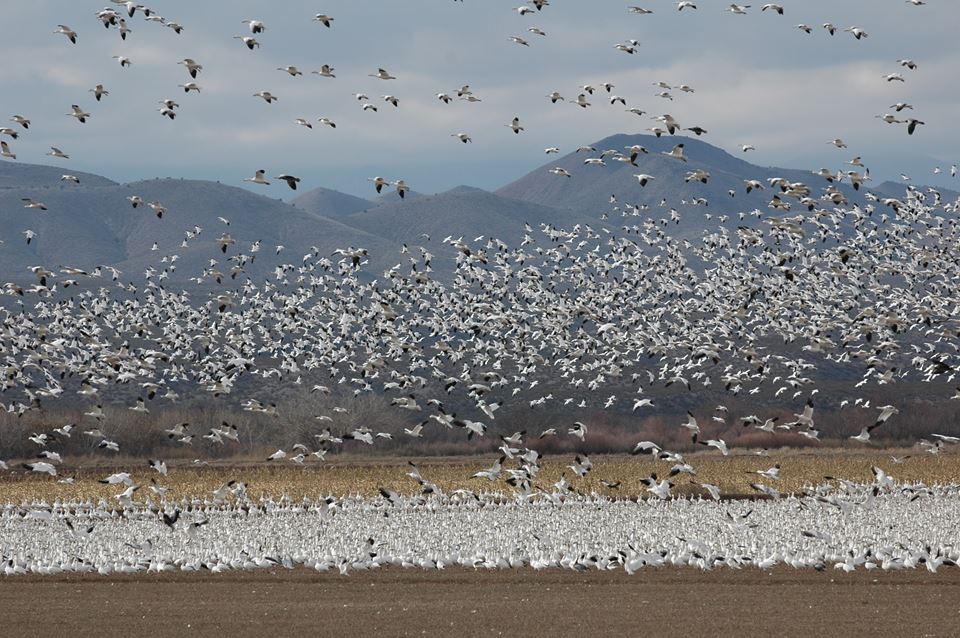
Photo: Snow geese by Jim Robertson

of fringe, anti-government fanatics. But what’s happening there is a logical extension of the anti-federal government, anti-public land movement that’s been growing for years in the West and, more recently, in Congress. The tactics may differ but the underlying notion is the same: dismantling our public lands—places like national forests — in favor of a system that prizes profits over conservation.

For several years, there’s been a concerted effort in Congress — which has gained some steam with Rep. Rob Bishop, R-Utah, at the helm of the House Natural Resources Committee — to hand federal land over to the states. The inevitable result, would be opening up these lands for more logging, mining, grazing, fossil fuel development and anything else that cuts a profit for a few (and ignores the natural value for many).

While people like Bishop and several Republican presidential candidates have rightly condemned the dangerous tactics of those in the Oregon standoff, they can’t distance themselves from the movement that’s been pushing to “give back” or “transfer” federal lands to the states.

Their very concept is premised on a serious flaw. America’s federal public lands — our national forests, national parks and the Bureau of Land Management’s grasslands, sagebrush steppe and deserts — never belonged to the states to begin with. When Western states entered into the compact of statehood with the United States, in exchange for receiving a very large amount of federal public land among other stipulations, they agreed to forever disclaim all right and title to those federal public lands.

As to transferring federal public lands to Western states, that would be tantamount to U.S. taxpayers handing over $1 trillion worth of land and assets. Assuming a conservative value of $1,500 per acre, multiply that by the total federal public lands of 674 million acres = $1.0 trillion at fair market value. Importantly, that figure doesn’t begin to account for the incalculable value of watersheds and clean water (our national forests produce half of the water in the West), wildlife habitat, carbon stored in soils, plants and trees, flood control, and recreation and tourism revenue.

Make no mistake, if our federal public lands were given to the states the intent is to privatize and sell to the highest bidder America’s natural legacy. Marco Rubio, Ted Cruz and Rand Paul, as well as the likes of Bishop and others, intend to turn these irreplaceable lands over to those who view them only as sources of profit for mining, logging, grazing and burning fossil fuels.

The states would have to privatize these lands, not only because they want the money, but also because they can’t afford to manage them. The fact is the federal government provides very large subsidies to the livestock industry, timber, mining and fossil fuels. The very reason that the national forests came into being was to protect lands and watersheds from robber barons who were stripping the West of its natural resources. The very reason we have laws today that govern federal public lands was to turn the tide against extractive industries and their rapacious appetite for oil, gas, minerals, grass and timber while laying waste our forests, rivers deserts, grasslands and tundra.

The recently occupied Malheur National Wildlife Refuge in Oregon, for example, is a critically important area for many unique species of birds that frequent the Pacific Flyway. Some 47 million birdwatchers in this country spend $40 billion a year. Those at the center of the controversy in Oregon, including the Bundy and Hammond families, have used public lands to graze their livestock. Nationally, public lands grazing generated $125 million less than what the federal government spent on the program in 2014, according to a report by natural resource economists commissioned by the Center for Biological Diversity. Federal grazing fees are 93 percent less than fees charged for non-irrigated Western private grazing, or just $1.69 per animal per month for each cow and calf that grazes the public land (it costs more to feed a house cat).

We all own these public lands and we should all have a say in how they’re managed. What’s happening in Oregon is deplorable — armed seizure of a federal building to bully the government and threaten violence — but there’s a larger movement here in D.C. that, for the future of our public lands, is deeply troubling as well. Once you privatize our irreplaceable natural heritage, there’s no going back.

I have a lot in common with the Bundys. Here’s what I’d like to say to them.

http://www.hcn.org/articles/im-not-so-different-from-the-bundys-heres-what-id-like-to-say-to-them

Like the Bundy brothers now illegally occupying the Malheur National Wildlife Refuge near Burns, Oregon, I’m a lifelong rural Westerner, and I believe that if I were to talk with them, we’d most likely find we have a lot in common.

There’s the way our lives were shaped by the land, for instance. I was born in Nevada, and I grew up and now live in southwestern Idaho. Though my family worked as carpenters, we lived on small farms where we raised cows and grew hay for the winter. Like the Bundys and many of their allies, I come from hard working, blue-collar folks.

From them I learned to love the land, especially the Northwestern high desert. I’ve hunted the uplands of eastern Oregon from Juntura to Rome, and from Leslie Gulch to the Imnaha. Much of that country is open range where cattle graze. Thanks to ranchers, I’ve watered my bird dogs at troughs where ranchers had enhanced a spring, benefitting both cattle and wildlife.

A group of mule deer bucks moves across Malheur National Wildlife Refuge in Oregon. There is no big game hunting on the refuge, so deer abound.

I imagine that if the Bundys and I sat down over coffee, we’d start trading stories about our early years. Pretty quickly, though, our differences would emerge. They’d insist that taking over a wildlife refuge is speaking for “the people” – Westerners frustrated by the federal government. I couldn’t let that stand.

Want to read more of our coverage of the standoff and what led to it? Find it here.

I’d respond by saying: That wildlife refuge you’re occupying belongs to me and to 320 million other Americans. You are trespassing, taking advantage of the hospitality and tolerance of the rest of the American people. You are abusing the rights you so readily invoke by occupying the refuge indefinitely. I would remind you that you are free to stay a maximum of 14 days, because that is the camping limit in most places, and it was put in place so that everyone can share the land.

If they let me continue, I’d suggest they go home and read Civil Disobedience by Henry David Thoreau and perhaps brush up on their history about Rosa Parks, Martin Luther King Jr. and the civil rights movement. Parks didn’t wave guns around and threaten to kill people on the bus.

Then I’d say: “You are carrying firearms and threatening to commit violence if you don’t get your way. You say you want this to be a peaceful protest, but in the same breath you warn that you will fight and die for your cause.  You bluster, trying to provoke a response, all the while using the media to protect you and further your cause.

“You are abusing your rights as an American. There are legal ways to change systems if you feel that they aren’t working. I have heard nothing from you about your responsibilities, only demands about what you want, though ultimately, what you want is to control a resource that belongs to me and to every other American. Public lands are our birthright, and you have no right to commandeer them for your own purposes.

“Frankly, I don’t want my land – which includes all the federal land in the West – turned over to people who behave like you. I want to be free to hunt, fish, hike, ride my horse, my mountain bike or all-terrain vehicle, to picnic, camp, and to bird watch on the nation’s vast tracts of federal ground, and I don’t want to have to ask for your permission to do so.

“Your protest is nothing more than an elaborate tantrum conducted with firearms. If you actually won claim to any public lands, I think you’d intimidate and bully others the way you and your followers did in Nevada, and the way you are doing now. Furthermore, your family owes me and 320 million of my fellow Americans more than a million dollars in back grazing fees for using public land without paying your fair share.

“When I cut firewood on nearby Forest Service land, I purchase my 10-cord, personal use permit. I pay my camping fees. I buy my hunting license. I pay to park and use ramps on wild rivers where I kayak. I pay fees because they are used to improve recreation opportunities for everyone.

So I want you to go home and start paying me and your fellow citizens what you owe us. That’s what good citizens and neighbors do. Thanks for the conversation.”

Malheur Occupiers under siege from PETA

https://www.washingtonpost.com/news/post-nation/wp/2016/01/06/go-vegan-and-go-home-occupiers-under-siege-from-peta-native-tribe/

On Tuesday, Bundy said some folks brought them soup and a sympathetic rancher stocked a freezer full of meat for the group holing up at the refuge. And the People for the Ethical Treatment of Animals (PETA) delivered vegan jerky to the militants on Wednesday.

The snacks came along with signs that read, “The End of Animal-Based Ag Is Nigh: GET OUT NOW!”

The occupiers gladly accepted the vegan fare, which is made of soy, seitan and shiitake mushrooms and packs a bigger protein punch than beef. At least one self-described hardcore carnivore occupying the refuge promptly announced his love for the meatless treats, a PETA spokesperson said.

“He tried the hickory smoked primal strip,” said PETA spokesperson Lindsay Rajt. “He said it tasted like salmon and he loved it.”

Showdown in the Malheur Marshes: the Origins of Rancher Terrorism in Burns, Oregon

http://www.counterpunch.org/2016/01/05/showdown-in-the-malheur-marshes-the-origins-of-the-armed-occupation-in-burns-oregon/

Malheur-Oregon-standoff-1

During the spring of 1995, shortly after the bombing of the Murrah Federal Building in Oklahoma City, James Ridgeway and I spent a couple of weeks traveling across the West for a series of stories in the Village Voice that chronicled  the rise of militant new rightwing movements of militias, white supremacists, Christian Identity sects and anti-government groups, including a profile of central Oregon rancher Dwight Hammond, now at the center of the armed seizure of the Malheur National Wildlife Refuge headquarters near Burns.

In the early 1990s, Hammond repeatedly transgressed federal environmental laws, trespassed on federal lands and hurled death threats at federal wildlife officials. Little action was taken against Hammond by a timid Clinton administration. Emboldened, Hammond and some of his fellow ranchers continued over the next two decades to flagrantly flout environmental laws and harass federal officials. These activities finally culminated in an act of poaching on Steens Mountain and two arson fires. Hammond and his son were convicted in federal court and sentenced to five years in prison. That conviction sparked the armed takeover of federal buildings now unfolding in Burns. Here is our report from 1995. — JSC

In the high desert of central Oregon, lies Harney County, a site of a long-festering and intense confrontation between federal officials and the militant property rights movement. Here federal Fish and Wildlife Service agents sought to fence off a wetland that had been trampled by a rancher’s cows on the Malheur National Wildlife Refuge about thirty miles south of the dust-caked town of Burns.

In an affidavit, Earl M. Kisler, a Fish and Wildlife Service enforcement officer, said that rancher Dwight Hammond had repeatedly threatened refuge officials with violence over an eight year period. On one occasion Hammond told the manager of the federal refuge that “he was going to tear his head off and shit down his neck.”

According to the affidavit, Hammond threated to kill refuge manager Forrest Cameron and assistant manager Dan Walsworth and claimed he was ready to die over a fence line that the refuge wanted to construct to keep his cows out of a marsh and wetland.

The tensions between the Hammond family and the government started when the refuge, which was established as a haven for migrating birds, refused to renew a grazing permit for Hammond’s cattle operation. Then came the incident over the wetland, which Hammond had been using as a water hole for his cows.

On August 3, 1994, a Fish and Wildlife Service crew turned up to complete the task of fencing off the marsh. They found the fence destroyed and a monkey-wrenched earthmover parked in the middle of the marsh. While the feds were waiting on a towing service to remove the Cat, Hammond’s son Steve showed up and began calling the government men “worthless cocksuckers” and “assholes.” Hammond then arrived at the scene, according to the government’s documents, and tried to disrupt the removal of the equipment. The rancher was arrested.

Susan Hammond said nine federal agents, five of them armed, took her husband into custody. “There five guns there, at least five guns there, and not one of them belonged to us,” she said. “We have been sitting and stewing and trying to figure something out. Trying to find out how something like this could happen in America.”

After Hammond’s arrest, Chuck Cushman of the American Land Rights Association, and a key organizer for the property rights movement in the West, said he helped stage a demonstration in Hammond’s defense in Burns. Refuge manager Cameron’s daughter attended the meeting. “She got up at our meeting,” Cushman told me. “She said she was tired of people vilifying her father. And I thought it was just wonderful. I got up and applauded her. She had the guts to do it. Too bad he didn’t have the guts to do the same thing.”

It was after that fateful gathering, while Cameron himself was 300 miles away in Portland completing the paperwork on Hammond’s arrest, that his family began receiving more threats, including one call threatening to wrap the Camerons’ 12-year-old boy in a shroud of barbed wire and stuff him down a well. Other callers warned Mrs. Cameron that if she couldn’t get along in the cow town, she ought to move out before something “bad” happened to her family. The families of three other refuge employees also received telephone threats after the meeting. Terrified, Mrs. Cameron packed up her four children, one of them confined to a wheelchair, and fled to Bend, more than 100 miles to the west.

Cushman later acknowledged that he may have “unintentionally” been a cause of these threats. Angered at the way the feds had arrested Hammond, the property rights organizer told me: “I went to the phone book and I picked out the names of all these guys and I wrote their phone numbers down. And I printed a sheet which I handed out to all the ranchers.  ‘Here are the names of the guys who went on that property. What I want you to do is everywhere these guys go in the community, when they go to the grocery store, when they go to the barbershop, look ‘em right in the eye and tell them: You’re not being a good neighbor. You’re not being friendly.’”

But, Cushman claimed, he also told Hammond’s supporters: “Do not harass these people. I said it right at the meeting and I said it in the document. If Cameron’s right, some people used that document and phoned them and made threats. I am very sorry that happened.”

Cushman nevertheless remained committed to keeping the pressure on federal wildlife agents. “I will make them responsible. Their names—no matter where they go or where they work—those people will know when they get there who they have to deal with. They will be a pariah for the rest of their lives. So the next time they will go to the county sheriff if they want to arrest a man and not the federal cops. They will take him to a local jail. They will not put the man in leg irons. They won’t treat them like vicious criminals.”

A year passed since Hammond’s arrest. The rancher  and his son both denied the government’s charges. No trial had taken place. In fact, after some rather questionable contacts between former Oregon congressman Bob Smith (a Republican) and the Clinton Justice Department, the government inexplicably reduced its original felony charges to misdemeanors.

“This whole thing has gone on longer than the O.J. trial,” Cameron told me. “But this case won’t resolve anything. There’s something deeper going on here, associated with the county movement. Until that’s resolved our position is going to remain pretty much the same.”

While the case was pending, Cameron and the other three employees at the wildlife refuge continued to be on the receiving end of threats from local ranchers and their allies. Shops in Burns began displaying signs warning, “This establishment doesn’t serve federal employees.” Two Harney County commissioners were recalled by voters angry that the county didn’t intervene against the wildlife refuge managers on behalf of the Hammonds and because the commissioners didn’t put the county supremacy ordinance up for a vote.

“We had an equally strange situation on the west side of the refuge,” said refuge manager Forest Cameron. “It was a place where cows would wander down off of BLM lands and onto the road at night. We’d had quite a few cow and car collisions. So we decided to put up a fence. You can’t just let cows lie down to sleep in the middle of a public highway in the middle of the night. That’s got to change. And there was fierce resistance to it, even though we worked closely with a lot of the local ranchers, relocated their corrals and the like. So we put up five miles of fence and then one night somebody hotwired one of the BLM backhoes and knocked down every foot of fence, tore up every fence post and demolished the backhoe. The point is that the harassment and intimidation continues in an open and confrontational way. In fact, it is branching out. Many of us feel that the legal process hasn’t moved swiftly or aggressively enough. We’ve been hanging in a kind of limbo. Maybe things will eventually work out. But right now all of us live in a state of anxiety. And you really worry about your kids.”

As for being a federal wildlife official in the West these days, Cameron chuckled darkly and said, “Well, it’s about learning to keep your head down.”

A version of this article originally appeared in the Village Voice.

Jeffrey St. Clair is editor of CounterPunch and author of Born Under a Bad Sky. James Ridgeway is a journalist living in Washington, DC.

Oregon Rancher ‘Heroes’ Accused of Child Abuse

http://www.thedailybeast.com/articles/2016/01/05/oregon-rancher-heroes-accused-of-child-abuse.html

Steven and Dwight Hammond, the inspiration for the ‘militia’ occupying an Oregon federal building, allegedly took sandpaper to their nephew’s chest.
A photo of a teenage boy with two bizarre wounds on his chest suggests that child abuser might be a better description than hero for the two ranchers in whose name so-called militia members have taken over a federal building in Oregon.

“Raising kids is like raising cows or dogs,” one of the ranchers is quoted as saying in a police report to which the photo is attached.

The photo is of Dusty Hammond, nephew of rancher Steve Hammond and grandson of rancher Dwight Hammond.

More: http://www.thedailybeast.com/articles/2016/01/05/oregon-rancher-heroes-accused-of-child-abuse.html

Malheur National Wildlife Refuge is for the birds

12196349_10153256579521188_5652107754797511661_n

“Malheur’s for the birds”

That’s the slogan that read across a T-shirt I wore back in the late ’70s, when I worked there for the summer in the maintenance department for the Malheur Field Station. A branch of Oregon’s Pacific University, the “Field Station” was where they held month-long courses in botany and ornithology.

I also took their anthropology/wilderness survival course, called, “Aboriginal Life Skills of the Northern Great Basin.” There, we learned how the Paiutes lived off the land, hundreds of years before ranchers claimed it for themselves and their ubiquitous cows. Their armed takeover of the Malheur National Wildlife Refuge headquarters building is apparently part of an effort to re-assert their “constitutional rights.”

As an avid birdwatcher, I know the refuge and its headquarters well. Possibly second only to Yellowstone National Park for biodiversity, wildlife can be found throughout the refuge. The Wildlife Department headquarters office is practically a required stop for die-hard birders, due to the oasis-like edge effect the treed property has in the midst of an otherwise contiguous sagebrush habitat.

Say’s the Portland Audubon Society of the unique national refuge:

This area is one of the premiere sites for birds and birding in the U.S. The refuge consists of over 187,000 acres of habitat which include wetlands, riparian areas, meadows, and uplands.

 Location: In the center of the southeast quarter of the state, 30 miles south of Burns in central Harney County.

Description: This area is one of the premiere sites for birds and birding in the U.S. The refuge consists of over 187,000 acres of habitat which include wetlands, riparian areas, meadows, and uplands. Refuge lands are configured in roughly a “T” shape, 39 miles wide and 40 miles long.

Ornithological Highlights: Malheur’s varied habitats, abundant resources, and location on the Pacific Flyway are utilized by a variety of migratory and resident birds. Over 320 species of birds have been observed at Malheur, including numerous watch-listed species such as Western Snowy Plover, Long-billed Curlew, Franklin’s Gull, Short-eared Owl, Greater Sage-Grouse, Bobolink, Trumpeter Swan, and Brewer’s Sparrow.

The refuge’s riparian habitat supports the highest known densities of Willow Flycatcher, up to 20% of the world’s population of White-faced Ibis, and significant breeding populations of American White Pelican and Greater Sandhill Crane. Breeding populations on the refuge also include a variety of gulls and terns and hundreds of pairs of various duck species. The first Oregon breeding record of Cattle Egret came from Malheur Lake in the mid-1980s. Black-crowned Night-Heron pairs nesting on the refuge generally number in the hundreds.

During migration, the Refuge regularly supports hundreds of thousands of waterfowl and tens of thousands of shorebirds, including a significant proportion of the total populations of several species. Malheur Refuge is also a winter concentration point for raptors of many species.

Thousands of birders come to the refuge annually to take part in the spectacle, whether they come for the waterfowl, songbirds, or both. Due to the high birder coverage and concentrated bird habitat Malheur Headquarters may have the highest all-time bird list of any single location in Oregon.

For more information on Malheur, please see the Technical Site Report in the National IBA database.

Links:

Yes, contrary to the cow-pushers who are now trying to take it over again, this time from the rest of the US citizens, Malheur’s for the birds…and for us bird watchers too.