Exposing the Big Game

Forget Hunters' Feeble Rationalizations and Trust Your Gut Feelings: Making Sport of Killing Is Not Healthy Human Behavior

Exposing the Big Game

Ocean warming puts fish, orcas in peril

http://www.dailyastorian.com/Local_News/20150910/salmon-nightmare-ahead-pending-ocean-warming-puts-fish-orcas-in-peril?utm_source=Daily+Astorian+Updates&utm_campaign=f6f6c5539f-TEMPLATE_Daily_Astorian_Newsletter_Update&utm_medium=email&utm_term=0_e787c9ed3c-f6f6c5539f-109860249
It’s too early to say for certain, but this year’s warm weather could have a big impact on future salmon runs as well as the animals that rely on the fish for food.
LONG BEACH, Wash. — Oregon and Washington will experience two big El Niño-like events in combination this year, scientists and fishery managers say. This has never happened before and the events could have major impacts on commercial and recreational fisheries — and ocean species from salmon to orcas — for years to come.

One of these events is a true El Niño — a big one — and brings with it the likelihood of less precipitation and warmer temperatures in the Pacific Northwest.

The other event, the “Blob,” is a warm expanse of water that has persisted off the West Coast for more than a year and only resembles El Niño.

It is an anomaly, a mystery. Formed by a completely different set of circumstances, it has brought about similar results as an El Niño. Scientists believe it could be one reason why Washington has experienced such unusually mild weather since spring 2014. It has certainly warmed the water off the West Coast, driving various ocean species farther north in search of cold water and drawing tropical species to the area.

So there is what everyone knows: The ocean is unusually warm right now and has been for the last two years. When El Niño arrives in full force, the ocean will likely continue to be warm. And warm water is never good for salmon.

Then there are the questions no one can answer yet.

Oregon and Washington are already beginning to see the effects of this big El Niño cycle, though the event itself has yet to arrive in full here in the North Pacific. When the Blob and El Niño meet — as scientists believe they will — what will happen?

And, after this year’s drought, record-breaking heat, massive toxic algal blooms off the West Coast and no snowpack in the mountains, what will life in the ocean look like next year?

Bill Peterson, an oceanographer with National Oceanic and Atmospheric Administration Fisheries, has a guess: “It’s going to be a nightmare, is what I suspect we’re going to see. … It’s kind of beyond our experience and all we can say is it’s not going to be good.”

Delicate chains

Heat up the ocean and many West Coast species begin struggling almost immediately.

Coho salmon, for example, have been “acting strange” this year, said Doug Milward, ocean salmon fishery manager for the Washington Department of Fish and Wildlife. He and others believe the fish are staying out in deeper water, waiting until the very last minute to enter Washington’s river systems where they will spawn. They are waiting for cooler water.

Sockeye, among the first salmon to run from the ocean to rivers and streams, were in trouble early on this season.

In July, more than a quarter million sockeye, approximately half of the 500,000 sockeye expected to return from the ocean, were dead or dying in the Columbia River and its tributaries due to warm water temperatures.

Meanwhile, salmon that were ocean-bound this spring and the ones that will head out next spring will face unknown conditions when they return several years later, but biologists say they are going into conditions that do not favor their survival; warm temperatures mean the salmon’s regular food sources may not be thriving either. The fish leaving next spring, reared in these conditions, may be even worse off. As for fish laid as tiny eggs in stream and river beds this year — no one knows.

Young salmon were certainly in trouble this summer, though. The warm temperatures led to outbreaks of bacterial diseases in hatcheries, killing off hundreds of thousands of young fish in Washington, Oregon and California.

Trouble for orcas?

Beyond salmon, biologists worry what this all could mean for the ocean species that rely on these fish for food.

Orcas often visit the communities near the Columbia River, but this year it seemed like people were spotting them constantly — NOAA wildlife biologist Brad Hanson says the number of sightings are probably not much higher than any other year; people are just paying more attention.

But, he added, salmon are an important part of an orca’s diet, likely one big reason why orcas flock to the region.

“With this year, with the drought occurring coastwide, it certainly is going to have an impact down the road. If not in the next couple of years, certainly in three or four years,” said Hanson, who was the chief scientist for a NOAA killer whale research cruise this spring. “… We are going to enter a period here in the not too distant future where we’re going to have reduced (salmon) run sizes. So the question is: How will the whales respond?”

Orcas must eat continuously. They can’t starve for extended periods of times the way other ocean mammals can, such as gray whales, living off fat reserves.

Orcas eat many kinds of fish, so Hanson and other biologists believe the large mammals could travel elsewhere for food. As the salmon change where and when they travel, the orcas might follow.

Still, Hanson added, if orcas are eating fish other than salmon, as the data suggests, how abundant is this other prey?

“It’s going to be critical for us to monitor that as best we can in the coming years,” he said.

Inland troubles

In the meantime, salmon fishing has been strong this summer. The Buoy 10 sport fishery near the mouth of the Columbia River ended with record catch rates, surpassing last year’s total catch within the opening weeks. Commercial fishing on the ocean has been brisk and conditions near shore have been normal, or as normal as the ocean, a shifting, swirling black box, ever is.

“When I look at this, I don’t see the warning signs I saw in the ’90s,” Milward said.

In the early ’90s, it was quickly becoming obvious that they were fishing on a very small pool of fish and that there were issues in the wide world beyond: climate shifts and damaged freshwater habitat.

“It’s been a wonderful fishing year in the ocean where I manage,” Milward said.

But it is in the areas beyond his management where he begins to worry.

From a human point of view, communities in Oregon and Washington had a beautiful spring and summer, the best longtime locals can remember.

For many, though, the summer’s beauty was marred by massive wildfires and drought. And with no snowpack to fuel streams and rivers in Washington and little rain, streams and rivers are running at an all time low. In June, the Washington Department of Ecology reported that the state’s snowpack was at zero percent of normal. Though there was still snow at higher elevations and in the glaciers, rivers and streams did not receive the boost they’d normally get from melting snow high in the mountains.

State and tribal fishery managers went into the summer worried about the effects of low-flow conditions on salmon-bearing streams and rivers in the Columbia Basin, conditions that can hamper fish passage and lead to high water temperatures (adding another stress on fish already stressed from their migration inland from the ocean). High temperatures and low flow can lead to less oxygen and put salmon more at risk of bacterial or fungal infection.

“I mean, those fish in the ocean now have no idea that we had no snowpack in the winter and no rain in the summer,” Milward said. The salmon are headed toward areas where “their native stream looks more like a creek than river.”

Red light, green light

Each year, Peterson and other NOAA scientists gather information that informs how fisheries will be run in the next season. They look at more than a dozen different indicators of ocean and fish health. They look at what is in the water, and they note what is missing. For each indicator, they put a red light or a green light next to it. Just like with traffic signals, green light means go. In the 1998 El Niño, all the indicators were red: Stop! In 2008, everything was green. In years where there’s a mix of red and green, it means, Peterson said, “basically we don’t know what’s going on (in the ocean).”

This year, he and state and federal fishery managers are ready for everything to come back red.

“I’m guessing redder than anything we’ve seen before,” Peterson said.

But the ocean is vast, he added, and scientists’ predications have been wrong before. “This could be an environmental disaster, or a blip on the screen that we forget in a couple of years.”

This year, sockeye — the salmon that had half of its total run wiped out by warm water when returning to the Columbia River and its tributaries — found other places to spawn. They ran up streams they’d never used before, streams where the water was still cold, where their young might survive.

To Peterson, salmon are a metaphor for resiliency.

“If you think about what they’ve put up with for the last 50 years and we still have them,” he said. “… They will find a way.”

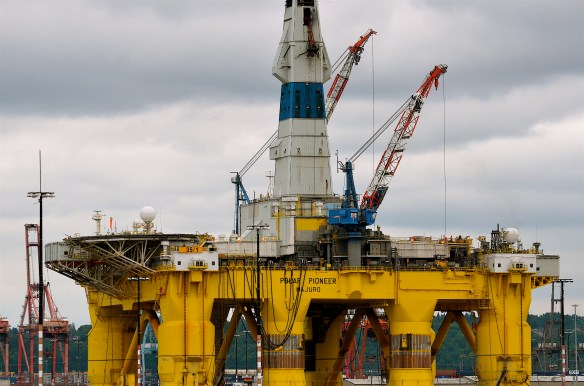
700 Walrus Seen Near Shell Oil Rigs in Arctic as Obama Visits Alaska

 August 31, 2015 10:39 am 

James MacCracken, supervisory wildlife biologist, U.S. Fish and Wildlife Service said in an Aug. 28 press conference call, “We are getting reports from Shell daily” of walrus near the ships and rigs and the talley so far is “700 walrus” seen by observers. When asked if all operations around the walrus by Shell are within the guidelines set by Interior Department regulation, MacCracken said, “Yes.” This is the first confirmation that protected sea mammals are swimming through the Burger oil leases which Shell just got permission to deep drill. Observers, paid by Shell, are required by Shell’s permit to perform drilling and other activities which might disturb or injure sea mammals. More information to come on this.

First aerial views of thousands of Pacific walrus hauling out Aug. 23 on Alaska Arctic shore.  Photo credit: Gary Braasch / World View of Global Warming
First aerial views of thousands of Pacific walrus hauling out Aug. 23 on Alaska Arctic shore. Small detail of telephoto image of 2015 haul out. Photo credit: Gary Braasch / World View of Global Warming

The press conference was also the first direct acknowledgement by the U.S. agencies in charge of studying and protecting the mammals that a new haul out had begun—nearly a week after the event actually started and only three days before President Obama begins his tour of Alaska focusing on rapid climate change. Gary Braasch made the first photos of the haul out at about 7 p.m. on Aug. 23, after seeing on USGS maps of locations of geotagged walrus that several were stationary in the Point Lay area.

Thousands of Pacific walrus coming ashore in northwest Alaska as sea ice melts recedes from habitat. Photo credit: Gary Braasch / World View of Global Warming

Toxic Algal Bloom Causes Another Sea Lion Crisis

Latest News
Sea Lion

California sea lions are having a tough year. As you know, starving sea lion pups were stranding along the California coast in record numbers earlier this year. Now, sea lions are facing another crisis: a dangerous neurotoxin called domoic acid.

Researchers say the massive algal bloom producing this toxin is the biggest and most toxic they’ve ever seen, extending from southern California all the way up to Alaska. And it’s leaving sick sea lions in its wake. About three-quarters of our current sea lion patients are suffering from the effects of this toxin, including lethargy, disorientation and seizures.

Since discovering this condition in sea lions in 1998, our researchers have learned a lot about domoic acid toxicity and how to treat it effectively. Thanks to support from people like you, we’ve been able to successfully release hundreds of healthy patients over the years that had stranded due to this toxin.

Toxic Algal Bloom Causes Another Sea Lion Crisis
Sea Lion

California sea lions are having a tough year. As you know, starving sea lion pups were stranding along the California coast in record numbers earlier this year. Now, sea lions are facing another crisis: a dangerous neurotoxin called domoic acid.

Researchers say the massive algal bloom producing this toxin is the biggest and most toxic they’ve ever seen, extending from southern California all the way up to Alaska. And it’s leaving sick sea lions in its wake. About three-quarters of our current sea lion patients are suffering from the effects of this toxin, including lethargy, disorientation and seizures.

Since discovering this condition in sea lions in 1998, our researchers have learned a lot about domoic acid toxicity and how to treat it effectively. Thanks to support from people like you, we’ve been able to successfully release hundreds of healthy patients over the years that had stranded due to this toxin.

Japanese town’s controversial dolphin hunt begins

SeaWorld says it won’t take beluga whales captured in Russia
http://www.orlandosentinel.com/business/os-seaworld-georgia-aquarium-belugas-20150903-story.html

Japanese town’s controversial dolphin hunt begins
http://news.yahoo.com/japanese-towns-annual-dolphin-hunt-begins-104914360.html
“In the annual hunt, people from the southwestern town corral hundreds
of dolphins into a secluded bay and butcher them, turning the water
crimson red. The scene was featured in “The Cove” documentary, drawing
unwanted attention to the little coastal community.”

11214207_829677830435133_118593585578390559_n

Stop Seismic Blasting

Seismic blasting is one of the loudest man-made noises in the ocean. The explosive blasts threaten the lives of dolphins and other marine mammals, by preventing them from finding their babies, mates, or even just food. Join us in telling President Obama to oppose seismic blasting in the Atlantic.

Add your name to oppose harmful seismic blasting off the East Coast before dolphins and whales pay the price.
oceana.org

Foundation removes 5,667 lost fishing nets from Puget Sound

http://www.komonews.com/news/local/Foundation-removes-5667-lost-fishing-nets-from-Puget-Sound-321765361.html

MOUNT VERNON, Wash. (AP) – The Northwest Straits Foundation has reached a milestone in its efforts to remove lost fishing nets from Puget Sound.

The foundation reported this week that it has retrieved 5,667 of the so-called “killer nets.”

About 260 species of marine animals were found in the nets, including 65 mammals, 1,092 birds and 5,659 fish. Many died while trapped in the nets, including porpoises, seals, otters, diving birds, sharks, salmon, crab and octopuses, the Skagit Valley Herald reports.

Foundation director Joan Drinkwin says between the time the program was launched in 2002 and the work was completed June 30, net removal restored 812 acres of marine habitat.

The organization is working with the fishing industry to prevent nets from becoming derelict. The organization also hopes to eventually recover lost fishing gear from deeper water.

Don’t Allow Whales to be Slaughtered off the Washington Coast!

Don't Allow Whales to be Slaughtered off the Washington Coast!

The National Marine Fisheries Service (NMFS) is considering an appalling plan to allow gray whales to be slaughtered off the Washington coast. Allowing a hunt would set a dangerous precedent that undermines the global moratorium on whaling.

Please submit your public comment opposing the hunting of gray whales off the coast of Washington.The risks of a hunt are significant. Proponents suggest that “only a few” whales will be killed for subsistence and cultural reasons. But even one whale is too many, regardless of who hunts them. Scientific evidence makes it clear these magnificent, sentient creatures are under grave threats from far too many sources.

The threats to gray whales are vast — from navy sonar and other underwater noise, to climate change, ocean acidification, ship strikes and pollution. The impact of this hunt on delicate gray whale populations has the potential to be huge. Not to mention, there are only a few individuals left in some populations, and there is a virtual certainty that whales from these populations will be killed because it’s nearly impossible to tell the difference between them during a hunt.

Please sign the petition today to submit your public comment to NFMS opposing the hunting of gray whales off the coast of Washington.

PETITION CLOSED

This petition is now closed. You can still make a difference in the Care2 community by signing other petitions today.

BROWSE PETITIONS ▸

Don’t Allow Whales to be Slaughtered off the

25,053

30,000

we’ve got 25,053 signatures, help us get to 30,000 by July 31, 2015

The National Marine Fisheries Service (NMFS) is inappropriately considering allowing gray whales to be slaughtered off the coast of Washington. Pierced with harpoons and riddled with numerous bullets, these magnificent creatures will suffer extreme pain if NMFS permits the hunt.

The hunt threatens not only a recovering population of Eastern North Pacific gray whales, but the few remaining individuals left in the endangered Western North Pacific and also the Pacific Coast Feeding Group populations. There is a very strong chance that whales within these smaller groups will be killed because it is virtually impossible to tell the difference between the populations, particularly given that hunts are often chaotic and conducted in tumultuous ocean conditions.

There is far too much scientific uncertainty about the impact a hunt would have on gray whales and the environment. Additionally, NMFS is not adequately considering the cumulative impacts of all the other threats to gray whales – such as navy sonar and other underwater noise, climate change, ocean acidification, oil and gas development, ship strikes and pollution.

The proposed hunt in Washington is just the first step toward a dangerous precedent that would undermine the global moratorium on whaling. Whale watching is a meaningful and economically lucrative alternative that helps maintain the gray whale’s iconic role in numerous cultures.

Gray whales have been known to migrate up to 22,000 kilometers, nearly 14,000 miles, crossing the jurisdictions of multiple countries. So this is an issue of international concern.

Please sign this petition to submit your official public comment opposing the hunt of gray whales and requesting that NMFS deny any permits to hunt gray whales in Pacific Coast waters.  less

The National Marine Fisheries Service (NMFS) is inappropriately considering allowing gray whales to be slaughtered off the coast of Washington. Pierced with harpoons and riddled with numerous bullets, these magnificent creatures will suffer extreme pain if NMFS permits the hunt.

The hunt threatens not only a recovering population of Eastern North Pacific gray whales, but the few remaining individuals left in the endangered Western North Pacific and also the Pacific Coast Feeding Group populations. There is a very strong chance that whales within these smaller groups will be killed because it is virtually impossible to tell the difference between the populations, particularly given that hunts are often chaotic and conducted in tumultuous ocean conditions.

There is far too much scientific uncertainty about the impact a hunt would have on gray whales and the environment. Additionally, NMFS is not adequately considering the cumulative impacts of all the other threats to gray whales – such as navy sonar and other underwater noise, climate change, ocean acidification, oil and gas development, ship strikes and pollution.

The proposed hunt in Washington is just the first step toward a dangerous precedent that would undermine the global moratorium on whaling. Whale watching is a meaningful and economically lucrative alternative that helps maintain the gray whale’s iconic role in numerous cultures.

Gray whales have been known to migrate up to 22,000 kilometers, nearly 14,000 mil… more

Humpback whale rescued after CRAB fishing gear entanglement

Crab pots, which require long vertical ropes through the water column, are a frequent source of entanglements. Fishermen and scientists are working together to minimize the risk to marine mammals.

Humpback whale rescued on high seas after reported entanglement

Members of the Whale Entanglement Team tracked this juvenile humpback up and down the Central Coast in an effort to free it from fishing gear. After four days, their efforts paid off when the whale swam free near the Gulf of the Farallones. (Photo courtesy Whale Entanglement Team, operating under MMHSRP Permit 18786)

Moss Landing >> A four-day odyssey to free a juvenile humpback entangled in fishing gear had a happy ending Monday when the whale finally swam free in the Gulf of the Farallones.

First spotted near Moss Landing, the whale was pursued by the Moss Landing-based Whale Entanglement Team with help from federal marine authorities. A crab pot line attached to gear later traced to Oregon had deformed the whale’s upper jaw and immobilized a flipper.

Over four grueling days that often lasted late into the night, the team tracked the whale and eventually was able to cut the whale free of the line. Officials said the prognosis appears to be good.

“We feel that it’s a young whale and it should survive,” said Peggy Stap, executive director and founder of Marine Life Studies and part of the Whale Entanglement Team.

So far this year, 40 whales have been reported entangled in the North Pacific Ocean, with 15 of those in the Monterey Bay alone. Researchers are still looking for two whales reported locally as being entangled.

In all of 2014, there were just 10 reported entanglements in the Monterey Bay area.

Stap estimated the whale at 33 feet, and despite its encumbrances, led rescuers from Moss Landing south to Point Sur before heading north past Año Nuevo. Whale Entanglement Team lead responder Pieter Folkens said the whale had life-threatening injuries, and rescuers feared the whale would lose its flipper.

Moss Landing-based Sanctuary Cruises first reported the whale. Rescuers tracked it with radio telemetry, and were aided by the U.S. Coast Guard and the National Oceanic and Atmospheric Administration’s Monterey Bay National Marine Sanctuary, often not returning to harbor until near midnight.

“It was just insane,” a weary Stap said.

Crab pots, which require long vertical ropes through the water column, are a frequent source of entanglements. Fishermen and scientists are working together to minimize the risk to marine mammals.

How the US Navy Plans to War Game the Arctic

Destroying What Remains: An Animal Rights Article from All-Creatures.org

FROM

Dahr Jamail, Truthout.org / TomDispatch.com
June 2015

[NOTE from All-Creatures.org: PLEASE visit WAR OF THE WHALES for detailed, sad, horrifying information about the effects of sonar on sea animals!]

Now, a dozen years after I left my home state and landed in Baghdad to begin life as a journalist and nine years after definitively abandoning Alaska, I find myself back. I wish it was to climb another mountain, but this time, unfortunately, it’s because I seem increasingly incapable of escaping the long and destructive reach of the US military.

Here’s just one example of the kinds of damage that will occur: the cyanide discharge from a Navy torpedo is in the range of 140-150 parts per billion. The Environmental Protection Agency’s “allowable” limit on cyanide: one part per billion.

Given that the Navy has been making plans for “ice-free” operations in the Arctic since at least 2001, their June “Northern Edge” exercises may well prove to be just the opening salvo in the future northern climate wars, with whales, seals, and salmon being the first in the line of fire.

Species affected will include blue, fin, gray, humpback, minke, sei, sperm, and killer whales, the highly endangered North Pacific right whale (of which there are only approximately 30 left), as well as dolphins and sea lions.

I lived in Anchorage for 10 years and spent much of that time climbing in and on the spine of the state, the Alaska Range. Three times I stood atop the mountain the Athabaskans call Denali, “the great one.” During that decade, I mountaineered for more than half a year on that magnificent state’s highest peaks. It was there that I took in my own insignificance while living amid rock and ice, sleeping atop glaciers that creaked and moaned as they slowly ground their way toward lower elevations.

Alaska contains the largest coastal mountain range in the world and the highest peak in North America. It has more coastline than the entire contiguous 48 states combined and is big enough to hold the state of Texas two and a half times over. It has the largest population of bald eagles in the country. It has 430 kinds of birds along with the brown bear, the largest carnivorous land mammal in the world, and other species ranging from the pygmy shrew that weighs less than a penny to gray whales that come in at 45 tons. Species that are classified as “endangered” in other places are often found in abundance in Alaska.

Now, a dozen years after I left my home state and landed in Baghdad to begin life as a journalist and nine years after definitively abandoning Alaska, I find myself back. I wish it was to climb another mountain, but this time, unfortunately, it’s because I seem increasingly incapable of escaping the long and destructive reach of the US military.

That summer in 2003 when my life in Alaska ended was an unnerving one for me. It followed a winter and spring in which I found myself protesting the coming invasion of Iraq in the streets of Anchorage, then impotently watching the televised spectacle of the Bush administration’s “shock and awe” assault on that country as Baghdad burned and Iraqis were slaughtered. While on Denali that summer I listened to news of the beginnings of what would be an occupation from hell and, in my tent on a glacier at 17 thousand feet, wondered what in the world I could do.

In this way, in a cloud of angst, I traveled to Iraq as an independent news team of one and found myself reporting on atrocities that were evident to anyone not embedded with the US military, which was then laying waste to the country. My early reporting, some of it for TomDispatch, warned of body counts on a trajectory toward one million, rampant torture in the military’s detention facilities, and the toxic legacy it had left in the city of Fallujah thanks to the use of depleted uranium munitions and white phosphorous.

As I learned, the US military is an industrial-scale killing machine and also the single largest consumer of fossil fuels on the planet, which makes it a major source of the greenhouse gas carbon dioxide. As it happens, distant lands like Iraq sitting atop vast reservoirs of oil and natural gas are by no means its only playing fields.

Take the place where I now live, the Olympic Peninsula in Washington state. The US Navy already has plans to conduct electromagnetic warfare training in an area close to where I moved to once again seek solace in the mountains: Olympic National Forest and nearby Olympic National Park. And this June, it’s scheduling massive war games in the Gulf of Alaska, including live bombing runs that will mean the detonation of tens of thousands of pounds of toxic munitions, as well as the use of active sonar in the most pristine, economically valuable, and sustainable salmon fishery in the country (arguably in the world). And all of this is to happen right in the middle of fishing season.

This time, in other words, the bombs will be falling far closer to home. Whether it’s war-torn Iraq or “peaceful” Alaska, Sunnis and Shi’ites or salmon and whales, to me the omnipresent “footprint” of the US military feels inescapable.

sonar war arctic
All of Southeast Alaska’s pristine coastline would be impacted by the Navy’s upcoming planned war games in the Gulf of Alaska. (Photo: Dahr Jamail/Truthout)

The War Comes Home

In 2013, US Navy researchers predicted ice-free summer Arctic waters by 2016 and it looks as if that prediction might come true. Recently, the National Oceanic and Atmospheric Administration (NOAA) reported that there was less ice in the Arctic this winter than in any other winter of the satellite era. Given that the Navy has been making plans for “ice-free” operations in the Arctic since at least 2001, their June “Northern Edge” exercises may well prove to be just the opening salvo in the future northern climate wars, with whales, seals, and salmon being the first in the line of fire.

In April 2001, a Navy symposium entitled “Naval Operations in an Ice-Free Arctic” was mounted to begin to prepare the service for a climate-change-induced future. Fast forward to June 2015. In what the military refers to as Alaska’s “premier” joint training exercise, Alaskan Command aims to conduct “Northern Edge” over 8,429 nautical miles, which include critical habitat for all five wild Alaskan salmon species and 377 other species of marine life. The upcoming war games in the Gulf of Alaska will not be the first such exercises in the region — they have been conducted, on and off, for the last 30 years — but they will be the largest by far. In fact, a 360 percent rise in munitions use is expected, according to Emily Stolarcyk, the program manager for the Eyak Preservation Council (EPC).

The waters in the Gulf of Alaska are some of the most pristine in the world, rivaled only by those in the Antarctic, and among the purest and most nutrient-rich waters anywhere. Northern Edge will take place in an Alaskan “marine protected area,” as well as in a NOAA-designated “fisheries protected area.” These war games will also coincide with the key breeding and migratory periods of the marine life in the region as they make their way toward Prince William Sound, as well as further north into the Arctic.

Species affected will include blue, fin, gray, humpback, minke, sei, sperm, and killer whales, the highly endangered North Pacific right whale (of which there are only approximately 30 left), as well as dolphins and sea lions. No fewer than a dozen native tribes including the Eskimo, Eyak, Athabascan, Tlingit, Sun’aq, and Aleut rely on the area for subsistence living, not to speak of their cultural and spiritual identities.

The Navy is already permitted to use live ordnance including bombs, missiles, and torpedoes, along with active and passive sonar in “realistic” war gaming that is expected to involve the release of as much as 352,000 pounds of “expended materials” every year. (The Navy’s EIS lists numerous things as “expended materials,” including missiles, bombs, torpedoes.) At present, the Navy is well into the process of securing the necessary permits for the next five years and has even mentioned making plans for the next 20. Large numbers of warships and submarines are slated to move into the area and the potential pollution from this has worried Alaskans who live nearby.

“We are concerned about expended materials in addition to the bombs, jet noise, and sonar,” the Eyak Preservation Council’s Emily Stolarcyk tells me as we sit in her office in Cordova, Alaska. EPC is an environmental and social-justice-oriented nonprofit whose primary mission is to protect wild salmon habitat. “Chromium, lead, tungsten, nickel, cadmium, cyanide, ammonium perchlorate, the Navy’s own environmental impact statement says there is a high risk of chemical exposure to fish.”

Tiny Cordova, population 2,300, is home to the largest commercial fishing fleet in the state and consistently ranks among the top 10 busiest US fishing ports. Since September, when Stolarcyk first became aware of the Navy’s plans, she has been working tirelessly, calling local, state and federal officials and alerting virtually every fisherman she runs into about what she calls “the storm” looming on the horizon. “The propellants from the Navy’s missiles and some of their other weapons will release benzene, toluene, xylene, polycyclic aromatic hydrocarbons, and naphthalene into the waters of twenty percent of the training area, according to their own EIS [environmental impact statement],” she explains as we look down on Cordova’s harbor with salmon fishing season rapidly approaching. As it happens, most of the chemicals she mentioned were part of BP’s disastrous 2010 oil spill in the Gulf of Mexico, which I covered for years, so as I listened to her I had an eerie sense of futuristic déjà vu.

Here’s just one example of the kinds of damage that will occur: the cyanide discharge from a Navy torpedo is in the range of 140-150 parts per billion. The Environmental Protection Agency’s “allowable” limit on cyanide: one part per billion.

The Navy’s EIS estimates that, in the five-year period in which these war games are to be conducted, there will be more than 182,000 “takes” — direct deaths of a marine mammal, or the disruption of essential behaviors like breeding, nursing, or surfacing. On the deaths of fish, it offers no estimates at all. Nevertheless, the Navy will be permitted to use at least 352,000 pounds of expended materials in these games annually. The potential negative effects could be far-reaching, given species migration and the global current system in northern waters. p>

In the meantime, the Navy is giving Stolarcyk’s efforts the cold shoulder, showing what she calls “total disregard toward the people making their living from these waters.” She adds, “They say this is for national security. They are theoretically defending us, but if they destroy our food source and how we make our living, while polluting our air and water, what’s left to defend?”

Stolarcyk has been labeled an “activist” and “environmentalist,” perhaps because the main organizations she’s managed to sign on to her efforts are indeed environmental groups like the Alaska Marine Conservation Council, and the Alaskans First Coalition.

“Why does wanting to protect wild salmon habitat make me an activist?” she asks. “How has that caused me to be branded as an environmentalist?” Given that the Alaska commercial fishing industry could be decimated if its iconic “wild-caught” salmon turn up with traces of cyanide or any of the myriad chemicals the Navy will be using, Stolarcyk could as easily be seen as fighting for the well-being, if not the survival, of the fishing industry in her state.

War Gaming the Community

The clock is ticking in Cordova and others in Stolarcyk’s community are beginning to share her concerns. A few like Alexis Cooper, the executive director of Cordova District Fishermen United (CDFU), a non-profit organization that represents the commercial fishermen in the area, have begun to speak out. “We’re already seeing reduced numbers of halibut without the Navy having expanded their operations in the GOA [Gulf of Alaska],” she says, “and we’re already seeing other decreases in harvestable species.”

CDFU represents more than 800 commercial salmon fishermen, an industry that accounts for an estimated 90 percent of Cordova’s economy. Without salmon, like many other towns along coastal southeastern Alaska, it would effectively cease to exist.

Teal Webber, a lifelong commercial fisherwoman and member of the Native Village of Eyak, gets visibly upset when the Navy’s plans come up. “You wouldn’t bomb a bunch of farmland,” she says, “and the salmon run comes right through this area, so why are they doing this now?” She adds, “When all of the fishing community in Cordova gets the news about how much impact the Navy’s war games could have, you’ll see them oppose it en masse.”

While I’m in town, Stolarcyk offers a public presentation of the case against Northern Edge in the elementary school auditorium. As she shows a slide from the Navy’s environmental impact statement indicating that the areas affected will take decades to recover, several fishermen quietly shake their heads.

One of them, James Weiss, who also works for Alaska’s Fish and Game Department, pulls me aside and quietly says, “My son is growing up here, eating everything that comes out of the sea. I know fish travel through that area they plan to bomb and pollute, so of course I’m concerned. This is too important of a fishing area to put at risk.” p>

In the question-and-answer session that follows, Jim Kasch, the town’s mayor, assures Stolarcyk that he’ll ask the city council to become involved. “What’s disturbing is that there is no thought about the fish and marine life,” he tells me later. “It’s a sensitive area and we live off the ocean. This is just scary.” A Marine veteran, Kasch acknowledges the Navy’s need to train, then pauses and adds, “But dropping live ordnance in a sensitive fishery just isn’t a good idea. The entire coast of Alaska lives and breathes from our resources from the ocean.”

That evening, with the sun still high in the spring sky, I walk along the boat docks in the harbor and can’t help but wonder whether this small, scruffy town has a hope in hell of stopping or altering Northern Edge. There have been examples of such unlikely victories in the past. A dozen years ago, the Navy was, for example, finally forced to stop using the Puerto Rican island of Vieques as its own private bombing and test range, but only after having done so since the 1940s. In the wake of those six decades of target practice, the island’s population has the highest cancer and asthma rates in the Caribbean, a phenomenon locals attribute to the Navy’s activities.

Similarly, earlier this year a federal court ruled that Navy war games off the coast of California violated the law. It deemed an estimated 9.6 million “harms” to whales and dolphins via high-intensity sonar and underwater detonations improperly assessed as “negligible” in that service’s EIS.

As a result of Stolarcyk’s work, on May 6th Cordova’s city council passed a resolution formally opposing the upcoming war games. Unfortunately, the largest seafood processor in Cordova (and Alaska), Trident Seafoods, has yet to offer a comment on Northern Edge. Its representatives wouldn’t even return my phone call on the subject. Nor, for instance, has Cordova’s Prince William Sound Science Center, whose president, Katrina Hoffman, wrote me that “as an organization, we have no position statement on the matter at this time.” This, despite their stated aim of supporting “the ability of communities in this region to maintain socioeconomic resilience among healthy, functioning ecosystems.” (Of course, it should be noted that at least some of their funds come from the Navy.)

Government-to-Government Consultation

At Kodiak Island, my next stop, I find a stronger sense of the threat on the horizon in both the fishing and tribal communities and palpable anger about the Navy’s plans. Take J.J. Marsh, the CEO of the Sun’aq Tribe, the largest on the island. “I think it’s horrible,” she says the minute I sit down in her office. “I grew up here. I was raised on subsistence living. I grew up caring about the environment and the animals and fishing in a native household living off the land and seeing my grandpa being a fisherman. So obviously, the need to protect this is clear.”

What, I ask, is her tribe going to do?

She responds instantly. “We are going to file for a government-to-government consultation and so are other Kodiak tribes so that hopefully we can get this stopped.”

The US government has a unique relationship with Alaska’s Native tribes, like all other American Indian tribes. It treats each as if it were an autonomous government. If a tribe requests a “consultation,” Washington must respond and Marsh hopes that such an intervention might help block Northern Edge. “It’s about the generations to come. We have an opportunity as a sovereign tribe to go to battle on this with the feds. If we aren’t going to do it, who is?”

Melissa Borton, the tribal administrator for the Native Village of Afognak, feels similarly. Like Marsh’s tribe, hers was, until recently, remarkably unaware of the Navy’s plans. That’s hardly surprising since that service has essentially made no effort to publicize what it is going to do. “We are absolutely going to be part of this [attempt to stop the Navy],” she tells me. “I’m appalled.”

One reason she’s appalled: she lived through Alaska’s monster Exxon Valdez oil spill of 1989. “We are still feeling its effects,” she says. “Every time they make these environmental decisions they affect us… We are already plagued with cancer and it comes from the military waste already in our ground or that our fish and deer eat and we eat those… I’ve lost family to cancer, as most around here have and at some point in time this has to stop.”

When I meet with Natasha Hayden, an Afognak tribal council member whose husband is a commercial fisherman, she puts the matter simply and bluntly. “This is a frontal attack by the Navy on our cultural identity.”

Gary Knagin, lifelong fisherman and member of the Sun’aq tribe, is busily preparing his boat and crew for the salmon season when we talk. “We aren’t going to be able to eat if they do this. It’s bullshit. It’ll be detrimental to us and it’s obvious why. In June, when we are out there, salmon are jumping [in the waters] where they want to bomb as far as you can see in any direction. That’s the salmon run. So why do they have to do it in June? If our fish are contaminated, the whole state’s economy is hit. The fishing industry here supports everyone and every other business here is reliant upon the fishing industry. So if you take out the fishing, you take out the town.”

The Navy’s Free Ride

I requested comment from the US military’s Alaskan Command office, and Captain Anastasia Wasem responded after I returned home from my trip north. In our email exchange, I asked her why the Navy had chosen the Gulf of Alaska, given that it was a critical habitat for all five of the state’s wild salmon. She replied that the waters where the war games will occur, which the Navy refers to as the Temporary Maritime Activities Area, are “strategically significant” and claimed that a recent “Pacific command study” found that naval training opportunities are declining everywhere in the Pacific “except Alaska,” which she referred to as “a true national asset.”

“The Navy’s training activities,” she added, “are conducted with an extensive set of mitigation measures designed to minimize the potential risk to marine life.”

In its assessment of the Navy’s plans, however, the National Marine Fisheries Service (NMFS), one of the premier federal agencies tasked with protecting national fisheries, disagreed. “Potential stressors to managed species and EFH [essential fish habitat],” its report said, “include vessel movements (disturbance and collisions), aircraft overflights (disturbance), fuel spills, ship discharge, explosive ordnance, sonar training (disturbance), weapons firing/nonexplosive ordnance use (disturbance and strikes), and expended materials (ordnance-related materials, targets, sonobuoys, and marine markers). Navy activities could have direct and indirect impacts on individual species, modify their habitat, or alter water quality.” According to the NMFS, effects on habitats and communities from Northern Edge “may result in damage that could take years to decades from which to recover.”

Captain Wasem assured me that the Navy made its plans in consultation with the NMFS, but she failed to add that those consultations were found to be inadequate by the agency or to acknowledge that it expressed serious concerns about the coming war games. In fact, in 2011 it made four conservation recommendations to avoid, mitigate, or otherwise offset possible adverse effects to essential fish habitat. Although such recommendations were non-binding, the Navy was supposed to consider the public interest in its planning.

One of the recommendations, for instance, was that it develop a plan to report on fish mortality during the exercises. The Navy rejected this, claiming that such reporting would “not provide much, if any, valuable data.” As Stolarcyk told me, “The Navy declined to do three of their four recommendations, and NMFS just rolled over.”

I asked Captain Wasem why the Navy choose to hold the exercise in the middle of salmon fishing season.

“The Northern Edge exercise is scheduled when weather is most conducive for training,” she explained vaguely, pointing out that “the Northern Edge exercise is a big investment for DoD [the Department of Defense] in terms of funding, use of equipment/fuels, strategic transportation, and personnel.”

Arctic Nightmares

The bottom line on all this is simple, if brutal. The Navy is increasingly focused on possible future climate-change conflicts in the melting waters of the north and, in that context, has little or no intention of caretaking the environment when it comes to military exercises. In addition, the federal agencies tasked with overseeing any war-gaming plans have neither the legal ability nor the will to enforce environmental regulations when what’s at stake, at least according to the Pentagon, is “national security.”

Needless to say, when it comes to the safety of locals in the Navy’s expanding area of operation, there is no obvious recourse. Alaskans can’t turn to NMFS or the Environmental Protection Agency or NOAA. If you want to stop the US military from dropping live munitions, or blasting electromagnetic radiation into national forests and marine sanctuaries, or poisoning your environment, you’d better figure out how to file a major lawsuit or, if you belong to a Native tribe, demand a government-to-government consultation and hope it works. And both of those are long shots, at best.

Meanwhile, as the race heats up for reserves of oil and gas in the melting Arctic that shouldn’t be extracted and burned in the first place, so do the Navy’s war games. From southern California to Alaska, if you live in a coastal town or city, odds are that the Navy is coming your way, if it’s not already there.

Nevertheless, Emily Stolarcyk shows no signs of throwing in the towel, despite the way the deck is stacked against her efforts. “It’s supposedly our constitutional right that control of the military is in the hands of the citizens,” she told me in our last session together. At one point, she paused and asked, “Haven’t we learned from our past mistakes around not protecting salmon? Look at California, Oregon, and Washington’s salmon. They’ve been decimated. We have the best and most pristine salmon left on the planet, and the Navy wants to do these exercises. You can’t have both.”

Stolarcyk and I share a bond common among people who have lived in our northernmost state, a place whose wilderness is so vast and beautiful as to make your head spin. Those of us who have experienced its rivers and mountains, have been awed by the northern lights, and are regularly reminded of our own insignificance (even as we gained a new appreciation for how precious life really is) tend to want to protect the place as well as share it with others.

“Everyone has been telling me from the start that I’m fighting a lost cause and I will not win,” Stolarcyk said as our time together wound down. “No other non-profit in Alaska will touch this. But I actually believe we can fight this and we can stop them. I believe in the power of one. If I can convince someone to join me, it spreads from there. It takes a spark to start a fire, and I refuse to believe that nothing can be done.”

Three decades ago, in his book Arctic Dreams, Barry Lopez suggested that, when it came to exploiting the Arctic versus living sustainably in it, the ecosystems of the region were too vulnerable to absorb attempts to “accommodate both sides.” In the years since, whether it’s been the Navy, Big Energy, or the increasingly catastrophic impacts of human-caused climate disruption, only one side has been accommodated and the results have been dismal.

In Iraq in wartime, I saw what the US military was capable of in a distant ravaged land. In June, I’ll see what that military is capable of in what still passes for peacetime and close to home indeed. As I sit at my desk writing this story on Washington’s Olympic Peninsula, the roar of Navy jets periodically rumbles in from across Puget Sound, where a massive naval air station is located. I can’t help but wonder whether, years from now, I’ll still be writing pieces with titles like “Destroying What Remains,” as the Navy continues its war-gaming in an ice-free summer Arctic amid a sea of offshore oil drilling platforms.
DSC_8029

After Rampant Overhunting, Sea Otters Still Dying

Death of two endangered sea otters at Long Beach sparks inquiry

By Matt WintersThe Daily Astorian

June 4, 2015 7:35AM

NATALIE ST. JOHN — EO Media Group
A deceased sea otter washed ashore near Cranberry beach approach May 27. The marine mammals remain very rare in the vicinity of the mouth of the Columbia River after rampant overhunting between the late 1700s and early 1900s. This otter and another found earlier in May could have been delivered here by ocean currents, a federal biologist believes.

Buy this photo

A deceased sea otter washed ashore near Cranberry beach approach May 27. The marine mammals remain very rare in the vicinity of the mouth of the Columbia River after rampant overhunting between the late 1700s and early 1900s. This otter and another found earlier in May could have been delivered here by ocean currents, a federal biologist believes.
LONG BEACH, Wash. — Two dead northern sea otters have washed up on Long Beach in recent weeks, a surprise since the marine mammals — which are classified as endangered in Washington state — are not known to live here.

Biologists with the U.S. Fish and Wildlife Service, the lead agency looking into the deaths, believe the otters likely picked up a deadly protozoa and may not have died here at all.

A mature female sea otter found on May 27 by a home-school group just north of Cranberry beach approach is frozen and now on its way to Madison, Wis., where it will be examined at the National Wildlife Health Center lab run by U.S. Geological Survey. They will test the organs and look for lesions on the brain.

It could be months before people here know exactly how or why the otter died.

Another otter washed ashore about a week or 10 days earlier closer to downtown Long Beach and was too decayed for scientific analysis.

“They very well could have floated from anywhere up north,” said Fish and Wildlife Services Biologist Deanna Lynch.

Though some people suspected recent high levels of a marine toxin called domoic acid off the Long Beach Peninsula could have contributed to the otters’ deaths, Lynch says it is far more likely to be protozoal encephalitis, a disease otters can pick up through their food.

Historical context

Most of the world’s sea otters live in coastal Alaska, according to the U.S. Fish and Wildlife Service. They have only recently started making a comeback in Washington state.

Here they eat sea urchins, clams, crabs and mussels. They must consume 25 percent of their body weight in food each day to maintain their high metabolism.

Sea otter pelts were once considered a pillar of the Lower Columbia River economy. Between 1700 and 1911, an estimated 1 million sea otters were trapped and killed for their fur along North America’s Pacific coast.

After being absent from the state for decades, 59 sea otters from Alaska were introduced to the Washington coast in 1969 and 1970. The sea otter was listed as a state endangered species in 1981, and has grown at an annual average rate of 8.2 percent from 1989 to 2004, according to WDFW surveys.

By 2010, they were believed to number about 1,000.

A survey from 2012 found the state’s largest concentration of otters was 562 around Destruction Island off the northern Olympia Peninsula. WDFW recovery plans predict that sea otters could be found once again in their historical southern habitat such as Grays Harbor and Willapa Bay.

The first modern Columbia sighting was on March 12, 2009, at North Head. Later in the same week, a sea otter was spotted at Cape Disappointment State Park. No official sightings were reported between then and the recent discoveries of deceased otters, though occasional appearances have been rumored.

The animals are protected by the federal Marine Mammal Protection Act, with steep fines and imprisonment for anyone convicted of harming or harassing them.

Because sea otters are so rare, confirmed sightings and strandings are important to report. If you see a sea otter, gather as much detail about the sighting as possible — its color, what it was doing, and where it was — then call 1-87-SEAOTTER to report your sighting.

If you encounter a stranded sea otter, do not approach it. It is illegal to handle sea otters and other marine mammals.

“The best advice we can give is stay clear and observe, don’t get near it no matter what,” Lynch said. “They can move faster than you think they can.”

‘Sea’ versus ‘river’

Many “sea otter” sightings in modern times are really just river otters taking dips in the ocean. Both species are members of the weasel family, a group that includes everything from minks to wolverines. But they are very different from each other. Several characteristics can help you identify which type of otter you are seeing:

• Adult sea otters are much bigger, reaching close to 5 or 6 feet long.

• They are stout animals with a thick multi-layered coat of fur.

• The fur on their bodies is usually dark brown while the fur on their heads can sometimes be lighter tan color.

• Both river and sea otters have webbed feet, but while river otters have distinct paws with claws and webbing, sea otters possess two flipper-like back feet in addition to their clawed and webbed forepaws.

• Sea otters rarely come to shore. They eat, sleep, mate and give birth in the ocean. They may drape themselves in kelp to keep from drifting while they sleep or gang up with other sea otters to float in large “rafts” on the ocean.

• They rarely come to land unless they are sick or the waves are simply too rough for them.