…but I’m a Compassionate Misanthropist

Webster’s defines a misanthropist, as, “one who hates or distrusts all people; to hate man.” Well, that sounds a little harsh—I don’t hate or distrust you people (not most of you, anyway).The thing I can’t stand is what mankind has become: a bully to all other life forms.

But my misanthropy is fueled by compassion, by a love for the Earth that includes its birds, mammals, fish, reptiles, amphibians, insects, plants, crustaceans and, yes, even some people.

Still, I’m not all that taken with our rampant success at the expense of all other HumanWeapons_170things that live and breathe. It’s not that I want humans to fail as a species (although on our present course I can see no other end result). I just don’t want to watch them suffer while they go spiraling down the tubes in their single-minded obsession to live up to their collective narcissistic self-esteem.

For the good of all, human or otherwise, Homo sapiens should back off and let Nature sort out the mess we’ve made—before we fuck things up even worse.
______________________________________________________

The preceding was an excerpt from my upcoming book, Uncontrolled Outbursts and Unsolicited Opinions of a Compassionate Misanthropist


The Roots of My Misanthropy

I am not a hate-filled person by nature, but I have what I consider a realistic view of Homo sapiens as a technologically over-evolved—yet morally under-evolved—ape that supersedes any blind allegiance to the species I might otherwise ascribe to. My disdain for humanity—hereby referred to as my misanthropy—knows no borders, boundaries, colors or cultures, aside perhaps from the emerging culture of do-no-harm veganism.

I’m not so enamored by the modest achievements and advancements we hear so much about that I don’t clearly see that mankind’s ultimate claim to fame is the “undoing” of the most incredible and diverse epoch in the history of life on earth.

My misanthropy is not aimed at individuals per se, but at an entire misguided species of animal with an arrogance so all-consuming that it views itself as separate—and above—the rest of the animal kingdom.

It’s not like humans can’t afford a little resentment once in a while, there are entire religions built specifically on the worship of mankind and its father figure—the maker made in the image of man. But sometimes someone needs to step back and see this species in perspective…

Ever since hominids first climbed down out of the trees and started clubbing their fellow animals, humanoids have been on a mission to claim the planet as their own. No other species could ever live up to man’s over-inflated self-image; therefore they became meat. Or if not meat, a servant or slave in one way or another.  If their flesh isn’t considered tasty, they’re put to use as beasts of burden, held captive for amusement or as literal guinea pigs to test drugs and torturous procedures for the perpetual prolongation of human life. Those who don’t prove themselves useful are deemed “pests” and slated for eradication.

Because, for whatever rationale, the human species sees itself as the top dog—all others: the underlings. My misanthropy is not really about a hate of humanity. I just tend to root for the underdog.

Text and Photography ©Jim Robertson, 2013. All Rights Reserved

Text and Photography ©Jim Robertson, 2013. All Rights Reserved

Guest Rant: It’s a Fucked Up World, Thanks to Humans

by Stephanie Theisen

Human society is doomed, I have come to that conclusion after many years, at least a couple of decades of watching the destruction of our planet for material objects, the extinction of Species because of human encroachment, overpopulation, development, invading and destroying natural habitats of other Earthlings with roads, housing tracts, malls, big box stores, mining, drilling, fracking, nuclear power, deforestation, hunting, over fishing our precious oceans & filling them with garbage, oil & radiation, poisoning our water supply & factory farming, all in the pursuit of money, cash, greed, redundancy intentional. I listen to people’s indifference, notice their apathy, lack of compassion for any other earthlings but their own, not even their own in many instances. Humans are famous for worshipping idols, royalty & celebrities, I find that repugnant, embarrassing & demeaning…. I wish humans would worship Mother Earth & Nature the way they do such superfluous shit as material possessions & phony icons, superstars, kings, queens etc….. Capitalism has peaked, we really can’t rape the planet any further without the imminent collapse of everything that keeps us alive. Mother Nature is going to vaccinate herself, it isn’t going to be pleasant. We are a burden, a cancer, a virus on this planet, we are going to lose if humanity does not wake up out of their consumer induced comas. Oh never mind, I’m watching my taped episode of entertainment tonight! Beyonce was spotted in a restaurant draped in the fur of 3 dozen murdered animals stuffing her pie hole with foie gras & roasted duck! She is my IDOL, love her! She is such a ruthless, vapid cunt, but I just love her music & she is soooo pretty, wanna be just like her!


Enough about the “Royal Baby” Already!

If there’s one thing we Americans understand, it’s that royalty isn’t a birthright, it’s a financial status.

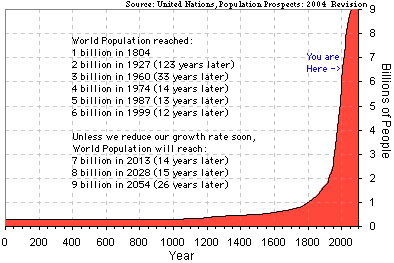
A baby is born every 8 seconds—what’s the big deal about this one? Sorry, but to us the so-called “Royal Baby” is just another of the 3,000 human offspring born into this world every 20 minutes (meanwhile, during the same 20 minutes, another plant or animal becomes extinct—27,000 species each year). The majestic brat is really only one more of the hundreds of thousands of little darlings born that day, or the 1.5 million people born every week.

(That’s like adding a city the size of Phoenix or Philadelphia. In just one week! And around the world right now, one in ten people lack access to clean drinking water, one in eight doesn’t have enough food to eat, while one in five lives on less than $1 a day.)

According to the Population Clock, there will be 125 million births in the world this year. By the time this group is ready to start school, there will have been at least another 625 million new humans born.

In light of all this, the birth of the “royal” baby hardly seems newsworthy.

graph

The World I Long For

On the wall of my weight room is a poster-sized print of the painting below, depicting North America’s wildlife at the site of California’s La Brea Tar Pits, 20,000 years ago: It’s a heartening image, reminiscent of the kind of biodiversity found only on the plains of Africa.

Familiar species still around today included peccary, deer, elk, coyote, bobcat, cougar, wolf and brown bear (the last two surviving species were hunted and trapped to extinction in California during the nineteenth and twentieth centuries), golden eagle, ravens and heron.

But the list of species once common, now extinct, on this continent is much longer. It includes American camels, horses, the California tapir, American mastodon and Columbian mammoth (two former representatives of the elephant family sorely missed on this continent today); also, a couple of now nonexistent bison (the giant and the ancient bison), three species of ground sloths: the Harlan’s, Jefferson’s and the Shasta (the latter, a mere daisy of a ground sloth compared to the 3,500 pound “giant” ground sloth).

They, as well as the stilt-legged llama and the dwarf pronghorn, the American lion, cheetah and saber-toothed cats, the dire wolf and the short-faced bear all disappeared shortly after the arrival of our species—the one blessedly absent from the scene at La Brea.

To me, the most beautiful thing about the painting is that the human species hadn’t yet shown up and started doing the damage they’re infamous for. Just pencil in a few stick figures and well over half the other species disappear. Sure, the genus Homo did less damage with stone-tipped spears than they could have with drones or AK-47s, but to the non-humans of the world, we were mighty dangerous and destructive nonetheless.

While many people nowadays harken back to a time before the emergence of modern technology and prior to the dawn of civilization—convinced that a harmonious era must have existed somewhere in human pre-history—when I pine for the good old days, this is the world I think of…

00-intro

One Man’s Success is Another’s Demise

Correction: that title should have read, “One Man’s Success is ALL Others’ Demise,” for mankind’s triumph comes at the cost of endangerment, degradation and despoil for every other species. It’s not a simple case of Darwinian “survival of the fittest;” it’s the first and only instance of a single species’ persistence setting off a mass extinction.

Charles Darwin never actually said anything about “survival of the fittest,” (those words were dreamed up by some sensationalizing journalist) Darwin’s thing was natural selection. And anyway, humans can hardly be thought of as the “fittest,” compared to nearly every other species out there. Without technology we’re nothing but bald-bodied, clawless, finless, fleshy, flightless, miniature land sloths—most unimpressive next to every other animal we’ve sent down the road to oblivion.

Yet each cog in the great wheel of life we carelessly cast aside is another nail in our own coffin. Homo sapiens won’t come out of this man-made biodiversity crisis smelling like roses, but rather like road kill. All the kings gadgets and all the kings medical men won’t be able to put Humpty-humanity back together again once we’ve completely cracked the fragile shell of life on Earth and sold it off as the last McMuffin.

So, biodiversity or anthropocentricity—what’s it gonna be? You can’t have it both ways.

Come on Man, didn’t your mother ever teach you not to play with mass extinction? Having your own epoch is not something to be proud of. The current era, the Anthropocene, was so named not for any great human achievement, but because we’ve disrupted things enough to bring on our very own mass extinction—and this biodiversity crisis won’t go away until we back down or get out of the picture.

We are tilling under everyone and everything that gets in the way of our single-minded push to raise a bumper-crop of humanity. Of all the Earth’s invasive species, Homo sapiens is the one in dire need of controlling. Yet, we’ve been able to cleverly avoid or survive every effort Nature has come up with to regulate our numbers…so far.

But be warned, lowly human: Mother Nature still has a few tricks to throw at you if you aren’t willing to manage your own population. For as every good farmer should know: he who grows a mono-culture risks crop failure.

Text and Wildlife Photography ©Jim Robertson, 2013. All Rights Reserved

Text and Wildlife Photography ©Jim Robertson, 2013. All Rights Reserved

Goodbye, Gurney’s pitta

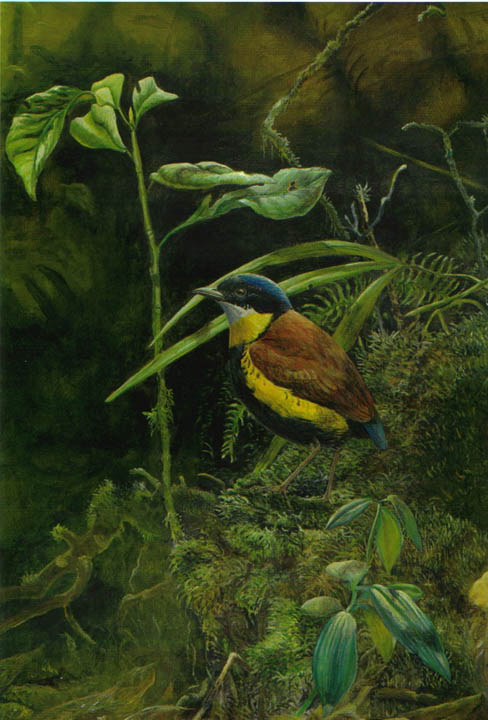
In keeping with the theme of yesterday’s post, “Where Will We Be in Y3K?” (the loss of biodiversity/mass extinction), here’s an article about another species faced with extinction which I received from fellow naturalist and wildlife advocate/animal activist, Barry Kent MacKay. Barry is also a great painter of birds, including this one of the critically endangered Gurney’s pitta…

Painting copyright Barry Kent MacKay

Painting copyright Barry Kent MacKay

Published: 22 May 2013 Post Publishing:

Southern Thailand is home to one of the world’s rarest bird species, but authorities must act now to save it from extinction

From May to October every year, the Gurney’s pitta (Pitta gurneyi), one of
Thailand’s protected wild animals, have their breeding season. Their last
remaining habitat in the Kingdom is a small fragment.

The site is an Important Bird Area (IBA) and arguably the most important
one on the peninsula, supporting the richest lowland forest birdlife in
Thailand. …

The Royal Forest Department (RFD), the Department of National Parks (DNP)
and Krabi provincial administration have been able to halt the destruction and a
little of the lowland forest remains. It is estimated that there may be as few as 13 individuals (perhaps only four to five breeding pairs) now surviving…

Continued…Full story here:

http://www.bangkokpost.com/lifestyle/family/351259/goodbye-gurney-pitta.

Where Will We Be in Y3K?

With several important issues on deck to blog about, the spring winds blew a tree over our power lines and we spent the afternoon back in the relative Stone Age, huddled next to an outside window, straining to read printed pages by what natural light the stormy day had to offer. I decided to do some spring cleaning and throw out anything I hadn’t read or in some other way utilized in the last decade or so. Just as the power came back on I came upon the following letter I wrote after reading Richard Leakey’s book, The Sixth Extinction. This letter, which is as relevant today as when I wrote it (except that there are now 7 billion people instead of 6), was published on January 10, 2000 in the Seattle Post Intelligencer:

Ina fit of arrogant optimism bolstered by surviving the Y2K non-crisis, many are asking, “Where will we be in Y3K?” Perhaps a more pressing question is,” Which species would be able to survive another 1,000 years of mankind’s reign of terror?”

Forget computer malfunctions, power outages or other inconveniences. The new millennium finds us in the midst of a mass extinction unrivaled since a giant asteroid struck Earth 65 million years ago. Unfortunately, Bruce Willis can’t bail us out of the impending Armageddon by simply blasting a menacing death-rock to smithereens.

Our species, one in 1,413,000, is out to prove that it doesn’t take an asteroid strike to unravel life’s intricate diversity. In doing so, humans are on a collision course with destiny. We are eradicating 30,000 species per year—120,000 times the natural extinction rate of one every four years.

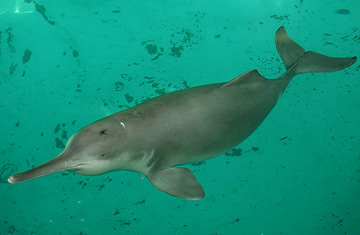
A recent annual survey by the Chinese government found so few of their nationally celebrated, freshwater white dolphins remaining in the Yangtze River that on Dec. 29 they were written off as living relics of an extinct species. China and India now boast more than 1 billion each of a human population that is 6 billion strong and growing. Comparing those figures with the billion inhabitants on the entire planet in 1600, any game manager would clearly see a species out of balance.

As Richard Leakey, the renowned paleoanthropologist warns, “Dominant as no other species has been in the history of life on Earth, Homo sapiens is in the throes of causing a major biological crisis, a mass extinction…And we may also be among the living dead.”

Where will we be in another millennium? Will a future Bruce Willis save us from ourselves? Or will we have gone the way of the dinosaur and the Yangtze white dolphin?

360_yangtze_dolphin_0810

One Park Does Not a Recovered Species Make

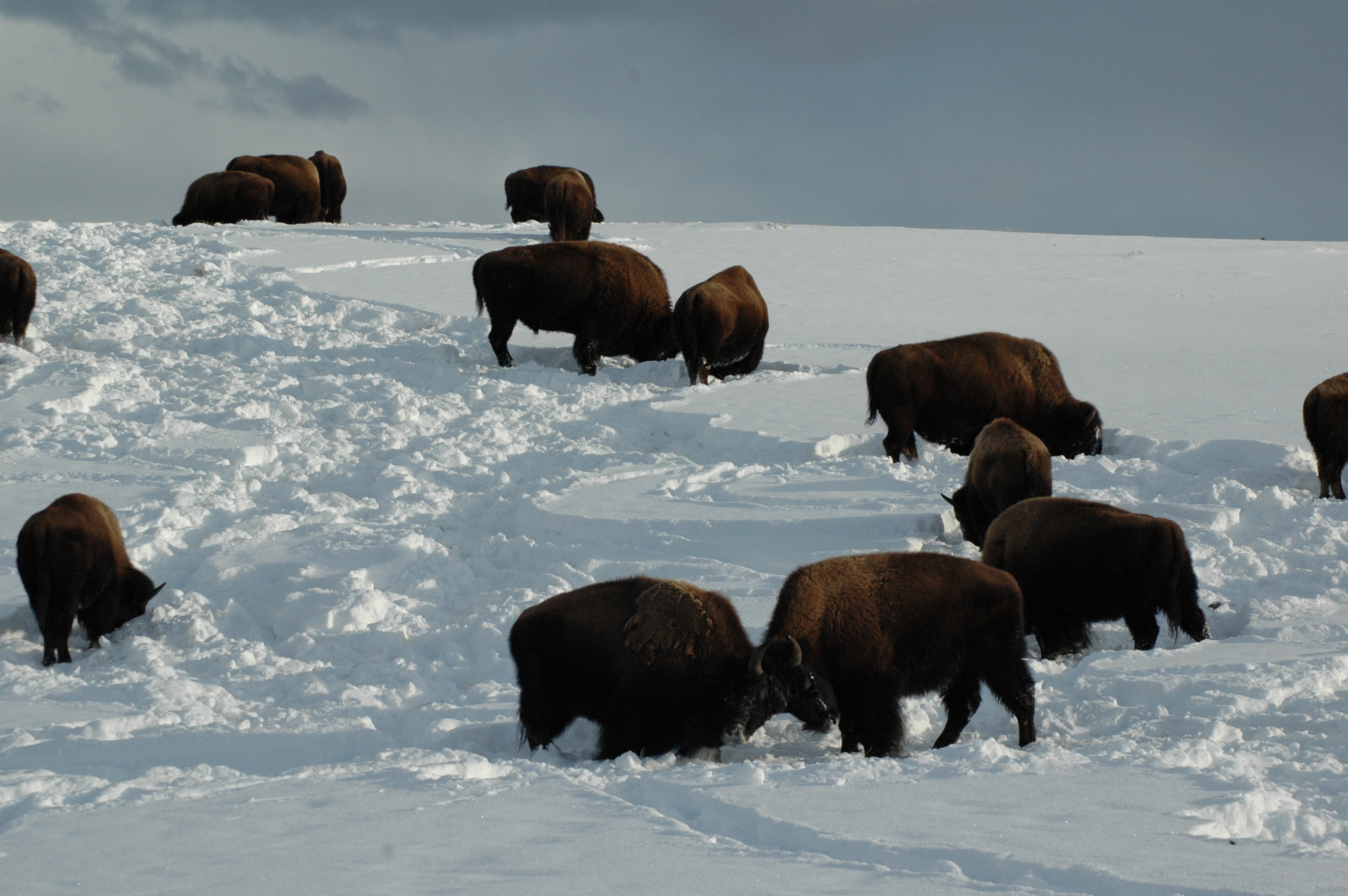
Ignorance must be such sweet bliss for anyone who visits Yellowstone National Park and thinks the wildlife they see there represents fully recovered populations of some of North America’s most endangered species. Sorry to say, one park does not a recovered species make. For all its size, spectacularity and relative biodiversity, Yellowstone is little more than an island in an anthropogenic wasteland to much of its megafauna.

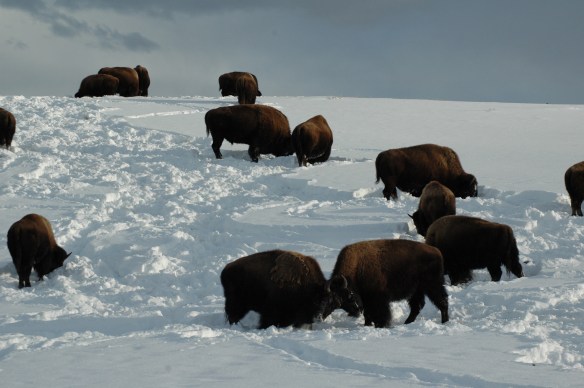
If ranchers and hunters had their way, wolves and grizzlies would be restricted to the confines of the park. Ranchers already have such a death-grip on Montana’s wildlife that bison are essentially marooned and forced to stay within park borders, battling snow drifts no matter how harsh the winter, despite an instinctual urge to migrate out of the high country during heavy snow winters.

Though Yellowstone is synonymous with the shaggy bovines, bison would prefer to spend their winters much further downriver, on lands now usurped and fenced-in by cowboys to fatten-up their cattle before shipping them off to slaughter.

Yellowstone’s high plateaus are on average well over 5,000 feet in elevation and can hardly be considered prime habitat for the wild grazers. Much of the park actually sits within the caldera of one the world’s largest active volcanoes. Any sizable eruption could release enough toxic gasses to kill off all of Yellowstone’s bison—the last genetically pure strain of the species now left on the continent.

People driving through cattle country on their way to Yellowstone often have no idea just how sterile the open plains they’re seeing really are. Gone are the vast bison herds that once blackened them for miles on end—killed off by hide-hunters, market meat-hunters or by “sportsmen” shooting them from trains just for a bit of fun. Gone are the wolves and plains grizzlies adapted to that arid habitat. And nearly gone are the prairie dogs as well as the ferrets, kit fox, plovers, burrowing owls and a host of others who depended on them for food or shelter.

Part of the reason I wrote Exposing the Big Game: Living Targets of a Dying Sport was to remind people about the wild species who once called so much of this continent home. No one’s going be able to claim ignorance on my watch; if I can’t go through life blissfully then neither can anyone else.

The following is an excerpt from one of the book’s two chapters on bison:

Selfless and protective, bison develop lasting bonds in and outside the family, not only between cows, calves and siblings but also between unrelated individuals who grew up, traveled and learned about life together. Juveniles help mothers look after the youngsters and will gladly lend a horn to keep potential predators away from the calves. I have witnessed cooperation among bison families often in the years I’ve spent observing and photographing them. I’ve also seen them put themselves in harm’s way to defend elk from hungry wolves, and even mourn over the bones of their dead.

But in a ruthless act of rabid backstabbing, 1600 bison—who had never known confinement or any reason to fear people—were slain to appease Montana ranchers during the winter of 2008. More than half of Yellowstone’s bison were killed in what was the highest body count since the nineteenth century. 1438 were needlessly and heartlessly shipped in cattle trucks to slaughterhouses (those nightmarish death camps where so many forcibly domesticated cattle meet their ends), while 166 were blasted, as they stood grazing, by sport and tribal hunters. Two winters prior, 947 bison were sent to slaughter and 50 were shot by hunters.

Instead of making amends for the historic mistreatment of these sociable, benevolent souls, twenty-first-century Montanans are still laying waste to them. Spurred on by industry-driven greed for grazing land (veiled under the guise of concern about brucellosis, a disease with a negligible risk of transmission that has never actually been passed from wild bison to cattle), the state of Montana sued to seize control of bison ranging outside Yellowstone. Now their department of livestock has implemented a lethal policy and the US National Park Service is facilitating it. Since the dawn of the new millennium, nearly 4000 Yellowstone bison have been put to death.
Text and Wildlife Photography ©Jim Robertson, 2012. All Rights Reserved

Text and Wildlife Photography ©Jim Robertson, 2012. All Rights Reserved


Silly Humans, Carrion is For Carnivores

Never before in the history of mammals have seven billion large, terrestrial, meat-eating members of one species ever single-handedly laid waste to so much of the Earth’s biodiversity. Human carnivorousness is killing the planet one species at a time, one ecosystem after another; one bison at a time, one wolf after another.

Every time you order a steak or grill a hamburger, you legitimize bison and wolf culling for the sake of livestock growers. If you really want to save the wolves and the bison, go vegan! And urge your friends and family and neighbors and co-workers to do the same.

Tell it to the world—it’s time to leave the predating to the predators!

Human beings can live much healthier on a plant-based diet, as their primate cousins always have. True carnivores, such as wolves, coyotes, cougars, marine mammals or members of the weasel family have to eat meat to survive. If you’re not willing to go vegan for your own health perhaps you could do it for the health of the planet; if not for the sake of the animals you eat, maybe for all the other species affected by your bill of fare.

Text and Wildlife Photography© Jim Robertson

Text and Wildlife Photography© Jim Robertson