Humans: Overall, Not Favorably Impressive So Far

The human species is surely impressed with itself. Even the name they chose to classify themselves—Homo sapiens (Latin for “wise man”)—suggests it. Undoubtedly, there must have been some thought involved in the process of mushrooming from a simple tree-dwelling leaf eater in one small corner of the planet, to becoming the scariest big game hunter to rule the Earth.

 UGH

(Carrying a torch)

                               “I’ll use this fire stick to chase that group of peacefully grazing, gregarious gazelles toward that cliff over there, and you guys try to spear as many as you can”

THAG

(Carrying a spear)

                                           “Good thinking, Ugh.”

Scenes like this played themselves out over and over as the species spread out and burgeoned to 7.2 billion. Now the technology of the killingest of creatures has advanced to the point that a single hunter, dressed in camouflage and drenched in another animal’s urine to con his victim as much as possible, can bring down the mightiest moose or tallest giraffe with the slightest squeeze of a trigger.

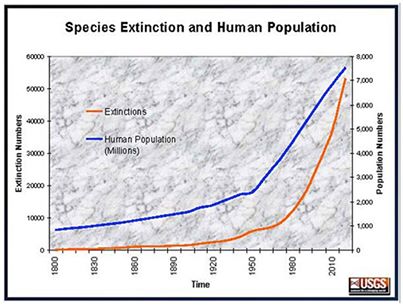
And still the species grows exponentially and continues to claim every last habitat.

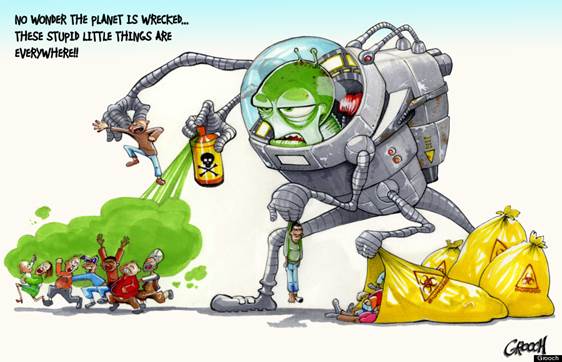
It was impressive when man built the first rocket and took a walk on the moon. However, the rockets they build to blow their enemies sky-high (while irradiating the land and sea) more clearly typify the species’ overall achievements to date. But lately it seems that nuclear annihilation won’t get to see its day; anthropogenic climate change and a man-made extinction spasm are now higher on the agenda.

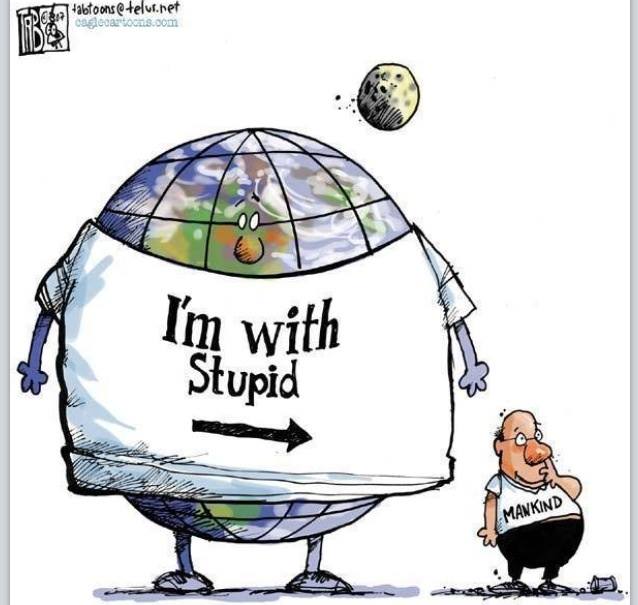
Perhaps the human, the only creature capable of destroying the Earth, should have been named Homo horribilus mactabilis (Latin for “horrible, dreadful, fearful; deadly, lethal man”).

What would really be impressive is if people were to drop their steak knives (and other weapons of mass destruction) en masse and make peace with this amazing planet and all of its inhabitants. The potential is there, but do they still have the will to learn?

1527138_271312873037188_1829199472_n

Hunters: Control Your Own Population

One of the unwelcome, unapproved hunter-comments received today asked the hypothetical question, “So what do you suggest?… Control the human population limiting each family to one child so we stop ‘encroaching’ animal habitat?” He surely knew not the wisdom of his words.

Dave Foreman, founder of the original Earth First!, posits in his book, Man Swarm and the Killing of Wildlife, that no one can call themselves a conservationist (and what hunter doesn’t like to call themselves a “conservationist”?) if they’re unwilling to at least acknowledge the human overpopulation problem.

The following quote from Man Swarm should make this point clear.

“…whenever conservationists spotlight threatened landscapes or wildlife, we need to bring in the ways high population and ongoing growth are behind that threat.

“Right now this is not being done. When horror stories pop up about the dreadful loss of wildlife somewhere in the world, population growth is rarely mentioned, much less blamed for it. A glaring example comes from a 2009 news story about the crash in wildlife numbers in the big game haven of Kenya. Nowhere in the article is Kenya’s skyrocketing population mentioned. Of the fabled big five animals only the buffalo is not now endangered, while Kenya could lose the others—lion, elephant, rhino and leopard. In all cases wildlife are threatened because swarming new populations of Men are pouring into former wildlife habitat. When conflicts arise, the wildeors are killed.

“In 1963, 20,000 lions lived in Kenya. In 2008 there were only 1,970. A ninety percent loss. Elephants went from 167,000 in 1963 to 16,000 in 1989. They are back at 32,000, which is still piddling. Black rhinos were poached down to 20,000 in 1970 to 391 in 1997. Now they are at 603 only with tough protection. Other big, wide-ranging wildlife are at all-time lows. Conservationists need to take such figures and show how exploding human populations are to blame and that, without serious birth reduction, wildlife will go.

“Now, let’s look at how growth is behind the Seven Ecological Wounds. Wound 1: overkill

“When I was in grade school I read the Weekly Reader telling us how more thorough harvesting of the seven seas would feed more and more mouths. Well, we did that. The upshot is crashing fisheries throughout the world, die-off of coral reefs, and the functional extinction of once-teeming highly interactive species such as cod, sharks, and tuna. When highly interactive species are killed off, their neighborhoods crumble and whither.

“As hungry little settlements swell and spread out, they gobble up bigger wildlife from rainforests and other wild lands. Even a little knot of huts with near-Stone Age tools can clean out the bigger wildlife in a nearby protected area. As more babies become more mommies and daddies, hunters go ever farther afield with snares, nets, and old guns. There are tropical National Parks still full of tall, never-cut trees and heavy lianas that are empty of big wildeors thanks to this belly-driven hunting.

“Historically, hunting has caused the extinction, local extirpation, or near extinction of wildlife, including once-highly abundant bison, passenger pigeons, shore birds, whales, cod, elephants, sea turtles, and many more. Such hunting has been driven by the “need” for meat and for new settlements and cropland by growing populations of Men worldwide and locally.”

1451324_650954518277931_1616731734_n

The Myth of Wildlife Overpopulation

http://foranimals.org/whats-left-for-wildlife/

What’s Left for Wildlife

The recent rushed passage of the National Defense Authorization Act with numerous anti-environmental riders exposes the sham of representative democracy. The Public Lands Council correctly describes the overwhelming vote for NDAA as clear case of Congress siding with ranchers. The act overturned grazing regulations which have been in effect over 30 years. Valles Caldera in northern New Mexico became a livestock operation funded by the National Park Service. As Congress would not dare to question, let alone defeat, a military appropriation, passage of this bill was a forgone conclusion. While a few liberal senators such as independent Bernie Sanders voted against the bill, the overwhelming majority of Democrats, including Elizabeth Warren, supported the military funding. Anti-environmental riders were of no concern to them.

Does the Democratic Party’s loss of the U.S. Senate mean anything for wildlife? Democratic Party support for the Keystone XL pipeline was the key to a failed attempt to keep control this year. It was a Democrat, Senator Jon Tester of Montana, who pioneered the practice of using riders to “must-pass” legislation to reverse decades of endangered species protection. With no significant opposition, Tester removed protection for wolves in the Northern Rockies, encouraging the Federal government to follow suit for other wolf populations. A recent court decision has temporarily reinstated protection for wolves in the Great Lakes region, but it remains to be seen if this decision will withstand appeal.

The legislative process is a competition of special interest groups, primarily funded by the wealthiest 1%. Lobbyists write legislation in closed-door committee meetings, which Congress rubber stamps with no meaningful discussion. Without a background in radical critiques of society, wildlife supporters know only liberal politics. Environmental and animal protection organizations, once based on grass-roots activism, are now merely insignificant lobbying organizations, whose primary purpose is raising funds for their own professional staff. Liberals challenge the National Rifle Association on gun control issues, but don’t seem to be aware that the NRA’s positions reflect its nature as a hunting organization. By working with so-called “hunter-conservationists,” environmental lobbyists legitimize the NRA agenda.

If there is anything more threatening to life on this planet than climate change it is nuclear war. Of course, New Mexico Senator Martin Heinrich, who has campaigned to increase hunting on Federal Lands, as well as supporting the Los Alamos nuclear lab, enthusiastically supported the military funding bill. It is particularly symbolic that the bill also included a national historic park commemorating the Manhattan Project, which launched the nuclear age. Perhaps we will someday see a national prehistoric park commemorating the discovery at Clovis of the weapons which launched the first anthropogenic mass extinction when humans arrived in the Americas during the Pleistocene.

The second anthropogenic mass extinction is now underway. In the latest Living Planet Index the World Wildlife Fund (WWF) estimates that over half of the population of wild vertebrates has disappeared in the last 40 years. Among the report’s conclusions: “The loss of habitat to make way for human land use – particularly for agriculture, urban development and energy production – continues to be a major threat to the terrestrial environment. When habitat loss and degradation is compounded by the added pressure of wildlife hunting, the impact on species can be devastating.”

International climate conferences are a sham, as debates focus only on how to raise money to help people adapt to inevitable climate change. There is no way to reverse climate change without drastically reducing the human population, an issue which liberal humanists ignore. The so-called radical left advocates “environmental justice” to help poor people adapt to climate change, while ignoring the destruction of wildlife habitat. Environmental justice for wildlife requires a movement to establish corridors to help wildlife adapt, as they once did when climate change occurred. Without a political left for wildlife there will be nothing at all left for wildlife.

227,000 more people born every day!

10678776_10152936650136840_7539051632152355942_n

Today’s my birthday. Big deal, huh? It may have seemed like a big deal for someone born in 1960, but nowadays, 227 HUNDRED THOUSAND people are born each and every day!

Here’s some light reading on overpopulation, for those who want to take a look at the bigger and bigger picture: http://www.biologicaldiversity.org/programs/population_and_sustainability/

Human population growth and overconsumption are at the root of our most pressing environmental issues, including the species extinction crisis, habitat loss and climate change. To save wildlife and wild places, we use creative media and public outreach to raise awareness about runaway human population growth and unsustainable consumption — and their close link to the endangerment of other species.

There are more than 7 billion people on the planet, and we’re adding 227,000 more every day. The toll on wildlife is impossible to miss: Species are disappearing 1,000 to 10,000 times faster than the natural rate. It’s clear that these issues need to be addressed before it’s too late…

1451324_650954518277931_1616731734_n

Wildlife needs half of the planet to avoid ‘biological holocaust’

Photo Copyright Jim Robertson

Photo Copyright Jim Robertson

https://exposingthebiggame.wordpress.com/wp-admin/post-new.php

Wednesday, August 27th, 2014 By

A Pulitzer Prize winner and Harvard scientist has said that half of the Earth should be human-free and dedicated solely to the world’s wildlife In order to avoid mass extinction of species.

Prominent biologist and two times Pulitzer winner E.O. Wilson has suggested that half of our planet should be dedicated to the world’s animals, as the only way to avoid critical mass extinction.

85-year old Wilson is considered the father of sociobiology and is a leading expert in biodiversity. His work largely focuses on the extinction crisis and the role human societies played in mass extinctions of the 20th century.

Speaking to the Smithsonian Magazine, Wilson explained his ‘Half Earth theory’ to try stop what he calls a ‘biological holocaust’, the sixth mass extinction event caused by humans, which is wiping out species at an incredible pace.

Wilson said in the interview, “It’s been in my mind for years, that people haven’t been thinking big enough –even conservationists. Half Earth is the goal, but it’s how we get there, and whether we can come up with a system of wild landscapes we can hang onto.

“I see a chain of uninterrupted corridors forming, with twists and turns, some of them opening up to become wide enough to accommodate national biodiversity parks, a new kind of park that won’t let species vanish.”

As an example of effective wildlife protected corridor, Wilson named the Yellowstone-to-Yukon 2,000 miles conservation region, which covers an area from Wyoming in the US to the Yukon territories in Canada.

A study from earlier this year revealed that humans are causing species to disappear at 1,000 times the natural rate, mainly because of the destruction of habitats and hunting, in addition to the effects of manmade climate change.

How the Current Mass Extinction of Animals Threatens Humans

We seem indifferent to the mass extinction we’re causing, yet we lose a part of ourselves when another animal dies out.

Simon Worrall

for National Geographic http://news.nationalgeographic.com/news/2014/08/140820-extinction-crows-penguins-dinosaurs-asteroid-sydney-booktalk/

Published August 20, 2014

More species are becoming extinct today than at any time since dinosaurs were wiped off the face of the Earth by an asteroid 65 million years ago. Yet this bio-Armageddon, caused mainly by humans, is greeted by most of us with a yawn and a shrug. One fewer bat species? I’ve got my mortgage to pay! Another frog extinct? There are plenty more!

A photo of the cover of Thom Van Doreen's book, "Flight Ways—Life And Loss At The Edge of Extinction"

In his new book Australian anthropologist Thom Van Dooren tries to break through this wall of indifference by showing us how we’re connected to the living world, and how, when a species becomes extinct, we don’t just lose another number on a list. We lose part of ourselves.

Here he talks about grieving crows and urban penguins—and how vultures in India provide a free garbage-disposal service.

Your book is part of a new field of enquiry known as extinction studies. Can you give us a quick 101?

It’s an attempt to think about what role the humanities, and to some extent the social sciences, might play in engaging with the contemporary extinction crisis. In other words, how ethics, historical, and ethnographic perspectives can flesh out our notion of what extinction is and the way that different communities are differently bound up in extinction or potential solutions via conservation.

We live in a time of mass extinctions. How bad is it?

I think that it’s pretty widely accepted now that we’re living through the sixth massive extinction. The fifth one was 65 million years ago, when the dinosaurs vanished. Today we’re losing biodiversity at a similar rate. And this is, of course, an anthropogenic mass extinction. The primary cause is human communities.

But what we’re trying to do in extinction studies is to think about scale in different ways. How the loss of a species is not just the loss of some abstract collection of organisms that we can add to a list but contributes to an unraveling of cultural and social relationships that ripples out into the world in different ways.

You say that despite this, there is very little public outcry. Are people just too overwhelmed by the enormity of the crisis? Or what?

I think there are lots of answers to that question. For some people it probably is overwhelming. People have “mourning fatigue.” But I think for most people it’s just a genuine lack of awareness about the rates of biodiversity loss that we’re experiencing.

There’s an even more important answer to the question, though, which is that we haven’t found ways to really understand why it is that extinction matters. We can talk about numbers and the loss of a white rhino or a kakapo. But we haven’t developed the kind of story that we need to explain why it is that it matters—what is precious and unique about each of those species.

You have a wonderful phrase, “telling lively stories about extinction.” What does that mean?

I was trying to get at two things. One is to tell stories that make a committed stand for the living world. The other is to tell stories that are themselves lively, that will draw people in and arouse a sense of curiosity and accountability for disappearing ways of life, so they might contribute to making a difference. Stories are one way we make sense of the world and decide what it is that matters and what it is we will invest our time and energy in trying to hold on to and take care of.

Flight Ways differs from many other books in that it’s less interested in the phenomenon itself than in our moral and emotional responses to the crisis.

I have a background in philosophy and anthropology. So I’m more interested in how we understand and live with extinction. I started out wanting to write a book about extinction in general. But what I found doing fieldwork with scientists and communities bound up with the disappearing birds I describe is that each extinction event is totally different. There isn’t a single extinction tragedy. Each case is a unique kind of unraveling, a unique set of losses and consequences that need to be fleshed out and come to terms with.

Tell us about “urban penguins.”

One of the last colonies on mainland Australia, only about 60 or 65 breeding pairs, live in what is the biggest harbor in Australia, Sydney, my hometown. Some of them even nest under the ferry wharf, which many people don’t know as they catch the ferry in and out of the mainland. They’re beautiful little birds, about one foot [30 centimeters] tall, and they’ve been coming here as long as there have been historical records. Thanks to the dedication and work of conservationists and volunteer penguin wardens, who make sure the birds aren’t harassed at night or attacked by dogs and foxes, they’ve managed to hang on.

So that’s a hopeful story?

Yes, I think in many ways it is a hopeful story. For the most part we’ve been talking about extinctions that are caused by people. But in this case living in proximity with humans seems to be working.

One of your bugbears is what you call human exceptionalism. What is that?

This is a concept used by philosophers to describe an attitude where humans are set apart from the rest of the natural world. A little bit special, and so not like the other animal species.

The Lords of Creation?

Exactly. Rather than thinking of ourselves as an animal, we have a long history, in the West at least, of thinking of ourselves as either the sole bearers of an immortal soul or a creature that is set apart by its rationality and its ability to manipulate and control the world.

There are a whole lot of consequences that flow on from that kind of an orientation to the world. And some of them are very damaging for our species and for the wider environment. By diagnosing and analyzing human exceptionalism, we can try to fit humans back into the “community of life,” as the philosopher Val Plumwood called it.

Extinctions affect us in complex ways. Tell us about the Gyps vulture of India.

That’s a particularly interesting case, which drove home to me how extinction matters differently to different communities. The Parsi community in Mumbai have traditionally exposed their dead to vultures in “towers of silence,” as they’re called in English. Now the vultures are disappearing. Estimates suggest that 97 to 99 percent of the birds have gone in the last few decades. So the Parsi community is left in a very difficult position of trying to figure out how to appropriately and respectfully take care of their own dead in a world without vultures.

Vultures are great at garbage disposal, aren’t they?

[Laughs.] They certainly are! It’s estimated that they clean up five to ten million camel, cow, and buffalo carcasses a year in India. And that is obviously a free service. [Laughs.]

They’ve also played an important role in containing disease of various kinds and controlling the number of predators that feed on those carcasses and spread other diseases, like rats or dogs. The worry now is that the decline in vultures may lead to rises in the numbers of scavengers and in the incidence of diseases like rabies and anthrax in India.

You wrap the idea of the importance of mourning the loss of a species into a chapter about the Hawaiian crow. Do crows really grieve?

Yes, I think there’s very good evidence to suggest that crows and a number of other mammals grieve for their dead, and we don’t quite know how to make sense of that. In part this is bound up in those issues of human exceptionalism—the notion that grieving is something that only humans do. But it’s clear from observations of different species around the world that crows do mourn for other crows. They notice their deaths, and those deaths impact on them. So the chapter is a provocation to us to pay attention to all of the extinctions that are going on around us, to take up the challenge of learning from them in a way that, I hope, leads us to live differently in the world.

The Hawaiian crow is another good news story, isn’t it?

That’s right, thanks to really dedicated work by the Hawaiian state government, the U.S. Fish and Wildlife Service, and the San Diego Zoo. They’ve been looking after these birds and breeding them in captivity for decades, and they now have over a hundred birds.

But what they need is somewhere for them to be released. They need good forest, and there’s not a lot of good forest left in Hawaii. Introduced species, like pigs and goats, have largely destroyed the understory of a lot of Hawaiian forest. There are plans to fence some of these areas and remove the ungulates, so that the forest might be restored. It’s a work in progress. But something a lot of people are dedicating a lot of time and energy towards achieving.

Your book is also a clarion call to action. You write, “We are called to account for nothing less than the entirety of life on the planet.” What can a regular Joe like me do?

That’s a tough question, which I struggle with all of the time. It’s one of the reasons that I write and tell stories. I love to do it. It’s also something that I find challenging, and I think might contribute in some way. So all that I can suggest to others is that they find ways of contributing, which they feel similarly passionate about and which might contribute, even in some small way. I don’t think change comes from singular, world-changing events. I think it’s built slowly, piece by piece, by people who are passionate about the world.

Read other interesting stories in National Geographic’s Book Talk series.


RELATED

Species Extinction Happening 1,000 Times Faster Because of Humans?
The Sixth Extinction: A Conversation with Elizabeth Kolbert
Mass Extinctions: What Causes Animal Die-Offs?

Humans have long history with causing extinctions

Die-offs around the end of last Ice Age linked to people, not climate

America’s Earliest Elmers Overhunted Elephants

Early Americans dined on four-tusked elephant relative, say scientists

Archaeologists have unearthed 13,400-year-old weapons crafted by the Clovis people mixed in with bones from an extinct elephant relative.

By Becky Oskin,

LiveScience Senior Writer July 15, 2014

  • A gomphothere jawbone as it was found in place, upside down, at the El Fin del Mundo site in Mexico. Vance Holliday/University of Arizona


There’s a new mega-mammal on the menu of America‘s first hunters.

On a ranch in northwestern Sonora, Mexico, archaeologists have discovered 13,400-year-old weapons mingled with bones from an extinct elephant relative called the gomphothere. The animal was smaller than mastodons and mammoths, but most had four sharp tusks for defense.

The new evidence puts the gomphothere in North America at the same time as a prehistoric group of paleo-Indians known as the Clovis culture, whose beautifully crafted projectile points helped bring down giant Ice Age mammals, including mammoths. This is the first time gomphothere fossils have been discovered with Clovis artifacts.

Recommended: Are you scientifically literate? Take our quiz

“The Clovis stereotypically went out and hunted mammoth, and now there’s another elephant on the menu,” said Vance Holliday, a co-author on the new study, published today (July 14) in the Proceedings of the National Academy of Sciences.

More: http://www.csmonitor.com/Science/2014/0715/Early-Americans-dined-on-four-tusked-elephant-relative-say-scientists