Exposing the Big Game

Forget Hunters' Feeble Rationalizations and Trust Your Gut Feelings: Making Sport of Killing Is Not Healthy Human Behavior

Exposing the Big Game

Will China’s Growing Appetite for Meat Undermine Its Efforts to Fight Climate Change?


https://www.smithsonianmag.com/science-nature/will-chinas-growing-appetite-for-meat-undermind-its-efforts-to-fight-climate-change-180969789/
The country consumes 28 percent of the world’s meat—twice as much as the United States. And that figure is only set to increase.
image: https://thumbs-prod.si-cdn.com/8Vb3Sj8yZqg-2UaKPnsSpXneW2c=/800×600/filters:no_upscale()/https://public-media.smithsonianmag.com/filer/21/dd/21dda208-afc3-424e-89f8-dbf066ea1ec4/chinese_butcher.jpg

Chinese_butcher.jpg
A butcher in Meizhou, China (Flickr user Taro Taylor)
By Marcello Rossi, Undark Magazine
SMITHSONIAN.COM
3 HOURS AGO
2000232

This article was originally published on Undark. Read it here.
At the center of the table in a modest, high-rise apartment in the teeming city of Shenzhen, China, a simmering pot of soup stock was surrounded by large platters featuring mushrooms, different kinds of thinly shaved meat, lettuce, potato, cauliflower, eggs, and shrimp. Folding his hands together, Jian Zhang, a onetime rural farmer who now works as an employee for a small consulting firm in the city, asked his fellow diners to give thanks for the meal — the likes of which he could have only dreamed of when growing up in a remote village in the Jiangxi province.

The reason was simple: His family was so poor that they had to make do with barely sufficient food supplies. “I often went hungry when I was a kid,” said Zhang, his voice betraying the painful memories of a hard childhood. Until the late 1980s, when the state-imposed food rationing system was phased out from people’s daily lives, food supplies were in serious shortage across China. Coupons for buying basic foodstuffs like grain, flour, rice, oil, and eggs were issued based on monthly rations.

Meat, recalled Zhang as he dipped a piece of beef into the bubbly broth, was a rare luxury that his family could afford “two or three times a month.”

Things have changed remarkably since then. In the past three decades, breakneck industrial development and economic growth have driven millions of Chinese from rural areas to cities, altering much about the Chinese way of life, especially in terms of their day-to-day eating habits — an evolution perhaps most pointedly crystallized in the average Chinese consumer’s access to meat. Once a rare luxury, it has now become a commonplace. “I still remember when beef was nicknamed the millionaire’s meat,” said Zhang, who reckoned that he spends around 600 yuan, or $88, each week on food, and half of that on meat. “Now I can eat it every day if I want.”

Fueled by rising incomes rather than urbanization, meat consumption in China grew sevenfold over the last three decades and a half. In the early 1980s, when the population was still under one billion, the average Chinese person ate around 30 pounds of meat per year. Today, with an additional 380 million people, it’s nearly 140 pounds. On the whole, the country consumes 28 percent of the world’s meat — twice as much as the United States. And the figure is only set to increase.

But as the Chinese appetite for meat expands, the booming nation is faced with a quandary: How to satisfy the surging demand for meat without undermining the country’s commitment to curbing greenhouse gas emissions and combating global warming — goals that have been expressly incorporated into national economic, social development, and long-term planning under the Xi Jinping administration.

***

Raising animals for human consumption, after all, generates climate-changing emissions at every stage of production. For one thing, it requires vast amounts of land, water, and food to raise livestock. For another, cattle are themselves a source of huge quantities of methane, a greenhouse gas much more potent than carbon dioxide. Finally, cattle-raising is a major contributor to deforestation, another cause of increases in carbon emissions. Overall, emissions from the livestock industry account for 14.5 percent of total carbon emissions, according to the United Nations Food and Agriculture Organization, and these emissions are likely to increase in the near future as the production of meat is predicted to nearly double in the next 30 years.

With the world’s largest population and a rising craving for meat, China will be one of the biggest sources of increased demand. Experts at the advocacy group WildAid say that average annual meat consumption in China is on track to increase by another 60 pounds by 2030.

“One could argue that Chinese just want to enjoy the kind of life Westerners have for years. In the end, per capita meat conumption in China is still half that of the United States,” said Pan Genxing, director of the Institute of Resources, Environment, and Ecosystem of Agriculture at Nanjing Agricultural University. But, he added, “given the sheer population size, even small increases in individual meat intake will lead to outsized climate and environmental consequences worldwide.”

China is already the world’s largest emitter of carbon emissions, accounting for 27 percent of global carbon emissions. Its livestock industry is responsible for producing half the world’s pork, one-fourth of the world’s poultry and 10 percent of the world’s beef. No one knows exactly how much livestock contributes to the country’s mammoth carbon emissions. The last time Beijing produced official figures in 2005, it said that the national livestock sector accounted for more than half of the emissions from its overall agricultural activities. But one thing is for sure: how China will deal with soaring demand for meat is of paramount importance to both the nation and the rest of the world.

A 2014 study published in Nature by researchers at the University of Cambridge and the University of Aberdeen stated that to keep up with the demand for meat, agricultural emissions worldwide will likely need to increase by up to 80 percent by 2050 — a figure that alone could jeopardize the ambitious plan to keep planetary warming below the 2-degrees Celsius benchmark set under the Paris climate accord.

China would contribute significantly to that growth. Marco Springmann, a sustainability researcher at Oxford Martin School at the University of Oxford, said that if meat consumption in the Asian country keeps growing as predicted, the nation would produce “an additional gigaton of carbon dioxide equivalents in greenhouse gas emissions, more than the current emissions of the global aviation industry” alone, and an increase of about one-tenth above China’s current level of emissions. According to a WildAid report, China alone could account for a growth in greenhouse gas emissions from 1.2 gigatons in 2015 to 1.8 gigatons by 2030.

“These calculations do not include land-use change,” Richard Waite, an associate at the World Resources Institute’s Food Program, told me by telephone from Washington, “but since meat production — especially beef production — takes up a significant amount of land, growing demand for meat in China would make for more forests converted to agriculture or pasture and also increase pressure on forests elsewhere.”

More meat on tables means more land given over to growing livestock feed — especially soybean, a crucial ingredient used to fatten up hogs and cattle quickly. Agricultural land, however, is in short supply in China. With around 20 percent of the world’s population, the country has only 7 percent of the world’s arable land, which is barely enough to keep up with the government’s goal of being self-sufficient for strategic commodities such as rice, corn, and wheat — a goal that has been at the heart of the national food security agenda for decades. Moreover, farmland in the country has been shrinking since the 1970s due to urbanization.

The increasing mismatch between available resources and surging demand has pushed China abroad in search of grain to feed livestock. The country now imports more than 100 million tons of soybeans per year, a figure corresponding to more than 60 percent of the global trade. In countries like Brazil, Argentina, and Paraguay, this has led to the clearing away of vast swaths of forests to make way for huge soybean monocultures, further driving up greenhouse gas emissions since forests typically store carbon in living biomasses, soil, dead wood, and litter, while plants sequester vast quantities of carbon dioxide from the atmosphere during photosynthesis.

Importing grains to feed livestock at home isn’t the only strategy China is adopting to bridge the gap. Under the auspices of the government, Chinese companies have been taking over foreign ones like Smithfield Foods, the world’s largest producer of pork. Meanwhile, the Chinese have also been importing meat from Australia, Brazil, Uruguay, Russia, and other countries, making China the world’s single largest market for meat.

“For decades, developed nations have relocated their factories to China, outsourcing their climate pollution and emissions,” said Waite. “Now China seems to have adopted the same paradigm.”

***

Sure enough, mitigating emissions from one the world’s largest, and most fragmented, livestock industries isn’t an easy task. It also doesn’t seem to be a priority for Beijing. “Some measures like subsidizing livestock farmers to turn animal waste – a major source of methane and nitrous oxide, two greenhouse gases much more potent than carbon dioxide – into organic fertilizers, encouraging them to take advantage of international carbon trading, or providing financial aid to install biogas plants to produce clean energy from manure have been implemented,” said Genxing of Nanjing Agricultural University. “But no specific low-carbon animal production policies exist in the country today.”

“For now, all the efforts are directed toward cutting emissions from sectors such as power generation and transportation,” he added, “and in the absence of major change, livestock emissions will continue to increase in China in the future.”

Programs aimed at curbing consumer demand for meat have begun to circulate. Two years ago, the Chinese Nutrition Society issued new dietary guidelines, which recommend cutting meat consumption in half, for example. The government also teamed up with WildAid to run celebrity-driven, high-impact media campaigns to promote the benefits of eating less meat. Should these campaigns prove effective, food-related emissions in China could be reduced by a billion metric tons compared to projected levels in 2050, Springmann suggested.

But accomplishing that is no easy feat. While the growth rate of animal protein consumption in the country has slowed somewhat in the past few years due to a number of factors — including new public health measures, better alternatives, contaminated meat, and a slowing economy — there are substantial cultural challenges that make it difficult to stem the tide. According Steve Blake, WildAid’s acting chief in China, most Chinese consumers fail to appreciate the link between higher meat intake to global warming. “While the issue of climate change is accepted in China much more so than in the U.S., the awareness about the impact of diet on climate change is very low,” he said. For a country where older generations “still vividly remember not even being able to afford meat a few decades ago,” he said, “meals featuring high amounts of meat are seen as a very good thing.”

Mixed messages from the government are also a hindrance.

“As is typical with Chinese governmental policy, the right and left hand are fighting against each other,” said Jeremy Haft, author of “Unmade in China: The Hidden Truth about China’s Economic Miracle,” in an email message. For example, Haft said, as the government encourages people to eat less meat, it is at the same time shifting the adverse environmental effects of cattle-rearing to the United States and other countries, where China continues to invest in agriculture.

But Haft pointed out that China has a rare opportunity to counteract the effects of this surge in meat-eating. “China’s remarkable development is regarded by many developing countries to be a model for lifting their own population out of poverty,” he noted. Given its centralized system, it has already proved it can be nimble in response to environmental risks — as happened with the transition away from fossil fuels toward renewable energy, which has caused national carbon dioxide emissions to decline or stay flat in the last few years, or with its subsidies for electrical vehicles, which has caused sales to skyrocket.

Now, Haft said, China needs to mount a similar effort to reduce meat consumption.

“If the country wants to become the world’s undisputed leading green superpower, it has to pave the way for a sustainable, low-carbon development [path] for low- and middle-income countries, inspiring them to follow suit,” Haft said. “And reducing emissions from the livestock sector should be part of the path.”

Marcello Rossi is a freelance science and environmental journalist based in Milan, Italy. His work has been published by Al Jazeera, Smithsonian, Reuters, Wired and Outside among other outlets.

Read more: https://www.smithsonianmag.com/science-nature/will-chinas-growing-appetite-for-meat-undermind-its-efforts-to-fight-climate-change-180969789/#Ch4mBESM5mWAZfsG.99
Give the gift of Smithsonian magazine for only $12! http://bit.ly/1cGUiGv
Follow us: @SmithsonianMag on Twitter
The meaty side of climate change

 / 

BY SHEFALI SHARMA

Last year, three of the world’s largest meat companies — JBS, Cargill and Tyson Foods — emitted more greenhouse gases than France and nearly as much as some big oil companies. And yet, while energy giants like Exxon and Shell have drawn fire for their role in fueling climate change, the corporate meat and dairy industries have largely avoided scrutiny. If we are to avert environmental disaster, this double standard must change.

To bring attention to this issue, the Institute for Agriculture and Trade Policy, GRAIN and Germany’s Heinrich Boell Foundation recently teamed up to study the “supersized climate footprint” of the global livestock trade. What we found was shocking. In 2016, the world’s 20 largest meat and dairy companies emitted more greenhouse gases than Germany. If these companies were a country, they would be the world’s seventh-largest emitter.

Obviously, mitigating climate change will require tackling emissions from the meat and dairy industries. The question is how.

Around the world, meat and dairy companies have become politically powerful entities. The recent corruption-related arrests of two JBS executives, the brothers Joesley and Wesley Batista, pulled back the curtain on corruption in the industry. JBS is the largest meat processor in the world, earning nearly $20 billion more in 2016 than its closest rival, Tyson Foods. But JBS achieved its position with assistance from the Brazilian Development Bank and apparently, by bribing more than 1,800 politicians. It is no wonder, then, that greenhouse gas emissions are low on the company’s list of priorities. In 2016, JBS, Tyson and Cargill emitted 484 million tons of climate changing gases, 46 million tons more than BP, the British energy giant.

Meat and dairy industry insiders push hard for pro-production policies, often at the expense of environmental and public health. From seeking to block reductions in nitrous oxide and methane emissions, to circumventing obligations to reduce air, water and soil pollution, they have managed to increase profits while dumping pollution costs on the public.

One consequence, among many, is that livestock production now accounts for nearly 15 percent of global greenhouse gas emissions. That is a bigger share than the world’s entire transportation sector. Moreover, much of the growth in meat and dairy production in the coming decades is expected to come from the industrial model. If this growth conforms to the pace projected by the U.N. Food and Agriculture Organization, our ability to keep temperatures from rising to apocalyptic levels will be severely undermined.

At the November United Nations Climate Change Conference (COP23) in Bonn, Germany, several U.N. agencies were directed, for the first time ever, to cooperate on issues related to agriculture, including livestock management. This move is welcome for many reasons, but especially because it will begin to expose the conflicts of interest that are endemic in the global agribusiness trade.

To skirt climate responsibility, the meat and dairy industries have long argued that expanding production is necessary for food security. Corporate firms, they insist, can produce meat or milk more efficiently than a pastoralist in the Horn of Africa or a small-scale producer in India.

Unfortunately, current climate policies do not refute this narrative, and some even encourage increased production and intensification. Rather than setting targets for the reduction of total industry-related emissions, many current policies create incentives for firms to squeeze more milk from each dairy cow and bring beef cattle to slaughter faster. This necessitates equating animals to machinery that can be tweaked to produce more with less through technological fixes and ignoring all of this model other negative effects.

California’s experience is instructive. Pursuing one of the world’s first efforts to regulate agricultural methane, the state government has set ambitious targets to reduce emissions in cattle processing. But California is currently addressing the issue by financing programs that support mega-dairies rather than small, sustainable operators. Such “solutions” have only worsened the industry’s already-poor record on worker and animal welfare, and exacerbated adverse environmental and health-related effects.

Solutions do exist. For starters, governments could redirect public money from factory farming and large-scale agribusiness to smaller, ecologically focused family farms. Governments could also use procurement policies to help build markets for local products and encourage cleaner, more vibrant farm economies.

Many cities around the world are already basing their energy choices on a desire to tackle climate change. Similar criteria could shape municipalities’ food policies, too. For example, higher investment in farm-to-hospital and farm-to-school programs would ensure healthier diets for residents, strengthen local economies, and reduce the climate impact of the meat and dairy industries.

Dairy and meat giants have operated with climate impunity for far too long. If we are to halt global temperature spikes and avert an ecological crisis, consumers and governments must do more to create, support and strengthen environmentally conscious producers. That would be good for our health — and for the health of our planet.

America’s Biggest Beef Eaters Responsible for Large Chunk of Climate Emissions

20 percent of Americans account for nearly half of all U.S. food-related emissions, and their diets are heavy on meat, a new study shows.

A new study matched what people reported eating with the carbon footprint of those foods and then ranked them. Beef was a big part of the difference. Credit: Jeff Swensen/Getty Images

A new study matched what people reported eating with the carbon footprint of those foods and then ranked their diets. The top 20 percent were responsible for eight times more emissions than the lowest 20 percent, and beef was a big part of the difference. Credit: Jeff Swensen/Getty Images

The biggest eaters of burgers, steaks and ribs contribute the largest hunk of diet-related greenhouse gas emissions in the United States, according to a new study that examined individual eating habits across the country.

New research from the University of Michigan and Tulane University finds that 20 percent of American eaters accounted for nearly half of total diet-related emissions, and that their diets were heavy on beef.

If those people consumed fewer calories and shifted to a more moderate diet with less beef, that could achieve almost 10 percent of the emissions reductions needed for the U.S. to meet its targets under the Paris climate agreement, the researchers found.

The study, published Tuesday in Environmental Research Letters, adds to a growing pile of evidence linking beef with high greenhouse gas emissions, but it is the first to look at what people ate—or recalled eating—rather than at data from the U.S. Department of Agriculture, which measures how commodities flow through the economy.

“USDA tracks how much of a commodity is imported and exported, what gets used for non-food purposes, and applies food waste losses to those numbers. What comes out of that is divided by the population,” said Martin Heller, the study’s lead author. “What we looked at is what an individual said they ate on a particular day.”

With the “recall survey” approach, Heller and his co-authors were able to examine what and how certain portions of the population ate, providing data they believe could be more useful in developing diet-related recommendations that might drive consumers toward more sustainable food choices.

The study comes as more countries are recommending lowering beef consumption for environmental reasons, and as some contemplate taxes on beef, in part to help reach their emissions targets under the 2015 Paris Agreement.

Comparing Diets, Low-Impact to Beefy

To develop their estimates, Heller and his team built a database that looked at the environmental impacts of producing 300 commonly eaten foods. They then linked the database to the National Health and Nutrition Examination Survey (NHANES), a nationally representative survey that includes self-reported dietary data for more than 16,000 Americans.

The researchers were able to rank those diets by their greenhouse gas emissions. They found that the top 20 percent, with the highest carbon footprint, was responsible for eight times more emissions than the lowest 20 percent, and that beef consumption accounted for 72 percent of the difference.

Meat production overall—largely from beef, but also including pork and chicken—accounted for 70 percent of the greenhouse gas emissions in the highest-impact group, but only 27 percent in the lowest-impact group. And while the highest-impact group consumed an average of nearly 3,000 calories a day and the lowest just above 1,300, when the researchers adjusted the findings based on caloric intake, the highest-impact group still represented five times more emissions.

The researchers did not look specifically at how the beef was produced, which can influence its carbon footprint. “That information is not available on the dietary side,” Heller said. “People aren’t saying where their beef is coming from or how it was raised. It was just beef.”

Where Do Those Emissions Come From?

Agriculture accounts for about 9 percent of U.S. greenhouse gas emissions, according to the USDA and Environmental Protection Agency. Globally, food production is responsible for 30 percent of total emissions.

Of the 14.5 percent of global emissions from the livestock industry, more than two-thirds come from beef, largely from fertilizer used to grow grain and from cattle belching.

The study notes research that says dietary choices will become critical to meeting emissions targets under the Paris climate agreement as global demand for food rises with a growing population.

BEEF EATERS CONTRIBUTE ALMOST HALF OF THE U.S.’S DIET-RELATED GREENHOUSE GAS EMISSIONS

Nearly half of the United States’ diet-related greenhouse gas emissions result from only 20 percent of Americans’ dietary choices, a new study finds.

The study, published in Environmental Research Letters, finds that Americans with the highest levels of beef consumption account for 72 percent of the increase in diet-related emissions between the highest- and lowest-impact groups in the study, which produces about eight times the amount of emissions compared to the lowest-impact group. The study’s researchers attribute this to the fact that animal-based foods, particularly cow-based, contribute significantly higher levels of greenhouse gas emissions per pound than plant-based foods.

“Reducing the impact of our diets could achieve significant reductions in greenhouse gas emission in the United States,” said lead author Martin Heller, a researcher at the University of Michigan’s Center for Sustainable Systems, in a press release. “It’s climate action that is accessible to everyone, because we all decide on a daily basis what we eat.”

This study is one of the few to break down the environmental impacts of individual self-selected diets, as opposed to other studies that evaluate environmental effects of diets at the aggregate level. “Such work is essential for estimating a distribution of impacts, which, in turn, is key to recommending policies for driving consumer demand towards lower environmental impacts,” the study states.

Are Meat Eaters Contributing to Climate Change?

https://www.webmd.com/food-recipes/news/20180328/are-meat-eaters-contributing-to-climate-change#1
By Robert Preidt

HealthDay Reporter

WEDNESDAY, March 28, 2018 (HealthDay News) — Climate change scientists have a beef with all the steaks and burgers Americans are eating.

Beef is a major source of greenhouse gas emissions associated with food production, the researchers said in a new study.

They found that one-fifth of Americans account for nearly half of all U.S. food-related greenhouse gas emissions that contribute to climate change.

And America’s love affair with beef is the main reason, said Martin Heller, the study’s first author.

“Reducing the impact of our diets — by eating fewer calories and less animal-based foods — could achieve significant reductions in greenhouse gas emissions in the United States,” said Heller, a researcher with the University of Michigan School for Environment and Sustainability.

CONTINUE READING BELOW
YOU MIGHT LIKE

“It’s climate action that is accessible to everyone, because we all decide on a daily basis what we eat,” he added.

For various reasons, “the production of both beef cattle and dairy cows is tied to especially high emissions levels,” Heller and his colleagues said in a university news release.

These bovines eat lots of feed that involves use of fertilizers and other substances manufactured through energy-intensive processes. There’s also the fuel used by farm equipment.

“In addition, cows burp lots of methane, and their manure also releases this potent greenhouse gas,” the researchers said.

Heller’s team created a database on the environmental effects of producing more than 300 types of foods. They linked that to data on the diets of more than 16,000 U.S. adults.

The researchers found that on any given day, 20 percent of Americans were responsible for 46 percent of all food-related greenhouse emissions in the country. Those with the greatest impact were linked with eight times more emissions than those with the lowest impact.

Beef consumption accounted for 72 percent of the difference in greenhouse gas emissions between the highest and lowest groups, according to the study.

The researchers only looked at emissions from food production. Emissions from processing, packaging, distribution, refrigeration and cooking of food would likely increase total emissions by 30 percent or more, according to Heller.

What does eating meat have to do with extreme weather conditions like this week’s snowstorms? Quite a lot, actually

http://www.independent.co.uk/voices/uk-weather-snow-extremes-cold-meat-eating-climate-change-methane-cattle-cows-a8234236.html

The top five meat and dairy corporations have higher greenhouse gas emissions than oil giant Exxon – if we’re going to have a ‘Green Brexit’, let’s start by examining how we eat

Reducing meat production and meat eating has the potential to avert climate catastrophe. That sounds dramatic, but consider the facts. Livestock farming is responsible for as much as 14.5 per cent of global greenhouse gas emissions – higher than all forms of transport combined. And a recent report from the Institute for Agriculture and Trade Policy revealed that the top five meat and dairy corporations have higher greenhouse gas emissions than oil giant Exxon.

This week I hosted a debate in the European Parliament on how we can reduce the climate impact of our diets based on a new report about tackling climate change through plant protein agriculture. Just 5 per cent of European consumers in 2016 followed a vegetarian diet compared with 19 per cent in Asia. And to feed the animals that eventually end up as meat on our plates requires the import of vast amounts of protein crops – especially soy – in the form of animal feed. This in turn contributes to deforestation in Latin America where large-scale intensive farms grow GMO soya to feed our animals.

The UK climate provides the perfect conditions for growing plant protein – largely peas and beans – for direct human consumption. Fava beans are but one example of the huge potential. They add essential nitrogen to soil, provide food beneficial to insects and are highly nutritious.

Hemp seeds are another. They can be grown almost anywhere, require low inputs of fertiliser, herbicides or pesticides and need little water, land and maintenance. Despite the potential, for farmers and consumers alike, the UK currently only assigns about 16 per cent of agricultural land to the growing of protein crops.

For farmers, protein crops can be incorporated into sustainable crop rotation systems and help a shift away from intensive chemical-reliant monocultures. They also have the rare ability to take nitrogen from the air and capture it in soil, reducing the need for expensive and environmentally damaging nitrogen fertilisers. For consumers, protein crops offer a more affordable source of protein than meat with many health benefits including being a good source of iron and fibre.

UK weather: Amazing timelapse video shows snow falling across London

EU production of protein crops is tiny compared with consumption. Just 2.5 per cent of soya beans consumed in the EU are grown in the EU. A consultation launched recently by the Commission demonstrates a growing recognition of our over-dependency on protein imports for animal feed and the need for greater self-sufficiency. It is the first step in developing an EU-wide protein plan. As Greens, we are pushing for more protein crops to be grown on arable land and that one or two protein crops are incorporated into crop rotations. We also want to see a greater use of EU-grown protein plants for fodder for animals.

It is important to stress that this is not about demonising or alienating livestock farmers, but providing alternatives and encouraging more diversified diets with less dependence on meat for protein. There would also be huge environmental benefits, from reduced methane emissions (from farms) and carbon emissions (from transporting animals) through to protecting forests and wildlife from massive monoculture plantations.

Given the benefits of increasing home-grown protein crops, you would expect the idea to be part of the Government’s consultation on the future for food, farming and the environment in a “Green Brexit”, launched this week. But it receives no mention at all.

This week, extreme weather has been in the news: the “Beast of the East” bringing cold weather and blizzards to the UK, as well as the Arctic experiencing unprecedented warmth. This prompted one climate scientist to comment: “There are further surprises in store as we continue to poke the angry beast that is our climate.”

Changing the way we grow, produce and eat food is not only essential to tame this “angry beast”; it is also one of the easier ways we can transition to a low carbon economy and lifestyle. We just need the right economic incentives and political will to make it happen.

“Clean Meat”? – Two Animal Rights Advocates Say “NO”

[This mirrors my views on the subject.]

*Why “growing meat without animals” is NOT a solution: two views*

On Jan. 10, we published “Slaughter-Free Flesh for Humanity
<http://www.upc-online.org/broiler/180110_slaughter-free_flesh_for_humanity.html>”
which drew fire
from some animal rights advocates including Joan Harrison, whose letter,
“When
Even ‘Clean Meat’ Isn’t Clean Enough,” appeared in *The Wall Street Journal*
,
January 13, 2018, as follows:

Regarding Matthew Scully’s review of Paul Shapiro’s “Clean Meat” (Books,
Jan.
6): I’m afraid I cannot agree with my fellow activists’ enthusiasm about
so-called clean meat. The new technology may relieve animal suffering to
some
extent in the short term by using donor herds, which would suffer and be
enslaved to provide cells out of which meat is then laboratory grown.
Though
this may end factory farming, which would be a blessing, it will do
nothing to
end the public’s identification of animals with food. Indeed, it will
likely
confirm this.

The object is not to end factory farming; the object is to end animal
farming
as such. The promoting of meat of this sort is thus a pernicious
undermining
of animal liberation. According to psychology professor and animal
activist
Bill Crain, experiments show that people eating the flesh of animals
generally
perceive animals in a negative light in contrast to people who don’t. Is
this
something we really wish to encourage? What about flesh emerging from a
bioreactor? Why not promote Monsanto’s GMOs? And what about developing
meat
from human cells? If the latter is repulsive to you, and clean meat from
cows,
pigs, chickens and lambs nevertheless seems okay, you are still under the
sway
of speciesism, the evils of which are well known. A simpler solution is
available, though it’ll take some time, one that is consistent with and
would
facilitate the liberating of animals both nonhuman and human: adopting a
plant-based diet. It’s already happening.

Joan Harrison
New York

_______________________

*On Jan. 25, UPC President Karen Davis asked Philosophy Professor, John Sanbonmatsu – who will be speaking at our March 10, 2018 Conscious Eating*
*Conference in Berkeley, CA – what he thinks of “clean meat.” He wrote
back:*

John Sanbonmatsu, PhD:
http://www.upc-online.org/forums/2018/index.html#john_sanbonmatsu

RE: “Clean Meat,” I think it is folly, for several reasons:

* I think too many vegans are thinking of this as the Holy Grail, which may
subtly be taking pressure and urgency off of other modes of action and
analysis.

* The framing of the discourse as “clean” vs. “unclean” meat aestheticizes
meat,
which is already an aestheticized commodity. The reality is, one form of
“meat” is based on genocidal violence, exploitation, and injustice, and
the
other isn’t. So it should be framed as a choice between violence and
nonviolence, not “cleanliness” in either an aesthetic or “morally
virtuous”
sense (as in, I have a “clean conscience”). One of the cafes here in
Cambridge
[MA] is called “Clear Conscience Cafe,” and naturally they serve grassfed
Angus beef, etc.

* I think it’s a terrible mistake to confuse the issue in consumers’ already
confused minds between “good” and “bad” forms of animal products. I was
in NYC
over the weekend, and one of the grocery stores had organic turkey and pig
sausages literally mixed in with the vegan “meat” products. So the
messaging
is, “This is where you get the ‘alternative’ and ‘healthy’ stuff, take
your
pick.” The last thing we need is to have ontological meat (i.e. flesh)
being
sold to consumers as more “ethical” meat.

* Most higher-end consumers will continue to choose “organic” and “local”
animal
flesh over synthetic, lab-grown meats. Why? Because they are figured as
“authentic.” Michael Pollan sneers when the topic of syn-meat comes up:
like,
who would want THAT? Just think about how educated Americans have been
steering away from “processed” and “artificial” foods for a generation.
And
now we want them to eat burgers made with lab-grown cow cells? No way. The
meat industry will turn right around and promote authentic meat even more
heavily than they do now.

* The whole synthetic meat movement is perpetuating the lie that the only
reason, or main reason, we can’t have universal veganism and an end to
animal
agriculture is because there are no “good” alternatives. That, and the lie
that the reason people “can’t” (or won’t) give up eating animals is
because
animals just taste TOO GOOD. Well, I don’t believe that. Yes, there are
undoubtedly some people so hooked on the exact specific taste of bacon or
whatever that they will cling to it until Doomsday. But I don’t think that
accounts for most or even a big part of resistance to Animal Rights or to
veganism specifically.

* What’s going to happen with this stuff is precisely what happened to Whole
Foods and the whole “humane meat” industry: synthetic meats will not be
competing with cheaper meat commodities; this industry will be competing
with
the chi-chi market for specialized foods. So the price point is going to
be
set high, because that’s where the market is going to be most lucrative
(because this is capitalism). Meanwhile, as I said, if the typical
consumer is
faced with a menu of “real” chicken and “synthetic real” chicken, he/she
is
going to choose the real chicken most of the time, or so I believe.

* If humans think so little of the dignity or suffering of animals that they
can’t or won’t countenance giving up farmed animal flesh until and unless
there is an exact, one-to-one replacement, in taste, texture,
availability,
etc., then what are the odds that they will make any concerted effort to
switch to synthetic meats at all?

* Against the odds, somehow, we need to smash speciesism as an idea and a
set of
institutions and beliefs and interpellated identities. If we don’t
challenge
that, if we can’t undermine it, I think it’s going to continue to be Game
Over
for animals, and all of the synthetic meats in the world won’t amount to
anything.

John Sanbonmatsu, Ph.D.
Associate Professor of Philosophy
Department of Humanities and Arts
Worcester Polytechnic Institute
Worcester, MA 01609

_______________________

Register NOW for UPC’s Seventh Annual Conscious Eating Conference:

*What are the Most Compassionate Choices? *

Berkeley, CA, March 10, 2018.
Information & Registration
<http://www.upc-online.org/forums/2018/index.html>


United Poultry Concerns is a nonprofit organization that promotes
the compassionate and respectful treatment of domestic fowl.
Don’t just switch from beef to chicken. Go Vegan.
http://www.UPC-online.org/ http://www.twitter.com/upcnews
http://www.facebook.com/UnitedPoultryConcerns

View this article online
<http://upc-online.org/diet/180126_clean_meat-two_animal_rights_advocates_say_no.html>


Hunter Arrested After Killing His Wife For Not Given Him Enough Meat

[Not a long article, but it says it all.] article by Cholo Brooks


 http://gnnliberia.com/2017/08/21/hunter-arrested-killing-wife-death-not-given-enough-meat/

Police in central Liberia, Gbarnga, Bong County has announced the arrest of a hunter early Monday morning who killed his wife three months ago after fleeing the County to seek safe heaven at the Liberia/Guinea border.

According to a Correspondent of Liberian Broadcasting Corporation (LBS), the man in question has been at large after he killed his wife for not given him enough meat in his bowl, a situation; the Correspondent said over the past months has created fear in residents of the County.

The Commander of the Gbarnga Police Detachment, according to the LBS Correspondent has also confirmed the arrest of the alleged murderer and currently placed behind bars awaiting trial.

UK could cut food emissions by 17% by sticking to a healthy diet

UK could cut food emissions by 17% by sticking to a healthy diet

DAISY DUNNE

04.12.2017 | 8:00pm

PUBLIC HEALTHUK could cut food emissions by 17% by sticking to a healthy diet
 

The UK could shed close to a fifth of its greenhouse gas emissions from food production if every Briton stuck to a healthy diet based on government guidelines, a new study concludes.

The authors find that, in the UK, a switch from the “average diet”, which is rich in meat and dairy, to a nationally recommended diet, which includes more fruit, vegetables and nuts, could cause food-related emissions to fall by up to 17%.

And if other wealthy countries, including the US, Canada and Australia, swapped their current eating habits for a state-endorsed diet, their emissions could decline by between 13 and 25%.

The new research “provides a valuable indication that we and the planet could be healthier together,” a scientist tells Carbon Brief.

UK’s growing appetite

Food production contributes to climate change in a number of ways. Farm machinery and transport cause CO2 to be released, crop fertilisers emit nitrous oxide and methaneis released by livestock and rice paddy fields. Agriculture also contributes to warming indirectly through deforestation.

In total, the production of food accounts for around 20% of the UK’s total greenhouse gas emissions, according to a 2014 study. Across the world, agriculture accounts for close to 30% of all emissions.

Researchers have suggested a number of ways in which countries can lower their emissions from agriculture. These include eating less meat and dairy, choosing more environmentally friendly crops and cow fodder, and reducing food waste.

However, new research, published in the Proceedings of the National Academy of Sciences, explores an alternative option. The study investigates how a switch from our current eating habits to a healthy diet based on government recommendations could help to lower our emissions.

Most countries offer their citizens a “nationally-recommended diet”. In the UK, Public Health England, Public Health Wales, the Scottish Public Health Network and Northern Ireland’s Public Health Agency are responsible for providing healthy eating guidelines.

Public Health England’s Eatwell Guide suggests that the average person should “eat less often and in smaller amounts”, with the goal of sticking to 2,000 calories a day for women and 2,500 calories a day for men. The guide also suggests we should eat less red and processed meat and consider choosing low–fat alternatives to dairy.

These guidelines are aimed at helping us eat healthily rather than lowering our environmental footprints, says the study’s lead author Professor Paul Behrens, a researcher in energy and environmental change at Leiden University in the Netherlands. He tells Carbon Brief:

“Although dietary choices drive both health and environmental outcomes, these diets make almost no reference to environmental impacts. We find that following a nationally recommended diet in high-income nations results in a reduction in greenhouse gases.”

Stepping onto the scales

For the study, the researchers first gathered information on the average diet of 37 countries from the Food and Agricultural Organisation of the United Nations (FAO). They then collected healthy eating guidelines from the national organisations tasked with providing dietary advice in each country.

To calculate the environmental impact of both the average and state-recommended diets, they collected data on emissions, “eutrophication” and land use from a “supply and use” database called EXIOBASE. Eutrophication is the buildup of nutrients in lakes and rivers as a result of fertiliser run-off.

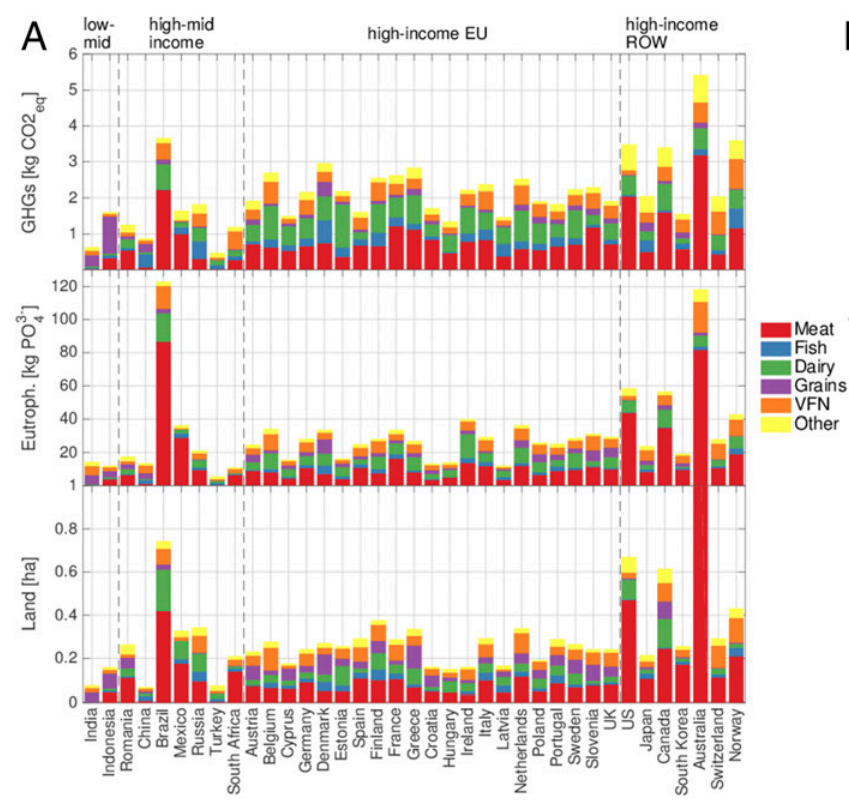
The total greenhouse gas emissions (top), eutrophication levels (middle) and land occupied (bottom) as a result of different types of food production of each country studied is shown on the graph below.

Countries are organised from low-middle income (left) to high-income (right), while colour is used to identify different foods, including meat (red), fish (blue), dairy (green), grains (purple), vegetables, fruits and nuts (VFN; orange) and other types of food (yellow).

Total greenhouse gas emissions (top), eutrophication levels (middle) and land occupied (bottom) as a result of different types of food production in 38 countries. Countries are organised from low-middle income (left) to high-income (right), while colour is used to identify different foods, including meat (red), fish (blue), dairy (green), grains (purple), vegetables, fruits and nuts (VFN; orange) and other types of food (yellow). Source: Behrens et al. (2017)

The analysis shows how the emissions derived from average diets increase with income, with animal products accounting for an average 70% of emissions in high-income countries, such as the UK and the US.

Brazil and Australia are notable exceptions to this finding. This is likely due to both the amount of meat in the diet and a national taste for grass-fed beef in both countries, which has significantly higher methane emissions than grain-fed beef, Behrens explains.

To work out the environmental impact of switching to a healthy diet, the researchers subtracted state-recommended diet data from the average diet data for each country.

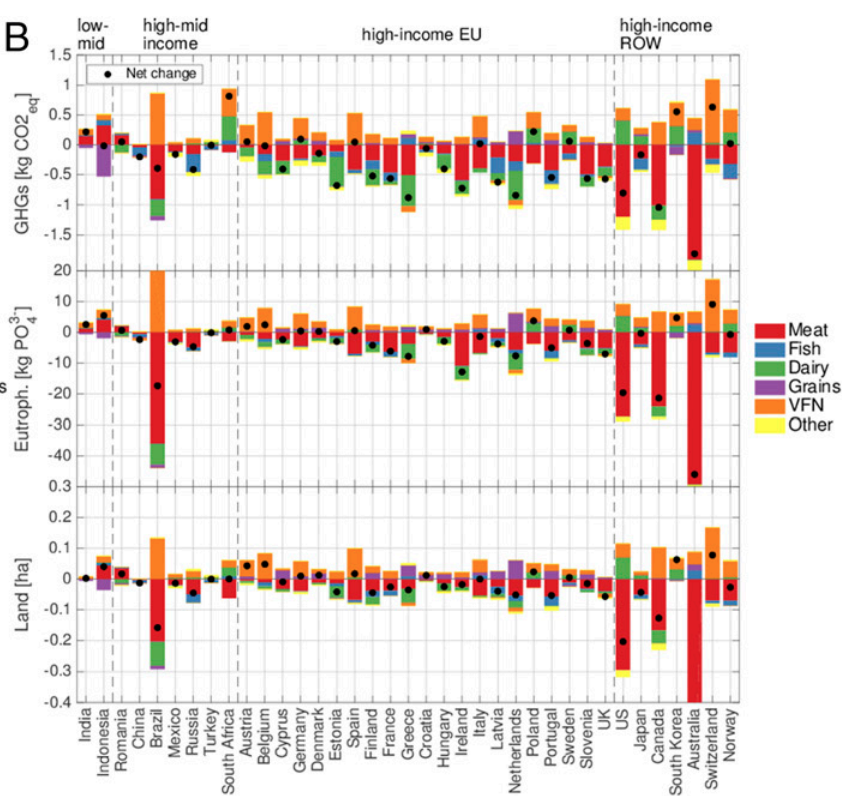
The results are shown on the chart below, which shows the net change (black dot) in emissions (top), eutrophication levels (middle) and land use (bottom) when this subtraction is applied. Bars above the dotted line indicate a rise in emissions while bars below the line show a drop in emissions.

Net change (black dot) in greenhouse gas emissions (top), eutrophication levels (middle) and land occupied (bottom) as a result of a change from an average diet to a nationally–recommended diet in 38 countries. Countries are organised from low-middle income (left) to high-income (right), while colour is used to identify different foods, including meat (red), fish (blue), dairy (green), grains (purple), vegetables, fruits and nuts (VFN; orange) and other types of food (yellow). Source: Behrens et al. (2017)

The chart illustrates how, in most countries, a switch to a state-recommended diet could cause a large reduction in emissions from meat (red) and dairy (green), and a smaller increase in emissions from fruit, vegetables and nuts (orange).

Emissions from a UK government-recommended diet are estimated to be 29% lower than emissions from the UK average diet. However, when the impact of food waste is considered in the analysis, this figure falls to 17%, Behrens explains:

“Food waste is over a third once you take into account production, processing and domestic food wastes. If you include all the emissions from food production, then the difference in the diets becomes smaller because you are still wasting a lot of food.”

In other high-income countries, including the US, Canada and Japan, a switch to a nationally-recommended diet could cause emissions to fall by between 13% and 25%, the analysis finds.

And in high-middle income countries, including China, Brazil and Mexico, a swap to a state-recommended diet could cause a drop in emissions of between 9% and 21%.

However, in India and Indonesia, a switch to a nationally endorsed eating plan could cause a small rise in overall emissions from food production. This is because, in both of these countries, authorities recommend including more meat in the diet. These recommendations have likely been made in response to relatively high levels of malnutrition in some communities in these countries, Behrens says.

Getting into shape

Despite the findings, it is clear that the average Briton is still far from sticking to the government’s recommended diet. In 2015, only 26% of adults ate the recommended five portions of fruit and vegetables a day, according to government statistics (pdf).

However, “we are starting to see change happening in the right places,” says Behrens, pointing to a rise in popularity of vegetarian and vegan diets. Around 2% of the UK’s population consider themselves to be vegetarian, according to a government survey. Behrens says:

“Major obstacles will be related to similar issues with any social and cultural change, and that is the inertia of existing habits. Some social issues can change very very quickly once the right conditions are in place. These sorts of diets are increasing steadily in the population, but usually these social changes reach a tipping point, when change happens relatively quickly, for example, the legalisation of gay marriage surprised many with its speed.”

The research shows that “simply eating what governments say we should for our health would reduce the food system’s impact on climate change,” says Tim Benton, a professor in population ecology at food security at the University of Leeds, who was not involved in the study. He tells Carbon Brief:

“Of course, much about the food system would have to change were the world to adopt sustainable, healthy, eating patterns: the crops grown, the way they are grown, and the subsidies and economics, as well as the retail environment. Nonetheless, this paper provides a valuable indication that we, and the planet, could be healthier together.”

Behrens et al. (2017) Evaluating the environmental impacts of dietary recommendations, PNAS, http://www.pnas.org/cgi/doi/10.1073/pnas.1711889114

Sharelines from this story
  • UK could cut food emissions by 17% by sticking to a healthy diet