Updated March 26, 2021: Thank you to everyone who contacted Sik Gaek restaurant in Queens, New York, to ask it to stop serving live octopuses and lobsters. Before disabling its Facebook page, the restaurant posted, “Sikgaek is no longer available for live octopus. We decided not to serve octopus and lobster alive.” We hope this is the truth and that this abject cruelty won’t simply be available “off menu.” Rest assured, we’ll be watching, and we hope you will, too.
Original post:
The intelligence of octopuses is well known, but did you know that they have been observed decorating their homes with pretty bits of glass, shells, and bottle tops? They’ve also been seen using tools and playing games! Octopuses have extremely sensitive skin for both touch sensation and chemical recognition. Their suckers are the equivalent of a tongue or fingertip, and the linings are regularly shed to maintain sensitivity to touch and taste. These brilliant beings are like us in so many ways that for most people, the thought of eating one alive is unimaginable.
However, Sik Gaek in Queens, New York, has for years insisted on serving octopuses and lobsters—another complex, misunderstood species also known to have the ability to experience great pain—still squirming on dinner plates, to those customers who find slowly hacking apart living, suffering animals to be appetizing. The restaurant even brags about this horrific practice on its website.
Please feel free to use our sample letter, but remember that using your own words is always more effective.
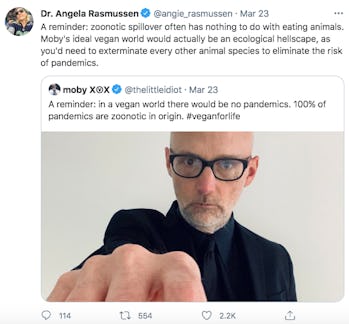
While it’s might be easy to dismiss his statement as a celebrity weighing in on a subject about which he has no expertise, it is reasonable to question how our relationship to animals might be contributing to pandemics. Our current pandemic, after all, is hypothesized to be the result of a virus that jumped from an animal species to humans — likely a bat.
It’s unquestionably true that our relationship to animals plays a big part in whether or not pandemics happen, Amesh Adalja, a senior scholar at the Johns Hopkins University Center for Health Security, tells Inverse. But it’s not the physical consumption of the animal that’s usually the problem, Adalja says — it’s how we live and how the animal ends up on our plate.
Moby’s controversial tweet on Tuesday ignited a debate about veganism.Moby
“It’s not getting a chicken sandwich from Chick-fil-A that’s causing bird flu to be an issue,” Adalja says. “It’s the way we raise it.”
As humans, we’re animals on a planet with other animals — it’s inevitable that we’re going to interact with species other than our own. “You can get bitten by a raccoon and get rabies, not because you were going to eat it, but just because you happened to encounter it in the wild,” Adalja says.
In fact, there are a number of really damaging diseases that have nothing to do with eating animals, even though those diseases can be transferred through animal vectors. For example, malaria is transmitted by mosquitos and Lyme disease is transmitted from deers to humans by ticks. It’s the “no pandemics” element of Moby’s message that’s the most incorrect.
CAN GOING VEGAN STOP ANIMAL DISEASE SPREAD?
What matters more than eating animals is how we’re interacting with animals.
Although it’s true that most of the recent diseases found in humans in recent decades are pathogens that jumped from animals to humans, there’s actually a lot that needs to go right in order for an animal borne-pathogen to become a human pandemic.
There are a few hurdles any pathogen needs to be able to accomplish before it becomes a pandemic in humans, Adalja explains.
It needs to be able to jump from an animal to a human effectively
Once in the human, it needs to cause some kind of disease
That disease needs to be contagious (humans have to be able to pass it to each other effectively)
Throughout history, there have been sporadic outbreaks that “came and went on their own” after a pathogen jumps from animals to humans, Adalja explains.
The difference now, he says, is how we live. And that’s more complicated than just whether or not we consume animals or animal products.
“As humans, we evolved to be omnivores,” Adalja says. “10,000 years ago, there were no vegans. There were also no pandemics.”
WHAT CAUSES PANDEMICS
Other than the fact that many humans still eat animals, everything else about how we live has changed since 10,000 years ago. We transitioned from a hunter-gatherer society to an agricultural society. We started having more people living in one place and population density begins to increase.
Adalja says that humans also, “started going to the bathroom where they lived and domesticating animals.” But even then, we didn’t start seeing the really big pandemics until industrialization.
“10,000 YEARS AGO, THERE WERE NO VEGANS. THERE WERE ALSO NO PANDEMICS.”
That doesn’t mean there were no plagues (the plague of Athens might have something to say). But even the Black Death in the mid-1300s was largely the result of population density, urbanization, and people interacting with each other more — not animal consumption.
Now, we’re more packed into spaces than we ever have been. And while our hygiene and understanding and treatment of diseases is infinitely better than it was in the 1300s, there’s one really big difference that adds to our pandemic risk: how small our world has become.
“An outbreak that happens on one side of the globe can get to the other side of the globe before you have even noticed it,” Adalja says. “And that’s what happened with Covid-19.”
Globalization, the rise of megacities, and increased population density have increased the rates and severity of pandemics more so than consuming animals and animal products, Adalja says.
IS THERE ANY LINK BETWEEN EATING MEAT AND PANDEMICS?
In some ways, yes. Our consumption of animals isn’t entirely unrelated to some pandemics, and, when it is related, it’s important to understand how we can change our behavior to minimize risk as much as possible.
Dr. Angela Rasmussen, a virologist, responds to Moby.Angela Rasmussen
Some studies suggest we could further reduce our risk of some pandemics by changing the way we farm animals. This is especially true for influenza viruses stemming from birds. A 2008 study looking at biosecurity and farming explains, “The high throughput and confinement of highly concentrated animal populations increases the intensity of microbial exposures for farmers, their families, farmworkers, veterinarians, and others in contact with these operations.”
A different study from 2008 stresses the importance of biosafety measures and educating workers, especially poultry workers, about best practices. The study, published in Public Health Reports, concludes:
“Critical components of worker protection include educating employers and training poultry workers about occupational exposure to avian influenza viruses. Other recommendations for protecting poultry workers include the use of good hygiene and work practices, personal protective clothing and equipment, vaccination for seasonal influenza viruses, antiviral medication, and medical surveillance.”
Adalja agrees. “Most of the time, those transmission events can be minimized if you just actually practice biosafety,” he says. “That might mean if you’re butchering an animal, you’re washing your hands, or not doing it with open arms, or rubbing your eyes or doing whatever it might be.”
Global monitoring and transparency would also go a long way to preventing potential pandemics by stopping the disease locally before it has a chance to spread as much as Covid-19 did.
If you want to go vegan or have a primarily plant-based diet, there are plenty of environmental and health reasons to do so. Preventing pandemics isn’t really one of them.
Burgers, bacon, steaks, and other meat products have come under scrutiny in recent years due to their impact on health, sustainability, and social justice issues. The number of companies working on meat alternatives in the U.S. is growing. Half of U.S. consumers under the age of 50 have already tried a plant-based meat product. Yet meat consumption in the U.S. is on the rise. As of 2017, America had the second-highest meat consumption in the world, surpassed only by Hong Kong. How much meat do Americans eat, and what are the impacts of their meat consumption?
How Much Meat Is Consumed in the U.S.?
Americans consume around 274 pounds of meat per year on average, not accounting for seafood and fish, or individual food waste. The total amount of meat consumed in the U.S. has increased by 40 percent since 1961. In 2017, the U.S. Department of Agriculture (USDA) reported that Americans are exceeding the amount of meat recommended by national dietary guidelines, although women in the U.S. eat about a third less meat than men, and around 42 percent less beef.
Beef and Veal
The U.S. has the world’s second-highest consumption of beef and buffalo after Argentina. In 2017 Americans consumed 81.74 pounds of beef and buffalo per capita, a 37 percent decrease from 1976, when Americans had reached a record consumption of 129.65 pounds per capita. In the late 1970s beef consumption started falling, due to scientific findings concerning the health impacts of saturated fats. In 2013 beef and buffalo consumption in the U.S. had dropped to under 80 pounds per capita, but then started rising again.
Pork
Pork consumption in the U.S. fluctuated between 72.64 and 53.19 pounds per capita between 1961 and 2017. The latest data shows that Americans eat an annual 66.18 pounds of pork per capita. The U.S. Census data and Simmons National Consumer Survey (NHCS) found that 268 million Americans ate bacon in 2020, with over 16 million eating five pounds of bacon or more during the year.
Poultry
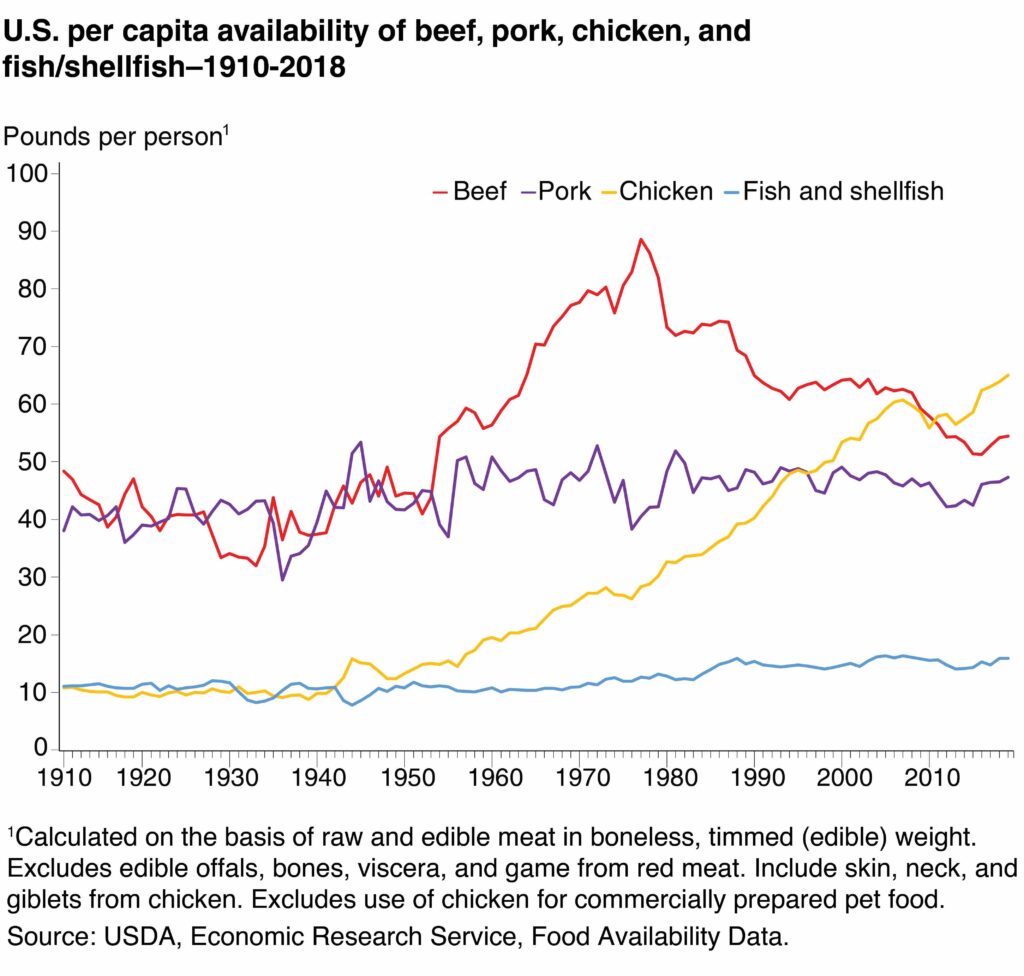
Poultry is defined as domestic fowl, including chickens, turkeys, and geese. In 2017 Americans consumed a record 122.75 pounds of poultry per capita. According to the USDA, chicken consumption has increased by 540 percent since 1910, from around 10.1 pounds per capita to 65.2 pounds in 2018. Since 1961 the consumption of poultry has more than tripled.
The growing popularity of chicken in the U.S. is linked to beef falling out of favor. For decades, consumers have been choosing chicken over beef due to health and environmental concerns; however, eating farmed chickens has also been shown to be problematic for several reasons.
Lamb
Since the 1960s the consumption of lamb and mutton in the U.S. has fallen from nearly five pounds to about one pound per capita. Almost 20 percent of lamb consumption in the U.S. occurs during the spring holidays. Urban consumers are more likely to eat lamb than consumers based in rural areas.
What Is the Most Consumed Meat in the U.S.?
Over the last three decades, chicken overtook beef and pork to become the most commonly consumed meat product in the U.S. In 2020 Americans ate 96.4 pounds of broiler chickens per capita. According to data by the USDA and Economic Research Service, Americans are expected to eat 101.1 pounds of broiler chickens per capita by 2030.
Is Meat Consumption Increasing or Decreasing?
Meat consumption in the U.S. increased by 40 percent between 1961 and 2017. Globally, meat consumption increased by 58 percent between 1998 and 2018.
The number of Americans identifying as vegetarians has remained roughly the same at 6 percent since 1999, according to Gallup surveys. The number of self-identifying vegans increased from just 2 to 3 percent between 2012 and 2018. Nonetheless, and despite projections of growing meat consumption, 23 percent of Americans reported reducing the amount of meat they ate in 2019. The number of U.S. consumers who have tried plant-based alternatives has also risen to 70 percent.
Investment firm UBS predicts that annual sales in the plant-based meat market will grow from $4.6 billion in 2018 to $85 billion in 2030. According to global consultancy AT Kearney, 60 percent of meat eaten globally in 2040 will be from plant-based or lab-grown alternatives. In response to changing consumer preferences, traditional meat producers are increasingly adding plant-based alternatives to their product ranges. A 2021 study found that the average American believes that the U.S. could go completely plant-based by 2039. Yet when faced with falling local demand, some meat companies instead resort to increasing their exports to countries with rising meat consumption levels. In September 2020, for example, the U.S. pork industry exported a record 29 percent of total pork production to buyers outside the U.S.
How Much Meat Is Wasted in the U.S.?
According to a 2020 study, Americans waste around a third of the food they purchase, costing the average household $1,866 per year, or $240 billion for the whole population. Fresh meat requires processing, and is a highly perishable product, which increases the likelihood of waste.
The USDA estimates that only half of the body of a slaughtered cow, pig, lamb, chicken, or turkey ends up being eaten. Beef, for example, can be wasted as it moves from farm to retail due to damage during packaging, inadequate storage, or when inspectors reject it for safety reasons. Within retail, packaging failures, color changes, spoilage, and overstocking can all cause further loss. At the consumer level beef can be wasted due to inadequate storage, spoilage, recalls, and when consumers prepare more beef than they ultimately eat.
Taking the number of farmed animals who die before slaughter into account, the amount of meat wasted in the U.S. is even higher. According to Iowa State University, an estimated 1 out of 3 pigs born into the U.S. pork industry dies before slaughter.
Meat waste entails wasting the land, feed, water, labor, antibiotics, and equipment needed to raise animals from birth to slaughter. Farmed animals only convert 2 to 13 percent of the calories they eat into edible body parts. Poultry wastes 77 percent of feed calories, pork 91 percent, lamb and mutton 94 percent, and beef 98 percent.
When we recognize the resource-intensiveness of animal agriculture, we can see meat consumption itself as a form of food waste.
What Would Happen If Everyone Ate Less Meat?
Animal agriculture, including meat production, is responsible for at least 37 percent of all greenhouse gas emissions. Increasing global meat consumption pushes the planet closer to dangerous limits. Supposing that the whole world adopted the U.S. diet, 138 percent of the world’s habitable land, more land than is available, would be required to meet human dietary needs. If the world instead adopted the more plant-based diet(s) of India, the area of habitable land currently used for agriculture could be more than halved, from 50 to 22 percent.https://ourworldindata.org/grapher/dietary-land-use-vs-beef-consumption
Plant protein can replace animal protein to meet human dietary needs. Instead of monocultures used to grow animal feed, farmers could repurpose land to grow more diverse crops, such as vegetables and pulses. Pulses have nitrogen-fixing properties, are a healthy source of protein with a long shelf life, and can significantly improve soil fertility and reduce food loss in agriculture.
Eating Less Meat
Meat consumption in the U.S. remains high, despite the increasingly urgent need to change global eating habits. Animal products have a significantly larger environmental footprint than plant-based products. According to scientists, a plant-based diet is “probably the single biggest way to reduce your impact on planet Earth.”
Since U.S. citizens have one of the highest rates of meat consumption globally, more people eating a plant-based diet is critical to reducing the country’s emissions, and transitioning towards a more sustainable system of food production.Read More
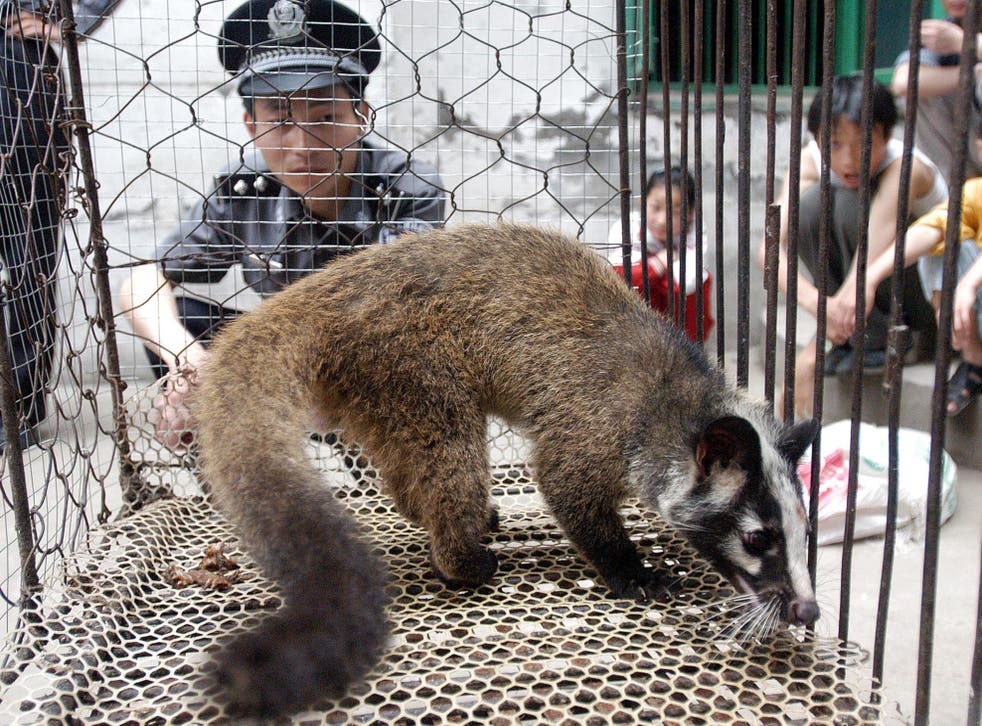
The experts believe the virus probably crossed from wildlife into farmed or domesticated animals in the Wuhan market, and from there to people (AFP via Getty Images)
The four WHO experts who carried out a month-long investigation in China insisted there was nothing that proved the disease was deliberately developed.
And they called for the threat of pandemics to be treated with the same seriousness as terrorism after the 11 September 2001 attacks.
The scientists said in a Chatham House briefing that they found links between the live-animal market in Wuhan, where people first fell ill, and regions where bats had viruses.Apes At San Diego Zoo Receive COVID-19 Vaccinehttps://imasdk.googleapis.com/js/core/bridge3.446.1_en.html#goog_1418780697
Peter Daszak, a zoologist and president of EcoHealth Alliance, which works to prevent pandemics, said: “There was a conduit from Wuhan to the provinces in South China, where the closest relative viruses to [the coronavirus] are found in bats.”
Dr Daszak said the wildlife trade was the most likely explanation of how Covid-19 arrived in Wuhan.
The WHO scientists and their Chinese counterparts considered the most likely explanation was that the virus crossed into domesticated or farmed animals, he added.Please enter your email addressPlease enter a valid email addressPlease enter a valid email addressSIGN UPI would like to be emailed about offers, events and updates from The Independent.Read our privacy notice
The world will find out “fairly soon, within the next few years” what started the pandemic, he predicted. It typically takes many years to pinpoint the animal reservoir of outbreaks.
The team are due to release a report next week on the initial conclusions of their mission to Wuhan.
Marion Koopmans, head of viroscience at University Medical Centre Rotterdam, said they visited the three laboratories closest to the Huanan market in Wuhan, and scrutinised their protocols and research, among other issues.about:blankabout:blankhttps://bd45e420140dbb8b103b0796f2feb7dd.safeframe.googlesyndication.com/safeframe/1-0-37/html/container.htmlhttps://bd45e420140dbb8b103b0796f2feb7dd.safeframe.googlesyndication.com/safeframe/1-0-37/html/container.htmlSkip in 5about:blank✕Skip in 5about:blank
“We concluded that it’s extremely unlikely there was a lab incident,” she said.
Dr Daszak called for the threat of pandemics to be treated with the same seriousness as terrorism after the 9/11 attacks. and working out where the next ones are going to come from and what it might be, whereas we do that with hurricanes and typhoons and all the rest of it,” hesaid.
He added: “After 9/11, we put in place a mechanism to track every single phone call into the US, and the minute there’s a rumour on the web or on these phone calls of an attack, the network is disrupted prior to the attack.
“That’s the kind of change or shift in thinking we need for pandemics, I believe.”
Dr Daszak said: “Let’s look at where wildlife are interacting with livestock and people, and see what is out there and try and find out what threats could emerge in future.”
A love of complex smells and flavours gave our ancestors an edge and stove pped hangoversDonna FergusonSun 7 Mar 2021 01.16 EST
279
Human evolution and exploration of the world were shaped by a hunger for tasty food – “a quest for deliciousness” – according to two leading academics.
Ancient humans who had the ability to smell and desire more complex aromas, and enjoy food and drink with a sour taste, gained evolutionary advantages over their less-discerning rivals, argue the authors of a new book about the part played by flavour in our development.
Some of the most significant inventions early humans made, such as stone tools and the controlled use of fire, were also partly driven by their pursuit of flavour and a preference for food they considered delicious, according to the new hypothesis.Advertisementhttps://5037925012011699e0d1c13b2cbcd914.safeframe.googlesyndication.com/safeframe/1-0-37/html/container.html
“This key moment when we decide whether or not to use fire has, at its core, just the tastiness of food and the pleasure it provides. That is the moment in which our ancestors confront a choice between cooking things and not cooking things,” said Rob Dunn, a professor of applied ecology at North Carolina State University. “And they chose flavour.”
Cooked food tasted more delicious than uncooked food – and that’s why we opted to continue cooking it, he says: not just because, as academics have argued, cooked roots and meat were easier and safer to digest, and rewarded us with more calories.
Some scientists think the controlled use of fire, which was probably adopted a million years ago, was central to human evolution and helped us to evolve bigger brains.
“Having a big brain becomes less costly when you free up more calories from your food by cooking it,” said Dunn, who co-wrote Delicious: The Evolution of Flavour and How it Made Us Human with Monica Sanchez, a medical anthropologist.Advertisementhttps://5037925012011699e0d1c13b2cbcd914.safeframe.googlesyndication.com/safeframe/1-0-37/html/container.html
However, accessing more calories was not the primary reason our ancestors decided to cook food. “Scientists often focus on what the eventual benefit is, rather than the immediate mechanism that allowed our ancestors to make the choice. We made the choice because of deliciousness. And then the eventual benefit was more calories and fewer pathogens.”
Human ancestors who preferred the taste of cooked meat over raw meat began to enjoy an evolutionary advantage over others. “In general, flavour rewards us for eating the things we’ve needed to eat in the past,” said Dunn.
In particular, people who evolved a preference for complex aromas are likely to have developed an evolutionary advantage, because the smell of cooked meat, for example, is much more complex than that of raw meat. “Meat goes from having tens of aromas to having hundreds of different aroma compounds,” said Dunn.
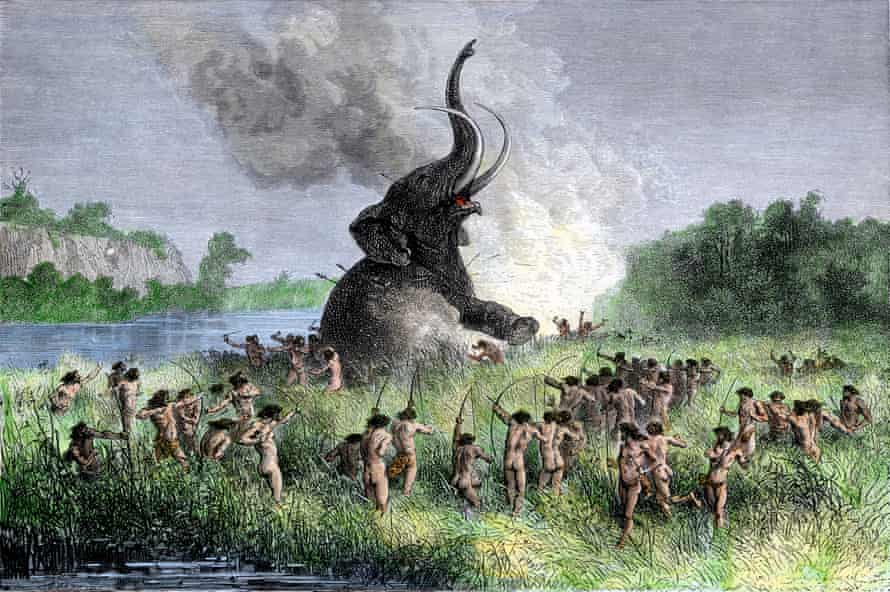
Prehistoric woolly mammoth hunters. Photograph: North Wind Picture Archives/Alamy
This predilection for more complex aromas made early humans more likely to turn their noses up at old, rotten meat, which often has “really simple smells”. “They would have been less likely to eat that food,” said Dunn. “Retronasal olfaction is a super-important part of our flavour system.”
The legacy of humanity’s remarkable preference for food which has a multitude of aroma compounds is reflected in “high food culture” today, Dunn says. “It’s a food culture that really caters for our ability to appreciate these complexities of aroma. We’ve made this very expensive kind of cuisine that somehow fits into our ancient sensory ability.”Advertisement
Similarly, our proclivity for sour-tasting food and fermented beverages like beer and wine may stem from the evolutionary advantage that eating sour food and drink gave our ancestors.
“Most mammals have sour taste receptors,” said Dunn. “But in almost all of them, with very few exceptions, the sour taste is aversive – so most primates and other mammals, in general, will, if they taste something sour, spit it out. They don’t like it.”
Humans are among the few species that like sour, he says, another notable exception being pigs.
At some point, he thinks, humans’ and pigs’ sour taste receptors evolved to reward them if they found and ate decomposing food that tasted sour, especially if it also tasted a little sweet – because that is how acidic bacteria tastes. And that, in turn, is a sign that the food is fermenting, not putrefying.
“The acid produced by the bacteria kills off the pathogens in the rotten food. So we think that the sour taste on our tongue, and the way we appreciate it, actually may have served our ancestors as a kind of pH strip to know which of these fermented foods was safe,” said Dunn.
Human ancestors who were able to accurately identify rotting food that was actually fermenting, and therefore OK to eat, would have had an evolutionary advantage over others, he argues. If they also figured out how to safely ferment food to eat over winter, they further increased their food supply.
The negative consequence of this is that fermented, alcoholic fruit juice, a sort of “proto wine”, would also have tasted good – and that probably led to horrific hangovers.
“At some point, our ancestors evolved a version of the gene that produces the enzyme that breaks down alcohol in our bodies, which is 40 times faster than that of other primates,” added Dunn. “And so that really made our ancestors much more able to get the calories out of these fermented drinks, and it would also probably have lessened the extent to which they had hangovers every day from drinking.”Advertisementhttps://5037925012011699e0d1c13b2cbcd914.safeframe.googlesyndication.com/safeframe/1-0-37/html/container.html
Flavour also drove humanity to innovate and explore, Dunn says. He thinks one reason our ancestors were inspired to begin using tools was to get hold of otherwise inaccessible food that tasted delicious: “If you look at what chimpanzees use tools to get, it’s almost always really delicious things, like honey.”
Having a portfolio of tools that they could use to find tasty things to eatgave our ancestors the confidence to explore new environments, knowing they would be able to find food, whatever the season threw at them. “It really allows our ancestors to move out into the world and do new things.”
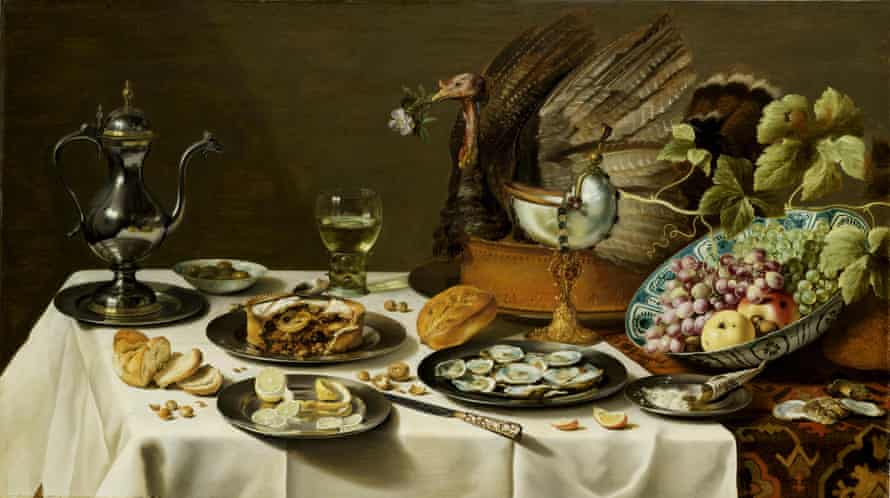
Still Life with a Turkey Pie, by Pieter Claesz, 1627. Photograph: FineArt/Alamy
Stone tools in particular “fast-forward” the ability of humans to find delicious food. “Once they can hunt, using spears, they have access to this whole world of foods that were not available to them before.”
At this point, Dunn thinks humanity’s pursuit of tasty food started to have terrible consequences for other species. “We know that humans around the world hunted species to extinction, once they figured out how to hunt really effectively.”
Dunn strongly suspects that the mammals that first went extinct were the most delicious ones. “From what we were able to reconstruct, it looks like the mammoths, mastodons and giant sloths all would have been unusually tasty.”Paleolithic diet may not have been that ‘paleo’, scientists sayRead more
To replicate the eating habits of prehistoric humans, the book, published later this month, details how one scientist dropped a horse who had just died into a pond and assessed how it fermented over time. “He would sample some meat to see if it was safe to eat. He described it as delicious – a little bit like a blue cheese,” said Dunn.
The Washington Post Magazine recently ran a misleading story on wild horses, focusing attention on anti-federalist ranchers in Nevada and the big money behind them. By failing to look beyond the superficial personality conflicts, and missing the real and important public lands issues, this article does its readers a disservice.
In the article, the writer characterizes the wild horse issue as an “emotional battle,” and correctly observes, “Many ranchers see the mustangs as an overpopulated invasive species that competes for the public land their livestock grazes.”
However, the reality is that wild horses are only bit players in a very real, West-wide ecological battle in which the livestock industry is the principle antagonist. Domestic cattle and sheep (not horses) are the most significant overpopulated invasive species, competing for the public land that our wildlife – elk, mule deer, pronghorn, and bighorn sheep – need to survive.
Pancake Herd, BLM lands, Nevada. Photo: Erik Molvar.
The scope of livestock destruction on western public land dwarfs the impact of wild horses. Wild horses are completely absent on almost 90% of western public lands, and on that small subset where they roam, free-ranging equids pose a measurable impact only in places where aggressive federal roundups aren’t already holding their populations at low levels. In the 1700s, there were an estimated two to seven million wild horses in North America, and native wildlife were abundant. Since the Wild Horse and Burro Protection Act of 1971, many herds have been entirely eliminated. Meanwhile, domestic livestock are found almost everywhere on federal public lands and are authorized to graze at densities that create long-term ecological destruction, with minimal oversight and management.
In fact, the livestock industry in the West plays a pivotal role in the two great environmental issues of our time: climate change and the biodiversity crisis. With their wholesale destruction of native grasses, cattle and domestic sheep today are converting native ecosystems to cheatgrass wastelands at a rate that hasn’t been seen since the Dust Bowl. Cheatgrass burns with unnatural frequency, eliminating sagebrush and other deep-rooted plants. An annual weed, it dies each year, surrendering its carbon and bankrupting the soil of its carbon stores. If left undisturbed, high deserts provide carbon sequestration that scientific studies have found to immobilize more carbon even than forests. Thus, the cattle grazing on western public lands are exacerbating the climate crisis. Public lands ranching also decimates native wildlife, degrading wildlife habitats and targeting native species from wolves to prairie dogs to beavers for elimination. The role of wild horses in all this has never been found to be anything other than negligible on either of these fronts.
The article also neglects to mention that Kevin Borba – one of the two livestock industry spokespeople featured in its story – is damaging the public lands where he runs his livestock. His Fish Creek Ranch grazing allotment covers almost 300,000 acres of leased public lands, lands that are failing the Bureau of Land Management’s (BLM’s) basic rangeland health standards. According to the BLM, the cause of the land health problem is cattle, not horses. Borba has a history of involvement with anti-public-land insurrections, including the 2014 “Grass March,” where anti-government ranchers drove across the country with horse trailers, ceremonially riding their horses through the towns along the way to protest federal management of livestock grazing on public lands.
Pancake Herd, BLM lands, Nevada. Photo: Erik Molvar.
Similarly, the article fails to identify the other livestock industry spokesman, David Duquette, as a supporter of the Hammonds, notorious ranchers and convicted arsonists who had set fire to Oregon’s public lands in order to create more grass for their cows. It was the Hammonds’ imprisonment that touched off the armed occupation of Malheur National Wildlife Refuge in 2015 by Cliven Bundy’s sons and their ragtag gang of domestic terrorists. These spokespeople aren’t outliers, they are just some of the more prominent voices in a movement that seeks to give control of public lands and resources to profit-driven interest groups.
Wild horses can absolutely damage the vegetation, as can any large herbivore, but this is rarely the case. In Wyoming, for example, the BLM is currently in a planning process to zero out three major wild horse Herd Management Areas in the fabled Red Desert, an area currently home to 2,065 wild horses, according to BLM estimates. The agency’s own analysis shows that all of these Herd Management Areas are able to maintain a “thriving natural ecological balance” under current management, without the massive reductions or elimination of wild horses proposed in the proposed plan.
The Washington Post article glosses over a deep and complicated controversy over land management in northeastern Nevada, in which a Bureau of Land Management field manager was targeted for bullying, not just by the livestock industry but by his own State Director, for trying to address chronic violations of domestic livestock leases on federal lands. These types of violations have been repeated over and over again throughout the West, and are symptomatic of systematic (and too often officially authorized) overgrazing of public lands by cattle and sheep that are the real problem here. A more penetrating article on the subject – featuring the same cast of characters – was written several years ago by a more thorough and insightful journalist. It’s too bad that the Washington Post couldn’t offer its readers an article living up to this higher standard of journalism.
By parroting the fake-news hysteria of the livestock industry, the Washington Post has given a nationwide megaphone to half-baked myths about wild horses first voiced by William Perry Pendley, the illegitimate and now-discredited interim director of the Bureau. This narrative distracts public attention from the very real and major ecological problems posed by domestic livestock. In doing so, it helps the livestock industry escape accountability for business practices that have long been abusive and destructive to America’s public lands.
By Jason ZimmermanPublished: Nov. 20, 2020 at 7:05 PM PST|Updated: 17 hours ago
GRAND CHUTE, Wis. (WBAY) – On the eve of the gun-deer season, while hunters were stocking up on last-minute items, meat processors were also preparing for what might be a busier weekend than recent years.
As soon as the sun rises, hunters across the state will begin this year’s deer harvest. Because of the COVID-19 pandemic, participation is likely to be a lot higher.
It was a busy Friday night at stores like Niemuth’s Southside Market in Appleton.
“A lot of people shopping, both Thanksgiving and deer hunting. Food is going out great. We got some good Wagyu steaks, a lot of good steaks going out for deer camp. The hot pickles for the Bloody Mary’s,” Richard Niemuth said.ADVERTISEMENThttps://77aa5539aa6ec22d993a5e4a8dc9767b.safeframe.googlesyndication.com/safeframe/1-0-37/html/container.html
Local meat processors wanted to make sure they’re ready for the crowds this weekend.
John Haen, co-owner of Haen Meats, says he already saw a surge in business during the recent bow hunt.
“COVID, I think a lot more people are spending time outdoors enjoying nature and taking part in the hunt that maybe that didn’t in past years, so something to do.”
In the back parking lot of Haen Meats, trailers are set aside for the harvest. They’re expected to fill up.ADVERTISEMENThttps://77aa5539aa6ec22d993a5e4a8dc9767b.safeframe.googlesyndication.com/safeframe/1-0-37/html/container.html
“During the gun season we do process a large amount of deer, but we do get to a point where we do get full, so we’ll cut as many as we can until we get to that point and then after that we just accept boneless venison because that’s something we can keep frozen,” Haen said.
Last year’s harvest was down by about 50,000 deer, but hunting license sales were up this year and it’s more likely we will see a spike.
JBS and BRF, two of the country’s biggest meat companies, are under the spotlight over their handling of the coronavirus pandemic. Photograph: Ueslei Marcelino/ReutersAnimals farmed is supported byAbout this contentDom Phillips in Rio de JaneiroPublished onWed 15 Jul 2020 06.32 EDT
1,319
Brazilian meat plants helped spread Covid-19 in at least three different places across the country as the virus continues to migrate from big cities to the country’s vast interior, experts have said.
At the beginning of this week the country was second only to the US with 1.88 million confirmed Covid-19 cases and 72,833 deaths .
Its powerful agribusiness sector is allied with the country’s far-right president, Jair Bolsonaro, who has dismissed the pandemic as a “little flu”. The beef sector is worth $26bn (£20.7bn), according to the Brazilian Confederation of Agriculture and Livestock (CNA), while its chicken industry is worth another $8bn.
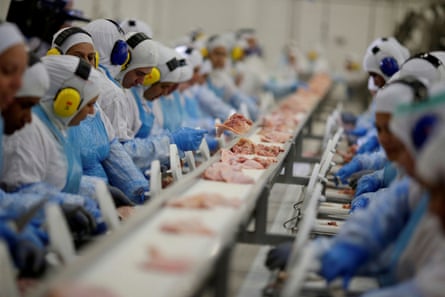
Meat plants have stayed open during the pandemic, and staff work closely together, often in refrigerated areas. Other countries, including the US, Canada, Ireland and Germany, have also seen clusters around slaughterhouses.
A JBS employee in Passo Fundo has his temperature checked. China recently suspended imports of meat from plants owned by BRF and JBS. Photograph: Diego Vara/Reuters
The conditions can create perfect Covid-19 breeding centres, said Priscila Schvarcz, a prosecutor from the Public Ministry of Labour (MPT), a branch of the federal prosecution service charged with supervising labour laws.
“We see a lot of workers infected,” said Schvarcz, a member of a national meat plant taskforce based in Rio Grande do Sul state in southern Brazil.Advertisement
Rio Grande do Sul has been hard hit. As of 23 June, 4,957 meat workers had tested positive at 32 plants in the state – a third of the total coronavirus cases in the area, prosecutors said. Five employees and 12 people in contact with them had died.
A study for the MPT showed that Covid-19 cases in central and southern Brazil were clustered around towns where meat plants were located and workers lived. “There is a direct relationship,” said Ernesto Galindo, the researcher who produced the study.‘Either we change or we die’: the radical farming project in the AmazonRead more
China, Brazil’s biggest trading partner, suspended imports of meat from plants owned by two of Brazil’s largest meat companies, BRF and JBS, at the beginning of this month. Brazil’s ministry of agriculture also suspended exports from a JBS plant in Rio Grande do Sul, business daily Valor said.
BRF said it was working with the Brazilian and Chinese authorities to resume deliveries. The company said that 98 of 2,873 workers at its plant in Lajeado, Rio Grande do Sul, tested positive in late May. JBS did not comment on China’s suspension of imports.
‘The focus was cows, not employees’
At a JBS plant in Dourados, in Mato Grosso do Sul state in the centre-west region, more than 4,000 employees were tested and nearly a quarter were positive, prosecutors said. The company suspended 1,600 workers on full pay but did not close the plant. As of 14 July, the town had 3,481 cases, a quarter of the state’s total.
The JBS plant in Dourados “was the initial focus for the outbreak”, said Andyane Tetila, an infectious diseases specialist in Dourados who works for the state health service. The JBS plant has 103 indigenous workers, many of whom live in nearby reserves where more than 150 people were subsequently infected, said Indianara Machado, an indigenous nurse who works in the reserve.
Employees work at JBS in Lapa in March. Prosecutors have said close working conditions at meat plants make them vulnerable to the spread of Covid-19. Photograph: Ueslei Marcelino/Reuters
JBS said it had put all its indigenous workers on paid leave and is supporting initiatives to control and prevent new coronavirus outbreaks in more than 100 municipalities across Brazil. Labour prosecutors said JBS moved quickly to contain the outbreak. “The company collaborated,” said Jeferson Pereira, a labour prosecutor in Dourados. “It contracted nurses and technicians to accompany visits.”Advertisementhttps://tpc.googlesyndication.com/safeframe/1-0-37/html/container.html
Another 85 people tested positive at a BRF plant in the town. The company said workers in this situation are suspended on pay, given medical attention and monitored by occupational health specialists at the company until they recover.
In June, a judge closed a JBS plant in the remote Amazon town of São Miguel do Guaporé in the north-west of Brazil for the second time after infections rocketed. As of 25 June, 377 of the plant’s 940 employees were infected – then more than half of the town’s caseload, prosecutors said.
Leandro da Conceição, 33, one of the workers in the plant, said he lost his sense of smell and taste. When he told his supervisor, he was ignored and kept working even though he got sicker and sicker.
Conceição was sent home after he produced his own positive test result. He and another worker later lost their jobs after a WhatsApp audio that featured them and other workers complaining about infections at the plant was published by local media. Both men were told falling production was the motive. “They had no reason to sack us,” he said. “I never missed work.”
Local labour prosecutor Helena Romero said: “We realised that the company was not carrying out containment measures, we observed that often workers kept working even though they had symptoms, and this could have contributed to spreading the illness.” The plant has since reopened.
After the outbreak in Lajeado, BRF signed an extrajudicial deal with labour prosecutors. The company said it had tested 31,000 employees nationwide in the past two months. Four of its plants had closed for testing and all 34 are now operating. Preventative measures included reducing bus capacity by half and suspending workers in Covid-19 risk groups. A permanent committee of specialists monitors its actions.
JBS did not explain why it had no agreements with labour prosecutors and declined to comment on outbreaks at individual plants. “JBS does not comment on legal decisions,” it said.
The company said that the health and safety of its team members was its key priority. It had adopted a strict protocol on control, prevention and safety at all processing units, in full compliance with government-mandated rules.
JBS said it followed guidance from the US Centers for Disease Control and Prevention and the World Health Organization as well “specialised physicians”. “Each test assessment takes place on a case-by-case basis,” the company said. It disinfected factories daily and takes workers’ temperatures, and has increased its fleet of buses and put those in risk groups and anyone with symptoms on paid leave.
Chen Yu used to walk a short distance to a nearby market to get fresh poultry. Now, to stew a pot of chicken soup or cook a whole duck for family gatherings, she has to take two buses downtown to buy the meat.
“Live poultry cannot be sold in my neighborhood market now,” said Chen, a housewife in her 50s who lives in China’s Jingdezhen city. In the bigger market about 40 minutes away, there’s a special containment room for live birds. “You can see them, point at one of them, then the owner will have it slaughtered. Picking the duck yourself is not what matters. The key is you see them live.”
China will gradually close all live poultry markets to cut public health risks and step up supervision of farmers’ markets amid the Covid-19 outbreaks, Chen Xu, an official with the State Administration for Market Regulation, said this month. Live animal sales are still taking place in markets with containment rooms in some cities, but they will also eventually stop operating.
The pandemic has put China’s farmers’ markets under global scrutiny as the virus is thought to have originated from a wet market in Wuhan where exotic animals were suspected of being sold. In some provinces, fresh seafood and equipment like chopping boards are being tested. Scientists are still probing the origins of the virus.
China consumed more than 19 million tons of poultry in 2018, becoming the largest consumer by volume after the U.S., according to the USDA. The number surged to almost 23 million tons in 2019 following the African swine fever outbreak in the Asian nation, the U.S. agency said, citing China’s farm ministry data.
Bird Flu
China has been temporarily closing live poultry markets because of bird flu outbreaks for years. In 2017, officials in some affected areas ordered the markets to shut, and culled more than 1 million infected or susceptible fowl. Consumers were advised to buy chilled or frozen chicken instead of freshly prepared products from markets, and to thoroughly cook the meat.
In 2006, China’s State Council announced it will gradually ban the trading and killing of live poultry in big cities, encouraging killing to be undertaken at professional slaughterhouses instead. In Chen’s city, however, changes slowly started taking place in the second half of 2019 and now her neighborhood market has stopped selling them.
A fresh Covid-19 attack in Beijing after it largely controlled the outbreak has again triggered concerns about biosecurity. The capital shuttered its largest fruit and vegetable supply center last month and locked down nearby housing districts as dozens of people associated with the wholesale market tested positive for the coronavirus.
Despite risks related to live animal slaughter, many meat consumers don’t seem to worry about live birds. Generally, customers don’t feel assured when they buy poultry from shelves of a shop, said Wang Xiaoying, a poultry dealer in Jingdezhen city of the Jiangxi province. “They say it’s not fresh.”
Quest for Fresh
Fresh poultry means so much to some Chinese people that Wang uses her WeChat not only as an online messaging tool, but also as a platform to promote fresh poultry delivery. Posting pictures of fresh, clean and feather-plucked birds from time to time, she emphasizes in the caption that the poultry she offers are “freshly killed upon ordering.”
Wang does not worry about the avian flu, saying that she has been in the business for more than two decades. Whenever the city government orders a ban on live poultry trading amid occasional bird flu outbreaks, her family business comes to a halt. The longest halt, Wang said, was as long as six months.
For Wang, however, the full ban initiative is bad news. As of now, she’s still able to operate as the new policy will be implemented in phases. If the birds are to be processed only at centralized slaughterhouses, she fears her business could halve. She also sells processed poultry meat, but their sales have been much lower than that of live birds.
The new Chinese policy may disappoint many customers, like housewife Chen. “We might find it hard at first, but we’ll get used to it,” she said.
(Updates to add USDA data in fifth paragraph)
For more articles like this, please visit us at bloomberg.com
Subscribe now to stay ahead with the most trusted business news source.
Chen Yu used to walk a short distance to a nearby market to get fresh poultry. Now, to stew a pot of chicken soup or cook a whole duck for family gatherings, she has to take two buses downtown to buy the meat.
“Live poultry cannot be sold in my neighborhood market now,” said Chen, a housewife in her 50s who lives in China’s Jingdezhen city. In the bigger market about 40 minutes away, there’s a special containment room for live birds. “You can see them, point at one of them, then the owner will have it slaughtered. Picking the duck yourself is not what matters. The key is you see them live.”
China will gradually close all live poultry markets to cut public health risks and step up supervision of farmers’ markets amid the Covid-19 outbreaks, Chen Xu, an official with the State Administration for Market Regulation, said this month. Live animal sales are still taking place in markets with containment rooms in some cities, but they will also eventually stop operating.
The pandemic has put China’s farmers’ markets under global scrutiny as the virus is thought to have originated from a wet market in Wuhan where exotic animals were suspected of being sold. In some provinces, fresh seafood and equipment like chopping boards are being tested. Scientists are still probing the origins of the virus.
China consumed more than 19 million tons of poultry in 2018, becoming the largest consumer by volume after the U.S., according to the USDA. The number surged to almost 23 million tons in 2019 following the African swine fever outbreak in the Asian nation, the U.S. agency said, citing China’s farm ministry data.
Bird Flu
China has been temporarily closing live poultry markets because of bird flu outbreaks for years. In 2017, officials in some affected areas ordered the markets to shut, and culled more than 1 million infected or susceptible fowl. Consumers were advised to buy chilled or frozen chicken instead of freshly prepared products from markets, and to thoroughly cook the meat.
In 2006, China’s State Council announced it will gradually ban the trading and killing of live poultry in big cities, encouraging killing to be undertaken at professional slaughterhouses instead. In Chen’s city, however, changes slowly started taking place in the second half of 2019 and now her neighborhood market has stopped selling them.
A fresh Covid-19 attack in Beijing after it largely controlled the outbreak has again triggered concerns about biosecurity. The capital shuttered its largest fruit and vegetable supply center last month and locked down nearby housing districts as dozens of people associated with the wholesale market tested positive for the coronavirus.
Despite risks related to live animal slaughter, many meat consumers don’t seem to worry about live birds. Generally, customers don’t feel assured when they buy poultry from shelves of a shop, said Wang Xiaoying, a poultry dealer in Jingdezhen city of the Jiangxi province. “They say it’s not fresh.”
Quest for Fresh
Fresh poultry means so much to some Chinese people that Wang uses her WeChat not only as an online messaging tool, but also as a platform to promote fresh poultry delivery. Posting pictures of fresh, clean and feather-plucked birds from time to time, she emphasizes in the caption that the poultry she offers are “freshly killed upon ordering.”
Wang does not worry about the avian flu, saying that she has been in the business for more than two decades. Whenever the city government orders a ban on live poultry trading amid occasional bird flu outbreaks, her family business comes to a halt. The longest halt, Wang said, was as long as six months.
For Wang, however, the full ban initiative is bad news. As of now, she’s still able to operate as the new policy will be implemented in phases. If the birds are to be processed only at centralized slaughterhouses, she fears her business could halve. She also sells processed poultry meat, but their sales have been much lower than that of live birds.
The new Chinese policy may disappoint many customers, like housewife Chen. “We might find it hard at first, but we’ll get used to it,” she said.
(Updates to add USDA data in fifth paragraph)
For more articles like this, please visit us at bloomberg.com
Subscribe now to stay ahead with the most trusted business news source.











 Exposing the Big Game
