Why these meatpacking workers fear for their health and safety amid COVID-19

Jun 24, 2020 6:40 PM EDTBy —

Fred de Sam Lazaro53commentsShareShare on FacebookShare on TwitterTranscriptAudio

https://www.pbs.org/newshour/show/why-these-meatpacking-workers-fear-for-their-health-and-safety-amid-covid-19

Many U.S. meatpacking plants shut down this spring due to coronavirus outbreaks. Nationwide, more than 27,000 workers have become infected, and nearly 100 have died. But in late April, President Trump ordered the facilities to stay open, deeming them critical to preserving the nation’s meat supply. Special correspondent Fred de Sam Lazaro reports on the experiences of some of these workers.

Read the Full Transcript

  • Judy Woodruff:It has been nearly six weeks since production resumed in most meatpacking plants across the country. Many were shut down amid coronavirus outbreaks. More than 27,000 workers have become infected, and 99 have died.In late April, President Trump ordered plants to reopen or remain open, calling them critical infrastructure to preserve the nation’s meat supply.Special correspondent Fred de Sam Lazaro returns to one community in Minnesota where a pork processing plant is back online.
  • Fred de Sam Lazaro:Here in the Fabled Valley, the Jolly Green Giant stands tall and now even masked, but it’s actually pork, not peas, that reigns.The huge meat processing plants are now nearly back at full capacity. But things are not exactly jolly.
  • Woman (through translator):We’re still going to have to keep working in fear, but we know that we need to continue working. We have no option.
  • Fred de Sam Lazaro:In Worthington, Minnesota, population 13,000, the JBS factory was shuttered by a COVID outbreak that sickened hundreds of its 2,100 employees.The effect was felt across this region, mostly at first among hog farmers in late April. Hundreds of thousands of their animals had to be euthanized.
  • David Bullerman:It’s devastating. I’d like President Trump to invoke the Defense Production Act of 1950. We need to get these plants open today.
  • Fred de Sam Lazaro:Echoing farmer Dave Bullerman’s plea, industry executives warned, the nation’s meat supply was threatened, a claim some analysts now say was exaggerated, noting that, in April, there were record pork exports to China.
  • President Donald Trump:I should be signing that over the next hour or so.
  • Fred de Sam Lazaro:But, on April 28, President Trump did order meatpacking plants to reopen and remain open, declaring them critical infrastructure.
  • President Donald Trump:Taking the liability, which frees up the entire system.
  • Fred de Sam Lazaro:The president said his move shielded companies from liability if their workers got sick.Back in Worthington, community organizer Jessica Velasco says the plight of workers never seemed a priority.
  • Jessica Velasco:Folks started talking about the hog farms that were losing money. The bigger issue than was them euthanizing all those poor hogs.The conversation should have been, how can we support both the JBS employees and the hog producers?
  • Fred de Sam Lazaro:She says the employees, predominantly refugees and immigrants, remain largely invisible and fearful. She says many lost trust in the company because of the way it acted as more and more workers fell ill, leading the plant to shut down.Rafael, like all workers we spoke with, asked to remain ANONYMOUS.
  • Rafael (through translator):They told the workers not to worry, everything was OK. To be honest, they were not prepared at all. Nothing was OK. That’s where many became scared, and it was kind of you either work or you don’t eat situation.
  • Fred de Sam Lazaro:Rafael says he decided to quit because of a health condition that leaves them vulnerable to COVID. These three workers returned.
  • Man (through translator):Everyone feels scared. Everyone feels like we do here.
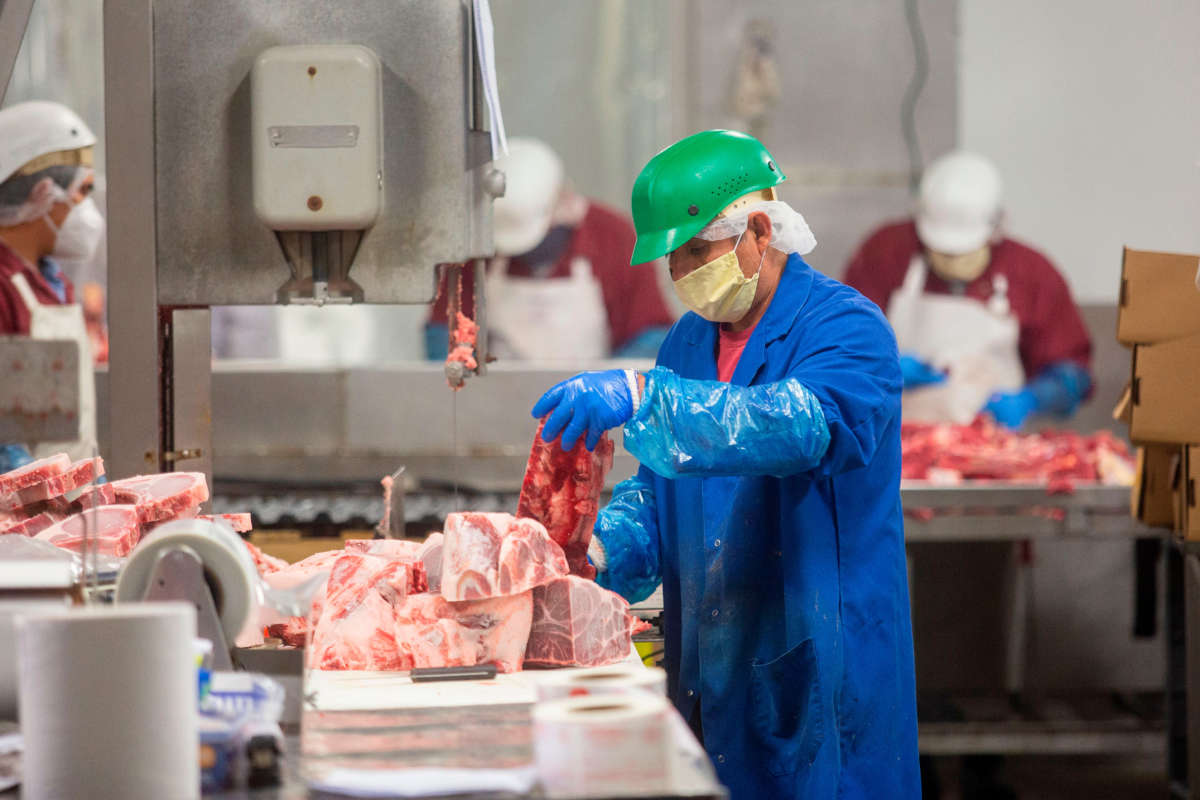
  • Fred de Sam Lazaro:JBS declined our request for an on-camera interview. It did send a video — parts of it time-lapsed — of improvements made at another plant in Greeley, Colorado, where several workers died.JBS has put some older COVID-vulnerable workers on paid furlough, and, among other steps, now requires employees to wear masks and face shields. And it installed barriers between workstations. Workers told us it feels safer, but not safe.
  • Steven:Personally, I think that they should make it mandatory for employees to get tested, so that we know who has it and who does not.
  • Fred de Sam Lazaro:The company says it tests employees who show symptoms and takes employees’ temperature when they arrive.That’s no comfort to Anna, who survived a painful COVID infection just before the plant closed.
  • Anna (through translator):They took mine, but it never showed a temperature. But I was already very sick. I didn’t show the symptoms.
  • Fred de Sam Lazaro:Most people like her have no choice but to return to work, she says.
  • Anna (through translator):We have family that we need to raise. We don’t have savings so we could just stay home.
  • Fred de Sam Lazaro:Meatpacking has long attracted new immigrants who have few options. It is an intensely tough environment, as even this JBS job posting seems to warn, standing 10 hours a day, doing repetitive tasks in very high temperatures or very low temperatures, with unpleasant odors.It’s something labor historian Peter Rachleff says most Americans avoid.
  • Peter Rachleff:The work force in meatpacking has almost always been people who are within one generation of having lived in agriculture, people who are able to work in that kind of blood and guts kind of environment.
  • Rev. James Callahan:If it was not for the immigrant community, this community would just fold up and die.
  • Fred de Sam Lazaro:Father James Callahan says immigrants sustain much of Worthington’s economy today, but he says this small town is not immune to the rancorous immigration debate, recalling comments he’s heard since the pandemic began.
  • Rev. James Callahan:Blaming the immigrant community for the spread of the virus, blaming people from the Asian communities for carrying it, I mean, a woman who said to me she was never going to eat in a Chinese restaurant again. I mean, how absurd is that?
  • Fred de Sam Lazaro:Are you finding a lot of that?
  • Rev. James Callahan:Not a lot, but enough where it becomes disturbing.
  • Fred de Sam Lazaro:He worries that meatpacking plants in Minnesota and elsewhere continue to see coronavirus spikes. So far, Father Callahan has presided over funerals in three-COVID related deaths of JBS workers, two of them since the plant reopened.For the “PBS NewsHour,” this is Fred de Sam Lazaro in Worthington, Minnesota.

Watch the Full EpisodePBS NewsHour from Jun 24, 2020By —

Fred de Sam Lazaro

Fred de Sam Lazaro is director of the Under-Told Stories Project at the University of St. Thomas in Minnesota, a program that combines international journalism and teaching. He has served with the PBS NewsHour since 1985 and is a regular contributor and substitute anchor for PBS’ Religion and Ethics Newsweekly.
UK Meat-Processing Plants Are COVID-19 Hotspots

Posted by Saskia on June 24, 2020 | Permalink

Across the UK, hundreds of workers at meat-processing plants and abattoirs have tested positive for COVID-19.

One such place – a chicken-processing plant on Anglesey – has seen over 175 cases among workers.

The UK isn’t alone: there have been similar outbreaks across Europe and in the US. Germany’s coronavirus reproduction number (R rate) jumped to 2.88 after a COVID-19 outbreak in a meat-processing plant in North Rhine-Westphalia, which has led to 1,500 new cases.

Because of their frigid temperatures and cramped conditions, meat-processing plants around the globe have become COVID-19 hotspots.

Eating Meat Has Deadly Consequences

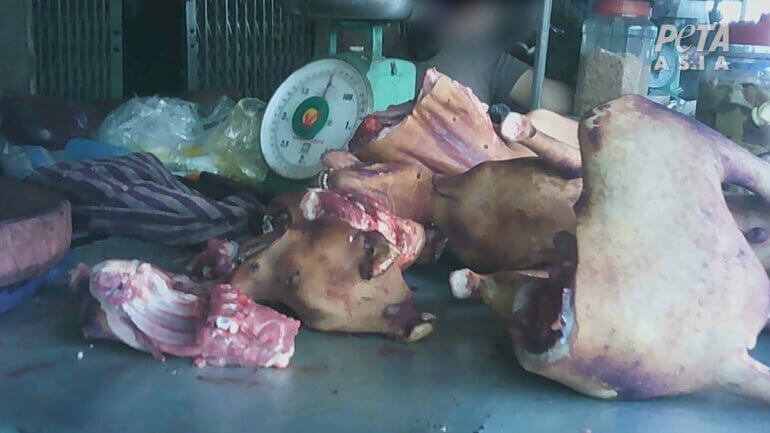
Experts say that the COVID-19 outbreak originated in a “wet market” in Wuhan, China, where humans had direct contact with live animals and dead animal flesh.

Now, this deadly disease is sweeping through blood-soaked, offal-strewn meat-processing plants and endangering workers, their families, and the whole community. And like wet markets, squalid abattoirs and meat factories are known to be hotbeds for disease.

According to Public Health England, “Many (60 to 80% [of]) emerging infections are derived from an animal source.” Filthy factory farms, abattoirs, and meat markets threaten the health of every human being on the planet by providing a breeding ground for deadly pathogens like the ones behind COVID-19, SARS, bird flu, and more.

Jo-Anne McArthur / We Animals

As COVID-19 spreads like wildfire from worker to worker, PETA is calling for abattoirs and meat-processing plants to shut down and stay closed, for everyone’s protection.

What You Can Do

Not only is animal agriculture responsible for deadly pandemics and putting human lives at risk, it also causes other animals immense suffering and is destroying the planet.

Humans’ mistreatment of other animals is harming not only them but also us, and now is the time for each and every person to take responsibility for our part.

The link between outbreaks of diseases like COVID-19 and eating meat is undeniable – and the solution is clear: to prevent future pandemics, humans must stop abusing other animals and go vegan.

Meat prices are surging. Good news: Fake meat is getting cheaper

https://www.cnn.com/2020/06/17/business/meat-prices-beyond-patties/index.html

 (CNN Business)With meat prices on the rise, a plant-based protein purveyor is making a play for consumers’ pocketbooks.

Beyond Meat (BYND)next week plans to launch a value pack of its plant-based burger patties for sale in retailers’ frozen food sections. The Cookout Classic 10-pack, which Beyond Meat is positioning as a limited-edition product, was developed as a way to sell patties that otherwise would have been produced for restaurants, which have been devastated by the pandemic and stay-at-home measures.
The company wants to narrow the price gap between plant-based and animal meat, Chuck Muth, Beyond Meat’s chief growth officer, said via email to CNN Business. The 10-pack has a suggested retail price of $15.99, or $1.60 per quarter-pound patty. By comparison, Beyond Meat’s two-patty pack sells for $5.99, just shy of $3 per patty.
The product launch comes at a time when meat has been getting a lot more expensive. Prices for meat, fish, poultry and eggs rose 3.7% in May from April, according to the Bureau of Labor Statistics. Beef and veal prices were up 11%, the largest ever monthly increase.
“We know that to be successful we have to win on taste, win on nutrition, and ultimately win on price,” he wrote. “If we can do those three things, we see tremendous opportunity to transition consumers from animal-based to plant-based meat.”
The cheaper plant-based products are still expected to be sold at a premium to animal beef — even though the traditional meat is pricier than this time last year.
Beef patties averaged $5.26 per pound as of June 12, according to the US Department of Agriculture. Those prices are up 5.26% from the week before and 17.7% from the comparable year-ago period.
The value-pack launch is one of several efforts to garner new customers. Beyond Meat plans to launch a direct-to-consumer website this summer and also is offering some of its current lineup at a discount.
The value pack concept could offer an attractive entry point for new and more price-sensitive customers, wrote Jon Andersen, a William Blair analyst, in a June 10 note.
Additionally, the move serves as an operational solution for lost sales at restaurants and other foodservice locations negatively affected by shutdowns, Andersen noted.

Trump Launches ‘Biggest Attack On Meat Giants In Centuries’

The Department of Justice is opening a probe into beef prices which recently doubled in a month
The Trump Administration is launching a probe into U.S. meat giants (Photo: Gage Skidmore)

The Trump Administration is launching a probe into U.S. meat giants (Photo: Gage Skidmore)

Donald Trump is launching what reports have branded the ‘biggest attack in centuries‘ on the giants of the U.S. meat industry.

The Department of Justice is launching a probe into beef companies, following beef prices almost doubling earlier this year, after more than 20 slaughterhouses across the U.S. were forced to shutter due to COVID-19 outbreaks.

Bloomberg reports that ‘regulators are also scrutinizing potential price manipulation, and on Capitol Hill, lawmakers are clamoring for a crackdown’, adding that ‘farmers have long complained about the dominance of just a handful of companies in beef and poultry markets, but antitrust enforcers haven’t before taken significant action against the companies’.

Antitrust laws

The probe follows reports that while consumers were paying these staggeringly high prices for meat, meat packing giants were extremely low prices to ranchers and farmers.

The probe will investigate whether these meatpacking companies are manipulating prices. If so, they could be violating antitrust laws – aka competition laws – statutes developed by the U.S. government. They were put in place to protect consumers by ensuring that fair competition exists in an open-market economy

‘Broken’

Ben Gotschall is interim executive director for the Organization for Competitive Markets, which advocates against consolidation in agriculture.

He told Bloomberg: “The market’s been broken for a long time, and the pandemic has just made it worse. Meatpackers are making record profits, and the ranchers are going out of business.

“Whatever Trump’s motivation might be, if he does the right thing you have to take it. I hope it’s more than just lip service.”

HOW TO BEAT A VEGAN IN ANY ARGUMENT

: Your step-by-step guide to justify killing animals and destroying the planet.
Step 1: REMIND THEM THAT OUR ANCESTORS ATE MEAT- No vegan is aware of this, but one thing they are aware of is that if humans have been doing something for thousands of years, it must be acceptable. After all, there’s nothing worse than moral progress!

Step 2: BECOME A PLANT RIGHTS ACTIVIST- Everyone knows that cutting the throat of live animals and cutting vegetables is the same thing. Vegans aren’t aware of the fact that plants feel pain too, and make sure to raise your voice whenever a vegan cuts a carrot.

Step 3: ASK THEM WHAT THEY’D DO IF THEY WERE STRANDED ON A DESERT ISLAND- Vegans routinely get stuck on desert islands and have to eat animals of desert for survival.

Step 4: REMIND THEM THAT EATING MEAT ISN’T ILLEGAL – If politicians think killing animals is okay, then it must be!

Step 5: SHOUT “UMM CHICKEN” REPEATEDLY- Vegans have never heard of this product. This will disorientate the vegan.

Step 6: POINT AT YOUR CANINE TEETH-
we know that if you have a body part capable of doing something, that means it’s okay to do whatever it/they can be used for. For consistency, make sure to sexually assault someone and then point at your penis when the police questions you why you did it.

Step 7: TELL THEM THAT WE NEED TO EAT ANIMAL PRODUCTS TO SURVIVE- Many vegans are unaware of the fact that they are actually dead, much like Bruce Willis’ character in ‘The Sixth Sense’.

Step 8: TELL THEM THAT MEAT IS TASTY- vegans aren’t aware of this, since none of them have ever eaten meat in their entire lives. Just tell them meat is yummy,they will definitely start killing animals for meat.

Step 9: TELL THEM VEGAN FOOD TASTES LIKE SHIT- It’s a well known fact that not a single one of the 20,000 edible plant species on earth or the spices and other products derived from them are even slightly appetising.

Step 10: REMIND THEM THAT THEY USE ELECTRICITY AND MOBILE PHONES- Being involved in a justice movement is hypocritical if you use electricity or mobile phones. Be sure to also tell racial equality campaigners, women rights and gay rights activists and anti child abuse campaigners that their cause is pointless for the same reason.

Step 11: CALL THEM PUSSY AND WEAK- we all know the one who cares for the weak and voiceless is pussy and weak by heart, tell them that killing the weakest animals remorselessly is what makes us strong.

Step 12: REMIND THEM THAT YOUR SITUATION IS JUST LIKE A LION’S – tell them you eat meat because you wanna be a lion! Let them know about that one time you stalked your prey down in a jungle with your canine teeth and flawless strength of your jaws and limbs to feed your family who was dying of hunger.

Step 13: MAKE THEM AWARE OF HOW YOU EATING MEAT AND ANIMAL PRODUCTS ACTUALLY BENEFITS THINGS- Finally, make the vegan aware of all the good eating meat, cheese, milk, eggs, fish, etc. does for animals, the environment, and other humans. Seeing as veganism helps none of those things, this will make the vegan realise which is the cause REALLY worth fighting for.

Step 14:- MAKE THEM AWARE THAT WE ARE OMNIVORES BECAUSE WE CAN MAKE WEAPONS TO HUNT ANIMALS- many vegans aren’t aware that even if we are not biologically and naturally capable of hunting animals, we can use weapons to kill them,so that makes us omnivores, for consistency make sure to kill your neighbour’s dog with a weapon and tell them that you did it because you are an omnivore.

STEP 15- LET THEM KNOW THE FARM ANIMALS ARE RAISED BY US SO ITS OK TO TAKE THEIR LIVES AWAY- for consistency kill your own children and tell the police that you did it because you brought them into existence, police will definitely understand you.

Step 16- TELL THEM ITS YOUR PERSONAL CHOICE – it’s a well known fact that its a personal choice to cut the throats of the animals just to eat them.

Step 17- TELL THEM VEGANS ARE ANNOYING AND THEY SHOULDN’T ACT AS IF THEY ARE SUPERIOR TO EVERYONE ELSE- Despite the fact that they do live by a higher ethical standard, they shouldn’t feel superior just because they don’t take lives of the animals. Let them know killing animals is what makes us superior.

Step 18- TELL THEM ITS THE SURVIVAL OF THE FITTEST- Its a well known fact that the strong prey on the weak and nature is cruel, for consistency make sure to kill little kids and then tell the police “its survival of the fittest,the strong prey on the weak and tell them nature is cruel”.

Step 19- FINALLY SHUT THEM UP AND TELL THEM TO STOP FORCING THEIR BELIEFS DOWN YOUR THROAT- we all know that forcing knives against the Throats of animals is better than forcing our beliefs down someone’s throat who isn’t comfortable with hearing the truths.

It’s Time to Rethink Our Food Choices

United Poultry Concerns <http://www.UPC-online.org>
June 7, 2020

JUNE 6, 2020

UPC President Karen Davis’s Letter to the Editor appears in the printed and
screen versions of Virginia’s *Eastern Shore Post* this week.

Dear Editor:

The coronavirus pandemic focuses our attention on the link between
cleanliness
and avoidance of disease. As much as possible, people are sanitizing their
hands, social distancing, and covering their faces to prevent the virus from
spreading. Yet most people consume products from chickens and other animals
who
have spent their life in polluted, overcrowded facilities.

Infectious microbes are drawn to population density, dirt, and weakened
immune
systems – the perfect conditions in which to spread in animals and humans
alike.

One of the worst things we do to animals in industrial farming is to prevent
them from practicing hygiene.

When chickens come to our sanctuary from a confinement facility, their
first act
in being placed on the ground is to take a dustbath. They instinctively
want to
clean their skin and feathers with particles of earth. This, for them, is
comparable to a waterbath for us.

Forcing animals to live in filth and breathe air rife with pathogens is an
experience they would not choose on their own.

Recognizing the importance of hygiene and staying healthy, we need to
remember
that the same link between health and hygiene applies to other species.
Animals
in nature would never survive if they carried the load of diseases and
immunological weaknesses that characterize modern farmed animals.

Let us think carefully about our food choices. A plant-based diet free of
animal
products is increasingly desirable and obtainable in today’s society. While
providing an opportunity for a more peaceful world, it is also an
intelligent
food safety choice.

A plant-based diet will not sacrifice jobs or hurt the economy. As long as
people exist, the same amount of food will be produced and consumed. Just
because we stop eating animal products doesn’t mean we stop eating.

Karen Davis, President
United Poultry Concerns, Machipongo

*Eastern Shore Post:*
It’s Time to Rethink Our Food Choices
<https://www.easternshorepost.com/2020/06/06/its-time-to-rethink-our-food-choices/

Rethinking meat — from farm to table

https://www.adirondackdailyenterprise.com/opinion/columns/field-and-forest-by-richard-gast/2020/06/rethinking-meat-from-farm-to-table/?fbclid=IwAR06tYGCKzST3OCU2s2nfzZ3mVFhJof3oPGUzDYGxu0fGOcY82ZOIYyWn74

Kate Mountain Farm is one of many Adirondack Harvest-associated local farms offering CSA meats and vegetables. Find local producers at adirondackharvest.com/browse. (Photo provided)

The food supply chain system is vulnerable. America’s meatpacking plants endure some of the highest rates of workplace injury of any U.S. job sector, and COVID-19 has introduced yet another occupational hazard. These crowded facilities have become frighteningly successful vectors for COVID-19 contagion.

On Sunday April 26, a news release entitled, “A Delicate Balance: Feeding the Nation and Keeping Our Employees Healthy” appeared as a full-page ad in The New York Times, The Washington Post and the Arkansas Democrat-Gazette. It was also widely posted on Facebook, Twitter, etc.

Written by John H. Tyson, chairman of the Board of Tyson Foods, the statement declared, “In small communities around the country, where we employ over 100,000 hard-working men and women, we’re being forced to shutter our doors. This means one thing — the food supply chain is vulnerable. As pork, beef, and chicken plants are being forced to close, even for short periods of time, millions of pounds of meat will disappear from the supply chain. … Farmers across the nation simply will not have anywhere to sell their livestock to be processed, when they could have fed the nation. Millions of animals — chickens, pigs and cattle — will be depopulated because of the closure of our processing facilities. The food supply chain is breaking.”

And with that, Southern and Midwestern farmers began euthanizing livestock.

Two days after the publication of Tyson’s letter, President Trump declared that meatpacking plants were “critical infrastructure” under the Defense Production Act of 1950 and prohibited their closure.

While this was happening, vegetable farmers were forced to let their crops rot in the fields or plow otherwise harvestable food into the ground. Dairy farmers, already grappling with low prices, found themselves dumping more than 3.5 million gallons of milk every day (estimate from Dairy Farmers of America). And everywhere, food pantries, facing unprecedented demand, were running out of food. This clearly reveals just how vulnerable, and how unjust, our food supply system can be. It also emphasizes the need to fix it.

Zoonosis: diseases transmitted to humans from animals

Lots of diseases, including most pandemics (e.g. H1N1 [swine flu], H5N1 [bird flu], Ebola, Lyme disease, malaria, rabies, ringworm, West Nile virus, severe acute respiratory syndrome [SARS], HIV/AIDS), originated in animals.

The Spanish flu pandemic of 1918, which infected roughly one-third of the world’s population of 500 million people, killing an estimated 50 million including 675,000 Americans, is believed to have originated on a pig farm. That was long before CAFO factory farms existed.

CAFOs: confined animal feeding operations

CAFO farms can generate a myriad of environmental and public health problems. CAFO manure contains potential contaminants including plant nutrients (e.g. nitrogen, phosphorus) and pathogens (e.g., E. coli, growth hormones, antibiotics, animal blood, silage leachate). The volume of waste produced depends on the type and number of animals farmed. A feeding operation with 800,000 pigs can produce over 1.6 million tons of waste a year. That amount is one-and-a-half times more than the annual sanitary waste produced by the city of Philadelphia, Pennsylvania (GAO, 2008).

The Environmental Protection Agency’s 2000 National Water Quality Inventory found that 29 states specifically identified animal feeding operations (AFOs), not just CAFOs, as contributing to water quality impairment (Congressional Research Service, 2008).

In order to protect their livestock from diseases that might kill entire populations, resulting in huge profit losses, CAFO farmers commonly treat their animals with antibiotics. And poultry fed antibiotic feed show significantly higher weight gain than those fed non-antibiotic feed (Settle et al. 2014). Animals growing at a greater rate than they would otherwise reduces operating costs and increases profit.

But use of antibiotic feed is threatening human health. Every year 2 million people experience serious illness due to untreatable bacterial infection and 23,000 die because the bacteria that made them sick is antibiotic-resistant (Young 2013). When antibiotic-resistant bacteria spreads to a large group of people and cannot be treated, we have what is known as a superbug. And many scientists believe that superbugs are the inevitable consequence we will face if CAFOs continue to use antibiotics indiscriminately in the feed of the nation’s largest source of meats.

Then there’s the animal cruelty issue, which I won’t get into here, other than to say that 9 billion animals, including 8.8 billion chickens, are raised and killed on large, overcrowded U.S. CAFO farms every year (source: Humane Society of the United States).


Locally sourced meat: a better alternative

There’s a better way to keep your freezer full: meat CSAs. Community-supported agriculture (CSA) farm programs directly connect farmers to consumers. You know right where your food is coming from. You’re supporting local farming families that raise top-quality pastured and grass-fed livestock — working with nature rather than against it. Pasture-based farming improves animal health, maximizes cost-efficiency and minimizes farm pollution. You reap the rewards by purchasing affordable, quality meats (and eggs) produced using sustainable farming practices.

You buy a share, and you pick it up when it’s ready. It’s that simple. And most farms offer share sizes to fit everyone’s needs. You can receive meat on a regularly scheduled timetable or one time only.

To learn more or find pretty much every type of locally grown and/or prepared food imaginable (and more), visit adirondackharvest.com/browse or contact your local Cornell Cooperative Extension office.

Humans and Neanderthals: Less different than polar and brown bears

https://phys.org/news/2020-06-humans-neanderthals-polar-brown.html

Humans and Neanderthals: less different than polar and brown bears
Credit: Kennis & Kennis Reconstructions

Ancient humans, Neanderthals and Denisovans were genetically closer than polar bears and brown bears, and so, like the bears, were able to easily produce healthy, fertile hybrids according to a study, led by the University of Oxford’s School of Archaeology.

The study, published 3 June in the journal Proceedings of the Royal Society B, shows that the genetic distance values between humans and our ancient relatives were smaller than the distance between pairs of species which are known to easily hybridize and have fertile young.

Professor Greger Larson, Director of the Palaeogenomics & Bio-Archaeology Research Network (PalaeoBARN) at Oxford and senior author of the study says, “Our desire to categorize the world into discrete boxes has led us to think of species as completely separate units. Biology does not care about these rigid definitions, and lots of species, even those that are far apart evolutionarily, swap genes all the time. Our predictive metric allows for a quick and easy determination of how likely it is for any two species to produce fertile  offspring. This comparative measure suggests that humans and Neanderthals and Denisovans were able to produce live fertile young with ease.”

The long history of matings between Neanderthals, humans, and Denisovans has only recently been demonstrated through the analysis of ancient genomes. The ability of mammalian species, including , to produce fertile hybrid offspring has been hard to predict, and the relative fertility of the hybrids remains an open question. Some geneticists have even said that Neanderthals and humans were at the “edge of biological compatibility.”

So the team developed a metric using genetic distances to predict the relative fertility of the first generation of hybrids between any two mammalian species. They did this by analyzing genetic sequence data from different species that had previously been shown to produce hybrid offspring. By correlating the genetic distance with the relative fertility of the hybrid offspring, it was possible to show that the greater the evolutionary distance between any two species, the less likely it is that the  between them would be fertile. In addition, the team used the distance values to determine a threshold of fertility.

When the distance values between humans, Neanderthals and Denisovans were calculated, they were even smaller than the values between several pairs of species which are known readily and easily to hybridize—including  and , and coyotes and wolves. This suggests we could have predicted the existence of Neanderthals and Denisovans in our genomes as soon as the first genetic sequences were generated.

This proxy can also be used to predict the likelihood that any two mammal species can give birth to live hybrids, a useful tool that can be used in decisions about whether to place animals together in zoos.

Richard Benjamin Allen, joint first author of the study says, “Many decisions in  have been made on the basis that related organisms that produce hybrids in captivity should be prevented from doing so. Such an approach has not considered the significant role that hybridisation has played in evolution in the wild, especially in populations under the threat of extinction. Our study can be used to inform future conservation efforts of related  where hybridization or surrogacy programs could be viable alternatives.”


Trump Demanded Meat Plants Stay Open, COVID Cases Have Now Tripled

President Donald Trump issued an executive order in late April requiring all meat processing plants in the U.S. to remain open, despite reports of coronavirus infections and related deaths being prevalent at a number of the plants.

Since that order was issued, the number of COVID-19 cases that have been identified at meat plants across the country has likely tripled, according to estimates from a nonprofit watchdog group.

At the time of Trump’s executive order, the Centers for Disease Control and Prevention (CDC) had identified around 5,000 employees across 20 meat processing plants who had contracted COVID-19, and 17 workers at those plants who had died from the disease. In spite of concerns about the disease spreading at these and other locations, the president issued his order, utilizing the Defense Production Act to classify processing plants as essential infrastructure.

The executive order prevented local governments and health officials from enforcing plant closures in the event of an outbreak and it’s now apparent that the disease has indeed spread at these meatpacking locations since the order.

More than 100 plants across the country have seen a high number of cases of COVID-19. The Food & Environment Reporting Network (FERN), a nonprofit journalism watchdog group dedicated to food and agricultural issues, estimated in a report published last week that 17,000 workers may have now contracted the disease, with at least 66 COVID-related deaths recorded among employees at meat processing plants.

In light of this, other organizations are demanding the federal government take a more proactive approach toward limiting the spread of COVID-19. Citing the large numbers of workers at meat processing plants contracting coronavirus, the Center for Food Safety produced a petition in which it demanded the U.S. Department of Labor’s Occupational Safety and Health Administration (OSHA) issue new emergency standards to protect employees’ health.

“Protecting workers in meatpacking plants is important not just for the workers, but also for our food safety,” the organization wrote in its letter. “Unprotected and sick workers are more likely to make mistakes, making it more likely that tainted meat gets onto store shelves. The last thing we need during this pandemic is a major foodborne illness outbreak.”

There are a number of reasons why meatpacking plants could be hotbeds for COVID-19. Workers typically stand close together, often shoulder-to-shoulder, on the assembly line. Many workers aren’t wearing protective gear at this time either, as it slows down their pace of work, while the companies themselves have admitted to struggling to find the necessary protective equipment for their workers, even after Trump’s executive order was issued.

Colder temperatures in the plants may also be helping the virus linger longer on surfaces or in air particles, and ventilation systems may be spreading coronavirus throughout the buildings.

Among the U.S. population in general, it’s feared that coronavirus will likely continue to spread even more than it already has, as several states begin transitioning away from stay-at-home orders that were previously issued.

As of Tuesday this week, the nation surpassed 100,000 deaths from COVID-19, and one estimate forecasts that 30,000 more Americans could die from the disease by Independence Day. Many health experts agree that a second wave of cases is likely to come about as states reopen businesses and other public areas.