Exposing the Big Game

Forget Hunters' Feeble Rationalizations and Trust Your Gut Feelings: Making Sport of Killing Is Not Healthy Human Behavior

Exposing the Big Game

The real reason Trump treats meatpacking workers as disposable

Tyson employee says HR told him, 'Come to work, you're safe'

CONCERNS HAS RESULTED IN A
COLLECTIVE DECISION TO
Now PlayingTyson employee says…
Tyson employee says HR told him, ‘Come to work, you’re safe’ 02:21

Raul A. Reyes is an attorney and a member of the USA Today board of contributors. Follow him on Twitter @RaulAReyes. The opinions expressed in this commentary are solely those of the author. View more opinions on CNN.

(CNN)Get back to work, says President Trump. He might as well add: even if it might kill you.

Tuesday, he used the Defense Production Act to order meat and poultry processing plants to stay open, despite the coronavirus pandemic. He declared them “critical infrastructure” in an executive order designed to avoid shortages of beef, pork and chicken.
“We’re working very hard,” Trump said, “to make sure our food supply chain is sound and plentiful.”
Given that meat processing plants are Covid-19 hotspots, this order is the height of irresponsibility and cruelty. It endangers the health of some of America’s most vulnerable workers, many of whom are Latino, African American and immigrants. It prioritizes corporate interests over workers’ lives.
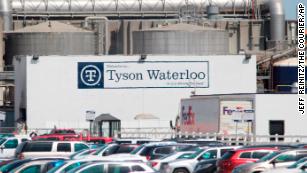
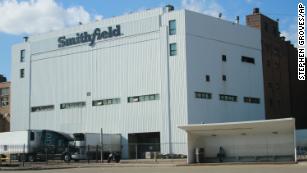
Across the country, meatpacking plants have been closing as their employees have gotten sick. Smithfield Foods closed its pork processing plant in Sioux Falls, South Dakota, this month after more than 600 workers tested positive for coronavirus. Last week, Tyson Farms shut down its biggest pork processing plant in Waterloo, Iowa, after more than 180 workers tested positive.
Other plants across the country have similarly closed, with reports of coronavirus-related illness and deaths.

Mayor: Closing Tyson plant was ‘best course of action’ to support workers 04:13
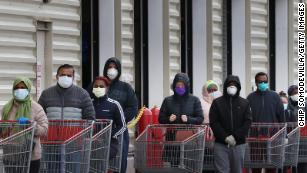
The employees at such plants work under extremely difficult, hazardous conditions. They often work shoulder to shoulder, receiving and killing animals and butchering them for sale. It is grueling, repetitive work that many Americans would shudder at doing, especially given the risk of injury and the low pay.
In 2017, employees at meat plants earned on average about $15 an hour plus benefits, while employees at chicken plants earned on average about a dollar less per hour. The think tank New American Economy estimates that nearly half of this workforce is made up of immigrants, and many are people of color.
Trump’s order may well amount to a death sentence for workers in meatpacking plants, who have little choice but to continue to work to provide for their families. In Iowa, for example, citing Iowa state data, The Gazette reports that African Americans and Latinos have disproportionately high rates of coronavirus as a result of their work in meatpacking plants when compared with US Census Bureau figures on their relative representation in the state: While Latinos are 6% of Iowa’s population, they account for 17% of the state’s confirmed coronavirus cases. African Americans are 3% of the state’s population, yet they are 9% of the state’s coronavirus cases.
These are the people the President wants to continue working for the benefit of American consumers. How unsurprising that the President, who has shown unprecedented cruelty and disdain for immigrants and minorities, now expects them to risk their lives so we all can have an uninterrupted food supply.
Recall, for one example, that last year, Trump ordered massive sweeps of food processing plants in Mississippi, resulting in hundreds of arrests of undocumented workers, as well as devastated communities.
The way Trump rolled out this executive order is especially telling. He told reporters he was working with Tyson Foods — as opposed to health and workplace safety experts. The order was developed in consultation with corporate industry leaders.
“We’re going to sign an executive order today, I believe, and that’ll solve any liability problems,” Trump said on Tuesday.
How meat plant closures could impact consumers

How meat plant closures could impact consumers 02:46
While his executive order states that employers will follow guidelines from the US Centers for Disease Control and Prevention and the Occupational Safety and Health Administration, his main concern seems to be for corporate bosses, not for employees or public health. And does anyone think that the President would be comfortable ordering white-collar professionals to stay at work, despite significant health risks of Covid-19 transmission?
That Trump was reluctant to invoke the Defense Production Act to expedite the production of personal protection equipment (PPE) for health care workers, and is now invoking the act in a manner that could truly harm meat plant workers, speaks volumes.
The president and CEO of the North American Meat Institute told the website Vox that meat processing plants are completely disinfected every night after the last shift, and that workers are required to wear masks and face shields when the plants can obtain them.
Separately, Dean Banks, the head of Tyson Foods, told CNN’s Erin Burnett that “we’re doing everything we can to make sure we take care of our team members.” Banks said that his company was “extremely early in providing as many protective measures as we could possibly imagine.”
Yet if conditions were safe, employees would not be staging walkouts and protesting at meat plants over working conditions.
There is no doubt that the meat processing sector is facing a serious threat from the coronavirus pandemic. The United Food and Commercial Workers international Union noted that plant closures have resulted in a 25% decline in pork slaughter capacity and a 10% reduction in beef slaughter capacity.
But the union also estimated that 20 meatpacking and food processing union workers have died from the virus so far, and that 6,500 union workers are sick or have been exposed to the virus. So safeguarding our food supply needs to begin with safeguarding workers on the food supply chain. A thoughtful response to this situation would be to prioritize worker safety, not corporate input.
Trump should be ordering the meat processing industry to comply with the highest standards of social distancing and safety, or else face fines and criminal liability. Instead he is protecting the industry at the expense of its workers.
Like so many other aspects of his administration’s coronavirus response, Trump’s latest executive order is profoundly misguided and negligent. Meat processing plant employees are not expendable — and should not be forced back into dangerous working conditions.

Is COVID-19 The Beginning Of The End For McDonald’s?

McDonald’s has temporarily closed. Is this a sign of things to come for the fast food giant?
Are McDonald's famous golden arches on the way out? (Photo: Adobe. Do not use without permission)

Are McDonald’s famous golden arches on the way out? (Photo: Adobe. Do not use without permission)

From the time the UK saw its first set of golden arches go up in 1974, our nation had never experienced a widespread closure of McDonald’s restaurants… until COVID-19 crossed our shores.

As of 7pm on March 23, each of the 1,270+ McDonald’s locations across the UK closed their doors, with no set date for their reopening. These are unprecedented times.

A bad thing

For the first time in decades, people no longer have access to the American company’s signature burgers and chicken nuggets. But is this such a bad thing for customers? And how will this impact animals?

With growing concerns about food safety in light of the COVID-19 pandemic and estimates that three out of every four new or emerging infectious diseases in people come from animals, it’s about time that food companies ramped up their efforts to prevent the spread of such diseases.

It’s been proven that the immune systems of animals raised on lower welfare factory farms are far weaker than any other; couple this with the immense overcrowding seen on these intensive farms – where some 90 percent of farmed animals are raised – and the risk of contracting and spreading dangerous diseases is worryingly high.

McDonald’s contribution

That being said, how is McDonald’s contributing to this issue? In part due to their size, chickens are the land animals raised in the greatest numbers by far. Every single year, approximately 25 million chickens are bred and slaughtered for McDonald’s UK alone.

That’s nearly one chicken for every two Brits, before even factoring in the many other animals that suffer immensely in order to maximise the company’s profits.

But maybe these birds are raised to high welfare standards and meet a relatively painless end…? Sadly not. Despite key competitor KFC adopting a robust set of chicken welfare standards in July 2019, known as the Better Chicken Commitment, McDonald’s is still yet to follow suit.

Chickens in a factory farm

Every single year, approximately 25 million chickens are bred and slaughtered for McDonald’s UK alone

Welfare issues

Among other issues, the company has failed to make a commitment to end the use of fast-growing chickens, meaning that the millions of birds in its supply chain grow so big, so fast, that their legs and organs are pushed to the absolute limit.

Some become unable to walk, while others die of heart attacks in just the first few weeks of their short lives. To make matters worse, these enormous birds are shockingly packed into sheds by the tens of thousands, each having as little space as an A4 piece of paper.

You’d be forgiven for thinking that the miserable, pain-ridden lives of these animals couldn’t get any worse, but sadly that’s not the case. At just five weeks old, they will experience a distressing journey to the slaughterhouse, where they will face a terrifying end. Because of the current stunning methods permitted by companies like McDonald’s, there’s no guarantee that every bird will be rendered unconscious before having their throats slit and bodies dunked in scalding hot water. The thought alone is too much to bear.

Do the animal-loving people of the UK really want chickens to be raised in such a horrific way? No.

Do they want companies like McDonald’s to put the public’s health at risk by continuing these potentially dangerous practices? Absolutely not.

The fast-food giant has failed to keep up with its competitors when it comes to offering meat alternatives (Photo: Adobe. Do not use without permission)

The fast-food giant has failed to keep up with its competitors when it comes to offering meat alternatives (Photo: Adobe. Do not use without permission)

Meat alternatives

Could it be that McDonald’s has instead focused its efforts on reducing the sale of meat to tackle these issues? Unfortunately not.

While KFC has spared no time in introducing its first plant-based burger, and Burger King following suit with its veggie Rebel Whopper, McDonald’s has failed to satisfy the public’s growing appetite for good quality meat-alternatives. The company’s meagre offering of veggie dippers earlier this year certainly did not get its customers’ heart’s racing.

During this challenging period, we have a great opportunity to take stock of what’s going on in the food industry and reevaluate which companies are acting in the best interests of people and animals. Likewise, companies like McDonald’s have the chance to restrategize and start making meaningful changes that benefit society.

There has never been a better time for McDonald’s to step out of the dark ages of food production and into the modern day. 2020 is a dangerous time for food companies to ignore the growing demand for high animal welfare standards and delicious plant-based food. If these issues aren’t addressed soon, we could be looking at the beginning of the end for McDonald’s.

Coronavirus: Trump orders meatpacking plants to stay open


Share this with Email Share this with Facebook Share this with Twitter

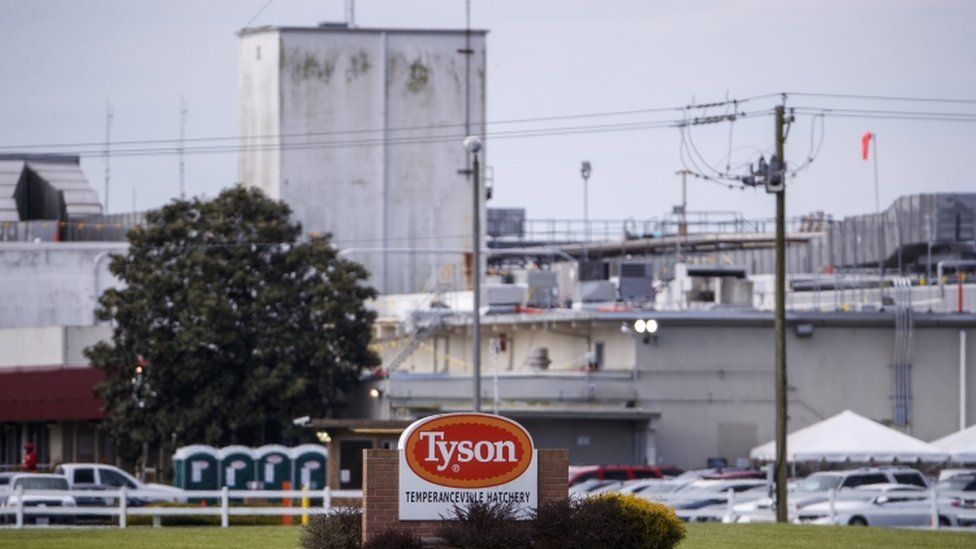
Image copyrightEPATyson Foods poultry processing plant in Temperanceville, VA
Image captionClosures of meat processing plants quickly affect the food supply chain

US President Donald Trump has ordered meat processing plants to stay open to protect the nation’s food supply amid the coronavirus pandemic.

He invoked a Korean War-era law from the 1950s to mandate that the plants continue to function, amid industry warnings of strain on the supply chain.

An estimated 3,300 US meatpacking workers have been diagnosed with coronavirus and 20 have died.

The UN last month warned the emergency threatened global food supply chains.

Twenty-two US meatpacking plants across the American Midwest have closed during the outbreak.

They include slaughterhouses owned by the nation’s biggest poultry, pork and beef producers, such as Smithfield Foods, Tyson Foods, Cargill and JBS USA.

What does the White House say?

“Such closures threaten the continued functioning of the national meat and poultry supply chain, undermining critical infrastructure during the national emergency,” says Tuesday evening’s executive order, invoking the 1950 Defense Production Act.

“Given the high volume of meat and poultry processed by many facilities, any unnecessary closures can quickly have a large effect on the food supply chain.”

The order designates the meatpacking plants as part of critical infrastructure in the US.

A White House official told US media it will work with the Department of Labor to issue guidance for vulnerable workers, such as over-65s and those with chronic health conditions, to stay at home.

Presentational grey line

Like lambs to the slaughter?

Analysis by Jessica Lussenhop, BBC News

The leadership of large meatpacking companies have faced tough questions over whether they did enough to prepare for the pandemic and protect workers.

On top of the fact that production lines necessitate that workers stand very close together, most are low-income, hourly workers.

Many are immigrants living paycheque to paycheque, like the ones at a Sioux Falls, South Dakota, pork plant who told the BBC that despite the risk, they have no choice but to go to work if plants are open.

Without strict adherence to safety guidelines – which are not currently being deemed “mandatory” by the Occupational Safety and Health Administration – it’s not hard to picture new outbreaks at factories, or resurgences of the virus in factories that shuttered but reopen prematurely.

All of this could leave these employees trapped in the same impossible choice they were in when the virus first began spreading in factories in late March: risk my health or lose my job.

Presentational grey line

What does the meat industry say?

John Tyson, chairman of Tyson Foods took out full-page ads on Sunday in the Washington Post and New York Times to warn “the nation’s food supply is breaking”.

“As pork, beef and chicken plants are being forced to close, even for short periods of time, millions of pounds of meat will disappear from the supply chain,” he wrote.

“As a result, there will be limited supply of our products available in grocery stores until we are able to reopen our facilities that are currently closed.”

He said millions of cattle, pigs and chickens will be euthanised because of slaughterhouse closures, limiting supplies at supermarkets.

Pork production has borne the brunt, with daily output slashed by at least a quarter.

Tyson – which employs some 100,000 workers nationwide – has suspended operations at its pork plant in Waterloo, Iowa.

Smithfield Foods shut down production at its plant in Sioux Falls, South Dakota, after an outbreak infected hundreds of employees.

What do the unions say?

The United Food and Commercial Workers International Union (UFCW), the largest US meatpacking union, demanded the Trump administration compel meat companies to provide proper protective equipment and ensure daily coronavirus testing for slaughterhouse workers.

“While we share the concern over the food supply, today’s executive order to force meatpacking plants to stay open must put the safety of our country’s meatpacking workers first,” said the union.

The UFCW said the White House order would provide legal cover to companies in case employees catch coronavirus at work.

“We’re working with Tyson,” Mr Trump told reporters in the Oval Office earlier on Tuesday. “We’re going to sign an executive order today, I believe, and that will solve any liability problems.”

Richard Trumka, the president of the AFL-CIO union, said: “Using executive power to force people back on the job without proper protections is wrong and dangerous.”

Meat shortage and China deals send Beyond Meat’s stock spiking

https://www.cnn.com/2020/04/27/investing/beyond-meat-stock-food-supply-shortage-starbucks-china/index.html

New York (CNN Business)Warnings of potential meat shortages in the United States because of food processing closures have led to a boom for Beyond Meat’s stock. New deals to sell plant-based food in China are helping too.

Shares of Beyond Meat (BYND) soared more than 40% last week. That was the stock’s best weekly performance since the company’s initial public offering last May. It rose again in early trading Monday but reversed course by midday and was down 5% after an analyst at UBS downgraded Beyond Meat’s stock to a “sell” rating.
Coronavirus outbreaks at meatpacking plants have led to closures of beef, pork and poultry facilities at major food processing companies Tyson (TSN). Chinese-owned Smithfield and Brazil’s JBS (JBSAY).
Tyson warned that “the food supply chain is breaking” in an ad published Sunday in The New York Times, Washington Post and Arkansas Democrat-Gazette.

Tyson employee says HR told him, ‘Come to work, you’re safe’ 02:21
Investors are clearly betting consumers may buy more plant-based proteins like burgers and sausage made by the likes of Beyond Meat and its top rival Impossible Foods if they aren’t able to find real beef, chicken or pork at their local supermarket.
close dialog
But a coronavirus-induced meat supply shortage isn’t the only thing that is lifting Beyond Meat’s stock. Beyond Meat’s entry into China — which is now trying to move past its own coronavirus crisis — also has investors excited.
Starbucks (SBUX) announced last week that it was adding three Beyond Meat dishes to its menu in China: Beyond Beef pesto pasta, lasagna and a spicy-and-sour wrap.
Beyond Meat CEO Ethan Brown said in a statement that this deal, the country’s entrance into the Chinese market, is an “important milestone” that will help Beyond Meat advance “our goal of increasing accessibility to plant-based protein globally.”
Still, it’s been a volatile first year for Beyond Meat as a publicly traded company.
The stock has soared during the past three weeks and has now more than quadrupled from its initial public offering price of $25.
But shares plunged earlier this year as concerns about the Covid-19 pandemic rattled investor confidence globally and raised fears about a severe recession and pullback in consumer spending.
The outbreak has also led to concerns about a severe drop in demand at big restaurants that have partnerships with Beyond Meat, including Dunkin’ (DNKN), Del Taco (TACO) and Denny’s (DENN).
Despite the recent rebound in the stock, shares remain more than 50% below the all-time high they hit last summer shortly after the IPO.
Competition in the plant-based protein market is intense.
In addition to Impossible, which sells the Impossible Whopper through a partnership with Restaurant Brands (QSR)-owned Burger King, traditional food giants such as Nestle (NSRGF), Kellogg (K) and ConAgra (CAG) have all launched their own plant-based protein products.

Tyson Foods takes out full-page ad: ‘The food supply chain is breaking’

Volume 20%

Tyson Foods executives said in a full-page ad published Sunday that the closure of food-processing plants due to the coronavirus is “breaking” the supply chain.

In a full-page ad published in The New York Times, The Washington Post and the Arkansas Democrat-Gazette, board chairman John Tyson wrote that “the food supply chain is breaking,” saying farmers will be left without anywhere to sell livestock and “millions of animals — chickens, pigs and cattle — will be depopulated because of the closure of our processing facilities.”

“There will be limited supply of our products available in grocery stores until we are able to reopen our facilities that are currently closed,” he added.

The company has already closed facilities in Logansport, Ind., and Waterloo, Iowa, while Smithfield has closed a facility in Sioux Falls, S.D., where at least one worker has died from the virus, as well as a JBS facility in Worthington, Minn. The Waterloo, Worthington and Sioux Falls facilities comprise about 15 percent of pork production in the U.S.

At least 182 cases of the virus were linked to the Waterloo plant closure, and three employees told CNN the plant has taken insufficient steps to protect them from the virus, including conditions that made it all but impossible to properly practice social distancing inside the facility.

The company told CNN plants are sanitized daily and Tyson himself wrote in the advertisement that the company performs daily temperature checks and requires the wearing of face masks in all facilities.

How our appetite for meat can set us up for pandemics

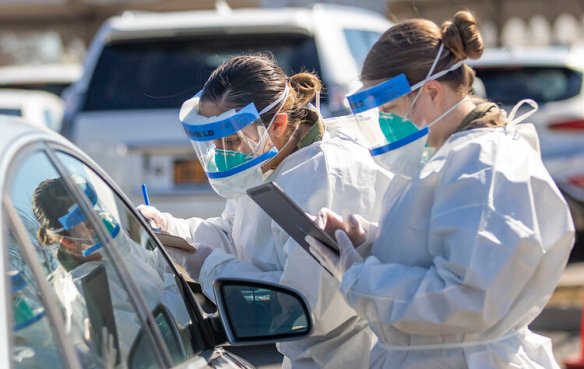
U.S. Army Spc. Reagan Long and Pfc. Naomi Velez register people at a COVID-19 Mobile Testing Center in Glen Island Park, New Rochelle, New York.  Image credit: New York National Guard

U.S. Army Spc. Reagan Long and Pfc. Naomi Velez register people at a COVID-19 Mobile Testing Center in Glen Island Park, New Rochelle, New York. Image credit: New York National Guard

https://stonepierpress.org/goodfoodnews/meatpandemics

Ed Winters, or Earthling Ed, as he’s known on Instagram, recently posted a video that received more than a million views and thousands of comments. The message of the six-minute video can be boiled down to this: “Many of the world’s deadliest outbreaks, including COVID-19, SARS, and bird flu, are directly linked to the exploitation of animals by humans.”

Winters, a British animal rights activist, filmmaker, and lecturer, is not alone in making this claim. The Counter, a food system-focused online publication, recently interviewed experts about the many potential connections between meat production and the pandemic. A March article in The Guardian, investigated the relationship between diseases like COVID-19 and global pig and poultry production. Last week, the European Union’s health chief told Reuters that there is “strong evidence that the way meat is produced, not only in China, contributed to COVID-19.”

The origins of COVID-19 are, at present, still unclear. We know COVID-19 is a zoonotic virus, meaning it can jump from animals to humans, and that it first circulated among bats. While many of the initial reported patients were linked to a seafood and live animal market in China, we don’t yet know how or when exactly the disease made the leap from animals to humans. However, there is a growing consensus that the industrialized way in which we raise the animals we eat is a risk factor for pandemics like COVID-19.

PERFECT BREEDING GROUND FOR DISEASE

Researchers have long worked to understand how animals pass diseases to humans. An estimated three out of four new or emerging infectious diseases originate in animals, and three out of five infectious diseases are spread by animals, according to the Centers for Disease Control and Prevention (CDC). Among the most common ways we catch diseases from animals is through “direct or indirect human exposure to animals, their products (meat, milk, eggs), and/or their environments,” states the World Health Organization (WHO).

“Both farmed and caged wild animals create the perfect breeding ground for zoonotic diseases.”

— LIZ SPECHT, ASSOCIATE DIRECTOR OF SCIENCE & TECHNOLOGY AT THE GOOD FOOD INSITITUTE

The demand for meat and dairy brings humans in more frequent contact with animals in a variety of ways, outlined in a 2004 report from the WHO. Most obvious are practices like live animal markets, wildlife consumption, and factory farming. There’s also evidence that deforestation, driven in large part by the demand for more grazing land, brings humans in more frequent contact with the wild animals who lose their habitats. (A Stanford study published this month in Springer found this to be true in western Uganda.) In addition, the world’s growing appetite for meat has increased global trade of livestock and more exotic wildlife, allowing zoonotic diseases to travel faster and farther.

“Both farmed and caged wild animals create the perfect breeding ground for zoonotic diseases,” says Liz Specht, Associate Director of Science & Technology at The Good Food Institute. “Extraordinarily high population densities, prolonged heightened stress levels, poor sanitation, and unnatural diets create a veritable speed-dating event for viruses to rendezvous with a weakened human host and transcend the species barrier.”

So while the coronavirus’s jump to humans was linked to a seafood and live animal market in Wuhan, China, it could just as easily have originated in Argentina, England, North Carolina, or any other place where employees of factory farms work alongside animals in cramped, stressful, and often unsanitary conditions.

“It’s easy for those of us in the Western world to shake our heads at the live wildlife markets in China,” writes Paul Shapiro, CEO and cofounder of The Better Meat Co. “But what’s more difficult is to be honest with ourselves about what kinds of pandemics we may be brewing through our own risky animal-use practices.”

FACTORY FARMING IS “A PERFECT STORM ENVIRONMENT”

Physician and best-selling author Michael Greger wrote about the threat of factory farming years ago when he published Bird Flu: A Virus of Our Own Hatching in 2006. He calls factory farming “a perfect storm environment” for pandemics. “If you actually want to create global pandemics,” he warns, “then build factory farms.”

History has validated Greger. The 1918 flu, which killed around 50 million people, is thought to have originated on a poultry farm in Kansas. The 1997 H5N1 bird flu likely started on Chinese chicken farms. More recently, a 2015 bird flu outbreak on North American chicken farms killed more than 32 million birds in 16 states, causing egg and poultry prices to skyrocket, though thankfully it never made the leap to humans. Earlier this year, both India and China reported additional bird flu outbreaks on poultry farms that have not yet crossed over to humans.

“If you actually want to create global pandemics, then build factory farms.”

— MICHAEL GREGER, PHYSICIAN AND AUTHOR

“There is clearly a link between the emergence of highly pathogenic avian influenza viruses and intensified poultry production systems,” says Belgian spatial epidemiologist Marius Gilbert. Gilbert’s group published a study in 2018 that looked at so-called conversion events, whereby bird flu strains suddenly became highly pathogenic, as well as “reassortment events,” when at least two different viruses combine by exchanging genetic material. These novel viruses can cause pandemics by appearing suddenly in populations that have no immunity.

Between 1959 and 2018, his group identified 39 conversion events and 127 reassortments. All but two conversion events took place on commercial poultry farms in industrialized economies in the US and Europe. The majority of the 127 reassortments took place in Asian countries where poultry production was transitioning from backyard to factory farms.

The risks are similarly high on high-density pig farms. The 2009 H1N1 swine flu is thought to have originated on North American pig farms before jumping to humans. The current African swine fever (ASF) outbreak has already slashed China’s pig population by a third, killing some 100 million. At present, ASF only occurs in animals, but a mutation in the virus could change this and even increase the severity of the disease.

“Swapping host species often allows pathogens to take a more sinister turn, causing severe illness or death in their new host despite only triggering mild symptoms in their animal reservoir,” says Liz Specht.

THE NEXT PANDEMIC

Before launching his campaign video, Ed Winters posted an oversimplified and since-removed graphic that stated: “COVID-19 was started by eating animals.” This post caught the attention of Matthew Brown, a writer at USA Today, who fact-checked Ed Winters’ post, rating the claim that COVID-19 was “caused by eating animals” as “partly false.”

Eating meat is not technically the problem, Brown argues. Zoonotic diseases are made possible by contact between humans and animals. In other words, the risks inherent in high-density animal production system make Winters’ assertion also partly true.

Meanwhile, Americans’ consumption of meat and poultry hit a record high of 222 pounds per person in 2018, a reminder of how difficult it will be to change our eating habits, even if doing so could help protect us from another pandemic.


Tia Schwab is a former Stone Pier Press News Fellow from Austin, TX.

Will There Be A Meat Shortage Because Of The Coronavirus?

Meat plant shutdowns and panic buying during the pandemic threaten to result in shortages at grocery stores. Experts tell us what to expect.
Since the coronavirus pandemic went full swing in March, shoppers in the United States have seen empty grocery shelves and have read about farmers dumping their milk and destroying produce because of a dearth of buyers.

More than a week ago, Smithfield Foods, one of the largest pork processors in the U.S., shut down its Sioux Falls, South Dakota, plant after more than 230 employees tested positive for COVID-19 and two people died. (Smithfield’s plants in North Carolina, Wisconsin and Missouri also reported that employees had tested positive and have shut down.)

Many other meat processing plants — including Tyson, JBS and Cargill — have also temporarily shut down in cities across the U.S. and in Canada (some of Tyson’s plants have opted not to shut down despite having sick employees) and several more deaths have occurred. Reports surfaced that the shutdown, coupled with panic buying, will result in meat shortages.

So, will it actually be difficult for consumers to buy meat soon? Experts advise there’s no need to panic. Let’s take a look at how grocery store shelves may look in the near future.

Even if your grocery store is low on meat, there’s likely a surplus of meat at farms.

The real problem right now is that the U.S. has too much meat but nowhere to send it.

“I don’t see any shortage in meat,” Mike Phillips, co-owner and salumiere of Minneapolis’ Red Table Meat Co., told HuffPost. “In fact, it’s the other way around, especially for the farmers I work with. They can’t get rid of enough. They’re worried they’re going to go bankrupt. They have a lot of money [invested] in feeding animals and nowhere for them to go.”

With distribution channels including restaurants and schools severed, a surplus of animals remain on farms. “The model only works when the pigs are ready,” Phillips said. “When the animals are ready, they’re ready. It’s going to cost a lot more to keep feeding them. Is there a place where it can be processed? Are those people still working if you process it? Who buys it? If nobody is going to buy it, where is it stored? Who pays the processing fees while no one is buying any of it?”

Not only is there nowhere for the meat to go, but in many cases there’s also no mode of transportation to get it there.

Ron Joyce is president and CEO of the North Carolina-based family-owned Joyce Farms. He said the media has fueled a panic-buying mentality and that, in his experience, the real problem of grocery store shortages has to do with transportation issues.

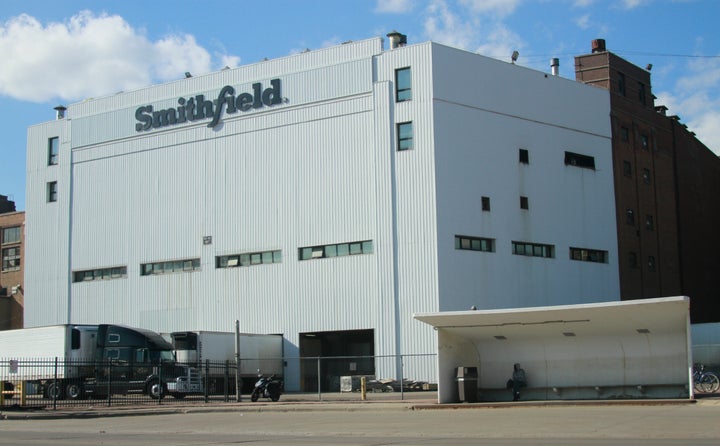
The Smithfield pork processing plant in Sioux Falls, South Dakota, was shut down when more than 230 employees tested positive for COVID-19.

The Smithfield pork processing plant in Sioux Falls, South Dakota, was shut down when more than 230 employees tested positive for COVID-19.

“If a store normally receives a truckload of products per day and, through panic buying, consumers are buying four or five times their normal quantities, it is not possible to immediately get four to five trucks per day,” he said. (According to Joyce Farms’ chief ranching officer, Allen Williams, “Food has to travel more than 1,500 miles in the U.S. to get to its final destination of a grocery store or restaurant.)

“I think America has the ability to produce the meat we need overall, but there could be short-term and/or regional shortages due to logistics and plants being closed,” Joyce said.

How grocery stores are affected.

On the grocery side, many stores have been able to keep up with meat demand, for the most part. One such chain is Whole Foods.

“Since we work with a variety of local and regional suppliers all over the country, it allows us to be more flexible with supply source and safely move inventory as needed to combat possible shortages,” Theo Weening, Whole Foods’ vice president of meat and poultry, told HuffPost.

“Specific product availability and replenishment in-store varies across the country based on a number of factors, such as shopper habits and supplier outages,” Weening said. “However, both our local and regional supplier partnerships, which meet our rigorous quality standards, have provided us with opportunities to be flexible and bypass interruptions to supply chains where possible, getting product to stores as quickly as we can.”

Another fear is that meat prices will increase at grocery stores because of supply and demand. But there’s not too much cause for concern, according to the experts.

Currently, the price of retail beef has indeed increased, even though the price of cattle is down, due in part to the meat supply pivoting from restaurants to retail (restaurants aren’t ordering as many filet mignons, but consumers are buying ground beef to make burgers at home).

Meat sales were up by 91% year over year for the week ending March 22.

But Phillips says he and farmers like him pay a “fixed” price for their livestock and that the price is “steady.”

“The farmer knows what the pig costs to grow and process,” he said. “I don’t see much change in those prices even in a 10-year period.”

“The production of meat and poultry in America is very efficient and is sensitive to demand,” Joyce said. “If demand increases, pricing normally increases short term and the supply increases, bringing pricing back down. If demand decreases, the opposite happens. Competition normally keeps pricing in balance in the long term. However, different animals have different grow-out times, so production adjustments can vary. Chickens are the quickest and easiest to adjust to demand because of their short growth period. Pork takes a little longer and beef takes the longest.”

But ultimately prices are influenced by consumers.

“When the consumer votes with their dollars to demand cheap meat, then you’re going to get places like Smithfield that will rise to the demand and give it to people,” Phillips said. “But if people vote with their dollars differently, then for sure you could sure see the farmers who are struggling right now, they have plenty of pork to sell.”

Why a meat shortage at grocery stores is unlikely.

Despite what appears to be a temporary shortage in supply chains, consumer relief is on the way. “Producers and retailers typically plan for steady demand increases and were not prepared to deal with the rapid surge we saw with the onset of the crisis,” the U.S. Department of Agriculture wrote on its blog. “But over the next few weeks, as retailers restock their shelves and demand from overstocked consumers declines, we will see fewer empty shelves and prices should stabilize or even decline.”

Additionally, the USDA announced that “in both commercial and public storage, the U.S. has stockpiled 925 million pounds of frozen chicken, 491 million pounds of frozen beef and nearly 662 million pounds of frozen pork,” and the federal government announced that it plans to purchase some of the farmers’ surplus meat and give $16 billion in direct payment to farmers. So it seems like a shortage might be overblown.

How do we prevent a meat shortage in the future?

Once the pandemic tapers off, what will the future of agriculture look like, or what should it look like?

“I think there will be more emphasis on local or regional production of food,” Joyce said. “I would like to see more people engaged in how and where food is produced. Most are not aware that a lot of it travels across the country or even from other countries to get to them.”

Phillips offered a similar sentiment. “I’m hopeful that people are going to be interested in quality and local things and creating more food themselves and understanding the real costs and price of foods …. This isn’t the first virus that’s going to come down the pipeline. Things are probably going to have to change a bunch, I would imagine. I feel like it is a chance for people to reconnect with the wheres and whys and hows of their food, and examine the system and decide what’s actually healthy for us and what’s not.”


A HuffPost Guide To Coronavirus

Experts are still learning about the novel coronavirus. The information in this story is what was known or available as of press time, but it’s possible guidance around COVID-19 could change as scientists discover more about the virus. Please check the Centers for Disease Control and Prevention for the most updated recommendations.

New Report Sheds Light on the Grossly Unsustainable Meat Industry

New Report Sheds Light on the Grossly Unsustainable Meat Industry


1 day ago
By Eliza Erskine
Cows
Lead Image Source : Image Source: ANEK SANGKAMANEE/ Shutterstock.com


A new report from IDTechEx has found that the meat industry is unsustainable in its current output. According to the report, the meat industry is worth $2 trillion and 100 billion pounds of meat was produced in the United States in 2017.

But as the world’s population grows to it’s expected 10 billion, meat production will reach a level detrimental to the environment. Even as the industry grows, experts recognize the industry as an inefficient way to consume and produce calories. Only 33% of protein intake is from meat and dairy.

Advertisement

According to the report, meat is responsible for deforestation, soil degradation, water stress, coastal dead zones and increases in greenhouse gas emissions. Environmental degradation and agriculture is well recorded. But as this report says, 77% of the agriculture land is used for meat and dairy, and we only get 33% of global protein from these sources.

In short, we do not have the land area or environmental resources to use so much land for so little protein benefits. The report suggests a shift to plant-based and cultured meats. Many meat companies including Nestle and Tyson Foods have already introduced plant-based meat products to help fill market requests for products.

Reducing your meat intake and eating more plant-based foods is known to help with chronic inflammation, heart health, mental wellbeing, fitness goals, nutritional needs, allergies, gut health and more! Dairy consumption also has been linked many health problems, including acne, hormonal imbalance, cancer, prostate cancer and has many side effects.

Advertisement

For those of you interested in eating more plant-based, we highly recommend downloading the Food Monster App — with over 15,000 delicious recipes it is the largest plant-based recipe resource to help reduce your environmental footprint, save animals and get healthy! And, while you are at it, we encourage you to also learn about the environmental and health benefits of a plant-based diet.

Here are some resources to get you started:

New Report Sheds Light on the Grossly Unsustainable Meat Industry

Amid stricter lockdown, Greeks roast lamb to celebrate Easter

ATHENS (Reuters) – Greeks celebrated Easter Sunday away from loved ones and their home towns because of a stricter lockdown to curb the spread of the coronavirus but were still able to enjoy spit-roasted lamb, a traditional part of the festivities.

Vassilis Kourtelis dances as his son Christos prepares spit-roasted lamb at their house on Easter Sunday, during a nationwide lockdown to prevent the spread of the coronavirus disease (COVID-19) outbreak in Athens, Greece, April 19, 2020. REUTERS/Alkis Konstantinidis

The Greek authorities had banned large family gatherings and mass church attendance during the Orthodox Easter week, which ends on Sunday. Last week, they had doubled fines for all those across the country who tried to travel by car for Easter without a serious reason.

Greeks stuck to the restrictions and spent the day with their close families and roasted lamb on verandas and balconies for the traditional Easter meal.

“We had ordered and sent lambs to Corfu in order to go and celebrate Easter with relatives, but coronavirus came along and we are stuck here,” said Vassilis Kourtelis, 62, from his porch of his house in Athens while roasting the lamb.

“But we are not going to let it ruin our mood, (we are celebrating) here with the family, as if we were there with our relatives. We send them video calls, they see us as we sing and dance.”

Greece has a relatively low rate of infections, which stood at 2,235 by Saturday, including 110 fatalities.

But as thousands of Greeks travel from Athens to their family homes for the Easter every year, the government was worried people would relax social distancing measures and banned unnecessary movement from Holy Saturday night to Easter Monday midnight, doubling the fines for offenders.

“We have pushed aside the first waves with discipline and solidarity,” Prime Minister Kyriakos Mitsotakis said in his Easter address. “Staying on the same course, we will soon be starting a gradually transition to a new era”.


Athens has said it would unwind its plan to ease the lockdown which ends April 27 after Easter but cautioned this will be a slow process.

“I believe next Easter we and others will be with our loved ones, with friends, with relatives, with our children, everyone together,” Kourtelis said.

Infections are straining meat processing plants

Coronavirus is infecting employees at the nation’s meat processing plants, raising fears of a strain in the food supply.
In Georgia, three employees at a Tyson Foods plant have died from coronavirus, and several others are sick or in quarantine, according to the Retail, Warehouse and Department Store Union.
“Workers debone chickens elbow to elbow with no access to masks. They work at speeds of upwards of 80 chickens per minute,” the Union said.
It accused Tyson of delaying distribution of personal protective equipment to workers, and implementation of measures such as social distancing protocols, protective barriers and staggered start times and breaks. CNN has reached out to Tyson Foods for comment.
And in South Dakota, more than half of the 143 new cases of coronavirus in the state are linked to the Smithfield Foods plant, one of the nation’s largest pork processing facilities, the state’s health department said.