All Meat Is the Product of Cruelty and Exploitation

A German serial killer, Fritz Haarmann, known as the “Butcher of Hanover,” cut his victims’ bodies into strips of flesh and sold them as pork. Here in North America, third-generation Canadian pig farmer and serial killer of 49 women, Robert Pickton, ground the bodies of his victims into sausage and sold it in packages or gave it out to friends.

While it’s appalling that folks who acquired meat from Pickton may have ingested human flesh, it is equally unsettling that they didn’t notice. To the taste buds it seems meat is meat. This tragedy was just one of many recent incidents that should make people rethink their carnivorous ways.

On a related note, according to an article by Cindi Avila with NBC News, Whole Foods admitted to accidentally reversing labels on two salads sold at its stores, a curried chicken salad and a vegan version called curried “chick’n” salad, last Tuesday and Wednesday at some 15 of its locations in the Northeast (including Connecticut, Maine, Massachusetts, New Jersey and New York). “The switched labels means it is highly likely someone who made a conscious choice not to eat animal products wound up doing so, through no fault of their own.”

To the ethical vegetarians who inadvertently ingested chicken flesh, the stomach-churning physical response of revulsion was on par with those of the pork-eaters who learned they’d cannibalized. Now, you might be asking yourself, “How can anyone compare eating chicken or pork to cannibalizing human flesh?”

The NBC article makes the clarifying point, “It may be hard for meat-eaters to understand, but this is a way of life that simply doesn’t involve compromise or mistakes. That’s especially the case for those of us who are vegetarian or vegan because of animal-welfare reasons or those who choose this for religious reasons.”

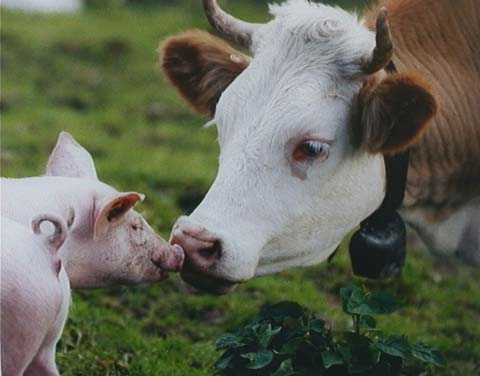
Pigs, like humans, cows and chickens, are capable of experiencing joy, affection, and pleasure. However, on hog farms, they are treated like unfeeling machines, confined in tiny stalls and fed growth-accelerating drugs that often cause lameness. Their teeth are cut with pliers, and their tails are cut off-without anesthetic. At the slaughterhouse, they are hung upside down and bled to death-often while they are fully conscious. Whether flesh comes from the victim of a serial killer or from a pig, a cow, or a chicken, it is the product of cruelty toward a thinking, feeling being who experiences pain and fear and wants to live free of exploitation.

In light of all this, why are people still eating meat? One common answer goes something like this: “I’m a human—superior to other beings—I’m entitled.” But a sense of entitlement is one of the trademark rationalizations that serial killers use to justify their wrongdoings, and grandiosity is also symptomatic of psychopathy, according to Canadian psychologist and author of Without Conscience: The Disturbing World of the Psychopaths Among Us, Robert D. Hare, Ph.D. Other symptoms outlined on Dr. Hare’s “psychopathy checklist,” such as shallow emotions and a lack of empathy or remorse, aid the killer—or meat-eater—in disregarding the suffering of his or her victims.

Psychopathic serial killers objectify their victims and consider their victims’ self-interests insignificant. The same rationale is called into play when one thinks of pigs only as “pork,” cows as “beef,” or chickens as “poultry,” without thought of the individuals or their suffering.

Both Canada and the U.S. have had recent cases of mad cow disease. As a result, we saw news footage of downer cows, too sick to walk, being dragged by chains into slaughterhouses. Press coverage of avian flu outbreaks reveal the intensely overcrowded conditions of chickens on factory farms-tens of thousands of animals cooped up in their own filth, each with less space than a standard sheet of typing paper. Besides being warned of health risks, consumers are finally learning about some of the cruelties endured by the animals they know only as “roasts” or “drumsticks.”

It is never too late to examine our actions and re-evaluate our food choices accordingly. By respecting the interests of all sentient beings, we are not akin to the conscienceless killers that plague our society. The only way to ensure that you are not supporting grotesque violence and cruelty against animals, or benefiting from their suffering, is to adopt a plant-based diet.
524958_3325028303604_654533903_n

Misery-Makers Love Company

The old saying, “misery loves company” has gotten so shopworn it’s become a cliché. But there’s a new saying (I know it’s new because just I thought it up today), a variation on that old one, which goes: “Misery-makers love company.” The point being, those who cause suffering don’t like to think they’re the only ones doing it.

Hunters, for example, are emboldened and find affirmation by recruiting others to take up their “sport.” It’s the same thing motivating trappers to form associations or duck hunters to form clubs. It’s why bowhunters spend so much time in chat rooms, and it’s part of the reason coyote and/or wolf haters hold social events called “contest hunts.”

Meanwhile, meat eaters feel a stronger sense of entitlement when they see so many others blindly munching on corpses. The same holds true for rodeo fans who get confirmation every time ESPN airs yet another calf-tormenting event.

The list could go on and on. As good people everywhere start citing their own examples, the saying, “Misery-makers love company,” is destined to become an overused cliché itself.

Text and Wildlife Photography ©Jim Robertson

Text and Wildlife Photography ©Jim Robertson

Forget the Calendar

According to the calendar, today’s my 52nd birthday. It’s hard to believe; I don’t feel any older than I was on the day I stopped eating meat and dairy 15 years ago. Though my choice to go vegan was for the sake of the animals—whose misery and death I was no longer willing to be a part of—the karmic reward (so to speak) has been the arrest of some of the detrimental conditions common among people in my alleged age group and a slowing down of the aging process all living things are subject to.

Unlike vegetables, fruits, nuts, grains and legumes, which can be kept as fresh as the day they were picked, meat begins to decompose the minute an animal is killed and their blood stops flowing. Any hunter or backyard butcher knows it’s a race against time to preserve dead meat before it spoils or is taken over by parasites (the microscopic kind as opposed to the human ones).Meanwhile, if not performed with great care, the morbid act of “gutting” an animal can spread E. coli and other intestinal nasties onto the “food.”

No matter how freshly killed the host animal was, their flesh is a product of death. It stands to reason that eating dead flesh cells, which contain no fiber and literally rot in the colon, will adversely affect whosoever consumes them. That’s why most herbivores live twice as long as the carnivorous species. And it’s why people who eschew meat and dairy* can potentially prolong their lives and find themselves feeling much more youthful and vital than most of their meat and dairy-eating counterparts.

*(For its part, dairy is rife with mucus forming pus—creating a favorable environment for respiratory contagions—as well as animal fat and acidic animal protein that leaches calcium from adult bones, while eggs are notoriously high in cholesterol.)

There’s a lot of truth in the saying, “You’re as young as you feel.” Forget the calendar, I don’t feel any older than 37. I can walk just as far, ski just as hard and chop as much wood as I did back then. I have just as much strength and stamina and am every bit as active in all ways—perhaps even more so, since I’ve had a decade and a half to recover from the ill effects of eating animal products.

Text and Wildlife Photography ©Jim Robertson

Paul Ryan Is Out to Corrupt His Little Girl

The hunting industry’s motto must be: “Get ‘em while they’re young.”

Being the diehard “sportsman” that he is, Republican vice presidential candidate Paul Ryan is taking that maxim to heart. Yesterday he told ABC News his daughter has watched him hunt for years, and he’d already bought her a Remington 700 .243 junior model rifle last Christmas.

“She’s going to get to go hunting this year for the first time,” Ryan said. “She’s 10 years old, so she can hunt starting at 10. I just need to get her some clothes.”

What kind of clothes? Why camo, of course. No doubt sensing a photo op, Ryan stopped at the Forest Park, Ohio, Outdoor World and paid $101.14 in cash for camouflage gloves and a jacket.

Females are supposed to be the more caring and nurturing of our species. How is teaching them to murder animals at an early age a good thing? Unless we want a world full of conscienceless, compassionless killers, it isn’t.

A normal young girl’s natural reaction to seeing a beautiful creature killed is shock, sadness, revulsion or repugnance. But if her father praises her enough when she brings down her first victim, there’s a chance she’ll end up thinking that she somehow enjoys it. From then on, when she sees a deer or rabbit, she will think of the praise she received; she’ll see them simply as trophies to mount on the wall; or she’ll envision them butchered and reduced to bloody lumps of meat. She’ll always be a little twisted in her perception of our fellow beings.

Years later, after a string of failed marriages, alcoholism, suicide attempts or a criminal record for child abuse or other violent crimes, in addition to a lifetime of inner turmoil, she might eventually seek psychiatric counseling. Only then will she realize that her problems began on the day her father first praised her for killing an innocent, sentient animal—the kind that she used to think of as beautiful.

And this Ryan guy wants to be our vice president? Considering the way he plans to corrupt his little girl, I’d want him to stay the hell away from my daughter.

Text and Wildlife Photography ©Jim Robertson