Exposing the Big Game

Forget Hunters' Feeble Rationalizations and Trust Your Gut Feelings: Making Sport of Killing Is Not Healthy Human Behavior

Exposing the Big Game

The pitfalls of simplification when looking at greenhouse gas emissions from livestock


http://news.trust.org/item/20180918083629-d2wf0/

What we choose to eat,  how we move around and how these activities contribute to climate change is receiving a lot of media attention. In this context, greenhouse gas emissions from livestock and transport are often compared, but in a flawed way.

The comparison measures direct emissions from transport against both direct and indirect emissions from livestock. The Intergovernmental Panel on Climate Change (IPCC) identifies and monitors human activities responsible for climate change and reports direct emissions by sectors. The IPCC estimates that direct emissions from transport (road, air, rail and maritime) account for 6.9 gigatons per year, about 14% of all emissions from human activities. These emissions mainly consist of carbon dioxide and nitrous oxide from fuel combustion. By comparison, direct emissions from livestock account for 2.3 gigatons of CO2 equivalent, or 5% of the total. They consist of methane and nitrous oxide from rumen digestion and manure management. Contrary to transport, agriculture is based on a large variety of natural processes that emit (or leak) methane, nitrous oxide and carbon dioxide from multiple sources. While it is possible to “de-carbonize” transport, emissions from land use and agriculture are much more difficult to measure and control.

Using a global life cycle approach, FAO estimated all direct and indirect emissions from livestock (cattle, buffaloes, goat, sheep, pigs and poultry) at 7.1 gigatons of CO2 equivalent per year, or 14.5% of all anthropogenic emissions reported by the IPCC. In addition to rumen digestion and manure, life cycle emissions also include those from producing feed and forages, which the IPCC reports under crops and forestry, and those from processing and transporting meat, milk and eggs, which the IPCC reports under industry and transport. Hence, we cannot compare the transport sector’s 14% as calculated by the IPCC, to the 14.5% of livestock using the life cycle approach.

Though it is the most systematic and comprehensive method for assessing environmental impacts according to the IPCC, there is no life cycle approach estimate available for the transport sector at a global level to our knowledge. Non-availability, uncertainty or variability of data limit its application. But several studies, including some reported by the IPCC, show that transport emissions increase significantly when considering the entire life cycle of fuel and vehicles, including emissions from extracting fuel and disposing of old vehicles. For example in the US, greenhouse gas emissions for the life cycle of passenger transport would be about 1.5 times higher than the operational ones.

Comparing transport and livestock raises another issue. Wealthy consumers, in both high and low income countries, who are rightly concerned about their individual carbon footprint, have options like driving less or choosing low carbon food. However, more than 820 million people are suffering from hunger and even more from nutrient deficiencies. Meat, milk and eggs are much sought after to address malnutrition. Out of the 767 million people living in extreme poverty, about half of them are pastoralists, smallholders or workers relying on livestock for food and livelihoods. The flawed comparison and negative press about livestock may influence development plans and investments and further increase their food insecurity.

Livestock emissions have come into particular focus because it generally takes more resources to produce beef than comparable other food items. Hence emissions from land-use change and feed production are high, in addition to enteric fermentation. Moreover, methane has a higher global warming potential than carbon dioxide but it’s lifespan in the atmosphere is only 12 years, which means that reducing methane emissions would have a positive impact on climate change in a much shorter time span.

Countries, particularly in Latin America, are responding to these challenges by developing low carbon livestock production that will achieve emission reductions at scale, focusing on emission intensity, soil carbon and pasture restoration, and better recycling of by-products and waste. Such programmes also produce a number of environmental and socio-economic co-benefits, like biodiversity and water conservation, or generation of rural employment and income.

The world needs both consumers that are aware of their food choices and producers and companies that engage in low carbon development. In that process, livestock can indeed make a large contribution to climate change mitigation, food security and sustainable development in general.

Anne Mottet is a Livestock Development Officer with the Food and Agriculture Organization (FAO) of the United Nations in Rome, specialising in natural resource use efficiency and climate change. She has 15 years of work experience in research, quantitative analysis and strategic consulting to the agricultural sector.

Henning Steinfeld is head of the livestock sector analysis and policy branch at the Food and Agriculture Organization (FAO) of the United Nations in Rome, Italy. He has been working on agricultural and livestock policy for the last 15 years, in particular focusing on environmental issues, poverty and public health protection. 

Europe’s meat and dairy production must halve by 2050, expert warns

Policymakers, farmers and consumers face ‘deeply uncomfortable choices’, says author of report advising urgent reduction of unsustainable livestock sector

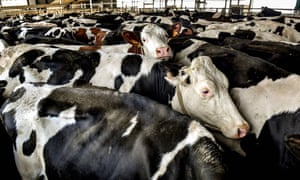
intensive cattle farm in France
 Study advises that the livestock industry needs to achieve a 74% drop in greenhouse gas emissions by 2050. Photograph: Philippe Huguen/AFP/Getty Images

Europe’s animal farming sector has exceeded safe bounds for greenhouse gas emissionsnutrient flows and biodiversity loss, and urgently needs to be scaled back, according to a major report.

Pressure on livestock farmers is set to intensify this century as global population and income growth raises demand for meat-based products beyond the planet’s capacity to supply it.

The paper’s co-author, Professor Allan Buckwell, endorses a Greenpeace call for halving meat and dairy production by 2050, and his report’s broadside is squarely aimed at the heart of the EU’s policy establishment.

Launching the report, the EU’s former environment commissioner Janez Potocnik said: “Unless policymakers face up to this now, livestock farmers will pay the price of their inactivity. ‘Protecting the status quo’ is providing a disservice to the sector.”

The study calls for the European commission to urgently set up a formal inquiry mandated to propose measures – including taxes and subsidies – that “discourage livestock products harmful to health, climate or the environment”.

Livestock has the world’s largest land footprint and is growing fast, with close to 80% of the planet’s agricultural land now used for grazing and animal feed production, even though meat delivers just 18% of our calories.

Europeans already eat more than twice as much meat as national dietary authorities recommend – far beyond a “safe operating space” within environmental limits, says the Rise foundation study.

As a result, huge sectoral “adjustments” will be needed by 2050 to rebalance the sector, including a 74% drop in greenhouse gas emissions and a 60% cut in nitrate-based fertiliser use, it finds.

Long before then, policymakers, farmers and society as a whole face “deeply uncomfortable choices”, according to Buckwell.

“We’re talking about fewer meat meals, less meat portions and moving to flexitarian diets without being dogmatic about it,” he said. “There is a role for softer public health messaging but harder messages are necessary too.”

Such a transformation “won’t happen spontaneously”, he added. “It requires strong signals from government so the policy proposal must include measures to discourage consumption of livestock products harmful to public health and the environment.”

Buckwell called for targeted taxes on harmful practices, with subsidised meat for low-income consumers, and a realignment of funding regimes to advise, retrain and hire more farmers for work in rural landscape management and animal welfare.

The hope is that consumers will eventually pay more for high quality meat produced in environmentally safe conditions, where countryside protection and animal welfare have been guaranteed.

The study follows angry condemnation of the EU’s recent common agricultural policy reform, which ignored a growing clamour for moves to more sustainable food systems.

Addressing the launch in a video message, the EU’s agriculture commissioner, Phil Hogan – who dismissed the sector’s emissions footprint earlier this year – said that he too wanted it to become “smarter, greener and cleaner, and do so fast”.

But his claim that more farm efficiency was the answer was slammed as “inherently contradictory” by BirdLife Europe’s policy chief, Ariel Brunner. The most sustainable farms are often less “efficient” in narrow terms of profit and loss, he argued, unless broader questions of energy and nutritionare considered.

One of the largest barriers to this sustainable food vision is Europe’s farmers themselves, still reeling from the financial blow dealt by this year’s drought.

Liam MacHale, the secretary-general of the Irish Farmers’ Association, told the Guardian that farmers were “an easy target” for environmentalists.

“Don’t single out our sector,” he warned the report’s authors. “Look at greenhouse gas emissions. Agriculture is blamed but look at consumer behaviour in the transport sector. They need to fly abroad to relax [despite] the emissions associated with that. The airlines are not being closed down, yet you’re talking about possibly eliminating the livestock sector.”

Buckwell told the Guardian he envisaged a contraction of the sector of between 40%-50%. “We have to contract consumption by roughly half to come within the safe operating space – a big change, in other words.”

Rice farming up to twice as bad for climate change as previously thought, study reveals

https://www.independent.co.uk/environment/rice-farming-climate-change-global-warming-india-nitrous-oxide-methane-a8531401.html

Levels of overlooked greenhouse gas are up to 45 times higher in fields that are only flooded intermittently

Rice is a vital crop that provides people with more calories in total than any other food

Rice is a vital crop that provides people with more calories in total than any other food ( STR/AFP/Getty Images )

Rice farming is known to be a major contributor to climate change, but new research suggests it is far bigger a problem than previously thought.

Techniques intended to reduce emissions while also cutting water use may in fact be boosting some greenhouse gases, meaning the impact of rice cultivation may be up to twice as bad as previous estimates suggest.

Scientists at the US-based advocacy group the Environmental Defense Fund suggest the short-term warming impact of these additional gases in the atmosphere could be equivalent to 1,200 coal power plants.

Considering the importance of rice as a staple food crop, providing more calories to the global population than any other food, the researchers have recommended ways to adapt farming practices and make its cultivation more climate-friendly.

Past estimates have suggested that 2.5 per cent of human-induced climate warming can be attributed to rice farming.

The main culprit is methane, a potent greenhouse gas emitted from flooded rice fields as bacteria in the waterlogged soil produce it in large quantities.

However, there is another gas produced by rice fields that can have a harmful climate effect. Nitrous oxide, commonly known as laughing gas, is also produced by soil microbes in rice fields.

Partly in a bid to reduce methane emissions, several international organisations have promoted intermittent flooding of rice fields, but this practice comes with problems of its own.

“The full climate impact of rice farming has been significantly underestimated because up to this point, nitrous dioxide emissions from intermittently flooded farms have not been included,” said Dr Kritee Kritee from the Environmental Defense Fund, who led the research.

Analysis by the team showed that process of alternately wetting and drying rice fields – while reducing methane levels – is producing up to 45 times more nitrous oxide than constantly flooded fields.

The intermittent flooding and airing of the fields results in pulses of microbial activity that in turn leads to increased nitrous oxide levels.

These results, obtained by working with farms in southern India, were published in the journal Proceedings of the National Academy of Sciences.

“Increasing pressure on limited water resources under a changing climate could make additional rice farming regions look to intermittent flooding to address water limitations and concerns about methane emissions,” said Dr Kritee.

“Water management on rice farms needs to be calibrated to balance water use concerns with the climate impacts of both methane and nitrous oxide emissions.”

Despite being a powerful greenhouse gas in its own right that traps even more heat in the atmosphere than methane over long time periods, most rice producing countries do not report their nitrous oxide emissions.

https://players.brightcove.net/624246174001/SydS6Pxaf_default/index.html?videoId=5806469110001&customParams=videoID%253D5806469110001%2526articleId%253D8531401%2526gs_channels%253DNONE%2526playertype%253Dclicktoplay%2526topictags%253Drice%2Cfarming%2Cagriculture%2Cclimatechange%2Cindia%3Bpermutive%3A3446%252C3448%252C3449%252C3507%252C7064%252C7065%252C3478%252C3487%252C3492%252C3499%252C3500%252C3527%252C3705%252C3737%252C3738%252C3748%252C3750%252C3751%252C3762%252C3763%252C3769%252C3783%252C3785%252C3795%252C3800%252C3812%252C3817%252C3821%252C3828%252C3845%252C3847%252C3850%252C3853%252C3881%252C3891%252C3899%252C3910%252C3915%252C3916%252C3937%252C3940%252C4052%252C4071%252C4076%252C4093%252C4104%252C4105%252C4155%252C4174%252C4183%252C4185%252C4187%252C4194%252C4203%252C4204%252C4208%252C4249%252C4298%252C4299%252C4306%252C4325%252C4327%252C4328%252C4336%252C4337%252C4342%252C4349%252C4359%252C4360%252C4363%252C4395%252C4482%252C4488%252C4489%252C4495%252C4496%252C4510%252C4511%252C4512%252C4559%252C4577%252C4742%252C4743%252C4844%252C4845%252C4961%252C4970%252C5061%252C5062%252C5064%252C5065%252C5067%252C5068%252C5074%252C5103%252C5266%252C5340%252C5455%252C5472%252C5574%252C5596%252C5700%252C5702%252C5706%252C5707%252C5757%252C5776%252C5790%252C6116%252C6117%252C6164%252C6251%252C6252%252C6302%252C6685%252C6750%252C6751%252C6762%252C6824%252C6833%252C7033%252C7066%252C7078%252C7312%252C7395%252C7440%252C7496%252C3482%252C3542%252C4554%252C6238%252C7609%252C7610%252C7612%252C3601%252C7667%252C7668%252C8022%252C7839%252C4670%252C5138%252C6823%252C8272%252C5476%252C5477%252C3557%252C3684%252C3489%252C3521%252C3483%252C3550%252C3493%252C3720%252C5708%252C3535%252C7361%252C6207%252C8598%252C3721%252C8269%252C3508%252C3509%252C3510%252C3660%252C3460%252C3461%252C3563%252C4248%252C7693%252C4808%252C8799%3B&customTargeting=%2F71347885%2F_main_independent%2Fin_environment%2Fin_environment_article&playsinline=true
Nicola Sturgeon mocks Donald Trump over climate change ahead of UK visit

Dr Kritee said it was essential that scientists began investigating this overlooked threat so that nations can tackle it effectively.

“We now know nitrous oxide emissions from rice farming can be large and impactful,” said Richie Ahuja, a co-author of this study.

By considering each farm individually and taking into account their methane, nitrous oxide and water use, the scientists suggest that specific strategies can be used that can minimise emissions of climate harming gases.

“We now also know how to manage the problem. Major rice producing nations in Asia are investing to improve the agriculture sector and could benefit from the suggested dual mitigation strategies that lead to water savings, better yields, and less climate pollution,” said Mr Ahuja.

New Zealand needs to get rid of up to a fifth of livestock methane emissions to stop more global warming

New Zealand’s emissions profile is unique

Agriculture 45%Road transport 17%Other 13%Manufacturing 8%Industrial 7%Public electricity 5%Waste disposal 5%

New research on methane emissions
New official research suggest we need 10-22 per cent reduction of livestock emissions

New Zealand would need to reduce livestock methane emissions by up to 22 per cent by 2050 to stop any additional global warming, official research shows.

This would likely require a serious reduction in the number of livestock farmed, unless new and untried technologies can be shown to work.

Livestock contribute the vast majority of our methane emissions, mostly through belching.

The release from the Parliamentary Commissioner for the Environment throws a wrench into an emerging consensus across the country that “stabilising” NZ’s short-lived methane emissions at current levels could be a viable option to stop warming.

READ MORE:
What is the NZ Government’s Zero Carbon Bill and will it do anything?
Simon Bridges offers Government bipartisan support on climate change
Farmers see some positives in Government approach to climate change 
Dr Andy Reisinger: livestock impact on climate change set to rise

It suggests that actual “stabilisation” would still require a reduction in livestock or the success of new methods to lower emissions, such as special feeds, vaccines or tweaking livestock breeding.

Climate Change Minister James Shaw is currently consulting on plans for a Zero Carbon Act, which would set some kind of reduction target in law.

Parliamentary Commissioner and former National Party Environment Minister Simon Upton is working on a wider report concerning the Zero Carbon Act but decided to put out this research from Andy Reisinger early in order to inform debate.

Federated Farmers vice-president Andrew Hoggard said the key point of the report was  reductions of 10-22 per cent were needed by 2050, whereas earlier reports before said they just needed to be stabilised.

There are three goals for 2050 currently on the table – and none of them consider “no more warming” to be the actual goal.

One is exactly what it says on the tin: net zero carbon, but nothing else, meaning agriculture’s “short-lived” methane emissions would be left alone. The second or middle option is net zero long-lived gases, like carbon dioxide and nitrous oxide, and “stabilised” short-term gases, like methane.

Finally, the third option is simply net zero for all greenhouse gas emissions by 2050.

“To me the report is saying we don’t need to go to complete net zero,” Hoggard said.

The middle option of “stabilisation” has attracted a lot of interest but has not yet been made completely clear. The idea behind it is that since methane emissions decay in the atmosphere much faster than carbon, the Government could keep a steady level of methane emissions over time and, because of the drop-off from emissions ten years ago, simply keep the level consistent without contributing much to further warming, recycling the decaying methane with new emissions.

About 43 per cent of New Zealand’s greenhouse gases are caused by methane and 11 per cent by nitrous oxide, the first generated by all livestock burping, the latter mainly by cows urinating.

The research released by Upton is careful not to suggest policy, but to simply make clear that while methane mostly decays within a decade or so, its lasting effects are such that a significant reduction would still be needed for New Zealand to contribute to no further warming.

“It shows that holding New Zealand’s methane emissions steady at current levels would not be enough to avoid additional global warming,” Upton said.

“If New Zealand’s emissions of livestock methane were held steady at 2016 levels, then within about ten years the amount of methane in the atmosphere from that source would level off. However the warming effect of that methane would continue to increase at a gradually declining rate for more than a century.”

Livestock contribute the vast majority of our methane emissions, mostly through belching.
KELLY HODEL/FAIRFAX NZ
Livestock contribute the vast majority of our methane emissions, mostly through belching.

Hoggard said if cow efficiency could be improved as it has, and farmers reduced stock, the reductions could occur.

“There are things I could do but might not be allowed. One the things that holds me back are dry conditions. Irrigation would help but that’s a dirty word, and a herd home would help but people get upset if cows are in there for a length of time.”

“People say cut cow numbers but they have an ideological view of the sector and don’t understand the trade-offs in operating a biological system,” Hoggard said.

The research shows that even if stabilised at 2016 levels warming from methane would increase by 10-20 per cent by 2050, and 25-40 per cent by 2100.

To avoid this New Zealand would need to reduce livestock methane emissions by between 10 and 22 per cent by 2050 and then 20-27 per cent by 2100.

The range of options depends on the amount that other countries reduce their emissions, as methane interacts with other gases in complex ways.

National climate change spokesman Todd Muller welcomed the report, saying it showed New Zealand needed to reduce agricultural emissions by “just” 10-22 per cent.

 “The research released today shows that reducing methane emissions by just 10 – 22 per cent will mean New Zealand’s methane emissions have a neutral impact on global temperature,” Muller said.

“If we reduce methane by 10 – 22 per cent, and reduce all other gases to zero, it is equivalent to a 54 – 60 per cent reduction in our total emissions which is in line with New Zealand’s existing 2050 target.”

Muller and party leader Simon Bridges have made clear they want to work with the Government on setting a target not likely to be changed the moment the Government does.

“We are working with the Government to make meaningful bi-partisan progress on climate change. National wants an independent, non-political Climate Change Commission established so we have a framework through which we address climate change issues in the future,” Muller said.

Acting Climate Change Minister Eugenie Sage said it was a useful contribution to the policy debate, and the reduction was achievable.

“This report shows New Zealand’s methane emissions would need to reduce by about 10 to 22 per cent below 2016 levels (ie the latest year for which emissions data is available) by 2050, with further reductions between 20 to 27 per cent by 2100, if we want to ensure methane emissions from livestock don’t contribute to additional global warming,” Sage said.

She noted some in the sector believed the reduction was possible with existing technology.

“That is seen as achievable by some in the agricultural sector, given that methane output per unit of production has been in decline by about 1 per cent per year for the last few decades, and given some leaders in the sector believe they can reduce methane output by as much as 30 per cent using existing technology and best practice.”

Greenpeace sustainable agriculture campaigner Gen Toop disagreed, saying a reduction in cow numbers was the only viable path forwards.

“The dairy industry say there are no easy solutions for reducing methane emissions from ruminants but they deny the obvious solution is to reduce livestock numbers. Fewer cows means fewer emissions,” Toop said.

“The simple truth is there are already too many cows for our climate to cope with, yet the Government is still allowing dairy conversions to continue – even in fragile and unique places like the Mackenzie country.”

Upton himself said the country and world needed to focus on reducing emissions.

“This whole debate started off in the early 1990s and we all said ‘we’re going to plant pine trees in the mean time because we don’t have an easy set of technologies, we’re going to use that time to find the technologies to find a way out,'” Upton said.

“We’ve used up 25 years, we still haven’t found the technologies. We haven’t focused on reducing emissions. We have to now focus on that.”

“2050 is not far away. You can’t turn things around overnight.”

He said there were encouraging technological breakthroughs, particularly on the carbon side of the issue, but actual reduction would still be needed.

Upton expected Governments would make peace with some level of warming from methane emissions, but should aim to get carbon down to net zero.

Unexpected future boost of methane possible from Arctic permafrost

https://eurekalert.org/pub_releases/2018-08/nsfc-ufb081718.php

NASA/GODDARD SPACE FLIGHT CENTER

New NASA-funded research has discovered that Arctic permafrost’s expected gradual thawing and the associated release of greenhouse gases to the atmosphere may actually be sped up by instances of a relatively little known process called abrupt thawing. Abrupt thawing takes place under a certain type of Arctic lake, known as a thermokarst lake that forms as permafrost thaws.

The impact on the climate may mean an influx of permafrost-derived methane into the atmosphere in the mid-21st century, which is not currently accounted for in climate projections.

The Arctic landscape stores one of the largest natural reservoirs of organic carbon in the world in its frozen soils. But once thawed, soil microbes in the permafrost can turn that carbon into the greenhouse gases carbon dioxide and methane, which then enter into the atmosphere and contribute to climate warming.

“The mechanism of abrupt thaw and thermokarst lake formation matters a lot for the permafrost-carbon feedback this century,” said first author Katey Walter Anthony at the University of Alaska, Fairbanks, who led the project that was part of NASA’s Arctic-Boreal Vulnerability Experiment (ABoVE), a ten-year program to understand climate change effects on the Arctic. “We don’t have to wait 200 or 300 years to get these large releases of permafrost carbon. Within my lifetime, my children’s lifetime, it should be ramping up. It’s already happening but it’s not happening at a really fast rate right now, but within a few decades, it should peak.”

The results were published in Nature Communications.

Using a combination of computer models and field measurements, Walter Anthony and an international team of U.S. and German researchers found that abrupt thawing more than doubles previous estimates of permafrost-derived greenhouse warming. They found that the abrupt thaw process increases the release of ancient carbon stored in the soil 125 to 190 percent compared to gradual thawing alone. What’s more, they found that in future warming scenarios defined by the Intergovernmental Panel on Climate Change, abrupt thawing was as important under the moderate reduction of emissions scenario as it was under the extreme business-as-usual scenario. This means that even in the scenario where humans reduced their global carbon emissions, large methane releases from abrupt thawing are still likely to occur.

Permafrost is ground that is frozen year-round. In the Arctic, ice-rich permafrost soils can be up to 260 feet (80 meters) thick. Due to human-caused warming of the atmosphere from greenhouse gas emissions, a gradual thawing of the permafrost is currently taking place where the upper layer of seasonally thawed soil is gradually getting thicker and reaching deeper into the ground. This process wakes up microbes in the soil that decompose soil organic matter and as a result release carbon dioxide and methane back into the atmosphere. This gradual thaw process is accounted for in climate models and is thought to have minimal effect as thawed ground also stimulates the growth of plants, which counterbalance the carbon released into the atmosphere by consuming it during photosynthesis.

However, in the presence of thermokarst lakes, permafrost thaws deeper and more quickly. Thermokarst lakes form when substantial amounts of ice in the deep soil melts to liquid water. Because the same amount of ice takes up more volume than water, the land surface slumps and subsides, creating a small depression that then fills with water from rain, snow melt and ground ice melt. The water in the lakes speeds up the thawing of the frozen soil along their shores and expands the lake size and depth at a much faster pace than gradual thawing.

“Within decades you can get very deep thaw-holes, meters to tens of meters of vertical thaw,” Walter Anthony said. “So you’re flash thawing the permafrost under these lakes. And we have very easily measured ancient greenhouse gases coming out.”

These ancient greenhouse gases, produced from microbes chewing through ancient carbon stored in the soil, range from 2,000 to 43,000 years old. Walter Anthony and her colleagues captured methane bubbling out of 72 locations in 11 thermokarst lakes in Alaska and Siberia to measure the amount of gas released from the permafrost below the lakes, as well as used radiocarbon dating on captured samples to determine their age. They compared the emissions from lakes to five locations where gradual thawing occurs. In addition, they used the field measurements to evaluate how well their model simulated the natural field conditions.

Team members with the Alfred Wegener Institute (AWI) for Polar and Marine Research in Germany then used U.S. Geological Survey-NASA Landsat satellite imagery from 1999 to 2014 to determine the speed of lake expansion across a large region of Alaska. From this data they were able to estimate the amount of permafrost converted to thawed soil in lake bottoms.

“While lake change has been studied for many regions, the understanding that lake loss and lake gain have a very different outcome for carbon fluxes is new,” said co-author Guido Grosse of AWI. “Over a few decades, thermokarst lake growth releases substantially more carbon than lake loss can lock in permafrost again [when the lake bottoms refreeze].”

Because the thermokarst lakes are relatively small and scattered throughout the Arctic landscapes, computer models of their behavior are not currently incorporated into global climate models. However, Walter Anthony believes including them in future models is important for understanding the role of permafrost in the global carbon budget. Human fossil fuel emissions are the number one source of greenhouse gases to the atmosphere, and in comparison, methane emissions from thawing permafrost make up only one percent of the global methane budget, Walter Anthony said. “But by the middle to end of the century the permafrost-carbon feedback should be about equivalent to the second strongest anthropogenic source of greenhouse gases, which is land use change,” she said.

###

To learn more about ABoVE, visit: https://above.nasa.gov/

Disclaimer: AAAS and EurekAlert! are not responsible for the accuracy of news releases posted to EurekAlert! by contributing institutions or for the use of any information through the EurekAlert system.

German Lawsuit Takes Aim at Climate Impacts of Agriculture

Industrial agriculture has grown in Germany, increasing nitrate and methane pollutionA lawsuit targets nitrate and methane pollution from industrial agriculture in Germany. Photo credit: Sean Gallup/Getty Images
 print

By Ucilia WangA new lawsuit in Germany could provide lessons for cutting emissions from agriculture, which has largely escaped air quality regulations or climate lawsuits in the United States despite its large greenhouse gas footprint.

Environmental Action Germany, an advocacy group that filed the lawsuit last month, is taking on the German government for failing to lower the amount of nitrates seeping into the surface and groundwater, mostly from large-scale farming operations.

While the lawsuit aims to force the government to tighten its nitrate regulations, it comes with a larger goal to limit factory farming, said Remo Klinger, an attorney at Geulen & Klinger, which is representing Environmental Action Germany in the case. This would in turn combat climate change because those large agricultural operations emit large amounts of methane, a potent greenhouse gas.

“A reduction in animals is one of the main elements of reducing nitrates,” said Klinger, who noted that farmers, as in the U.S., wield tremendous political influence in Germany. “The high number of animals is linked to climate change because of their methane emissions.”

Nitrate pollution has a direct link to methane emissions. High nitrate levels in ground and surface water typically comes from excessive use of fertilizers and poor management of animal manure, especially at giant, industrialized farms that raise hundreds or thousands of animals in a confined space and require giant holding ponds to store the manure.

Dairy and cattle farms in particular are a rich source of methane. Animals burp methane while digesting food, and their manure also releases methane as it decomposes. Methane excels at trapping heat and accelerates global warming more quickly than carbon dioxide. In the U.S., raising livestock is the largest source of methane emissions, according to the Environmental Protection Agency. Worldwide, agriculture is estimated to produce 14.5 percent of all greenhouse gas emissions, according to the U.N. Food and Agricultural Organization.

Environmental Action Germany wants to tackle the problem by forcing the government to lower nitrate levels by placing a lower cap on the amount of manure that each farm can accommodate per hectare of land each year, Klinger said. Shrinking these farms would lower their methane emissions.

Germany’s level of nitrate pollution is the second highest in the European Union, trailing only Malta. A government study in 2016 showed that 28 percent of the nitrate monitoring stations showed nitrate levels in groundwater exceeding the EU limit of 50 milligrams per liter.

The European Commission sued Germany in 2016 over the high nitrate levels and won a ruling from the European Court of Justice in June. Germany, which amended its nitrate regulations in 2017, said its new rules now help it comply with the EU limit. But critics, such as Environmental Action Germany, said loopholes in the new regulations make them ineffective.

The U.S. is also lax when it comes to minimizing the environmental impacts of industrial farms, said Jonathan Lovvorn, chief counsel of the Humane Society of the United States and a lecturer at Harvard Law School. Only farms that reach a certain size are subject to the federal Clean Water Act, and they mostly escape oversight under the Clean Air Act.

While plenty of lawsuits have been filed against farms over air and water quality, they have largely been unsuccessful historically, Lovvorn said.

A few recent victories include a $473.5 million judgment against a subsidiary of Smithfield Foods last week. The company lost a federal nuisance lawsuit in which the neighbors of its three giant hog farms in North Carolina said they couldn’t stand the stench and flies from open pits of animal waste or the rumbling of company trucks that pick up hogs for slaughter in the middle of the night.

Few suits have attempted to challenge these farms’ methane emissions and climate impacts.

“Agricultural emissions are completely unaddressed by federal statutes,” Lovvorn said. “It’s a ticking time bomb for the animal agricultural industry. Sooner or later they will be called into reckoning for the fact that they put a substantial amount of emissions into the atmosphere.”

Lovvorn says the ongoing lawsuits filed by cities in the U.S. against fossil fuel companies could also offer lessons for battling large agriculture companies’ climate footprint.

“My suspicion is people are watching the cities’ climate cases in the energy sector closely and likely thinking about to what extent any favorable rulings could provide a footing to do something about agricultural climate emissions,” he said.

As is the case in Germany, the agriculture industry holds a lot of political clout, making it difficult to pass regulations to change farming practices. That influence stems from an idealized view of farmers as wholesome, self-reliant owners of small plots, even though family-owned farms are disappearing and giving way to industrialized farms, Lovvorn said.

California, the largest dairy-producing state in the country, was the first state to create programs to cut methane emissions from farms, part of its larger effort to address climate change. Last year, New York announced a methane reduction plan that require state agencies to evaluate and develop programs to cut methane in agriculture.

California’s program provides money to buy digesters that convert methane into biogas. It also supports a smaller program that finances better manure management practices at industrial farms, from changing how manure is collected and processed to taking animals out of confinement and letting them roam in a pasture.

These two programs are voluntary because the state won’t start regulating methane emissions from dairy and other livestock farms until 2024. The state aims to reduce methane emissions by 40 percent below 2013 levels by 2030.

The larger focus on promoting digesters has its critics. Tara Ritter, senior program associate for climate and rural communities at the Institute for Minnesota-based Agricultural Trade and Policy, said the effort would still allow factory farms to operate and doesn’t adequately address the water and air quality problems that come from raising so many animals in a confined space.

“California is trying to be a leader on climate change, yet it just slaps a lot of digesters on farms,” Ritter said.

What Fossil Fuels and Factory Farms Have in Common

In 2008, Cabot Oil and Gas started fracking operations in Dimock, Pennsylvania. It was around that time the community started noticing their water was turning brown and making people and animals sick. One woman’s water well exploded. Fracking had come to town.

It’s a familiar story in other rural communities—from Pennsylvania to Montana and Texas—where fracking has contaminated drinking water resources and emitted toxic air pollution associated with higher rates of asthma, birth defects, and cancer.

But the story is similar in other communities where fracking or other extreme fossil fuel extraction isn’t happening. Air and drinking water that’s been dangerously polluted from industrial operations affect communities across Iowa, including the state’s largest city, Des Moines. Polluting facilities are operating in Central OregonNorth Carolina,Wisconsin, and Maryland. None of those places are fracking, but they are host to another environmental hazard facing rural communities: factory farms.

Like the fossil fuel cartel, this highly consolidated industry prioritizes profits at the cost of our environment. Factory farms are an industrial model for producing animals for food where thousands of cows, pigs, or birds are raised in confinement in a small area. While farms can and do apply manure as a fertilizer to cropland, factory farms produce more manure than nearby fields can absorb, leading to runoff into surface waters and contaminants leaching into groundwater. And storing concentrated quantities of manure releases toxins like ammonia and hydrogen sulfide into the air, threatening nearby communities—and even leading to worker deaths. The nearly half a million dairy cows on factory farms in Tulare County, California, produce five times as much waste as the New York City metropolitan area and carries chemical additives and pathogens like E. coli, many of which are antibiotic resistant.

Factory farms are also an issue of environmental injustice. In North Carolina counties that contain hog factory farms, schools with larger percentages of students of color, and those with greater shares of students receiving free lunches are located closer to hog farms than whiter and more affluent schools. Just like with fossil fuel infrastructure, these toxic facilities are more likely to be in places that are least able to resist their development.

Another thing factory farms have in common with fossil fuels: They are a danger to the climate. Livestock production contributes 14.5 percent of all human-caused greenhouse gas emissions. Methane emissions from the digestive processes of cattle contribute 39 percent of the greenhouse gas emissions from livestock production, and manure storage and processing contribute 10 percent. Additionally, monoculture crops like corn and soy are a hallmark of our highly consolidated food system and are one of the reasons we can raise mass quantities of livestock. These crops contribute nearly half of the emissions from the sector. Meanwhile, more sustainable meat production methods like smaller farms and grass-fed operations may have lower greenhouse gas emissions than factory farms. Without a rapid transition away from factory farming, we will not avoid catastrophic climate change.

Yet attempts to regulate factory farms have been weak-kneed and ineffective. For example, federal law requires they report significant releases of toxic pollutants like ammonia. But the Environmental Protection Agency actually does little to monitor, much less prevent, these emissions. In 2009, for example, the agency rolled back regulations so that only the largest facilities had to report these emissions—and only to local, not national, emergency response officials. In 2018 Congress went even further, granting an exemption from reporting requirements for air emissions created by manure on farms. Similarly, the EPA does not collectcomprehensive data on factory farm size or location, making oversight impossible. And while the Clean Water Act regulates water pollution from industrial facilities, the EPA has looked the other way; the agency estimated in 2011 that less than half of the facilities required to get discharge permits had actually obtained them.

Calls to ban fracking have been proliferating since we have found that it is too dangerous to simply regulate. The inherent risks to our environment, our climate, and our communities are simply too much.

Now, we need to say the same thing about factory farms. Both industries are putting rural communities at risk so that large polluting companies can become larger and more profitable. Climate advocates who are already facing down the fossil fuel industry should find common cause with those who are fighting to stop industrial agriculture in their community.

Systemic change is needed. We can’t shop our way out of the damage that is being done to our environment by simply choosing to reduce meat consumption or ride bikes to work. While these are meaningful steps, we must also demand policy action. It’s time to reverse the decades of pro-industry policy that have made Big Ag and Big Energy bigger and badder, and create policies that start phasing out pollution from agriculture and energy.

We know how to do it: We need to demand meaningful laws and regulations—including bans on new polluting factory farms and fossil fuel infrastructure—that prioritize people over profit. This is already happening at the state level in places like Iowa, but we need to work at all levels, starting now, to enact the changes we need to protect our environment, our water, and our communities.

If McDonald’s is serious about reducing its carbon footprint, it may need to rethink the hamburger

The company has an ambitious-sounding plan to curb its emissions. But can it really take a meaningful stance on climate change while selling more Big Macs?

ENVIRONMENT FARM NEWS POLICY

In late March, McDonald’s issued a bold press releaseannouncing major cuts to its greenhouse gas emissions—a plan that will require the company to rethink not only how it lights and fuels its restaurants, but also how it sources its beef, which the company says amounts to 29 percent of its carbon footprint.

The changes will “enable McDonald’s to grow as a business without growing its emissions” through 2030, according to the press release, which offers some dazzling figures: a 36 percent reduction in greenhouse gas emissions from restaurants and offices, and a 31 percent reduction in “emissions intensity” from its supply chain (including  beef), which will prevent the release of 150 million metric tons of greenhouse gas.

But a closer look at the company’s “science-based” plan, which is completely voluntary and largely unverifiable, raises questions about how meaningful the emissions cuts will be.

McDonald’s has to contend with a body of science that suggests we need to reduce our beef consumption.

The company’s announcement, nevertheless, speaks to the company’s growing awareness of the economic challenges that climate change is expected to bring in the decades ahead.  Changing weather patterns will create more inconsistent agricultural conditions, while government regulators—in any of the 120 countrieswhere McDonald’s operates—could impose carbon taxes that also raise production costs.

The company is also thinking about consumers. As noted in its most recent annual report to investors: “the ongoing relevance of our brand may depend on the success of our sustainability initiatives, which require system-wide coordination and alignment.”

Given its burger-centric business model, McDonald’s may have a tough row to hoe trying to brand itself as a leader on climate change. Beef production emits more greenhouse gas than almost any other food we produce. And McDonald’s is one of the largest buyers in the world, last year reporting using 1.6 billion pounds of beef, a mountain of meat that casts an enormous carbon footprint.

When pressed for details about how it intends to reduce emissions from beef, McDonald’s would not offer many specifics.

“We are looking for ways to incorporate soil health initiatives into our supply chain sustainability programs through managed grazing practices and regenerative agricultural practices,” said Terri Hickey, McDonald’s senior manager of global corporate communications, in an email. She directed me toward materials that appear focused on the company’s previous beef sustainability goal, which was aimed at 2020.

McDonald’s overall carbon footprint may not change much, even if the company meets its proposed “reductions.”

As McDonald’s trumpets the “science” surrounding its greenhouse gas mitigation plan, the company increasingly has to contend with a body of science that suggests many of us need to reduce our beef consumption. This prescription is coming not just from public-health experts but also from climate scientists, who point to the high environmental costs of beef production.

Climate change doesn’t augur the end of red meat in our diets, or the collapse of McDonald’s, but it could mean significant dietary changes for many of us in the future.  While it seems unthinkable that the company would retire its iconic Big Mac and beefy Double Quarter Pounder with Cheese, our changing climate is a good reason to wonder whether cheap beef will still be the centerpiece on McDonald’s menu in the decades ahead.

Beef’s big impacts

Animal agriculture, as a whole, contributes around 15 percent of global greenhouse gas emissions, with beef cattle being the largest emitters, according to the Food and Agriculture Organization of the United Nations (UNFAO). Because cows digest food via enteric fermentation, they produce methane, a potent greenhouse gas, in their burps. Cattle production’s carbon footprint also includes the greenhouse gases from growing and fertilizing feed corn, as well as manure-related emissions.

Cows also have high environmental impacts because they give birth to one calf at a time instead of producing litters like pigs, says Gidon Eshel, an environmental science professor at Bard College in New York.

This biological reality may be difficult to change, but Eshel says if McDonald’s is serious about making emissions reductions, there are a lot of little things the company’s beef suppliers could do to become “less inefficient.” Still, reducing emissions meaningfully also likely means reducing consumption, he says.

Beef cattle require 28 times more land and 11 times more water than other farm animals on average, and emit five times more greenhouse gas

“The real question one must ask first about any environmental choice is not how large it is, but how easy would it be to cut it by an order of magnitude,” Eshel says.

For example, Eshel says, a modern, fuel efficient vehicle might get three times more miles to the gallon than an old gas-guzzler, presenting as much as a three-fold reduction in emissions.  Even more significant emissions cuts might be gained by shifting agriculture from beef cattle to almost any other kind of food production, he says. (That being said, beef cattle can be raised on marginal lands where it is difficult to grow other foods).

2014 study Eshel co-authored reported that beef is the second most commonly consumed source of calories in the U.S., but, according to his estimates, beef cattle require 28 times more land, 11 times more water, and emit five times more greenhouse gas than other farm animals, on average.

According to Eshel’s estimates, the 1.6 billion pounds of beef that McDonald’s used last year would produce around 22 million metric tons of greenhouse gas emissions. That’s equivalent to the average emissions you’d see from 4.8 million cars in a given year. Or, viewed another way, it amounts to one-third of one percent of total U.S. greenhouse gas emissions, says Eshel.

Reducing emissions meaningfully would also mean reducing consumption.

“One product, served by a single company, is a third of a percent of the total,” Eshel says. “I think it’s worth pausing and absorbing this.”

Emissions estimates, however, are not an exact or settled science—and the actual footprint of McDonald’s beef could be much lower or higher than Eshel estimates. Scientists are always rethinking how to calculate emissions, but they are clear that current beef production has a larger carbon footprint than most other foods we eat.

A groundbreaking study published last year and funded by NASA’s Carbon Monitoring System research initiative, found that methane emissions from livestock are probably higher than previously estimated—as much as 11 percent higher than prevailing estimates offered by the Intergovernmental Panel on Climate Change (IPCC) in 2006. It’s a finding that should factor into McDonald’s greenhouse gas targets.

Ghassem Asrarone of the study’s co-authors and the director of the Joint Global Change Research Institute, nevertheless, is sanguine about the “basket” of interventions livestock producers can draw on to reduce methane emissions, like better manure management.

Some of these interventions could increase the cost of production, however, which could also mean increasing the cost of burgers at McDonald’s, emblematic of the trade-offs that will work against the fast-food giant.

While Asrar thinks there are many ways the beef industry can and should reduce emissions, he is also clear that reducing consumption is part of the solution.

“That’s the general conclusion that the majority of published research reached,” says Asrar. “We have to manage our meat consumption if you want to reduce our footprint.”

The beef industry, citing its own science, sees things slightly differently.

Our changing climate is a good reason to wonder whether cheap beef will still be the centerpiece on McDonald’s menu in the decades ahead.

“Reducing consumption of beef, especially in the U.S. will do little towards mitigating climate change, and could cause significant sustainability issues with our entire system,” according to the U.S. Roundtable for Beef Sustainability, which hails U.S. beef as the “most efficient production system in the world.”

The Roundtable, citing its goal to “be the trusted global leader in environmentally sound, socially responsible and economically viable beef,” recently released a “sustainability framework” that addresses greenhouse gas emissions.  Its draft recommendations include things like the use of pharmaceuticals to promote faster animal growth.

Administered, in part, by the National Cattlemen’s Beef Association, a beef lobby group, the Roundtable’s members include meatpackers like JBS and Tyson, as well as a host of other companies that feed into the beef production model—like seed and animal pharmaceutical companies—and whose business interests are threatened by dietary shifts away from beef. It also includes fast-food companies like McDonald’s.

Fact-checking McDonald’s science

McDonald’s press release used the word “science” seven times, noting that its “science-based” program will “prevent 150 million metric tons of greenhouse gas emissions from being released into the atmosphere by 2030,” equal to taking “32 million passenger cars off the road for an entire year.”

But the science that informs the company’s emissions reduction program merits scrutiny.

McDonald’s annually reports data about its carbon footprint through a non-profit group called the CDP (previously the Carbon Disclosure Project). The CDP, however, charges companies an administrative fee to participate in its disclosure process, creating financial ties that erode the scientific independence of the project.

McDonald's quarter pounder with cheeseMcDonald’s

Avoiding the worst impacts of our changing climate means making major emission reductions—real, verifiable, science-based reductions—that may include Americans eating fewer burgers

Independence is paramount because carbon footprint calculations are subject to variations in how the data are measured, reported, and interpreted by regulatory bodies and accountability initiatives, as well as to political and economic influence.

For example, McDonald’s told me it has already “reassessed” its 2015 emissions data (it wouldn’t provide a copy), which will serve as a baseline for its planned emissions reductions through 2030. But how do we have confidence that McDonald’s data reporting and reassessments aren’t just clever accounting and paper trading?

“It’s a good method to get the most credits for your cuts: You inflate your baseline and then whatever cuts you make are much greater,” says Shefali Sharma, director of the European arm of an advocacy group called the Institute for Agriculture and Trade Policy. “Independent verification is key to understanding whether McDonald’s 2015 data is reliable.”

McDonald’s press release prominently notes that its emissions-reduction program has been “approved” by the “Science-Based Target Initiative,” which is managed by the World Resources Institute and the United Nations Global Compact—and also the World Wildlife Fund and CDP (both of which McDonald’s funds). In other words, it’s also not independent of McDonald’s.

Alberto Pineda, director of the initiative (and also associated with the World Wildlife Fund and CDP), says conflicts of interest are managed in a few ways, including through a “consensus” process where all of the initiative’s partners have to agree on emissions targets.

How do we have confidence that McDonald’s data reporting and reassessments aren’t just clever accounting and paper trading?

Pineda also clarifies that McDonalds’ supply chain emissions—the large bulk of the company’s carbon footprint, including its beef supply—are expected to “flatline” through 2030. That means McDonalds’ overall carbon footprint may not change much, even if the company meets its proposed “reductions.” Rather than reducing emissions, it may be more accurate to say the company’s plans are focused on not increasing emissions. If you squint at the press release, and look past the impressive-sounding 36 percent cuts in emissions, you’ll see that the company notes that its plan will “enable McDonald’s to grow as a business without growing its emissions.”

But avoiding the worst impacts of our changing climate doesn’t just mean not growing emissions; it means making major emission reductions—real, verifiable, science-based reductions. And that may include Americans eating fewer burgers.

“Coming up with proxy targets for companies that volunteer to do so on a self-reporting basis does not get us there,” notes Sharma, who is skeptical of industry taking the lead on climate change. “Moreover, it actually has the potential of deceiving consumers that indulging in this company’s products is helping the planet, when in effect, it may actually be increasing the company’s absolute emissions.”

The economic threat of climate change

As early as 2009, McDonald’s began advising investors about the potential liabilities the company faces related to climate change. In the most recent annual report it filed with the Securities and Exchange Commission, the company notes “there is a possibility that governmental initiatives, or actual or perceived effects of changes in weather patterns, climate, or water resources, could have a direct impact on the operations of the System in ways which we cannot predict at this time.”

While beef remains cheap and abundant, McDonald’s may quietly be rethinking its burger-as-usual business model.

Climate change is expected to manifest increasingly volatile weather, like droughts and rising temperatures, that could interfere with feed grain (corn) production, the building blocks of beef in the current U.S. feedlot production model. At the same time, as McDonald’s hints, “governmental initiatives“ could start asking the agricultural sector to pay the greenhouse-gas costs associated with all the manure that beef cattle produce, the methane they belch, and the fertilizers used to grow the corn that feeds them. This would almost certainly raise the price of beef, possibly substantially.

Government initiatives could also target McDonald’s customers, like publishing nutritional guidelines recommending reduced beef consumption. China, a major growth market for the Golden Arches, recently revised its national dietary guidelines in an effort to reduce meat consumption by 50 percent, a prescription widely cited as having both public health and environmental import. Similar guidelines were underway in the U.S., but were foiled by an intense lobby effort from the meat industry.

As these pressures loom over the company, beef remains cheap and abundant, for the moment, in places like the U.S. Still, McDonald’s may quietly be rethinking its burger-as-usual business model.

Just before McDonald’s announced its greenhouse emissions plan, the company shared a major marketing initiative to promote sales of chicken—a meat that Americans eat far more of than beef, and that, in current production models, has a far smaller carbon footprint than beef. A veggie burger on the menu could reduce emissions even further.

“I would be quite surprised if, in the short-term, McDonald’s or other burger joints abandoned beef altogether, and I don’t really think that is necessary for meeting either their targets or societal [climate] targets,” says Martin Heller, a researcher in the Center for Sustainable Systems at the University of Michigan. “It may mean offering menu options with smaller beef portions, and/or discontinuing large portion options. It likely will also mean introducing more non-beef options including (one would hope) plant-based alternatives.”

Climate change is expected to manifest increasingly volatile weather, like droughts and rising temperatures, that could interfere with feed grain (corn) production, the building blocks of beef in the current U.S. feedlot production model

In this regard, McDonald’s appears decidedly behind the curve, as many of its competitors have already begun expanding menus in this direction. This year, the drive-in fast-food chain Sonic introduced a new burger made from 25 percent mushrooms, marketed not only as environmentally friendly but also healthier than an all-beef patty. Burger King has long had a veggie burger on its menu; Carl’s Jr. has a meatless sandwich called the “Veg it Guacamole Thickburger;” and White Castle sells a veggie-patty version of its famous sliders.

McDonald’s is still in the courtship phase with veggie burgers in different markets. After a short test run in Finland last fall with a new, soy-based McVegan burger, the company made it a permanent menu option last December—but only in Finland and Sweden. “As the main ingredient is plant-based, the McVegan is considered to have a smaller climate impact,” a McDonald’s spokesperson told reporters.

As Heller suggests, another option fast-food restaurants could pursue to reduce beef-related emissions is simply shrinking the size of their burgers. That would reduce costs for the companies, and presumably make it easier to keep cheap burgers at the center of their menus going forward.

Right now, McDonald’s menu seems to focus on getting customers to buy more burger, not less. A Quarter Pounder with Cheese, fries, and a drink comes in just under $7 at my local McDonald’s. You can add another quarter-pound patty (making the burger a half-pounder) for only about a dollar more.

A grass-fed Big Mac?

Though McDonald’s has yet to publicize specific details about how it will reduce emissions from its beef supply, the company has pledged a $4.5 million grant to Arizona State University to study the climate benefits of Adaptive Multi-Paddock (AMP) grazing.

All cattle in the U.S. spend the first part of their lives grazing on pasture, but the vast majority are “finished” on crowded feedlots where they are fattened with corn. A recent study published in the journal Agricultural Systems found that keeping cattle on pasture their entire lives, and intensively rotating them across grasslands in the AMP model, could lead to major reductions in the carbon footprint of beef.

“It is hard to imagine that the very powerful commodity crop and beef organizations would back any beef/climate related policy.”

The study challenges previous research showing that feedlot cattle have a smaller carbon footprint than those finished on pasture. But even if AMP finishing is widely adopted and can deliver emissions reductions, it comes with a major tradeoff; it produces far less beef than feedlots.

I asked the lead author of the new AMP grazing study how much of the current volume of beef production could be sustained if finishing moved from the dominant feedlot model to AMP grazing.

“It’s safe to say that more than half could be produced,” says Paige Stanley, an environmental science graduate student at the University of California, Berkeley, who acknowledges the political and economic implications of slashing production by close to half.

“There are many actors and driving forces that will determine the future of beef production,” Stanley told me later via email. “It is hard to imagine that the very powerful commodity crop and beef organizations would back any beef/climate related policy.”

These powerful interests are some of McDonald’s closest partners in its work on beef sustainability (see herehere, and here), and these groups are unlikely to allow the highly productive corn-fed feedlot beef model go quietly into the night. Under current U.S. agricultural policy, feedlot beef is inexpensive and plentiful, which feeds McDonald’s business model and the customers who buy from its dollar menu.

That may be why McDonald’s research funding is limited to comparing the benefits of AMP grazing to other grazing models. Reconsidering feedlot finishing, project lead Peter Byck of Arizona State University tells me, is off the table.

SCIENCE MATTERS: Curbing industry’s methane emissions gives Canada a leading edge 

click to enlargeVIA THE DAVID SUZUKI FOUNDATION

  • VIA THE DAVID SUZUKI FOUNDATION

Canada has taken a major step in cleaning up its oil and gas sector. We’re the first country to commit to methane emission regulations for the industry, marking an important shift toward climate protection.

The new regulations help uphold a major plank in the Pan-Canadian Framework on Clean Growth and Climate Change, under which Canada committed to cutting oil and gas industry methane pollution by 40 to 45 percent over the next eight years. The policy represents the most significant contribution to holding industry accountable for reducing its greenhouse gas emissions.

Why is this a big deal?

Methane is one of the most powerful greenhouse gases. Over a 20-year period, it’s 84 times more potent than carbon dioxide as a climate pollutant. Scientists estimate it’s responsible for 25 percent of already observed disruption to Earth’s climate, so reducing it has been prioritized as a top global climate solution.

The oil and gas industry is the largest emitter of methane here and in many countries. That’s why the federal regulations are so important and why they must be strictly enforced.

Last year, the International Energy Agency reported that the oil and gas industry emits about 76 million tonnes of methane worldwide every year. It also found 75 percent of those can be easily reduced, and about 50 percent could be reduced at no net cost, or even for a profit because industry can sell the captured gas.

Drew Nelson—a leading world expert on methane and the Environmental Defense Fund’s international affairs director and a former U.S. climate negotiator under the Obama administration—told the David Suzuki Foundation Canada’s role is important: “Reducing oil and gas methane emissions is the single most effective action we can take to prevent the warming of our climate today. If every country around the world followed Canada’s methane reduction lead, it would have the climate impact of closing one-third of the world’s coal-fired electricity plants.”

Canada must act because scientific evidence shows the problem is bigger than claimed.

Peer-reviewed research from the David Suzuki Foundation and others confirms that federal and provincial governments and industry vastly under-report our oil and gas industry’s methane emissions. Research published last year by the Foundation and St. Francis Xavier University found methane emissions from B.C.’s oil and gas industry are at least 2.5 times higher than industry and government report.

Solutions are at hand. Cutting methane emissions from the oil and gas sector is one of the least expensive, most effective ways to address climate change. If industry cleans up leaking methane, it will create jobs and save the very resource it wants to sell. Yet many in industry, even with economic benefits, are reluctant to fulfil their climate responsibilities, so we need government intervention.

For the new federal regulations to be effective, government must hold provinces accountable for meeting or exceeding the benchmark. But provinces are going in different directions on how they will shrink methane pollution. Some are proposing concessions to the oil and gas industry that, if enacted, would result in fewer emissions reductions and create imbalances across the country.

The B.C. government, on the other hand, is positioning itself as a leader. It has committed to extending the carbon tax to methane emissions, as outlined in its 2017 confidence and supply agreement. But industry pressure to enact weak regulations could also occur in B.C.

B.C. should seize this opportunity and implement strong provincial regulations, apply the carbon tax to methane emissions and create jobs in oil and gas to clean up the industry.

With these federal regulations, the B.C. government has a clear responsibility: to set the gold standard for climate protection as citizens, communities and industry work to reach our country’s climate targets while modernizing our economy.

It’s been a long time since B.C. led North America on climate with its groundbreaking approach to building a cleaner economy through the carbon tax — an approach that has shown results. The province now has a chance to lead again by setting the course for national efforts. The test will be whether the federal government can remain firm in the face of industry opposition and require provinces to achieve verifiable progress to shrink methane pollution consistent with Canada’s Paris Agreement climate target.

———

Science Matters is a weekly column on issues related to science and the environment from David Suzuki, written with contributions from David Suzuki Foundation science and policy director Ian Bruce. Learn more at davidsuzuki.org.

Changing our diets to save the world

https://www.newsroom.co.nz/2018/03/31/100859/changing-our-diets-to-save-the-world

IN-DEPTH: Can we grow enough food to feed us all in a changing climate? And can New Zealand thrive as a dairy exporter without worsening climate change? Eloise Gibson spoke to IPCC food security and farming experts and found them surprisingly upbeat.

If we’re honest, the question on New Zealanders’ lips at a meeting of top scientists in Christchurch before Easter was a variation of that Kiwi classic: what do you think of New Zealand?

Newsroom specifically wanted to know what the experts thought of New Zealand’s prospects of thriving as a meat and dairy-exporting nation, in a future where people eat less meat and milk.

We talked through the issues with five experts, whose readiness to answer suggested we were not the first to raise it since they reached our shores.

As the rest of New Zealand prepared to gorge on marshmallow and chocolate eggs, they were here with more than a hundred other agriculture and climate scientists considering the much less sweet task of how to feed the world without worsening climate change.

It’s the second meeting of the 120 researchers, who are now about a quarter of the way through drafting the Intergovernmental Panel on Climate Change Special Report on Climate Change and Land.

The report, scheduled for August 2019, will cover desertification, land degradation, food security, sustainable land management and greenhouse gas emissions.

The authors can’t discuss in any detail what the final tome will say, but they can talk about their own research.

Based on their research in climate modelling, food security and farming methods, all of them agreed that eating and farming patterns need to change a lot if we’re to feed more people in our new and altered climate. That means raising fewer livestock and sharing the meat and milk we still eat more fairly between nations.

Right now, people in rich countries over-consume, despite the hefty climate impact of their livestock-heavy habits, says Pete Smith, a climate change and soil professor at the University of Aberdeen. “We can’t have nine or ten billion people consuming the way people do in the Western world,” he says. “But that’s not to say we don’t still have livestock in the system, we certainly do. But we can’t continue at the rate we are,” he says. “Although consumption has to come down, there are still going to be global markets.”

To supply those, choosier markets, New Zealand’s milk and meat must be not only carbon-neutral but meet other standards of human health (including responsible antibiotic use) and not polluting the environment, he says.

Our products must be very good, because they’ll be expensive. A changing climate will raise food prices across the board, but it may hit animal products worse by forcing countries to include the true environmental costs of growing food, our experts said. Still, New Zealand shouldn’t be afraid to boost its price tags.

BEYOND CUTTING COW BURPS

Holding the pre-Easter IPCC meeting in Christchurch signaled global recognition of what most Kiwis know already – that, among developed nations, our greenhouse gas emissions are uniquely skewed towards farming.

Our problem is mostly cows, with their methane-laced burps and gas-producing urine, both of which New Zealand spends millions trying to solve.

But when these researchers talk about the climate costs of food growing; they’re looking much wider than reducing cow burps.

They’re discussing wholesale changes to the food system. “This is first time really that the IPCC has tackled food, as opposed to agriculture, in a big way,” says Tim Benton, who studies food security in his job as Dean of Strategic Research Initiatives at the University of Leeds. “I’m really hoping that, for the first time, people will start to pay attention to the impact our food systems have on climate and the impact climate has on our food systems.”

Globally, agriculture ranks second only to fossil fuels as a source of greenhouse gases.

Smith, from the University of Aberdeen, lists the numbers: “Direct emissions from crops and livestock are about 14 or so percent of global emissions, if you include deforestation it’s 24 percent, and if you add things like transport for moving food around and the embedded emissions in the agri-chemicals, you’re probably talking 30 per cent,” he says. “We can’t meet the Paris targets without it.”

Farming faces a circular problem. Growing food creates a lot of greenhouse gases, and greenhouse gas is threatening the world’s food-producing capability. “If we don’t tackle climate change, the impacts on the food system will be such that there’s no guarantee we could feed 11 billion people at the end of the century,” says Benton.

Even cows are not immune. “Dairy cows really do not like warmer temperatures, it decreases milk production and fertility,” says Cynthia Rosenzweig, a senior climate scientist at the NASA Goddard Institute for Space Studies.

Rosenzweig founded a project called AgMIP, which collates and improves the models researchers use to project climate change’s impact on farming, as well as farmers’ options for adapting. “We add climate models, crop and livestock production, and economists to bring in the demand side from consumers,” she says.

“When we do these rigorous multi-model projections, what we find is that in the mid- and high- latitudes, things could get better for some decades, as those regions warm. But in the lower latitudes, where primarily the developing countries are, food production is projected to decrease. When we take these results and feed them into the economic models, we find that, overall, globally, there’s a decline in production and an increase in food prices,” says Rosenzweig. “We look at the 2020s, 2050s and 2080s and it basically gets progressively worse. It just gets hotter and we get more heavy rainfalls and more droughts, all of which affect agriculture.”

AgMIP used its models to test whether adaptation methods, like planting heat- or drought-tolerant varieties, changing crops, or increasing irrigation or fertilizer could make up for lower yields from climate change in various regions of the world. The answer was usually no, even assuming farm technology keeps improving. “Mostly when you look at different regions the adaptation can compensate for some of the climate effects but not all,” says Rosenzweig. “That means we need mitigation.”

Mitigation, Rosenzweig, Smith and Benton each explained, has to include rearing less livestock, especially our burping cows. “We need to think about what we’re eating and how much. Because large-scale animal production, especially industrial animal production, has a very large carbon footprint,” says Rosenzweig.

None of them suggests everybody goes vegan, because most of us will not, they say.

“It’s just unrealistic to think that everybody is going to give up meat tomorrow,” says Rosenzweig. “So we need to realise there’s probably a pathway of healthy diets that is not no meat at all, but reduced meat consumption.”

Dairy has a lower greenhouse footprint than beef, but it remains considerably higher-emitting than producing vegetable products. Still, no-one expects a quick switch. “New Zealand has an important livestock sector and I don’t think these people are about to start growing carrots tomorrow. It’s about finding pathways to sustainable production,” says Rosenzweig.

Benton agrees. “On an existential basis, I don’t think any country needs to be particularly worried, because we’re talking about changes over a number of years,” he says. “If you look back 30 years, our agricultural industry was very different to what it is today and in 30 years’ time it will be different again.”

Major change is certainly needed, says Benton. Trade rules, subsidies and other policies serve many people too much low-nutrient food, artificially cheaply, he says. “$590 billion dollars around the world is spent on agricultural subsidies that largely support the eight major crops that make up the bulk of our food, and those crops are pretty low in nutrition – rice, maize, soya, sugar, palm oil…,” he says. “Food is easily available, it’s cheap, it’s economically rational to over-consume and throw it away. Increasingly, influential bodies like the UN are coming to the conclusion that our food system’s not working.”

The savings to health and the environment could counterbalance any cost of producing nutritious food more cleanly, says Benton. For example, he says, by 2025 the cost of treating Type 2 diabetes alone is projected to be higher than the economic value in GDP generated by producing all food. “When you consider malnutrition in all its forms through to obesity, cardiovascular disease and various cancers that come from eating the wrong sort of food, about half the world’s population are not a healthy weight,” he says. “We’ve got to the point where we have a super-abundance of food but…calories are really cheap and nutrition is not,” says Benton. “It doesn’t make any sense that the price of food doesn’t reflect the cost of growing food or the healthcare costs caused by food,” he says. “In the long-run, if your crop has an impact on, say, water, that cost needs to be somehow internalized. If food wasn’t subsidized by the environment and health systems, it would be more expensive and then people wouldn’t be able to waste so much and eat so much.”

Benton knows that rising costs will raise an inevitable question, which is, what about poor people, who are already under-nourished? That can be dealt with in other ways, he says.

“[UK] research has found that subsidizing the cost of food through unsustainability amplifies costs so much in the long-run that the correct thing to do is support the poor so they can afford to buy food, it doesn’t make sense to support food systems as a whole to support the poorest in society,” he says.

Another hope is that growing a greater diversity of crops, with less waste, will help build resilience to climate change in countries where sufficient food is hard to come by. But Rosenzweig warns of the need to go slowly, to avoid hurting food supplies. Unlike Benton, she doesn’t believe the world’s mega-food-producers are likely to go anywhere or be pushed out by artisan farmers. But, she says, the giants will get more sustainable, as will medium and small producers. Rosenzweig and Benton agree that food is going to cost more, and that people will eat less livestock products.

“For producing countries like you and Brazil that raises the question of…what you would lose from people buying less produce,” says Benton. “In the long-run, my feeling is that the economics of food production will change so that producing less is still profitable. In the long-run, the food system has to become more transparent and that should make it easier for people to say, ‘I value food that is very healthy or high animal welfare’…and it will be easier to find,” says Benton. “The digital revolution will allow you to visit a farm virtually from anywhere in the world and say ‘I like what that farmer is doing.’”

MARKETING TACTICS

That leaves the question of what people will enjoy sufficiently to spend a small fortune on it.

Smith, from the University of Aberdeen, doesn’t accept the argument sometimes made on behalf of the United States’ feedlot industry (and supported by a few prominent U.S. agricultural scientists) that feedlot meat and dairy is preferable to pasture farming, because of its greater greenhouse efficiency. It’s true, if somewhat counter-intuitive, that products, especially meat, from cows fed grain in feedlots are typically lower in greenhouse gases.

But that’s not the whole story, says Smith. “The feedlot systems need to get their food from somewhere and about 30 per cent of all crops grown on the planet go into livestock feed,” he says. “The more feedlot systems you have, the more land you need to produce those crops. And while it’s true that the greenhouse gas per unit of product is lower for those feedlot systems, that’s as a result of forcing the animal up to slaughter weight much quicker so they’ve had less chance to emit methane. Climate change is not the only game in town, and the over-use of growth hormones and antibiotics [needed to fatten animals faster] is not accepted in many countries,” says Smith.

Annette Cowie, a principal research scientist at the New South Wales Department of Primary Industries, believes that there will always be a place for livestock that can forage for food, such as grass, that people can’t eat, on land where crops can’t grow.

Ruminants like cows have this unique ability. Cowie also sees huge potential for new technologies such as biochar, which can trap emissions in the soil, though she is wary of overblowing the advances farms could make.

But, as Smith explains, New Zealand doesn’t need to eliminate cow burps to claim to be cleaner. He puts only a little store in gas-squashing technologies, like the methane-inhibiting feed supplements New Zealanders are working on, because they’ll never reduce emissions to zero. “The only way is to offset emissions by planting more trees or creating carbon sinks. In the future, you might say, ‘for this litre of milk we made this many greenhouse gases but we’ve created a forest offsetting it domestically’,” says Smith. “You’ve got a great climate, great soil for producing pasture,” he says. “It’s not perfect, at the moment you’ve got over-fertilization and other stuff, but if you can get those issues addressed…New Zealand could be putting its stuff on the international market as the most environmentally-benign dairy products there are,” he says.

Long-term, we shouldn’t be afraid to have fewer cows, producing less, says Smith. “The push toward productivity has not necessarily moved us in the right direction on other measures,” he says. “One of the big issues is, we currently don’t pay farmers enough, and we’ve come to expect very low food prices. When you’re not squeezing every last litre of milk out of the land by over-fertilizing, you can step back and accept maybe 5 percent less milk for a massive environmental benefit,” says Smith. “We, as a society, might decide to pay farmers the difference.”

NEW WORKING ENVIRONMENT

Such a move would be a mighty relief to the farmers Mark Howden works in Australia, where he’s the director of the Climate Change Institute at Australian National University. In a food system that favours maximum production and reliability, climate change is already proving a major headache, he says. Some Australian farmers are doing it tough, though not in every location, says Howden. “What farmers are seeing now in terms of changes in rainfall is different depending where you are. Some farmers are having to, say, move out of wheat farming and into mixed farming with livestock that can handle the dry conditions. “Their options are shrinking and they’re feeling significantly stressed,” he says. “And what farmers are seeing now is very much in line with the projections for the future.”

Meanwhile, at supermarkets: “The demand is for very reliable foodstuffs, with no variation in quality, so the supermarkets can employ their marketing strategies,” he says. “Both of those things are challenged with the increased variability and extremes of climate that we’re already seeing and that will increase in future, so the pressure from the value chain is in the opposite direction to the pressure from climate. That increases stress on farmers,” says Howden.

One tactic that’s already been employed by a few Australian farmers is “hedging” their climate risk by buying farms in at least two different micro-climates. “They can have more than one farm in different regions, so in New Zealand maybe you’d have one in the South Island and one in the North, so it’s unlikely both will be affected in the same way and you can buffer your supply system.” Another strategy is educating consumers “about why there is variability in produce and the importance of seasonal cooking, and that just because an apple has a spot on it, doesn’t mean it’s not okay,” says Howden.

One of the biggest things that Howden recommends that farmers do to reduce stress might not come easily. It involves changing farmers’ minds, not their farming systems. Howden says his work shows it is easier to cope with changes when farmers accept that climate change is happening. “In Australia, farmers are about four times more likely than the average Australian to say they don’t believe in climate change [the figures are 32 per cent versus 7 percent]. Yet when you actually look at what farmers are doing, the vast majority are changing their practices to adjust to a changing climate. There’s a discrepancy between what they’re saying and what they’re doing, and those sorts of discrepancies actually cause stress in their own right,” says Howden. “It stops effective strategic decision-making, because if you’re thinking this is just a few bad years, you’re expecting it to get cooler and wetter again. What we find is that those who take climate change seriously have lower stress levels, because they are empowered to take action.”

When Howden talks to farmers about adapting, their approaches change over the course of a few meetings. “Often they are initially focused on the technical options, so, say, they’re still growing wheat but different varieties. But after a few discussions on climate change, where they end up is that the important thing is having much better strategic business capability and the ability to juggle trade-offs,” he says.

Rosenzweig, the impact modeler, sums up those trade-offs and farmers’ tricky conundrum. “The challenges for agriculture everywhere are to simultaneously be reducing their emissions of greenhouse gases and be adapting to a changing climate,” she says. To do it, they will need our help, and that includes changing our diets. “That’s why there’s a role for people changing what we eat. Because as we go from 6 or 7 billion people to 9 or 10 billion, how are we actually going to do that?” she says.