“There’s no way back,” he said in an emailed comment. “Even if a few farmers somehow survive, there’s still no future. We can only survive if we have a large, robust business.”
Denmark is fighting a new mutation of the coronavirus found in its mink farms. Prime Minister Mette Frederiksen says the variant has the potential to derail efforts to develop a Covid vaccine. The only option left, she says, is to cull the country’s entire mink population of roughly 17 million animals.
The Danish Fur Breeders’ Association estimated on Wednesday that about two-thirds of that population — both infected and healthy animals — have been culled. That’s after farmers acted on a government order which has since been retracted because it broke the law. Local media reported that all infected mink — roughly 8 million — would be dead by late Wednesday.
The fate of the animals, some of which were killed in such haste that there were eye-witness reports of thousands of mink carcasses strewn across a public motorway, provides a graphic reminder of the real-world consequences of a string of political missteps in Denmark that could have global consequences.
Condemnation
Frederiksen’s handling of the crisis has drawn condemnation from a united parliament. Her government, which initially offered financial incentives to farmers to start culling as soon as possible, has since said it didn’t know the order to kill all Denmark’s mink required new legislation. An emergency bill needing a three-quarters majority has failed, and the legislative process is now in limbo.
Meanwhile, Denmark’s main animal rights group, Dyrenes Beskyttelse, said it plans to involve the police after viewing a video showing a botched cull by state workers.
The law states “that anyone who wants to put down an animal has to ensure that it’s done as painlessly as possible,” Yvonne Johansen, the head of Dyrenes Beskyttelse, said in a statement. “That’s not what I’m seeing here.”
Food and Fisheries Minister Mogens Jensen, who has overseen the planned eradication of Denmark’s mink, was grilled by lawmakers on Wednesday. He faced attacks from both the opposition and members of the ruling bloc, with some even calling for his resignation.
Frederiksen’s government, which still expects a standard bill to pass with a simple majority of more than 50%, wants all Danish mink farming to be banned until 2022. That means breeding animals will be wiped out, effectively shuttering the industry.
As Denmark gets dragged into a domestic political battle, scientists worry that the risk that mink mutations pose is misunderstood.
The arrival of Covid-19 in Denmark was a clear “game changer” for its mink farmers, Kare Molbak, the country’s top epidemiologist, told newspaper Politiken. Maintaining the industry now “represents far too high a national health risk,” he said.
“Mink are very easily infected by the coronavirus, and once it’s there, it spreads at the speed of light,” he said. “We’ve seen how that then spreads to humans. That makes it practically impossible to handle the spread during a pandemic.”
For more articles like this, please visit us at bloomberg.com
Mogens Jensen, seen here in 2014, has stepped down as Denmark’s agriculture minister due to mishandling a cull of the Danish mink population.Mandel Ngan/AFP via Getty Images
Denmark’s agriculture minister has resigned amid backlash to the government’s order to cull all of the country’s mink population.
Mogens Jensen stepped down on Wednesday. He released a statement in which he said his ministry had made a mistake in ordering the destruction of all minks in Denmark. Jensen repeated his earlier apologies, offering particular regret to the country’s mink farmers.
Last week it emerged that Denmark’s government did not have the legislation in place for such a directive, though a deal was later reached to create a retroactive legal basis for the cull.
Danish Prime Minister Mette Frederiksen also apologized earlier this week and said the government had not been aware there was no legal basis for its decision. “I do not mean to disregard the law,” she said, according to The Associated Press.
Still, the cull of Denmark’s 17 million farmed mink — which are raised for their fur — continues, and must be completed by midnight Thursday.Article continues after sponsor message
The cull was ordered after a mutated version of the SARS-CoV-2 virus was found to have spread among the country’s mink herd — one of the world’s largest — and then to humans. The AP reported at least 11 people were sickened by a mutated version of the virus.
Multiple mutations of the virus have been found in minks, but a variant known as C5 was the most concerning to scientists, due to its structure. Research from a Danish public health body, the Statens Serum Institut, had suggested that C5 might hinder the effectiveness of a vaccine against COVID-19.
The Danish health ministry said in a press release Thursday that no further cases of the C5 variant have been detected since Sept. 15, and that this variant is now thought to be extinct.
Francois Balloux, director of the University College London Genetics Institute, toldThe Guardian that “concerns over Cluster 5 may have been overestimated at the time,” but that doesn’t mean Denmark’s cull was wrongly conceived.
“No, the cull was not unjustified,” he said. “Mainly because of the number of mink infected with COVID-19. The mutation was not really the justification for me. It was the large mink reservoir of COVID-19. I would also mention that minks escape regularly, so you don’t want that risk of infecting the wild animal population, either.”
Meanwhile, minks in other countries have also tested positive for the coronavirus, including outbreaks on mink farms in the United States.
On Thursday, authorities in Ireland said all minks would be culled on three farms there due to coronavirus concerns, the BBC reported. Greece announced last week it had culled minks on farms where the animals had tested positive.
Sweden’s health agency said Thursday that a number of people working in the mink industry there had tested positive for the coronavirus, and it was working to analyze any connection between infected minks and infected people.
According to the AP’s Copenhagen bureau: “There are 1,139 mink farms in Denmark, employing about 6,000 people. Breeders have said the culling will put an end to the industry.”
Denmark was forced to mass-cull its farmed mink population after mutated strains of Covid-19 had transferred to humans. Will this be the moment fashion cuts ties with fur for good?
Last week, Denmark announced it would be undertaking a mass cull of the country’s farmed mink population after mutated strains of Covid-19 had transferred to humans, infecting at least 12 people. The international concern is that the mutation could jeopardise the effectiveness of any potential vaccines, including the formulation announced this week by Pfizer.
Denmark is the world’s most prolific producer of mink pelts: with between 15 and 17 million of the animals housed in more than 1,000 mink farms when the cull was announced (meaning the mink population is at least treble that of Denmark’s human one). The mink are bred purely for their fur, much of which ends up being made into clothing, as well as furniture and soft furnishings. Although latest reports indicate that the cull has been scaled back to infected areas in face of growing opposition and questions over the government’s legal advice, this could prove to be a crucial turning point for the global fur trade.
The scale of the cull –– indicative of the appetite among brands and consumers for fur –– is perhaps surprising, given that the fashion industry’s taste for fur is seemingly on the wane. Over the past few years a roster of high profile brands including Prada, Burberry, Gucci, Chanel, Versace, Armani, and DKNY have all pledged to stop using fur altogether: some ceasing use of all pelts including mink, chinchilla, and rabbit, with others going even further and halting production of anything made of exotic animal skins and angora, too.
This anti-fur stance has been gaining traction among retailers as well. The Yoox Net-a-Porter group stopped selling fur in 2017, while last year Farfetch and Macy’s declared their intentions to do the same. As for the catwalk, in 2018 the British Fashion Council vowed that London Fashion Week’s catwalks would no longer feature fur, and the British government is now considering banning all sales of fur after Brexit (fur farming itself was made illegal in the UK in 2000). The manufacture and sale of new fur products is also banned in California and even the Queen has got in on the act, making a switch to faux fur last year (according to Lyst, Buckingham Palace’s announcement on the matter in November 2019 led to a 52 per cent increase in viewing of faux fur products.)
These kinds of industry pledges are increasingly welcome as the public perception of fur continues to sour. No longer the marker of luxury it was, fur is now often seen as a retrograde product mired in unjustifiable ethical issues. The rise of innovative fur alternatives has also helped. While Shrimps, Maison Atia, and Stand Studio renew the desirable status of faux fur on a season-by-season basis, Stella McCartney is continuing to pioneer sustainable alternatives via its Koba Fur Free Fur (made from a mix of plant products and recycled polyester) which is engineered to look and feel like fur, minus the animal cruelty.
So, will this mink cull force the fashion industry to finally kill off its fur trade? It’s hard to tell. Most of Denmark’s mink pelts are exported to China, where demand remains strong. But the fur industry has undoubtedly taken a downward turn in recent years. Although the British Fur Trade Association and auction houses such as Saga Furs claim that younger consumers are increasingly turning to fur, overall sales seem to be dropping. Between 2015 and 2018, global fur sales fell from $40 billion to $33 billion, while mink prices have apparently declined from €59 a pelt in 2013 to just €19 in September 2020.
As the pandemic continues to put strain on an already ailing industry, perhaps it also provides a useful moment to pause and once more question the validity of fur’s presence in the fashion industry at all. This could be the time to say goodbye to it — for good.
Wed 18 Nov 2020 12.31 ESTLast modified on Wed 18 Nov 2020 14.58 EST
Shares612
Danish farmers have until midnight on Thursday 19 November to cull all mink in the country. Photograph: Mads Claus Rasmussen/Ritzau Scanpix/AFP/Getty
Seven countries are now reporting mink-related Sars-CoV-2 mutations in humans, according to new scientific analysis.
The mutations are identified as Covid-19 mink variants as they have repeatedly been found in mink and now in humans as well.
Uncertainty around the implications of the discovery of a Covid-19 mink variant in humans led Denmark, the world’s largest mink fur producer, to launch a nationwide cull earlier this month.
The cull was sparked by research from Denmark’s public health body, the Statens Serum Institut (SSI), which showed that a mink variant called C5 was harder for antibodies to neutralise and posed a potential threat to vaccine efficacy.Advertisement
Denmark, the Netherlands, South Africa, Switzerland, the Faroe Islands, Russia and the US have all reported cases of mink-related mutations.
Despite a political backlash the cull has continued, and farmers have until midnight on Thursday to cull all mink in the country. However, the row over the cull has forced the resignation of the Danish agriculture minister, Mogens Jensen.
SSI director Kåre Mølbak has also said he would resign. It was the SSI’s findings on reduced antibody efficacy that led to the cull order. Mølbak told local media he is retiring because he is 65 and denied it was related to the mink cull.
Until now there had been no widespread reports of mink variants in humans outside Denmark. But scientists uploading virus sequencing and variant information to Gisaid, a global database initiative, said there have been signs of the mink variants around the world.
“We knew there were these mink variants in seven countries, but we only had about 20 genomes of each, which is very few. Then last week the Danes uploaded 6,000 genome sequences and with those we were able to identify 300 or more of the mink variant Y453F in viruses having infected humans in Denmark,” said University College London (UCL) Genetics Institute director Francois Balloux.
Asked about the implications of the findings, Balloux said it was an indication of the need to cull farmed mink. “A bigger host reservoir means more infections in humans. The main point here, I think, is that although the mutation might not be scary, there is still very good reason to get rid of the mink reservoir. We just don’t need it.” In Denmark, he added, they have a lot of mink, “over three times more than humans”.
The prevalence of Danish mink-related mutations is evident in the Gisaid database. “Denmark has 329 F-variant sequences, which roughly maps to as many individuals, although there may be some duplicates,” said Prof Seshadri Vasan from the University of York, who analysed the database for the mink variants. “The Netherlands has six. South Africa and Switzerland have two each, while the Faroe Islands, Russia and Utah [US] have one each.”
Asked how the spread might have happened, Vasan said that given some of the human and mink F-variants were from samples collected in Denmark in June, it might be that “movement of people, animals or goods could have spread the F-variant to other countries”.
But, because the Gisaid database includes only patchy patient information and no travel history – and as some of the samples lack collection dates – he said it is impossible to say exactly how and when the spread took place, although local scientists might be better placed to understand.
Last month, Vasan and his team published a global template aimed at improving the collection and sharing of de-identified patient information in a bid to improve data quality.
Viruses are known to mutate, but variants alone are not necessarily a problem. Most importantly, said Prof Joanne Santini, a microbiologist at UCL, we still don’t know whether this mutation happened in mink or humans first.
In a joint email this week to the Guardian, Santini and UCL colleague Prof Sarah Edwards, a bioethicist, said the Sars-CoV-2 Y453F variant in the spike protein is “unlikely to pose any serious risk to the expected efficacy of current candidate vaccines, or itself pose a new public health threat” on its own.
If, however, the variant originated in mink and spread to humans, “then we would have to doubt our ability to manage outbreaks in otherwise seemingly contained farm animals once detected”.
Constant mutations could be a source of concern too. The email added that “multiple additional variants in the spike protein could indeed have concerning implications for how infectious the virus is to humans and also to animals”, potentially posing “new threats to the expected efficacy of our candidate vaccines”.
“The early observations by CSIRO [Commonwealth Scientific and Industrial Research Organisation] scientists demonstrate the possible implications for the wider spread of Sars-CoV-2 variants between humans and animals,” she said.
Although Denmark is the only country to order a nationwide mink cull, others, including the Netherlands, Spain and, most recently, Greece, are killing mink with Covid-19. On Tuesday, Reuters reported mandatory mink testing had started in Poland, despite industry fears that tests could lead to a nationwide cull.
On the business side, the Danish cull has had immediate effects. Last week, Denmark’s breeder association and world’s largest fur auction house, Kopenhagen Fur, announced a “controlled shutdown” over the next three years, while Danish thinktank estimates put the cost of mink farm closures at about DKK3bn (£360m).
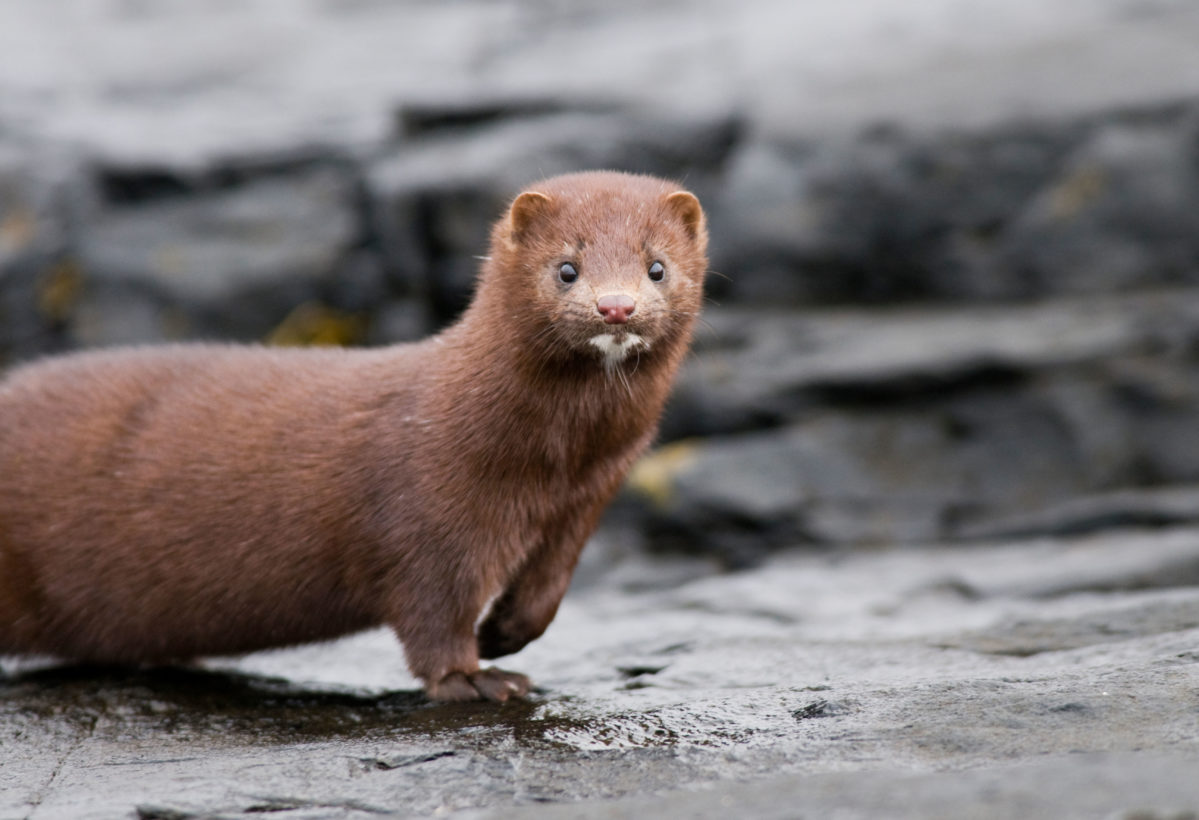
Minks are transmitting Covid-19 to humans. Don’t blame the minks.
From Denmark to the US, outbreaks on mink farms raise concerns that a virus mutation could make our vaccines ineffective.By Sigal Samuel Nov 13, 2020, 11:20am EST
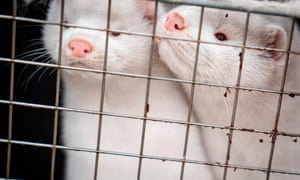
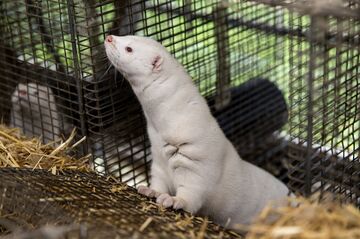
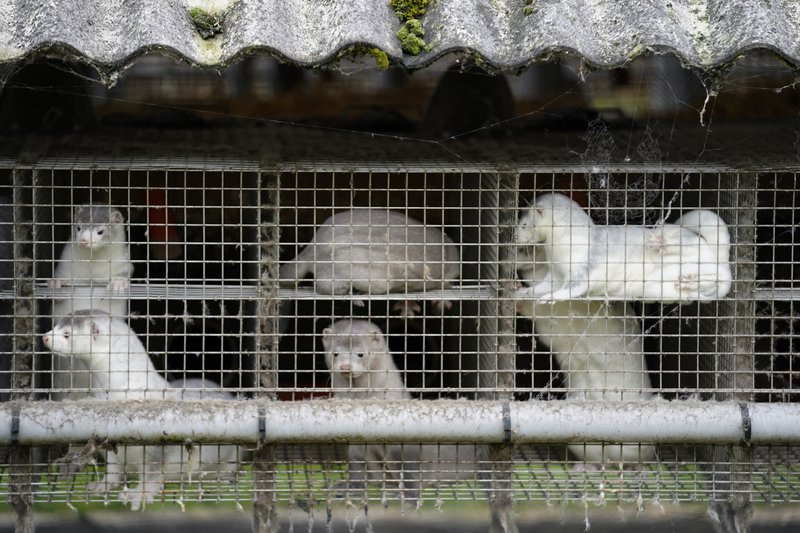
When minks are bred for their pelts — which are used to make fur coats and accessories — they are confined in small cages for their entire lives. They cannot engage in natural behaviors like roaming territories, digging, or swimming.
This story is part of a group of stories called
Finding the best ways to do good.
Denmark’s fur farms are home to 17 million minks, and last week, the government announced it would kill all of them.
This week, however, the government rolled that back a bit. Now, the government merely recommends killing all farmed minks in the country. It will only requirethe killing of minks —weasel-like animals prized for their fur —on farms where Covid-19 has been detected.
Danish Prime Minister Mette Frederiksen initially said all 17 million minks would be culled because the virus that causes Covid-19 had moved from humans to minks and back to humans. The country’s public health officials reported that while in the mink, the virus had mutated, raising the risk of a new strain circulating among us that our vaccines would be ineffective against — a finding that, to be clear, is preliminary and has not been confirmed in peer-reviewed research. In a worst-case scenario, that could set back the clock on our pandemic recovery.
This fear isn’t limited to Denmark. There have also been Covid-19 outbreaks on mink fur farms in the Netherlands, Spain, Sweden, Italy — and the US. At least a million minks have already been culled by gassing in the Netherlands and Spain, though the US has so far avoided culling. On farms in Utah, Wisconsin,and Michigan, thousands of minks have died of the disease, but mink-to-human transmission has not yet been detected.
The threat to public healthseems to raise an ethical dilemma: Should farms kill all their minks in order to prevent a mutated form of the virus from spreading among all human beings? Is causing that much animal suffering justifiable if it prevents a lot of human suffering, which could result if our future vaccines are ineffective against the new strain?
Denmark, at first, thought the answer was yes. But it was forced to backtrack after experts pointed out that the government couldn’t legally mandate a mass cull without passing new legislation, and after infectious disease experts questioned the scientific basis for the cull.
If it turns out to be true that the mink variant would jeopardize our vaccines and that there’s a strong chance that thousands or evenmillions of people will therefore die if we don’t cull the minks, you could make the case that a cull is the lesser of two evils. But we just don’t have enough data right now to know whether that’s true.
We do, however, know one thing with certainty. The fact that we are being forced to choose between two reasonable impulses — wanting to prevent animal suffering and wanting to prevent human suffering — is the result of another decision made: to farm thousands and thousands of animals in close quarters and unsanitary conditions.
Large-scale animal farming amplifies the threat of pandemics
Mink fur farms have a reputation for cruelty. The animals spend their entire lives confined in small cages, where they grow so distressed that they sometimes resort to self-mutilation and even cannibalism.
In both environments, animals live in cages under harsh conditions that compromise their immune systems. They’re tightly crowded together, often coming into contact with each other’s secretions and excrement. To make matters worse, selection for specific genes makes the animals almost genetically identical. That means that a virus can easily spread from animal to animal without encountering any genetic variants that might stop it in its tracks. As it rips through a herd, the virus can mutate and grow more virulent.
That’s why Michael Greger, an expert on zoonotic viruses, previously told me, “If you actually want to create global pandemics, then build factory farms.”
Both with fur farms (which contain thousands of animals) and with larger factory farms (which contain tens or hundreds of thousands of animals), we have created perfect-storm environments for the emergence and spread of disease. As the Humane Society Veterinary Medical Association recently wrote, “Fur farms often lack naturally mitigating factors — such as abundant sunlight, genetic variability, and healthy distance between animals. For these reasons, fur farms provide potential channels for diseases to propagate.”
The sheer number of animals we keep on these farms makes it likely for disease to spread. It’s also what makes it hard for us to think of a way to stamp out the problem other than by killing all the animals.
Jeff Sebo, a professor of environmental studies, bioethics, and philosophy at New York University, said the moral of the story is obvious: “As a general rule, if you have so many animals in your care that you are unable to care for them during crises, then that is too many, and you should not be allowed to own or keep that many animals in the first place.”
Culling animals en masse is not as rare as we might like to think. This spring, millions of animals were euthanized on American factory farms because there were no meat plants to send them to for slaughter; many plants had been shuttered after workers contracted Covid-19. And right now, hundreds of birds in the UK are being culled because an outbreak of the H5N2 avian influenza has been detected.
The way we’ve designed our animal farming system forces us to make tragic choices. “It basically makes us have to get into some contorted ethical reasoning,” Sebo said.
The mink situation has forced even some animal advocates to support a cull, for fear that leaving minks alive with untreated Covid-19 will cause them severe respiratory distress. “If mink on a farm are infected, suffering respiratory problems, and are not being culled, their welfare will also be seriously compromised,” said Joanna Swabe, a policy adviser for Humane Society International. Animal Protection Denmark CEO Britta Riis likewise said it was a “necessary decision” to cull, expressing concern about the welfare of the minks before they die.
And of course there are the potential public health risks for humans, which require more research but are not farfetched. The bottom line:“We have placed ourselves in this situation where we’re forced to make a choice that we never should have had to make,” Sebo said.
If we decide to keep raising thousands of animals on high-density farms, it’s clear we will keep finding ourselves in terrible and unnecessary moral binds where we have to choose between animal welfare and human welfare. We need to ask ourselves whether the benefit — a fur coat, a cheap cut of meat — is really worth the cost.
Sign up for the Future Perfect newsletter. Twice a week, you’ll get a roundup of ideas and solutions for tackling our biggest challenges: improving public health, decreasing human and animal suffering, easing catastrophic risks, and — to put it simply — getting better at doing good.
For now, farmers across Denmark have halted the mass slaughter of mink, and are only putting down animals that are infected. Photographer: Ole Jensen/Getty Images
Mink farms pose a serious threat to human health in the age of Covid, and will continue to do so even if individual mink mutations of the virus are fought back, according to Kare Molbak, Denmark’s top epidemiologist.
Denmark had planned to cull its entire population of mink — 17 million animals — after discovering a new strain of Covid-19 that has the potential to derail global efforts to develop a vaccine. The so-called cluster 5 variant carried in Danish mink led to mutations in the virus pod’s spike protein, which most vaccines target.
But this week, the planned cull was shelved after political infighting forced Denmark’s minority government to acknowledge it didn’t have parliament’s support to move ahead. There are even questions as to the legality of its order to exterminate the country’s mink population.
With political agendas dominating the day, the concern now is that the scientific arguments will get drowned out. Molbak, in his interview with Politiken, voiced his concern over the focus of lawmakers, which he suggested is misplaced.
“I think that the issue of cluster 5 has received far too much attention,” he said. Even if the cluster 5 mutation dies out, “there’d be new variants in mink that would spawn equivalent or bigger problems, a cluster 6, 7 or 8.”
“Our biggest concern since June has been the large reservoir that the mink provide the virus,” he said. “It’s a perfect storm. You have an animal that’s particularly receptive toward the virus and that, at the same time, is kept in large numbers, as is the case in Denmark.”
“Mink are very easily infected by the coronavirus, and once it’s there, it spreads at the speed of light,” he said. “We’ve seen how that then spreads to humans. That makes it practically impossible to handle the spread during a pandemic.”
1 of 5FILE – In this Friday, Oct. 9, 2020 file photo, minks in a farm in Gjoel in North Jutland, Denmark. Denmark’s prime minister says the government wants to cull all minks in Danish farms, to minimize the risk of them re-transmitting the new coronavirus to humans. She said Wednesday, Nov. 4, 2020, a report from a government agency that maps the coronavirus in Denmark has shown a mutation in the virus found in 12 people in the northern part of the country who got infected by minks. (Mads Claus Rasmussen/Ritzau Scanpix via AP, File)
COPENHAGEN, Denmark (AP) — More than a quarter million Danes went into lockdown Friday in a northern region of the country where a mutated variation of the coronavirus has infected minks being farmed for their fur, leading to an order to kill millions of the animals.
Prime Minister Mette Frederiksen said the move was meant to contain the virus, and it came two days after the government ordered the cull of all 15 million minks bred at Denmark’s 1,139 mink farms.
The coronavirus evolves constantly and, to date, there is no evidence that any of the mutations pose an increased danger to people. But Danish authorities were not taking any chances.
“Instead of waiting for evidence, it is better to act quickly,” said Tyra Grove Krause, head department at Statens Serum Institut, a government agency that maps the spread of the coronavirus in Denmark.
In seven northern Danish municipalities with some 280,000 residents sport and cultural activities have been suspended, public transportation has been stopped and regional borders have been closed. Only people with so-called “critical functions” such as police and health officials and different authorities are being permitted to cross municipal boundaries.ADVERTISEMENThttps://598824f24255f8188d3ac7c9665c3618.safeframe.googlesyndication.com/safeframe/1-0-37/html/container.html
People in the region have been urged to to be tested. As of Saturday, restaurants must close and school students from fifth grade and up will switch to remote learning Monday.
“We must knock down completely this virus variant,” Health Minister Magnus Heunicke said Thursday, adding that the mutated virus had been found in 12 people.
Last month, Denmark started culling millions of minks in the north of the country after COVID-19 infections were reported among the stock there. Nationwide, at least 216 out of the 1,139 fur farms in Denmark have now been infected.
Kaare Moelbak of Statens Serum Institut said the virus variant was registered in August and September, and no mutations have been found since, so it was not known if it still exists. The mutated virus was found in five mink farms, according to the government body.
WHO officials said each case needs to be evaluated to determine if any of the changes mean the virus behaves differently.
“We are a long, long way from making any determination of that kind,” said Mike Ryan, the WHO emergencies chief. He said that such mutations happen all the time in viruses.
“Right now the evidence that we have doesn’t suggest that this variant is in any way different in the way it behaves,” he said in Geneva.
Peter Ben Embarek, a WHO expert on food safety, said that initial studies on pigs, chickens and cattle “show that these species are not at all susceptible in the same way that mink are, for example. So even if these animals were infected, they would not be able to sustain and spread the disease in the same way.”
Britain on Friday said that people coming from Denmark must self-isolate for 14 days, adding the country to a list of countries it deems risky.
The Danish government said a mutation of the virus had been found in 12 people infected by minks, which farmers have been ordered to cull en masse, but experts said the significance of any variant strain and its effect on humans was unclear because it was yet to be studied.
Denmark, the world’s largest mink fur exporter, produces an estimated 17 million furs per year. Kopenhagen Fur, a cooperative of 1,500 Danish breeders, accounts for 40% of the global mink production. Most of its exports go to China and Hong Kong.
The pelts of the mink will be destroyed and Danish fur farmers have said the cull, which is estimated to cost up to 5 billion kroner ($785 million), may spell the end of the industry in the country.
Overall, Denmark has reported 53,180 cases of coronavirus and 738 deaths.
___
Jamey Keaten in Geneva contributed to this report.
COPENHAGEN (Reuters) – Denmark will cull its mink population of up to 17 million after a mutation of the coronavirus found in the animals spread to humans, the prime minister said on Wednesday.Slideshow ( 2 images )
Health authorities found virus strains in humans and in mink which showed decreased sensitivity against antibodies, potentially lowering the efficacy of future vaccines, Prime Minister Mette Frederiksen said.
“We have a great responsibility towards our own population, but with the mutation that has now been found, we have an even greater responsibility for the rest of the world as well,” Frederiksen told a news conference.
The findings, which have been shared with the World Health Organization and the European Centre for Disease Prevention and Control, were based on laboratory tests by the State Serum Institute, the Danish authority dealing with infectious diseases.
The head of the WHO’s emergencies programme, Mike Ryan, called on Friday for full-scale scientific investigations of the complex issue of humans – outside China – infecting mink which in turn transmitted the virus back to humans.
“We have been informed by Denmark of a number of persons infected with coronavirus from mink, with some genetic changes in the virus,” WHO said in a statement emailed to Reuters in Geneva. “The Danish authorities are investigating the epidemiological and virological significance of these findings.”
Authorities in Denmark said five cases of the new virus strain had been recorded on mink farms and 12 cases in humans, and that there were between 15 million and 17 million mink in the country.
Outbreaks at mink farms have persisted in the Nordic country, the world’s largest producer of mink furs, despite repeated efforts to cull infected animals since June.
Denmark’s police, army and home guard will be deployed to speed up the culling process, Frederiksen said.
Christian Sonne, professor of Veterinary and Wildlife Medicine at Aarhus University, said in an email he believed culling the herd now as a precautionary measure was a sound decision and could prevent a future outbreak that would be more difficult to control. Sonne co-authored a letter published in the journal Science last week calling for the cull.
“China, Denmark, and Poland should support and extend the immediate and complete ban of mink production,” Sonne and his co-authors wrote last week.
Tougher lockdown restrictions and intensified tracing efforts will be implemented to contain the virus in some areas of Northern Denmark, home to a large number of mink farms, authorities said.
“The worst case scenario is a new pandemic, starting all over again out of Denmark,” said Kare Molbak, director at the State Serum Institute.
Minks have also been culled in the Netherlands and Spain after infections were discovered.
COPENHAGEN (Reuters) – Denmark will cull its mink population of up to 17 million after a mutation of the coronavirus found in the animals spread to humans, the prime minister said on Wednesday.Slideshow ( 2 images )
Health authorities found virus strains in humans and in mink which showed decreased sensitivity against antibodies, potentially lowering the efficacy of future vaccines, Prime Minister Mette Frederiksen said.
“We have a great responsibility towards our own population, but with the mutation that has now been found, we have an even greater responsibility for the rest of the world as well,” Frederiksen told a news conference.
The findings, which have been shared with the World Health Organization and the European Centre for Disease Prevention and Control, were based on laboratory tests by the State Serum Institute, the Danish authority dealing with infectious diseases.
The head of the WHO’s emergencies programme, Mike Ryan, called on Friday for full-scale scientific investigations of the complex issue of humans – outside China – infecting mink which in turn transmitted the virus back to humans.
ADVERTISEMENT
“We have been informed by Denmark of a number of persons infected with coronavirus from mink, with some genetic changes in the virus,” WHO said in a statement emailed to Reuters in Geneva. “The Danish authorities are investigating the epidemiological and virological significance of these findings.”
Authorities in Denmark said five cases of the new virus strain had been recorded on mink farms and 12 cases in humans, and that there were between 15 million and 17 million mink in the country.
Outbreaks at mink farms have persisted in the Nordic country, the world’s largest producer of mink furs, despite repeated efforts to cull infected animals since June.
Denmark’s police, army and home guard will be deployed to speed up the culling process, Frederiksen said.
Christian Sonne, professor of Veterinary and Wildlife Medicine at Aarhus University, said in an email he believed culling the herd now as a precautionary measure was a sound decision and could prevent a future outbreak that would be more difficult to control. Sonne co-authored a letter published in the journal Science last week calling for the cull.
“China, Denmark, and Poland should support and extend the immediate and complete ban of mink production,” Sonne and his co-authors wrote last week.
Tougher lockdown restrictions and intensified tracing efforts will be implemented to contain the virus in some areas of Northern Denmark, home to a large number of mink farms, authorities said.
“The worst case scenario is a new pandemic, starting all over again out of Denmark,” said Kare Molbak, director at the State Serum Institute.
Minks have also been culled in the Netherlands and Spain after infections were discovered.
Reporting by Nikolaj Skydsgaard and Jacob Gronholt-Pedersen; additional reporting by Stephanie Nebehay in Geneva and Michael Erman in Maplewood, N.J. Editing by Jon Boyle, Nick Macfie, Timothy Heritage and Tom Brown
The problem came to light in April, when two fur farm workers in the Netherlands were found to have contracted the coronavirus from mink, which is the only known animal-to-human transmission following the initial outbreak. Photo by Mark Hicken/Alamy Stock Photo
Update (6/12/2020): Dutch authorities have confirmed they have killed 575,000 mink, including 480,000 pups, during the cull on 13 fur factory farms. The killing will conclude tomorrow.
The Netherlands is expected to kill more than 350,000 mink by gassing, in a massive cull following an outbreak of coronavirus on fur farms in the country. It is estimated that most of these—about 300,000—are pups just days or weeks old.
The killing of animals on fur farms is heartbreaking under any circumstances, because of how utterly needless and preventable it is. But this tragic cull, and the scale of it, is a stark reminder of the many problems that surround fur factory farming, impacting both animal welfare and human health, and why all production of this unnecessary commodity needs to end immediately.
The problem came to light in April, when two fur farm workers in the Netherlands were found to have contracted the coronavirus from mink, which is the only known animal-to-human transmission following the initial outbreak. In following weeks, 13 of the Netherlands’ roughly 130 fur farms reported mink infected with the virus. And the number of infected farms keeps on growing. The farms said more mink were dying than usual, and some had nasal discharge or difficulty breathing.
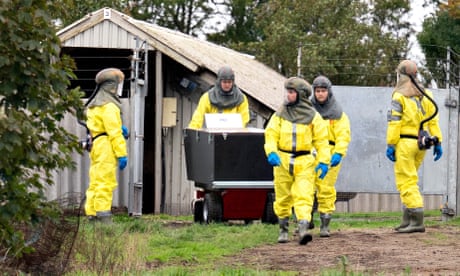
This month, the government ordered all mink on infected Dutch fur farms be killed to prevent the further spread of the coronavirus to humans. The cull, which began last week, has farm workers in protective clothing using gas to kill mink mothers and their pups. The animals’ bodies are then transported to a disposal center in a sealed shipping container and the farms disinfected.
It is now clear that these fur farms, where animals are crowded in close contact with each other, are reservoirs for the spread of pandemics. Organizations like ours have been sounding the alarm bell over fur farms—and the high risk for disease they pose—for years, and as tragic as this development is, it is not surprising to us.
Fur farms also pose an extraordinary animal welfare problem. Much like factory farms and wildlife markets, the animals in these operations live short, miserable lives in small, barren and filthy cages, usually without any veterinary care. A Humane Society International investigation of Finland’s fur farms last year showed many animals had eye infections and gaping wounds, including a mink with a large, bloody hole in the head. Some animals lay dead in the cages and others ate them or walked over them.
Such fur farms exist around the globe, including in the United States, where the top 10 states for mink pelt production (in order of most to least) are Wisconsin, Utah, Idaho, Oregon, Minnesota, Iowa, Illinois, Pennsylvania, Michigan and Washington. As part of our 11-point policy plan to reduce animal suffering and help prevent future national and global pandemics, the Humane Society family of organizations is calling for an end to all fur farming everywhere it exists around the world.
We have already made tremendous progress in fighting fur, with dozens of fashion designers and retailers turning away from this cruel product in recent years. In the United States, California has banned the production of fur and all sales of new fur products. Globally, Britain became the first country in the world to ban fur production, and it has been followed by a dozen European countries, including Austria, the Czech Republic and Norway.
The Netherlands, once the third largest fur farming country in the world, banned fur production in 2013 with an 11-year phaseout. But the tragedy now playing out in the country is an opportunity for the government there, and for governments in all fur-producing nations, to take note of the serious public health and animal welfare problems associated with fur farms and close them down without delay. With the pandemic still ravaging the globe, it simply doesn’t make sense for anyone to reinvest in an enterprise that’s fallen out of fashion and favor the world over.



/cdn.vox-cdn.com/uploads/chorus_image/image/67785080/mink_GettyImages_144813756.0.jpg)
 Exposing the Big Game