Fewer people apply for permits to hunt wolves

by Elizabeth Dunbar, Minnesota Public Radio
September 6, 2013

ST. PAUL, Minn. — The number of people who want to hunt wolves in Minnesota this fall and winter has dropped significantly from last year.

About 13,000 people have applied for licenses to participate in this year’s wolf hunting season, compared to more than 23,000 last year, state Department of Natural Resources officials said.

After a survey showed the state’s wolf population has declined, department officials decided to issue 3,300 permits this year. That’s down from 6,000 permits last year.

“I’m sure last year with the novelty of it and trying to get in on the first-ever regulated wolf hunt in Minnesota’s history probably caused some people to apply,” said Steve Merchant, the DNR’s wildlife population and regulation manager. “Other people thought, ‘well geez, if the permits are down 50 percent it’s going to half my chances of winning so I’m just not going to put in this year.'”

Merchant said applicants have about a 1 in 4 chance of getting a wolf license, about the same odds as last year.

The early wolf season begins at the same time as the firearms deer season on Nov. 9.

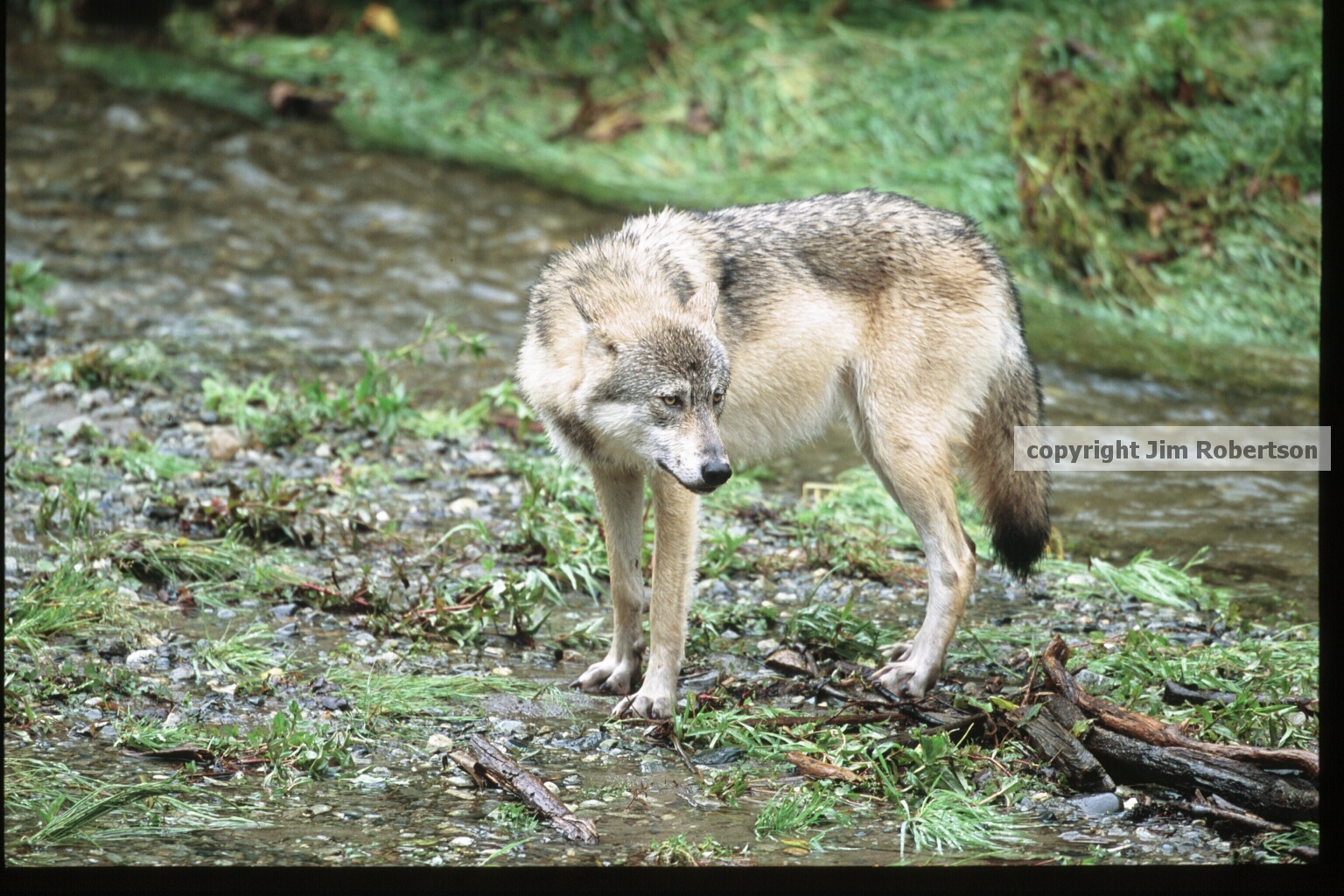
copyrighted wolf in river

Sleeping teen is bitten by wolf near Lake Winnibigoshish

This must have been in the same part of Minnesota that I posted about two days ago, where people have been regularly feeding wolves. Too bad, because people were starting to appreciate seeing wolves there. But wolves best be deathly afraid of humans at all times, if they know what’s good for them. The DNR doesn’t have to send in UN inspectors before going on the offensive against wolves.

There’s no mention in this article about why the wolf bit someone, but my guess is he was attracted by the smell of whatever food the humans had cooked that night or had in the tent with them. Who knows, maybe the kid had a peperoni stick by his head and the wolf was startled when he stirred his sleep. (People should know not to bring food in a tent with them.) I remember a camping trip where my brother in law had brought food in the tent and woke up to find that a mouse had chewed it, right by his head.

Anyway, the wolf (rest his soul) obviously wasn’t really trying to hurt or kill anyone, or he wouldn’t have been deterred when a 16 year old boy kicked at him.

http://www.startribune.com/local/221254011.html                                                                                                                                                                                                                                                                                                                                                                                                                                                                                                                                     JOSEPHINE MARCOTTY    Star Tribune August 26, 2013

A solitary wolf bit a 16-year-old-old boy sleeping outside his tent near Lake Winnibigoshish on Sunday, the first documented wolf attack in Minnesota history.

The unidentified boy, who is reportedly from Solway, Minn., stood up and kicked at the wolf, which then ran away, according to state wildlife officials.

The teenager, who was staying at a campground in the Chippewa National Forest, was driven to a hospital near Bemidji, where he was treated for a gash on the back of his head and canine punctures on either side of his face.

A 75-pound adult male wolf that matched the description provided by the boy and others at the campground was trapped and killed Monday morning by federal wildlife officials.

The wolf’s body was taken to the University of Minnesota veterinary school, where it is being tested for rabies and dissected. Investigators will collect DNA in an effort to match it to saliva samples on the victim.

“This is a rare occurrence,” said Tom Provost, enforcement manager for the Department of Natural Resources. He said there have been no other recorded cases in Minnesota of a wild wolf attacking a human, though it has occurred elsewhere in the United States and Canada, and more frequently in India.

The wolf that was killed Monday had a deformed jaw. The top and bottom were out of alignment, and it was missing a canine tooth, Provost said, meaning the animal likely had learned to survive by hanging around campgrounds.

In order to hunt successfully, wolves must be able to exert tremendous force on their prey, Provost said. An adult wolf is capable of biting with a force of 1,000 to 1,500 pounds of pressure per square inch, a strength that makes it possible to chomp through a moose femur in six to eight bites. A German shepherd has a biting pressure of 750 pounds per square inch.

“It was trapped in an area where it was likely habituated to humans and had the ability to grab easy food,” he said. “That’s not normal behavior.”

In fact, other campers reported that the wolf was behaving in an entirely unwolf-like way. Normally, wolves stay away from humans and are rarely alone. Pat Tetrault, 28, was one of several people who saw the wolf in the campground Friday and early Saturday. His wife saw it by their truck. In the early morning, while the family of four and their dog were fast asleep, it bit through the wall of their tent.

“It was by where my son was sleeping,” Tetrault said. “He said he felt it go under the tent, and then lift it up. He thought it was pretty cool. Took him awhile to go back to sleep.”

About ten minutes later Tetrault said he heard shouting from the direction of where the teenager was bitten.

Provost said that the teenager was lying outside his tent when “unbeknownst to him a large canine approached him from the rear.” He woke up when the wolf bit his head, and it was a “struggle to free himself from its jaws,” Provost said. The boy confronted the wolf, but it fled only when he launched a kick at it.

Friends and members of his family provided rudimentary first aid, and then drove him to the hospital.

Wildlife officials evacuated the campground and set up a perimeter. One officer saw it on the road and took a shot at it, but missed. On Monday morning federal wildlife officials found the wolf caught in a leg-hold trap that had been set around the campground over the weekend, and shot it.

copyrighted wolf in river


In northern Minn., a campaign against feeding wolves

http://minnesota.publicradio.org/display/web/2013/08/22/environment/campaign-against-feeding-wolves?

by Dan Kraker, Minnesota Public Radio

BRIMSON, Minn. — “Don’t feed the wildlife!” is a message frequently trumpeted at campgrounds around Minnesota. It’s usually meant to warn people not to feed deer or bears.

But this summer wildlife managers are expanding that message to wolves.

In at least two locations in northeast Minnesota, people are feeding wolf pups — easy meals that could have very negative consequences.

At Hugo’s, the bar and general store that Gary Hepola runs with his wife in the tiny town of Brimson, about 40 miles north of Duluth, it doesn’t take long to see a wolf pup.

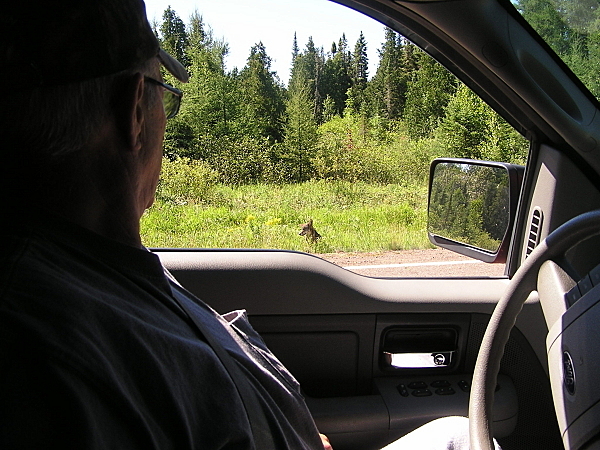
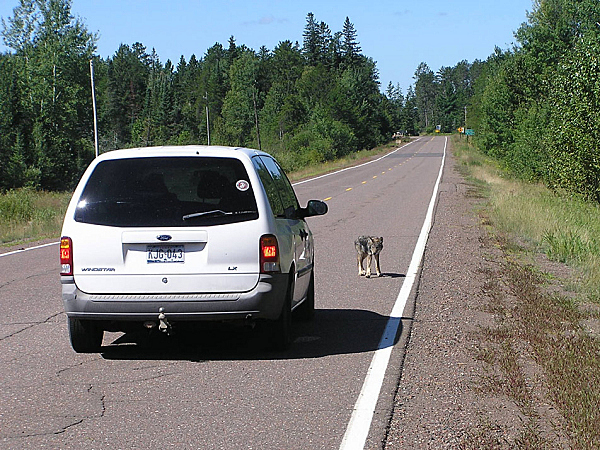
“You’ll notice they have no fear here,” said Hepola as he pulled his pickup out of the parking lot. “They’ll come right up to that window.”

Sure enough, the young wolf, with pointy ears and splotches of gray, white and tan fur, ambles right up to Hepola’s open window. “What are you doing? Get off the road!”

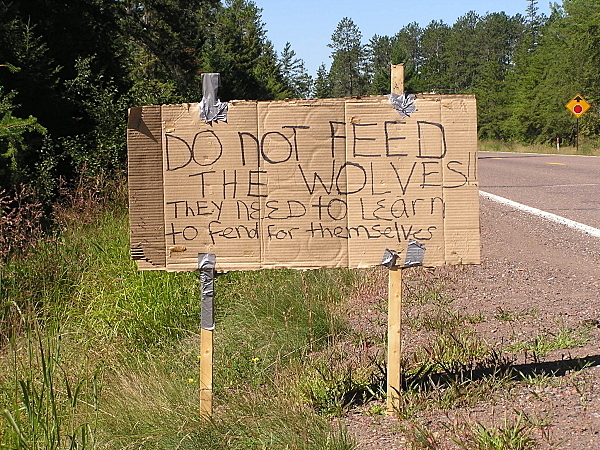
Hepola said the wolves have grown steadily bolder over the past six weeks or so. He has seen people place piles of food on the side of the road to lure the wolves in close to snap pictures.

“I’ve chewed a few people out [and] said, ‘Don’t be feeding the wolves,'” he said. “People don’t realize they’re going to become adults. They’re cute now — not so cute when they’re big.”

Hepola fears that some of the pups might not even make it to adulthood. One of eight was killed by a car last week.

That number could grow, said Nancy Hansen, assistant area wildlife manager in Two Harbors for the Department of Natural Resources.

“They are at a very busy intersection,” Hansen said. “It’s going to get busier, with hunting season coming up, so I’m concerned.”

Hansen said the wolf pups are using a stretch of forest near the intersection of two county highways as a rendezvous site. The adults in the pack leave the pups to hunt and return with food.

Wildlife experts say people sometimes see wolf pups alone, perhaps think they look thin, and assume they have been abandoned and need food. Hansen said the DNR is trying to educate the public otherwise.

“Basically, we really need people to police themselves,” she said. “As neat as it is to see these animals, this is not a normal situation, and anything they’re doing to get their picture taken with a wolf pup or feed a wolf pup, it’s not good for the pups.”

Hansen said officials cannot relocate the pups, because they would either die away from the pack or just return to the rendezvous point.

“If we can’t turn it around, we’ll probably have to capture the pups, they’ll either have to be moved to a facility, or destroyed,” she said.

Hansen said she has never seen a situation like the “Hugo’s wolves” as she refers to them. She said news of the wolves has spread like wildfire on Facebook, and more and more people are flocking to see them.

Jess Edberg, the information services director at the International Wolf Center in Ely, is dealing with a similar situation on the Echo Trail near the Boundary Waters Canoe Area.

“The wolf pups were walking across the road, sitting on the road, watching vehicles go by, and somebody did see there was fresh food put out there the other day,” she said.

Edberg said every year or two she hears of emboldened wolves not fleeing from passing cars. In those situations, she said, it’s not enough to simply not feed them. She said even a passive observer can encourage wolves to frequent an area.

“We want to make sure that wildlife have a healthy fear avoidance of humans, so honking your horn or yelling, not encouraging the animal to be there is going to be helpful for the survival of that animal,” Edberg said.

At Hugo’s Bar in Brimson, owner Jody Hepola said the wolves have become something of a tourist attraction.

“The store’s been busy,” she said. “Lots of people come in to comment and get a snack while they’re out looking for the wolves, and lots of phone calls, asking, ‘Are they’re really wolves up there? What time of day, where can we see them?”

But Hepola said she would gladly give up the increased business. She wants the wolves to learn to fend for themselves.

The War on Wolves: Who Are the Real Predators?

Michael Markarian, of the HSUS Legislation Fund, wrote the following on their “Animals and Politics” page:


The Chicago Tribune weighed in with an editorial this weekend on the Obama Administration’s latest in a series of proposals to strip recovering gray wolves of their federal protections—leaving the fate of wolves to the blood lust of hostile state politicians and trophy hunting and ranching interests. More than 1,000 wolves have been killed with painful steel-jawed leghold traps, hound hunting, and other methods since Wisconsin, Minnesota, Idaho, Montana, and Wyoming legalized hunting seasons—including storied Yellowstone National Park wolves whose packs had been studied for decades, but were gunned down in their GPS collars over the park border.

WolvesAs if that wasn’t bad enough, Montana officials now propose lengthening the wolf hunting season and increasing the bag limit. It’s alarming to Yellowstone administrators who say it places more of the park’s wolves in jeopardy when they step over the border into Montana—putting the Department of the Interior in the awkward position of handing wolf management to the states and then watching from the sidelines as they kill the very descendants of the wolves reintroduced to the park 17 years ago. And just last month, Wisconsin raised its quota to 275 wolves which, when combined with other forms of human-caused wolf mortality, likely will result in 50 percent of the entire wolf population in the state being killed—despite the fact that Wisconsin voters oppose wolf hunting by a more than eight-to-one margin.

You’d think the pogrom for wolves in the Northern Rockies and Great Lakes regions would cause the Obama Administration to pause before adding to the carnage. But the U.S. Fish and Wildlife Service has announced its plans to drop endangered species protections for the gray wolf population in virtually all of the lower 48 states, with the exception of about 75 wild Mexican wolves in Arizona and New Mexico.

Some states have set up sound, capable management plans for wolves—such as Washington, which this year passed legislation to create a state gray wolf conflict account to be used for mitigation, assessment, and payments for injury or loss of livestock caused by wolves. But many others have taken a regressive, dangerous approach. The Utah legislature even handed out hundreds of thousands of taxpayer dollars to a private group to advocate for killing wolves. Instead of hoping for the best from a patchwork of state authorities subject to varying degrees of political power exerted by ranching and hunting interests, the federal government should be overseeing and working with the states and driving the nation toward full recovery of wolves.

The Tribune is urging concerned citizens to submit comments to the U.S. Fish and Wildlife Service by visiting this web site before the September 11 deadline, and urging the agency to keep protections intact for one of America’s most ecologically valuable creatures.

Meanwhile, in Michigan, state politicians are so dead-set on killing wolves that they pulled a fast one on voters who gathered more than 250,000 signatures to place the question of wolf hunting on the ballot. Michigan lawmakers passed a second bill, signed into law by Gov. Rick Snyder, to subvert a vote of the people and allow wolf hunting, after their first bill was the subject of a citizen referendum. They want to take the power to decide wildlife issues away from the state’s voters, and put it in the hands of seven unelected bureaucrats—paving the way to kill wolves and other protected species.

But Michigan citizens are fighting back against this undemocratic power grab, and have launched a second referendum campaign to stop the trophy hunting and trapping of wolves and restore the right of Michigan voters to weigh in on critical wildlife issues. With the bodies of wolves piling up around the country, Michigan citizens are taking a stand for these rare and majestic treasures. You can join them by visiting the Keep Michigan Wolves Protected campaign.

Minnesota’s wolf population down from 2008

Minnesota’s wolf population down from 2008
A survey across Minnesota’s northern forest last winter showed the state has about 2,211 wolves, down some from the most recent survey in 2008.

http://www.duluthnewstribune.com/event/article/id/272049/
By: John Myers, Duluth News Tribune

Wolf numbers down

A survey across Minnesota’s northern forest last winter showed the state has about 2,211 wolves, down some from the most recent survey in 2008.

The Minnesota Department of Natural Resources announced the revised estimate today after a winter-long survey taken by biologists and other wildlife experts.

The number is down about 710 from the state’s last major wolf count taken during the winter of 2007-2008 and comes on the heels of last autumn’s controversial wolf hunting and trapping seasons when 413 wolves were killed. They were the first regulated wolf seasons in Minnesota and the first sanctioned public killing of wolves since the 1960s and were allowed only after the animals had recovered enough to be taken off the federal endangered species list earlier in 2012.

Another 200 or so wolves were trapped and killed last year, as they are each year, under a government-sanctioned program that targets wolves near where livestock have been attacked.

The 2007-08 survey estimated that 2,200 to 3,500 wolves roamed over about 30,000 square miles across the northern third of Minnesota. That was down from the 2004 survey estimate of 2,300 to 3,700. The 1998 survey showed 2,000 to 3,000 wolves.

Although lower than the 2008 wolf population survey midpoint estimate of 2,921 wolves, the population exceeds the state’s minimum goal of at least 1,600 wolves and is above the federal recovery goal range of 1,251 to 1,400 animals.

“Results from the 2013 wolf survey continue to demonstrate that Minnesota’s wolf population is fully recovered from its once-threatened status and the population is responding naturally to the availability of deer, wolves’ primary food source,” said Dan Stark, DNR large carnivore specialist.

The survey doesn’t include wolf pups born this year, which will substantially increase the population, at least until humans and other factors begin to take their toll.

Critics of hunting and trapping in Minnesota say the low end of the population estimate could be too few wolves to sustain ongoing wolf killing. But supporters of wolf hunting and trapping say the survey shows the population remains robust under state management.

After a century of unrestricted shooting and trapping as a nuisance animal, Minnesota is believed to have fewer than 500 wolves, all in the Superior National Forest in Northeastern counties, when the animal was first given federal protections in the 1970s.

Left alone, wolves gradually rebuilt their numbers and expanded their range, with Minnesota wolves also moving into Wisconsin and Michigan, which now have thriving populations.

Wolf numbers in the western Great Lakes reached the government’s official “recovered” level by the late 1990s but it took more than a decade for the U.S. Fish and Wildlife Service to overcome political and legal opposition to the move leaving wolves unprotected.

Lawsuits are pending that seek once again to place wolves back under protections of the Endangered Species Act, especially noting they have reached safe population levels in only a small fraction of their original range in the U.S.

copyrighted Hayden wolf walking

Your Call Are Making a Difference for Wolves

I heard some encouraging news today from a diehard activist who has called every one of the Minnesota state representatives listed as contacts for the bill to reinstate a five-year moratorium on recreational wolf hunting and trapping. She learned that of all the issues, they were hearing the most about the wolf issue and one staffer said, “he has not taken ONE call against the bill.

Her message to us is, “Please keep up the calls people—its making a difference!”

Here’s the info again and the contact info, from Howling For Wolves:

Today, legislation was introduced into the Minnesota House of Representatives to reinstate a five-year moratorium on recreational wolf hunting and trapping. Chief house author, Rep. Jason Isaacson (DFL – Shoreview) introduced H.F. 1163, the companion bill for S.F. 666 introduced by Sen. Chris Eaton. The bill calls for a five-year wait before another wolf hunting season can be proposed, and only for population management purposes after other options are explored. Read the press release here.

Mark your calendars! A Senate hearing of the bill has been scheduled on Tuesday, March 12 at noon before the Environment and Energy committee. Let’s fill the hearing room and the halls for the wolf. It was your efforts making calls and sending emails to committee members that pushed us forward.

Now we need your help to secure a hearing in the House Environment and Natural Resources Policy committee. A bill must be heard and passed out of one committee before March 15, 2013 to stay alive. Please call the committee members listed below to voice your support for H.F. 1163 and request the bill be heard and passed through committee.

House Environment and Natural Resources Policy Committee Rep. David Dill (Chair) 651-296-2190 Rep. Peter Fischer (Vice Chair) 651-296-5363 Rep. Tom Hackbarth 651-296-2439 Rep. John Benson 651-296-9934 Rep. Tony Cornish 651-296-4240 Rep. Dan Fabian 651-296-9635 Rep. Andrew Falk 651-296-4228 Rep. Steve Green 651-296-9918 Rep. Rick Hansen 651-296-6828 Rep. Clark Johnson 651-296-8634 Rep. Denny McNamara 651-296-3135 Rep. John Persell 651-296-5516 Rep. Mark Uglem 651-296-5513 Rep. Jean Wagenius 651-296-4200 Rep. JoAnn Ward 651-296-7807 Rep. Barb Yarusso 651-296-0141

Please know that to work a bill into law requires many repeated actions to push it through. We will have several urgent requests for actions over the next few weeks to keep each bill moving forward to a final floor vote. In the meantime, mark your calendars for the Senate hearing on Tuesday, March 12 at 12 pm. Please email us atrespond@howlingforwolves.org if you are able to attend. We want a strong showing of support at this hearing.

_____________________

Meanwhile in Montana,

Another activist writes, “I counted the public comments MTFWP received in January about the Wolf Hunt closure next to Yellowstone National Park (YNP). Overwhelmingly the votes were in favor of a closure. I kept a strict count of all the Montana comments and was pretty close on the others too.  Here’s my count:

There were a total of 1811 comments.

750 of those comments were from Montanans:

•554 in favor of a wolf hunt closure around YNP

•196 opposed to a closure around YNP


1061 comments were from out of state, USA citizens and some from overseas

•~1058 were in favor of a wolf hunt closure, protecting YNP wolves

•~3 were opposed


As wolf advocate Justin Forte put it, “This dictatorship that hunters and ranchers have had over the rest of us on wildlife policy has gone on for too long! It is time for all of us to stand up and say ‘No More!’”

Text and Wildlife Photography ©Jim Robertson, 2013. All Rights Reserved

Text and Wildlife Photography ©Jim Robertson, 2013. All Rights Reserved


Bill to stop wolf hunts in MN introduced today

From Howling For Wolves

Today, legislation was introduced into the Minnesota House of Representatives to reinstate a five-year moratorium on recreational wolf hunting and trapping. Chief house author, Rep. Jason Isaacson (DFL – Shoreview) introduced H.F. 1163, the companion bill for S.F. 666 introduced by Sen. Chris Eaton. The bill calls for a five-year wait before another wolf hunting season can be proposed, and only for population management purposes after other options are explored. Read the press release here.

Mark your calendars! A Senate hearing of the bill has been scheduled on Tuesday, March 12 at noon before the Environment and Energy committee. Let’s fill the hearing room and the halls for the wolf. It was your efforts making calls and sending emails to committee members that pushed us forward.

Now we need your help to secure a hearing in the House Environment and Natural Resources Policy committee. A bill must be heard and passed out of one committee before March 15, 2013 to stay alive. Please call the committee members listed below to voice your support for H.F. 1163 and request the bill be heard and passed through committee.

House Environment and Natural Resources Policy Committee
Rep. David Dill (Chair) 651-296-2190
Rep. Peter Fischer (Vice Chair) 651-296-5363
Rep. Tom Hackbarth 651-296-2439
Rep. John Benson 651-296-9934
Rep. Tony Cornish 651-296-4240
Rep. Dan Fabian 651-296-9635
Rep. Andrew Falk 651-296-4228
Rep. Steve Green 651-296-9918
Rep. Rick Hansen 651-296-6828
Rep. Clark Johnson 651-296-8634
Rep. Denny McNamara 651-296-3135
Rep. John Persell 651-296-5516
Rep. Mark Uglem 651-296-5513
Rep. Jean Wagenius 651-296-4200
Rep. JoAnn Ward 651-296-7807
Rep. Barb Yarusso 651-296-0141

Please know that to work a bill into law requires many repeated actions to push it through. We will have several urgent requests for actions over the next few weeks to keep each bill moving forward to a final floor vote. In the meantime, mark your calendars for the Senate hearing on Tuesday, March 12 at 12 pm. Please email us atrespond@howlingforwolves.org if you are able to attend. We want a strong showing of support at this hearing.

Text and Wildlife Photography ©Jim Robertson, 2013. All Rights Reserved

Text and Wildlife Photography ©Jim Robertson, 2013. All Rights Reserved