
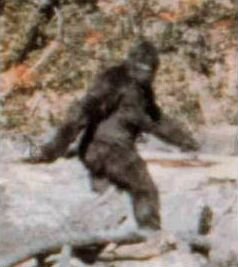
 Lately I’ve made reference to Bigfoot—that legendary creature that people occasionally claim to see in the Northwest forest, but who have yet to be physically proven—as an analogy for the oft-cited but never really sighted mythical character the “ethical hunter.” The latter, of course, is a contradiction in terms. How can a person make sport of killing of animals in the prime of their lives and call themselves “ethical?”
But aside from the myth factor, the comparison is flawed. Bigfoot are said to be peaceful, self-sufficient vegetarians who live in harmony with the rest of life around them. ( Naturally, they avoid humans like the plague.)
The idea that a human-like creature can fit in with their environment and not destroy it does seem far-fetched these days. But for hundreds of thousands of years, our earliest ancestors lived alongside Australopithecus robustus, a plant-eating hominid who just tried to mind their own business until our direct carnivorous cousins killed or drove them off (just as gorillas of today’s world are falling victim to the bush meat trade.)
Upon reflection, human hunters, even those claiming to be the “ethical” ones, don’t deserve to be mentioned in the same sentence as higher beings like Bigfoot. Although a general rule of thumb may be, the more human-like, the more destructive, Bigfoot is a hopeful exception. The notion of a peaceful, inoffensive, upright two-legger is refreshing indeed.

L-R, Bob Titmus, Jim Robertson at Harrison Hot Springs, B.C., with some of Bob Titmus’ bigfoot casts. Circa 1980



 Exposing the Big Game