Authorities in Montana say a 911 caller discovered his friend dead in a tent in what appeared to have been a fatal bear attack — but officials soon discovered the camper was actually the victim of a brutal murder.
Dustin Kjersem, 35, was found dead in his tent on Saturday morning along Moose Creek Road north of Big Sky, Montana, Gallatin County Sheriff Dan Springer said at news conference Wednesday. A friend who was supposed to have met Kjersem went searching for him when he didn’t show up as scheduled on Friday.
The friend ultimately discovered Kjersem’s body in a tent at a makeshift campsite and called 911, telling responders the death appeared to have been caused by a bear attack, the sheriff’s office said.
An agent with the Montana Fish, Wildlife and Parks agency who visited the site, however, found no signs of bear activity, and investigators said they soon found evidence of a “vicious attack,” which is being investigated as a homicide.
Dustin Kjersem / Credit: Gallatin County Sheriff’s Office
Kjersem, who was last seen on Thursday afternoon, sustained “multiple chop wounds,” including to his skull, an autopsy showed.
“He was brutally killed at his campsite and we need your help,” Springer said, adding that his detectives were working “all hours of day and night to find his killer.”
No suspects have been identified, and Springer said the remote area of the crime scene, where there is no cellphone service, was making the investigation more difficult than most cases.
“People have asked me if there’s a threat to this community and the answer is we don’t know. We don’t have enough information to know at this time,” he said.
“We do know that someone was out there who killed someone in a very heinous way so if you’re out in the woods you need to be paying attention, you need to remain vigilant,” Springer said.
Kjersem was driving a black 2013 Ford F-150 with a black topper and a silver aluminum ladder rack, and police have asked the public to come forward with any information they might have.
2013 Ford F-150 / Credit: Gallatin County Sheriff’s Office
“Think of the whole canyon,” Captain Nathan Kamerman said at the news conference. “If you saw something weird in the canyon area, or in town with his truck, please reach out to us.”
Kjersem’s sister Jillian Price called her brother a skilled tradesman and a loving father.
“I asked our community to please find out who did this,” she said. “There is someone in our valley who is capable of truly heinous things.”
A grizzly bear was shot and later killed after chasing a hunter up a tree in Montana, authorities said.
The animal, a mother bear with two cubs, charged the unidentified man while he was hunting by the Hidden Lakes in Gallatin County, Montana, the sheriff’s office said in a news release. He shot the bear with a pistol before climbing a tree, but the wounded bear remained in the area.
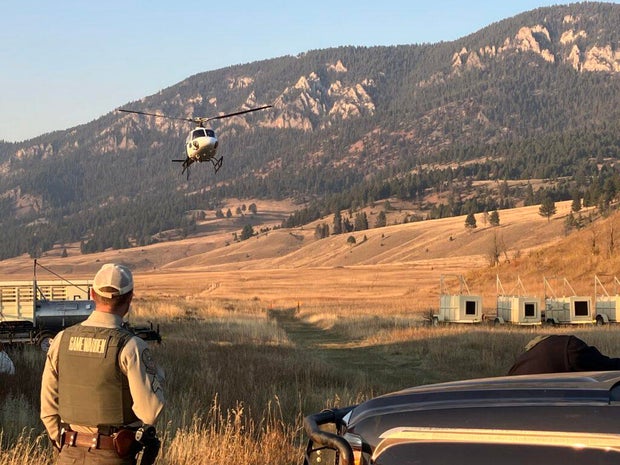
County dispatchers received a 911 call from the hunter at 2:08 p.m. on Saturday. The man waited in the tree until a Montana Fish, Wildlife and Parks helicopter arrived on the scene.
When the Fish, Wildlife and Parks personnel arrived, they “dispatched the wounded grizzly,” the sheriff’s office said, and rescued the hunter. He was not injured, and was transported out of the area on the helicopter. The Gallatin County Sheriff’s Office assembled a search and rescue team, but it was not needed to find the man.
A Montana Fish, Wildlife and Parks helicopter meets a search and rescue team after rescuing a hunter.Gallatin County Sheriff’s Office
The Hidden Lakes are a series of eight lakes on the west side of the Gallatin Range, a part of the Rocky Mountains. The area is home to grizzly bears and wolves. Gallatin County Sheriff Dan Springer said that the incident should serve as a reminder for hunters to be aware of their surroundings, to carry bear spray, avoid signs of bears, and hunt in groups and carry a communication device to call for help if necessary.
Multiple bear attacks have been reported in Montana in recent months. In late September, a man was attacked by a bear and injured, then walked over a mile to reach a rescue helicopter. In mid-August, a three-year-old girl was attacked by a black bear while she was in a tent at a private campground just north of Yellowstone National Park. A bear believed to be involved was captured and euthanized hours after the incident.
In July, a man shot and killed a grizzly bear after it charged him while he was picking berries. Another grizzly bear was killed by Montana Fish, Wildlife & Parks officials that same day after it broke into a home.
it is the kind of articles like yours, “Wolf hunting and trapping down despite added opportunities,” that does nothing to inspire a better relationship between humans and nature in general, and wild animals, in this case with wolves.
And this at a time when we need to cultivate empathy and compassion for others, especially for nonhuman animals–domestic and wild,–and are in need for education on how to co-exist, become more tolerant and appreciative of nature–recall that we are in the midst of an accelerating rate of plant and species extinction, global destruction of ecosystems and mass killings of nonhuman animals, oh and let’s not forget climate change.
Your article presents the activity of killing wolves as something that is valuable, when an opposing view would call it an activity of ‘very sick’ individuals.
Stating that hunters and trappers have “achieved” killing a mere third of the allowable number of wolves in Montana is supporting the status quo of this ecologically and ethically indefensible madness brought on by legislators, and a Governor and his choice of FWP Commissioners –a representative of the Safari Club International and Outfitters, who are wolf haters and have no sense of respect for wild animals here in our state. The only decent member of this commission with decency is Pat Byorth.
Repeating the new language of “threshold,” which has a much better sound than a “quota,” shifts the focus of the tragedy of the high number of wolves killed to the human, who then will act. This tells the public that there is nothing to worry about, no need for concern, let alone empathy. This trivializes the lives of wolves even further.
Putting your emphasis on the “harsh weather conditions” and increased gas prices that make wolf killing so hard for the poor sportsmen, omits the animal side completely. It really does not get more anthropocentric–only the human side matters; forget that wolves and tens of thousands of other wild animals are getting killed by trappers this year alone; forget that these sentient animals greatly suffer from physical pain and psychological trauma in neck snares, and other body-gripping and killing devices set by ‘poor’ trappers; forget that this mass killing impacts not only on these animals themselves but also on their mates and young, the latter of whom may die as a result of their mother killed in traps or shot by a so-called ‘hunter.’
How many wolf pups are going to die in their den, now that their mother won’t come home to nurse them? Do you really not care about this?
Just like sometime ago in the Bitterroot, when a mountain lion mother who was found, strangled to death by a snare with her two little cubs also dead next to her body.
In conclusion, presenting the disaster of the ongoing wolf slaughter as a game where ‘sportsmen’ compete, achieve and are allowed etc., could not be further from reality.
It would be very helpful for the public to read articles that are more sensible, consider the animal side for a change, and encourage us not to engage in aggressive, violent and cruel behavior such as most hunting and all trapping, and the ongoing wolf slaughter but rather cultivates empathy and compassion for ‘others’ as stated before.
It is one thing if you personally support killing of wolves, but please do not put your opinions in a public article that presents us with a biased information. As you certainly know, words matter.
Very dark days lie ahead for us, for our state’s reputation, for tourism, for our state’s economy, and particularly for wolves and other animals. The wildlife and beloved family pets will pay the ultimate price in this unethical, indiscriminate, and unnecessary war declared on wolves in Montana.
In support and collaboration with some of our closest allies, Plan B to Save Wolves, Wolves of the Rockies, The 06 Legacy, and the Apex Protection Project, Trap Free created this action alert, below, focused on the Yellowstone Wolves. We did not make this decision lightly. The Yellowstone wolves are the poster child of wolves. They are both deeply valued and deeply despised. We do not want to put them in further jeopardy. However, they are the trophies, wolf haters, and outfitters will target. They have no quota, anymore, on the number of Yellowstone wolves who can be killed, and these wolves are clueless. Their deaths will be heard worldwide and felt through the heart and the wallet. We cannot sit back, wait, and watch. As WOTR founder once said to us, “If we cannot save Yellowstone wolves, we cannot save any.”
Please take action below and make the calls. With enough pressure we should be able to at least stop this pending targeted slaughter we know will be on the prized Yellowstone wolves and the foreseen annihilation of hundreds of unknown wolves will not be muted!
YELLOWSTONE WOLVES NEED YOU NOW
If you are a fan of Yellowstone, a future or past visitor, or a business owner who benefits from Yellowstone National Park, then WE ARE IMPLORING YOU to be a voice for Yellowstone Wolves.
This is an EMERGENCY. In Montana, killers will be targeting Yellowstone wolves as a badge of honor, for revenge, and for the ease now in killing them. The fascination and love of wolves viewed and watched by millions in the park, annually, have habituated many wolves into thinking that humans will cause them no harm. However, they are about to be seriously betrayed.
The Montana Fish & Wildlife Commission removed the quotas outside the park, so those who hate wolves CAN NOW KILL countless Yellowstone wolves as they cross the imaginary park boundary lines.
Effective August 20, 2021, in sync with the Montana 2021 legislature’s passing of anti-wolf bills, here is how wolves in Montana can legally be killed:
1. By outfitters, landowners, and others with landowner permission, enticing wolves with bait onto private land so they can also shoot them at night using artificial light or night vision scopes.
2. With baited unattended indiscriminate massive secreted leghold traps and countless cheap snares.
3. With archery beginning September 5, guns September 15, and trapping and snaring as early as November 29. The Montana wolf season closes on March 15 during the wolves’ latter stage of pregnancy and birthing.
4. And with monetary reimbursements ~$1,000, a bounty, from an Idaho based organization for Montana wolf killers.
The Yellowstone wolves have significant intrinsic and extrinsic value:
They are the poster child of wolves. These wolves are known, observed, photographed, studied, and treasured.
They will represent the secreted and disturbingly unethical, cruel fate that will befall all the unknown wolves in Montana and in which the recent overwhelming majority of 25,000 submitted public comments opposed.
Tourism is Montana’s second and fastest-growing industry. Many come here for wildlife, and especially to Yellowstone to see wolves.
In 2005, 10 years after wolves returned to Yellowstone, a study estimated wolf-centered ecotourism generated > $35 million in the park’s surrounding gateway communities.
In 2019, Yellowstone National Park reports tourism generated a cumulative economic benefit of $642 million for local economies near the park.
Years of scientific research and educational discoveries will be lost with this pending slaughter.
Montana Fish & Wildlife Commission’s approval of these wolf “hunts” has nothing to do with hunting, or as anti-wolf bills’ sponsor, Rep. Paul Fielder said, fair chase. They will become culls, potentially decimating, even eliminating entire naive Yellowstone packs.
PLEASE, TAKE A FEW MINUTES, now to try to stop this, using your own words, and being respectful, do the following:
1. Contact MONTANA OFFICE OF TOURISM AND BUSINESS DEVELOPMENT and tell them that you are demanding protections for wolves as a patron of Yellowstone, a tourist, or a relevant business owner. 1-406-841-2870 / Toll-free 800-847-4868 Email: travelcounselor@visitmt.com Online contact: https://www.visitmt.com/contact.html
2. Contact MONTANA GOVERNOR GREG GIANFORTE about the negative economic impact this will have; the economic benefit in 2019 from tourism to local Yellowstone Park communities was an estimated $642 million. 1-406-444-3111, or online https://svc.mt.gov/gov/contact/shareopinion
3. Contact SECRETARY OF THE INTERIOR, DEB HAALAND and urge her to protect Yellowstone wolves, save the Northern Rocky Mountain region wolves from this unethical and unnecessary slaughter, and move to a federal emergency listing of all wolves to prevent the imminent eradication of the species. 1-202-208-3100 email: feedback@ios.doi.gov or online https://www.doi.gov/contact-us
4. Contact PRESIDENT JOE BIDEN and insist he put the wolves back on the endangered species list as the states have demonstrated their inability to manage wolves responsibly and through science; and this is not what the American public supported for wolf reintroduction and recovery.1-202-456-1414 (Switchboard) 1-202-456-1111 (Comments) or online https://www.whitehouse.gov/contact/
Montana FWP officials euthanized a pair of grizzly bears after they several depredations on llamas, sheep, goat and chickens over time near Whitefish. (Photo by John Moore/Getty Images)
KALISPELL, Mont. — Montana wildlife officials said Tuesday that state bear management specialists killed a pair of grizzly bears near Whitefish that had been involved in numerous livestock attacks.
An adult female grizzly bear was captured on Monday and its yearling captured on Tuesday in the Haskill Basin area.
The animals were euthanized because of a history of killing livestock including sheep, llamas, chickens and a goat.
Last week, authorities killed an adult male grizzly bear in the Dupuyer area after it was suspected of attacking calves across numerous ranches.
The following was sent out by Montana Fish, Wildlife and Parks:
Montana Fish, Wildlife & Parks bear management specialists euthanized a pair of grizzly bears after numerous depredations on llamas, sheep, goat, and chickens over time near Whitefish.
FWP specialists captured an adult female grizzly bear on May 31 and its yearling on June 1 in the Haskill Basin area. The decision was made to kill both bears due to their history of livestock depredations and in consultation with the U.S. Fish and Wildlife Service.
The bears most recently entered an enclosure holding numerous animals on private property and killed a llama. The bear pushed through a gate to enter the pen where the llama was located along with other animals, including six wallaroos. FWP staff responded to assist the landowner and continue efforts to capture the bears.
The adult female bear was previously captured and fitted with a GPS radio collar, but the collar was malfunctioning and came off in the summer of 2019. Data collected from the radio collar identified the bear at several sites where sheep, llamas, and chickens were killed around Whitefish. Attempts to recapture the adult female were unsuccessful during 2020.
Earlier this spring, FWP received reports of sheep killed off East Edgewood Drive. Staff with the U.S. Department of Agriculture’s Wildlife Services set a trap in the area and attempted to capture the bear but was unsuccessful. Cameras set up at the site identified the adult female and yearling. Several days later, the bears killed goats on private property in Haskill Basin. Additional traps and cameras were set but efforts to capture the bears was unsuccessful until most recently. Reports of chickens killed on private property in the area persisted at the same time.
At the end of the session, the Legislature passed a bill that had language inserted at the last minute that basically guarantees hunting outfitters more nonresident hunting clients. Other bills carrying the same language died in committee.
On Thursday, House Bill 637 was on its way to the governor’s desk after the House and Senate voted to pass subsequent amendments on mostly party-line votes on the last day of the session.
Sportsmen’s groups including the Backcountry Hunters and Anglers and the Montana Wildlife Federation are telling their members to ask Gov. Greg Gianforte to veto the bill, partly due language added Tuesday that is a handout to hunting outfitters.
It would give thousands of big game licenses – elk and deer – to nonresidents who agree to hunt with an outfitter, thus exceeding the limit of 17,000 nonresidents allowed to hunt in Montana. It also gives extra preference points for future license drawings to any nonresident who hunts with an outfitter.
Both actions encourage nonresidents to hunt preferentially with outfitters.
These are similar to changes that sportsmen opposed in Senate Bill 143 and House Bill 505. Dozens of sportsmen spoke in opposition to both bills and both were eventually tabled in committee.
On Wednesday, the Montana Wildlife Federation issued a statement saying, “Public hunters made it clear this session that everybody should have an equal opportunity to hunt in Montana, and this provision is just another attempt to put outfitted clients at the front of the line.”
In mid-march, HB 637, sponsored by Seth Berlee, R-Joliet, started as a “clean-up” bill clarifying several definitions and requirements of Fish, Wildlife & Parks regulations, such as who needed nonresident bear and mountain lion licenses, when boats could be used in hunting and reclassifying wolves as furbearers.
Many sportsmen had issues with the bill to begin with, because it did little to preserve Montana’s wildlife resources. For instance, it increased the number of nonresident mountain lion licenses while allowing nonresident large landowners or their guests to hunt lions without a license to use dogs.
Still, the bill flew through the House even though a fiscal note estimated FWP would lose a half-million dollars a year due to fewer nonresidents being required to buy licenses.
The bill was amended in the Senate, adding a section that would increase payments to landowners participating in FWP’s Block Management program.
By the time the Senate sent the amended bill back to the House on April 26, it was getting late in the game. Legislators were already talking about making “Sine die” motions to end the session as the budget got closer to being finished.
After the House voted against the bill as amended, House Speaker Rep. Wylie Galt, R-Martinsdale, sent the bill into a special conference on Monday. When the conference committee returned the bill to the House on Tuesday, the outfitter big game licenses were suddenly part of the bill.
Sen. Pat Flowers, D-Bozeman, tried to call attention to the change.
“This is being introduced on maybe the 2nd to last day of the legislature… Senate Bill 143 got tremendous interest,” Flowers said Tuesday on the Senate Floor. “To add this on as a simple amendment to what was a quote ‘agency clean up bill’ is disingenuous and does a disservice to sportsmen and women who don’t know this is happening.”
The Backcountry Hunters and Anglers had already opposed HB 637 because it allowed hunters to pursue black bears and mountain lions on the same day they purchase their tags, setting up an opportunity for less reputable hunters to shoot first and tag later.
Because wildlife is part of the public trust that FWP should manage for future generations, BHA opposed allowing nonresident landowners to hunt lions and bears on their property without a license.
But the outfitter license giveaway was the last straw for sportsmen, according to a BHA website post.
“Both chambers, in record time, passed 2nd and 3rd readings last night- all within the same day as the bill taking an entirely new form, and all without public comment or a public hearing with public testimony. The NO votes deserve our thanks; the YES votes have some explaining to do,” the post said.
Montana Gov. Greg Gianforte signed a bill Friday allowing the use of private funds to reimburse wolf hunters or trappers for their expenses — reminiscent of bounties that widely exterminated the species in the last century.
Hunting and livestock groups, and their Republican allies in the legislature, contend not enough of the 1,200 wolves in Montana are being killed by hunters to limit their impact on big game outfitters or cattle and sheep producers.
The reimbursement program is similar to one in Idaho, where a private group pays its members up to $1,000 for costs incurred while scouting, hunting or trapping wolves.
Opponents argued there are tourists who come to Montana to see wolves and if too many are killed, they will return to protection under the Endangered Species Act.
Last week, Gianforte signed bills to allow the snaring of wolves, in addition to trapping; and another one to extend the wolf hunting season.
Lawmakers have also forwarded to the governor a bill to allow individuals to kill an unlimited number of wolves, hunt at night with artificial lights and night vision scopes and use bait to lure wolves into traps.
In Idaho, a bill that would allow the state to hire private contractors to reduce the wolf population from about 1,500 to 150 is quickly moving through the legislature. It allows the use of night-vision equipment to kill wolves as well as hunting from snowmobiles and all-terrain vehicles, among other changes.
Backers cite cattle and sheep deaths that cost ranchers hundreds of thousands of dollars, while opponents say the legislation threatens a 2002 wolf management plan involving the federal government.
Photo by: National Park Service via AP, FileFILE – In this March 21, 2019, aerial file photo provided by the National Park Service, is the Junction Butte wolf pack in Yellowstone National Park.By: Jacob Fischler – Daily MontananPosted at 8:51 AM, Apr 05, 2021 and last updated 7:51 AM, Apr 05, 2021
A controversial decision in the last months of the Trump administration to remove gray wolves from the endangered species list led to a massive overhunt in Wisconsin this year that Ojibwe tribal representatives said disrespected their wishes.
But there’s no indication yet that the Biden administration will attempt to roll back that move, despite an order the day President Joe Biden took office that departments across the government review decisions from the previous four years that were “damaging to the environment, unsupported by the best available science, or otherwise not in the national interest.” The order specifically cited the gray wolf delisting as one to reconsider.
It’s also unclear what effect the three-day hunting season in Wisconsin, where hunters killed nearly double the state’s non-tribal quota, will have on other states.
The season was held in late February after a Nov. 3 Fish and Wildlife Service order removed gray wolves from the endangered species list in all of the lower 48 states, mostly affecting the Great Lakes region. Wolves in the Northern Rocky Mountains had already been delisted federally.
A Wisconsin judge ruled in February that state law required a wolf hunting season. The state set a limit of 119 wolves that could be harvested by the general public, with an additional 81 reserved for the Ojibwe tribes.
“The second it gets beyond a certain threshold, there’s a quick and irrational desire to hunt them again,” Jennings said.
Jennings’ group opposed the hunt because of biological factors and because of the reverence for wolves in Ojibwe culture.
The animal’s fate is seen as tied to the Ojibwe people, and they view policies throughout U.S. history where the government has sought to remove both Native Americans and wolves as strengthening that shared existence, Jennings said.
“What happens to one happens to the other,” he said. “There’s a mirror prophecy…. And that mirrored history is pretty fresh in the minds of a lot of our tribal nations.”
Although the state was forced by the court decision to hold a hunting season, Jennings said tribes were not meaningfully consulted.
“When you’re pushing for a hunt to happen in a week’s time, you’re essentially saying ‘We’re going to bypass the tribal consultation process,’” Jennings said. “And that’s exactly what tribal communities viewed as happening.”
The timing of Wisconsin’s hunt, when females may be pregnant and wolf pelts are not as valuable, added a layer of disrespect, the group said in a statement before the season opened.
Representatives for the Wisconsin Department of Natural Resources did not return messages seeking comment Friday.
Managing large carnivores
Government management of large carnivores like wolves is often controversial. The animals can pose a danger to people, livestock and the livelihoods of ranchers.
“Wolves are strong, smart and vicious predators,” Luke Hilgemann, the CEO of Hunter Nation, the organization that sued the state to force a wolf season, wrote in a March 19 op-ed for the Wisconsin State Journal. “Wolves are to be respected and revered. But too many of any species — particularly predators — can wreck the entire ecosystem.”
In neighboring Minnesota, wolf populations have remained strong since before the animal was listed on the federal endangered species list, said Dan Stark, a large carnivore specialist with the Minnesota Department of Natural Resources. The population has hovered around 2,700 for the past three years, about double the 1,250-1,400 goal that federal authorities set.
“Anything we can learn about what methods were allowed or what steps were taken to manage and provide the controls for that season closure could help inform us as we develop or if we adopt a proposal for a season,” he said.
Minnesota DNR policymaking committees include tribal members and formal tribal consultation is also part of the process, as is consultation with people concerned about wolves preying on livestock, Stark said.
The department’s review of its wolf management policy was slowed by the pandemic, Stark said. A review committee would likely have a plan ready for public review in the summer and a final recommendation in the fall.
Jennings said there was no indication of how the federal government might act. Interior Secretary Deb Haaland is the first Native American person to hold that office, but tribal communities understand her job goes beyond their concerns, Jennings said.
Other than citing the gray wolf in the executive order, the Biden administration has not given any other sign it intends to undo the delisting, which could be a lengthy process.
If the agency agreed the rule was invalid, it could begin a new rulemaking process to put the gray wolf back on the list, she said.
The government’s answer to the Earthjustice suit is due April 19.
A spokeswoman for the Fish and Wildlife Service declined to comment. A spokesman for the Interior Department did not return a request for comment.
The Fish and Wildlife Service kept the grizzly bear, another well-known large and potentially dangerous mammal, on the endangered species list, the service announced this week.
Wolf hunting in Montana
In Montana, where wolf hunting has been legal since a 2011 law authored by Sen. Jon Tester and Rep. Mike Simpson, R-Idaho, the state Legislature has pursued measures to expand hunting.
“What we’re seeing this session is an all-out war against wolves,” Nick Gevock, the conservation director for MWF, said. “We support ethical wolf hunting, but this is something different. This is a purposeful effort to drive their numbers to a bare minimum.”
Gilles Stockton, the president of the Montana Cattlemen’s Association, said the state’s official tally of around 870 wolves is likely an undercount. The animals are overpopulated throughout the state and are a threat to livestock producers, he said. Hunting is an important tool in managing that threat, he added.
The group didn’t have a position on the specific bills the Legislature has passed, but said “more aggressive methods are necessary and should be allowed.”
Many in western Montana, where wolf populations are more plentiful, have advocated for similar measures for years, Gevock said. But with the state now led by a Republican governor after 16 years of Democratic control, the chances of enactment are greater.
Gevock said the governor’s office has not said if it will veto the bills.
State authorities fined Gianforte earlier this month for killing a wolf without first taking the proper training course.
It’s here. SB314 “The Wolf Extermination” bill will he heard and voted on Tuesday afternoon, 4/13, in the Montana House of Representatives. It will then have a final hearing and vote most likely the following day before dying or going to Governor Gianforte.
SB314 by Rep. Bob Brown mandates the Montana Fish & Wildlife Commission reduce wolves in our state down to the bare minimum, but no less than 15 breeding pairs in order to avoid re-listing. It enables them to do so by the “most liberal” and unethical methods such as hunting over bait, killing latter stage pregnant wolves, night hunting, night vision scopes, multiple wolves on one tag, and of course indiscriminate cruel traps and snares. One can easily anticipate killing contests inclusive of wolves.
Passage of SB314 will mean ~85-90% of wolves in Montana will have a legal and unjust target on their backs. Yet, they are having no difficulty killing wolves in Montana. Every year they break a new record. This 2020 wolf season was no exception. Hitting a new high, over 325 wolves were reported killed by trapping and hunting. This does not account for poaching, SB200 landowner wolf kills, highway mortality, etc. in which an estimated 500 wolves are killed every year in Montana. Depending on who is talking, Montana’s estimated wolf population is between 800-1200 wolves, or was.
SB314 takes the other trap and kill wolves bills, HB224 Wolf Snaring, HB225 Extended Wolf Season, SB267 Wolf Bounties, passing into law now in our state with Governor Gianforte’s signature and ties them all up in a bow requiring the Wildlife Commission implement these means, methods, and more, to exterminate wolves in Montana….but avoid the Feds.
In response to an email with the data, science, and our objections to SB314 we sent to all Montana Representatives, today, we already heard back from one. Rep. Gunderson, HD1, Libby, Montana. Gunderson Steven <steve.gunderson@mtleg.gov> Tue 4/13/2021 To: Trap Free Montana Public Lands TFMPL Thanks for reminding me of the many reasons to vote for Senator Brown’s bill!!
Steve
We have not received a reply in requesting his reasons.
Call the front desk and leave a message for up to 5 Representatives urging a NO on SB314. 1-406-444-4800
Also today, Tuesday, the 13th, HB367, by Rep Paul Fielder, Senate Fish & Game hearing is this afternoon and we will be testifying against it. They meet at 3pm. HB367 is to amend our Montana constitution making hunting, fishing and trapping a right and the preferred methods to manage wildlife in our state. In 2004, Montana voters overwhelming supported amending the constitution to preserve the opportunity to hunt and fish, not to trap. If this reaches the Senate floor and passes with 34 out of 50 Montana Senators it will go before Montana voters in November 2022.
Do not let up on contacting and urging our Montana Senators to Vote NO on HB367 a significant far reaching Constitutional amendment disastrous to wildlife and that will cost us a small fortune to defeat if it winds up going to the voters.
Not only did Montana Governor Greg Gianforte poach an elk in the year 2000, but recently he has trapped and murdered one of the most federally valued and protected animals in America: Yellowstone wolf #1155. He has gotten off the hook with a slap on the wrist and shows no remorse for his sickening actions. Additionally, he recently signed a bill to ban sanctuary cities in Montana even though there aren’t any sanctuary cities here. Not only is that a waste of time and tax money, but it threatens our county-by-county government system.
Another proposal of Gianforte’s is to remove a hefty amount of funding from Montana public schools, which threatens Montana’s history of having the highest high school graduation rate in the nation. He also wants high schoolers to take computer programming instead of a foreign language. After working in Montana retail myself and having to ask another employee to translate for a customer and I multiple times, this does not seem like a well-thought-out proposal, especially since Montana’s economy heavily relies on tourism. We should be prioritizing Mandarin and Spanish education over computer programming, especially since today’s high schoolers already know LOTS about technology.
Please sign and share this petition if you believe Greg Gianforte has disgraced Montana’s culture and needs to resign. It has been made clear that his intentions for Montana are not in the people’s interest, but in his own.




![items.[0].image.alt](https://ewscripps.brightspotcdn.com/dims4/default/41c0da1/2147483647/strip/true/crop/5880x3308+0+306/resize/1280x720!/quality/90/?url=http%3A%2F%2Fewscripps-brightspot.s3.amazonaws.com%2Fa2%2Ff1%2Ff60ebddb4f348213634ade885299%2Fwolf.jpg)


 Exposing the Big Game