One Park Does Not a Recovered Species Make

Ignorance must be such sweet bliss for anyone who visits Yellowstone National Park and thinks the wildlife they see there represents fully recovered populations of some of North America’s most endangered species. Sorry to say, one park does not a recovered species make. For all its size, spectacularity and relative biodiversity, Yellowstone is little more than an island in an anthropogenic wasteland to much of its megafauna.

If ranchers and hunters had their way, wolves and grizzlies would be restricted to the confines of the park. Ranchers already have such a death-grip on Montana’s wildlife that bison are essentially marooned and forced to stay within park borders, battling snow drifts no matter how harsh the winter, despite an instinctual urge to migrate out of the high country during heavy snow winters.

Though Yellowstone is synonymous with the shaggy bovines, bison would prefer to spend their winters much further downriver, on lands now usurped and fenced-in by cowboys to fatten-up their cattle before shipping them off to slaughter.

Yellowstone’s high plateaus are on average well over 5,000 feet in elevation and can hardly be considered prime habitat for the wild grazers. Much of the park actually sits within the caldera of one the world’s largest active volcanoes. Any sizable eruption could release enough toxic gasses to kill off all of Yellowstone’s bison—the last genetically pure strain of the species now left on the continent.

People driving through cattle country on their way to Yellowstone often have no idea just how sterile the open plains they’re seeing really are. Gone are the vast bison herds that once blackened them for miles on end—killed off by hide-hunters, market meat-hunters or by “sportsmen” shooting them from trains just for a bit of fun. Gone are the wolves and plains grizzlies adapted to that arid habitat. And nearly gone are the prairie dogs as well as the ferrets, kit fox, plovers, burrowing owls and a host of others who depended on them for food or shelter.

Part of the reason I wrote Exposing the Big Game: Living Targets of a Dying Sport was to remind people about the wild species who once called so much of this continent home. No one’s going be able to claim ignorance on my watch; if I can’t go through life blissfully then neither can anyone else.

The following is an excerpt from one of the book’s two chapters on bison:

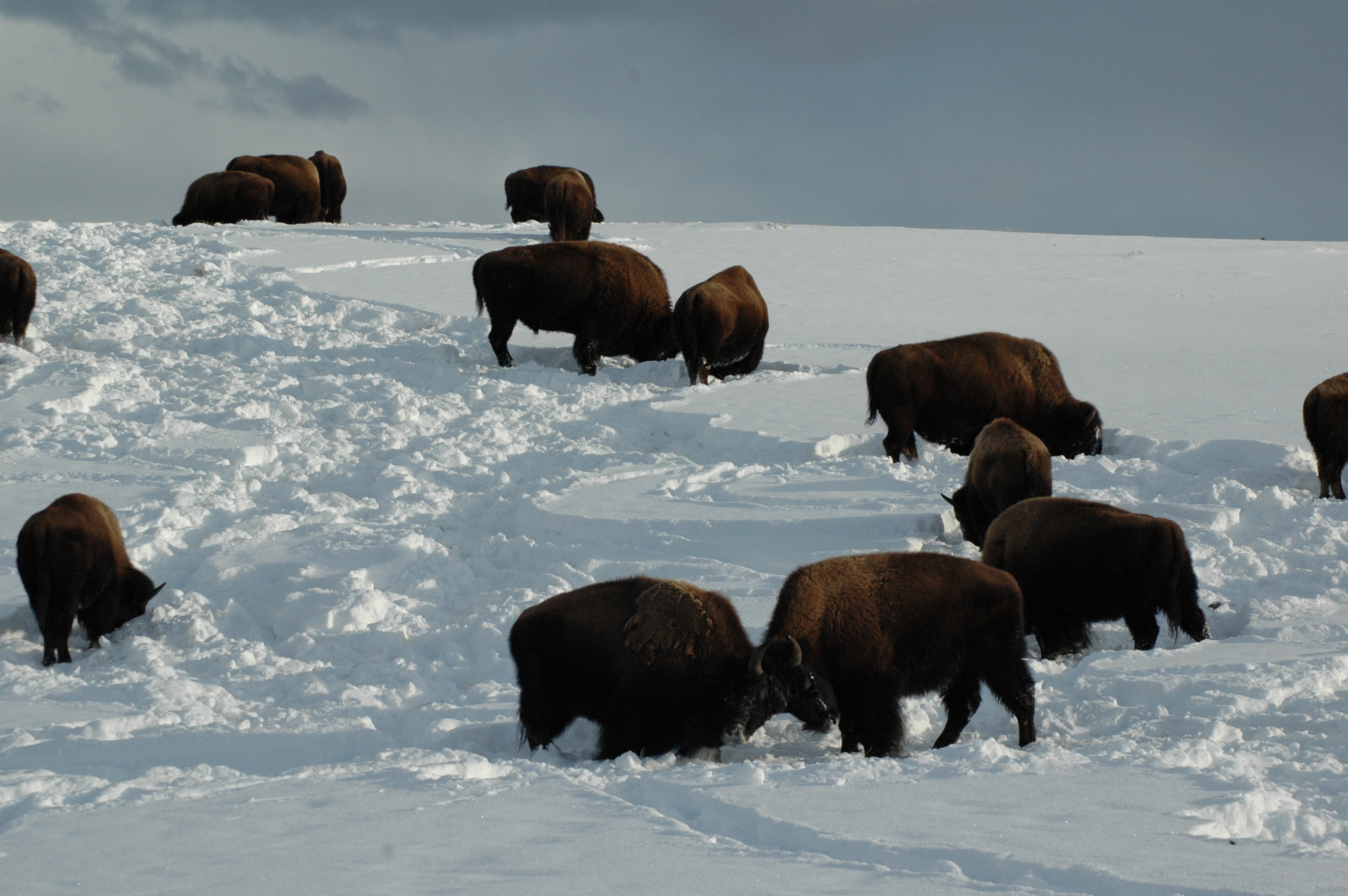
Selfless and protective, bison develop lasting bonds in and outside the family, not only between cows, calves and siblings but also between unrelated individuals who grew up, traveled and learned about life together. Juveniles help mothers look after the youngsters and will gladly lend a horn to keep potential predators away from the calves. I have witnessed cooperation among bison families often in the years I’ve spent observing and photographing them. I’ve also seen them put themselves in harm’s way to defend elk from hungry wolves, and even mourn over the bones of their dead.

But in a ruthless act of rabid backstabbing, 1600 bison—who had never known confinement or any reason to fear people—were slain to appease Montana ranchers during the winter of 2008. More than half of Yellowstone’s bison were killed in what was the highest body count since the nineteenth century. 1438 were needlessly and heartlessly shipped in cattle trucks to slaughterhouses (those nightmarish death camps where so many forcibly domesticated cattle meet their ends), while 166 were blasted, as they stood grazing, by sport and tribal hunters. Two winters prior, 947 bison were sent to slaughter and 50 were shot by hunters.

Instead of making amends for the historic mistreatment of these sociable, benevolent souls, twenty-first-century Montanans are still laying waste to them. Spurred on by industry-driven greed for grazing land (veiled under the guise of concern about brucellosis, a disease with a negligible risk of transmission that has never actually been passed from wild bison to cattle), the state of Montana sued to seize control of bison ranging outside Yellowstone. Now their department of livestock has implemented a lethal policy and the US National Park Service is facilitating it. Since the dawn of the new millennium, nearly 4000 Yellowstone bison have been put to death.

Text and Wildlife Photography ©Jim Robertson, 2012. All Rights Reserved

Text and Wildlife Photography ©Jim Robertson, 2012. All Rights Reserved


State Agency Game Farming Is Not Compatible with Ecosystem Integrity

The following pro-wildlife/anti-wolf hunting article puts today’s “game” department policies into perspective…

State Agency Game Farming Is Not Compatible with Ecosystem Integrity
by George Wuerthner

With the delisting of wolves from protection under the Endangered Species Act, management of wolves has been turned back to the individual states where wolves occur. In most of these states, we see state agencies adopting policies that treat wolves as persona no grata, rather than a valued member of their wildlife heritage. Nowhere do I see any attempt by these state agencies to educate hunters and the general public about the ecological benefits of predators. Nor is there any attempt to consider the social ecology of wolves and/or other predators in management policies. Wolves, like all predators, are seen as a “problem” rather than as a valuable asset to these states.

In recent years state agencies have increasingly adopted policies that are skewed towards preserving opportunities for recreational killing rather than preserving ecological integrity. State agencies charged with wildlife management are solidifying their perceived role as game farmers. Note the use of “harvest” as a euphemism for killing. Their primary management philosophy and policies are geared towards treating wildlife as a “resource” to kill. They tend to see their roles as facilitators that legalize the destruction of ecological integrity, rather than agencies dedicated to promoting a land ethic and a responsible wildlife ethic.

Want proof? Just look at the abusive and regressive policies states have adopted to “manage” (persecute) wolves and other predators.

Idaho Fish and Game, which already had an aggressive wolf killing program, has just announced that it will transfer money from coyote killing to pay trappers to kill more wolves in the state so it can presumably increase elk and deer numbers.

The Montana Department of Fish, Wildlife and Parks (MDFWP) which many had hoped might be a bit more progressive in its predator attitudes, supports new regulations that will expand the wolf killing season, number of tags (killing permits), and reduces the license fee (killing fee) charged to out of state hunters who want to shoot wolves.

Wyoming is even more regressive. Wolves are considered “predators” with no closed season in many parts of the state.

Alaska, perhaps displaying the ultimate in 19th Century attitudes that seem to guide state Game and Fish predator policies, already has extremely malicious policies towards wolves, and is now attempting to expand wolf killing even in national parks and wildlife refuges (it is already legal to hunt and trap in many national parks and refuges). For instance the Alaska Fish and Game is proposing [aerial?]-gunning of wolves in Kenai National Wildlife Refuge and wants to extend the hunting/trapping season on wolves in Lake Clark National Park, Katmai National Park, and Aniakchak National Preserve until June, long after pups have been born. Similar persecution of wolves to one degree or another is occurring in Minnesota, Wisconsin and Michigan, which have been given management authority for wolves in those states.

Although some states like Montana changed their name from “game” to wildlife, their attitudes and policies have not changed to reflect any greater enlightenment towards predators.

Montana recently increased the number of mountain lions that can be killed in some parts of the state to reduce predation on elk.

South Dakota Game, Fish and Parks is on a vendetta against a newly established mountain lion population in that state, and greatly increased mountain lion kill in a small and recently established population of these animals.

The Wyoming Game and Fish is almost salivating at the prospect of grizzly delisting so hunters can kill “trophy” grizzly bears.

I could give more examples of state game agencies that have declared war on predators in one fashion or another.

The point is that these agencies are still thinking about predators with a 19th Century mindset when the basic attitude was the “only good predator is a dead predator” and the goal of “wildlife management” was to increase hunter opportunities to shoot elk, deer, moose and caribou. These ungulates are seen as desirable “wildlife” and predators are generally viewed as a “problem.”

Many state game farming agencies suggest that they have to kill these carnivores to garner “social acceptance” of predators. Killing wolves, bears, coyotes and mountain lions is suggested as a way to relieve the anger that some members of the ranching/hunting/trapping community have towards predators. Is giving people who need counseling a license to kill so they can relieve their frustrations a good idea? Maybe we should allow frustrated men who are wife beaters to legally pound their spouses as well?

Despite the fact that many of these same agencies like to quote Aldo Leopold, author of Sand County Almanac, and venerate him as the “father” of wildlife management, they fail to adopt Leopold’s concept of a land ethic based upon the ecological health of the land.

Aldo Leopold understood that ALL wildlife have an important role to play in ecosystem integrity. Decades ago back in the 1940s he wrote: “The outstanding scientific discovery of the twentieth century is not television, or radio, but rather the complexity of the land organism. Only those who know the most about it can appreciate how little we know about it. The last word in ignorance is the man who says of an animal or plant: “What good is it?” If the land mechanism as a whole is good, then every part is good, whether we understand it or not. If the biota, in the course of aeons, has built something we like but do not understand, then who but a fool would discard seemingly useless parts? To keep every cog and wheel is the first precaution of intelligent tinkering.”

To keep every cog and wheel means keeping not only species from going extinct, but maintaining the ecological processes that maintain ecosystem function. What makes state game farming policies so unacceptable is that there is no excuse for not understanding the ecological role of predators in ecosystem integrity. Recent research has demonstrated the critical importance of predators for shaping ecosystems, influencing the evolution of prey species, and maintaining ecosystem integrity. We also know that predators have intricate social relationships or social ecology that is disrupted or destroyed by indiscriminate hunting.

Yet state game farming agencies continuously ignore these ecological findings. At best the policies of game farming agencies demonstrates a lack professionalism, or worse, maybe they are just as ignorant of recent scientific findings as the hunters/trappers they serve.

Ironically these same state game farming agencies see that the numbers of hunters and anglers are declining, along with their budgets. Agencies depend upon the killing fees (licenses and tags) charged to hunters and anglers for the privilege of killing and privatizing public wildlife to run their operations. Yet instead of broadening their base of support from other wildlife watchers to those interested in maintaining ecological integrity, these agencies are circling the wagons, and adopting policies that reflect the worse behaviors and attitudes of the most ignorant and regressive hunting/trapping constituency. In the process, they are alienating more moderate hunters and anglers, as well as the general public.

The problem is that state game farming agencies have a conflict of interest. Their budgets depend on selling killing permits which depends upon the availability of elk, deer, moose and caribou to kill, not more predators. Any decline in the population of these “game” animals is seen as a potential financial loss to the agency. Therefore, these agencies tend to adopt policies that maintain low predator numbers. Yet these same agencies are never up front about their conflict of interest. They pretend they are using the “best available science” and “managing” predators to achieve a “balance” between game and predators.

Because of this conflict, game farming agencies turn a blind eye to ethical considerations as well. Most of the public supports hunting if one avoids unnecessary suffering of the animals—in other words, makes a clean kill. They also want to know the animal did not die in vain and the animals is captured and/or killed by generally recognized codes of ethical behavior. In other words, the animal is consumed rather than killed merely for “recreation” or worse as a vendetta and the wildlife has a reasonable chance of evading the hunter/trapper. But when the goal is persecution, ideas about ethics and “fair chase” are abandoned.

Personally I would rather see state agencies reform themselves and adopt more inclusive, informed and progressive attitudes towards all wildlife, especially predators. But judging from what I have seen, it appears these state game farming agencies are headed in the opposite direction.

If they continue down this path, it’s clear that they will lose legitimacy with the public at large. Efforts to take away management authority will only strengthen. For instance, voters in a number of states have already banned the recreational trapping of wildlife, always over the objections of state game farming agencies. Efforts are now afoot to ban trapping in Oregon and I suspect other states will soon follow suit.

The next step will be to take away any discretion for hunting of predators and perhaps ultimately hunting of all wildlife. The trend towards greater restrictions is seen as the only way to rein in the abusive policies of state game farming agencies. In California, the state’s voters banned hunting of mountain lions in 1991. Oregon banned hunting of mountain lion with dogs. In other states, there are increasing conflicts between those who love and appreciate the role of predators in healthy ecosystems, and state game farming agencies.

Bans on all hunting has even occurred in some countries. Costa Rica just banned hunting and Chile has so limited hunting that it is effectively banned.

I suggest that the negative and maltreatment of predators displayed by game farming agencies in the US, will ultimately hasten the same fate in the U.S.

ABOUT THE AUTHOR
George Wuerthner is an ecologist and former hunting guide with a degree in wildlife biology

Contact info for MFWP

Here are two things you can do for wolves in the Yellowstone area…

1. Plan to attend the Montana FWP meeting Tuesday January 29, 2013 at 10 am to make a public comment: asking MTFWP to close the wolf hunt. You will have 2 minutes to speak.

2. Send a letter to MTFWP: Email Montana FWP Commissioners: fwpcomm@mt.gov, FWP Director Hagener: jhagener@mt.gov and Montana Governor Bullock: governor@mt.gov

Here are some things Bear Creek Council’s has written to FWP, which you might use as talking points:

YNP Wolf Project had lost 8 or more radio-collared and uncollared Yellowstone research wolves to hunting in Montana. Millions of tourists around the world were outraged to hear of the deaths of wolves they have observed. Montana’s economy depends on wolf and wildlife tourism, which brings in more dollars than ranching or hunting outfitting.

We want to see wolves protected in Yellowstone National Park and in the Gallatin National Forest/Absaroka-Beartooth Wilderness areas:

1. Our region depends economically on wolf tourism in Yellowstone Park and our National Forest. People come here to hike in wolf country or to visit the number one place in the world to observe wild wolves, Yellowstone National Park. Montana has begun hammering away at the wolves here, allowing hunters to take an inordinate number from our region and damaging an invaluable economic, educational, and research wildlife population.

2. We value and want to advance YNP Wolf Project research on predator-prey relationships and other science about wolves.

MTFWP claims its management polices are based on hard science, but aside from the YNP Wolf Project’s 18 years’ work, there are very few long-term studies of wolf predator-prey relations. Why isn’t Montana protecting the some of the best research on wolf-prey relationships? Why aren’t we protecting the study subjects—Yellowstone wolves?

One value of YNP Wolf Project is that it studies one of the largest unexploited wolf populations in the world. Until Montana’s hunts in opened the hunts in 2009 and 2012, there were practically no human-caused wolf mortalities in the park. Does Montana FWP want to be responsible for destroying one of the best research projects on wolves in the world?

3. We want to see wolves valued as native Montana and North American wildlife and for their role in our predator-prey ecosystem.

WTF’s Up w/MFWP?

What the Fuck (WTF) is up with the Montana state wildlife officials these days? Now they want to make it even easier to hunt and trap wolves in their state.

Last year, just after wolves were removed from federal endangered species protection, the Montana Fish, Wildlife and Parks department (MFWP) seemed comparably tame (well, compared to Idaho anyway). Though they wasted no time in implementing the state’s first season on wolves in seventy-some years, at least they spared wolves the torment of trapping.

Ignoring 7,000 letters in support of wolves, this year they added trapping to their wolf assault and upped the original “bag limit” from one to three per trapper—before the season even started. Instead, they’re bowing to the whims and whinings of ranchers, hunters and trappers who have called for an expansion of wolf killing and more liberal rules than the state had last year, when “only” 166 wolves were ruthlessly murdered. MFWP officials responded to anti-wolf, anti-nature, anti-environmental pressure by making the 2012 season longer, eliminating most quotas and allowing wolf trapping for the first time.

The agency is now mercilessly asking for additional measures in the form of a state House Bill, HB 73. Their proposal would let hunters and trappers buy multiple tags; use electronic wolf calls; reduce the price of a non-resident tag from $350 to $50 and eliminate the potentially life-saving requirement that hunters wear fluorescent orange outside of elk and deer season. (Okay, I’ll go along with that last one—who cares if wolf hunters shoot each other?)

“We want to get a wolf bill out of the Legislature so we can implement those things that can potentially make a difference,” said FWP spokesman Ron Aasheim, adding selfishly, “More management flexibility. That’s what we want now.”

The House committee will also take up a second bill by Republican Rep. Ted (oh shit, not another Ted!) Washburn, of Bozeman, which would also limit the total number of wolves allowed to live in the entire state (we’re talking 147,046 square miles) to no more than 250. Washburn’s plan also asks for an Oct. 1-Feb. 28 wolf hunting season and an even longer season for special districts next to Yellowstone and Glacier National Parks!!

No doubt you all remember that fateful day in 2011 when congress lifted federal protections for wolves in Montana and Idaho, handing management over to those openly hostile states.

Meanwhile, the nefarious Montana state wildlife officials are currently opposing federal Threatened Species protection for the depressingly rare wolverine, down to only 35 breeding individuals in the lower 48.

Not many hunters can honestly say that they don’t mind sharing “their” elk, moose or deer with the likes of wolves, cougars or coyotes. But those few who claim to support a diversity of life need to realize that every time they purchase a hunting license and a deer or elk tag, they validate wolf hunting and trapping. To game managers, every action, right down to the purchase of ammo and camo at Outdoor World, is a show of support for their policies—including killing wolves to ensure more deer, elk, moose or caribou for hunters to “harvest.”

A far cry from living up to their laughably undeserved reputation as the “best environmentalists,” hunters are just foot-soldiers carrying out a hackneyed game department program of “harvesting” ungulates and “controlling” predators. It’s an agenda based not on science or the time-tested mechanisms of nature, but on the self-serving wants of a single species—Homo fucking sapiens (HFS). Modern hunting is about as anti-environmental as mining, clear-cut logging, commercial fishing or factory farming.

Text and Wildlife Photography ©Jim Robertson, 2012. All Rights Reserved

Text and Wildlife Photography ©Jim Robertson, 2012. All Rights Reserved

Situation Update: Judge lets wolf season resume near Yellowstone

Judge lets wolf season resume near Yellowstone

By MATTHEW BROWN, Associated Press
Updated 7:42 pm, Wednesday, January 2, 2013
BILLINGS, Mont. (AP) — Wolf hunting and trapping can resume near Yellowstone National Park after a Montana judge on Wednesday blocked the state from shutting down the practice over concerns that too many animals used in research were being killed.

The restraining order from Judge Nels Swandal allows hunting and trapping to resume in areas east and west of the town of Gardiner in Park County.

State officials closed the gray wolf season in those areas on Dec. 10. That came after several wolves collared for scientific research were killed, drawing complaints from wildlife advocates.

The move prompted a lawsuit from sporting groups and a state lawmaker from Park County, Rep. Alan Redfield, who said the public was not given enough chance to weigh in on the closures.

In his order, Swandal sided with the plaintiffs. He said the lack of public notice appeared to violate the Montana Constitution and threatened to deprive the public of the legal right to harvest wolves.

He ordered the state “to immediately reinstitute and allow hunting and trapping of wolves in all areas of Park County.”

A Jan. 14 hearing was scheduled in the case. The other plaintiffs are Citizens for Balanced Use, Big Game Forever, Montana Outfitters and Guides Association and Montana Sportsman for Fish and Wildlife.

A spokesman for the state, Ron Aasheim, said Montana wildlife commissioners followed proper public notice requirements before issuing the closures.

Wildlife advocate Marc Cooke said the lawsuit over the 60-square-mile closure area revealed the “irrational hatred” of some hunting and trapping supporters.

“You have 145,000 square miles in Montana, and they’re fighting over a measly 60 square miles of land that is critical habitat for these animals. To me, it’s very vindictive,” he said.

Montana had an estimated 650 wolves at the end of 2011. Through Wednesday hunters reported killing 103 of the animals and trappers had killed at least 30 more.

State officials lifted quotas on wolves across most of Montana this spring in hopes of decreasing a predator population blamed for livestock attacks and driving down elk numbers in some areas.

But park officials said at least seven Yellowstone wolves — including five wearing tracking collars — were shot by hunters in Montana, Idaho and Wyoming. Also shot were four collared wolves originally from the park but now living outside it. Three more shot in the vicinity of the park had unknown origins and were not wearing collars, park officials said.

The current season marks Montana’s first experience with wolf trapping since the animals lost their endangered species protections last year under an order from Congress.

Wolf hunting has also been contentious in Wyoming this season. The state took over wolf management from the U.S. Fish and Wildlife Service on Oct. 1, and hunters killed 43 wolves out of a 52-animal quota before Wyoming’s hunt ended Dec. 31.

Coalitions of environmental groups have filed federal lawsuits, now pending in Washington, D.C., and Denver, seeking to force the U.S. Fish and Wildlife Service to reclaim wolf management from Wyoming.

The groups say they’re concerned that Wyoming’s wolf management plan won’t ensure long term survival of the species, which the federal government reintroduced into Yellowstone in the mid-1990s.

Wolves in Wyoming are classified as unprotected predators that may be shot on sight in most of the state. They’re managed as trophy game animals in a flexible trophy hunting zone on the outskirts of Yellowstone.

Idaho also allows hunting and trapping of wolves, although it allows a maximum of 30 animals a year to be taken in a zone just outside Yellowstone. Through Wednesday, hunters and trappers in Idaho reported killing 154 wolves statewide, including 11 near Yellowstone.

_________________________________________

Well, there’s the facts and figures according to the Associated Press. I don’t know what to say. This time I’m in agreement with Marc Cooke; these hunting groups and some Montana state reps have an “irrational hatered” of wolves. As I said in an earlier post, wolf hunting should be considered a hate crime.

Time to put our full support behind the coalitions of environmental groups who’ve filed federal lawsuits seeking to force the U.S. Fish and Wildlife Service to take back wolf management from Wyoming. Come to think of it, Montana and Idaho need to be included in that lawsuit…

Text and Wildlife Photography ©Jim Robertson

Text and Wildlife Photography ©Jim Robertson

Sleeping With the Enemy

Q. When are wolf advocates not really wolf advocates?

A. When they advocate for wolf hunting.

While other wildlife groups have worked to get this long-suffering species back under ESA protection, the Montana-based, Wolves of the Rockies not only told the Missoulian, “We are not advocating the end of wolf hunting,” but followed up that howler with an article in the Great Falls Tribune, in which they stated: “We at Wolves of the Rockies understand and acknowledge the importance of hunting as a tool for managing wolves, and we stand beside the ethical* hunter in doing so.”

This group asked permission to use some of my wolf photos on their Facebook page. Assuming they were on the side of the wolves, I allowed it. Given their recently stated attitude, I am forced to rescind my permission and ask them to remove my photos from their site.

Why would a wolf advocacy group publically announce their support for wolf hunting, at the risk of alienating wolf supporters and undermining the efforts of other groups fighting the barbaric treatment of wolves across the country?

This question was answered nicely (nicer than I would have) by a Facebook friend with what she  called ‘just her two cents’ (but I would argue it’s worth a lot more than that): “I’ve seen other organizations feel they have to outwardly ‘support’ hunting to get the attention of game departments, DNRs, politicians etc., in order to appear ”mainstream” & therefore afforded a sympathetic ear and/or seat at the table….I DISagree with that stance because it doesn’t work. Even if you have 100 or 1000 hunters on your side, the wildlife management system is not going to support or implement non-lethal conservation or management practices. I’ll bet Wolves of the Rockies die a little inside when they say they support hunting as a tool for wolf management, because I think in a perfect world they don’t want them hunted any more than the rest of us do. It’s too bad they have taken a position of compromise…”

I see it as kind of a, “If you can’t beat ‘em, join ‘em” approach; the same kind of thing that the Washington-based group, Conservation Northwest, pulled** during the state’s helicopter attack on the Wedge pack earlier this year. What these groups don’t realize is that when you sleep with the enemy, you don’t get just a little bit pregnant.

*see, In the Eyes of the Hunted, There’s No Such Thing as an “Ethical Hunter”

** see, Save the Wolves —Abolish Ranching and Hunting Now

And if you haven’t already, please sign these petitions to Stop Wolf Hunting in North America

and to Stop Wolf Trapping in Montana

Text and Wildlife Photography ©Jim Robertson

Text and Wildlife Photography ©Jim Robertson

Wolf Hunters Are Guilty of Hate Crimes

It occurs to me that the killing of wolves by those who detest them qualifies as a hate crime. By definition, a hate crime is: a crime, usually violent, motivated by prejudice or intolerance toward a member of a social group.

Well, you don’t get a much more social group than a wolf pack—and you don’t find any greater prejudice or intolerance than among wolf-haters and hunters.

In an effort to defend his wolf hunting, wildlife snuff-filmmaker Randy Newberg presented the following shocking testimony to the court of public opinion (via NPR News), “Having these hunting seasons [on wolves] has provided a level of tolerance again.”

The U.S. Fish and Wildlife Service, Montana, Idaho and Wyoming state game departments and, most shocking of all, Yellowstone wolf biologists, are all going along with this line of thinking. But allowing wolf haters to have their fun by giving them a season on the object of their disdain is akin to letting the Clan get away with murder once in a while, believing it will “provide a level of tolerance again.”

Text and Wildlife Photography ©Jim Robertson, 2012. All Rights Reserved

Text and Wildlife Photography ©Jim Robertson, 2012. All Rights Reserved

Killing Wolves Provides “a Level of Tolerance”?

Yep, you read it right, according to Randy Newberg, who hunts wolves and makes hunting television programs, many people who live in Wyoming, Montana and Idaho don’t like wolves and hate that the federal government forced their recovery on them, “Having these hunting seasons has provided a level of tolerance again.” Newberg told NPR News that wolf hunts are easing the animosity many local people feel toward the predator. And Yellowstone biologist, Doug Smith, adds, “To get support for wolves, you can’t have people angry about them all the time, and so hunting is going to be part of the future of wolves in the West. We’ve got to have it if we’re going to have wolves.”

So, let me get this straight, in order to placate and appease good ol’ boys and get them to put up with the presence of one of North America’s most historically embattled endangered species, we have to let them kill some of them once in a while? Wolf hunting and trapping are just a salve—a bit of revenge-killing for them–why not let them have their fun? By this logic, they should also be entitled to shoot an Indian every so often (like their forefathers who tried to wipe them out), to help promote tolerance and cultural acceptance.

Excuse me, but why should we care what wolf hunters think they need to get them to go along with the program—those people are sick, end of story. Just look at their evil, gloating grins and smug, satanic smirks plastered on their faces whenever they pose with their “trophy” wolf carcasses. But don’t bother telling them that they’re vacuous, malicious little goblins, apparently they enjoy being hated by wolf-lovers—otherwise they wouldn’t pose for the camera and spread their gruesome images around the internet whenever they make a kill.

In the spirit of promoting tolerance, it only seems fair that wolf advocates be allowed a season on them in return for all the losses they’ve endured. I don’t know if it would really engender a feeling tolerance, but it can always be justified as a way of “managing” or “controlling” them, and thinning their numbers.

Text and Wildlife Photography ©Jim Robertson, 2012. All Rights Reserved

Text and Wildlife Photography ©Jim Robertson, 2012. All Rights Reserved

Ban Wolverine Trapping—as a Matter of Principle

In an uncharacteristically uplifting post last week (semi-satirically entitled “Be of Good Cheer”), I shared the news that wolverines—critically endangered from decades of falling prey to the “tradition” of fur trapping—are for now off the hit list of species allowable to trap in Montana, thanks to an injunction filed by animal advocacy groups that resulted in a Temporary Restraining Order (TRO). While about every other “furbearer” in that state remains at risk, to the wolverine now spared the prospect of being caught by the leg in a steel-jawed trap for days and nights on end until some trapper arrives and clubs them to death this is nothing short of a Christmas miracle!

But that miracle may be short-lived if trappers and the Montana Fish Wildlife and Parks department—who are trying desperately to reverse the TRO against wolverine trapping—have their way.

In addition to being inherently cruel and demented, trapping is a lazy-man’s blood sport. Even some hunters resent the ease at which trappers can score a kill. A trapper can be likened to a fisherman who casts several baited hooks out into a lake and leaves them there, not bothering to come back for a week or so to see what he’s caught. All the while, the animal struggles and suffers—out of sight, out of mind…

Throughout recorded history, trapping has been the greatest threat to the existence of wolverine and their kin. Entire populations have been wiped out across the country, from the Sierra Nevada to the southern Rockies and from Washington’s Cascade mountains to the Minnesota woodlands.

In their 1927 book entitled Mammals and Birds of Mount Rainier National Park, authors Walter Taylor and William Shaw give accounts of Washington wolverines trapped and poisoned around the turn of the Twentieth Century. They write, “The wolverine, if ever common, has undergone a marked decrease throughout the Cascade Range, probably due to the increasing price put on his pelt by the fur trade.” Even a hundred years ago these two had the foresight to observe, “Where possible, the balance of nature should be left to establish itself.”

Text and Wildlife Photography© Jim Robertson

Text and Wildlife Photography© Jim Robertson

I couldn’t agree more.

The shadowy wolverine is one savage scavenger who is very dear to my heart. Despite their scarcity, I’ve been extremely fortunate to see them on four separate occasions, each one a high point in my memory. If my life were to flash in front of me, it would appear as a wildlife slide-show set to music—a Bolero, building in intensity—featuring images of black bears and cougars; bison, bighorns and bugling elk; snowshoe hare and ermine in a frosty meadow; pine marten in the boreal forest; mink and otters in the wetlands and badgers in the sagebrush. Moose, wolves, lynx and grizzlies in the wilds of Alaska would appear as the music reaches a crescendo, followed by a wolverine effortlessly scaling an alpine slope as the grand finale.

The first timeI saw a wolverine was in 1978, on a steep, snowy mountainside in Washington’s rugged North Cascades range. I was on a solo climb, my ice ax at the ready to avoid an uncontrolled, high-speed slide to the valley bottom. Suddenly, a fast-moving, dark-colored animal raced across an even steeper pitch about 50 yards above. Judging by the size and shape, my initial impression was coyote or wolf; then as I watched it move and got a better view of its stature, I recognized it for what it was—a wolverine! After he streaked out of sight, I continued my slow ascent, kicking steps into the snow and sinking my ice ax in for safety’s sake, up to where his trail—the only remaining sign of the incredible spectacle I’d just witnessed—crossed the steepest pitch of the slope. When I reached the wolverine’s distinctive, five-toed tracks, I could see that though his rapid traverse appeared effortless, he had dug his sharp claws deep into the snow with each step—confirming that a wolverine is as well adapted to its mountain habitat as an otter is to water, or a raven to air.

Since I considered it my back yard, I was thrilled to know that the North Cascades National Park and adjoining wilderness areas comprised a habitat extensive and secluded enough for such a secretive animal—and we’re talking sasquatch secretive—to feel at home.

I knew it had probably been a once in a lifetime sighting, but when some of the snow melted, I decided to return and planned to stay a while this time. I crossed the slope where I’d last seen the wolverine and headed over a pass into a trail-less, glacier-carved valley in search of a likely den site. Thinking like a wolverine, I chose a spot that had rarely, if ever, been visited by human beings, setting up camp by a small alpine tarn. As luck would have it, I came across a set of the familiar five-toed tracks that led up toward a small cave under a rocky cliff. Not wanting to disturb the cave’s occupants, I watched the opening from a respectful distance. Within minutes, I heard the sound of falling rocks and looked up to see a wolverine, probably a mother, eying me suspiciously from the ledge above her den.

Appreciating how unwelcome I was, I quickly determined that I had accomplished all I could hope to achieve without annoying the animal to the point that she might leave the area for good. Though I was tempted to stay around in hopes of a photo op, I instead did the right thing and moved on, leaving that wild place to the wildlife who depend on it.

Not being a fan of intrusive hardware, like the ear tags or radio collars used in the study of wild animals, I never reported the sighting or the location of the den to wildlife “authorities.” I object, on behalf of animals everywhere, to the ham-fisted treatment of wildlife for “research” purposes, and I knew that rather than taking my word for it, some overeager biologists, wildlife “managers” or other self-appointed “experts” would march out there and trap, collar or otherwise traumatize the animal.

My misgivings proved justified. Years later, I learned that at least two young wolverines were trapped, jabbed with needles, immobilized and manhandled; their ears were tagged and they were fitted with awkward, bulky radio-collars. It seems the biologists at the scene badgered their captives in every way imaginable, short of sending them to Abu Ghraib or on a hunting trip with Dick Cheney.

Worse yet, by meddling with such rare and reclusive animals—keeping one of them confined for days until “game experts” from Missoula, Montana could make the trip across two states to get some hands-on of their own—they may have separated one yearling from her mother. (Judging by the tracks around the box-trap, mama wolverine must have stayed around until people roared into the area on snowmobiles, forcing her to reluctantly abandon her trapped youngster and retreat further into the wilderness.)

After an Interminable imprisonment in a claustrophobic box trap, and then awaking from an unsettling tranquilization surrounded by gawking people—now with tags in her ears and a burdensome collar around her neck—another young female wolverine trapped by biologists in Washington fled through the Pasayten Wilderness and across the border into Canada.

When a Forest Service biologist told the Seattle Times, “…the best way to ensure wolverines continue in Washington is to learn as much about this population as we can,” I had to wonder if tormenting an animal so much that she hurriedly left the relative safety of Washington State (where a voter-approved initiative has banned recreational fur trapping) was really the best way to ensure the species continues. Canada and Alaska persist in allowing that archaic tradition. Putting animals through unnecessary suffering is just part of doing business up there—not a safe place for a “fur-bearer” of any kind.

Further knowledge is always helpful, but surely new information can be acquired through the use of remote cameras and other less disruptive methods. And really, how much more do we need to know before we reach information overkill?

We already know a lot about wolverines, such as the fact that they are the largest terrestrial mustelid—the brontosaurus of the weasel family. Among their relatives, the only species any larger are the sea otter and the Amazonian of all otters, the giant otter of the Amazon River basin. A wolverine looks like an oversized, striped mink or a small, elongated, agile bear. (Sorry I don’t have a photo of one to include here; all the sightings I’ve had have been brief, and all of the wolverine moved too quickly to get a clear photograph—just a couple of the challenges of using only ethically-acquired images.)

Putting their trademark pungent anal scent glands to good use, they seem to take special pleasure in fouling trapper’s cabins (whether for recreation or revenge, only the wolverine really knows…and they’re not telling). Possibly their best known attribute is their ferocity—wolverines could easily be considered the Tasmanian devils of the Northern Hemisphere. But a real-world Bugs Bunny would no doubt meet his match with these part-time predators.

The main thing we need to know about wolverines, we already well know: as a species, their numbers are perilously low.

I had my third wolverine sighting in the mid-1980s, on the volcanic flanks of Alaska’s remote Mount Katmai. I was backpacking with a couple of friends when we surprised a wolverine who crossed barely 20 yards in front of our path. He reacted not by baring his teeth and snarling, but by getting the hell out of there to the relative safety of a rocky cliff formed by a geologically recent lava flow. The naturally acrobatic animal leapt up from ledge to ledge with the fluid grace of a furry brown waterfall flowing in reverse. Within a few seconds the wolverine scaled a pitch that would have taken an hour and a half of effort for a skilled rock climber.

The encounter made me realize that, contrary to their notorious reputation for fierceness, wolverines will go to great lengths to avoid people. Clearly, in order to thrive, sensitive species like wolverine require vast expanses of wild land—and a minimum of human activity.

The most recent sighting I had was just a few years back, during one of my many trips into Yellowstone while living near the park in southwest Montana. That sighting was bittersweet as the wolverine was barely within the park boundary, and I knew all too well that trapping was legal at the time anywhere outside the protection of Yellowstone National Park. I couldn’t help but think just how easy it would be for a trapper to snag this far-ranging park animal in one of their horrible torture devices. All they’d need is a state permit, a few steel-jawed leg-hold traps, a snowmobile and a complete and utter lack of conscience, remorse or compassion.

There are only around 250 to 300 wolverines in the continental United States, but for reasons that have nothing to do with science and everything to do with “higher priorities” and political pressure from trappers, they are still currently considered only a “candidate” for federal Endangered Species Act protection.

Even the Montana state game department must understand that a population as pitifully low as the wolverine’s suffers immensely when a trapper kills even one individual. Prior to the TRO, “game managers” were set to allow five wolverines to be sacrificed to the gluttonous trappers. What’s the point of having a season on five wolverines? Clearly it’s symbolic—just a matter of principle for them. But a principle is supposed to be a moral or ethical standard based on something upright and upstanding, not an immoral standard based on something lowly and loathsome like trapping.

It’s high time to ban wolverine trapping entirely—as a matter of principle!
Text and Photography© Jim Robertson

Text and Photography© Jim Robertson

Montana Wolverine hearing set for January 10th

In the middle of writing a post on wolverines celebrating the end of trapping in Montana, I was informed that trappers and the Montana Fish Wildlife Parks Department are frantically trying to reverse the Temporary Restraining Order (TRO) and commence with the wolverine trapping season.  The agency is even getting other states wildlife agencies involved to act as witnesses. Stay tuned for my lengthy, updated wolverine post; in the meantime, Here’s the latest article on the situation–note that the follow up hearing is set for January 10th…….

A Helena judge issued a temporary restraining order that will delay Montana’s wolverine trapping season.

Written by Tribune staff
A Helena judge issued a temporary restraining order that will delay Montana's wolverine trapping season. The season was set to begin Saturday.
AP File Photo/Glacier National Park, Jeff Copeland

A district court judge in Helena granted a temporary restraining order against the state’s wildlife agency that blocks the opening of Montana’s wolverine trapping season until at least early next year.

The season was set to open Saturday.

The restraining order was sought by a coalition of groups trying to halt wolverine trapping in Montana. Helena District Judge Jeffery Sherlock granted the order. A follow-up hearing is set for Jan. 10.

The eight-group coalition, led by the Western Environmental Law Center, wants to ban wolverine trapping until the U.S. Fish and Wildlife Service determines if the wolverine will be placed on the federal list of threatened and endangered species.

Ken McDonald, wildlife bureau chief for Montana Fish, Wildlife & Parks in Helena, said Montana’s quota of five wolverines is based on sound wildlife management science that doesn’t put the state’s wolverine population at risk.

In 2010, USFWS determined that threats to the wolverine included climate change but declined to list it as an endangered or threatened species due to higher priorities. At the time, USFWS suggested that the wolverine population is stable or expanding and that between 250 and 300 wolverines inhabit the northern Rocky Mountains.

McDonald said FWP will immediately begin to examine the restraining order and consider legal options but for now trappers are prohibited from pursuing wolverines in Montana.